ERA’s Ranger uranium mine should be closed down – Australian Conservation Foundation
Meanwhile, the Australian Conservation Foundation is calling for all Ranger operations to end. Foundation spokesman Dave Sweeney says there are severe environmental risks associated with the mine.
“Over the course of the history of ERA’s operations, we have seen over 150 publicly documented leaks, spills, accidents and breaches,” he said. “Some of them have been small but some of them have been severe.”
ERA flags future for Ranger uranium despite loss http://www.abc.net.au/news/2012-04-11/ranger-uranium-era-agm/3943640 By Phoebe Stewart, April 11, 2012 Operations at the Ranger facility were closed for five months last year because of extremely wet weather. One of the world’s biggest uranium miners is forecasting a strong future despite reporting a big loss last year. Continue reading
Australia’s uranium promoters working hard against the reality of falling profits
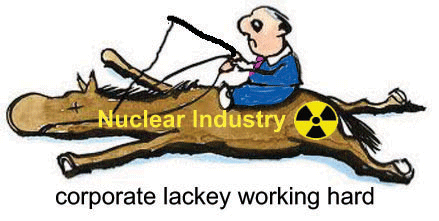 Uranium bulls have spent much of the past 12 months arguing there is a serious disconnect between the way the sharemarket and short-term investors view the outlook for uranium and the way long-term industry players (the CGNPCs and Rios of the world, for example) see it.
No sweeteners for yellowcake players, The West, Kate Emery April 11, 2012, A little over a year after the Fukushima nuclear disaster and despite endlessly positive outlook statements from the uranium industry, the fact remains it’s a still a tough time to be in the yellowcake business. Continue reading
Decline in Ranger uranium mine’s production, profit and morale – time to close it down
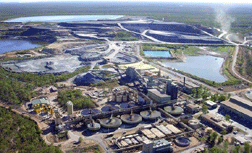 ERA tightens 2012 guidance, Colin Jacoby , 10 April 2012 …The uranium miner Energy Resources of Australia reported production of 612 tonnes of uranium oxide for the March quarter, down 41% from its December 2011 quarter production of 1030t.. The company was dogged by high rainfall at Ranger and access to high-grade ore was restricted due to the water level in the pit.
With ERA unable to access the high-grade ore located at the bottom of the pit, the ore milled during the quarter was sourced from stockpiled material. … the company said 2012 production remained highly dependent on the level of rainfall for the remainder of the year.
Kakadu uranium miner faces growing criticism. ACF, 11 April 12, Mining at the troubled Ranger uranium operation in Kakadu has been described as dirty, dangerous and desperate by the Environment Centre NT and the Australian Conservation Foundation. The groups have used Energy Resources of Australia annual meeting today in Darwin to re-affirm their concerns about uranium mining inside the World Heritage listed Kakadu National Park.
 ”ERA’s open cut mine has seen over 150 leaks, spills and breaches; radioactive exposure to workers; mismanagement of water and a mine shutdown that resulted in a $150 million dollar loss last year. The mine continues to pose ongoing environmental risk to Kakadu and the creation of more unwanted and poorly managed radioactive waste,” said Environment Centre NT campaigner Cat Beaton.
“Much of that waste is stored in an overloaded tailings dam that continues to leak over 100,000 litres of contaminated water a day.” Continued Ms Beaton.
In recent years ERA’s controversial Ranger mine has been plagued by declining production, morale and profit, with operations severely impacted by severe weather events. The company is attempting to reverse this decline by moving away from open cut mining in favour of underground mining.
“ERA’s fortunes are in systemic decline and will not be turned around by a tunnel to nowhere,” said ACF nuclear campaigner Dave Sweeney. “In the shadow of Fukushima – which we know was fuelled by Australian uranium – we need an open assessment of the costs and consequences of the uranium trade, not piecemeal approvals of short term projects that generate long term risks and problems”. “Uranium mining is unclean and unsafe, and this industry remains contaminating and contested”. Concluded Mr. Sweeney.
Australian Nuclear Science and Technology Organisation competed unfairly against private company
 Nuclear agency ‘breached competition rules’, ABC News, By business editor Peter Ryan April 05, 2012 Australia’s government-owned nuclear and scientific agency been has criticised for using its public ownership to win a contract to supply nuclear medicine to hospitals in New South Wales.
A report by the Productivity Commission has found that the Australian Nuclear Science and Technology Organisation (ANSTO) breached some rules on competitive advantage when it beat a small private company, Cyclopharm Limited, in the multi-million dollar tender last year. Continue reading
Australian Nuclear Science and Technology Organisation (ANSTO) involved in uncompetitive dodgy business behaviour
Nuclear facility in hot water,THE AUSTRALIAN, BY:LEIGH DAYTON , April 05, 2012 AUSTRALIA’S nuclear research facility engaged in uncompetitive behaviour to gain a lucrative and exclusive contract with NSW Health to provide radiopharmaceuticals for medical imaging, according to the Productivity Commission.
A damning report by the commission’s Australian Government Competitive Neutrality Complains Office, released yesterday, concludes that PetNet Pty Ltd – a wholly-owned subsidiary of the Australian Nuclear Science and Technology Organisation – breached competitive neutrality guidelines, set in 2004.
The report confirms PetNet effectively undercut competitive bids from private firms by relying on its relationship to ANSTO.
The AGCNCO report follows testimony to Senate estimates in 2011 and early this year by ANSTO chief executive Adi Patterson that “we operate within our rules of competitive neutrality and efficient business operations”……. http://www.theaustralian.com.au/news/health-science/nuclear-facility-in-hot-water/story-e6frg8y6-1226319057403
Glencore and Xstrata: an anti environment monster rears its ugly head
 From THE Australian 28 March 12 –on the merger of Glencore and Xstrata “Xstrata-Glencore will be worth $86bn, still less than BHP Billiton or Rio Tinto, but it promises to be a shark among whales. Glencore’s trading skills will be allied to Xstrata’s global production … Glencore was a company with a dubious past — it was founded by Marc Rich, the sanctions-busting oil trader who received a presidential pardon from Bill Clinton — and a reputation as a group of smart, influential and wealthy traders.”
from Wikipedia: ” Glencore “has been accused of illegal dealings with rogue states: apartheid South Africa, USSR, Iran, and Iraq under Saddam Hussein“, and has a “history of busting UN embargoes to profit from corrupt or despotic regimes”. Specifically, Glencore was reported to have been named by the CIA to have paid $3,222,780 in illegal kickbacks to obtain oil in the course of the UN oil-for-food programme for Iraq.” – and that’s only a minor part of Glencore’s dubious dealings – Christina Macpherson
Toro Energy’s uranium project in Western Australia may or may not be a goer
Toro uranium project faces feasibility study http://www.abc.net.au/news/2012-03-22/toro-uranium-project-faces-feasibility-study/3906292 ABC News, March 22, 2012 Toro Energy has contracted an Australian engineering company to conduct a feasibility study into its uranium project near Wiluna in northern Western Australia.
The study by Bateman Australia will determine the operating costs and capital needed to mine uranium to sell to overseas customers. Toro Energy is still seeking federal and State Government approval to begin operations at the site where it hopes to mine up to 800 tonnes of uranium oxide concentrate per year. The feasibility study is expected to be completed by September, while Toro Energy hopes to begin selling uranium in 2014.
Investment coming into renewable energy in Australia
TRUenergy ready to invest in renewables again, REneweconomy, By Giles Parkinson on 16 March 2012 TRUenergy, one of the big three retailers responsible for building or commissioning renewable energy projects to meet the 20 per cent renewable energy target by 2020, says that it is ready to invest in projects, and expects to make its first decisions before the end of the year. Continue reading
Grandiose tower for grandiose BHP and its biggest uranium mine in the world
 discussions between major developers and BHP about a new $250m office tower in Currie Street, for which the company would have naming rights….
BHP plans office tower linked to Olympic Dam expansion, BY:MICHAEL OWEN:The Australian March 09, 2012 BHP Billiton is looking at teaming with a major developer to build a new office tower in Adelaide ahead of the planned expansion of its Olympic Dam mine in the far north of South Australia.
It is understood BHP is in talks with several developers and construction companies about a new office tower that could be worth up to $250 million.
The high-rise development, potentially slated for Currie Street, in Adelaide’s CBD, would provide the company with a significant visible presence as it launches a mammoth project with an estimated mine life of more than 100 years. Continue reading
Doubts over whether or not BHP’s new big Olympic Dam uranium mine will go ahead

 Reuters report on mining conference in Canada Mar 6, 2012 By Euan Rocha TORONTO, March 6 – The Anglo-Australia mining giant, which already operates an underground mine at the site, has yet to sign off on the budget for
the open pit…. but BHP may opt to delay taking on the heavy financial burden that could easily be in the $10 billion to $20 billion range…..
…. PDAC, the mining industry’s largest annual gathering. The convention, organized by the Prospectors and Developers Association of Canada, opened in Toronto on Sunday.
Even though Olympic Dam, located 550 km (345 miles) north of Adelaide, is one of BHP’s biggest growth prospects, the cost of
digging the massive pit may prove prohibitive.
Last month the company reported a profit decline, and it struck a cautious tone on its expectations for growth in China, one of its
biggest markets. That has led some to speculate that the miner may delay spending on capital-intensive projects such as Olympic Dam and the Jansen potash project in the Canadian province of Saskatchewan.
In late 2011, BHP finalized state approvals to begin construction work on the open-pit phase of the Olympic Dam project, but the agreement would lapse around December if BHP delays its decision on proceeding.
“We want to see a board decision before the end of the year about substantial works beginning. If not, the approvals run out and BHP know this,” said Tom Koutsantonis, minister for mineral resources and energy for the state of South Australia.” I’m not in the business, and no government should be in the business, of allowing anyone to have massive tenements that they don’t develop …”-
A spokesman for BHP declined to comment on the remarks.
MASSIVE SCALE The sheer scale of the open-pit project is formidable. BHP will have to shovel rock for five to seven years before it reaches the Olympic Dam ore body, discovered in the mid-1970s…..
http://www.reuters.com/article/2012/03/06/canada-mining-pdac-olympicdam-idUSL2E8E60E220120306
Rare earths: what if Malaysia puts public health over Lynas’ profit?
Lynas languishes as Malaysian radiation protests grow, BY:BARRY FITZGERALD, The Australian, March 01, 2012 RARE-EARTHS stock Lynas cannot pull a trick at the moment. Uncertainty about its ability to win over the local community
at its soon-to-be completed finishing plant in Malaysia has driven the stock down 53 per cent from from its April 2011 peak of $2.60 a share to the $1.22 a share on offer at the close of trade yesterday.
Radiation fears surrounding the plant have become something of a cause celebre in Malaysia, prompting concerns that Lynas’s ability to make finished products from concentrates sent from its Mount Weld mining operation in Western Australia to fully maximise its returns is now under threat.
In the meantime, the West Australian government has amended the state’s Mining Act to impose a 2.5 per cent royalty on Mount Weld production. Rare earths is a new industry for the state and the 2.5 per cent rate has been part of the assumptions surrounding the Mount Weld project since Lynas got serious with feasibility studies into its integrated development, with the offshore finishing plant, in 2005…
.. Last weekend thousands of protesters rallied around the Malaysian plant, calling for its closure. Wong Tack, a key organiser of the event, said: “Malaysians have made our stand and we do not want this hazardous project.”
Protesters also attacked the Lynas website, which was still down yesterday. http://www.theaustralian.com.au/business/mining-energy/lynas-languishes-as-malaysian-radiation-protests-grow/story-e6frg9df-1226285564001
Melting permafrost leads Australian uranium company to exploit Greenland
 Asian, European Firms Circle Greenland Mining Project, WSJ, By Robb M. Stewart, FEBRUARY 22, 2012, In one of the world’s coldest climates, competition to develop a future source of uranium and rare earths is heating up…. The impact of climate change has made mining in Greenland easier by melting permafrost, while the island’s growing autonomy from Denmark has enabled officials to award more exploration licenses….
The government of Greenland late last year amended the Perth-based Greenland Minerals & Energy company’s exploration license to include uranium, the first such permit for the nuclear fuel on the island. According to John Mair, the company’s executive director of business development, an attractive option as a strategic partner would be a consortium interested in rare earths as well as uranium…. http://blogs.wsj.com/dealjournalaustralia/2012/02/21/asian-european-firms-circle-greenland-mining-project/
Hans Joseph Fell warns on Australia’s economic need to foster renewable energy
The end of baseload? It may come sooner than you think, RENeweconomy, By Giles Parkinson 20 February 2012 Hans Joseph Fell interviewe d by RENeweconomy
“…….Q: What is your assessment of policies in Australia?
 A: You have wonderful research for renewables in Australia, at ANU, Sydney University and elsewhere. Research is very important but without market introduction it is not so useful, and you do not have enough deployment. You need a good feed-in-tariff. But you do have a carbon price, which balances a bit the high external cost of fossil fuel production, so it balances a little the uncompetitiveness of renewables.
The main thing is that Australia is the biggest exporter of uranium and coal – most investors believe that when uranium and coal prices rise, it is good for their business, because they have a bigger income. But I believe that this is not stable in future. It happens already in Germany, the higher the coal price is rising, the more coal fired power stations they close, because they are uncompetitive with renewables. The higher they go, the less coal other countries will buy from Australia. I see most new investment in coal is a stranded investment.
Q: That message is not getting across.
A: That’s because they believe it will go on., but it will not go on. The oil price will be the leading price for all energies. Peak oil is already here, the IEA says it is. In coming years we must fear declining oil production. This will lift price very high, and that will increase pressure on people, banks and nations. The only chance to come out of this economic crash is to go renewables…… http://reneweconomy.com.au/2012/the-end-of-baseload-it-may-come-sooner-than-you-think-29425
Australian uranium mining company makes dramatic loss, and share price fall
Paladin’s annus horribilis worsens, The Age, Peter Ker February 15, 2012 URANIUM miner Paladin Energy has managed to underwhelm the market yet again, despite the worst aspects of yesterday’s $US120.2 million loss being known for several months.
Investors wiped more than 5 per cent off the value of the stock … The loss was largely due to a $US133 million write-down on the value of Paladin’s Kayelekera mine in Malawi. Paladin revealed the write-down to the market late last year. …
the market was not impressed. Analysts at Goldman Sachs said the result was worse than expected, and by the close of trading 10¢ had been shaved off Paladin’s share price, taking it to $1.70 – dramatically lower than the $5.40 it was fetching less than a year
ago.
Some of the negativity appeared to be linked to ballooning expenses, despite chief executive John Borshoff cutting his own pay by 25 per cent and reducing exploration in an effort to rein in costs.
From $US31 a pound in the first half of 2010, Paladin’s costs rose to $US34 a pound in the six months to December 31, and costs at the Kayelekera mine were as high as $US46 a pound in the final quarter of last year. http://www.theage.com.au/business/paladins-annus-horribilis-worsens-20120214-1t45b.html#ixzz1mVWU3qJN
Toro Energy sells out of uneconomic Mt Woods uranium project
Toro Energy: shareholders accept termination terms for Mt Woods uranium project Proactive Investors, , February 14, 2012 by John Phillips Toro Energy (ASX: TOE) has updated the market on the Mt Woods uranium project.
Toro said that shareholders have voted to accept the terms of a termination agreement for the company’s involvement in the Mount Woods uranium project in South Australia….. OZ Minerals has conducted major exploration programs at Mt Woods and, despite extensive drilling campaigns, no potentially economic uranium results have been reported
from the project.
1 This month.
20 September –National Day of Action in Melbourne on the International Day of Peace


Help Aunty Sue Protect Her Land and Sacred Sites From Destructive Rocket Testing.
.

Australians deserve the truth
about
AUKUS – https://aukuspublicinquiry.com/


PETITION – To: Prime Minister Anthony Albanese and the Australian Labor Government

of the week – Australians for War Powers Reform (AWPR)
To see nuclear-related stories in greater depth and intensity
 Antinuclear