Australia’s biggest smelter to launch massive wind and solar tender, says nuclear too costly

Giles Parkinson, Renew Economy, Mar 13, 2024
A massive tender for wind and solar projects is to be launched next week to help repower Australia’s biggest aluminium smelter Tomago, near Newcastle, with its majority owner saying nuclear is out of the question because it is too slow and too expensive.
The tender will be a landmark event for the Australian renewable energy transition, because the Tomalgo smelter – with annual demand of more than 8 terawatt hours, is the biggest single energy consumer in the country.
Majority owner Rio Tinto this year has already announced two record-breaking contracts for wind and solar farms in Australia to provide power for its Boyne Island smelter in Gladstone, Queensland, and its two alumina refineries in the same port city.
Those contracts included one for the first gigawatt scale solar project in Australia, the 1.1 GW Upper Calliope solar project in central Queensland, and the 1.4 GW Bungapan wind project to be developed by iron ore billionaire Andrew Forrest’s majority owned Windlab.
In an interview on Renew Economy’s popular and weekly Energy Insiders podcast this week, the head of Pacific Repowering in Rio Tinto’s energy and climate division, Vik Selvaraja, says the first steps towards a new tender will be launched next week.
“Next week, we’re launching an RFP (request for proposals) for Tomago,” Selvaraja told the podcast.
“And we are very, very keen to go down a very similar process of assessing what projects exist in New South Wales that we can partner with to bring to the market.”………………………………..
The switch from fossil fuels to renewables for the country’s biggest consumers of energy makes a nonsense of the claims that such facilities can only prosper on so-called “base-load” power, a claim the federal Coalition uses to justify its plans to extend the life of coal fired generators and replace them with nuclear.

Opposition energy spokesman Ted O’Brien has been claiming that while nuclear is expensive to build, it is somehow cheap to consume. But that too is a nonsense claim, and only made possible in some countries by government ownership and massive subsidies.
Asked about the nuclear option, Selvaraja said: “As far as we can see … all validated and independent data that exists on costs say that it (nuclear) is a very expensive source of energy. And I think in Australia, certainly, we’ve got low cost wind and solar, and we were going to run with that.”
Rio Tinto, it should be noted, was once one of the major producers of uranium, but no more following the closure of the Ranger mine in the NT, owned by Energy Resources of Australia.
You can listen to the full interview with Selvaraja here, along with our weekly commentary of all things energy. You can find past episodes of the Energy Insiders and other RenewEconomy podcasts here. https://reneweconomy.com.au/australias-biggest-smelter-to-launch-massive-wind-and-solar-tender-says-nuclear-too-costly/
Market has ‘made its decision’ about nuclear energy being too expensive
Labor MP Andrew Charlton says the market has “made its decision” about nuclear energy being too expensive.
Mr Charlton joined Sky News Australia to discuss the latest developments in nuclear energy across the world.
“We saw recently the small nuclear reactor in Idaho was cancelled because of rising costs – that was a market decision to say no to nuclear,” he said.
“Let’s remember, this small nuclear reactor in Idaho is the one that the Liberal Opposition called the future of clean energy – it’s now being cancelled, it’s being scrapped.
“The truth is that the market has made its decision about nuclear energy; it knows that nuclear energy is by far the most costly type of new energy that we could add into the grid, and that’s why it’s not part of the government’s plan.”
Cost update blasts nuclear out of energy mix
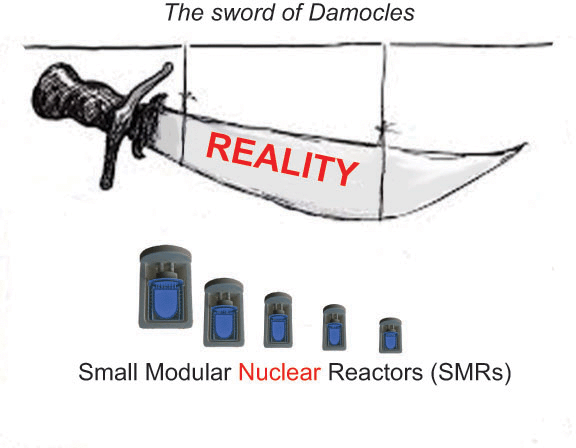
Canberra Times, By Marion Rae, December 21 2023
A surge in the cost of small nuclear reactors has forced the national science agency to change its calculations for Australia.
The latest modelling of all energy sources, released by CSIRO on Thursday, includes data from a recently scrapped project in the United States that was showcasing nuclear small modular reactors (SMRs) as a way to fight climate change.
The draft GenCost 2023-24 report, out for consultation over summer, shows that while inflation pressures are easing there has been a recalculation on SMRs that puts them out of reach.
Real data on a high-profile six-reactor power plant in the United States has confirmed that the contentious technology costs more than any energy consumer wants to pay.
Project costs for the Utah project were estimated at $18,200 per kilowatt, but the company has since disclosed a whopping capital cost of $31,100/kW, prompting its cancellation in November.
In contrast, under existing policies the cost of new offshore wind in Australia in 2023 would be $5545/kW (fixed) and $6856/kW (floating), while rooftop solar panels are calculated at a modest $1505/kW………………………………………………………………………………………………………………..
A small but vocal group of industry backers have been calling for nuclear SMRs for some years, citing the emerging low-emission technology as being suitable for Australia’s vast and geologically stable landmass.
The coalition recently pledged to reopen the nuclear debate in Australia, where laws ban any research or use of nuclear energy despite the country having the world’s largest uranium reserves.
Regulators estimate it would be around 15 years to first production from a decision to build nuclear SMR in Australia, given the scale of legislative change required.
But even if a decision to pursue a nuclear SMR project in Australia were taken today, with political backing for new laws, it is “very unlikely” a project would be up and running as quickly as 2038, CSIRO said.
Further, CSIRO warned nuclear electricity costs put forward by proponents may be for technology that is not appropriate for Australia, or calculated from Russian and Chinese government-backed projects that don’t operate commercially. https://www.canberratimes.com.au/story/8467236/cost-update-blasts-nuclear-out-of-energy-mix/
Renewables cheaper than nuclear, coal now and into the future: CSIRO
By Mike Foley, December 21, 2023 https://www.smh.com.au/politics/federal/renewables-cheaper-than-nuclear-coal-now-and-into-the-future-csiro-20231219-p5esga.html
Electricity produced by renewables is cheaper than fossil fuels and nuclear power and is expected to remain the lowest cost power source for decades to come, according to findings from the top science agency which challenge the federal opposition’s campaign against the government’s climate policy.
The new findings were published in released in CSIRO’s GenCost report on Thursday, which includes projections that an electricity grid dominated by 90 per cent renewables would deliver considerably cheaper power to households compared to fossil fuel and nuclear alternatives.
Opposition Leader Peter Dutton and his climate change and energy spokesman, Ted O’Brien, are calling for the government to halt the rollout of new energy transmission lines amid a farmer backlash over land access. The Coalition has mounted a campaign for nuclear power to be added to the nation’s energy mix.
Nuclear advocates have criticised previous CSIRO reports for not incorporating the costs of tens of billions of dollars of transmission lines needed to link the growing fleet of wind and solar farms across the country into population centres.
However, CSIRO has now included more than $30 billion of new transmission lines and projects to provide back up power when the wind isn’t blowing and the sun isn’t shining – such as the $12 billion Snowy 2.0 pumped hydro dam.
Its findings still showed that renewables were cheaper than nuclear, coal and other fossil fuels.
The report said that small modular reactors (SMR), a nascent technology not yet in commercial use but favoured by the opposition, would be far more expensive than coal and gas plants as well as renewables.
How did CSIRO calculate the costs?
GenCost uses the metric known as the levelised cost of electricity. This is how much it costs for a power plant to generate electricity, which includes capital expenditure as well as the revenue required to create a return on investment.
The report showed that a mix of wind and solar power in 2023 would generate electricity for $90 to $134 per megawatt hour.
This cost range is projected to fall to a $70 to $100 by 2030 – with renewables generating 90 per cent of the grid’s electricity. The Albanese government has set a target for renewables to reach 82 per cent of the energy mix by 2030.
CSIRO found coal generation is more expensive, even without the cost of transmission lines to link the power stations to the grid. Coal electricity generation costs between $110 and $220 per megawatt hour in 2023. This price drops slightly to a range of $85 to $135 in 2030.
The nuclear option
Dutton is calling for Australia to join a global “nuclear renaissance”, which would require removing the 1998 ban on nuclear energy and building small modular reactors on the site of retired coal-fired power plants.
US company NuScale was developing the world’s most advanced commercial SMR project in Utah, but the project was abandoned in November due to a 70 per cent blowout in project costs.
Using the NuScale project as a guide, CSIRO found that were SMR technology available today it would generate electricity at a cost of $380 to $640 a megawatt hour. This marked an increase from its July projections for SMRs to generate electricity at between $200 and $350 per megawatt hour.
CSIRO said SMR costs would fall as the technology develops, with a projected cost of $210 to $350 a megawatt hour of electricity generation in 2030.
NuScale’s development in Utah was expected to take at least 15 years to switch on, and CSIRO said this was a reasonable time frame to assume for Australia – if the current legislative ban on nuclear energy was removed and the necessary political support was in place.
‘Cottage industry’: Gurus say nuclear no match for solar energy
Professor Green described nuclear as “pie in the sky” – including the small modular reactor technologies that have enthused the British government and the opposition in Australia as countries race to transition to green energy.
Hans van Leeuwen https://www.afr.com/companies/energy/cottage-industry-gurus-say-nuclear-no-match-for-solar-energy-20231013-p5ebxp
Hans van Leeuwen covers British and European politics, economics and business from London. He has worked as a reporter, editor and policy adviser in Sydney, Canberra, Hanoi and London. Connect with Hans on Twitter. Email Hans at hans.vanleeuwen@afr.com
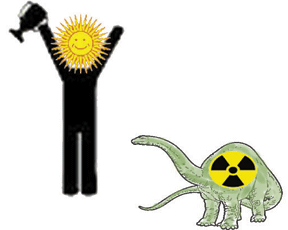
London | The debate on nuclear power is a distraction from solar, which is about to tip into exponential growth that will sweep aside all other energy sources, say Australia’s much-garlanded pair of leading solar inventors.
Andrew Blakers and Martin Green, often dubbed the “fathers of photovoltaics”, described nuclear energy as “a cottage industry”, with no chance of reaching economies of scale in any useful timeframe.
Solar, though, “is going to take over energy it is in a way that will be utterly astonishing for most people”, Professor Blakers said.
“It is going to do it as fast as we went from film photography to digital photography. In the space of 20 years, basically we’re going to flip from solar being a few per cent to solar being everything but a few per cent. It really is the fastest energy change in all of history by a large margin,” he said.
The two men were in London to collect the latest in a string of prizes for their work on PERC solar photovoltaic technology, which has brought down the cost of solar panels by 80 per cent in the past decade.
At Buckingham Palace on Thursday (Friday AEDT), the King awarded them and their colleagues Aihua Wang and Jianhua Zhao with the Queen Elizabeth Prize for Engineering.
Professor Green described nuclear as “pie in the sky” – including the small modular reactor technologies that have enthused the British government and the opposition in Australia as countries race to transition to green energy.
“They are going to have a few prototypes up by 2030, but it really needs the economy of volume to get the prices down to where they’re projecting,” he said. “So you need to be selling hundreds of these things, not just a few sample ones.”
He also said that the history of power generation had been about reducing costs by making things bigger. “It’s going against historical trend, I think, imagining that you can do things cheaply by making a lot of [smaller ones].”
Professor Blakers said nuclear was simply not in the net-zero race. “This year, it looks like the world will do about 500 gigawatts of solar and wind – maybe 400 gigawatts of solar, 100 gigawatts of wind. Hydro will do about 20 gigawatts, nuclear will do approximately one, gas and coal maybe 50,” he said.
“Solar has been growing at 20 per cent a year for a long time. If it continues to grow at this level, we will completely decarbonise the world by the early 2040s. This is how fast it’s happening. It’s so cheap compared with anything else.”
Nuclear, meanwhile, had not increased its capacity in the past 13 years, he said, adding no more than a gigawatt a year.
“You cannot grow an industry from one to multi-thousand gigawatts, which is what you’d need per year, in any reasonable timeframe. It’s impossible unless you put it on a war footing,” he said.
“You just don’t have enough engineers, scientists, raw materials, the factories, the factories to build the factories, the factories to build the factories to build the factories – it just doesn’t happen.”
Grids: the big hurdle
Both men were convinced that battery technologies and costs would continue to fall, driving increasingly rapid growth. The one big obstacle in Australia was transmission.
“Basically, you need a lot of new transmission to bring the new solar and wind into cities. And we’re not building it,” Professor Blakers said.
“Transmission only becomes important once you get up to 30, 40 per cent solar-wind. We’re currently 33 per cent solar-wind, and we will be 75 per cent by 2030. We don’t have a transmission problem yet. But in two years’ time, we’ll have a major one, and everyone can see that.”
He said initiatives to increase compensation to land owners should overcome the remaining community resistance.
Professor Green said the growth of solar energy use would not unseat China’s dominance of the supply chain for solar panels.
“Solar is basically going to demolish the market for coal and gas. And the geopolitical question is whether India, Europe and the US would tolerate having 80 or 90 per cent of the global solar industry coming out of China,” he said.
“It’s very hard to see other countries competing with China. The momentum they’ve got.”
He said India might become a major manufacturer, but its industry’s development would not be as co-ordinated and co-operative as China’s had been.
China, though, would have to address the demand of its customers for higher environmental and social standards – creating an opportunity for Australia to become a player in providing green-friendly metallurgical-grade silicon.
Aukus: UK defence giant BAE Systems wins Australian £3.95bn #nuclear submarine contract
BBC News By Peter Hoskins, Business reporter 2 October 23 #antinuclear #nuclear-free #NoNukes
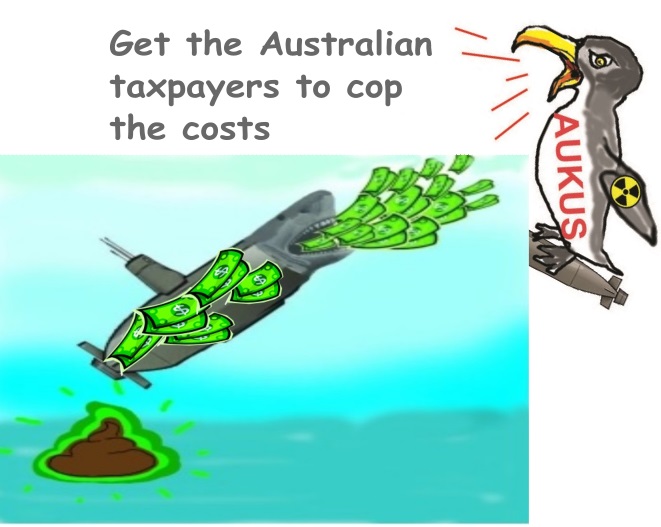
Britain’s biggest defence firm, BAE Systems, has won a £3.95bn ($4.82bn) contract to build a new generation of submarines as the security pact between the US, UK and Australia moves ahead.
In March, the three countries announced details of the so-called Aukus pact to provide Australia with nuclear-powered attack submarines by the late 2030s.
The pact aims to counter China’s ambitions in the Indo-Pacific region.
Beijing has strongly criticised the three countries over the deal.
……………………..”This multi-billion-pound investment in the Aukus submarine programme will help deliver the long-term hunter-killer submarine capabilities the UK needs to maintain our strategic advantage and secure our leading place in a contested global order,” UK Defence Secretary Grant Shapps said as the Conservative party conference got under way in Manchester.
………………….Other major UK defence contractors are also getting a boost from the Aukus deal.

In March, it was confirmed that Rolls-Royce Submarines would provide all the nuclear reactor plants that will power the SSN-Aukus vessels.
In June, Rolls-Royce said it would almost double the size of its Raynesway facility in Derby as a result of the deal. On Sunday, Babcock International, which maintains and supports the UK’s submarines, said it had signed a five-year deal with the Ministry of Defence to work on the SSN-Aukus design.
The Aukus security alliance – which was first announced in September 2021 – has repeatedly drawn criticism from China.
However, the three Western countries say the deal is aimed at shoring up stability in the Indo-Pacific more https://www.bbc.com/news/business-66979798
BAE lands £4bn contract for Aukus attack submarines

Britain has signed contracts worth GBP4 billion to finance a new phase of
the SSN-Aukus next-generation attack submarine project, according to
government officials. The deals, which involve British companies BAE
Systems PLC, Rolls-Royce Holdings PLC and Babcock International Group PLC,
are part of the Aukus military alliance between the US, Australia and the
UK to counter China in the Asia-Pacific region.
London South East 2nd Oct 2023
Modelling shows estimated cost of Peter Dutton’s nuclear energy plan

Each reactor’s estimated capital cost is $18,167/kW in 2030 compared with large-scale solar at $1058/kW and onshore wind at $1989/kW. When broken down, the modelling suggests each individual taxpayer would be burdened with a “whopping $25,000 cost impost” for such a transition
.Australian taxpayers would be slugged with a $387bn bill if Peter Dutton’s current plan to transition to nuclear was actioned.
Ellen Ransley, news.com.au, 18 Sept 23
Replacing Australia’s retiring coal-fired power stations with the Coalition’s suggested nuclear energy model would cost taxpayers up to $387bn, new modelling suggests.
Opposition Leader Peter Dutton, backed particularly by junior Coalition partners the Nationals, has previously suggested that Australia could “convert or repurpose coal-fired plants and use the transmission connections which already exist on those sites”.
Mr Dutton has also said nuclear is the “lowest cost form” of low carbon electricity, but has not explicitly outlined how much such a transition would cost.
New analysis done by the energy department shows the projected cost, which assumes replacing all of the output from closing coal-fired plants with small modular reactors, would be costly.
Energy and Climate Change Minister Chris Bowen said Mr Dutton and the opposition “need to explain why” Australians would be slugged with a $387bn burden for their nuclear energy plan that “flies in the face of economics and reason”.
But the Greens have called on the government to stop the distraction and explain to Australians why they are forging ahead with new coal and gas projects when the country is in the grips of a “climate crisis”.
“Australia is forecast to have its worst summer since the Black Summer, and yet Labor is approving more coal and gas. Peter Dutton’s nuclear push is a distraction from Labor’s continual approval of new coal and gas projects,” party leader Adam Bandt said.
“We should not allow ourselves to be distracted by Peter Dutton’s push for nuclear when Labor keeps opening new coal and gas projects in the middle of a climate crisis.”
A minimum of 71 small modular reactors – providing 300MW each – would be needed if the policy were to fully replace the 21.3GW output of the country’s retiring coal fleet.
Each reactor’s estimated capital cost is $18,167/kW in 2030 compared with large-scale solar at $1058/kW and onshore wind at $1989/kW. When broken down, the modelling suggests each individual taxpayer would be burdened with a “whopping $25,000 cost impost” for such a transition.
The opposition want to trump the benefits of non-commercial SMR technology, without owning up to the cost and how they intend to pay for it,” Mr Bowen said.
“After nine years of energy policy chaos, rather than finally embracing a clean, cheap, safe and secure renewable future, all the Coalition can promise is a multi-billion dollar nuclear flavoured energy policy.”
In total, the $387bn plan costs about 20 times what the Albanese government’s Rewiring the Nation fund is projected to cost.
The government says that fund will help achieve 82 per cent renewable energy by 2030, by unlocking over 26GW of new renewable generation capacity, and over 30GW of transmission capacity.
When Mr Dutton made his pitch for a nuclear transition in July, he suggested the Liddell Power Station could be a possible site for a small nuclear reactor…………………………………..more https://www.news.com.au/finance/business/mining/modelling-shows-estimated-cost-of-peter-duttons-nuclear-energy-plan/news-story/39f543faf65d77c53f33ec8d10175d02
Replacing Australia’s retiring coal power stations with small nuclear reactors could cost $387bn, analysis suggests
The figure adds fuel to the growing political dispute over the pace and form of Australia’s energy transition
Daniel Hurst https://www.theguardian.com/australia-news/2023/sep/18/replacing-australias-retiring-coal-power-stations-with-small-nuclear-reactors-could-cost-387bn-analysis-suggests
The federal government says it would cost as much as $387bn to replace Australia’s retiring coal-fired power stations with the form of nuclear power proposed by the Coalition.
The figure, produced by the energy department, is the projected cost of replacing all of the output from closing coal-fired plants with small modular reactors.
The opposition leader, Peter Dutton, has previously suggested that Australia “could convert or repurpose coal-fired plants and use the transmission connections which already exist on those sites”.
However, he has not been explicit about how much of the coal-fired electricity output would be replaced with nuclear-sourced energy – an uncertainty that makes projecting the cost difficult.
The figure adds fuel to the growing political dispute over the pace and form of Australia’s energy transition.
The government said the new analysis showed a minimum of 71 small modular reactors – providing 300MW each – would be needed if the policy were to fully replace the 21.3GW output of Australia’s retiring coal fleet.
“According to the 2022-23 GenCost report modelling under the current policies scenario, this could cost $387bn,” a government summary said.
“This is due to the estimated capital cost of $18,167/kW for [small modular reactors] in 2030, compared to large scale solar at just $1,058/kW, and onshore wind at $1,989/kW.”
The government said this would represent “a whopping $25,000 cost impost on each Australian taxpayer”.
The minister for climate change and energy, Chris Bowen, said the opposition wanted to promote the benefits of “non-commercial” small modular reactor technology “without owning up to the cost and how they intend to pay for it”.
“Peter Dutton and the opposition need to explain why Australians will be slugged with a $387bn cost burden for a nuclear energy plan that flies in the face of economics and reason,” Bowen said.
“After nine years of energy policy chaos, rather than finally embracing a clean, cheap, safe and secure renewable future, all the Coalition can promise is a multi-bullion-dollar nuclear-flavoured energy policy.”
Dutton identified Liddell as a possible site for a small modular reactor when he gave a pro-nuclear speech in July.
At the time, Dutton said he saw nuclear “not as a competitor to renewables but as a companion” and he wanted “an Australia where we can decarbonise and, at the same time, deliver cheaper, more reliable and lower emission electricity”.
He called on the government to consider removing legislative prohibitions on new nuclear technologies – a step the former Coalition government didn’t attempt during its nine years in power – “so we do not position Australia as a nuclear energy pariah”.
Dutton further accused Bowen of burrowing “so deeply down the renewable rabbit hole that he refuses to consider these new nuclear technologies”.
“The new nuclear technology train is pulling out of the station. It’s a train Australia needs to jump aboard.”
The estimates released by the government on Monday are partly based on the costs for small modular reactors outlined in the CSIRO’s GenCost report.
That report notes that global commercial deployment of small modular reactors is “limited to a small number of projects and the Australian industry does not expect any deployment here before 2030”.
The report notes some uncertainty around the projections.
“Nuclear SMR current costs are not reported since there is no prospect of a plant being deployed in Australia before 2030,” said the CSIRO report, released in July.
“However, some improved data on nuclear SMR may be available in future reports and projected capital costs for SMR have been included from 2030 onward.”
The federal government has set a goal of 82% of electricity coming from renewable energy by 2030, up from about 35% today.
To achieve this, the federal government has committed $20bn in low-cost finance for “rewiring the nation” – updating transmission lines – but is facing pushbacks from rural communities.
Property values in Kimba? Not so good, since the town agreed to host a nuclear waste dump.
Paul Waldon 23 May 23
When the fear of nuclear waste came to Kimba, the nuclear coterie commission a report.
“Points of claim taken from, The University of Queensland, final report November 2018.”
• Value in the residential housing market has fallen by 30-40% over the past 5 years
• As of July 2018, 35 residential properties were listed for sale compared with an historical average of 10-15.
• Perceptions are that not many people are moving to Kimba from outside the wider region.
• The rental market is currently stagnant, with local landlords indicating a reduction of over 10- 20% in weekly rental rates required to attract tenants
• No new residential housing construction has occurred in the past 3 year
This is a sign of a town floundering, a town dying, a town with no future as long as it embraces the ideal of nuclear waste.
AUKUS may turn out to be the largest financial swindle perpetrated by the United States and the United Kingdom against Australia and other Asia Pacific nations

Now, it appears that Australia is becoming yet another naval base for the deployment of US and British fleets in the Asia-Pacific Region, including the basing of US nuclear submarines in 2026, without any hope of restoring economic ties with China and, consequently, the prior level of welfare in the near future. This is in addition to paying “compensation” under the guise of investing in unfeasible defense plans.
https://journal-neo.org/2023/05/20/aukus-may-turn-out-to-be-the-largest-financial-swindle-perpetrated-by-the-united-states-and-the-united-kingdom-against-australia-and-other-asia-pacific-nations/ 20.05.2023 Author: Bakhtiar Urusov
Equipment for the country’s ground forces “arrives with depressing regularity,” years behind time, and substantially over budget, according to a report issued on April 19 by the British Parliament’s Budgetary Control Committee. For instance, the programs, which provide new Ajax armored fighting vehicles and Morpheus tactical communication and information systems, have faced significant difficulties. According to the MPs’ assessment, the issue is made worse by underfunding of the defense budget expenditures and the pound’s declining purchasing value in relation to the dollar.
Ten days later, on April 28 this year, the Royal Navy informed the public about the decision to decommission the HMS Prince of Wales aircraft carrier, launched just four years ago (in 2019), to be used as a donor for spare parts for the HMS Queen Elizabeth aircraft carrier of the same class. According to the Royal Navy, the $3.72 billion aircraft carrier has docked more frequently than it has participated in naval operations, and the most recent maintenance cost $42 million.
This dispiriting news came just a month after the leaders of the US, the UK, and Australia had disclosed their ambitious long-term plans to build a nuclear-powered submarine fleet for Canberra on the basis of British technology, which will cost the Australian budget $245 billion.
When it comes to extremely sophisticated projects like nuclear submarines, it seems inconceivable that the parties involved would be so irresponsible as to neglect to evaluate the contractors’ capacity to meet their obligations. Still, if you trust the claims made by senior US, British, and Australian officials, the opposite is true in the case of AUKUS. Canberra would never have consented to work together on submarine design and construction with Great Britain’s waning technological strength otherwise. The example of the HMS Prince of Wales aircraft carrier shows that not only is Great Britain unable to complete a big naval project, but it is also facing significant technological difficulties in order to satisfy present ambitions for defense construction and equipment upgrades.
In the realm of economic crime, assigning work to a contractor who is known to be unable to perform is fraud, money laundering, or corruption.
In the context of Anglo-Saxon big politics, this appears to be retaliation against a certain sector of Australia’s elites for Canberra’s departure from a coordinated approach to restrain the PRC back in the day. This is primarily about the carefree era when Australia and China’s trading and economic relations remained unbroken, providing Canberra with significant revenue from exports to the PRC of a wide range of items, from wine and agricultural products to hard coal and other minerals.
Now, it appears that Australia is becoming yet another naval base for the deployment of US and British fleets in the Asia-Pacific Region, including the basing of US nuclear submarines in 2026, without any hope of restoring economic ties with China and, consequently, the prior level of welfare in the near future. This is in addition to paying “compensation” under the guise of investing in unfeasible defense plans.
All nations, including India, Japan, the Republic of Korea, New Zealand, and some ASEAN members that have been invited to participate in the AUKUS, should take a closer look at this alliance.
Bakhtiar Urusov, a political observer, exclusively for the online magazine “New Eastern Outlook.”
‘Extremely difficult’ for nuclear energy to ever have a future in Australia- says Secretary of pro nuclear union
Outgoing Australian Workers Union national secretary Daniel Walton says he has witnessed “the pressures businesses have been under” with energy for the last decade……….
He said he has tried to take a “pragmatic view to finding energy solutions”.
“I think for nuclear, as much as I saw it as a fantastic opportunity, I think it’s genuinely going to be extremely difficult for it to ever have a future in Australia.” https://www.skynews.com.au/business/energy/extremely-difficult-for-nuclear-energy-to-ever-have-a-future-in-australia/video/ca2d728160fae4f6faa9e9956bca5b71
The question of nuclear in Australia’s energy sector
In Australia’s transition to net zero emissions, the energy sector has a major role to play. But does nuclear power have a place in our future grid?
CSIRO, 15 May 23
Key points
- Nuclear power does not currently provide an economically competitive solution in Australia.
- Lead author of Gencost, Paul Graham says the main area of uncertainty with nuclear is around capital costs.
- There is a lack of robust real-world data around small modular reactors (SMRs) due to low global use.
As Australia attempts to hit ambitious emissions reduction targets during the transition to net zero, we know the energy sector has a major role to play. We also know that it makes sense to be informed of and assess a full range of technologies: some new and emerging, some established and proven.
In this context, it’s unsurprising that a debate around nuclear power has been reignited. Nuclear proponents believe there is potential for small modular reactors (SMRs) to be used for low-emissions electricity generation in Australia, providing essential firming capacity to support variable renewables.
However, a review of the available evidence makes it clear that nuclear power does not currently provide an economically competitive solution in Australia – or that we have the relevant frameworks in place for its consideration and operation within the timeframe required. Without more real-world data for SMRs demonstrating that nuclear can be economically viable, the debate will likely continue to be dominated by opinion and conflicting social values rather than a discussion on the underlying assumptions.
GenCost 2022-2023: the cost of electricity generation
Each year CSIRO works with the Australian Energy Market Operator (AEMO) to produce GenCost – a detailed report that provides current and projected costs for electricity generation and storage technology.
The annual GenCost process is highly collaborative and draws on the deep expertise and knowledge of a large number of energy industry stakeholders. There are opportunities for members of the energy community to review the work and provide pre-publication feedback to improve its quality.
Paul Graham, CSIRO energy economist and lead author of the report, says it’s an open, public process that many people can participate in.
“AEMO wants to know that the data they use for planning and forecasting results is from a good level of consultation and lots of quality checking. Everyone in the industry has a fair chance to take part,” Paul says.
On 16 December 2022, the fifth GenCost report was released as a draft for public consultation. It remained consistent with findings from previous years, showing that renewables, led by onshore wind and solar PV, remain the lowest cost power generation technologies………………………………………………………
Using the standard formula for levelised costs plus the additional calculations specific to storage and transmission, wind and solar come in at a maximum of $83 per megawatt hour in 2030. This is a useful point in time for comparison because this is the earliest date at which nuclear SMR could be built in Australia.
In contrast, SMRs come in at $130-311 per megawatt hour. This range allows for nuclear SMR capital costs to halve from where we think they are at present. ………
A lack of real-world data on nuclear
One of the key principles that guides the GenCost process is the need for high quality data to base the report’s calculations on. According to Paul, the lack of robust data has been a challenge when it comes to nuclear – and for SMRs in particular.
…………………………………. Only two SMRs are known to operate in the world, located in Russia and China, and both have experienced cost blowouts and delays.
…………………….. Australian frameworks are not ready
Beyond the unfavourable economics, is the long time to build nuclear capability. The opportunity for the technology to play a serious role in emissions reduction for Australia is fast running out.
According to Renewables 2022, the latest edition of the International Energy Agency’s (IEA) annual report on the sector, renewable energy will surpass coal by early 2025 as the largest source of global electricity. Over the forecast period, their share of power will increase by 10 percentage points, reaching 38 per cent in 2027. Electricity generation from renewables is the only energy source that is expected to grow, while shares for coal, natural gas, nuclear and oil will decline.
………………..in Australia, where there are a range of other considerations at play: not least the fact that that nuclear power is currently not permitted by law. Two separate pieces of Commonwealth legislation – the Australian Radiation Protection and Nuclear Safety Act 1998 and the Environment Protection and Biodiversity Conservation Act 1999 – expressly prohibit the approval, licensing, construction, or operation of a nuclear plant. The only exception to that rule is a research reactor near Sydney, which is used for research and the production of medical isotopes.
“Plenty of other people have made the case against nuclear on the basis of issues like a lack of social licence, or the challenges involved with siting. Those issues are not unique to nuclear – but unlike other technologies, nuclear hasn’t had to go through siting or approval processes before in Australia,” Paul says.
“Taking all that into account and knowing that the longer it takes to build something the more likely it is that real costs will increase rather than decrease, it’s very clear that nuclear is going to find it very challenging to compete against renewables.” https://www.news.com.au/technology/environment/nuclear-power-at-least-15-years-away-says-regulator/news-story/6b8c4ec9c94cd4d05471783678abdb59
Nuclear waste is a $476m problem even before AUKUS
Justin Hendry 11 May 23, https://www.innovationaus.com/nuclear-waste-is-a-476m-problem-even-before-aukus/?fbclid=IwAR2jeLiHd5k32VIsMOXxhGnAaIfIyFJUvtLblzvt3mbMFPrGCSnOLL3d8UU
A long-planned nuclear waste facility to store and dispose of radioactive material that has built up over decades has secured significant funding after the former Coalition government settled on a site for the facility.
More than $160 million will be spent on preparatory work for the National Radioactive Waste Management Facility, including “technical, design, regulatory and governance activities, and community engagement”.
But there is no indication when the facility – which has been on the cards in one form or another for 40 years – might be ready, with the funding provided in Tuesday’s federal Budget intended to stretch until 2030.
The facility will become the single location for the disposal of Australia’s low level nuclear waste and a temporary storage location for intermediate level waste which until now has resulted from scientific research and industrial, agricultural and medical applications. [Ed. They don’t here mention the waste generated by the Opal nuclear reactor itself !]
That is set to change from early 2030, when Defence is expected to begin acquiring up to five Virginia-class nuclear powered submarines from the US for delivery, before building a new squadron of nuclear submarines based on a British design for delivery in early 2040.
Existing radioactive waste is currently kept at the Australian Nuclear Science and Technology Organisation’s (ANSTO) Lucas Heights reactor in Sydney, with another 100-plus locations across Australia also being used for storage.
In November 2021, the former Coalition government acquired a site near the town of Kimbra on Eyre Peninsula in South Australia to build the facility, which is opposed by the local Barngarla people.
By May last year, parts of the facility’s design and planning had already been outsourced, despite an ongoing legal challenge from Traditional Owners set to begin next month.
South Australian Premier Peter Malinauskas has reportedly already ruled out the facility handling spent fuel rods from AUKUS submarines, although is lobbying the federal government for the rods to be stored in the state’s Woomera Prohibited Zone.
The funding for the National Radioactive Waste Management Facility is accompanied by further Budget measures to support the development of radioactive waste management, storage and disposal, including a $5.2 million project with Defence and the planned Australian Submarine Agency.
The Department of Industry, Science and Resources will also receive $9.7 million over the next five years to develop a “pathway” for the long-term disposal of intermediate-level radioactive waste generated from non-defence activities.
In total, the Industry department has been allocated $476.4 million, the bulk of which will be used by the Australian Radioactive Waste Agency to continue managing a national inventory of radioactive waste and coordinate its disposal and storage.
Elsewhere in the Budget, the ANSTO has been funded with at least $84.4 million over three years to provide nuclear medicines, with the full 10-year funding package not-for-publication due to “commercial sensitivities”.
More than half of the funding will be used by the agency to manage the shutdown of its OPAL nuclear reactor for maintenance in March 2024, requiring medicines that would ordinarily be produced onshore to be imported.
During the shutdown, the reactor’s unique cold neutron source, which has been used since 2007, will be replaced, promising “increased scientific performance” well into the next decade, according to ANSTO.
The remaining $39.9 million in known funding set aside for ANSTO over the next three years will be used to wind-up ANSTO Nuclear Medicine by June 2024, with its operations, assets and liabilities to be transferred to ANSTO.
An undisclosed amount of funding will be used by ANSTO to build a new nuclear medicine manufacturing building and maintain its current facility, as well as develop a business case for a new facility to “support Australia’s sovereign nuclear security science capability”.
The agency will also receive $16.3 million as part of a $4.5 billion nuclear-powered submarine support package to provide “radiological baselining and monitoring, and provide advice on the safe implementation of nuclear technology”.
As previously announced by the government, a new Australian Submarine Agency will be created within Defence to manage the submarine program, with $7.9 million from that allocation to be used to establish the Australia-Nuclear Powered Submarine Safety Regulator
Do you know more? Contact James Riley via Email.
Nuclear power too costly for Australia’s net zero future

Nuclear power plant costs need sharp fall to help Australia reach net zero target, a study finds. By NICK EVANS, RESOURCE WRITER 19 Apr 23 more https://www.theaustralian.com.au/business/renewable-energy-economy/nuclear-power-plant-costs-need-sharp-fall-to-help-australia-reach-net-zero-target-a-study-finds/news-story/d62e6d66e4fa17fba73fd794bf4c37ea 19 Apr 23
The price of building nuclear power plants would need to fall dramatically for it to find a place in Australia’s decarbonisation strategy, and carbon capture will need to play a major role in the nation’s net-zero economy alongside a staggering increase in the rate of renewable energy generation.
Those are among the findings of final modelling in a major expert study of Australia’s path to net zero carbon emissions, conducted by interdisciplinary teams from the University of Melbourne, The University of Queensland, Princeton University’s Andlinger Centre for Energy and Environment, and Nous Group.
The expert group, Net Zero Australia, will release its final modelling on Wednesday, saying the country needs to triple the capacity of the National Electricity Market by the end of the decade to be on track to reach the commitment of being net zero by 2050.
Net Zero Australia released its interim modelling in August last year, after a multi-year effort to model Australia’s possible paths to a near-zero carbon economy, which suggested the country will require wind and solar capacity worth 40 times the capacity of the current NEM to achieve the goal.
Robin Batterham, emeritus professor of engineering at the University of Melbourne – and Australia’s former chief scientist – chaired the steering committee and told The Australian the new figures incorporated the potential use of nuclear power, as well as forecast changes in the cost of installing wind and power generation, to reach its new conclusions.
Among those are the conclusion that nuclear power will have little or no role to play unless costs of building and operating plants fall by at least 30 per cent from current “international best practice”, and the build out of renewable energy generation is significantly constrained – by any one of a range of factors, including policy settings, supply chain issues, or simply the time taken to win environmental and other permits.
“Even if you took the lowest costs that are currently being built in the world now, which is the Korean (reactors) in the Middle East, and then knock 30 per cent off them, nuclear only just gets a look in if you really constrain the renewables build,” he said.
The South Korean-led construction of the Barakah nuclear power plant in Abu Dhabi built four reactors, collectively with a nameplate generation capacity of about 5400MW. Initially tipped to cost $US20bn ($30bn) and be fully operational by 2020, its full cost is now estimated at about $US24bn – and the plant did not have its first unit supplying power until 2021.
Professor Batterham said the updated modelling – intended to be updated on an ongoing basis – also factored in substantial cost inflation in the Pilbara and other parts of northern Australia, downgrading the likely size of solar energy installations, and increasing the proportion of energy expected to be generated by offshore wind farms, particularly in the nation’s southern waters.
“This is quite a message to the states because it says you don’t have to change the numbers much to shift the opportunities around quite a bit,” he said.
But the size of the task in front of the country is still staggering, according to Net Zero Australia’s modelling.
Australian projects will need to attract up $7 trillion-$9 trillion worth of investment to decarbonise the nation’s own electricity market and replace existing export products, and grow renewable energy generation by about 40 times the current NEM generation capacity.
Under the most aggressive renewable energy scenario modelled by Net Zero Australia, the country’s total domestic energy costs would fall from just under 9 per cent of GDP to about 7 per cent by 2050.
And the skilled workforce needed to install and run new generation assets, transmission lines, and associated decarbonisation efforts will need to double to at least 200,000 people by 2030 and reach 700,000-850,000 – most with technical skills – by 2060.
Continue reading1 This month

of the week – Australians for War Powers Reform (AWPR)
To see nuclear-related stories in greater depth and intensity
 Antinuclear