Australian government rushing laws to crack down on protestors
The government is under fire from within its own ranks for trying to “rush” anti-protest laws through Parliament in the last sitting week for the year.
Liberal member for Clark and Speaker Sue Hickey said she would listen to debate before casting her vote on the laws – as did Independent member for Clark Madeleine Ogilvie.
Political manipulations- the Swedish allegations against Julian Assange
We need to ask ourselves why the focus is not on the crimes perpetrated by those involved in war crimes. Why is an Australian citizen being subjected to US espionage laws even though he was never on US soil? More importantly, why should an Australian citizen have allegiance to the US?
 The Swedish case against Assange was always political, https://www.theage.com.au/national/the-swedish-case-against-assange-was-always-political-20191120-p53cgs.html,By Greg Barns and Alysia Brooks, November 20, 2019 It is almost a decade since Julian Assange woke to discover, on the front page of a Swedish newspaper, that Swedish authorities had decided to pursue him on allegations of sexual misconduct. Immediately, Julian presented himself to the police station to make a statement and clear his name. After speaking with prosecutors, he was told he could leave the country; so he did.
Currently, Assange is held on remand in Belmarsh prison, in conditions that are exacerbating his already fragile health, and impeding his ability to prepare his defence. He is facing unprecedented charges under the US Espionage Act, for allegedly carrying out actions that journalists and publishers engage in as a part of their work. He is facing 175 years – an effective death sentence – for allegedly engaging in journalism.
And let’s not forget the material that was exposed by WikiLeaks. The releases included evidence of war crimes, including torture and unlawful killings, perpetrated during the Iraq and Afghanistan wars, and the Guantanamo files, which demonstrated that the majority of men, and children, were being held and tortured at the prison, even though they were innocent of any crime.
We need to ask ourselves why the focus is not on the crimes perpetrated by those involved in war crimes. Why is an Australian citizen being subjected to US espionage laws even though he was never on US soil? More importantly, why should an Australian citizen have allegiance to the US?
Greg Barns is a barrister and adviser to the Australian Assange Campaign. Dr Alysia Brooks is a human rights and due process advocate.
Journalists beware! Australia now a surveillance state
 Australia now a surveillance state with journalists as POIs under ASIO Act, Michael West.com, by John Stapleton — 21 November 2019 Will future historians see the Abbott/Turnbull/Morrison era as the period of governance when totalitarian instincts were unleashed? The targeting of journalists is just the beginning of a much greater disaster, writes journalist and author, John Stapleton. Australia now a surveillance state with journalists as POIs under ASIO Act, Michael West.com, by John Stapleton — 21 November 2019 Will future historians see the Abbott/Turnbull/Morrison era as the period of governance when totalitarian instincts were unleashed? The targeting of journalists is just the beginning of a much greater disaster, writes journalist and author, John Stapleton.
The #RighttoKnow movement barely touches on the intensity of media manipulation by the conservatives since they regained power in 2013; from blocking popular Facebook sites to harassing little-read authors like me. Imagine you’re writing something critical of the government. You know there are cameras in your home, a keylogger on your computer – every keystroke is observed or recorded. And then you hear cries of derision from a neighbouring house. I experienced this while completing the third and final book in a series on Australian life, Dark Dark Policing. The first two, Terror in Australia: Workers’ Paradise Lost and Hideout in the Apocalypse, may not have set the bestseller lists alight, but that is not the point. My lifetime in journalism never prepared me for so much abusive surveillance. My epiphany came post-retirement. Returning from years in Asia, I was jarred by the dilapidated state of Australia in contrast to the dynamic societies I had been in. And so began my work on a book initially titled Workers’ Paradise Lost. But it was impossible to ignore the biggest story of the day, terror, with the then Prime Minister, Tony Abbott, abandoning good government in favour of terrifying the population, pounding on about “the death cult” at every opportunity. This was despite repeated warnings from terror-messaging experts that his terminology was counterproductive, actually attracting recruits to Islamic State……. Among the most egregious laws passed by the Abbott and Turnbull governments were Journalist Information Warrants, issued entirely in secret. Journalists are not informed if a warrant is taken out against them and face jail if they publicise the fact. The laws have become so strict that journalists cannot write about security operations, or even surveillance of their reporting, without the risk of prison. I chose to use novelistic techniques. …….. The tranches of anti-journalist legislation introduced jail terms of up to ten years for journalists who disclose what are known as SIOs, Secret Intelligence Operations. Who decides what an SIO is? ASIO does…… The point is, the public narrative – thereby, the nation’s culture – is being controlled: from barely read authors like me, to the mainstream media, to Facebook warriors. Suppress dissent and you foment revolution. Thanks to the blizzard of poorly drafted legislation that the Liberals introduced to exploit the fear of terror, we now live in a country where, as the Inspector-General of Intelligence and Security recently pointed out, you can be jailed for five years for breaching orders you didn’t know existed; where children as young as ten can be incarcerated without charge. It doesn’t take the gift of prophecy to know that future historians will see the Abbott/Turnbull/Morrison era as the worst period of governance in Australia’s history, when totalitarian instincts were unleashed. The targeting of journalists is just the beginning of a much greater disaster. https://www.michaelwest.com.au/australia-the-surveillance-state-with-journalists-now-pois-under-the-asio-act/ |
|
Journalism’s future in crisis – the case of Julian Assange
JOHN PILGER: Assange’s case will define the future of free journalism, https://independentaustralia.net/life/life-display/john-pilger-assanges-case-will-define-the-future-of-free-journalism,13324 By John Pilger | 18 November 2019 John Pilger describes the disturbing scene inside a London courtroom last week when the WikiLeaks publisher, Julian Assange, appeared at the start of a landmark extradition case that will define the future of free journalism.
Her face was a progression of sneers and imperious indifference; she addressed Julian Assange with an arrogance that reminded me of a magistrate presiding over apartheid South Africa’s Race Classification Board. When Julian struggled to speak, he couldn’t get words out, even stumbling over his name and date of birth.
When he spoke truth and when his barrister spoke, Baraister contrived boredom; when the prosecuting barrister spoke, she was attentive. She had nothing to do; it was demonstrably preordained. In the table in front of us were a handful of American officials, whose directions to the prosecutor were carried by his — back and forth this young woman went, delivering instructions.
Her knee in the groin was to announce that the next court hearing would be at remote Woolwich, which adjoins Belmarsh Prison and has few seats for the public. This will ensure isolation and be as close to a secret trial as it’s possible to get. Did this happen in the home of the Magna Carta? Yes, but who knew?
Who will then dare to expose anything of importance, let alone the high crimes of the West? Who will dare publish ‘Collateral Murder’? Who will dare tell the public that democracy, such as it is, has been subverted by a corporate authoritarianism from which fascism draws its strength?
Once there were spaces, gaps, boltholes, in mainstream journalism in which mavericks, who are the best journalists, could work. These are long closed now. The hope is the samizdat on the internet, where fine disobedient journalism is still practised.
The greater hope is that a judge or even judges in Britain’s court of appeal, the High Court, will rediscover justice and set him free. In the meantime, it’s our responsibility to fight in ways we know but which now require more than a modicum of Julian Assange’s courage.
USA tried to make Iceland complicit, (like Australia is), in the persecution of Julian Assange
What is Australia doing? Isn’t Julian Assange an Australian citizen? However, I don’t see Australian authorities taking on the responsibility to protect their citizen. Australia shows, as far as I can see, the same indifference and hence complicity with the U.S. as is the case in most other lands. And may I add where is the world press, the same press which gratefully published the material WikiLeaks provided them with? Why are they quiet? In the end, we are all responsible. We are seeing an individual and an organisation taken to court, with 18 charges which could lead to 175 years in prison.
The FBI tried to make Iceland a complicit ally in framing Julian Assange https://independentaustralia.net/life/life-display/the-fbi-tried-to-make-iceland-a-complicit-ally-in-framing-julian-assange,13277
By Sara Chessa | 5 November 2019 Former Icelandic Interior Minister tells Independent Australia how he blocked U.S. interference in 2011 in order to defend WikiLeaks and its publisher Julian Assange. Sara Chessa reports.
Former Icelandic Interior Minister tells Independent Australia how he blocked U.S. interference in 2011 in order to defend WikiLeaks and its publisher Julian Assange. Sara Chessa reports.
A MINISTER OF THE INTERIOR wakes up one summer morning and finds out that a plane full of United States Federal Bureau of Investigation (FBI) agents has landed in his country, aiming to carry out police investigations without proper permission from the authorities.
How many statesmen would have the strength to say, “No, you can’t do this”, to the United States? Former Icelandic Interior Minister Ögmundur Jónasson, in fact, did this — and for the sake of investigative journalism. He understood that something wrong with the sudden FBI mission in Reykjavik, and that this had to do with the whistleblowing website WikiLeaks and its publisher Julian Assange. Continue reading
Australia’s media fights for freedom of press – BUT NOT FOR JULIAN ASSANGE
 Mainstream Media Fights for Own Freedom, But Not for Assange’s, Sydney Criminal Lawyers, 02/11/2019 BY PAUL GREGOIRE Major Australian mainstream media outlets joined forces a fortnight ago to launched the Right to Know campaign. It aims to see public interest journalism decriminalised, and safeguards for whistleblowers enhanced.This unprecedented display of unity has seen The Guardian, the ABC, Nine, News Corp, SBS and the MEAA join forces in calling on the government to enact reforms. And this is rather significant, considering some of these organisations have been much criticised for towing the party line.
The Right to Know has six demands: exceptions so journalists can’t be prosecuted under national security laws, freedom of information reform, defamation law reform, a narrowing of the information classified as secret, protections for whistleblowers and the right to contest warrants.
Of course, the campaign was sparked by the June AFP press raids, which saw agents rifle through the house of a News Corp journalist, as well as the offices of the national broadcaster, in what was understood by many to be a warning to the media and whistleblowers to keep quiet.
However, a glaring campaign omission is the case of an Australian publisher who’s currently being remanded in the UK over charges that apply in the US, which relate precisely to public interest journalism. Yet, the Australian media has all but forgotten their colleague, Julian Assange.
Silenced by association
“The Right to Know campaign drives to the heart of the matter more than many journalists realise,” remarked Ian Rose, a member of the Support Assange and Wikileaks Coalition.
“While on the one hand, they’re right to finally be calling out the creeping incursions and restrictions into media freedoms,” he told Sydney Criminal Lawyers. “On the other, they don’t have the inner fortitude to stand up for Assange.”
According to Rose, there are two reasons that the Australian media has abandoned the Walkley award-winning journalist. One is that he’s “an egalitarian”, which “frightens the hell out of the ruling class”, as most of the work of WikiLeaks has been all about exposing their lies.
The second reason behind the silence is that the “oligarchs” are the “journalists’ paymasters”. And for this reason – which is underscored by the justifiable fear of losing their lives – journalists have refrained from “calling these people out”.
An excuse for silencing
Attorney general Christian Porter spoke out against the Right to Know campaign, claiming that by providing the media with the right to contest warrants could hinder criminal investigations. And he also asserted that the campaign demands could lead to national security threats.
As an example of how the media could become such a threat, Porter pointed to Assange having published leaked classified documents on WikiLeaks. The top lawmaker further set out that while this act of publication was widely condemned, the local industry still awarded Assange a Walkley……..
Neglecting an ally
And as for what the Australian media should be doing about one of its own locked away in isolation in circumstances that undermine the rule of law, Mr Rose says that it “ought to get over its jealousy and unite to support Assange”.
Indeed, the Right to Know campaign should embrace Assange’s cause, as it’s the quintessential example of the concerted crackdown on journalists that’s currently taking place across the western world. And there’s a clear correlation between his silencing and the local AFP raids.
“The way Assange is being treated is the way journalists are starting to be treated, and the way all of society will be treated if we don’t collectively call for a stop to the new dictatorial world order,” Rose warned.
And as an example of how this silencing of dissent is spreading beyond the media, Rose pointed to the recent assault on nonviolent climate activists, which has seen the application of ongoing arrests, draconian bail conditions, intimidatory procedures and the passing of restrictive laws……..https://www.sydneycriminallawyers.com.au/blog/mainstream-media-fights-for-own-freedom-but-not-for-assanges/
The movement to save Julian Assange – his father in Ireland
Will you come and help?’ Father of Julian Assange on campaign to free his son, Irish Examiner, MICHAEL CLIFFORD November 09, 2019 At 80, John Shipton thought he would be enjoying his retirement, he tells Michael Clifford. Instead, he is touring European capitals campaigning for his son, Wikileaks founder Julian Assange.
A parent’s work is never done. John Shipton entering his ninth decade. He’d like to kick back, maybe learn a few recipes, stroll at a leisurely pace towards the declining years.
But his son needs him. His son’s health is in serious danger and his future looks dark, with the prospect of spending decades, if not the remainder of his life, in prison.
His son is Julian Assange. It’s a name that is familiar to most people, although many would, at this remove, find it difficult to couple his celebrity standing with his talent or achievement.
Assange is an Australian who has been a serious thorn in the side of the powerful. His Wikileaks organisation was responsible for disseminating information that showed what exactly the US and its allies were getting up to in foreign wars.
Wikileaks exposed war crimes. It was the receptor for whistleblower Chelsea Manning’s treasure trove of documents that painted a picture of torture and maltreatment by US forces in Iraq, among other crimes.
Vanity Fair described the resultant stories as “one of the greatest journalistic scoops of the last 30 years… they have changed the way people think about how the world is run”…….
Assange is a category B prisoner, which means he’s not considered an immediate danger to fellow human beings or society in general, but his conditions of detention are still onerous.
“He’s locked up 22 or 23 hours a day,” his father says. “It’s a grade A maximum security prison. Because those in it are treated like terrorists, that’s what Julian is being subjected to.”
Shipton was in Dublin recently on a flying visit that now forms part of his current “job”. That entails lobbying, meeting, and publicising on behalf of his son. Shipton is on a tour of European capitals trying to round up support……
Assange is in a bad way, there is no doubt about that. Both physically and psychologically, his condition is deteriorating. The prison conditions are onerous but they come following eight years cooked up in the embassy, at times under serious stress. The day before arriving in Dublin Shipton had been in to see his son.
“As you would expect after nine years of persecution, he’s a bit down in the dumps,” he says.
“The report of the UN rapporteur on torture says it all really, pointing out that he has every sign of having suffered torture with both physical and mental results…..
The UN rapporteur on torture, Nils Melzer, did visit Assange with two doctors in June in Belmarch and were highly condemnatory of the conditions in which he was being kept.
Last week, Melzer issued a further statement, saying Assange’s life was at risk and that he must not be extradited to the US as a consequence of “exposing serious governmental misconduct”…..
Melzer goes further and offers an opinion on what is driving the harsh treatment.
“In my view, this case has never been about Mr Assange’s guilt or innocence, but about making him pay the price for exposing serious governmental misconduct, including alleged war crimes and corruption,” he says. “Unless the UK urgently changes course and alleviates his inhumane situation, Mr Assange’s continued exposure to arbitrariness and abuse may soon end up costing his life.”…..
Since coming to power, Trump has railed against many forms of the free press. And his government has requested Assange’s extradition to stand trial for spying.
If he is extradited, his father doesn’t have much confidence in the prospects of a fair trial.
“The espionage law courts are held in Elizabeth, Virginia,” says Shipton. “It’s a town where all the constituents are from the intelligence community. Every judgement in the espionage courts they say just go to jail. It’s not theoretical. If he’s tried he will go to jail.”
The next hearing on extradition isn’t scheduled until February and on the basis that he previously did skip bail while awaiting an extradition hearing he is unlikely to get bail. For his family and close friends, the most immediate issue is his health rather than the political and legal vortex into which he has been drawn.
At a recent court appearance on October 21, he was described by eyewitnesses as appearing “distressed and disorientated”.
He is subject to a legal process, but few could argue that it is anything more than political. Assange published leaked material. In that he was performing an act of journalism.
Manning, for instance, was prosecuted and served seven years of what was originally a 35-year sentence. But Assange’s role was that of publisher.
Much of Wikileaks most serious material was presented in collaboration with leading global newspapers, including the New York Times and The Guardian.
His father believes that the attack on the press through Assange is not fully appreciated.
“It’s in the self interests of all journalists and news corporations to ensure that this is fought,” he says…… https://www.irishexaminer.com/breakingnews/views/analysis/michael-clifford/will-you-come-and-help-father-of-julian-assange-on-campaign-to-free-his-son-962776.html
A travesty of justice- extradition process of Julian Assange
|
Julian Assange’s Extradition Process Is ‘A Charade’, The Real News Network, November 5, 2019
Interview Transcript
GREG WILPERT: Julian Assange recently lost a court bid to have his upcoming February 2020 extradition hearing postponed. The hearing about the postponement took place on October 21, and according to observers who were present, he could barely speak in coherent sentences. Reacting to the hearing, UN Human Rights Rapporteur Nils Melzer warned last Friday that Assange continues to show symptoms of psychological torture. Melzer had visited Assange in May when he conducted an extensive review of his physical and psychological condition. In his statement on Friday, Melzer said, “Despite the medical urgency of my first appeal, and the seriousness of the alleged violations, the U.K. has not undertaken any measures of investigation, prevention, and redress required under international law.” In addition to the concerns about Assange’s treatment at Belmarsh Prison outside of London, many have also raised concerns about the impartiality of the proceedings against him. Assange was jailed last April when the Ecuadorian Embassy, where he had been given political asylum, allowed the police to arrest him. He then received a 50-week sentence for having skipped jail in 2012. The Trump Administration has since then requested Assange’s extradition on 17 charges of espionage for which he could receive a 170-year prison sentence in the United States. Joining me now to discuss the latest developments in the case of Julian Assange is John Pilger. He has been observing the Assange case very closely and was present at the October 21 court hearing…… John Pilger – “…..His physical condition has changed dramatically. He’s lost about 15 kilos in weight. To see him in court struggling to say his name, and his date of birth, was really very moving. I’ve seen that when I visited Julian in Belmarsh Prison where he struggles at first, and then collects himself. I’m always impressed by the sheer resilience of the man, because as Melzer says, absolutely nothing has been done to change the conditions imposed on him by the prison regime. Nothing has been done by the British authorities.
This was almost underlined by the contemptuous way that this court hearing recently was conducted by this judge, by this magistrate. There was a sense among all of us who were there that the whole charade, and it seemed a charade, was preordained. You had sitting in front of us, on a long table, four Americans who were from the U.S. Embassy here in London, and one of the prosecution team was scurrying backwards and forwards to get instructions from them. The judge could see this, and she allowed it. It was just absolutely outrageous.
When Julian did try to speak, and to say that basically he was being denied the very tools with which to prepare his case, he was denied the right to call his American lawyer. He was denied the right to have any kind of word process or laptop. He was denied certain documents. As he said, “I’m even denied my own writings,” as he called it. That is, his own notes and manuscripts. This hasn’t changed at all, and of course the effect of that on his morale, to say the least, has been very significant, and that showed in the court.
Greg Wilpert – ” ….district judge, Vanessa Baraitser, and one of the things that she did was completely dismiss Assange’s request for determination whether the extradition proceedings are even legal. That is, he cites according to U.K. law, “Extradition shall not be granted if the offense for which extradition is requested is a political offense”
JOHN PILGER quotes Julian’s lawyer Gareth Peirce – “….under law, it’s not a matter of opinion. They are political. All but one of the charges concocted in Virginia are based on the 1917 Espionage Act, which was a political piece of legislation used to chase off the conscientious objectors during the first World War.
It’s political. There is no charge. There is no basis, no foundation, for allowing these extradition proceedings to go forward, and almost perversely the judge seemed to, if not acknowledged that in her contempt for the proceedings. Whenever Julian Assange spoke, she feigned a disinterest, a boredom, and whenever his lawyers spoke, the same thing. Whenever the prosecutor spoke, she was attentive. The theatrics of this hearing were quite remarkable. I’ve never seen anything like it. Then very hurriedly, when Julian Assange’s lawyer requested a delay in when the case actually starts from February, they said, “We’re not going to be ready in February,” and she dismissed that out of hand.Not only that, she said that the extradition case would be held in a court that is in fact adjoining Belmarsh prison. It’s almost part of the prison. It’s a long way out of London.
So you have, if not a secret trial, but a trial in which, or an extradition hearing in which very few seats are available to the public. It’s a very difficult place to get to. So every obstacle has been put in the way of Assange getting a fair hearing. And I can only repeat, this is a publisher and a journalist convicted of nothing, charged with nothing in Britain, whose only crime is journalism. That may sound like a slogan, but it’s true. They want him for exposing the kind of outrageous war crimes, Iraq, Afghanistan, that journalists are supposed to do. “
GREG WILPERT: “…….How do you explain this lack of concern among the media and human rights groups for Assange’s situation?
JOHN PILGER: Because so many human rights groups are deeply political, Amnesty International never made Chelsea Manning a prisoner of conscience. A really disgraceful thing. Chelsea Manning, who was effectively tortured in prison, and they haven’t, as you say, they haven’t elevated Julian’s case. Why? Well, they’re an extension. They’re an extension of an establishment that is now almost systematically coming down on any form of real dissent. In the last five, six years, the last gaps, the last bolt holes, the last spaces in the mainstream media for journalists, from average journalists for the likes Assange, not only Assange, for the likes of people like even myself and others, have closed. The mainstream media, certainly in Britain, always held open those spaces. They’ve closed, and there is generally I would think a fear, right throughout the media, a fear about opposing the state on something like the Assange case. You see the way the whole obsession with Russia has consumed the media with so many nonsensical stories. The hostility, the animosity towards Julian. My own theory is that his work shamed so many journalists. He does what journalists ought to have done, and don’t do any more. He’s done the job of a journalist. That can only explain it. I mean when you take a newspaper like The Guardian, which published originally the WikiLeaks revelations about Iraq and Afghanistan, they turned on Julian Assange in the most vicious way.
They exploited him for one thing. A number of their journalists did extremely well with their books, and Hollywood scripts, and so on, but they turned on him personally. It was one of the most unedifying sights I think I’ve ever seen in journalism. The same thing happened in the New York Times. Again, I can only surmise the reason for that. It’s that he shames them. We have a desert of journalism at the moment. There are a few who still do their jobs; who still stand up against establishment power; who still are not frightened. But there’re so few now, and Julian Assange is totally fearless in that. He knew that he was going to run into a great deal of trouble with the state in Britain, the state in the United States–but he went ahead anyway. That’s a true journalist…… https://therealnews.com/stories/julian-assange-extradition-process-charade
|
|
Strong public demand for climate action, but Australian government determined to punish climate protesters,
 An increasingly outraged public is demanding action in a nation intimately linked to coal mining. The government has responded by threatening a new law to punish protesters. NYT, By Damien Cave and Livia Albeck-Ripka, Nov. 6, 2019 SYDNEY, Australia — One climate activist halted train service by chaining himself to the tracks. Others have glued themselves to busy roads, causing gridlock. And just last week, protesters locked arms to stop people from entering a mining conference before being forcibly dispersed by police officers with pepper spray.
A surge of climate activism is flooding Australia as the country falls behind on its promise to reduce emissions — effectively ignoring the Paris Agreement the Trump administration just abandoned. Prime Minister Scott Morrison has responded with a threat that’s alarmed scientists and free speech advocates, arguing that the government should outlaw “indulgent and selfish” efforts by environmental groups to rattle businesses with rallies and boycotts. “The right to protest does not mean there is an unlimited license to disrupt people’s lives,” Mr. Morrison said, adding, “I am very concerned about this new form of progressivism.”
Australia’s “climate wars,” once confined to election campaigns, are now spilling into the streets with some of the biggest protests the country has ever seen. An increasingly outraged public is demanding action while the conservative national government refuses to budge, relying on the police to squelch dissent……..
Coal-loving politicians
Two years ago, when Mr. Morrison was Australia’s treasurer, he stood up in the House of Representatives with a hunk of black coal in his hand.
“Don’t be afraid. Don’t be scared,” he said. “It won’t hurt you.”
His shiny prop had been shellacked to keep his hands clean, but the point he made then is one he and his governing coalition stand by: Coal is good……Now, Australia is the world’s largest coal exporter. It is also a major exporter of natural gas, making for a resource-driven country that is
“rich, dumb and getting dumber,” according to one recent headline summarizing the findings of a Harvard study that ranked Australia’s economy 93rd in complexity, behind Kazakhstan, Uganda and Senegal. The mingling of mining interests with national interests is perpetuated through a revolving door: lawmakers frequently work for the coal industry after leaving office. And for some, defending coal has come to be equated with defending the country.Even the opposition center-left Labor Party is hooked, pushing for emissions cuts while continuing to support more coal mining……
An increasingly angry public
Poll after poll shows growing concern about climate change among Australians of all ages and political persuasions.In September, a survey by the Australia Institute found that 81 percent of Australians believe climate change will result in more droughts and flooding (up from 78 percent in 2018). Two out of three Australians agreed that the government should plan for an orderly phaseout of coal, while 64 percent said Australia should aim for net-zero emissions by 2050.
And researchers continue to sound the alarm. A paper co-written by an Australian scientist and signed by 11,000 other experts warned on Wednesday of a clear “climate emergency.”……
The so-called climate strike in September, part of a global effort led by children, was the largest mass demonstration in Australian history.
It was quickly followed last month by the Extinction Rebellion protests, and then came last week’s anti-mining protests in Melbourne….. Over 10 days of protests in London, the police arrested more than 1,700 Extinction Rebellion protesters.
Australia aims to go further. A law passed last year allows the military to break up protests. The Labor government in Queensland is fast-tracking a law to add new fines for protesters who use locking devices to prevent their removal……. Reduced coal mining would not hurt the economy as much as people think.
According to the Australia Institute poll from last month, Australians believe coal mining accounts for 12.5 percent of Australia’s economic output and employs 9.3 percent of its work force. “In reality,” the report says, “coal mining employs only 0.4 percent of workers in Australia and is 2.2 percent of Australia’s G.D.P.” Of the roughly 238,000 jobs that mining provides in Australia, only around 50,000 are tied to coal, according to government figures.
“The government relies on ignorance,” Professor Eckersley said. “It’s a very toxic politics.”
Portrayals of extreme activism are also exaggerated. The vast majority of protesters demanding climate action are not radical disrupters. They are more like Jemima Grimmer, 13, who asked adults to “respect our futures” at the Sydney climate strike in September, or Vivian Malo, an Aboriginal woman attending last week’s protest in Melbourne, where she said the experience of being pepper-sprayed felt like chemotherapy “on the outside.” Here in a country rapidly losing its laid-back image, the future of Australia’s climate battles could be seen in her bloodshot eyes as she stood near a line of stone-faced police officers, describing their use of force as “scary.”
“The insatiable drive for resource extraction,” she said. “It’s out of control.” https://www.nytimes.com/2019/11/06/world/australia/australia-climate-protests-coal.html
Gross injustice: the relentless destruction of Julian Assange
The charge against Julian is very specific; conspiring with Chelsea Manning to publish the Iraq War logs, the Afghanistan war logs and the State Department cables. The charges are nothing to do with Sweden, nothing to do with sex, and nothing to do with the 2016 US election; a simple clarification the mainstream media appears incapable of understanding.
The campaign of demonization and dehumanization against Julian, based on government and media lie after government and media lie, has led to a situation where he can be slowly killed in public sight, and arraigned on a charge of publishing the truth about government wrongdoing, while receiving no assistance from “liberal” society.
Unless Julian is released shortly he will be destroyed. If the state can do this, then who is next?
 The Annihilation of Julian Assange, https://www.truthdig.com/articles/the-annihilation-of-julian-assange/, Craig Murray “In Defense of Julian Assange,” edited by Tariq Ali and Margaret Kunstler, is now available for OR Books.
I was deeply shaken while witnessing yesterday’s events in Westminster Magistrates Court. Every decision was railroaded through over the scarcely heard arguments and objections of Assange’s legal team, by a magistrate who barely pretended to be listening.
Before I get on to the blatant lack of fair process, the first thing I must note was Julian’s condition. I was badly shocked by just how much weight my friend has lost, by the speed his hair has receded and by the appearance of premature and vastly accelerated aging. He has a pronounced limp I have never seen before. Since his arrest he has lost over 15 kg in weight.
But his physical appearance was not as shocking as his mental deterioration. When asked to give his name and date of birth, he struggled visibly over several seconds to recall both. I will come to the important content of his statement at the end of proceedings in due course, but his difficulty in making it was very evident; it was a real struggle for him to articulate the words and focus his train of thought.
Until yesterday I had always been quietly skeptical of those who claimed that Julian’s treatment amounted to torture – even of Nils Melzer, the UN Special Rapporteur on Torture – and skeptical of those who suggested he may be subject to debilitating drug treatments. But having attended the trials in Uzbekistan of several victims of extreme torture, and having worked with survivors from Sierra Leone and elsewhere, I can tell you that yesterday changed my mind entirely and Julian exhibited exactly the symptoms of a torture victim brought blinking into the light, particularly in terms of disorientation, confusion, and the real struggle to assert free will through the fog of learned helplessness. Continue reading
Scott Morrison doesn’t like even the “quiet people” speaking up
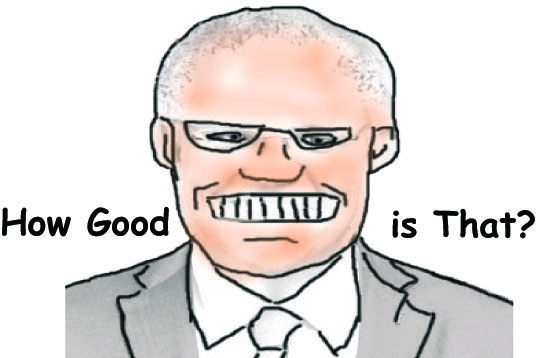 Morrison doesn’t like it when the quiet Australians start to speak up, Canberra Times, Ebony Bennett , 2 Nov 19,
In his government’s latest free-speech crackdown, Prime Minister Scott Morrison has vowed to outlaw civil society groups campaigning against Australian businesses that work with companies with dubious environmental, human rights or ethical records.
The bank ruled out lending to Adani, as did other banks – in part because AYCC’s Dollarmite protests were a real risk to their brand (this was before the banking royal commission tanked it) but also because Adani’s coal mine is a dud project that has failed to secure finance from virtually any bank or investor, except for billionaire Gautam Adani himself.
Scott Morrison says this style of campaigning “is a potentially more insidious threat to the Queensland economy and jobs and living standards than a street protest”.
That was in 2014, when former prime minister Tony Abbott proposed a ban on secondary boycotts. Australia’s competition laws already restrict secondary boycotts – but that is mostly targeted at unions, with exemptions for campaigns run by environmental and consumer groups……
Scott Morrison doesn’t like it when quiet Australians break their silence and take aim at dodgy companies or those who choose to provide services to them – especially when they’re in his favoured industries, like the coal industry. While the Coalition government rolls out the red carpet for the coal industry, it can’t pull up the drawbridge fast enough when it comes to renewables.
If the Minerals Council says jump, the federal government (and NSW and Queensland governments) say “how high?” Whereas the Coalition government has done its level best to kill off the renewables industry. Thankfully, in the long term they have been about as effective at killing off renewables as they have been at cutting emissions: hopeless.
The Morrison government regularly boasts about Australia’s record on renewables, but the fact is it is single-handedly destroying the holy trinity of renewable energy policy: the Renewable Energy Target (RET), the Australian Renewable Agency (ARENA) and the Clean Energy Finance Corporation (CEFC).
Collectively, the RET, ARENA and the CEFC are responsible for unleashing $23.4 billion worth of investment in renewable energy over a five-year period (2013-18). But there’s nothing the Coalition loves more than throwing sand in the gears of the success of the renewables industry.
Looking ahead, the RET has been exhausted, ARENA is running out of money and the last bastion of renewable energy investment, the CEFC, is now being bastardised to fund fossil-fuel projects……..
Prime Minister Scott Morrison has gone to great pains to talk up renewables, but the truth is that the PM is quite happy to wreck the renewables revolution. He labels those who protest companies wrecking our environment as “selfish and indulgent”, but the truth is that under Scott Morrison, free speech is reserved only for people with paid jobs, and protests are only to be tolerated at convenient times, in convenient places.
If you don’t like it, shut up – or Scott Morrison will make you shut up.
How good is Australia?
- Ebony Bennett is deputy director at independent think tank the Australia Institute. Twitter: @ebony_bennett. https://www.canberratimes.com.au/story/6470618/morrison-doesnt-like-it-when-the-quiet-australians-start-to-speak-up/?cs=14246
Scott Morrison delivers a speech that sounds very like an attack on democracy
|
Scott Morrison threatens crackdown on protesters who would ‘deny liberty’ https://www.theguardian.com/australia-news/2019/nov/01/scott-morrison-threatens-crackdown-on-secondary-boycotts-of-mining-companies?CMP=share_btn_tw
PM signals action on secondary boycotts of resources companies and says progressives want to tell Australians ‘what you can say, what you can think’ Paul Karp @Paul_Karp Fri 1 Nov 2019 Scott Morrison has branded environmental protesters “anarchists” and threatened a radical crackdown on the right to protest in a speech claiming progressives are seeking to “deny the liberties of Australians”.In a speech to the Queensland Resources Council on Friday, the prime minister said a threat to the future of mining was coming from a “new breed of radical activism” and signalled the government would seek to apply penalties to those targeting businesses who provide services to the resources industry. Civil society groups, including the Human Rights Law Centre and Australian Conservation Foundation, and the Greens immediately attacked the proposal as undemocratic and a bid to stifle a social movement fighting for Australia to take action on climate change. Morrison told Australian corporations to listen to the “quiet shareholders” and not environmental protesters, who he suggested could shift targets from coal companies to all carbon-intensive industries including power generation, gas projects, abattoirs and airlines. In a speech proposing limits on free speech advocating boycotts against polluting companies, Morrison said progressives wanted to tell Australians “what you can say, what you can think and tax you more for the privilege of all of those instructions”. He claimed that “progressivism” – which he labelled a “new-speak type term”, invoking George Orwell – intends “to get in under the radar, but at its heart would deny the liberties of Australians”. “Apocalyptic in tone, it brooks no compromise,” Morrison said. “It’s all or nothing. Alternative views are not permitted.” He pointed to the “worrying development” of environmental groups targeting businesses or firms involved in the mining sector with “secondary boycotts”, such as businesses refusing to provide banking, insurance or consultancy services. “They are targeting businesses of all sizes, including small businesses, like contracting businesses in regional Queensland.” “Let me assure you this is not something my government intends to allow to go unchecked. “Together with the attorney general, we are working to identify mechanisms that can successfully outlaw these indulgent and selfish practices that threaten the livelihoods of fellow Australians.” But Morrison admitted the government “can’t force one Australian company to provide a service to another”. The Greens were quick to reverse the charge of intolerance and level it at Morrison, with acting leader Adam Bandt labelling him “a direct threat to Australian democracy and freedom of speech”. “The prime minister’s commitment to outlaw the peaceful, legal protest of Australian individuals and community groups reads like a move straight from the totalitarian’s playbook,” he said. |
Australian government rejects call for help from Julian Assange’s legal team
 Why is it that the Australian government is so helpful to Australian murderers and drug dealers imprisoned overseas, but so relentlessly unhelpful to an Australian whose only crime is to tell the truth?
Assange legal team asks for Australian government help amid growing health fears, https://www.theage.com.au/politics/federal/assange-legal-team-asks-for-australian-government-help-amid-growing-health-fears-20191028-p534xw.html, By Rob Harris
The WikiLeaks founder has been held in HM Prison Belmarsh since his April 11 arrest at the Ecuadorian embassy, where he had lived in asylum for almost seven years.
Australian officials told a Senate estimates hearing on Thursday that diplomats had not heard back from Assange’s lawyer since writing to her last week asking that she raise with him their offer of consular assistance.
The 48-year-old is fighting US attempts to extradite him to face 17 counts of spying and one of computer hacking in relation to WikiLeaks’ release of thousands of classified Pentagon files regarding the Iraq and Afghanistan wars.
Barrister Greg Barns, an adviser to the Australian Assange campaign, told The Age and The Sydney Morning Herald his UK lawyers on Friday requested consular assistance following a recent inquiry from the Department of Foreign Affairs and Trade.
“Julian’s lawyers are asking for the Australian government’s assistance in dealing with their client’s inhumane conditions in Belmarsh prison which has led to, and is continuing to cause, serious damage to Julian’s health,” Mr Barns said.
His supporters say he is being kept in solitary confinement and is allowed out of his cell for only 45 minutes a day. At a court appearance last week, he appeared gaunt and disorientated.
Assange was due to be released on September 22 but was told at a court hearing last month he would be kept in jail because there were “substantial grounds” for believing he would abscond.
The Australian Lawyers Alliance (ALA) passed a motion at its national conference on Saturday calling for the Australian government to do “all it can” to bring Assange home and resist US attempts to extradite him.
ALA national president Andrew Christopoulos said it was an important issue about the rule of law and protecting an Australian in a vulnerable position overseas.
“This is about standing up for the rule of law, fairness and the freedom to expose wrongdoing,” he said. “The reported decline of Julian Assange’s physical and mental health heightens the need for urgent government intervention. The government has intervened in cases like this before and should do so in this circumstance.”
If the case goes to a series of appeals, Assange could remain in a UK jail until at least 2025.
Foreign Minister Marise Payne last week acknowledged the publicity around the case and that Assange had high-profile and loyal supporters. She said it was important to let the legal process run its course.
“He has been offered consular services … like any other Australian would,” Senator Payne told the Senate committee. “I think it’s important to remember that as Australia would not accept intervention or interference in our legal processes, we are not able to intervene in the legal processes of another country
Australia’s media under threat

“Media outlets have faced attacks in the form of centralisation of private ownership, funding cuts to public broadcasters, and potential prosecution of journalists, including News Corp journalist Annika Smethurst.”
One of the report’s authors, Geoffrey Watson, SC, former counsel assisting the Independent Commission Against Corruption, said he had been shocked by how quickly the brutal type of politics that evolved in the United States and the United Kingdom, and partly led to the ascendancy of Donald Trump and Boris Johnson, had taken root in Australia.
“One day you see the judiciary attacked and the next someone in the media,” said Mr Watson, who is a director of the Centre for Public Integrity. “On the third day it might be the CSIRO, they even attack our scientists. Some people don’t recognise it as the same problem, but it is all part of the same disease.”
He said the effectiveness of the media in Australia as a watchdog was not only threatened by personal and legal attacks by the government, but by regulations that had allowed ownership of newspapers to be reduced to an effective duopoly.
The report, entitled “Protecting the Integrity of Accountability Institutions”, said that a range of institutions – including the judiciary and the Administrative Appeals Tribunal, the public service, integrity commissions such as the ICAC, statutory authorities such as the Human Rights Commission and the Fair Work Commission, and the CSIRO – had all been targeted in recent years by interested parties seeking to undermine their independence and public trust.
“These institutions are important not only because they ensure actual accountability, transparency and good governance but because they build confidence and trust within the Australian community,” it said. “When this confidence and trust is diminished, divisiveness and conflict increase. This impacts social cohesiveness and the economy, and the welfare of all Australians suffers. Ultimately, as international experience has shown, it is a threat to democracy itself.”
It cited as examples of interference attempts by federal ministers to influence the Victorian Court of Appeal in 2017 terrorism cases, sustained funding cuts and personal attacks on the ABC, and the de-skilling of the public service through the outsourcing of up to 50 per cent of government departments to contractors.
The report listed a series of principles that needed to be respected in order to protect the independence of the threatened institutions. They include protection from political retribution, secure and sufficient funding, secure tenure of senior officials and public access to advice to the government from accountability institutions, as well as the creation of an effective federal integrity watchdog.
The Centre for Public Integrity, a independently funded think tank, was formed earlier this year in part to champion the case for a such a body. The report comes in the midst of a campaign by Australian media, including the Herald and The Age, to defend the public right to information in the face of increasing attempts by government and government agencies to suppress information, prosecute whistleblowers and criminalise legitimate public interest journalism.
ABC challenges the validity of Federal Police raids
 We don’t want any sensationalist headlines,’ AFP
  allegedly told ABC, https://www.theage.com.au/national/we-don-t-want-any-sensationalist-headlines-afp-allegedly-told-abc-20191028-p534ux.htmlby Michaela Whitbourn ,October 28, 2019 —An Australian Federal Police agent told the ABC it wanted to avoid “sensationalist headlines” such as “AFP raids ABC” before it seized a raft of documents from the broadcaster’s Sydney headquarters, the Federal Court has heard.
The ABC is challenging the legal validity of the search warrant authorising the June 5 raid by the federal police on its offices in Ultimo and is seeking the return of documents seized at the time. Continue reading
1 This month

of the week – Australians for War Powers Reform (AWPR)
To see nuclear-related stories in greater depth and intensity
 Antinuclear