Abbott government leads resistance to Obama’s efforts to combat climate change
 Abbott government resists US moves against coal power, The Age March 26, 2015 – Lisa Cox, Mark Kenny The Abbott government has again put itself on a collision course with US President Barack Obama, this time over government funding for coal-fired power plants.
The revelations call into question Canberra’s readiness to cooperate with other major economies in the lead-up to global climate talks in Paris in December.
Environment groups believe Australia is running interference in order to protect its own coal export markets in Asia……..the Australian government is arguing that limiting financial assistance to non-coal based power plants would send the wrong message to developing economies………
>Doug Norlen, a senior economic policy manager with Friends of the Earth, US, said the Abbott government was putting itself at odds with President Obama, who was using international forums to push other world leaders to reduce fossil fuel use in the lead-up to the Paris talks.
“This is interesting in several contexts, including in the recent context of the G20 where President Obama gave a very strong speech on the need to protect the Great Barrier Reef from damage from fossil fuel exportation,” he said.
“As we go forward, the Paris meetings become an important place where countries need to stand up and declare their seriousness about climate change or shirk their responsibility.”……..http://www.theage.com.au/federal-politics/political-news/abbott-government-resists-us-moves-against-coal-power-20150326-1m7mxr.html
Climate change, extreme heat and bushfires in WA
 The heat is on: climate change, extreme heat and bushfires in WA http://apo.org.au/research/heat-climate-change-extreme-heat-and-bushfires-wa
- Western Australia is experiencing a long-term increase in average temperatures and in 2014 the state recorded its highest ever annual average maximum temperature.
- The number of heatwave days in Perth has increased by 50% since 1950.
- Nine of Western Australia’s hottest Januarys on record have occurred in the last 10 years.
- The number of days per year
with severe fire danger weather is projected to almost double in south west Western Australia by 2090 if global carbon emissions are not drastically reduced.
Recent fires in Western Australia have been influenced by record hot dry conditions.
- The long-term trend to hotter weather in Western Australia has worsened fire weather and contributed to an increase in the frequency and severity of bushfires.
- The concept of a normal bushfire season is rapidly changing as bushfires increase in number, burn for longer and affect larger areas of land.
- By 2030, the number of professional firefighters in WA will need to more than double to meet the increasing risk of bushfires.
3. The economic, social and environmental costs of increased extreme heat and bushfire activity is likely to be immense.
- In Perth, from 1994-2006, there were over 20 heat attributable deaths per year. If average maximum temperatures were 2°C warmer, this number would almost double to 40 deaths.
- Some of Western Australia’s most fire-prone regions may become unlivable as the risks to lives and property caused by bushfires continue to increase.
- Without effective action on climate change, there will be 20 times the number of dangerous days for outdoor workers by 2070, reducing productivity.
4. Tackling climate change is critical to protecting Western Australia’s prosperity.
- As a nation we must join the global effort to substantially reduce emissions and rapidly move away from fossil fuels to renewable energy if we are to limit the severity of extreme heat and bushfires both in Western Australia and nationally.
Intergenerational Report fails to consider the impacts of climate change beyond 2020.
 Intergenerational Report goes backwards on climate change KELLIE CAUGHTABC Environment 6 Mar 15 Despite projecting Australia’s future out to 2055, the Intergenerational Report failed to consider the impacts of climate change beyond 2020.
IT’S UP TO THIS generation, including our political leaders, to do the right thing to protect the people and places we love.
Despite this, the 2015 Intergenerational Report has failed to outline concrete, long-term steps to address one of the greatest threats facing our children — climate change.
There’s no plan to future-proof Australia, and the budget, against the worst impacts of climate change. Instead, it’s a missed opportunity to build on the 2010 report which highlighted climate change as among the top three challenges to Australia’s long-term economic sustain ability. To give perspective, the 2010 report mentioned ‘climate change’ more than 80 times. The 2015 report, just 19 times.
It relies on the Government’s Emissions Reduction Fund as the key policy until 2020, but lacks a plan beyond this. There are no projections of the costs of climate impacts, and no clear pathway for Australia to reduce its dependence on fossil fuels and sensibly transition towards zero carbon pollution (net) by 2050………
In 2014, Australia became the first country to remove its price on carbon. Before the repeal the carbon price contributed to a 1.4 per cent fall in carbon pollution in the 2013/14 financial year. If we are to provide a better future for our kids, Australia should be cutting its carbon pollution by at least 25 per cent by 2020 and at least 40 per cent by 2025 (below 2000 levels).
Australia will be one of the countries hardest and fastest hit by climate change. Unless we show a commitment to our future generations now, they will bear the brunt of these impacts. The 2015 Intergenerational Report failed on climate change. Yet, by acting soon and alongside others in Paris, Australia still has the opportunity to correct this for the sake of our children, and grandchildren.
Kellie Caught is Climate Change National Manager for WWF-Australia. http://www.abc.net.au/environment/articles/2015/03/06/4192607.htm
Australia has its own cogs in the climate science denial machine.
 Doubt over climate science is a product with an industry behind it With its roots in the tobacco industry, climate science denial talking points can be seen as manufactured doubt Guardian, Graham Readfearn 5 Mar 15“………As well as the sympathetic Rupert Murdoch-owned press and the fossil fuel industry, there is the influential free market “think tank” the Institute of Public Affairs.
The IPA is another group to push climate science denial while also defending the tobacco industry (the Sydney Morning Herald reported in 2012 that British American Tobacco was a financial supporter of the institute.)
Last year the IPA encouraged supporters to take advantage of a tax concession to help fund a climate book with chapters written by a familiar line-up of climate science denialists – one of which was Dr Soon.
In February, the IPA ran a short speaking tour promoting its book Climate Change: The Facts (it was suggested to me that moving the semi colon in the book’s title one word to the left would better describe the contents).http://www.theguardian.com/environment/planet-oz/2015/mar/05/doubt-over-climate-science-is-a-product-with-an-industry-behind-it
Shoddy Intergenerational Report ignores climate change
Climate Change? What Climate Change! And Other Tales From The Intergenerational Report New Matilda, 5 Mar 15 By Ben Eltham A report that predicts the future and ignores climate change is a farce, writes Ben Eltham “……a government report that looks forward to 2055 is ambitious. But that’s the premise of today’s 2015 Intergenerational Report.
Can we really take seriously a government document that attempts to see 40 years into the future?
No, we can’t. Of course we can’t.
We know this because the report ignores climate change.
Climate is mentioned only 12 times in a 175-page report. You could argue that for this government, the less said on climate the better. Even so, this is cloud-cuckoo stuff.
There is no discussion of the potential costs of climate change to government spending, for instance in the cost of more frequent extreme weather events and natural disasters. There is no discussion of the potential for taxing carbon emissions to meet Australia’s future budgetary challenges. And there is no discussion of the potential future impacts of global carbon deals on a resource-intensive Australian economy.
With a kind of Orwellian satire, the report even spruiks for the Abbott government’s risible Direct Action carbon subsidies. On page 40, the IGR argues that the government’s $2.55 billion emissions reduction fund will somehow get us to our 5 per cent 2020 emissions reduction target.
It’s at the point where the IGR lists the federal government’s “strong decisions in managing the Great Barrier Reef” that the whole thing descends into farce…….
Climate change is the dominant geopolitical fact of the future. It will bend the future more surely than tax takes or pension liabilities. It will reshape the global economy, threaten food yields, increase natural disasters, lay waste to Australia’s region and generate hundreds of millions of refugees. ….
You don’t have to take such shoddy work seriously, and as a busy citizen, you shouldn’t. The Intergenerational Report is not a serious attempt to make projections about government policy. It is an ornament, a prop in a policy theatre, a bell-and-whistle for the next Treasury lockup.
Like most such reports, the IGR will be quickly forgotten. https://newmatilda.com/2015/03/05/climate-change-what-climate-change-and-other-tales-intergenerational-report
Government’s Intergenerational report is a junk document and should be rewritten
Green groups slam report as inadequate ELISE SCOTT AAP MARCH 05, 2015 Daily Telegraph, “………despite the report being a snapshot of the next 40 years, it fails to detail any post-2020 emission reduction goals or the long-term costs of climate change.
Climate Institute chief John Connor believes the report shines a spotlight on the inadequacies of government policies and ignores economic challenges and opportunities.It refers to recent analysis that shows changes in the frequency of extreme weather but contains just one sentence about future impacts.”It’s almost breathtaking,” Mr Connor told AAP.”It’s woefully inadequate. It doesn’t even deal with this generation of policy, let alone the next.
 “The Australian Greens are demanding the report be rewritten.”This is a junk document and should be tossed away,” leader Christine Milne told reporters in Canberra.Senator Milne wanted to see “serious modelling” on the costs of global warming.The absence of long-term projections is a shared concern of the World Wildlife Foundation and the Australian Conservation Foundation.ACF spokesman Josh Meadows said climate change was the one area that could be planned for, yet the report ignored forward-thinking completely……..
Mr Connor welcomed the government’s acknowledgement the international community had committed to limiting global warming to 2C.The intergenerational report produced by Labor in 2010 found unmitigated climate change would leave Australian GDP in 2100 about eight per cent lower than the level it would be in the absence of climate change. http://www.dailytelegraph.com.au/news/breaking-news/green-groups-slam-report-as-inadequate/story-fni0xqi3-1227249614927
AUDIO: EU wants USA, China, Australia to join global climate agreement
 AUDIO: EU pressures US and China to join global climate agreement ABC Radio, The World Today ,David Mark reported this story on Thursday, February 26, 2015 ELEANOR HALL: The European Union (EU) has ratcheted up pressure on the United States and China to join a global climate agreement.
Overnight the EU released its target for greenhouse gas reductions ahead of a meeting later this year in Paris.
It’s committing to reducing emissions by at least 40 per cent over 1990 levels by 2030 as David Mark reports.
DAVID MARK: The US and China made some commitments to greenhouse gas reduction targets at the APEC (Asia-Pacific Economic Cooperation) meeting in Brisbane last year.
Now the EU has announced specific targets – its member countries will reduce greenhouse gas emissions by 40 per cent by 2030 over 1990 levels.
Overnight the EU released its target for greenhouse gas reductions ahead of a meeting later this year in Paris. It’s committing to reducing emissions by at least 40 per cent over 1990 levels by 2030 as David Mark reports.
DAVID MARK: The US and China made some commitments to greenhouse gas reduction targets at the APEC (Asia-Pacific Economic Cooperation) meeting in Brisbane last year.
Now the EU has announced specific targets – its member countries will reduce greenhouse gas emissions by 40 per cent by 2030 over 1990 levels……
ERWIN JACKSON: Well, I think the momentum is towards having a core agreement in Paris which is legally binding, which does ensure that countries come forward and have national targets………
In Lismore a new political party starts off – to tackle climate change
 Political party forms in Lismore to tackle climate change Darren Coyne, Echo Net Daily, 19 Feb 15, A new political party focused on tackling climate change is being formed by a group of north coast residents. The Renewable Energy Party plans to stand candidates in every state and territory at the next Federal election in 2016.
Following a meeting at the Lismore Worker’s Club this week, the political hopefuls announced they were in the process of signing up the 500 members required to form the party.
Campaign manager Jim Moylan said membership was not likely to be a problem. ‘Aussies are really passionate about climate change,’ Mr Moylan said.‘Our Facebook page has gone-off like a skyrocket. All we did was set up a news-feed to climate change news – and a big audience appeared.’
Mr Moylan told Echonetdaily that the micro-party would act as ‘better angels’ to The Greens and other left-leaning parties……..
Party founder Peter Breen, a former independent member of the New South Wales Parliament, and a former member of both Labor and the Liberal parties, will be national coordinator of the party. Mr Breen, a resident of Byron Bay, said the party had good prospects.‘Of course they will take us seriously. We are well funded, well organised and mainstream,’ Mr Breen said.
‘We have advertising people, political insiders, fund-raisers, social media specialists and other professionals.
‘The Renewable Energy Party wants science and the public interest to dictate the terms of the climate debate – not coal, gas and oil companies.’

Following the Lismore meeting, the fledging party released the following statement.
‘Renewable energy needs grass roots representation. More than a million households in Australia now use solar energy and we are getting a very bad deal from the major energy companies who all own coal mines.
‘Currently, Australians are paying as much as $1,000 per year for electricity and gas connections – before we even turn on our appliances. On top of that, the major energy companies pay 6 to 8 cents for solar power exported to the grid while charging four times that amount for customers to buy it back”
‘In the UK, politicians are talking seriously about phasing out fossil fuels, but Australian politicians are talking about phasing out renewable energy. The Renewable Energy Party hopes to bring a consumer’s perspective to the debate in Australia.’
‘The Renewable Energy Party will speak on behalf of the many Australians who believe that climate change is simply the most important issue we face. We support the 97 per cent of climate scientists who say man-made climate change is real and we need to do something serious about the predicted global temperature rise.
‘According to the International Monetary Fund, Australia’s implicit subsidies to oil, coal and gas companies are worth 1.8 per cent of GDP, or about $23 billion annually. Subsidies to the renewable energy industry are small beer by comparison.
‘The Renewable Energy Party has been formed to highlight the differences between the favourable treatment given to the fossil fuel industries by government and the difficulties faced by the emerging renewable energy industry.
‘It is also a fact that renewable energy creates more jobs per unit of energy delivered than fossil or nuclear fuels. Action on climate change is our best hope for better present and a more promising future,’ the statement concluded.http://www.echo.net.au/2015/02/political-party-forms-lismore-tackle-climate-change/
Dry Future for Adelaide ( very unwise to bring water wasting nuclear industry)
 Makes you question the intelligence of South Australia’s businessmen and politicians – even contemplating the high water use, and high water-polluting industries of nuclear industries, and expanding uranium mining
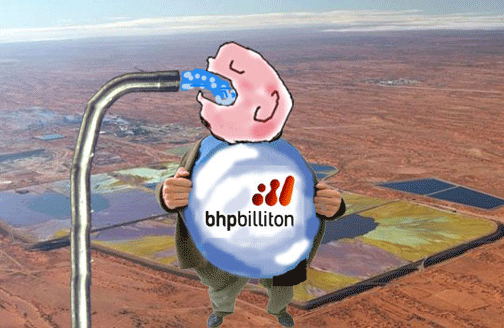
This means Adelaide needs to start planning climate change adaption strategies for its water supply now, in combination with reducing greenhouse gas emissions.
Declining supply
The finding is based on one of the most detailed modelling efforts that has been conducted into the water security of an Australian city. Based on the outputs of 15 recent global climate models combined with downscaling rainfall to the catchment scale and hydrological modelling, we assessed how changes in rainfall and evaporation and transpiration (water evaporating from plants) will affect runoff in the Onkaparinga Catchment. Historically, this catchment has supplied on average about 50% of Adelaide’s water supply, with the remainder supplemented by pumping from the Murray River.
The findings suggested that a high level of confidence can be placed in projections of a decline in runoff. In fact, 98% of the model simulations suggested a decrease in runoff by the end of the century (the remaining 2% suggest little change).
However, the magnitude of change is highly uncertain – some projections suggest only small levels of change; others as much as 75% or more.
Dealing with the dry
The results paint a bleak future, but there are things we can do. The most obvious solution is to collectively reduce our greenhouse gas emissions. By looking at a low-emission trajectory (i.e. one that assumes that society will take active measures to reduce emissions) the reduction of reservoir inflows might only be 25%.
As well as reducing emissions, we need to start preparing to adapt to a drier future…….http://theconversation.com/adelaide-is-facing-a-dry-future-it-needs-to-start-planning-now-37750
Liberals’ panic over climate change put Abbott in a role beyond his abilities
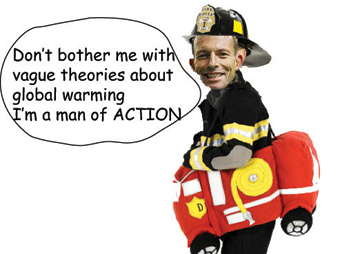 Remember, Abbott is the product of the Liberals’ freak-out over climate , Guardian Jason Wilson 10 Feb 15
 Hotter summers to become ‘normal’ in Australia
The 2013 heatwave in Australia would be impossible if not for climate change. The scorching heat experienced by Australians in late 2012 and early 2013 had set new temperature records in ever state and territory in the country.
According to the Bureau of Meteorology, the national average of daily temperatures in 2013 had rise to record-breaking levels for an extended period. NASA had noted that Australia’s extreme temperatures in Jan. 2013 were extended not just days but weeks, The Washington Postreports.
A new report by Australia’s independent Climate Council has found that 2013, the country’s hottest year ever, would be “virtually impossible” without climate change. The summer heatwaves of late 2012 and early 2013 were also enhanced by global warming and increased the chance of reaching extreme temperature levels.
The Climate Council report was written by Will Steffen, a professor at the Australian National University, and based his research on several climate change models. …….
The professor said the report highlighted the importance of developing an action plan to reduce emissions. If something is not done, Steffen warned that an extreme heat event would be a normal occurrence by the middle of the century.
Climate Council chief councillor Professor Tim Flannery said the report allowed scientists to “quantify” the effect of human activities on extreme weather events, reports ABC. He said Australia should reduce greenhouse gas emissions if it wants to achieve a better climate in the future. http://au.ibtimes.com/australia-experience-hotter-prolonged-heatwaves-extremely-hot-summers-normal-1420002
Warming of Southern Oceans
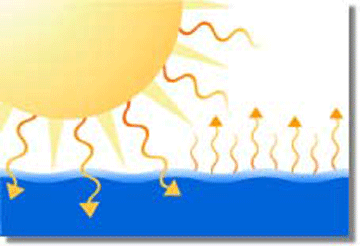 Southern oceans play major role in absorbing world’s excess heat, study finds February 3, Peter Hannam Environment Editor, The Sydney Morning Herald The world’s oceans are heating at the rate of two trillion 100-watt light bulbs burning continuously, providing a clear signal of global warming, according to new study assessing data from a global fleet of drifting floats.
The research, published on Tuesday in the journal Nature Climate Change, used data collected from the array of about 3500 Argo buoys from 2006-13 to show temperatures were warming at about 0.005 degrees a year down to a depth of 500 metres and 0.002 degrees between 500-2000 metres.
Oceans south of the 20-degree latitude accounted for two-thirds to 98 per cent of the heat gain during the period studied, with three giant gyres in the southern Pacific, Indian and Atlantic oceans largely responsible for drawing down the extra warmth.
“The global ocean heat content right now is the most reliable metric of that radiation imbalance” between the energy received from the sun and what is radiated back to space, said Susan Wijffels, an oceans expert at the CSIRO and one of the report’s authors………..
“The ocean is just vertically transferring the heat away from the surface to the depth,” Dr Wijffels said. “The ‘hiatus’ is not meaningful.”
Even with the relative slowdown in surface temperature increases, 14 of the world’s 15 warmest years on record have been in the 21st century, the World Meteorological Organisation said on Monday.
The United Nations body also confirmed that 2014 was the hottest year, edging out 2010 and 2005. The readings were based in part on United States agencies, including NASA which last month also declared 2014 as its warmest year.
John Church, another of the paper’s authors and also from the CSIRO, said the temperatures in the atmosphere – which accounts for just 1 per cent of the planet’s heat uptake – would rise sharply if oceans absorbed less of the heat……..
As it is, warming oceans are swelling in volume, lifting sea levels, and also affecting ecosystems, he said.
“If we want to avoid the worst impacts of climate change then we need to start taking some mitigation action,” Dr Church said. This included cutting carbon emissions and lifting renewable energy targets at home and overseas.
Future Argo missions will extend coverage to higher latitudes, including sea-ice zones, and reach depths of 6000 metres.
However, Dr Wijffels said Australia’s contribution is in doubt with about half of its Argo budget tied up with the Abbott government’s stalled higher education reform bills. Those funds run out “in a few months”, she said.
The Nature study was led by Dean Roemmich of the California-based Scripps Institution of Oceanography. http://www.smh.com.au/environment/climate-change/southern-oceans-play-major-role-in-absorbing-worlds-excess-heat-study-finds-20150202-133j2p.html
CSIRO Report on Climate Change in Australia
Climate change in Australia http://apo.org.au/research/climate-change-australia
 CSIRO and the Bureau of Meteorology have released climate change projections for Australia that provide updated national and regional information on how the climate may change to the end of the 21st century.
The projections are the most comprehensive ever released for Australia and have been prepared with an emphasis on informing impact assessment and planning in the natural resource management sector. Material has been drawn from observations and from simulations based on up to 40 global climate models and four scenarios of greenhouse gas and aerosol emissions during the 21st century.
The 2015 projections provide greater levels of detail and confidence compared to previous projections. Findings are consistent with previous projections research and analysis for Australia, and incorporate an increased knowledge base.
The new climate change projections for Australia are funded by the Department of the Environment through the NRM Planning for Climate Change Fund with co-funding from CSIRO and the Bureau of Meteorology.
The Technical Report is intended to provide detailed information for researchers and decision makers. It is a comprehensive report outlining the key climate change projection messages for Australia across a range of variables. The report underpins all information found in other products, including this website. It contains an extensive set of figures and descriptions on recent Australian climate trends, global climate change science, climate model evaluation processes, modelling methodologies and downscaling approaches. The report includes a chapter describing how to use climate change data in impact assessment and adaptation planning.
Key findings
Overarching findings
Australia’s climate has already changed.
- It has become hotter since 1910, with warming across Australia of 0.9°C
- Rainfall has increased in northern Australia since the 1970s and decreased in south-east and south-west Australia
- More of Australia’s rain has come from heavy falls and there has been more extreme fire weather in southern and eastern Australia since the 1970s.
- Sea levels have risen by approximately 20cm since 1900.
Projections for Australia’s future climate vary regionally and depend on which of the four greenhouse gas and aerosol emissions scenarios is considered. Overarching findings include:
- Australia’s average temperature will increase and we will experience more heat extremes and fewer cold extremes.
- Extreme rainfall events that lead to flooding are likely to become more intense.
- The number of tropical cyclones is projected to decrease but they may be more intense and reach further south.
- Southern and eastern Australia is projected to experience harsher fire weather.
- Sea levels will continue to rise throughout the 21st century and beyond.
- Oceans around Australia will warm and become more acidic.
Additional findings
Temperature
- Australian average temperature has increased by 0.9° C since 1910.
- We have seen more hot days and less cold days.
- Temperatures will continue to increase over the 21st century.
- The extent of those increases will depend on global emissions of greenhouse gases and aerosols.
- By late in the century (2090), Australian average temperature is projected to increase by 0.6 to 1.7°C for a low emission scenario, or 2.8 to 5.1°C under a high emission scenario.
- Hot days are projected to occur more frequently while there will be fewer frost days.
Rainfall
- Winter and spring rainfall in southern Australia is projected to decline while changes in other areas are uncertain.
- For the rest of Australia, natural climate variability will predominate over rainfall trends caused by increasing greenhouse gases until 2030. By 2090, a winter rainfall decrease is expected in eastern Australia.
- Overall, extreme rain events are projected to become more intense.
- This finding is consistent across Australia even in areas where average rainfall is projected to decrease or the average direction of change is uncertain. This is largely due to the ability of a warmer atmosphere to hold more water.
- However, the projected reduction in average rainfall in south-west Western Australia may be so strong as to weaken this extreme rainfall tendency.
Drought
- The time in drought will increase over southern Australia, with a greater frequency of severe droughts.
- The time in drought and the frequency of extreme droughts may increase elsewhere in Australia.
- A projected increase in evaporation rates will contribute to a reduction in soil moisture across Australia.
Tropical cyclones
- Tropical cyclones may occur less often; however they will likely be more intense.
Snow
- There will be a decrease in snowfall, an increase in snowmelt and thus reduced snow cover.
Fire Weather
- Southern and eastern Australia are projected to experience harsher fire weather, including an increase in the number of days with a ‘severe’ fire danger rating.
- Projections for fire weather in northern Australia and inland areas are less certain.
Sea level rise
- Sea levels will continue to rise throughout the 21st century and beyond.
- Projections of sea level rise for the Australian coastline by late in the century (2090) are comparable to, or slightly larger than, the projected global mean sea level rise of up to 82 cm under a high emission scenario.
- A collapse in the marine based sectors of the Antarctic ice sheet could make sea level rise projections several tenths of a metre higher by late in the century.
New South Wales distances itself from Abbott govt on Climate Change
NSW signs up to global climate group, SMH, Peter Hannam February 1, 2015 The Baird government has moved to burnish its climate change credentials, becoming Australia’s first conservative government to sign up to The Climate Group.
- NSW will join South Australia and Tasmania as the only Australian states to be members of the international non-profit organisation, which brings business, governments and communities together to promote renewable energy and cut carbon emissions blamed for global warming. Both SA and Tasmania signed up under Labor-led governments……….
- NSW has distanced itself over the past year from conservative counterparts, including the Abbott government, on climate and other issues. It backed leaving the Renewable Energy Target as it is, in contrast to the Abbott government’s efforts to cut the 2020 goal by as much as 40 per cent, and has spent $3 million preparing climate change studies for expected impacts to 2030 and 2070……..
- London-based The Climate Group shut its Australian offices in mid-2013, citing an “increasingly challenging political environment for action on climate change” at the time.
Its States & Regions members account for more than 300 million people and 13 per cent of global GDP, said Libby Ferguson, a group director.
NSW was “a forward-thinking state” with “progressive renewable policies”, Ms Ferguson said…..http://www.smh.com.au/environment/nsw-signs-up-to-global-climate-group-20150201-13301u.html
Climate change already impacting Australia’s sports
Grassroots sports at risk from heatwaves due to climate change, report warns, Guardian, Oliver Milman 31 Jan 15 Extreme heat policies of sports such as tennis, Aussie rules and cricket will have to find ways to better protect the wellbeing of competitors as temperatures rise Climate change will threaten the viability of grassroots sport in Australia, and elite tournaments will have to adapt to rising temperatures, extreme rainfall and shrinking snow cover, a report has warned.The extreme heat policies of sports such as tennis, Aussie rules and cricket will have to “dramatically improve” to protect the health of competitors at all levels, the Climate Institute analysis concluded.
The report, featuring a foreword from former AFL chief executive Andrew Demetriou, warned that while elite sport might be able to adapt to a changing climate, the “ability to respond at local sporting grounds is more questionable”.
The Climate Institute compiled the report in the wake of the blistering heat that affected the Australian Open tennis tournament last year. Players and court staff fainted, water bottles melted and a participant even warned someone might die after temperatures hit 43C.
The Open has since introduced new protocols that require the match referee to consider suspending play if the ambient temperature reaches 40C.
But the Climate Institute warned that the heat policies of other sports were patchy, with a recent AFL match taking place in 38C heat and last year’s Tour Down Under having no heat stipulations, even though cycling races in certain states are normally halted in extremely high temperatures.
“Heat policies are a bit confused and ambiguous between state and national levels,” said John Connor, chief executive of the Climate Institute. ……………
elongated droughts in parts of Australia, coupled with extreme rainfall, will degrade community sporting grounds and even affect large stadiums, such as the Suncorp stadium in Brisbane, which was covered in 1.5m of water during the 2011 Queensland floods.
Some of the most dramatic changes could hit those who enjoy winter sports, with the CSIRO report warning of “very substantial decreases in snowfall, increase in melt and thus reduced snow cover”…….http://www.theguardian.com/environment/2015/jan/30/grassroots-sports-at-risk-from-heatwaves-due-to-climate-change-report-warns
1 This month

of the week – Australians for War Powers Reform (AWPR)
To see nuclear-related stories in greater depth and intensity
 Antinuclear