Hotter summers to become ‘normal’ in Australia
The 2013 heatwave in Australia would be impossible if not for climate change. The scorching heat experienced by Australians in late 2012 and early 2013 had set new temperature records in ever state and territory in the country.
According to the Bureau of Meteorology, the national average of daily temperatures in 2013 had rise to record-breaking levels for an extended period. NASA had noted that Australia’s extreme temperatures in Jan. 2013 were extended not just days but weeks, The Washington Postreports.
A new report by Australia’s independent Climate Council has found that 2013, the country’s hottest year ever, would be “virtually impossible” without climate change. The summer heatwaves of late 2012 and early 2013 were also enhanced by global warming and increased the chance of reaching extreme temperature levels.
The Climate Council report was written by Will Steffen, a professor at the Australian National University, and based his research on several climate change models. …….
The professor said the report highlighted the importance of developing an action plan to reduce emissions. If something is not done, Steffen warned that an extreme heat event would be a normal occurrence by the middle of the century.
Climate Council chief councillor Professor Tim Flannery said the report allowed scientists to “quantify” the effect of human activities on extreme weather events, reports ABC. He said Australia should reduce greenhouse gas emissions if it wants to achieve a better climate in the future. http://au.ibtimes.com/australia-experience-hotter-prolonged-heatwaves-extremely-hot-summers-normal-1420002
Warming of Southern Oceans
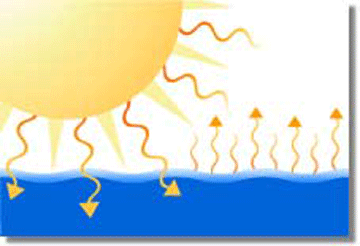 Southern oceans play major role in absorbing world’s excess heat, study finds February 3, Peter Hannam Environment Editor, The Sydney Morning Herald The world’s oceans are heating at the rate of two trillion 100-watt light bulbs burning continuously, providing a clear signal of global warming, according to new study assessing data from a global fleet of drifting floats.
The research, published on Tuesday in the journal Nature Climate Change, used data collected from the array of about 3500 Argo buoys from 2006-13 to show temperatures were warming at about 0.005 degrees a year down to a depth of 500 metres and 0.002 degrees between 500-2000 metres.
Oceans south of the 20-degree latitude accounted for two-thirds to 98 per cent of the heat gain during the period studied, with three giant gyres in the southern Pacific, Indian and Atlantic oceans largely responsible for drawing down the extra warmth.
“The global ocean heat content right now is the most reliable metric of that radiation imbalance” between the energy received from the sun and what is radiated back to space, said Susan Wijffels, an oceans expert at the CSIRO and one of the report’s authors………..
“The ocean is just vertically transferring the heat away from the surface to the depth,” Dr Wijffels said. “The ‘hiatus’ is not meaningful.”
Even with the relative slowdown in surface temperature increases, 14 of the world’s 15 warmest years on record have been in the 21st century, the World Meteorological Organisation said on Monday.
The United Nations body also confirmed that 2014 was the hottest year, edging out 2010 and 2005. The readings were based in part on United States agencies, including NASA which last month also declared 2014 as its warmest year.
John Church, another of the paper’s authors and also from the CSIRO, said the temperatures in the atmosphere – which accounts for just 1 per cent of the planet’s heat uptake – would rise sharply if oceans absorbed less of the heat……..
As it is, warming oceans are swelling in volume, lifting sea levels, and also affecting ecosystems, he said.
“If we want to avoid the worst impacts of climate change then we need to start taking some mitigation action,” Dr Church said. This included cutting carbon emissions and lifting renewable energy targets at home and overseas.
Future Argo missions will extend coverage to higher latitudes, including sea-ice zones, and reach depths of 6000 metres.
However, Dr Wijffels said Australia’s contribution is in doubt with about half of its Argo budget tied up with the Abbott government’s stalled higher education reform bills. Those funds run out “in a few months”, she said.
The Nature study was led by Dean Roemmich of the California-based Scripps Institution of Oceanography. http://www.smh.com.au/environment/climate-change/southern-oceans-play-major-role-in-absorbing-worlds-excess-heat-study-finds-20150202-133j2p.html
CSIRO Report on Climate Change in Australia
 Climate change in Australia http://apo.org.au/research/climate-change-australia
 CSIRO and the Bureau of Meteorology have released climate change projections for Australia that provide updated national and regional information on how the climate may change to the end of the 21st century.
The projections are the most comprehensive ever released for Australia and have been prepared with an emphasis on informing impact assessment and planning in the natural resource management sector. Material has been drawn from observations and from simulations based on up to 40 global climate models and four scenarios of greenhouse gas and aerosol emissions during the 21st century.
The 2015 projections provide greater levels of detail and confidence compared to previous projections. Findings are consistent with previous projections research and analysis for Australia, and incorporate an increased knowledge base.
The new climate change projections for Australia are funded by the Department of the Environment through the NRM Planning for Climate Change Fund with co-funding from CSIRO and the Bureau of Meteorology.
The Technical Report is intended to provide detailed information for researchers and decision makers. It is a comprehensive report outlining the key climate change projection messages for Australia across a range of variables. The report underpins all information found in other products, including this website. It contains an extensive set of figures and descriptions on recent Australian climate trends, global climate change science, climate model evaluation processes, modelling methodologies and downscaling approaches. The report includes a chapter describing how to use climate change data in impact assessment and adaptation planning.
Key findings
Overarching findings
Australia’s climate has already changed.
- It has become hotter since 1910, with warming across Australia of 0.9°C
- Rainfall has increased in northern Australia since the 1970s and decreased in south-east and south-west Australia
- More of Australia’s rain has come from heavy falls and there has been more extreme fire weather in southern and eastern Australia since the 1970s.
- Sea levels have risen by approximately 20cm since 1900.
Projections for Australia’s future climate vary regionally and depend on which of the four greenhouse gas and aerosol emissions scenarios is considered. Overarching findings include:
- Australia’s average temperature will increase and we will experience more heat extremes and fewer cold extremes.
- Extreme rainfall events that lead to flooding are likely to become more intense.
- The number of tropical cyclones is projected to decrease but they may be more intense and reach further south.
- Southern and eastern Australia is projected to experience harsher fire weather.
- Sea levels will continue to rise throughout the 21st century and beyond.
- Oceans around Australia will warm and become more acidic.
Additional findings
Temperature
- Australian average temperature has increased by 0.9° C since 1910.
- We have seen more hot days and less cold days.
- Temperatures will continue to increase over the 21st century.
- The extent of those increases will depend on global emissions of greenhouse gases and aerosols.
- By late in the century (2090), Australian average temperature is projected to increase by 0.6 to 1.7°C for a low emission scenario, or 2.8 to 5.1°C under a high emission scenario.
- Hot days are projected to occur more frequently while there will be fewer frost days.
Rainfall
- Winter and spring rainfall in southern Australia is projected to decline while changes in other areas are uncertain.
- For the rest of Australia, natural climate variability will predominate over rainfall trends caused by increasing greenhouse gases until 2030. By 2090, a winter rainfall decrease is expected in eastern Australia.
- Overall, extreme rain events are projected to become more intense.
- This finding is consistent across Australia even in areas where average rainfall is projected to decrease or the average direction of change is uncertain. This is largely due to the ability of a warmer atmosphere to hold more water.
- However, the projected reduction in average rainfall in south-west Western Australia may be so strong as to weaken this extreme rainfall tendency.
Drought
- The time in drought will increase over southern Australia, with a greater frequency of severe droughts.
- The time in drought and the frequency of extreme droughts may increase elsewhere in Australia.
- A projected increase in evaporation rates will contribute to a reduction in soil moisture across Australia.
Tropical cyclones
- Tropical cyclones may occur less often; however they will likely be more intense.
Snow
- There will be a decrease in snowfall, an increase in snowmelt and thus reduced snow cover.
Fire Weather
- Southern and eastern Australia are projected to experience harsher fire weather, including an increase in the number of days with a ‘severe’ fire danger rating.
- Projections for fire weather in northern Australia and inland areas are less certain.
Sea level rise
- Sea levels will continue to rise throughout the 21st century and beyond.
- Projections of sea level rise for the Australian coastline by late in the century (2090) are comparable to, or slightly larger than, the projected global mean sea level rise of up to 82 cm under a high emission scenario.
- A collapse in the marine based sectors of the Antarctic ice sheet could make sea level rise projections several tenths of a metre higher by late in the century.
New South Wales distances itself from Abbott govt on Climate Change
NSW signs up to global climate group, SMH, Peter Hannam February 1, 2015 The Baird government has moved to burnish its climate change credentials, becoming Australia’s first conservative government to sign up to The Climate Group.
- NSW will join South Australia and Tasmania as the only Australian states to be members of the international non-profit organisation, which brings business, governments and communities together to promote renewable energy and cut carbon emissions blamed for global warming. Both SA and Tasmania signed up under Labor-led governments……….
- NSW has distanced itself over the past year from conservative counterparts, including the Abbott government, on climate and other issues. It backed leaving the Renewable Energy Target as it is, in contrast to the Abbott government’s efforts to cut the 2020 goal by as much as 40 per cent, and has spent $3 million preparing climate change studies for expected impacts to 2030 and 2070……..
- London-based The Climate Group shut its Australian offices in mid-2013, citing an “increasingly challenging political environment for action on climate change” at the time.
Its States & Regions members account for more than 300 million people and 13 per cent of global GDP, said Libby Ferguson, a group director.
NSW was “a forward-thinking state” with “progressive renewable policies”, Ms Ferguson said…..http://www.smh.com.au/environment/nsw-signs-up-to-global-climate-group-20150201-13301u.html
Climate change already impacting Australia’s sports
Grassroots sports at risk from heatwaves due to climate change, report warns, Guardian, Oliver Milman 31 Jan 15 Extreme heat policies of sports such as tennis, Aussie rules and cricket will have to find ways to better protect the wellbeing of competitors as temperatures rise Climate change will threaten the viability of grassroots sport in Australia, and elite tournaments will have to adapt to rising temperatures, extreme rainfall and shrinking snow cover, a report has warned.The extreme heat policies of sports such as tennis, Aussie rules and cricket will have to “dramatically improve” to protect the health of competitors at all levels, the Climate Institute analysis concluded.
The report, featuring a foreword from former AFL chief executive Andrew Demetriou, warned that while elite sport might be able to adapt to a changing climate, the “ability to respond at local sporting grounds is more questionable”.
The Climate Institute compiled the report in the wake of the blistering heat that affected the Australian Open tennis tournament last year. Players and court staff fainted, water bottles melted and a participant even warned someone might die after temperatures hit 43C.
The Open has since introduced new protocols that require the match referee to consider suspending play if the ambient temperature reaches 40C.
But the Climate Institute warned that the heat policies of other sports were patchy, with a recent AFL match taking place in 38C heat and last year’s Tour Down Under having no heat stipulations, even though cycling races in certain states are normally halted in extremely high temperatures.
“Heat policies are a bit confused and ambiguous between state and national levels,” said John Connor, chief executive of the Climate Institute. ……………
elongated droughts in parts of Australia, coupled with extreme rainfall, will degrade community sporting grounds and even affect large stadiums, such as the Suncorp stadium in Brisbane, which was covered in 1.5m of water during the 2011 Queensland floods.
Some of the most dramatic changes could hit those who enjoy winter sports, with the CSIRO report warning of “very substantial decreases in snowfall, increase in melt and thus reduced snow cover”…….http://www.theguardian.com/environment/2015/jan/30/grassroots-sports-at-risk-from-heatwaves-due-to-climate-change-report-warns
Scientists warn on climate change – a hotter drier South Australia
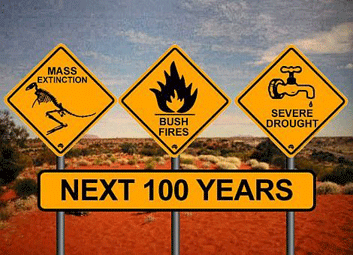 South Australia to get much hotter, drier, new climate change report reveals The Advertiser KATRINA STOKES JANUARY 27, 2015 SOUTH Australia is only going to get hotter and drier and more prevalent periods of drought and fire-related conditions will continue to increase, a report released today reveals.
The CSIRO and Bureau of Meteorology report says what climate change experts have been saying for a long time — climate change is real.
The experts predict Adelaide will experience an increase in the number of days above 35C from 20 in 1995 to 26 in 2030, to between 28 and 47 in 2090.
TO READ THE FULL REPORT CLICK HERE……..
ey predictions from the report include:
WINTER and spring rainfall in southern Australia is projected to decline, while changes in other areas are uncertain
THE time in drought will increase over southern Australia, with a greater frequency of severe droughts
BY 2090, Australian average temperatures are projected to increase by 0.6 to 1.7C for a low emissions scenario, or 2.8 to 5.1C under a high emission scenario
MORE hot days are like to occur as well as harsher fire weather, including an increase in the number of days with a “severe” fire danger rating
Climate Institute chief executive officer John Connor said the report findings demonstrated why it was in Australia’s best interest to “drive ambitious climate action”.
“This new data reinforces earlier analysis for Treasury (the government) that showed large chunks of the Australian economy will be whacked by global warming … sectors like agriculture, health and ecosystems are hit well beyond their ability to adapt,” he said……… http://www.adelaidenow.com.au/news/south-australia/south-australia-to-get-much-hotter-drier-new-climate-change-report-reveals/story-fni6uo1m-1227198291102?nk=12eb6391f5cbbe65f220fb12fca19ba4
Tony Abbott ‘frozen in time’ as Western Australia sizzles with climate change
 WA sizzles as scientists reveal 2014 was the hottest in a century news.com.au JANUARY 18, 2015 NOT even the beach offered respite from the sun’s nuclear intensity as WA sizzled and the mercury approached 40C in Perth on Saturday…….Ambulance officers advised the elderly to stay inside and drink plenty of water and slip, slop, slap was the order of the day as the UV index peaked at 14. Readings of 11 and above are considered “extreme”.
New research from the US National Oceanic and Atmospheric Administration and the US space agency NASA shows 2014 was the hottest year in more than a century, reviving alarm about global warming.And WA’s top meteorologists agree, saying West Australians face decades of rising temperatures with hotter, drier and more extreme summers as a result of climate change.
Australia in 2014 experienced its third hottest year and hottest decade on record, according to the Bureau of Meteorology.
“It’s climate change. Temps across Australia are warming. There is no getting away from it,” weather bureau spokesman Neil Bennett said.
The NOAA report found that “globally averaged temperature over land and ocean surfaces for 2014 was the highest among all years since record-keeping began in 1880”. The average temperature in 2014 was 0.69C above the 20th century average, beating the previous record-holding years of 2005 and 2010. Russia, Alaska, parts of the US and South America, eastern and western coastal Australia, North Africa and most of Europe all experienced record heat.
Federal Labor environment spokesman Anthony Albanese said in the wake of the NOAA report that Prime Minister Tony Abbott can no longer ignore the evidence on climate change. “Tony Abbott is frozen in time while the world warms around us,” he said……http://www.news.com.au/national/western-australia/wa-sizzles-as-scientists-reveal-2014-was-the-hottest-in-a-century/story-fnii5thn-1227188545684?from=public_rss
The Global Catholic Climate Movement launched in Australia
 Catholics in Australia join global movement to curb climate change, The Age January 15, 2015 Peter Hannam Environment Editor, The Sydney Morning Herald Australia’s Catholics are preparing to step up campaigns to address climate change ahead of an expected call to action by Pope Francis.
The Global Catholic Climate Movement, an international coalition of Catholic groups including Catholic Earthcare Australia, was launched on Thursday to bolster support for a global climate treaty at the Paris summit planned for December. That’s going to create real change that’s really needed, and that’s great.
Jacqui Remond, director of Catholic Earthcare Australia, said Catholics numbered one in four Australians and the time is ripe for them to push for greater action on curbing global warming.
“Looking at the leadership and the governance we have in Australia right now, there isn’t a lot of hope coming from the policies and the agenda that’s set,” Ms Remond said.
However, Ms Remond said hope is coming from abroad with Pope Francis expected to release the first encyclical on ecology as soon as March. The doctrinal directive is likely to focus on the damage to humanity and ecosystems caused by climate change.
“[The encyclical] has a significant influence because it sets a benchmark for learning for everyone in the church, which includes the cardinals, the bishops, the clergy, the lay people,” Ms Remond said. “This message will have an incredible ripple effect through the church and beyond.”
Ms Remond said Pope John Paul II and Pope Benedict XVI had also spoken out about climate change, with the latter installing solar panels on church buildings in Rome and making the Vatican the world’s first carbon-neutral state…….http://www.theage.com.au/environment/climate-change/catholics-in-australia-join-global-movement-to-curb-climate-change-20150115-12qs0r.html
The psychology behind climate change denialism, (helped by Murdoch media)
Climate change: Why some of us won’t believe it’s getting hotter, SMH January 11, 2015 Peter Martin Economics Editor, The Age What is it about the temperature that some of us find so hard to accept?
The year just ended was one of the hottest on record. In NSW it was the absolute hottest, in Victoria the second-hottest, and in Australia the third hottest………
when it comes to the slowly rising temperature some of us won’t even accept the readings. And that says something about us, or at least about those of us who won’t accept what’s in front of our faces.
I am not prepared to believe that these people are anti-science. Some of them are engineers, some mining company company executives. Like all of us, they depend on science in their everyday lives.
 Nor am I prepared to believe they’ve led sheltered lives, although it’s a popular theory. In the United States a survey of six months of coverage on Rupert Murdoch’s Fox News Channel found that 37 of its 40 mentions of climate change were misleading.
The misleading coverage included “broad dismissals of human-caused climate change, disparaging comments about individual scientists, rejections of climate science as a body of knowledge, and cherry-picking of data”.
Fox News called global warming a “fraud”, a “hoax” and “pseudo science”.
Rupert Murdoch’s Wall Street Journal fared little better. 39 of its 48 references were misleading.
In Australia it’s not as bad. Rupert Murdoch’s The Australian gives more space to climate change than any other newspaper. Its articles are 47 per cent negative, 44 per cent neutral and 9 per cent positive, according to the Australian Centre for Independent Journalism.
It’s impossible to read The Australian‘s articles without feeling at least a bit curious about climate change.
Another theory is that it’s to do with psychology. Some people are more threatened by bad news than others, making them less able to accept that it’s real.
And now a more sophisticated theory suggests that it’s not about the facts at all. It’s really a debate about the implications, disguised as a debate about the facts. Troy Campbell and Aaron Kay, a researcher and associate professor in neuroscience at Duke University in North Carolina find that belief in temperature forecasts is correlated with beliefs about government regulation and what those forecasts would mean for government regulation……..http://www.smh.com.au/comment/climate-change-why-some-of-us-wont-believe-its-getting-hotter-20150110-12koa1.html
Three Australian States pushing Fed govt for climate change action
Victoria’s environment minister, Lisa Neville, said she was seeking “urgent” talks with the NSW and SA governments to forge a united front against Tony Abbott’s stance on climate change.
Neville told Guardian Australia the states would seek greater clarity on how the federal Emissions Reduction Fund, which will provide grants to businesses, would work. The federal government’s leadership on climate change would also be questioned.
“I’m looking to have urgent conversations with NSW and South Australia on the role they can play with us,” she said. “We’ll look at whether there’s a shared view on emissions reduction and also national advocacy so we can put climate change back into public debate.
“Each state has a responsibility to push the federal government in this area. National action will have the most impact on climate change, so we need a unified voice to get the federal government, first of all, to acknowledge climate change.
“The Abbott government has, unfortunately, walked away from its responsibility to act on climate change. We’d prefer strong national and international action, but if we have to play a leadership role in Victoria, we will do that.
“We need to put pressure on the federal government as well as build a proper community conversation about climate change again.”
Neville, who will have her first meeting with the federal environment minister, Greg Hunt, this month, said the federal Coalition needed to resolve the “mess” surrounding its attempts to cut the national renewable energy target and ensure its ERF grants were spent effectively to bring down emissions……….
South Australia’s renewable energy investment has forged ahead of Victoria and NSW, at a time when all states are experiencing a trend of rising temperatures…….
The NSW government, while keen to not publicly criticise its Coalition counterpart in Canberra, has indicated that it wants stronger action on climate change…….“The NSW government also has a renewable energy action plan to increase the proportion of renewable energy in NSW and has made its position on the renewable energy target clear.”
….Hunt’s office did not respond to a request for comment. http://www.theguardian.com/environment/2015/jan/08/climate-change-victoria-seeks-join-nsw-south-australia
Global warming contributed to Sydney’s record warm year
Sydney weather: Record warm year with few cold spells January 6, 2015 Peter Hannam Environment Editor, The Sydney Morning Herald
If you thought Sydney had been warm over the past year or so, you’d be right.
Last year was the city’s equal warmest for overnight temperatures and its second-warmest for means and maximums in 156 years of record keeping at Observatory Hill.
For some temperature measures, such as for NSW heat, the previous record had been set only a year earlier.
Agata Imielska, senior climatologist at the Bureau of Meteorology in Sydney, said it was “quite surprising” to see last year eclipse 2013 given the bar had been set so high.
“We just didn’t have the cool periods,” Ms Imielska said. “There was a real persistence in the warmth.”
Globally, 2014 was the hottest year on record, the Japan Meteorological Agency declared this week. Land and sea-surface temperatures were 0.27 degrees above the 1981-2010 average, easily eclipsing the previous highs set in 1998, 2010 and 2013.
“Global warming is contributing to these heat records, and it’s very unlikely that we would have seen the proliferation or the frequency of these heat records around the world without the influence of global warming,” Karl Braganza, head of climate monitoring at the bureau, said.
“The climate system we live in … that’s all about 1 degree warmer than it used to be,” Dr Braganza said.
Warm and dry
For NSW, 2014 was the hottest on record for mean temperatures and the equal warmest for maximums. Among the other states, only the Northern Territory failed to notch a year among the four warmest on record……….http://www.smh.com.au/environment/climate-change/sydney-weather-record-warm-year-with-few-cold-spells-20150106-12ikgr.html
Hottest daytime temperatures on record – Victoria in 2014
Victoria experienced hottest daytime temperatures on record in 2014, BOM annual report reveals, ABC News By Loretta Florance 5 Jan 15 Victoria recorded its hottest year on record for maximum daytime temperatures in 2014, the Bureau of Meteorology’s (BOM) annual report has revealed.
The state also recorded the second warmest year on record for mean temperatures, and the third warmest for minimum temperatures. The mean maximum temperature was 1.53 degrees Celsius above average, the Bureau of Meteorology found………
climate modelling showed that an El Nino effect on both the atmosphere and the ocean might progress over the summer, which would mean warmer temperatures in Victoria.
“We know that the year an El Nino event gets going tends to be the warmer years, so globally you’d expect 2015 to be at least as warm as 2014 if not warmer – and 2014 globally is actually looking like it’s going to be the warmest year on record,” he said.
“For eastern Australia, you tend to have the warm conditions persist through the financial year, so at least until the middle of next year, is what you’d be expecting for average conditions.” http://www.abc.net.au/news/2015-01-06/victoria-swelters-through-its-hottest-year-on-record-2014/6002710
Health of Australians already threatened by global warming
As shepherds watched, it got hotter and hotter December 24, 2014 Peter Hannam Environment Editor, The Sydney Morning Herald Human health – and that of other animals and even plants – is likely to become an ever more pressing public issue as temperatures rise with global warming, cities grow and populations age………
Until recently, public health authorities would issue a warning whenever the temperature was likely to exceed a certain level.
However, heatwaves are also related to the conditions people are accustomed to. To reflect that, the Bureau of Meteorology last year pioneered a heatwave service that predicts the severity of coming heatwaves based on both how far temperatures are likely to deviate from historical averages but also taking into account the previous month’s weather.
In a further tweak, the bureau has added charts to assess the impact of each heatwave after it’s hit. That’s needed because people often don’t realise the damage to health can come from exposure to prolonged warmth rather than a particular temperature spike. Continue reading
Australia’s carbon tax resulted in dramatic decline in greenhouse gas emissions
New data shows record fall in carbon emissions , The Age Gareth Hutchens December 23, 2014 – Environment Minister Greg Hunt has quietly published data, just two days before Christmas, showing the second year of operation of Australia’s carbon price was more successful at reducing emissions than the first.
New data from Australia’s National Greenhouse Gas Inventory show emissions declined across Australia by 1.4 per cent over the 12 months to June.
That compares to a decline in emissions of 0.8 per cent for the previous 12 months.
The carbon price was introduced by the Gillard government and began operation on July 1, 2012. It ended on July 1, this year after the Abbott government fulfilled an election pledge by abolishing it.
The new data, published on Tuesday, record emissions produced during the final year of operation of the carbon price, from June 2013 to June 2014.
They show the electricity (minus 4 per cent), agriculture (minus 2.6 per cent), industrial processes (minus 1.3 per cent) and transport sectors (minus 0.4 per cent) all experienced declines in emissions this year………….
Greens Leader Christine Milne has slammed the federal government for waiting until after the Lima Climate Change Conference to release the data, saying the figures show just how effective Australia’s carbon price was at bringing down pollution.
“This is the biggest ever drop recorded and the price made it happen,” Ms Milne told Fairfax Media.
“Why did the government withhold this report until after the Lima climate talks? These are embarrassing figures for the Abbott government because they demonstrate just how destructive they have been to the global effort to reduce pollution and tackle dangerous global warming,” she said…….http://www.theage.com.au/environment/climate-change/new-data-shows-record-fall-in-carbon-emissions-20141223-12d1z3.html
Problem of rising sea levels causing waves of dissent in Queensland Liberal National Party
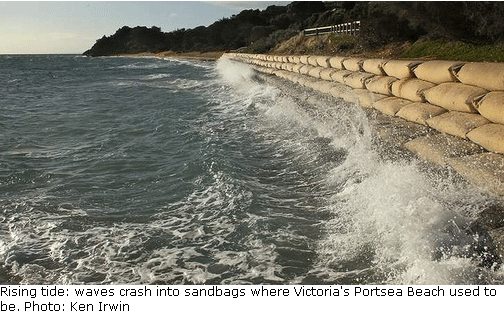 Will climate change denials sink the LNP? DES HOUGHTON THE COURIER-MAIL DECEMBER 20, 2014 IT’S a controversy that could not have come at a worse time for Campbell Newman. Cracks are appearing in LNP ranks over a State Government edict forcing Moreton Bay Regional Council to remove a theoretical climate change sea level rise of 0.8m when considering developments.
Inside the party there are waves of discontent. Continue reading
1 This month



Help Aunty Sue Protect Her Land and Sacred Sites From Destructive Rocket Testing.
.

Australians deserve the truth
about
AUKUS – https://aukuspublicinquiry.com/

PETITION – To: Prime Minister Anthony Albanese and the Australian Labor Government

of the week – Australians for War Powers Reform (AWPR)
To see nuclear-related stories in greater depth and intensity

