Abbott govt’s climate paper for Paris is likely to be a disgrace
 Australia ‘at risk of failing’ biggest climate test in a decade say climate groups, as government releases Paris discussion paper, The Age March 28, 2015 Lisa Cox National political reporter The Abbott government says it will be a constructive player in global climate talks, but environment groups have warned it is laying out a path that puts Australia at risk of failing the most important climate test in a decade.
The government has published an issues paper ahead of public consultation on Australia’s post-2020 emissions reduction targets ahead of a new global climate deal in Paris at the end of this year.
Australia’s targets are under review and the government has promised it will announce new targets mid-year…….the Greens said the paper puts Australia on track for a repeat of 1997 Kyoto talks, where then environment minister Robert Hill argued Australia should be made an exception because of the economy’s high dependence on coal…….. Continue reading
Abbott’s “Direct Action” climate policy – a gift to the big polluters
 Top polluters to set own limits virtually penalty free, according to Direct Action policy paper ABC News 27 Mar 15 By the National Reporting Team’s Lisa Main Australia’s 140 top polluters will set their own limits for future pollution virtually penalty free, according to the Government’s latest Direct Action policy paper.
The Federal Government is building towards the launch of its flagship climate change initiative, the Emission Reduction Fund (ERF), in mid-April. As part of that it has released a consultation paper outlining “safeguards” to ensure the big polluters do not offset emissions saved through the ERF.
Companies subject to the safeguards will select a baseline, or limit, for future pollution. That baseline will be set according to the highest peak of emissions from the past five years.
Grattan Institute energy program director Tony Wood said the ideas proposed in the paper simply would not work. “The safeguard mechanism was always a critical element of the Direct Action plan, but there is nothing in this safeguard mechanism that puts any absolute limit on a whole range of sectors,” he said.
There is also significant wiggle room for companies, according to the paper. Changes to the baselines can be made if there are changes to the company size or if the company has a “limited ability to control such emissions”. “All of the flexibility seems to be in the hands of the emitter and that runs counter to the fundamental principal of the paper,” Mr Wood said.
System designed as a toothless tiger, economist says Continue reading
Australian farmers lobbying Abbott government for emissions trading scheme
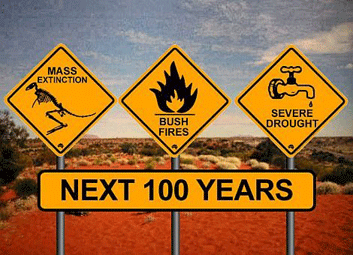 Climate change: farmers urge Coalition to restore emissions trading scheme, Guardian, Gabrielle Chan, 26 Mar 15 Failure to acknowledge the problem is ‘doing the industry a disservice’ and harming Australia’s international standing, says farming group A delegation of farmers has called for the Abbott government to act on climate change by restoring an emissions trading scheme, maintaining the current renewable energy target and spending on rail infrastructure to improve inland transport and reduce carbon emissions.
The farmers have spent two days lobbying the Coalition to start implementing a suite of policies to deal with the effects of climate change, warning of dire consequences for the agriculture sector if the threat was not addressed.
They have told the government MPs, including John Cobb and the staff of the treasurer Joe Hockey, that the Direct Action policy, which provides incentives for polluters to reduce carbon emissions, will not work to ameliorate climate change, “but if the government wants to give away money, people will keep taking it”.
The delegation said the lack of climate policies was being exacerbated by the cuts to research and development funding for applied climate science and the Bureau of Meteorology.
The visit came as intense negotiations between the government and Labor continued over the RET, which currently requires the government to source 41,000 gigawatt hours of energy from renewables by 2020. The latest government offer to Labor is 32,000GWh.
It also follows a report by University of Melbourne researchers called Appetite for Change, which charted the detrimental effects of climate change on Australia’s food production.
The farmers, organised by Earth Hour Australia, said the Abbott government needed to show leadership on the issue and it could start by using the term climate change, rather than “climate variability”………http://www.theguardian.com/environment/2015/mar/26/climate-change-farmers-urge-coalition-to-restore-emissions-trading-scheme
Australia’s lost credibility in international climate talks, thanks to Tony Abbott
Ultimately, Australia’s diminished influence could have an impact on its economy, in ways that the Australian public, and the Australian media, did not understand. (Indeed, RenewEconomy has been the only Australian media at the last three climate talks, Doha, Warsaw and Lima).
 Abbott throwing away Australian influence at climate talks, report says, REneweconomy, By Giles Parkinson on 25 March 2015
The Lowy Institute report – written by Howard Bamsey, Australia’s former special envoy on climate change, and Kath Rowley, the general manager of reviews at the Climate Change Authority – says climate change negotiations should be at the top of Australia’s priorities. If not, Australia risks losing the ability to influence the shape of a new global climate treaty that could have major consequences for its own economy. Continue reading
Abbott govt’s Direct Action policy to give privileges to heavy-polluting electricity industry
Greens Leader Christine Milne said the policy would not raise revenue because the baselines were  being set so high that no company would breach them.
“It’s just a joke of a policy which will do nothing to reduce emissions and nothing to drive energy efficiency or more innovative practices,” she said.
 Power sector to get special treatment under Direct Action, The Age March 27, 2015 Peter Hannam and Lisa Cox The Abbott government has proposed a major concession to the heavy-polluting electricity industry in its direct action climate change policy by exempting individual companies from caps on emissions. Continue reading
Abbott government leads resistance to Obama’s efforts to combat climate change
 Abbott government resists US moves against coal power, The Age March 26, 2015 – Lisa Cox, Mark Kenny The Abbott government has again put itself on a collision course with US President Barack Obama, this time over government funding for coal-fired power plants.
The revelations call into question Canberra’s readiness to cooperate with other major economies in the lead-up to global climate talks in Paris in December.
Environment groups believe Australia is running interference in order to protect its own coal export markets in Asia……..the Australian government is arguing that limiting financial assistance to non-coal based power plants would send the wrong message to developing economies………
>Doug Norlen, a senior economic policy manager with Friends of the Earth, US, said the Abbott government was putting itself at odds with President Obama, who was using international forums to push other world leaders to reduce fossil fuel use in the lead-up to the Paris talks.
“This is interesting in several contexts, including in the recent context of the G20 where President Obama gave a very strong speech on the need to protect the Great Barrier Reef from damage from fossil fuel exportation,” he said.
“As we go forward, the Paris meetings become an important place where countries need to stand up and declare their seriousness about climate change or shirk their responsibility.”……..http://www.theage.com.au/federal-politics/political-news/abbott-government-resists-us-moves-against-coal-power-20150326-1m7mxr.html
Climate change, extreme heat and bushfires in WA
 The heat is on: climate change, extreme heat and bushfires in WA http://apo.org.au/research/heat-climate-change-extreme-heat-and-bushfires-wa
- Western Australia is experiencing a long-term increase in average temperatures and in 2014 the state recorded its highest ever annual average maximum temperature.
- The number of heatwave days in Perth has increased by 50% since 1950.
- Nine of Western Australia’s hottest Januarys on record have occurred in the last 10 years.
- The number of days per year
with severe fire danger weather is projected to almost double in south west Western Australia by 2090 if global carbon emissions are not drastically reduced.
Recent fires in Western Australia have been influenced by record hot dry conditions.
- The long-term trend to hotter weather in Western Australia has worsened fire weather and contributed to an increase in the frequency and severity of bushfires.
- The concept of a normal bushfire season is rapidly changing as bushfires increase in number, burn for longer and affect larger areas of land.
- By 2030, the number of professional firefighters in WA will need to more than double to meet the increasing risk of bushfires.
3. The economic, social and environmental costs of increased extreme heat and bushfire activity is likely to be immense.
- In Perth, from 1994-2006, there were over 20 heat attributable deaths per year. If average maximum temperatures were 2°C warmer, this number would almost double to 40 deaths.
- Some of Western Australia’s most fire-prone regions may become unlivable as the risks to lives and property caused by bushfires continue to increase.
- Without effective action on climate change, there will be 20 times the number of dangerous days for outdoor workers by 2070, reducing productivity.
4. Tackling climate change is critical to protecting Western Australia’s prosperity.
- As a nation we must join the global effort to substantially reduce emissions and rapidly move away from fossil fuels to renewable energy if we are to limit the severity of extreme heat and bushfires both in Western Australia and nationally.
Intergenerational Report fails to consider the impacts of climate change beyond 2020.
Intergenerational Report goes backwards on climate change KELLIE CAUGHTABC Environment 6 Mar 15 Despite projecting Australia’s future out to 2055, the Intergenerational Report failed to consider the impacts of climate change beyond 2020.
IT’S UP TO THIS generation, including our political leaders, to do the right thing to protect the people and places we love.
Despite this, the 2015 Intergenerational Report has failed to outline concrete, long-term steps to address one of the greatest threats facing our children — climate change.
There’s no plan to future-proof Australia, and the budget, against the worst impacts of climate change. Instead, it’s a missed opportunity to build on the 2010 report which highlighted climate change as among the top three challenges to Australia’s long-term economic sustain ability. To give perspective, the 2010 report mentioned ‘climate change’ more than 80 times. The 2015 report, just 19 times.
It relies on the Government’s Emissions Reduction Fund as the key policy until 2020, but lacks a plan beyond this. There are no projections of the costs of climate impacts, and no clear pathway for Australia to reduce its dependence on fossil fuels and sensibly transition towards zero carbon pollution (net) by 2050………
In 2014, Australia became the first country to remove its price on carbon. Before the repeal the carbon price contributed to a 1.4 per cent fall in carbon pollution in the 2013/14 financial year. If we are to provide a better future for our kids, Australia should be cutting its carbon pollution by at least 25 per cent by 2020 and at least 40 per cent by 2025 (below 2000 levels).
Australia will be one of the countries hardest and fastest hit by climate change. Unless we show a commitment to our future generations now, they will bear the brunt of these impacts. The 2015 Intergenerational Report failed on climate change. Yet, by acting soon and alongside others in Paris, Australia still has the opportunity to correct this for the sake of our children, and grandchildren.
Kellie Caught is Climate Change National Manager for WWF-Australia. http://www.abc.net.au/environment/articles/2015/03/06/4192607.htm
Australia has its own cogs in the climate science denial machine.
 Doubt over climate science is a product with an industry behind it With its roots in the tobacco industry, climate science denial talking points can be seen as manufactured doubt Guardian, Graham Readfearn 5 Mar 15“………As well as the sympathetic Rupert Murdoch-owned press and the fossil fuel industry, there is the influential free market “think tank” the Institute of Public Affairs.
The IPA is another group to push climate science denial while also defending the tobacco industry (the Sydney Morning Herald reported in 2012 that British American Tobacco was a financial supporter of the institute.)
Last year the IPA encouraged supporters to take advantage of a tax concession to help fund a climate book with chapters written by a familiar line-up of climate science denialists – one of which was Dr Soon.
In February, the IPA ran a short speaking tour promoting its book Climate Change: The Facts (it was suggested to me that moving the semi colon in the book’s title one word to the left would better describe the contents).http://www.theguardian.com/environment/planet-oz/2015/mar/05/doubt-over-climate-science-is-a-product-with-an-industry-behind-it
Shoddy Intergenerational Report ignores climate change
Climate Change? What Climate Change! And Other Tales From The Intergenerational Report New Matilda, 5 Mar 15 By Ben Eltham A report that predicts the future and ignores climate change is a farce, writes Ben Eltham “……a government report that looks forward to 2055 is ambitious. But that’s the premise of today’s 2015 Intergenerational Report.
Can we really take seriously a government document that attempts to see 40 years into the future?
No, we can’t. Of course we can’t.
We know this because the report ignores climate change.
Climate is mentioned only 12 times in a 175-page report. You could argue that for this government, the less said on climate the better. Even so, this is cloud-cuckoo stuff.
There is no discussion of the potential costs of climate change to government spending, for instance in the cost of more frequent extreme weather events and natural disasters. There is no discussion of the potential for taxing carbon emissions to meet Australia’s future budgetary challenges. And there is no discussion of the potential future impacts of global carbon deals on a resource-intensive Australian economy.
With a kind of Orwellian satire, the report even spruiks for the Abbott government’s risible Direct Action carbon subsidies. On page 40, the IGR argues that the government’s $2.55 billion emissions reduction fund will somehow get us to our 5 per cent 2020 emissions reduction target.
It’s at the point where the IGR lists the federal government’s “strong decisions in managing the Great Barrier Reef” that the whole thing descends into farce…….
Climate change is the dominant geopolitical fact of the future. It will bend the future more surely than tax takes or pension liabilities. It will reshape the global economy, threaten food yields, increase natural disasters, lay waste to Australia’s region and generate hundreds of millions of refugees. ….
You don’t have to take such shoddy work seriously, and as a busy citizen, you shouldn’t. The Intergenerational Report is not a serious attempt to make projections about government policy. It is an ornament, a prop in a policy theatre, a bell-and-whistle for the next Treasury lockup.
Like most such reports, the IGR will be quickly forgotten. https://newmatilda.com/2015/03/05/climate-change-what-climate-change-and-other-tales-intergenerational-report
Government’s Intergenerational report is a junk document and should be rewritten
Green groups slam report as inadequate ELISE SCOTT AAP MARCH 05, 2015 Daily Telegraph, “………despite the report being a snapshot of the next 40 years, it fails to detail any post-2020 emission reduction goals or the long-term costs of climate change.
Climate Institute chief John Connor believes the report shines a spotlight on the inadequacies of government policies and ignores economic challenges and opportunities.It refers to recent analysis that shows changes in the frequency of extreme weather but contains just one sentence about future impacts.”It’s almost breathtaking,” Mr Connor told AAP.”It’s woefully inadequate. It doesn’t even deal with this generation of policy, let alone the next.
“The Australian Greens are demanding the report be rewritten.”This is a junk document and should be tossed away,” leader Christine Milne told reporters in Canberra.Senator Milne wanted to see “serious modelling” on the costs of global warming.The absence of long-term projections is a shared concern of the World Wildlife Foundation and the Australian Conservation Foundation.ACF spokesman Josh Meadows said climate change was the one area that could be planned for, yet the report ignored forward-thinking completely……..
Mr Connor welcomed the government’s acknowledgement the international community had committed to limiting global warming to 2C.The intergenerational report produced by Labor in 2010 found unmitigated climate change would leave Australian GDP in 2100 about eight per cent lower than the level it would be in the absence of climate change. http://www.dailytelegraph.com.au/news/breaking-news/green-groups-slam-report-as-inadequate/story-fni0xqi3-1227249614927
AUDIO: EU wants USA, China, Australia to join global climate agreement
 AUDIO: EU pressures US and China to join global climate agreement ABC Radio, The World Today ,David Mark reported this story on Thursday, February 26, 2015 ELEANOR HALL: The European Union (EU) has ratcheted up pressure on the United States and China to join a global climate agreement.
Overnight the EU released its target for greenhouse gas reductions ahead of a meeting later this year in Paris.
It’s committing to reducing emissions by at least 40 per cent over 1990 levels by 2030 as David Mark reports.
DAVID MARK: The US and China made some commitments to greenhouse gas reduction targets at the APEC (Asia-Pacific Economic Cooperation) meeting in Brisbane last year.
Now the EU has announced specific targets – its member countries will reduce greenhouse gas emissions by 40 per cent by 2030 over 1990 levels.
Overnight the EU released its target for greenhouse gas reductions ahead of a meeting later this year in Paris. It’s committing to reducing emissions by at least 40 per cent over 1990 levels by 2030 as David Mark reports.
DAVID MARK: The US and China made some commitments to greenhouse gas reduction targets at the APEC (Asia-Pacific Economic Cooperation) meeting in Brisbane last year.
Now the EU has announced specific targets – its member countries will reduce greenhouse gas emissions by 40 per cent by 2030 over 1990 levels……
ERWIN JACKSON: Well, I think the momentum is towards having a core agreement in Paris which is legally binding, which does ensure that countries come forward and have national targets………
In Lismore a new political party starts off – to tackle climate change
 Political party forms in Lismore to tackle climate change Darren Coyne, Echo Net Daily, 19 Feb 15, A new political party focused on tackling climate change is being formed by a group of north coast residents. The Renewable Energy Party plans to stand candidates in every state and territory at the next Federal election in 2016.
Following a meeting at the Lismore Worker’s Club this week, the political hopefuls announced they were in the process of signing up the 500 members required to form the party.
Campaign manager Jim Moylan said membership was not likely to be a problem. ‘Aussies are really passionate about climate change,’ Mr Moylan said.‘Our Facebook page has gone-off like a skyrocket. All we did was set up a news-feed to climate change news – and a big audience appeared.’
Mr Moylan told Echonetdaily that the micro-party would act as ‘better angels’ to The Greens and other left-leaning parties……..
Party founder Peter Breen, a former independent member of the New South Wales Parliament, and a former member of both Labor and the Liberal parties, will be national coordinator of the party. Mr Breen, a resident of Byron Bay, said the party had good prospects.‘Of course they will take us seriously. We are well funded, well organised and mainstream,’ Mr Breen said.
‘We have advertising people, political insiders, fund-raisers, social media specialists and other professionals.
‘The Renewable Energy Party wants science and the public interest to dictate the terms of the climate debate – not coal, gas and oil companies.’

Following the Lismore meeting, the fledging party released the following statement.
‘Renewable energy needs grass roots representation. More than a million households in Australia now use solar energy and we are getting a very bad deal from the major energy companies who all own coal mines.
‘Currently, Australians are paying as much as $1,000 per year for electricity and gas connections – before we even turn on our appliances. On top of that, the major energy companies pay 6 to 8 cents for solar power exported to the grid while charging four times that amount for customers to buy it back”
‘In the UK, politicians are talking seriously about phasing out fossil fuels, but Australian politicians are talking about phasing out renewable energy. The Renewable Energy Party hopes to bring a consumer’s perspective to the debate in Australia.’
‘The Renewable Energy Party will speak on behalf of the many Australians who believe that climate change is simply the most important issue we face. We support the 97 per cent of climate scientists who say man-made climate change is real and we need to do something serious about the predicted global temperature rise.
‘According to the International Monetary Fund, Australia’s implicit subsidies to oil, coal and gas companies are worth 1.8 per cent of GDP, or about $23 billion annually. Subsidies to the renewable energy industry are small beer by comparison.
‘The Renewable Energy Party has been formed to highlight the differences between the favourable treatment given to the fossil fuel industries by government and the difficulties faced by the emerging renewable energy industry.
‘It is also a fact that renewable energy creates more jobs per unit of energy delivered than fossil or nuclear fuels. Action on climate change is our best hope for better present and a more promising future,’ the statement concluded.http://www.echo.net.au/2015/02/political-party-forms-lismore-tackle-climate-change/
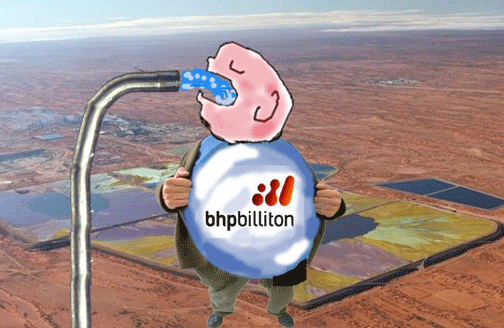
Dry Future for Adelaide ( very unwise to bring water wasting nuclear industry)
 Makes you question the intelligence of South Australia’s businessmen and politicians – even contemplating the high water use, and high water-polluting industries of nuclear industries, and expanding uranium mining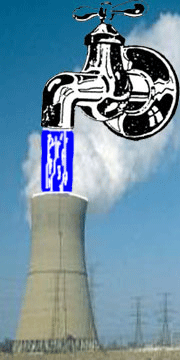
This means Adelaide needs to start planning climate change adaption strategies for its water supply now, in combination with reducing greenhouse gas emissions.
Declining supply
The finding is based on one of the most detailed modelling efforts that has been conducted into the water security of an Australian city. Based on the outputs of 15 recent global climate models combined with downscaling rainfall to the catchment scale and hydrological modelling, we assessed how changes in rainfall and evaporation and transpiration (water evaporating from plants) will affect runoff in the Onkaparinga Catchment. Historically, this catchment has supplied on average about 50% of Adelaide’s water supply, with the remainder supplemented by pumping from the Murray River.
The findings suggested that a high level of confidence can be placed in projections of a decline in runoff. In fact, 98% of the model simulations suggested a decrease in runoff by the end of the century (the remaining 2% suggest little change).
However, the magnitude of change is highly uncertain – some projections suggest only small levels of change; others as much as 75% or more.
Dealing with the dry
The results paint a bleak future, but there are things we can do. The most obvious solution is to collectively reduce our greenhouse gas emissions. By looking at a low-emission trajectory (i.e. one that assumes that society will take active measures to reduce emissions) the reduction of reservoir inflows might only be 25%.
As well as reducing emissions, we need to start preparing to adapt to a drier future…….http://theconversation.com/adelaide-is-facing-a-dry-future-it-needs-to-start-planning-now-37750
Liberals’ panic over climate change put Abbott in a role beyond his abilities
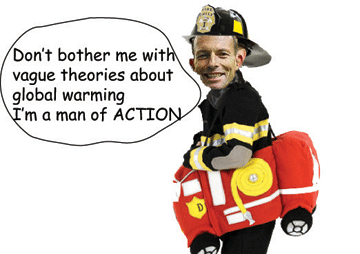 Remember, Abbott is the product of the Liberals’ freak-out over climate , Guardian Jason Wilson 10 Feb 15
 1 This month



Help Aunty Sue Protect Her Land and Sacred Sites From Destructive Rocket Testing.
.

Australians deserve the truth
about
AUKUS – https://aukuspublicinquiry.com/

PETITION – To: Prime Minister Anthony Albanese and the Australian Labor Government

of the week – Australians for War Powers Reform (AWPR)
To see nuclear-related stories in greater depth and intensity

