IPCC report strengthens activisim against coal and gas industries
 Australian activism reaches fever pitch as IPCC warns on climate, Guardian, 1 April 14 New South Wales campaign group is harnessing community support to confront oil and gas companies over drilling As George Bernard Shaw put it: “The reasonable man adapts himself to the world; the unreasonable one persists in trying to adapt the world to himself. Therefore all progress depends on the unreasonable man.”
Australia‘s coal and gas operators may not agree with Shaw, but it is the power of these unreasonable people that new campaign group Our Land, Our Water, Our Future hopes to tap. Continue reading
Australia is a “canary in a cage” when it comes to climate change
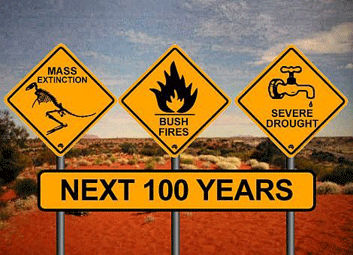 Climate change could be putting human health at risk: Australian IPCC report researchers ABC News, By Carl Smith 31 March 14, Climate change will increasingly harm people’s health and Australians will be particularly vulnerable, according to Canberra authors of the latest international climate change report.
The health section of the United Nation’s Intergovernmental Panel of Climate Commission (IPCC) report shows humans will be more at risk over coming years with areas of the world likely to become uninhabitable.
University of Canberra’s Professor Helen Berry is one of three Canberra researchers who have contributed to the health section of the report. She says human health has so far been neglected in public discussions on climate change, as debate has generally focused on the environment and the economic effects of reducing emissions.
“If climate change goes on unchecked we will see many deaths – we are seeing many deaths already – and you can imagine the human population could possibly go extinct if you take the effects of climate change to their extreme logical conclusion,” she said.
“We as a nation and we as a world really need to be focusing on health and well-being, because it’s the bottom line for human survival.”
Fellow contributor Professor Colin Butler, also from the University of Canberra, says climate change could be a major threat in the decades to come.
“We might be heading into a new dark age, not in the next five years but maybe in the next 100 years,” he said.
“We’ve got to put far more effort onto slowing down the pace of climate change, rather than deluding ourselves to the idea that we can adapt to it.
“I’m very concerned that within 100 years there will be devastation through multiple interacting pathways – more expensive foods, sea level rise, migration, ultimately war.”
Australia a climate change ‘canary in a cage’
Professor Helen Berry says Australia should be particularly concerned. “Australia’s already a hot country, warming is not good for us,” she said. “Warming brings about an increased risk of droughts, of bushfires, of floods and storms, and heatwaves. “All of these climatic conditions are common already in Australia and they will become more and more common and more and more erratic and wild and unpredictable. “When that happens, larger numbers of people are affected, injured, sometimes killed tragically in these disasters.”
Professor Berry warns Australia is a “canary in a cage” when it comes to climate change………http://www.abc.net.au/news/2014-03-31/climate-change-researchers-say-climate-puts-human-health-at-risk/5356306
Superannuation fund is deeming fossil fuels as an unethical investment
 Superannuation fund UniSuper plans to to add fossil fuels to list of unethical investments http://www.abc.net.au/news/2014-03-30/super-fund-adds-fossil-fuels-to-unethical-investments-list/5354066 By Nonee Walsh 30 Mar 2014, One of Australia’s top 10 superannuation funds is planning to add fossil fuels to its list of unethical investments.
UniSuper, Australia’s seventh largest fund that services higher education and research workers, told members who chose its socially responsible packages that investment in fossil fuels, gaming, alcohol and weapons would be withdrawn this year unless members objected.
Those sectors are currently included in the Dow Jones sustainability index.
UniSuper proposes initially withdrawing from exploration and production in the coal and gas sector.
However it says in the future it will look at withdrawing from investment in power suppliers and other fossil fuel companies.
UniSuper has $1.6 billion in its sustainable investments, which is a small proportion of its overall fund
Intergovernmental Panel on Climate Change; how does it work?
Explainer: how are IPCC reports written? , The Conversation, 29 March 14 David Karoly, Professor of Atmospheric Science at University of Melbourne This week in Yokohama, Japan, a group of scientists and representatives of more than 120 governments are meeting to approve the report Climate Change 2014: Impacts, Adaptation and Vulnerability. They will also agree on its Summary for Policymakers – an arduous process of negotiation and line-by-line approval. On Monday they will release it to the media and public.
This is the second part of the Assessment Report of the IPCC. It follows last September’s release of the first part, Climate Change 2013: The Physical Science Basis.
The IPCC was established in 1988 to undertake comprehensive assessments of the scientific basis of climate change and the impacts and future risks to different sectors and regions. It also assesses the options for adapting to these impacts, and opportunities to mitigate climate change.
The IPCC is the accepted global authority on climate change. A recent explainer on The Conversation has described the structure of the IPCC and how it works.
It has three “Working Groups”: one on Climate Change Science; one on Impacts, Adaptation and Vulnerability; and one that deals with Mitigation of Climate Change. They work together to prepare comprehensive Assessment Reports roughly once every six years. The IPCC Third Assessment Report was released in 2001 and the Fourth Assessment Report in 2007.
Now we are in the middle of the release of the various parts of the Fifth Assessment Report, one from each Working Group and finally the Synthesis Report, to be released later this year.
 How are the reports written?

The IPCC assessments are written by hundreds of leading scientists who volunteer their time. They undertake comprehensive assessments of the scientific literature across a very wide range of topics relevant to climate change. The reports are required to present policy-relevant information, but it must be presented in a policy-neutral manner, so there are no recommendations in any IPCC assessment.
Each part of the report goes through three stages of drafting and review by experts and governments. All review comments and the responses from the authors on how they addressed the comments are made public. This review process is more open and comprehensive than for any other scientific publication or assessment, including the peer-reviewed science publications on which the reports are based.
The final stage, the approval of the Summary for Policymakers, is often misunderstood. The government representatives go through the final draft line by line, seeking to ensure that the text is scientifically accurate, that any uncertainties are carefully explained, and that the language is as clear as possible. The authors of the chapters ensure their scientific accuracy and can veto any text that they consider to be inaccurate. Every line is approved by consensus by the representatives of all the governments present. It takes a long time.
A very helpful explainer on how to read an IPCC report was published on The Conversation last September.http://theconversation.com/explainer-how-are-ipcc-reports-written-24641
Tony Abbott’s ‘Direct Action’ ineffective as a curb on carbon emissions
 Direct Action subsidies: wrong way, Abbott, go back
Crikey, FRANK JOTZO AND PAUL BURKE | MAR 25, 2014 Nothing has happened since the election to challenge the view that the Coalition’s Direct Action plan for carbon reduction is vastly inferior to carbon pricing, write economists Frank Jotzoand Paul Burk at INSIDE STORY. Direct Action is often perceived as an exercise in keeping up appearances: a fig-leaf policy from a government that has expressed little enthusiasm for serious action on climate change. But with the possible neutering of the Renewable Energy Target, Direct Action subsidies are set to be the main pillar of Australia’s climate change mitigation effort as well as a new drain on our scarce fiscal resources.
The cornerstone of Direct Action is a system of subsidies for emissions-reducing projects, channelled through an Emissions Reduction Fund. In a nutshell, government will pay companies to implement specific projects that are thought to reduce emissions. It will “buy up the cost curve”, purchasing the lowest-cost emissions reductions first.
Not much more detail is available about the policy than was sketched before the election. The government’s December 2013 green paper leaves many of the most crucial questions open, including how baselines would be set, whether there would be a penalty for companies that exceed their baselines, and whether projects in all parts of the economy would compete directly or there would be separate pots of money for sectors such as agriculture, forestry and industrial energy efficiency.
The consultation process is under way and will no doubt reveal the competing interests of different groups. It is also no foregone conclusion that the Senate will vote in favour of the scheme.
When examined under a bright light — as we have done so inour submissions to the recent Senate inquiry on Direct Action — Direct Action doesn’t hold up at all well. Yes, it’s an attractive political phrase, the combination of two very positive-sounding words. Yes, the Coalition’s negative strategy surrounding carbon pricing has been politically successful. But as a piece of public policy for use in achieving either short- or long-term emissions reduction goals, Direct Action is fundamentally flawed.
From an economic point of view, the first weakness of Direct Action is that, unlike carbon pricing, it doesn’t offer the potential to pick all of the “lowest hanging” emissions reduction opportunities….. http://www.crikey.com.au/2014/03/25/direct-action-subsidies-wrong-way-abbott-go-back/
Hooray, Labor Leader Bill Shorten speaks out on Climate Change
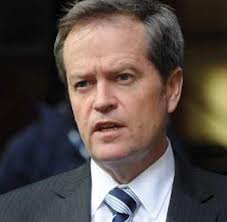 Bill Shorten vows to fight climate change deniers and conspiracy theorists The Age, March 17, 2014 James Massola Political correspondent Opposition Leader Bill Shorten has lashed out at the conspiracy theorists, keyboard warriors and social media trolls who have hijacked the debate about man-made climate change. There’s an important difference between tackling the misinformation peddled by climate change deniers, and stooping to their level.
And Mr Shorten has pledged to be a “disciple of science and innovation”, promising the Labor Party will encourage risk-taking and entrepreneurialism and warning “Australia can either get smarter or get poorer – we can choose to compete or give up”.
The Opposition Leader has been under sustained political pressure from the federal government to support the repeal of the carbon tax, but he has promised to vote against repeal if the alternative is the government’s Direct Action policy. He has also committed to taking a market-based system for pricing carbon to the 2016 election.
“Labor won’t be walking away from our action on climate change – or bowing to the will of a Prime Minister who offers cynical nostrums that emissions trading is rendered meaningless because it deals with an ‘invisible, odourless substance’,” he said.
Mr Shorten told the annual Science Meets Parliament conference in Canberra on Monday the climate change debate was a “cautionary tale for what happens if we abandon the field to the conspiracy theorists and keyboard warriors, the social media trolls and the angry shouts of talkback radio”.
“Too many of us took the popular support for action on climate change for granted,” he said.
“A mistake that has seen Australia move from a co-operative conversation on the best international method for dealing with the causes of climate change and mitigating against its effects to an argument poisoned by allegations of conspiracy and alarmist ‘warmism’.”… http://www.theage.com.au/federal-politics/political-news/bill-shorten-vows-to-fight-climate-change-deniers-and-conspiracy-theorists-20140317-34×01.html
Bernie Fraser deplores Abbott Govt’s policies opposing action on Climate Change
 Abbott government is putting business profits ahead of the community: Bernie Fraser http://www.theage.com.au/federal-politics/political-news/abbott-government-is-putting-business-profits-ahead-of-the-community-bernie-fraser-20140313-34os6.html March 13, 2014 Lisa Cox National political reporter Former Reserve Bank governor Bernie Fraser says the Abbott government is working in the short term interests of business and not the long term interests of the community in its policies on climate change.
Mr Fraser, in an address to the National Press Club, has also expressed surprise at the “brazenness and scale” of the campaign waged by the government and big business against the carbon and mining taxes.
The chairman of the Climate Change Authority, which the government plans to abolish, said on Thursday that the debate over climate policy in Australia was now devoid of balance and maturity.
Abbott govt ignores Chief Scientist, takes advice from climate denier
Tony Abbott’s scientific and business advisers at odds over climate change, Guardian 28 Feb 14, Chief scientist says it is not an illusion while head of PM’s business advisory group refers to ‘groupthink’ Tony Abbott’s top scientific and business advisers are at odds over the science of climate change with the chief scientist, Ian Chubb, strongly rejecting assertions that climate science is a “delusion” or a result of “groupthink”.
Chubb said the scientific evidence for human-induced global warming was so overwhelming that those who reject it are usually forced to “impugn the messenger” with “stupid expressions like ‘groupthink’” or “silly” arguments that global warming is a “delusion”.
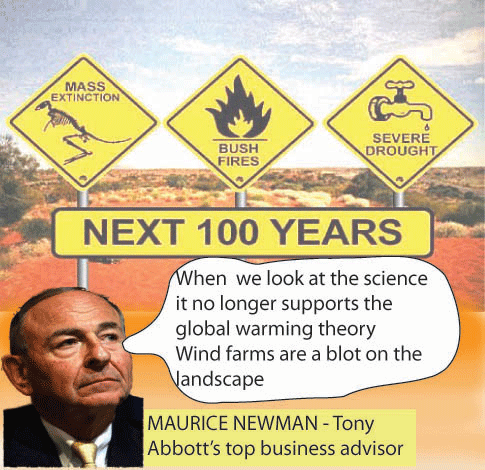 Among those who have used the phrase “groupthink” in relation to the debate about climate science are the head of the prime minister’s business advisory group, Maurice Newman, and the man chosen by the prime minister to head the review of the renewable energy target, businessman Dick Warburton. Two months ago Newman wrote a newspaper article describing climate science as a “scientific delusion”.
Chubb, who as chief scientist is supposed to provide high-level independent advice to the prime minister and other ministers, was speaking at the launch of the final report on Australia’s greenhouse gas reduction efforts by the independent climate change authority, a body the Abbott government is seeking to abolish.
“Climate science is one of the most heavily scrutinised areas of science I have ever experienced,” said Chubb.
“The overwhelming bulk of it has stood the test of that scrutiny … I find a lot of the science compelling.”…
The chairman of the climate change authority, Bernie Fraser, a former governor of the Reserve Bank, said he agreed with Chubb’s assessment of the compelling nature of climate science and said he thought those who did not accept it were either “mavericks at the fringes” or “those who speak in the short-term interests of industry”.
And Fraser also took issue with the “uncivilised” nature of Australia’s climate debate, including “the wild assertions blaming every lost job on the carbon tax … assertions not based on any objective consideration of the evidence”. http://www.theguardian.com/environment/2014/feb/27/abbotts-advisers-at-odds-climate-change
Australia the only country to wind back national climate legislation.
Abbott’s climate policy: ‘So unintellectual to as to be unacceptable’ REeweconomy,By Jonathan Gifford on 27 February 2014 The latest update of a report that assessed 66 countries on their climate change mitigation strategies has singled out Australia as being the only country to wind back national climate legislation.
The report was complied by Globe International, a body which assesses climate mitigation laws worldwide, and its head, Lord Deben, described moves to abolish the carbon tax in Australia as being “very disappointing” – in an interview with theFinancial Times.
Lord Deben, when he was John Gummer, was a former UK government minister under Prime Ministers Margaret Thatcher and John Major. He has lashed out at the Abbott government’s climate policies as being, “so unintellectual as to be unacceptable; I mean it is just amazing.”
The British peer’s remarks to the Financial Times, itself hardly a bastion of radicalism, included a stab at the climate analysts from which Abbott bases his climate policy, describing their work as “very dubious.”
“[This is] the last example of a government coming to power on the basis that really all this [climate change] is nonsense,” said Deben……
Lord Deben is a Conservative Party peer and his comments echo those made toRenewEconomy last week by Australian economist and climate policy advisor Ross Garnaut.
“This isn’t a conservative government in Australia, this is radical government,” Garnaut said. “A conservative government would’ve wanted to conserve all the good things about Australian life wouldn’t be seeking to undermine the current climate policies.”.http://reneweconomy.com.au/2014/abbotts-climate-policy-so-unintellectual-to-as-to-be-unacceptable-21542
Climate change hitting Adelaide earlier than predicted
 Hot weather in Adelaide already at levels not expected until 2030, says Climate Council report ,The Advertiser ELLEN WHINNETT HERALD SUN FEBRUARY 17, 2014
THE frequency of hot-weather days in Adelaide has already reached levels previously not expected until 2030, according to a report by the controversial Climate Council.
The council — the publicly funded version of the official national climate authority cut off by the Abbott Government — will release its latest environmental report on Tuesday. It says heatwaves will become more common and severe in Australia and that Adelaide, Melbourne and Canberra are already experiencing more extreme-heat events.
Adelaide has sweltered through a summer of record-breaking heat, enduring two severe heatwaves and more days above 40C than in any summer on record.
The council report says Adelaide’s heatwaves are an average 2.5C hotter than they were half a century ago, and peak heat days are 4.5C hotter…….http://www.adelaidenow.com.au/news/south-australia/hot-weather-in-adelaide-already-at-levels-not-expected-until-2030-says-climate-council-report/story-fni6uo1m-1226829833961
Australia’s Minerals Council out to stop climate change action, and start nuclear power
 Use G20 for power push: miners ANNABEL HEPWORTH THE AUSTRALIAN FEBRUARY 17, 2014 MINING giants will urge the government to use the presidency of the G20 to secure a renewed commitment to end global “energy poverty”, recognise coal as a cheap and plentiful fuel, and call for a national debate on nuclear power.
The powerful Minerals Council of Australia will today call on the Abbott government to urgently seek to reverse a move by the World Bank to restrict funding for coal-fired power generators in poor nations to “rare circumstances”.
And in a move sure to inflame tensions with environmental groups, the miners will ramp up calls for the repeal of the carbon tax and the phasing out of the renewable energy target, saying Australia now has some of the highest electricity prices in the developedworld largely because of “ill-judged policy interventions”…….. Continue reading
The facts on Abbott’s war on the environment and climate change action
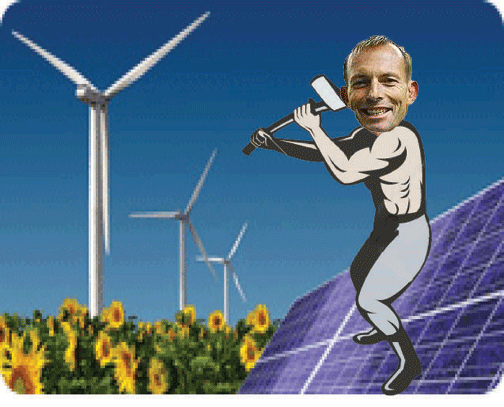 War on the environment a distraction from climate change policy, The Conversation, David Holmes, 11Feb14 ,A fter almost six months in office, it seems that the Abbott government’s reputation for action on climate change and the environment in general is in tatters.
Overseas, condemnation has been directed at a government now labelled as the ‘most hostile to its nation’s environment in history’. And that assessment is made with scant attention to what the Coalition government is doing on climate change, where it has pulled out all the stops to bring climate change policy to heel before the interests of big coal and big mining.On the environment, the Abbott government has departed from the Howard years of striking a balance with conservation values and listening to the concerns constituents have for the environment.
Balancing economic growth with sustainability had been at the forefront of legislative and regulatory protection, including the Howard government’s Environment Protection and Bio-diversity Conservation Act (1999). But the scrapping of the Environment Defenders Office (EDO) is symbolic of the distinctive shift we are seeing with this government.he EDO has played a crucial role in providing free legal advice to communities that wish to question and challenge decisions, such as coal seam gas drilling or dredging of the Great Barrier Reef. But in the context of a government that is driven to extract‘every molecule’ of gas and every last seam of coal from the driest country on earth, it has deemed that opposition to mining is not to be tolerated.
The really bad news for climate change mitigation policy is that the Abbott government’s open season on the environment will distract Australian’s from climate policy settings, which is the one area to which all environmental issues will one day be subordinated…….
Australia is the only nation currently demolishing a working carbon price, which has, in its very short life so far, already mitigated 40 megatonnes of C02.
The administrative and advisory infrastructure put in place to tackle climate change has been all but eradicated. To rehearse the measures:
- Abolishing the Climate Commission
- Axing of COAG’s Environment Ministers Forum after 41 years.
- Scrapping the Biodiversity Fund, Clean Energy Finance Corporation and Environmental Defenders Offices
- Foreshadowing the abolition of the climate change Authority in July
- Cutting funding to the: Caring for our Country Program, Low Carbon Communities Program, and the Australian Renewable Energy Agency.Perhaps the decision invoking the most contempt relates to the Clean Energy Fund. Originally, the Abbott government had claimed that abolishing Clean Energy Finance Corporation will cost the budget A$439 million. However, it now transpires that investing in renewable energies is highly profitable, and the taxpayer is actually going to gain $760 million instead.
The contradictions here don’t stand up to even rudimentary analysis. On the one hand the Abbott government dogmatically claims that these cuts are economically driven, but this is patently false when it comes to the CEFC. ……http://theconversation.com/war-on-the-environment-a-distraction-from-climate-change-policy-22983.
Mark Diesendorf points out that nuclear power is just NOT “low emission”
Sure, let’s debate nuclear power – just don’t call it “low-emission” , The Conversation , Mark Diesendorf, Associate Professor and Deputy Director, Institute of Environmental Studies, UNSW at University of New South Wales 6 Feb 14,
With environmental considerations constraining the further development of hydro-electric sources, nuclear technologies continue to present an option for future reliable energy that can be readily dispatched into the market.
This sentence appears in a passage dealing with the “move to low-emissions energy”, and although nuclear is not explicitly described as a low-emission option, it certainly looks as if the government is prepared to consider embracing nuclear power as part of an alleged move away from fossil fuel
Is nuclear energy really low-emission?

Unfortunately, the notion that nuclear energy is a low-emission technology doesn’t really stack up when the whole nuclear fuel life cycle is considered. Continue reading
Tony Abbott’s pathetic performance at Davos, on climate change
there is a growing view among business leaders and mainstream economists who see global warming as a force that contributes to lower gross domestic products, higher food and commodity costs, broken supply chains and increased financial risk.
 Shipping Oars,The Australian Independent Media Network BY KAYE LEE on JANUARY 26, 2014 Tony Abbott’s brief sojourn in Davos left most of us cringing and somewhat bemused as to the purpose of his journey. He met with some Australian big business leaders and delivered a speech that had nothing to do with the stated priorities of the forum – the problem of increasing income inequality and the economics of climate change. Le Figaro noted Abbott’s address as a footnote, quoting him as calling for more free trade, an idea that was a long way from the agenda – très loin de la thématique – of earlier gatherings. In fact, Tony left before any of these meetings took place.
But he did fit in a few personal meetings.
Apparently the Dutch Prime Minister also requested a meeting. Tony suggested it was a meet-and-greet but I suspect there was a bit more to it than that. Continue reading
Like Abbott, New South Wales government not taking climate change seriously
 Climate doomsday planning powers to be eroded EAN HIGGINS THE AUSTRALIAN JANUARY 30, 2014 COUNCILS in NSW will be instructed to distinguish between “clear and present dangers” of coastal erosion and flooding and “doomsday” UN scenarios of global sea-level rises under a landmark policy on coastal planning and climate change to be unveiled today.
NSW Planning Minister Brad Hazzard will release a draft circular aimed at stopping some coastal councils from imposing draconian planning restrictions based exclusively on UNIntergovernmental Panel on Climate Change predictions of what could happen a century ahead.(subscibers only)….. http://www.theaustralian.com.au/national-affairs/policy/climate-doomsday-planning-powers-to-be-eroded/story-e6frg6xf-1226813428273#
1 This month

of the week – Australians for War Powers Reform (AWPR)
To see nuclear-related stories in greater depth and intensity
 Antinuclear