Australia’s Minerals Council out to stop climate change action, and start nuclear power
 Use G20 for power push: miners ANNABEL HEPWORTH THE AUSTRALIAN FEBRUARY 17, 2014 MINING giants will urge the government to use the presidency of the G20 to secure a renewed commitment to end global “energy poverty”, recognise coal as a cheap and plentiful fuel, and call for a national debate on nuclear power.
The powerful Minerals Council of Australia will today call on the Abbott government to urgently seek to reverse a move by the World Bank to restrict funding for coal-fired power generators in poor nations to “rare circumstances”.
And in a move sure to inflame tensions with environmental groups, the miners will ramp up calls for the repeal of the carbon tax and the phasing out of the renewable energy target, saying Australia now has some of the highest electricity prices in the developedworld largely because of “ill-judged policy interventions”…….. Continue reading
The facts on Abbott’s war on the environment and climate change action
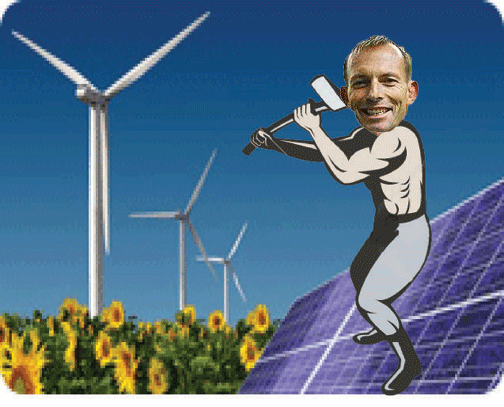 War on the environment a distraction from climate change policy, The Conversation, David Holmes, 11Feb14 ,A fter almost six months in office, it seems that the Abbott government’s reputation for action on climate change and the environment in general is in tatters.
Overseas, condemnation has been directed at a government now labelled as the ‘most hostile to its nation’s environment in history’. And that assessment is made with scant attention to what the Coalition government is doing on climate change, where it has pulled out all the stops to bring climate change policy to heel before the interests of big coal and big mining.On the environment, the Abbott government has departed from the Howard years of striking a balance with conservation values and listening to the concerns constituents have for the environment.
Balancing economic growth with sustainability had been at the forefront of legislative and regulatory protection, including the Howard government’s Environment Protection and Bio-diversity Conservation Act (1999). But the scrapping of the Environment Defenders Office (EDO) is symbolic of the distinctive shift we are seeing with this government.he EDO has played a crucial role in providing free legal advice to communities that wish to question and challenge decisions, such as coal seam gas drilling or dredging of the Great Barrier Reef. But in the context of a government that is driven to extract‘every molecule’ of gas and every last seam of coal from the driest country on earth, it has deemed that opposition to mining is not to be tolerated.
The really bad news for climate change mitigation policy is that the Abbott government’s open season on the environment will distract Australian’s from climate policy settings, which is the one area to which all environmental issues will one day be subordinated…….
Australia is the only nation currently demolishing a working carbon price, which has, in its very short life so far, already mitigated 40 megatonnes of C02.
The administrative and advisory infrastructure put in place to tackle climate change has been all but eradicated. To rehearse the measures:
- Abolishing the Climate Commission
- Axing of COAG’s Environment Ministers Forum after 41 years.
- Scrapping the Biodiversity Fund, Clean Energy Finance Corporation and Environmental Defenders Offices
- Foreshadowing the abolition of the climate change Authority in July
- Cutting funding to the: Caring for our Country Program, Low Carbon Communities Program, and the Australian Renewable Energy Agency.Perhaps the decision invoking the most contempt relates to the Clean Energy Fund. Originally, the Abbott government had claimed that abolishing Clean Energy Finance Corporation will cost the budget A$439 million. However, it now transpires that investing in renewable energies is highly profitable, and the taxpayer is actually going to gain $760 million instead.
The contradictions here don’t stand up to even rudimentary analysis. On the one hand the Abbott government dogmatically claims that these cuts are economically driven, but this is patently false when it comes to the CEFC. ……http://theconversation.com/war-on-the-environment-a-distraction-from-climate-change-policy-22983.
Mark Diesendorf points out that nuclear power is just NOT “low emission”
Sure, let’s debate nuclear power – just don’t call it “low-emission” , The Conversation , Mark Diesendorf, Associate Professor and Deputy Director, Institute of Environmental Studies, UNSW at University of New South Wales 6 Feb 14,
With environmental considerations constraining the further development of hydro-electric sources, nuclear technologies continue to present an option for future reliable energy that can be readily dispatched into the market.
This sentence appears in a passage dealing with the “move to low-emissions energy”, and although nuclear is not explicitly described as a low-emission option, it certainly looks as if the government is prepared to consider embracing nuclear power as part of an alleged move away from fossil fuel
Is nuclear energy really low-emission?

Unfortunately, the notion that nuclear energy is a low-emission technology doesn’t really stack up when the whole nuclear fuel life cycle is considered. Continue reading
Tony Abbott’s pathetic performance at Davos, on climate change
there is a growing view among business leaders and mainstream economists who see global warming as a force that contributes to lower gross domestic products, higher food and commodity costs, broken supply chains and increased financial risk.
 Shipping Oars,The Australian Independent Media Network BY KAYE LEE on JANUARY 26, 2014 Tony Abbott’s brief sojourn in Davos left most of us cringing and somewhat bemused as to the purpose of his journey. He met with some Australian big business leaders and delivered a speech that had nothing to do with the stated priorities of the forum – the problem of increasing income inequality and the economics of climate change. Le Figaro noted Abbott’s address as a footnote, quoting him as calling for more free trade, an idea that was a long way from the agenda – très loin de la thématique – of earlier gatherings. In fact, Tony left before any of these meetings took place.
But he did fit in a few personal meetings.
Apparently the Dutch Prime Minister also requested a meeting. Tony suggested it was a meet-and-greet but I suspect there was a bit more to it than that. Continue reading
Like Abbott, New South Wales government not taking climate change seriously
 Climate doomsday planning powers to be eroded EAN HIGGINS THE AUSTRALIAN JANUARY 30, 2014 COUNCILS in NSW will be instructed to distinguish between “clear and present dangers” of coastal erosion and flooding and “doomsday” UN scenarios of global sea-level rises under a landmark policy on coastal planning and climate change to be unveiled today.
NSW Planning Minister Brad Hazzard will release a draft circular aimed at stopping some coastal councils from imposing draconian planning restrictions based exclusively on UNIntergovernmental Panel on Climate Change predictions of what could happen a century ahead.(subscibers only)….. http://www.theaustralian.com.au/national-affairs/policy/climate-doomsday-planning-powers-to-be-eroded/story-e6frg6xf-1226813428273#
Repost: Peter Cosgrove spruiks “clean” nuclear for BHP Billiton
Lack of Australian nuclear plant almost immoral: Peter Cosgrove Amanda O’Brien : The Australian * February 04, 2010 “…………….The former Australian of the Year said he anticipated there would be an outcry but there was no cleaner energy source than nuclear power.(!!)..………General Cosgrove pulled no punches in his speech to the breakfast at the University of Western Australia, which was hosted by major coal producer BHP Billiton.

Lack of Australian nuclear plant almost immoral: Peter Cosgrove | The Australian
Australia is letting down Pacific Islanders on Climate Change
 But he and Pacific nations like Palau have won no favours from their big neighbour, Australia. Palau has publicly expressed disappointment with Australia’s and Canada’s climate change position.
He recently told Radio Australia the Pacific is disappointed about the Australian government’s moves to abolish the Climate Change Council and the Climate Change Authority, as well as the carbon tax.
Marshall Islands’ President Christopher Loeak says it’s not too late for climate action to save the Pacific http://www.abc.net.au/news/2014-01-21/an-climate-change/5210462 Is it too late to save low-lying Pacific nations from being lost forever because of rising sea levels?
The President of Marshall Islands, Christopher Loeak, doesn’t think so and he’s been on a relentless campaign to get the world to listen to his message.
He does concede time is running out, but has been encouraged by news that a number of nations recently announced they’d signed up to the Majuro Declarationto cut emissions. “We were really happy that the United States agreed to join and also European Union and in the United States, Hawaii also has agreed to join,” he told Radio Australia. Continue reading
John Howard rises up again, to tell furphies about climate change
In Australia, the figures are very clear. A majority of Australians accept that humans are causing global warming. John Howard is simply wrong with regard to Australia

Are most Australians really climate ‘agnostics’? Guardian, Alex White, 20 Jan 14, Former Prime Minister John Howard claimed Australians had “settled into a state of sustained agnosticism” on climate change. Is this true? Last year, former conservative Australian prime minister John Howard gave a speech at the climate-change denying Global Warming Policy Foundation in London.
In his speech, he derided climate change mitigation advocates as “alarmists” and “zealots” for whom “the cause has become a substitute religion”. He also said that politicians should not heed the advice of scientists when making policy, and repeated the denialist line that climate change was natural: “Of course the climate is changing. It always has,” he said. Continue reading
Nuclear power has no future for reducing Australia’s carbon emissions
even on the most optimistic projections of the world’s leading nuclear agency, nuclear power won’t play any significant role in decarbonising the electricity sector, let alone the economy as a whole.
 A few more observations on nuclear power January 18th, 2014 John QuigginL I thought I should respond to the latest suggestions from Department of Industry and others that nuclear power is an option worth considering for Australia. While I’m at it, I’ll add some updates on global developments.
The most striking feature of recent Australian discussion, beginning with the Australian Energy Technology Assessment from 2011 is the claim that “small modular reactors” represent an appealing option for Australia. AETA listed these as being one of the cheapest options for 2020. with an estimated levelised cost of between $75 and $125/MWh.
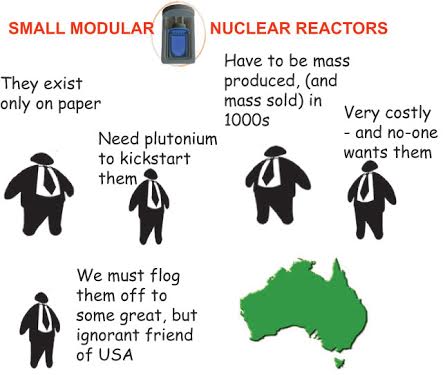
That’s both ambitious and remarkably precise for a technology that does not yet exist, even in prototype form. Continue reading
Australia can’t afford to ignore the various impacts of climate change
heatwaves dubbed the “silent killer” because they led to more deaths than do other natural events
Rising temperatures and possible lower rainfall have the potential to cut future farming output sharply.
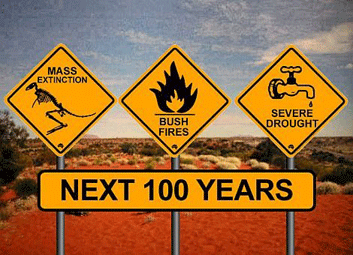 Scorchers: the reality of a sunburnt country January 18, 2014 Peter Hannam Environment Editor, The Sydney Morning Herald “………Wang Xiaoming, a senior principal scientist at CSIRO, said lip-service is often paid to the [planning for climate change] issue but little more.
“If you’re looking at the current building codes, if you’re looking at engineering design standards, actually there’s nothing considering future climate change at the moment,” Wang said.
Building standards and design can make a big difference. According to CSR, a building materials producer, lax standards in the past mean the power system is strained each time an extreme event – hot or cold – arrives.
A prototype home design by CSR in western Sydney shows what can be achieved with products already on the market. When the city was breaking its maximum heat record on January 18 last year the house remained about 15-16 degrees cooler than outside temperatures without the need for any airconditioning, the company says……..
‘Silent killer’ Continue reading
Abbott’s “Direct Action” climate plan – a gift to big polluters?
Three major loopholes in the Direct Action climate plan The Conversation, Jemma Green Senior Research Fellow at Curtin University 17 January 2014, Under the draft plan, companies will be invited to bid for funding regardless of whether their project is commercially viable without it. Projects that are already viable without government help are naturally in a better position to make a competitive bid in the scheme’s “reverse auction” – by which the government will award funds to projects that promise the biggest emissions cuts for the least money.
Baseline call
The second problem hinges on the fact that emissions reductions cannot be calculated without reference to a previous “baseline” level. But the government has delayed its decision on how emissions baselines will be determined until mid-2015. How these are decided will be of greatest interest to the biggest emitters………
Long deadlines, minor penaltiesYet under the government’s current plan, even a company that is given a favourable historic baseline, and then exceeds it anyway, could be given plenty of leeway…….
What’s more, in cases where a company routinely fails to meet emissions targets, the government says it does not want the policy to be punitive. Therefore companies could well not comply, without suffering significant financial consequences.
The proposal is open for comment until February 21, and the plan faces plenty more scrutiny, particularly when new Senators take their seats in July. Those Senators also control the fate of the previous government’s carbon price, which has already been repealed in the lower house…..http://theconversation.com/three-major-loopholes-in-the-direct-action-climate-plan-21838
The reality of a heating Australia
New research by the Alternative Technology Association suggests that even with modest assumptions for technology improvements in solar power many communities and households will find it attractive to drop off the grid within a few years in “a quick and dramatic” change.
“A shift to cost-effective standalone power solutions appears highly plausible by 2020, in a wide range of market segments,” the report said, citing a study of Bendigo, Werribee and parts of inner Melbourne.
 Scorchers: the reality of a sunburnt country, January 18, 2014 Peter Hannam, Environment Editor, The Sydney Morning Herald As searing temperatures swept across the country this week, Australians got a strong indication of summers to come. Peter Hannam asks if we are prepared for hotter days.
Sarah Perkins, a heatwave expert at the University of NSW, says heatwaves in Australia are arriving earlier in the season, are more frequent, more intense, and more prolonged. Previous major heatwaves, such as in 1939, are also linked to major bushfires. Along with the projections for more intense heat, research also shows fire-danger ratings are on the increase across south-eastern Australia. Australians will need to adapt to major changes in their lives – along with much of the world.
“For the first half of this century, we expect these [heatwave] trends to continue,” said Lesley Hughes, a professor studying climate change and ecosystems at Macquarie University. “Whether they continue beyond 2050, will be really up to how well we’ve reduced [greenhouse gas] emissions,”she said.
While sea-breezes spared much of Sydney and the coastal strip north from this week’s heat, few other affected regions were so lucky. Adelaide, Melbourne and Canberra each reached 40 degrees on Thursday for a second day in a row, and had only done that before on single days over the past 70 years of records. Canberra’s Friday maximum just missed making it three days in a row.
No El Nino this time Continue reading
Abbott’s attack on renewable energy is bad economic judgment
The most baffling thing about Abbott’s assault on renewable energy is that it also flies in the face of economic good sense.
Australian PM Ignores Climate Change, Trades Renewables for Coal , Triple Pundit, ““““Eric Justian | Thursday January 16th, 2014 “……..The Australian government, under Prime Minister Tony Abbott, seems committed to exacerbating its nation’s climate woes. Even as his Environmental Minister approved a vast coal mine that will produce 40 million tons of CO2-emitting coal per year, Abbott is calling Australia’s strong renewable energy sector into question.
He’s cutting funding for renewables, threatening to remove the 20 percent renewable energy standard and even falling back on the old and largely debunked criticism that wind power has negative impacts on human health. Australia’s National Health and Medical Research Council looked into the issue in 2010 and again in 2012. And now Abbott is calling for another review. Because, why not?
And just for good measure, he’s also dismantling Australia’s well-regarded plans for curbing carbon emissions and jettisoning the nation’s goals for carbon reductions………
Australia can power itself entirely through renewable sources like wind and solar power by 2040. They could do it affordably, reliably and cleanly — working towards reducing the climatic impact on the nation. There’s simply no benefit to moving back toward coal, and nothing but risk.At least the U.S. doesn’t hold a monopoly on climate change denialists in public office. http://www.triplepundit.com/2014/01/australian-pm-ignores-climate-change-trades-renewables-coal/
Climate change being ignored by Australia’s leaders. to our cost

Giving financial assistance to the coal industry is irresponsible, to say the least. This is an industry that has profited, unhindered, for at least a century. This is an industry that should be phased out by Australia. This is an industry that will fall into the abyss, at the hands of its own customers, as the rest of the world takes on climate change.
What ever happened to climate change in Australia? http://www.onlineopinion.com.au/view.asp?article=15927&page=2 David Leigh 17 Jan 14 In the lead up to the last election, climate change was part of usual rhetoric that politicians espouse, along with the many other championed causes. It was either about the Clean Energy Fund, fueled by the Carbon Tax and by the Labor camp, or it was about not believing the science from the Liberals. Actually, that is far from liberal open-mindedness, when you think about it.
Either way, the airwaves were full of discussion about the biggest threat to humanity of all time. Now, as we find ourselves 6-months into Abbott’s Australia, there is little or no discussion. First he attempted to silence the reporting body by removing its funding, as though stopping talk would make it all go away. Now, even the Labor opposition remains quite on the subject. Only the Greens appear to understand that it won’t abate, although the Green focus seems to be snagged temporarily on asylum seeker wellbeing. Incidentally, that is another subject that seems to have gone away since the reporting stopped.
Despite having just had the hottest year on record and every monthly Australian record being broken and with the US having an unprecedented cold snap with temperatures below –34c the subject has conveniently gone quiet. This of course suits the big end of town, because climate change is expensive to mitigate. They should also realize it is far more expensive to ignore.
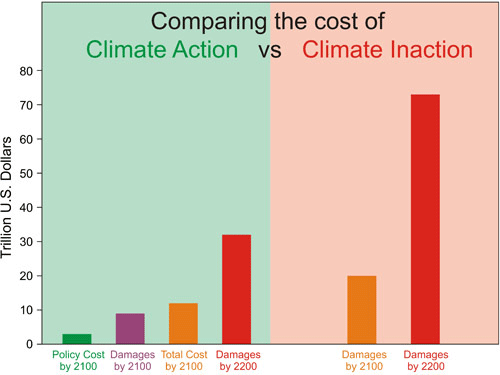
Australia is still locked in the same old political cycle of red team, blue team and the policies of the current blue team – if you can call them policies – seem focused only on the next 3-years. It is a far cry from the time of independents like Tony Windsor and Rob Oakeshott, where governance was about policy not dogma Continue reading
Australian Climate Denialism from Mont Pelerin Society to Tony Abbott
The argument put by Lindsay back in 2008 is identical to that put by Tony Abbott’s chief business advisor Maurice Newman in recent columns, the latest only a few weeks ago
Mont Pelerin Society Revealed As Home To Leading Pushers Of Climate Science Denial DESMOGBLOG.COM, GRAHAM READFEARN, 14 JAN 14 THERE’S a popular talking point coming from climate change denialists that all people who accept the science and the need to act on it are somehow blinded by faith.
In Australia, climate science contrarian columnists can barely touch their keyboards without typing out the words “global warming faith” or explaining how human-caused global warming is some sort of “new religion”.
This “climate religion” narrative often goes hand-in-hand with another favourite denialist talking point where climate scientists are only doing what they do because there’s a dollar in it.
Presumably the laws of physics, the melting ice sheets, the increasing risk of bushfires, the hottest decades on record and the acidifying oceans are also waiting for their cash.
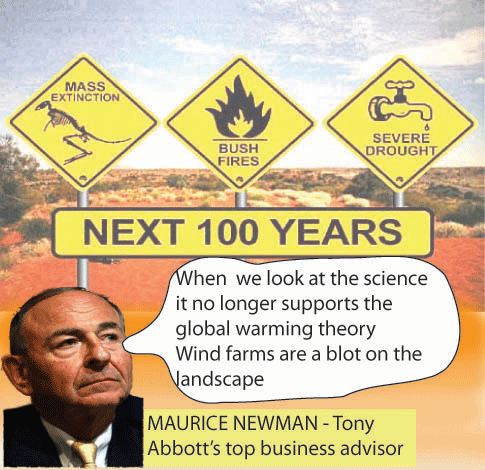 Maurice Newman, the man hand-picked by Australian Prime Minister Tony Abbott to be the government’s top business advisor, loves both of these debating points.
Newman has described climate scientists as being a “global warming priesthood” and belonging to a new “religion”. In a second opinion column in two weeks in The Australian, Newman repeats his cynicism over the IPCC and climate scientists, describing them as a “cartel” that “will deny all contrary evidence”. Newman even repeats the myth that in the 1970s scientists were certain the world was heading for global cooling, when in fact, as this study shows, a healthy majority of scientific papers were predicting the opposite. ……
In Australia, Mont Pelerin Society members include Continue reading
1 This month


Help Aunty Sue Protect Her Land and Sacred Sites From Destructive Rocket Testing.
.

Australians deserve the truth
about
AUKUS – https://aukuspublicinquiry.com/

PETITION – To: Prime Minister Anthony Albanese and the Australian Labor Government

of the week – Australians for War Powers Reform (AWPR)
To see nuclear-related stories in greater depth and intensity

