Biden as president would pursue climate ‘cheaters’, such as Morrison’s Australia
  Biden as president would pursue climate ‘cheaters’ – and Australia could be among them, Scott Morrison has resisted a call to action from the UK – but the US would be hard to ignore, Guardian, Richie Merzian 4 Nov 20, ”…….. If Joe Biden takes the Oval Office, on the day of his inauguration, 20 January 2021, he can formally ask to rejoin the Paris agreement. It takes one year to pull out but only 30 days to sign up. However, regaining membership to the agreement is just the beginning. The divergence on climate policy between the Democratic and Republican candidates is huge – possibly the widest divide between the two platforms – and while Trump questions global warming, Biden has the most ambitious climate policies of any presidential candidate (exceeding those of Barack Obama).First, Biden will lock the US into net zero emissions by 2050. Not an ill-defined target some time in the second half of the century, like the Australian government’s, but a 30-year target. A target that means putting coal, oil and gas on a downward trajectory, and bringing total global CO2 emissions under a net-zero target to over 60%, including major importers of Australian coal and gas – China, Japan and the Republic of Korea. Biden as president would pursue climate ‘cheaters’ – and Australia could be among them, Scott Morrison has resisted a call to action from the UK – but the US would be hard to ignore, Guardian, Richie Merzian 4 Nov 20, ”…….. If Joe Biden takes the Oval Office, on the day of his inauguration, 20 January 2021, he can formally ask to rejoin the Paris agreement. It takes one year to pull out but only 30 days to sign up. However, regaining membership to the agreement is just the beginning. The divergence on climate policy between the Democratic and Republican candidates is huge – possibly the widest divide between the two platforms – and while Trump questions global warming, Biden has the most ambitious climate policies of any presidential candidate (exceeding those of Barack Obama).First, Biden will lock the US into net zero emissions by 2050. Not an ill-defined target some time in the second half of the century, like the Australian government’s, but a 30-year target. A target that means putting coal, oil and gas on a downward trajectory, and bringing total global CO2 emissions under a net-zero target to over 60%, including major importers of Australian coal and gas – China, Japan and the Republic of Korea.
Within his first 100 days, Biden has committed to convene a climate world summit to directly engage the leaders of the major carbon-emitting nations of the world to persuade them to join the United States in making more ambitious national pledges, above and beyond the commitments they have already made. From the US, we could see a new, more ambitious emission reduction target than its underwhelming 26-28% by 2025 (if that sounds familiar, it’s because Australia has the exact same underwhelming target range but for 2030, and without the desire to improve it). Importantly, Biden will pursue countries seen as “cheating” on climate action, using “America’s economic leverage and power of example”. Given the Morrison government’s insistence on using leftover carbon credits to avoid any credible emission reductions over the next decade – dubbed by the former UN climate chief Christiana Figueres as “cheating” and by numerous Australian law professors as legally baseless – Australia may be a target of that pursuit. Australia and the US might also be at odds over financial support for climate action in developing countries. Biden’s campaign promises include meeting the US climate finance pledge, of which $2bn to the Green Climate Fund is still outstanding. Prime minister Scott Morrison pulled Australia out of the Green Climate Fund in 2018 during an interview with Alan Jones and has resisted calls since from our neighbours in the Pacific to rejoin. While presidential office is key, if Democrats take a majority of Senate seats their capabilities on climate would grow fast. The president, Senate and key states could see the US move quickly – even this year. And much like the climate leadership shown by states and territories in Australia that are all signed up to net-zero by 2050 targets, a number of US state governments have already banded together to take climate action under Trump. According to the America’s Pledge report, sub-national action makes it possible for the US to cut emissions by 37% by 2030. And despite Trump’s best efforts to revive the coal industry, more coal capacity (37GW) has been retired under his presidency than during Obama’s second term (33GW). The US consumed more energy from renewables than coal in 2019, for the first time in over a century, setting the stage for Biden’s promise of a carbon pollution-free power sector by 2035. This 12 December the Paris agreement turns five. The United Kingdom, which will host the next UN climate conference, will mark the occasion with an ambition summit. And while Scott Morrison has resisted calls from the UK to do more on climate, it may be harder to resist similar calls from the US. Morrison claims, “Our policies won’t be set in the United Kingdom, they won’t be set in Brussels, they won’t be set in any part of the world other than here.” I wouldn’t be so sure. When former president Obama pressured the Abbott government to do more on climate change in 2014, it had an impact. Let’s see what happens when Washington calls again. https://www.theguardian.com/commentisfree/2020/nov/04/biden-as-president-would-pursue-climate-cheaters-and-australia-could-be-among-them |
|
Rest super fund commits to net-zero emission investments after Brisbane man sues
|
Rest super fund commits to net-zero emission investments after Brisbane man sues, ABC, By national science, technology and environment reporter Michael Slezak, 2 Nov 20,
A 25-year-old man from Brisbane has successfully sued one of Australia’s biggest super funds over its handling of climate change, forcing it to commit to net-zero emissions for its investments by 2050.Key points:
In 2018, Mark McVeigh sued Rest, his superannuation fund, in the Federal Court after it failed to provide him with information on how it was managing the risks of climate change. Mr McVeigh alleged Rest had breached the Superannuation Industry Act and the Corporations Act by failing to manage those risks — which could include fossil fuel companies plummeting in value or infrastructure being damaged by extreme weather. The law requires trustees of super funds to act with care, skill and diligence to act in the best interest of members — including managing material risks to its investment portfolio. In an 11th-hour settlement reached on Monday while the case was adjourned, Rest agreed its trustees have a duty to manage the financial risks of climate change. Because the case was settled out of court, the outcome doesn’t carry the same weight as a legal precedent decided in court. But Mr McVeigh’s lawyer, David Barnden, head of Equity Generation Lawyers, said the case still sets an important precedent globally. “This outcome should represent a significant shift in the market’s willingness to tackle climate risk — a shift which should set a clear precedent for the industry in Australia, and also pension funds around the world,” Mr Barnden said……….. https://www.abc.net.au/news/2020-11-02/rest-super-commits-to-net-zero-emmissions/12840204 |
|
Australian doctors accuse government of failing on climate change
“We are also united by our concern about the climate crisis and the impact it is having on the safety and wellbeing of Australians and our neighbours. Public health is inextricably linked to climate health. Climate damage is here now – and it is killing people.”
The doctors accuse Mr Taylor of failing in his ministerial duties by directing public money to fossil fuel projects, failing to adequately reduce Australia’s emissions obligations and by not committing Australia to a 2050 net zero emissions target…….
In the letter the doctors said there is already a noticeable health impact from increased frequency and intensity of bushfires, floods, dust storms, drought and extreme heat in Australia.
“As a result, Australians are already seeing higher rates of respiratory illness, diarrhoea and morbidity requiring hospital admission during hot days, and higher rates of suicide in rural areas during drought years.
“The burning of fossil fuels such as coal and gas that drives global warming is also a major contributor to air pollution – this silent killer is linked to the premature deaths of 3000 Australians each year. Higher levels of air pollution are also associated with increasing illness and death related to ischaemic heart disease, chronic obstructive airways disease, lung cancer and asthma.” …..https://www.smh.com.au/environment/climate-change/australian-doctors-accuse-government-of-failing-on-climate-change-20201101-p56ajj.html
North of Australia is headed for a severe heatwave
 Severe heatwave could break record temperatures in the Top End, ABC By Chelsea Heaney and Amy Culpitt 2 Nov 20, Temperatures across the Top End are set to soar, with the Bureau of Meteorology predicting a severe heatwave is here to stay.Key points: Severe heatwave could break record temperatures in the Top End, ABC By Chelsea Heaney and Amy Culpitt 2 Nov 20, Temperatures across the Top End are set to soar, with the Bureau of Meteorology predicting a severe heatwave is here to stay.Key points:
After sticking out a sweaty weekend, with temperatures climbing up and over 40 degrees Celsius across various parts of the Top End, there appears to be no relief in sight and no concrete signs of any big wet season storms. Senior meteorologist Billy Lynch said the heat and sunny skies were “unusual” for this time of the year. “Darwin got up to 36.3C [on Sunday] and the rural area got up to about 39C. Then in inland parts, we saw Jabiru get to 40C and Katherine 41C,” he said. “Those temperatures are a few degrees above average, the November average for Darwin is 33C. “For Katherine the average is about 37C and we’re looking at 41C and 42C, so it’s nearly 5 degrees above average. “It is a little unusual to see temperatures getting this high at this time of year.
It’s these temperatures that have many outdoor workers worried………. Report reveals NT economically vulnerable to climate change The data comes as new research by Deloitte revealed that Queensland, the Northern Territory and Western Australia would be the most negatively affected economically because of climate change. In the NT, the services, mining and tourism industries would be hardest hit. By 2070, the Territory could see a drop in 12 per cent of its gross domestic product and 5 per cent fewer jobs because of the impacts of climate change, the report states. Heat expert Matt Brearley urged people to reconsider their plans during the current hot spell, especially those involving the outdoors. “Those producing heat, such as people exercising or working, out camping or having a fish in the boat, they’ll lose less heat and potentially cook themselves,” he said…….. https://www.abc.net.au/news/2020-11-03/severe-heatwave-record-breaking-temperatures-northern-territory/12840316 |
|
International team tracks record-setting smoke cloud from Australian wildfires
|
International team tracks record-setting smoke cloud from Australian wildfires, Science Daily , October 29, 2020
|
|
Australia is on the frontline, in the new age of fire
”Covid-19 is more than an illness. It is a symptom of the ailing health of our planet.”.
 Born in the ice age, humankind now faces the age of fire – and Australia is on the frontline Born in the ice age, humankind now faces the age of fire – and Australia is on the frontline The bushfires and the plague are symptoms of something momentous unfolding on Earth – an acceleration of our impact on nature, Guardian, by Tom Griffiths, 1 Nov 20 What has been the most shocking event of 2020? Was it awakening on New Year’s Day to more news of terror in Australia’s southern forests, to the realisation that the future was suddenly here, that this spring and summer of relentless bushfire was a planetary event? Was it the silent transmission of Covid-19, already on the loose and soon to overwhelm the world and change the very fabric of daily life everywhere at once? Or was it the surging race riots and protests, especially across America, where police brutality triggered grief, anger and outrage about the inequality and injustice still faced by black people? Could we even distinguish them from each other, this overlapping sequence of horrors? Fire, plague and racism are always with us, percolating away, periodically erupting, sometimes converging. They came together in the colonisation of Australia when the conquering British brought smallpox, scorned Indigenous rights and fought Aboriginal fire with gunfire. Systemic racism is the virus, declared Black Lives Matter protesters. ………
Throughout 2019, fire experts had pleaded with the federal government to hold a bushfire summit to prepare for the dreaded summer, but the prime minister had refused. The crisis could not be acknowledged in case it gave credence to the need for climate action. As if neglect and omission in the face of the fire threat were not enough, Coalition politicians and their apologists then hastily encouraged lies about the causes of the fires, declaring that they were started by arsonists and that greenies had prevented hazard-reduction burns. Yet these fires were overwhelmingly started by dry lightning in remote terrain, and hazard-reduction burning is constrained by a warming climate. The effort to stymie sensible policy reform after the fires was as pernicious as the failure to plan in advance of them.
There was barely a moment to breathe between bushfires and Covid. Australians had been in lockdown for months even before the year began, fighting fires that had started at the end of winter, cowering indoors from smoke, heat and ash, and wearing masks on their brief forays outside. People spoke courageously of “the new normal” but did not yet understand that “normal” was gone. Just as they finally stepped outside to sniff the clearer autumn air, it was declared dangerous again. Their masks were still in their pockets. Despite the connections between these crises, politicians were keen to separate them, as if one blessedly cancelled out the other, not least because the pandemic gave the prime minister a chance to reset after his disastrous summer. Instead of forcing handshakes he was forced to withhold them. For the beleaguered Coalition government, Covid seemed to provide the escape it wanted from climate politics.
Australians were forbidden from talking about the obvious relationship between bushfires and climate, so how will we manage to interrogate the common origins of climate change and the pandemic? The fires and the plague are both symptoms of something momentous that is unfolding on Earth: a concentration and acceleration of the impact of humans on nature. As the environmental scientists Inger Andersen and Johan Rockström argued in June: “Covid-19 is more than an illness. It is a symptom of the ailing health of our planet.”……..
Covid-19 spilled over from wild animals to humans and became a pandemic because of ecosystem destruction, biodiversity loss, climate change, pollution, the illegal wildlife trade and increased human mobility. “So when you’re done worrying about this outbreak,” Quammen warns, “worry about the next one. Or do something about the current circumstances.” Doing something about it means more than finding a vaccine; it means urgently addressing the causes of the climate emergency and the biodiversity crisis. It means understanding how dire the current rupture is in the long-term relationship between humans and nature……………
It is confirmation that in the 21st century our country remains a colony, still unable to accept (as the Uluru statement puts it) that “this ancient sovereignty can shine through as a fuller expression of Australia’s nationhood”. The deep environmental and cultural inheritance of this continent, with all the wisdom and perspective it might offer about living in this place, about survival, species and cultural burning, about fires, plagues and rising seas, is not yet important enough to Australians. When will it be, if not now? The insidious smoke is coming. • This essay will be part of the anthology Fire, Flood and Plague, edited by Sophie Cunningham and published by Penguin Random House in December https://www.theguardian.com/australia-news/2020/nov/01/born-in-the-ice-age-humankind-now-faces-the-age-of-fire-and-australia-is-on-the-frontline
|
|
$3 trillion and 880,000 jobs to be lost, if Australia continues inaction on climate change
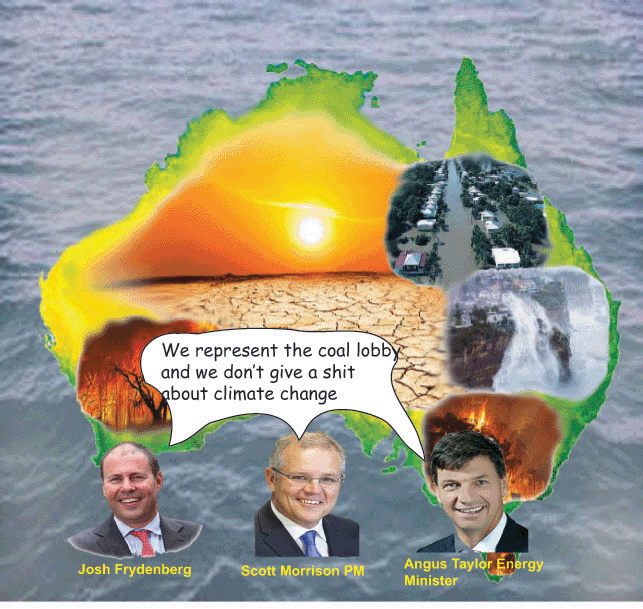 Australia will lose more than $3 trillion and 880,000 jobs over 50 years if climate change is not addressed, Deloitte says, ABC News, By Kathleen Calderwood– 1 Nov 20 The Australian economy will lose more than $3 trillion over the next 50 years if climate change is not addressed, according to a new report from Deloitte Access Economics.Key points: Australia will lose more than $3 trillion and 880,000 jobs over 50 years if climate change is not addressed, Deloitte says, ABC News, By Kathleen Calderwood– 1 Nov 20 The Australian economy will lose more than $3 trillion over the next 50 years if climate change is not addressed, according to a new report from Deloitte Access Economics.Key points:
The report found the economy could shrink by 6 per cent over the next 50 years and 880,000 jobs could be lost. Report author Pradeep Philip, who was a policy director for former prime minister Kevin Rudd, said there was also a lot to be gained if warming was kept below 1.5 degrees and Australia achieved net zero carbon emissions by 2050. “If we do act over the next few years then in just 50 years there is a benefit to the economy of $680 billion,” he said. “We’ll have an economy 2.6 per cent bigger, generating 250,000 jobs, so this tells us if you are pro-growth and pro-jobs then we need to act on climate change now……. Businesses ‘moving despite Government inaction’ Sheep grazier and chair of Farmers for Climate Action, Charlie Prell, says the pressure is already being felt in his industry, but opportunities are available to help agriculture businesses get by if climate change is addressed………. https://www.abc.net.au/news/2020-11-02/australian-economy-lose-$3-trillion-climate-change-inaction/12837244 |
|
|
Bushfire royal commission’s final report issues warning to Australia over climate change,
 Bushfire royal commission’s final report issues warning to Australia over climate change, ABC News, By national science, technology and environment reporter Michael Slezak, 1 Nov 20, Bushfire royal commission’s final report issues warning to Australia over climate change, ABC News, By national science, technology and environment reporter Michael Slezak, 1 Nov 20, The bushfire royal commission’s final report is a stark warning of a future marked by extreme weather impacts of climate change.The commissioners describe their task at the very top of the report as “looking to the future”. And they are very clear about what that means. “Extreme weather has already become more frequent and intense because of climate change; further global warming over the next 20 to 30 years is inevitable,” they say. And as for what that means for fire regimes, they don’t mince their words. “Catastrophic fire conditions may render traditional bushfire prediction models and firefighting techniques less effective,” they say. The report notes there’s essentially nothing we can do about “locked in” warming set to occur over the next two decades. But what happens after that is up to us. Warming “beyond the next 20 to 30 years is largely dependent on the trajectory of greenhouse gas emissions”, it says. The commissioners also highlight evidence that avoiding or mitigating risks is much more cost effective than responding to disasters after they happen — an approach they unequivocally state is not adequate. “We need to do much more than put out fires. A resilient nation will seek to mitigate the risk of disasters through a wide range of measures, and it will attend to all of the complex and sometimes long-term consequences,” they say. Many commentators, including former fire chiefs, cross bench politicians and conservation groups, have argued the implication from the findings is clear: that greenhouse gas emissions must be quickly reduced to net zero. But of the report’s 80 recommendations, the commissioners do not make any aimed at trying to stop global warming. Their only climate-related recommendation calls for climate models to be created that can provide projections for smaller geographical areas — making them more useful for local disaster preparedness. Arguably, making recommendations about Australia’s greenhouse gas emissions or trajectory was outside the inquiry’s terms of reference. But that hasn’t stopped others drawing their own conclusions. “The Bushfire Royal Commission has laid out the facts in no uncertain terms: climate change drove the Black Summer bushfires, and climate change is pushing us into a future of unprecedented bushfire severity,” said Greg Mullins, former commissioner of Fire and Rescue NSW and founder of Emergency Leaders for Climate Action. “The Federal Government absolutely must act on the root cause of worsening bushfires in Australia, and take urgent steps to reduce greenhouse gas emissions. This clearly means no new coal or gas, and a rapid transition to renewable energy.” ……….. https://www.abc.net.au/news/2020-10-31/bushfire-royal-commission-final-report-a-stark-warning/12835096 |
|
Key findings from the report on Australian’s attitude towards climate change and energy

Climate of the nation 2020, Tracking Australia’s attitudes towards climate change and energy 28 OCT 2020 https://apo.org.au/node/309142, Audrey Quicke, Ebony Bennett, PUBLISHER The Australia Institute
The Australia Institute’s annual Climate of the Nation report details changing attitudes and beliefs around climate change, including its causes, impacts and solutions.
The 2020 report shows more Australians believe climate change is occurring and that humans are the main cause than since 2012. Australians support a range of decarbonisation policies and increasingly want Australia to be a world leader in finding solutions to climate change.
Key findings:
- After the devastating Black Summer bushfires, eight in ten Australians (82%) are concerned that climate change will result in more bushfires, up from 76% in 2019
- Vast majority of Australians (83%) want coal-fired power stations to be phased out
- Only 12% of Australians prefer investment in gas to power Australia’s economic recovery, while the majority of Australians (59%) prefer investment in renewables as a pathway for economic recovery
- Australians overestimate gas industry employment by a factor of 40x, believing, on average, that 8.2% of the workforce is in fossil gas mining when the reality is it represents just 0.2% of the Australian workforce
- Seven in ten Australians (71%) want Australia to be a global leader in finding solutions to climate change, a jump of 9 percentage points from 2019
- More than two in three Australians (68%) believe Australia should have a national target for net-zero emissions by 2050, including majority support across Coalition voters (59%), Labor voters (81%), Greens voters (90%), Other voters (65%).
British Prime Minister urges Scott Morrison on climate action: Morrison twists the message
|
But a statement from Mr Morrison described the call differently, noting that Mr Johnson “welcomed” Australian emissions reduction initiatives and “strongly endorsed” the Australian approach. The UK has a policy of achieving net zero carbon emissions by 2050. A press release from 10 Downing Street following the call said Mr Johnson “stressed that we need bold action to address climate change, noting that the UK’s experience demonstrates that driving economic growth and reducing emissions can go hand-in-hand”. The equivalent statement from the Australian Prime Minister’s office stated: “PM Johnson welcomed our significant increase in emissions reduction programs announced through the Budget, and strongly endorsed our focus on unlocking practical pathways to reducing emissions,” it read. “Both countries agreed to work closely together to accelerate research and deployment of low-emission technologies ahead of COP26.” COP26, the 2021 United Nations Climate Change Conference, will be held next year in Glasgow. Policies to be set locally Labor Senator Penny Wong pressed Foreign Minister Marise Payne over the contrast during senate estimates. “There is no reference to net zero emissions [in Scott Morrison’s statement] there is no reference to bold action and there is no reference to ambitious targets,” Senator Wong said……. https://www.abc.net.au/news/2020-10-28/boris-johnson-scott-morrison-climate-change-bold-action/12817474 |
|
Long-term research shows ocean acidification ramping up on the Reef
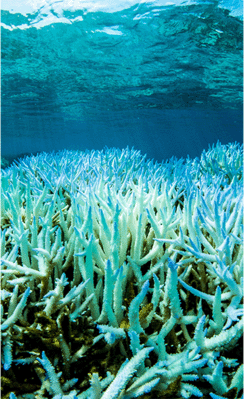 The future is now: long-term research shows ocean acidification ramping up on the Reef The future is now: long-term research shows ocean acidification ramping up on the Reef
A new study has shown ocean acidification is no longer a sombre forecast for the Great Barrier Reef but a present-day reality AUSTRALIAN INSTITUTE OF MARINE SCIENCE https://www.eurekalert.org/pub_releases/2020-10/aiom-tfi102820.phpResearch News Ocean acidification is no longer a sombre forecast for the Great Barrier Reef but a present-day reality, a new study reveals. The study, published in the international Journal Scientific Reports, shows carbon dioxide (CO2) and ocean acidification are rapidly increasing on the Reef. Seawater CO2 has risen 6 per cent over the past 10 years and matches the rate of CO2 increases in the atmosphere, confirming the influence of atmospheric CO2 on seawater CO2 levels. “People talk about ocean acidification in terms of 50 years’ time, but for the first time our study shows how fast ocean acidification is already happening on the Reef,” said Dr Katharina Fabricius, lead author and Senior Principal Research Scientist at the Australian Institute of Marine Science (AIMS). The research, a collaboration between AIMS and CSIRO, drew on over a decade of observations collected as part of Australia’s Integrated Marine Observing System (IMOS) to conclude that the Reef’s rich carbonate seafloor is not buffering against ocean acidification as previously thought. “Our research shows that acidification is rapidly changing the conditions that support the growth of coral on the Reef. It’s never been more important to address ocean acidification in plans to manage the Reef”, said Dr. Bronte Tilbrook, a Senior Principal Research Scientist at CSIRO who leads IMOS’ observational projects for CO2 and ocean acidification. Ocean acidification results from seawater absorbing excess CO2 that has been emitted into the atmosphere. The CO2 dissolves in the seawater where it changes the chemistry. This includes decreasing the water’s pH, and reducing the aragonite saturation state, which is critical for building the skeletons of reef-building coral and other marine organisms. Under reduced pH conditions, their calcium carbonate skeletons take longer to form and weaken, leaving them more susceptible to damage and erosion. While long-term data exist for CO2 and ocean acidification trends in open oceans, there have been very few long-term data on these trends in coastal waters around the world, including the Great Barrier Reef. Biological and physical processes like respiration create large fluctuations in CO2 in coastal areas, making the detection of trends more difficult. The study has filled this important knowledge gap by analysing 10 years of CO2, pH and aragonite saturation state data (2009-2019). These data were collected as part of Australia’s IMOS network at two long-term monitoring stations, located 650 kilometres apart at contrasting locations. The researchers found the minimum CO2 concentrations measured today were likely to already have passed the highest CO2 levels expected 60 years ago, even after accounting for the effects of temperature, nutrients, salinity, and daily and seasonal changes. “We know now that oceans are taking up about 23% of the excess CO2 from the air. They actually provide a service to humanity by slowing climate change. But the price to pay is that the seawater’s carbon chemistry is changing, and we didn’t know it was happening in dynamic coastal waters at such fast rates,” Dr Fabricius said. In another research first, AIMS and CSIRO scientists have used data from 1384 Reef sites to show coastal acidification’s negative impacts on three important indicators of Reef health:
The study, published earlier this year in the journal Global Change Biology, found these baby coral and coralline algae also decreased and seaweed increased as fine suspended sediment increased across the Reef — with the greatest sediment concentration and organism changes observed closer to the shore. The researchers highlighted effective water quality management as an achievable solution to reduce coastal acidification’s impact on the Reef. ### Australia’s Integrated Marine Observing System (IMOS) is enabled by the National Collaborative Research Infrastructure Strategy (NCRIS). It is operated by a consortium of institutions as an unincorporated joint venture, with the University of Tasmania as Lead Agent. |
|
Kevin Rudd’s vision for a green recovery out of the pandemic
 New jobs, new industries, new wealth’: Kevin Rudd’s vision for a green recovery out of the pandemic
Former PM says Australia risks becoming ‘the complacent country’ and could suffer another recession if it remains tied to fossil fuels, Guardian, Adam Morton Environment editor @adamlmorton, Tue 20 Oct 2020 Kevin Rudd has called for solar panels to be made compulsory on all new buildings and increased incentives to be offered to households that do not yet have them as part of a “genuinely green recovery” from recession.
Speaking at an Australian National University event on Monday, the former prime minister repeated his 2007 declaration that climate change was the “great moral challenge of our time” and accused the Morrison government of putting jobs and long-term living standards at risk by failing to deal with the issue as promised under the Paris agreement.
Rudd said the government could have used the coronavirus pandemic as a spur to accelerate the shift to becoming a zero emissions economy, but had instead used it as an excuse to delay action further. It was evidence Australia had become “the complacent country” on the issue despite the experience of last summer’s catastrophic bushfires, he said.
“Besides the United States under [Donald] Trump and Brazil under [Jair] Bolsonaro, we in Australia are the only major economy that does not take the need for action on climate change seriously. Nor do we recognise the economic opportunities that will come with that action. I would argue this is bad company to keep,” Rudd said as part of his keynote address at the Wilson Dialogue.
“I fear that seeking to untangle our carbon-intensive economy much later than the rest of the world could in fact be what causes the next recession in Australia as the global economy increasingly walks away from fossil fuel dependency.”
Rudd said his vision for a green recovery from the pandemic included large-scale investment in renewable energy to position as a clean energy superpower, saying there was evidence it could create “new jobs, new industries, new wealth” while providing clean energy at home and creating clean energy technology that could be exported……….
In his speech, Rudd urged people to “launch, collectively, a national fusillade against the Murdoch media”, which he said had been the “echo-chamber of climate change denialism for the best part of a decade”. https://www.theguardian.com/australia-news/2020/oct/20/new-jobs-new-industries-new-wealth-kevin-rudds-vision-for-a-green-recovery-out-of-the-pandemic
USA election result, and Australia’s response- the world’s climate in the balance
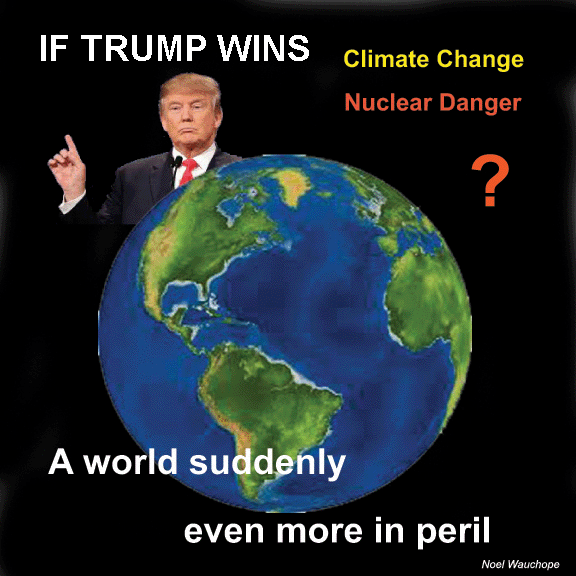
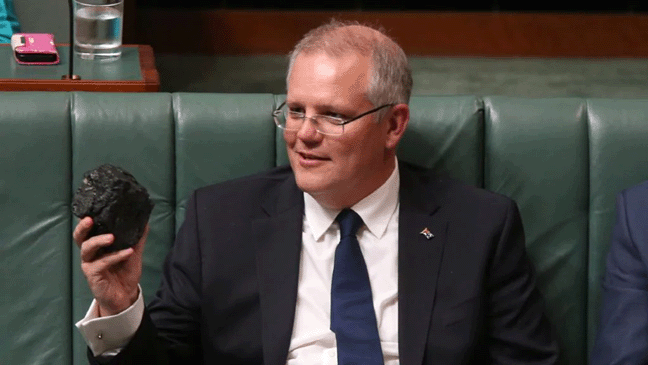
This is a cautionary tale for Australia. In both the US and Australia, conservative politicians seem more eager to bail out dirty polluters than protect the public
For Australia’s sake, I hope Trump’s climate science denialism loses. https://www.theguardian.com/commentisfree/2020/oct/17/for-australias-sake-i-hope-trumps-climate-science-denialism-loses, Michael Mann US policy has emboldened Scott Morrison to be less ambitious on climate, just when so much is at stake.
|
Anyone in Australia who witnessed the Black Summer bushfires (as I did), and anyone in the US who experienced the thick smoke from our western wildfires (as I have), knows how much damage climate change is already doing. The stark reality is that worldwide efforts to avert ever-more catastrophic climate change impacts lie in the balance in the 2020 US election. Donald Trump will go down in history bearing substantial responsibility for the deaths of over 200,000 Americans due to his rejection of the advice of public health experts and his refusal to endorse policies such as social distancing and mask-wearing that could have saved many thousands of lives. But his rejection of the science of climate change sets the stage for a far greater toll. Far more human lives will be lost from the impacts of climate change if we fail to act. Whether or not Trump gets re-elected – and how other countries like Australia respond to the outcome of the US election – could determine the fate of our planet. Indeed, I’ve stated that a second Trump term might well be “game over for the climate” if it leads to the collapse of international efforts to act. The damage caused by Trump’s climate denial is painfully visible within the US as we endure climate change-fuelled extreme weather events, including unprecedented wildfires in the west and unprecedented hurricanes in the east. But the damage can be felt around the world. Trump has proudly, and shamelessly, trumpeted his climate denialism on the global stage, joining with petrostates such as Russia, Saudi Arabia and Brazil in opposing international climate efforts. Indeed, Trump’s actions have emboldened Australia to be less ambitious on climate too, prime minister Scott Morrison following Trump’s lead in promoting climate denial, coddling fossil fuel interests and blocking efforts to support a clean, renewable energy transition. By pulling the US out of the Paris agreement (one of the first and only campaign promises he kept) Trump ceded America’s leadership on the defining challenge of our time. Thus far, other countries have fortunately filled the leadership void, at least temporarily. The EU and China, with its new net-zero pledge, have stepped up to the plate, recognising that they will benefit from the opportunities of a clean energy economy and better protect their citizens from dangerous climate change impacts. But nobody stands to benefit more from climate action, or lose more if we fail to act, than Australia. Having spent a sabbatical leave down under earlier this year, aimed at collaborating with scientists in Australia to study the impact of climate change on extreme weather events, I instead witnessed those impacts first-hand. I saw the muted beauty of the Blue Mountains when shrouded in wildfire smoke. If Trump is re-elected, and we collectively continue down a path of insufficient climate action, it may not be long before those fires rage year-round, and the Blue Mountains are lost in a perpetual grey and dismal haze. It’s the same with the vibrant sea life of the Great Barrier Reef, which I was fortunate enough to witness with my family during my time in Australia. The delicate ecosystems of the GBR are already on the ropes, with fossil fuels pushing up temperatures in the ocean to the point where bleachings occur with such frequency and ferocity that corals simply cannot recover. Research released this week found that the reef has lost half its coral, largely due to warming oceans caused by climate change. Add the impact of ocean acidification from increasing carbon emissions, and we could sadly, within a decade or two, be reading the GBR’s obituary for real. It doesn’t have to be like that. For one thing, renewable energy costs are plummeting while the technology just keeps getting more efficient and better, so dirty energy no longer makes economic sense. For example, on one recent Sunday, all the electricity demand for the entire state of South Australia was met by solar power alone, and every state and territory in Australia has committed to go carbon neutral by 2050. Here in the US, we’ve seen a record number of cities and states stepping up on climate goals too, knowing clean energy is good for their communities’ health, resilience and prosperity. Policymakers must accelerate the shift to clean energy that is already under way. As we’ve learned in the Trump-era, some fossil fuels are too far gone for even the most determined polluter-in-chief to save. Though another term would give Trump time to defend his environmental rollbacks in court and solidify his dirty energy policies, he has already failed to save coal from market forces, and another four years isn’t going to reverse the long-term decline of the industry. This is a cautionary tale for Australia. In both the US and Australia, conservative politicians seem more eager to bail out dirty polluters than protect the public, denying politically inconvenient science in order to offer lavish payouts to help unprofitable fossil fuel companies. If we are to avert catastrophic warming, we must do just the opposite, providing financial incentives for renewables and disincentives for fossil fuels. That will level the playing field, and accelerate the clean energy transition. We must take the earliest exit possible off the fossil fuel highway. By trying to squeeze out the last drop of fossil fuel industry profits, the Morrison government could well be on its way to bleaching the life from Australia’s coral reefs and blighting the blue of its mountains. There is some good news, however. Regardless of whom Americans vote for – and for the sake of the planet, I hope it’s Joe Biden and the Democrats – Australians can still work together for structural change at home. You can’t solve it alone, but we also can’t solve it without you. Australia has seen that the sun can power an entire state’s electricity for a day. Now it’s time to make that happen every day. Australia must distance itself from the handful of bad petrostate actors who have sabotaged global climate action and rejoin the coalition of the willing, when it comes to the battle to save our planet. • Michael E. Mann is distinguished professor of atmospheric science at Pennsylvania State University. He is author of the upcoming book The New Climate War: The Fight to Take Back Our Planet, due out in January (Public Affairs Books) |
|
Litigation: a promising new way to address Australia’s climate inaction
The pandemic lays bare a truth leaders consistently ignore: in the end, nature reigns supreme.
It ought to be worth noting that last month was Earth’s hottest September over the 140-year global temperature record, or that this year is in record territory even without an El Nino, or that warming over the past 12 months was just 0.2C below the internationally agreed “safe” limit……
The sad fact is that new temperature records have next to no impact in a world that has become hardened against climate shocks, a situation encouraged by an unholy coalition of political and corporate interests which over many decades have worked hard to obscure the true story.
As a nation, we ought to be up in arms about the Morrison government’s plans to ramp up methane extraction, based on the false claim that generating power by burning natural gas is somehow clean energy. But we’re not. It seems that in a pandemic you don’t question and don’t argue.
The pandemic is bad and generally getting worse getting worse as countries battle with competing health and economic demands. But at least, on the whole, governments recognise that COVID-19 constitutes an emergency and that urgent measures are needed to counter it.
What they don’t see is that the pandemic emergency sits within a bigger emergency. For all its devastation – and we should never downplay its impact on lives and livelihoods – in the long run we know it will end. That cannot be said about the all-enveloping catastrophe of climate change………
Litigation and divestment are two potent legal and financial levers that hold much promise. A case brought this year against the federal government promises to pull both of them.
Katta O’Donnell, a 23-year-old La Trobe University law student, grew up in Victoria’s central highlands. She experienced the impact of long-term drought on that landscape, and twice in 11 years saw it devastated by unstoppable wildfire. Last year, inspired by a lecture by Australian climate law specialist David Barnden, she decided it was time to act.
With Barnden’s help, O’Donnell filed a federal court claim alleging that the Australian government was breaching its legal duty and misleading sovereign bond investors by failing to disclose climate-driven financial risks, such as stranded fossil fuel assets and worsening environmental conditions.
In identifying a material risk to the market in government bonds everywhere, her action attracted attention globally, including in business circles in Europe and the United States alert to any sign of future financial loss.
Australia’s troubled environment, she told me last week, puts it on the front line of the climate crisis. Coral bleaching threatens Great Barrier Reef tourism, drought is lowering our capacity to grow food, and last summer’s bushfires will cost us upwards of $100 billion. Such tangible threats prompted Sweden to sell its Australian bonds last November.
The pandemic is telling us that fiscal and monetary controls, budgets and banks and all the rest of our economic constructs and artifices can’t hide the fact that it is nature, above all, that determines wealth, or its absence. We should all take that message to heart and welcome O’Donnell’s initiative as a long-overdue wakeup call. http://southwind.com.au/2020/10/13/on-trial-australias-dismal-climate-record/
Queensland election – all about climate, coal, and minority parties
 ‘Queensland paradox’ pushes coal and climate to centre stage of election campaign, Guardian, Ben Smee @BenSmee, Sat 10 Oct 2020
 As Labor and the LNP try to woo regional and metro voters with at-times contradictory messages, minor parties thrive
On Sunday in Clermont – in the dusty heart of Queensland – the coal fanatic Liberal National party senator Matt Canavan and the mining magnate Clive Palmer will hold a rally, mocking the convoy of climate protesters who made a somewhat unwelcome voyage north last year.
Three days earlier, almost 1,000km away in Brisbane’s trendy western suburbs, the Greens announced state election plans to provide free school meals, funded by a $55bn increase to mining royalties.
Somewhere in between lies what the University of Queensland political scientist Glenn Kefford calls “the Queensland paradox” – the challenge for major parties to woo voters in both Toowong and Townsville with different, sometimes contradictory, messages.
“The state might appear a certain way to outsiders but it’s really interesting and diverse,” Kefford says.
As Labor and the LNP attempt to “walk both sides of the street”, divisive issues including coalmining and climate change have again been pushed to the forefront of the campaign………
Avoiding the third rail
Of course, it’s impossible to talk about Queensland, coal, climate and the election without mentioning the third rail of that debate: Adani.
On the eve of the election, Labor sought to neutralise a potential campaign problem by signing a long-delayed royalties deal for Adani’s under-construction Carmichael coalmine.
Polling released this week shows Labor extending its dominance over the LNP in greater Brisbane. The party also hopes to pick up seats on the Gold Coast and the southern Sunshine Coast.
Of most concern to Labor strategists are the party’s regional seats, including the working-class regional cities of Townsville, Mackay, Rockhampton and Gladstone, where voters swung fiercely towards the Coalition at the 2019 federal election.
The premier, Annastacia Palaszczuk, began her hi-vis “jobs, jobs and more jobs” campaign by hopping across north Queensland, pushing a pro-mining message.
Kefford said Labor appeared to be attempting to address failures from last year’s federal election campaign in north and central Queensland by running messaging tailored to suit local campaigns in regional areas……….
‘Frankenstein majority’
Queensland politics has become known for its embrace of minor parties,………
“There’s a good chance of [a hung parliament], there’s no doubt,” Kefford said. “The major parties, they have to rationalise what they’re doing and be strategic about their messaging. They can’t be everything to everyone.” https://www.theguardian.com/australia-news/2020/oct/10/queensland-paradox-pushes-coal-and-climate-to-centre-stage-of-election-campaign
1 This month

of the week – Australians for War Powers Reform (AWPR)
To see nuclear-related stories in greater depth and intensity
 Antinuclear