Long-term research shows ocean acidification ramping up on the Reef
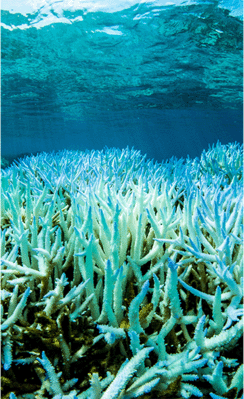 The future is now: long-term research shows ocean acidification ramping up on the Reef The future is now: long-term research shows ocean acidification ramping up on the Reef
A new study has shown ocean acidification is no longer a sombre forecast for the Great Barrier Reef but a present-day reality AUSTRALIAN INSTITUTE OF MARINE SCIENCE https://www.eurekalert.org/pub_releases/2020-10/aiom-tfi102820.phpResearch News Ocean acidification is no longer a sombre forecast for the Great Barrier Reef but a present-day reality, a new study reveals. The study, published in the international Journal Scientific Reports, shows carbon dioxide (CO2) and ocean acidification are rapidly increasing on the Reef. Seawater CO2 has risen 6 per cent over the past 10 years and matches the rate of CO2 increases in the atmosphere, confirming the influence of atmospheric CO2 on seawater CO2 levels. “People talk about ocean acidification in terms of 50 years’ time, but for the first time our study shows how fast ocean acidification is already happening on the Reef,” said Dr Katharina Fabricius, lead author and Senior Principal Research Scientist at the Australian Institute of Marine Science (AIMS). The research, a collaboration between AIMS and CSIRO, drew on over a decade of observations collected as part of Australia’s Integrated Marine Observing System (IMOS) to conclude that the Reef’s rich carbonate seafloor is not buffering against ocean acidification as previously thought. “Our research shows that acidification is rapidly changing the conditions that support the growth of coral on the Reef. It’s never been more important to address ocean acidification in plans to manage the Reef”, said Dr. Bronte Tilbrook, a Senior Principal Research Scientist at CSIRO who leads IMOS’ observational projects for CO2 and ocean acidification. Ocean acidification results from seawater absorbing excess CO2 that has been emitted into the atmosphere. The CO2 dissolves in the seawater where it changes the chemistry. This includes decreasing the water’s pH, and reducing the aragonite saturation state, which is critical for building the skeletons of reef-building coral and other marine organisms. Under reduced pH conditions, their calcium carbonate skeletons take longer to form and weaken, leaving them more susceptible to damage and erosion. While long-term data exist for CO2 and ocean acidification trends in open oceans, there have been very few long-term data on these trends in coastal waters around the world, including the Great Barrier Reef. Biological and physical processes like respiration create large fluctuations in CO2 in coastal areas, making the detection of trends more difficult. The study has filled this important knowledge gap by analysing 10 years of CO2, pH and aragonite saturation state data (2009-2019). These data were collected as part of Australia’s IMOS network at two long-term monitoring stations, located 650 kilometres apart at contrasting locations. The researchers found the minimum CO2 concentrations measured today were likely to already have passed the highest CO2 levels expected 60 years ago, even after accounting for the effects of temperature, nutrients, salinity, and daily and seasonal changes. “We know now that oceans are taking up about 23% of the excess CO2 from the air. They actually provide a service to humanity by slowing climate change. But the price to pay is that the seawater’s carbon chemistry is changing, and we didn’t know it was happening in dynamic coastal waters at such fast rates,” Dr Fabricius said. In another research first, AIMS and CSIRO scientists have used data from 1384 Reef sites to show coastal acidification’s negative impacts on three important indicators of Reef health:
The study, published earlier this year in the journal Global Change Biology, found these baby coral and coralline algae also decreased and seaweed increased as fine suspended sediment increased across the Reef — with the greatest sediment concentration and organism changes observed closer to the shore. The researchers highlighted effective water quality management as an achievable solution to reduce coastal acidification’s impact on the Reef. ### Australia’s Integrated Marine Observing System (IMOS) is enabled by the National Collaborative Research Infrastructure Strategy (NCRIS). It is operated by a consortium of institutions as an unincorporated joint venture, with the University of Tasmania as Lead Agent. |
|
Kevin Rudd’s vision for a green recovery out of the pandemic
 New jobs, new industries, new wealth’: Kevin Rudd’s vision for a green recovery out of the pandemic
Former PM says Australia risks becoming ‘the complacent country’ and could suffer another recession if it remains tied to fossil fuels, Guardian, Adam Morton Environment editor @adamlmorton, Tue 20 Oct 2020 Kevin Rudd has called for solar panels to be made compulsory on all new buildings and increased incentives to be offered to households that do not yet have them as part of a “genuinely green recovery” from recession.
Speaking at an Australian National University event on Monday, the former prime minister repeated his 2007 declaration that climate change was the “great moral challenge of our time” and accused the Morrison government of putting jobs and long-term living standards at risk by failing to deal with the issue as promised under the Paris agreement.
Rudd said the government could have used the coronavirus pandemic as a spur to accelerate the shift to becoming a zero emissions economy, but had instead used it as an excuse to delay action further. It was evidence Australia had become “the complacent country” on the issue despite the experience of last summer’s catastrophic bushfires, he said.
“Besides the United States under [Donald] Trump and Brazil under [Jair] Bolsonaro, we in Australia are the only major economy that does not take the need for action on climate change seriously. Nor do we recognise the economic opportunities that will come with that action. I would argue this is bad company to keep,” Rudd said as part of his keynote address at the Wilson Dialogue.
“I fear that seeking to untangle our carbon-intensive economy much later than the rest of the world could in fact be what causes the next recession in Australia as the global economy increasingly walks away from fossil fuel dependency.”
Rudd said his vision for a green recovery from the pandemic included large-scale investment in renewable energy to position as a clean energy superpower, saying there was evidence it could create “new jobs, new industries, new wealth” while providing clean energy at home and creating clean energy technology that could be exported……….
In his speech, Rudd urged people to “launch, collectively, a national fusillade against the Murdoch media”, which he said had been the “echo-chamber of climate change denialism for the best part of a decade”. https://www.theguardian.com/australia-news/2020/oct/20/new-jobs-new-industries-new-wealth-kevin-rudds-vision-for-a-green-recovery-out-of-the-pandemic
USA election result, and Australia’s response- the world’s climate in the balance
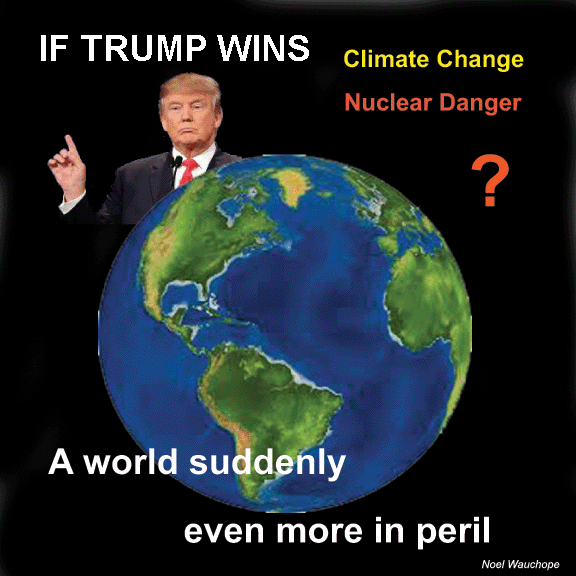
This is a cautionary tale for Australia. In both the US and Australia, conservative politicians seem more eager to bail out dirty polluters than protect the public
For Australia’s sake, I hope Trump’s climate science denialism loses. https://www.theguardian.com/commentisfree/2020/oct/17/for-australias-sake-i-hope-trumps-climate-science-denialism-loses, Michael Mann US policy has emboldened Scott Morrison to be less ambitious on climate, just when so much is at stake.
|
Anyone in Australia who witnessed the Black Summer bushfires (as I did), and anyone in the US who experienced the thick smoke from our western wildfires (as I have), knows how much damage climate change is already doing. The stark reality is that worldwide efforts to avert ever-more catastrophic climate change impacts lie in the balance in the 2020 US election. Donald Trump will go down in history bearing substantial responsibility for the deaths of over 200,000 Americans due to his rejection of the advice of public health experts and his refusal to endorse policies such as social distancing and mask-wearing that could have saved many thousands of lives. But his rejection of the science of climate change sets the stage for a far greater toll. Far more human lives will be lost from the impacts of climate change if we fail to act. Whether or not Trump gets re-elected – and how other countries like Australia respond to the outcome of the US election – could determine the fate of our planet. Indeed, I’ve stated that a second Trump term might well be “game over for the climate” if it leads to the collapse of international efforts to act. The damage caused by Trump’s climate denial is painfully visible within the US as we endure climate change-fuelled extreme weather events, including unprecedented wildfires in the west and unprecedented hurricanes in the east. But the damage can be felt around the world. Trump has proudly, and shamelessly, trumpeted his climate denialism on the global stage, joining with petrostates such as Russia, Saudi Arabia and Brazil in opposing international climate efforts. Indeed, Trump’s actions have emboldened Australia to be less ambitious on climate too, prime minister Scott Morrison following Trump’s lead in promoting climate denial, coddling fossil fuel interests and blocking efforts to support a clean, renewable energy transition. By pulling the US out of the Paris agreement (one of the first and only campaign promises he kept) Trump ceded America’s leadership on the defining challenge of our time. Thus far, other countries have fortunately filled the leadership void, at least temporarily. The EU and China, with its new net-zero pledge, have stepped up to the plate, recognising that they will benefit from the opportunities of a clean energy economy and better protect their citizens from dangerous climate change impacts. But nobody stands to benefit more from climate action, or lose more if we fail to act, than Australia. Having spent a sabbatical leave down under earlier this year, aimed at collaborating with scientists in Australia to study the impact of climate change on extreme weather events, I instead witnessed those impacts first-hand. I saw the muted beauty of the Blue Mountains when shrouded in wildfire smoke. If Trump is re-elected, and we collectively continue down a path of insufficient climate action, it may not be long before those fires rage year-round, and the Blue Mountains are lost in a perpetual grey and dismal haze. It’s the same with the vibrant sea life of the Great Barrier Reef, which I was fortunate enough to witness with my family during my time in Australia. The delicate ecosystems of the GBR are already on the ropes, with fossil fuels pushing up temperatures in the ocean to the point where bleachings occur with such frequency and ferocity that corals simply cannot recover. Research released this week found that the reef has lost half its coral, largely due to warming oceans caused by climate change. Add the impact of ocean acidification from increasing carbon emissions, and we could sadly, within a decade or two, be reading the GBR’s obituary for real. It doesn’t have to be like that. For one thing, renewable energy costs are plummeting while the technology just keeps getting more efficient and better, so dirty energy no longer makes economic sense. For example, on one recent Sunday, all the electricity demand for the entire state of South Australia was met by solar power alone, and every state and territory in Australia has committed to go carbon neutral by 2050. Here in the US, we’ve seen a record number of cities and states stepping up on climate goals too, knowing clean energy is good for their communities’ health, resilience and prosperity. Policymakers must accelerate the shift to clean energy that is already under way. As we’ve learned in the Trump-era, some fossil fuels are too far gone for even the most determined polluter-in-chief to save. Though another term would give Trump time to defend his environmental rollbacks in court and solidify his dirty energy policies, he has already failed to save coal from market forces, and another four years isn’t going to reverse the long-term decline of the industry. This is a cautionary tale for Australia. In both the US and Australia, conservative politicians seem more eager to bail out dirty polluters than protect the public, denying politically inconvenient science in order to offer lavish payouts to help unprofitable fossil fuel companies. If we are to avert catastrophic warming, we must do just the opposite, providing financial incentives for renewables and disincentives for fossil fuels. That will level the playing field, and accelerate the clean energy transition. We must take the earliest exit possible off the fossil fuel highway. By trying to squeeze out the last drop of fossil fuel industry profits, the Morrison government could well be on its way to bleaching the life from Australia’s coral reefs and blighting the blue of its mountains. There is some good news, however. Regardless of whom Americans vote for – and for the sake of the planet, I hope it’s Joe Biden and the Democrats – Australians can still work together for structural change at home. You can’t solve it alone, but we also can’t solve it without you. Australia has seen that the sun can power an entire state’s electricity for a day. Now it’s time to make that happen every day. Australia must distance itself from the handful of bad petrostate actors who have sabotaged global climate action and rejoin the coalition of the willing, when it comes to the battle to save our planet. • Michael E. Mann is distinguished professor of atmospheric science at Pennsylvania State University. He is author of the upcoming book The New Climate War: The Fight to Take Back Our Planet, due out in January (Public Affairs Books) |
|
Litigation: a promising new way to address Australia’s climate inaction
The pandemic lays bare a truth leaders consistently ignore: in the end, nature reigns supreme.
It ought to be worth noting that last month was Earth’s hottest September over the 140-year global temperature record, or that this year is in record territory even without an El Nino, or that warming over the past 12 months was just 0.2C below the internationally agreed “safe” limit……
The sad fact is that new temperature records have next to no impact in a world that has become hardened against climate shocks, a situation encouraged by an unholy coalition of political and corporate interests which over many decades have worked hard to obscure the true story.
As a nation, we ought to be up in arms about the Morrison government’s plans to ramp up methane extraction, based on the false claim that generating power by burning natural gas is somehow clean energy. But we’re not. It seems that in a pandemic you don’t question and don’t argue.
The pandemic is bad and generally getting worse getting worse as countries battle with competing health and economic demands. But at least, on the whole, governments recognise that COVID-19 constitutes an emergency and that urgent measures are needed to counter it.
What they don’t see is that the pandemic emergency sits within a bigger emergency. For all its devastation – and we should never downplay its impact on lives and livelihoods – in the long run we know it will end. That cannot be said about the all-enveloping catastrophe of climate change………
Litigation and divestment are two potent legal and financial levers that hold much promise. A case brought this year against the federal government promises to pull both of them.
Katta O’Donnell, a 23-year-old La Trobe University law student, grew up in Victoria’s central highlands. She experienced the impact of long-term drought on that landscape, and twice in 11 years saw it devastated by unstoppable wildfire. Last year, inspired by a lecture by Australian climate law specialist David Barnden, she decided it was time to act.
With Barnden’s help, O’Donnell filed a federal court claim alleging that the Australian government was breaching its legal duty and misleading sovereign bond investors by failing to disclose climate-driven financial risks, such as stranded fossil fuel assets and worsening environmental conditions.
In identifying a material risk to the market in government bonds everywhere, her action attracted attention globally, including in business circles in Europe and the United States alert to any sign of future financial loss.
Australia’s troubled environment, she told me last week, puts it on the front line of the climate crisis. Coral bleaching threatens Great Barrier Reef tourism, drought is lowering our capacity to grow food, and last summer’s bushfires will cost us upwards of $100 billion. Such tangible threats prompted Sweden to sell its Australian bonds last November.
The pandemic is telling us that fiscal and monetary controls, budgets and banks and all the rest of our economic constructs and artifices can’t hide the fact that it is nature, above all, that determines wealth, or its absence. We should all take that message to heart and welcome O’Donnell’s initiative as a long-overdue wakeup call. http://southwind.com.au/2020/10/13/on-trial-australias-dismal-climate-record/
Queensland election – all about climate, coal, and minority parties
 ‘Queensland paradox’ pushes coal and climate to centre stage of election campaign, Guardian, Ben Smee @BenSmee, Sat 10 Oct 2020
 As Labor and the LNP try to woo regional and metro voters with at-times contradictory messages, minor parties thrive
On Sunday in Clermont – in the dusty heart of Queensland – the coal fanatic Liberal National party senator Matt Canavan and the mining magnate Clive Palmer will hold a rally, mocking the convoy of climate protesters who made a somewhat unwelcome voyage north last year.
Three days earlier, almost 1,000km away in Brisbane’s trendy western suburbs, the Greens announced state election plans to provide free school meals, funded by a $55bn increase to mining royalties.
Somewhere in between lies what the University of Queensland political scientist Glenn Kefford calls “the Queensland paradox” – the challenge for major parties to woo voters in both Toowong and Townsville with different, sometimes contradictory, messages.
“The state might appear a certain way to outsiders but it’s really interesting and diverse,” Kefford says.
As Labor and the LNP attempt to “walk both sides of the street”, divisive issues including coalmining and climate change have again been pushed to the forefront of the campaign………
Avoiding the third rail
Of course, it’s impossible to talk about Queensland, coal, climate and the election without mentioning the third rail of that debate: Adani.
On the eve of the election, Labor sought to neutralise a potential campaign problem by signing a long-delayed royalties deal for Adani’s under-construction Carmichael coalmine.
Polling released this week shows Labor extending its dominance over the LNP in greater Brisbane. The party also hopes to pick up seats on the Gold Coast and the southern Sunshine Coast.
Of most concern to Labor strategists are the party’s regional seats, including the working-class regional cities of Townsville, Mackay, Rockhampton and Gladstone, where voters swung fiercely towards the Coalition at the 2019 federal election.
The premier, Annastacia Palaszczuk, began her hi-vis “jobs, jobs and more jobs” campaign by hopping across north Queensland, pushing a pro-mining message.
Kefford said Labor appeared to be attempting to address failures from last year’s federal election campaign in north and central Queensland by running messaging tailored to suit local campaigns in regional areas……….
‘Frankenstein majority’
Queensland politics has become known for its embrace of minor parties,………
“There’s a good chance of [a hung parliament], there’s no doubt,” Kefford said. “The major parties, they have to rationalise what they’re doing and be strategic about their messaging. They can’t be everything to everyone.” https://www.theguardian.com/australia-news/2020/oct/10/queensland-paradox-pushes-coal-and-climate-to-centre-stage-of-election-campaign
Net zero emissions target for Australia could launch $63bn investment boom
|
Net zero emissions target for Australia could launch $63bn investment boom, Guardian, Lisa Cox, 12 Oct 20,
Modelling shows moving towards a net zero emissions economy would unlock financial prospects in sectors including renewables and manufacturing Australia could unlock an investment boom of $63bn over the next five years if it aligns its climate policies with a target of net zero emissions by 2050, according to new economic modelling. The analysis, by the Investor Group on Climate Change (IGCC), finds the investment opportunity created by an orderly transition to a net zero emissions economy would reach hundreds of billions of dollars by 2050 across sectors including renewable energy, manufacturing, carbon sequestration and transport. However, if the country keeps to its current targets and climate policies, investment worth $43bn would be lost over the next five years, growing to $250bn by 2050. The Investor Group on Climate Change represents investors in Australia and New Zealand who are focused on the effect of the climate crisis on the financial value of investments. Among its membership are institutional investors with funds under management worth more than $2 trillion. The organisation commissioned the consultancy Energetics to examine the domestic investment opportunities that would arise from an orderly transition to net zero emissions by 2050. The report finds a net zero scenario would unlock $63bn in investment over the next five years, including $15bn in manufacturing, $6bn in transport infrastructure such as charging stations, and $3bn in domestic green hydrogen production, as companies and governments moved towards the stronger emissions goal. ………. “What it shows is that the investment opportunities extend well beyond just the renewables industry,” said Erwin Jackson, the IGCC’s director of policy. “Renewables are the backbone of the transition but there are massive opportunities in other sectors such as manufacturing, restoring the land, and electrification of transport.” The report, which targets governments, companies, investors and financial regulators, says its estimates are conservative because they do not factor in the export potential of industries such as clean hydrogen. It argues that if governments set stable policy, and companies and investors collaborate to align their decisions with the goals of the Paris agreement, then billions of dollars over the short and long term could support the jobs and wealth of millions of Australians, particularly in regional areas. The Morrison government has refused to commit Australia to a net zero emissions target and has focused its climate policy on a new technology roadmap covering hydrogen, energy storage, “low carbon” steel and aluminium, carbon capture and storage, and soil carbon……… John Connor, the chief executive of the Carbon Market Institute, said the reality Australia faced was its economy was running “below capacity and it needs a new direction”. He said clean technologies like renewable energy and transport represented significant opportunities for Australia in a post-carbon world and the country’s vast land mass, with landscapes in need of regeneration, gave it a competitive advantage in carbon sequestration. “We can either coast off the cliff into the hothouse of economic and climate disaster, or we can turn a corner towards an orderly transition and the opportunities that are there,” Connor said. https://www.theguardian.com/australia-news/2020/oct/12/net-zero-emissions-target-for-australia-could-launch-63bn-investment-boom |
|
China’s dramatic plan for switch to renewables – a warning to Australia’s fossil-fuel economy
 China just stunned the world with its step-up on climate action – and the implications for Australia may be huge, The Conversation, October 8, 2020, Hao Tan, Associate professor, University of Newcastle, Elizabeth Thurbon, Scientia Fellow and Associate Professor in International Relations / International Political Economy, UNSW, John Mathews, Professor Emeritus, Macquarie Business School, Macquarie University, Sung-Young Kim, Senior Lecturer in International Relations, Discipline of Politics & International Relations, Macquarie School of Social Sciences, Macquarie University China just stunned the world with its step-up on climate action – and the implications for Australia may be huge, The Conversation, October 8, 2020, Hao Tan, Associate professor, University of Newcastle, Elizabeth Thurbon, Scientia Fellow and Associate Professor in International Relations / International Political Economy, UNSW, John Mathews, Professor Emeritus, Macquarie Business School, Macquarie University, Sung-Young Kim, Senior Lecturer in International Relations, Discipline of Politics & International Relations, Macquarie School of Social Sciences, Macquarie University
|
|
Australia now the worst OECD country for climate change action
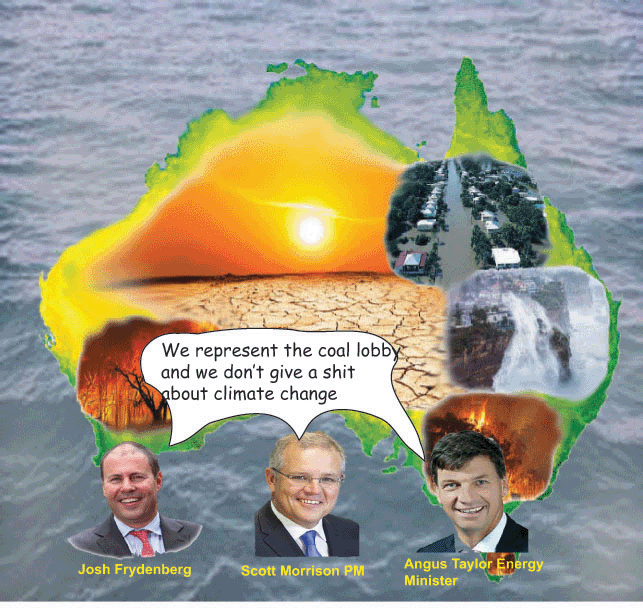 Back of the pack: Australia now the worst OECD country for climate change action, The New Daily, Cait Kelly, 7 Oct 20, Australia has become the worst-performing of all OECD countries when it comes to climate change, and will soon become a global pariah unless federal policies change fast, experts warn.It comes as UK Prime Minister Boris Johnson became the first democratic leader to outline a green-centred plan for rebuilding the country and creating jobs when the coronavirus crisis ends.
One of Australia’s leading experts in climate change, Professor Will Steffen said the UK’s announcement has left Australia in the dust.
“The UK is the first country to put forward a concrete plan but other OECD counties, particularly the Nordic ones – Denmark, Norway and Sweden – already have advanced plans,” he told The New Daily.
“We and the United States are stumbling around while most European countries are trying to get it done.”
He said depending on how the US election plays out, Australia could soon become an outlier.
We’re pretty much alone now and who knows how the US is going to go,” Professor Steffen said. If the election changes the government, you’ll see much more action on climate change. They’ve got great wind resources. They’ve got enormous tech capability. If they get the politics right, they could change fast.
We have enormous renewable sources, but we’re being held back by politics.”
The stark warning we have fallen behind the pack comes as new analysis from WWF reveals that in terms of committing to stimulus spending on renewables, Australia lags even further behind.
We are currently spending five times less than the conservative UK government and 10 times less than South Korea – a major trading partner……….
The government has focused Australia’s economic recovery from COVID-19 on fossil fuels, namely gas. ……. https://thenewdaily.com.au/news/national/2020/10/07/australia-climate-change-oecd/
Morrison government again fails on climate ation, snubs renewable energy
But investment in renewable energy was largely shunned. Notably, the government allocated just A$5 million for electric vehicles. It confirmed funding for the Australian Renewable Energy Agency (ARENA) for another decade, but the money is far less than what’s needed.
The COVID-19 pandemic has seen the Morrison government abandon long-held dogma on debt and deficits. However, the federal budget shows when it comes to climate and energy, the government is singing from the same old songbook.
A techno-fix
The budget doubled down on the Morrison government’s rhetoric of “technology, not taxes”, by choosing preferred technologies for investment.
This “picking winners” approach would have some chance of addressing climate change if it were based on a comprehensive analysis of the best path to zero emissions. But instead, the government has largely made offerings at the altars of technologies worshipped by the conservative side of politics.
The government will spend an as-yet undisclosed sum, possibly A$11 million, to refurbish the Vales Point coal-fired power station. The commitment to this coal infrastructure, co-owned by prominent Liberal party donor Trevor St Baker, is a disgraceful misuse of public money. It will also do little to halt the steady decline of coal-fired power generation.
As previously announced, the government will spend A$52.9 million to support the gas industry, which Frydenberg says will lower prices and support more manufacturing jobs. It includes money for gas infrastructure planning and to open up five gas basins, starting with Beetaloo Basin in the Northern Territory.
The budget confirms A$50 million for carbon capture and storage (CCS) to fund projects to cut emissions from industry. But proving the viability of large-scale CCS projects is extremely difficult, as experience in the United States and Canada has shown. In this context, allocating just A$50 million to get the technology off the ground is simply laughable.
History suggests the spending offers little return on investment. Research by the Australia Institute in 2017 revealed federal governments have spent A$1.3 billion in taxpayers’ money on CCS projects, with very little to show for it.
Renewables snubbed
Meanwhile, last night’s budget largely shunned investment in renewable energy.
The budget confirmed A$1.4 billion in ARENA funding for a further ten years, including a pretty paltry A$223.9 million over the next four years. Separately, the government will also seek to pass legislation to change ARENA’s investment mandate, enabling it to fund gas and carbon capture projects.
The government has allocated a tiny A$5 million towards electric vehicle development, including money towards a manufacturing facility in South Australia. It’s good to see electric vehicles on the government’s radar. But the commitment is dwarfed by investment overseas, including a reported US$300 billion set aside by global car makers over the next decade to bring electric vehicles to mass production.
The measly spending on clean energy technology does not make economic sense. The renewable energy sector is standing by to slash emissions and deliver lower energy prices – if only the right policy environment existed.
The budget was also an opportunity for the government to ditch its irrational opposition to carbon pricing. Recent research has comprehensively shown carbon pricing slows growth in greenhouse gas emissions.
Vehement carbon pricing critics, such as conservatives Tony Abbott, Craig Kelly and Barnaby Joyce, are now either discredited or out of parliament altogether. And scores of countries around the world have implemented some form of price on carbon.
A global outlier
Most obviously, the budget was an opportunity to commit to net-zero emissions by 2050, as many developed countries have done.
The Morrison government has already used dodgy accounting tricks to meet Australia’s Paris Agreement commitment – reducing emissions by 26% on 2005 levels. The absence of a net-zero target suggests the government intends to allow emissions to grow indefinitely after 2030.
This approach is out of step with many of Australia’s international peers. Democratic presidential candidate Joe Biden, now the clear favourite to win the US election in November, is campaigning on what has been described as “the most aggressive climate platform” ever put forward by a presidential nominee.
China’s zero emissions target is contrasted with Australia’s inaction on global heating
China’s escalation is also set to have implications for Australia’s diplomatic position in the Pacific, where it has been attempting to manage China’s rising influence among some of its closest neighbours.
“From both sides of Parliament Australian politicians aren’t understanding it, they approach climate change like it’s just another issue for our Pacific counterparts. What Australian politicians 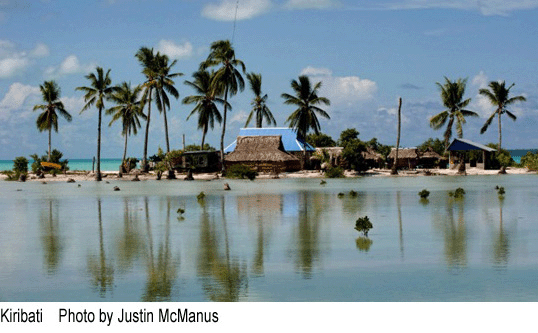 do often miss is this issue is personal,” said Professor Bamsey.
“It concerns Pacific politicians when they get out of bed, they can see the changes to the future of their country when they look out the window.”
China’s zero emissions target puts Australia on notice, The Age, By Eryk Bagshaw and Mike Foley, September 30, 2020 — Australia’s former top climate diplomat has warned China’s net-zero emissions target will leave Australia behind, threatening future trade deals and its influence in the Pacific as the Morrison government becomes wedged between the US and China on climate action.
Howard Bamsey, who was Australia’s special envoy on climate change during the Rudd government, said the announcement from President Xi Jinping last week had turned the politics of emissions reduction into a sharp economic and diplomatic issue.
Professor Bamsey, who was also Australia’s ambassador for the environment under the Howard government, said the new policy “pulls the rug out from under the argument” that Australia’s domestic climate goals do not need to accelerate because China was yet to increase its ambitions.
“It’s clear now China is accepting a leadership role,” he said. “Xi made the announcement. That carries all the weight of the state and party.”
The coronavirus has forced this year’s United Nations Glasgow Climate Change Conference to be rescheduled to November 2021, turning Australia’s international emissions obligations into a major election flashpoint. The earliest month a federal election can be held is August 2021 and voters are expected to go to the polls by the end of next year.
China, which is simultaneously the world’s largest polluter and biggest producer of renewable energy, pledged to go carbon neutral by 2060 at the UN General Assembly last week………… Continue reading
Forget the lobbying. It’s the spin that wins on climate, report finds
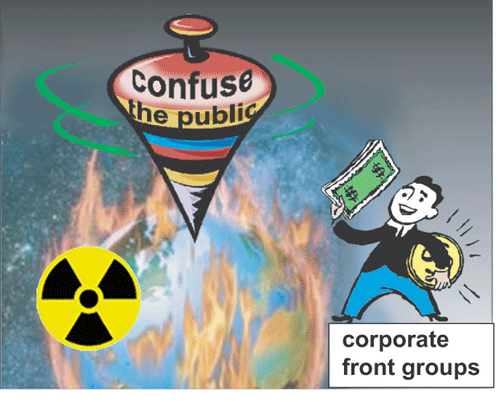 When it comes to impacting Australia’s climate wars, little can stand up to the fossil fuel industry’s public spin. GEORGIA WILKINS, SEP 24, 2020
These tactics focus on influencing public opinion and the broader political agenda rather than direct engagement with policymakers.
InfluenceMap, which is funded by environmental and investor groups, says the Minerals Council of Australia had the biggest negative influence on Australian climate-related….(subscribers only) https://www.crikey.com.au/2020/09/24/forget-the-lobbying-its-the-spin-that-wins-on-climate-report-finds/
Farmers have called out the federal government’s climate change low emissions policy as selling out an industry for profit
Farmers have called out the federal government’s climate change low emissions policy as selling out an industry for profit.Farmers for Climate Action slam Australian Government’s technology investment roadmap, Examiner, Caitlin Jarvis, 25 Sept 20
Federal Energy Minister Angus Taylor unveiled the draft technology investment roadmap this week, with steps towards low emissions.
Tasmanian farmer Brett Hall, who runs a beef property at Bronte Park, near Miena, said climate change was evident every day on his farm.
He said low emissions targets were an excellent first step, but it was a matter of too little, too late, and time was running out.
“Climate change is evident to us working on the land, but we need to see stronger initiatives because the evidence is there to suggest that we have not done enough so far and we’re past that point,” he said……… https://www.examiner.com.au/story/6938510/why-farmers-are-angry-about-low-emissions-roadmap/?cs=95
Australian scientists censored on speaking about climate change

 Censored: Australian scientists say suppression of environment research is getting worse
Survey finds that many researchers are banned from speaking about their work or have had their research altered to downplay risks. Nature , Dyani Lewis, 22 Sept 20, Environmental scientists in Australia say that they are under increasing pressure from their employers to downplay research findings or avoid communicating them at all. More than half of the respondents to an online survey thought that constraints on speaking publicly on issues such as threatened species, urban development, mining, logging and climate change had become worse in recent years1.
The findings, published this month in Conservation Letters, reflect how politicized debates about environmental policy in Australia have become, says Saul Cunningham, an environmental scientist at the Australian National University in Canberra. “We need our publicly funded institutions to be more vocal in defending the importance of an independent voice based on research,” he says.
Australian scientists aren’t the only ones who have reported interference in science or pressure — particularly from government employers — to downplay research findings. Scientists in the United States, Canada and Brazil have also
Scale of the problem
Two hundred and twenty scientists in Australia responded to the survey, which was organized by the Ecological Society of Australia and ran from October 2018 until February 2019. Some of the respondents worked in government; others worked in universities or in industry, such as environmental consultancies or non-governmental organizations.
The results show that government and industry scientists experienced greater constraints from their employers than did university staff. Among government employees, about half were prohibited from speaking publicly about their research, compared with 38% employed in industry and 9% of university staff. Three-quarters of those surveyed also reported self-censoring their work (see ‘Scientists silenced’)……….
One-third of government respondents and 30% of industry employees also reported that their employers or managers had modified their work to downplay or mislead the public on the environmental impacts of activities such as logging and mining. ………. https://www.nature.com/articles/d41586-020-02669-8
Medical groups are urging Greg Hunt to include climate change in 10-year health strategy
SBS, 22 Sept 20
A national preventative health strategy is useless if it doesn’t address the risks of climate change, experts have told the responsible minister.
Numerous health groups from across the country have signed a joint statement to Health Minister Greg Hunt calling for climate change to be a key part of the national preventative health strategy.
The strategy is currently being developed, with public feedback on its consultation paper open until the end of the month.
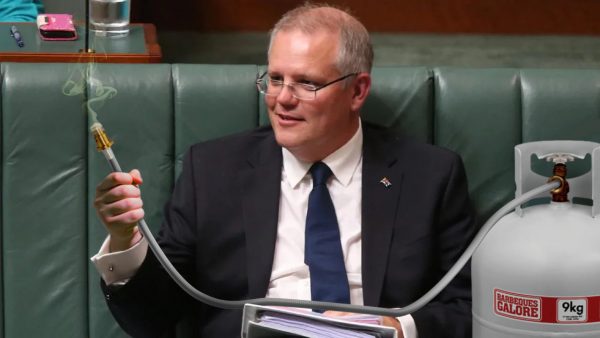
Scott Morrison transfers his love affair with coal, to gas
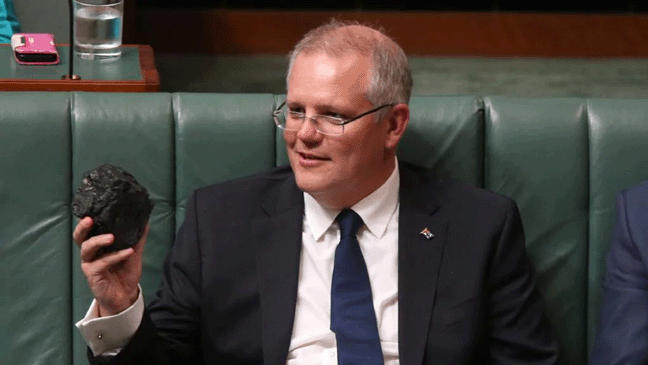
Our coal-fondling PM switches his prop to gas, but is anything really different? Jacqueline Maley, Columnist and senior journalist, The Age, 20 Sept 290 In February 2017, Scott Morrison walked into Parliament to perform a piece of coal-centred theatre that became one of the defining moments of his political career. “Mr Speaker, this is coal,” he pronounced, brandishing a black lump. “Don’t be afraid, don’t be scared. It won’t hurt you!”
As was pointed out at the time, the coal must have been lacquered – touching raw coal covers you in black dust. Morrison didn’t want to get his hands dirty. He just wanted to score a political point.
His speech was not about the benefits of coal so much as it was a gleeful attempt to wedge Labor over the electability problem it had, and still has – the insoluble tension between its heavy industry-reliant, blue-collar voter base, and its urban voters, who want meaningful climate action.
No one feels this tension more than Opposition Leader Anthony Albanese, who is old-Labor in his sensibilities, but whose inner-Sydney electorate is under siege from the Greens…………
It was always the Coalition, of course, that had the ideological attachment to coal as an energy source. The Nationals, in particular, appear to be moving away from representing farmers to supporting what is buried in the earth beneath their crops.
It is Labor that has always had the political problem with coal. It needed to convince its blue-collar base it cared about jobs and electricity prices, while also being serious about emissions reduction. But Labor is also the only side of politics that has ever been effective on emissions reduction, instituting in 2012 the only sensible mechanism to bring emissions down – a carbon price and emissions trading scheme.
It worked, in the short time it was operational, before being abolished by Tony Abbott, elected in a 2013 landslide to do exactly that.
The energy prop has changed now, with Morrison this week announcing he wants a “gas-led recovery” for the post-COVID-19 future. He is backing slowly away from coal.
In a speech in the Hunter Valley – a carefully chosen location given its significance in Labor’s own climate wars – he said there was “no credible energy transition plan for an economy like Australia that does not involve the greater use of gas”.
Details of his plan were scant. It is a plan for a plan. Morrison issued an ultimatum to electricity companies, saying if the industry did not back “dispatchable” electricity generation by next year, taxpayer money would be used to build a gas-fired power plant in the Hunter Valley, replacing the near-defunct Liddell coal plant at Muswellbrook………
Most Australians are too stressed by contemporary events, and fatigued by the climate wars, to follow the detail, which is complex. But Morrison will be able to use his “gas-led recovery” rhetoric to hedge.
His government no longer has to fight a rearguard action in defence of coal, an energy source that markets have firmly turned away from, and which public opinion is swaying against. But his party can still keep its distance from the renewable energy sources to which it seems to nurse an ideological objection. It remains to be seen if the plan will work to reduce emissions, or ensure low electricity prices.
Meanwhile, business continues to move ahead faster than the government. On Friday, BlackRock, the world’s largest investor, with $US7.32 trillion in assets under management, released a report showing that more than 1000 global companies and other organisations had signed up to the Task Force on Climate-related Financial Disclosure standards.
………Morrison’s plan for a plan will stand in for an energy policy, for now, from a government that has thoroughly betrayed the electorate on this issue for the seven years it has been in power. In that time, the earth has warmed further, and Australia has had a good taste of what is yet to come in terms of climate devastation. https://www.theage.com.au/politics/federal/our-coal-fondling-pm-switches-his-prop-to-gas-but-is-anything-really-different-20200918-p55ww9.html
1 This month



Help Aunty Sue Protect Her Land and Sacred Sites From Destructive Rocket Testing.
.

Australians deserve the truth
about
AUKUS – https://aukuspublicinquiry.com/

PETITION – To: Prime Minister Anthony Albanese and the Australian Labor Government

of the week – Australians for War Powers Reform (AWPR)
To see nuclear-related stories in greater depth and intensity

