Geo-engineering for climate action – not popularidea
Climate engineering faces PR problem Anna Salleh ABC 14 Jan 14 The general public have an overall negative image of climate engineering, which includes proposals to use mirrors in space to reduce global warming, a new study has found.
Although some were viewed more positively than others, the study published this week in the journal Nature Climate Change, suggests the public is nervous and unsure about implementing them.
Climate engineering uses technologies to reduce the amount of solar radiation reaching the Earth or directly remove carbon from the atmosphere.
Some of the more ambitious proposals are to reflect sunlight using orbiting mirrors in space, or inject tiny particles known as aerosols into the stratosphere.
Climate engineering also includes carbon dioxide removal technologies such as biochar, a very stable form of charcoal that could be locked away in farmlands.
“It’s quite an extraordinary idea,” says lead author, Professor Malcolm Wright, from Massey University‘s School of Communication, Journalism and Marketing.
In an online survey, Wright and colleagues asked more than 2000 Australians and New Zealanders what they thought about different climate engineering technologies……
Unknown effects
Survey respondents had to associate positive and negative attributes to each of the technologies.
Wright says the associations were overwhelmingly negative, with people concerned primarily with “unknown effects” of climate engineering.
“Around two thirds of associations were negative,” says Wright.
“There was an incredibly striking pattern. While the reaction was negative overall for all techniques, it was much more positive for carbon dioxide removal than it was for solar radiation management.”…….http://www.abc.net.au/science/articles/2014/01/14/3925334.htm
“Direct Action” – Tony Abbott’s slush fund for polluting industries
 “What is clear in the green paper is that there is no requirement for business to reduce carbon pollution,” Mr Burke said. “The policy offers no response for businesses that increase pollution.”
No penalty for carbon polluters GRAHAM LLOYD THE AUSTRALIAN, 7 JAN 14 COMPANIES will not be punished if they fail to meet their carbon emissions targets under the Coalition’s Direct Action plan.
Instead, the government will introduce “flexible compliance arrangements”, some of which are more generous than those argued for by industry.
Federal Environment Minister Greg Hunt told The Australian yesterday the Direct Action scheme, outlined in a green paper now open for comment, was not designed to be punitive. Continue reading
Australians will pay heavy price for government climate denialism policies
The international Panel on Climate Change (IPCC) warns that planet earth is on track for an overall increase of 3 degrees Celsius by the year 2030.
Australia is predicted to fare worse with an average temperature rise of 3 – 5 degrees Celsius for the same period unless we drastically reduce our CO2 emissions, which sadly appears most unlikely.
Now we find our Federal government approving the gigantic ‘China First’ coal mine in Queensland (owned by Clive Palmer).
Sure, there are conditions which must apply, but if this is to proceed then we Australians will race to the top as the world’s worst polluters per capita.
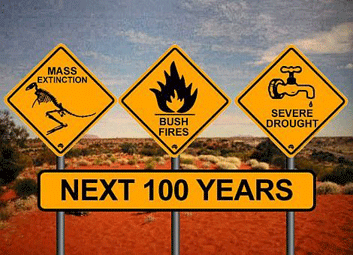 in Australia we can expect more extreme weather events including more bushfires
Time to accept responsibility for climate change, Bendigo Advertiser, By IAN COOPER, California Gully Jan. 5, 2014 FOR some decades now, climate scientists have been alerting us to the consequences of man-made global warming.
The physics of global warming is that Earth’s surface absorbs short wavelength ultra-violet radiation from the sun and re-radiates this energy as longer wavelength infrared radiation at a frequency that coincides with carbon dioxide’s absorption spectrum at approx 667 cycles per cm.
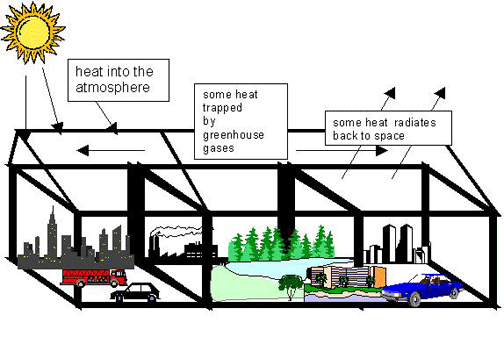
As a consequence, the CO2 molecules in the atmosphere absorb this energy as quantised energy of vibration, or simply heat; heat which otherwise would have radiated to outer space. The more CO2 in the atmosphere, the more heat trapped and the more green-house effect.
Put simply, “If we continue to increase the level of CO2 in the atmosphere, then Earth’s average surface temperature will inevitably rise”. Continue reading
Maurice Newman’s anti-science ravings are government policy
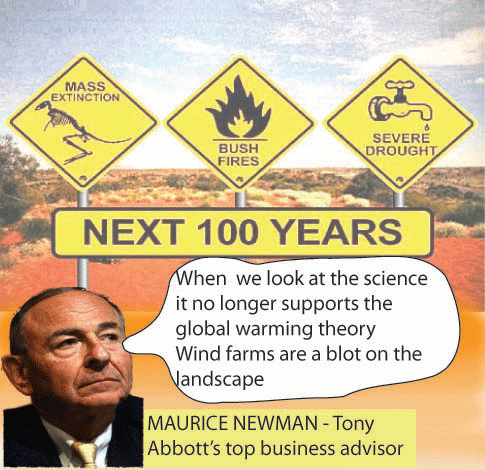 Newman is no outlier – he is meeting Abbott at least once a week, and the CEDA speech was drafted in close consultation with the PM and his office:
In other words, this is Abbott by proxy. He still thinks climate change is crap, he’s just using a ventriloquist
This is not just dog-whistling to climate skeptics, this is part of policy formulation. Abbott is already dismantling climate change policies and institutions and seeking to replace it with Direct Action, a program that is dismissed in both the scientific and investment worlds
 Australia, ‘hostage to climate change madness’? To say so is madness indeed Tony Abbott still thinks climate change is ‘crap’, he’s just using his controversial business adviser Maurice Newman as a ventriloquist to say so Giles Parkinson theguardian.com, Wednesday 1 January 2014 When the Russian scientific vessel MV Akademik Shokalskiy gotstuck in ice earlier this week while hosting a mission to retrace the steps of Sir Douglas Mawson and to conduct research on climate science, the blogosphere and talk-back radio were quick to gloat. What would the scientists say now, the deniers demanded to know, as if the presence of sea ice was enough to disprove the entire theory of climate change.
When expedition leader Chris Turney was informed of the comments in an ABC radio interview on Tuesday morning, he was dumbstruck and mildly amused. There were all sorts of explanations for the proliferation of ice at this location, such as thecalving of the large B09B iceberg and its spectacular collision with the extended tongue of the Mertz Glacier. But none that would ever satisfy such people, Turney suggested.
- Disconcertingly, these claims are no longer the province of bloggers, right wing media and talk-back radio. They now have currency in the highest corridors of power in Australia. Continue reading
Tony Abott’s climate denialist voice – Maurice Newman
“The worst part about Mr Newman’s ignorant comments is that he’s only voicing what we know Tony Abbott thinks about climate change,”
The CSIRO says robust scientific findings include clear evidence for global warming
 Tony Abbott’s top business adviser accuses IPCC of ‘dishonesty and deceit’, The Guardian, 31 Dec 13 ‘The scientific delusion, the religion behind the climate crusade, is crumbling,’ Maurice Newman says Tony Abbott’s top business adviser has accused theIntergovernmental Panel on Climate Change of “dishonesty and deceit” as it focuses on “exploiting the masses and extracting more money” in a climate crusade.
Maurice Newman, chairman of the prime minister’s new Business Advisory Council, used an interview with the Australian newspaperto launch a strongly worded attack on the global body that provides advice to governments on the body of scientific findings about climate change.
Newman also argued Australia had fallen “hostage to climate change madness” but he believed the “scientific delusion” was crumbling amid suggestions the global temperature could drop to little ice age levels.
The opposition described Newman as an embarrassment to Australia, saying he was not a scientist and therefore not qualified “to make such outrageous claims”. Continue reading
Australians should worry about skin cancer, ozone depletion and climate change
 Climate change, the ozone hole, and skin cancer – they’re all connected, Online opinion, By Noel Wauchope, 30 Dec 13 As I watch the TV news on these hot summer days, I marvel, in a sort of shocked way, at the acres of bare human flesh exposed to the harsh sunlight.- Australians of all ages, frolicking at the beaches. Don’t they know about skin cancer? Don’t they care?
Like the mythical mass suicide of lemmings, do they frolic to their doom.?
In a slower sort of frolic, Australia under the Abbott government no longer seems to know or care, about climate change.
Science is finding new connections between global warming and the ozone hole, and skin cancer, especially in Australia.
Australia has just had its hottest year on record. Global warming is happening, whether or not one argues about the cause. The hole in the ozone layer is still there, even though talk of that has gone out of fashion. And there’s skin cancer on the increase 2 common forms, and the less common melanoma, and another nasty rare one, that is becoming less rare in Australia.
What are the connections here?………
This article is not attempting to say that by addressing climate change,we are going to prevent skin cancer, although it is pretty clear that the faster Australia heats up, the greater will be the incidence of skin cancer. (So, on that basis alone, it would be a good idea to get on to a global drive to fight climate change.)
No, what is bugging me is the lack of information, media and public concern in Australia, about UV radiation, about skin cancer, and also cataracts and eye cancers, which also are caused by UV radiation..
You see, although the effects of UV radiation are world-wide, Australia is a special case, and we should be more concerned than nearly any other country.
Mathieu Isidro explains this, in a recent article:……
these rather frightening connections between skin cancer, ozone depletion and climate change are surely more reasons for Australia to take a leading role in action to slow the rate of climate change. http://www.onlineopinion.com.au/view.asp?article=15873
This year – Australia’s hottest on record!
 2013 Australia’s hottest year on record SMH, December 21, 2013 Peter Hannam 2013 is the year Australia marked its hottest day, month, season, 12-month period and, by December 31, hottest calendar year.
“We’re smashing the records,” said Andy Pitman, director of the ARC Centre of Excellence for Climate System Science at the University of NSW. “We’re not tinkering away at them, they’re being absolutely blitzed.”
Global interest in Australia’s weather flared early. In January, when models predicted heat that was literally off the charts, the Bureau of Meteorology added colours to maps – a deep purple and pink – to indicate maximum temperatures of 50-54 degrees.
But for David Jones, head of climate analysis at the bureau, 2013’s stand-out event was a month largely overlooked by a media diverted by football finals and federal elections: “From a climate point of view, what happened in September was probably the most remarkable.” ……… http://www.smh.com.au/environment/climate-change/2013-australias-hottest-year-on-record-20131220-2zqpf.html#ixzz2o8JP6w00
Australian researchers find worrying connection between global warming and El Nino events
Climate change to make ‘Super El Nino’ events twice as likely, ABC 12 Dec 13 PENNY ORBELL The drought conditions brought on by extreme versions of the El Nino weather phenomenon are likely to happen twice as often as climate change takes hold.
AUSTRALIAN RESEARCHERS have found that extreme versions of the cyclical weather pattern El Niño — dubbed ‘super El Niños’ — will double in frequency under projected global warming scenarios, with repercussions for many countries across the globe…….”Our results show that a warmer climate will increase the probability for the occurrences of super El Niños, and lead to a higher probability for associated extreme weather.”
The most extreme scenarios of global warming modelled by the researchers predicted more intense El Niños, and are most frequently associated with water current reversals…….
If emissions continue to increase at their current rate, some researchers warn that extreme weather events caused by super El Niños will become more frequent, with those most at risk being fishermen in developing nations and farmers.
“El Niño events typically bring dry conditions for Australia. So an increase in the occurrence of extreme El Niños will mean more frequent droughts, which will have an impact on our water resources and agriculture,” said Santoso. http://www.abc.net.au/environment/articles/2013/12/11/3908868.htm
Bernie Fraser calls on Australian to keep the Climate Change Authority
 Bernie Fraser criticises axing of Climate Change Authority The Age Tom Arup 9 Dec 13, Former Reserve Bank governor Bernie Fraser has called on the government to retain an independent climate advisory body as it unwinds Labor carbon policy. He challenged the government’s claims that it could get similar climate advice from other public servants.
The Climate Change Authority chairman said he was frustrated and disappointed that the government was giving up a chance to receive ”good, independent advice”.
The Abbott government wants to axe the authority as part of its repeal of the carbon tax. It also wants to shut the $10 billion Clean Energy Finance Corporation…….Mr Fraser said public servants did good work, but did not have the freedom and opportunity to deliver well-considered, independent advice in the manner of the authority, Reserve Bank or Productivity Commission.
”On a subject as complex as climate change, I would have thought every government – whatever its complexion – would want to get good independent advice,” he said.
”I find it a bit frustrating this opportunity … seems to be foreclosing a bit with the present government………….Mr Fraser’s comments follow those of Clean Energy Finance Corporation chairwoman Jillian Broadbent urging the government to re-think its plans to axe that institution. http://www.smh.com.au/federal-politics/political-news/bernie-fraser-criticises-axing-of-climate-change-authority-20131208-2yzey.html#ixzz2n0g3Af2Os a disappointment.”
Australia has hottest Spring on record
 Australia records its warmest spring after blazing September, http://www.thebull.com.au/premium/a/42492-australia-records-its-warmest-spring-after-blazing-september.html Blair Trewin Climatologist, National Climate Centre at Australian Bureau of Meteorology. 1 Dec 13,
The spring of 2013 has been Australia’s warmest on record. Mean temperatures for the season were 1.57C above the 1961-1990 average, surpassing the previous record of 1.43C (set in 2006) by 0.14C. Daytime maximum temperatures were also the highest on record, coming in 2.07C above average and 0.24C above the previous record (also set in 2006), while overnight minimum temperatures were the fourth-warmest on record.
The warmth was most dramatic in September, which saw a mean temperature anomaly of +2.75C, setting a new monthly record by more than a degree. October was also a very warm month, 1.43C above average. Temperatures during November were closer to normal, 0.52C above average, but were still warm enough to complete a record spring.
The warmth was extensive, with virtually the entire country experiencing above-average mean temperatures for the spring. It was the warmest spring on record over an area covering most of western Queensland (sufficient to give Queensland its warmest spring on record), and extending into the eastern interior of the Northern Territory.
Records were also set on the west coast around Perth, on the east coast around Sydney, and on parts of the Nullarbor. The spring ranked in the 10 warmest on record over 83% of the country. The record warm spring leaves Australia on track to have its warmest calendar year on record. Mean temperatures for Australia for the 11 months ending in November were 1.23C above average and 0.18C above the previous record year, 2005.AUTHOR

Blair Trewin
Climatologist, National Climate Centre at Australian Bureau of Meteorology
Tony Abbott has trashed Australia’s international reputation on climate change
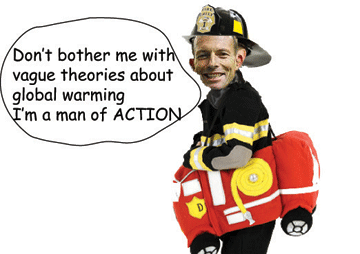
But over the next six months, Abbott intends to trash the very mechanisms that could deliver this increased ambition – the carbon price, the renewable energy target and the Clean Energy Finance Corporation – along with the independent advisory body, the Climate Change Authority, that could possibly counter the advice from his inner circle of mad ideologues to whom the words “climate change”, “green” and “clean energy” are as inflammatory as the names Fairfax and the ABC.
On the international stage, in the climate change arena, Australia’s reputation has been shattered
 Australia backing into climate change corner, MacroBusiness, 29 Nov 13, Carbon Economyon November 25, 2013 Cross-posted from Giles Parkinson at Reneweconomy. Tony Abbott has some homework to do. Over the next 15 months he is going to have to figure out how it is that Australia will meet its contribution to a new treaty that aims to limit global warming to 2°C.
He’s not the only one. More than 190 nations associated with the UN climate talks agreed on Saturday on a series of milestones that will hopefully take the world to a meaningful climate agreement in Paris in 2015. As part of that agreement, ministers will meet in June next year, country leaders in September, and by the first quarter of 2015, they will need to lay their targets on the table.
For Abbott this could be quite a challenge. Firstly, Australia, as one of the wealthiest nations in the world, and the biggest emitter per capita of any industrialised nation, will be expected to pull its weight. Continue reading
Australian Industry Group not happy with the government’s climate plan
 AUDIO: Ai Group urges changes to climate plan (AM)
Ai Group warns of flaws in Coalition climate change plan as Warsaw talks wrap up ABC Radio News AM By Lexi Metherell 25 Nov 2013, The Federal Government now has a deadline of early 2015 to set a target for reducing carbon emissions after nearly 200 countries reached a deal at the end of international climate talks in Warsaw.
But a peak industry body says a central part of the Government’s climate change policy will not always work.The Warsaw meeting ended with an agreement on a timetable for nations to name their emissions cuts before another meeting in Paris in December 2015. The Paris meeting aims to produce an international agreement to replace the Kyoto Protocol that will come into place in 2020. The Government is proposing to pay polluters to reduce emissions under its $1.5 billion Emissions Reduction Fund, which it wants up and running in July.
In its submission on the scheme, industry lobby group Australian Industry Group says companies are not always going to be able to deliver as planned. While the Government wants the fund to target domestic emissions, Ai Group is urging it also to include international carbon emissions. Chief executive Innes Willox says the Government should spend a portion of the allocated budget on the reserve of international carbon credits. “We need to get our emission reductions done at least cost,” he said…….
Australia’s current target is to reduce emissions by 5 per cent by 2020 and the Climate Change Authority is recommending that it be at least 15 per cent.Ai Group says its proposal is a “prudent fallback” in case that target cannot be reached or if the Government wants to go further than 5 per cent.”…..
Federal Environment Minister Greg Hunt was unavailable for interview. http://www.abc.net.au/news/2013-11-25/business-group-warns-on-climate-policy-as-warsaw-talks-wrap-up/5114192
Australia a fossil fool at the international climate talks
Australia left exposed on the climate front The Age, November 25, 2013 EDITORIAL So intense has been the focus on axing the ”carbon tax”, for which a repeal bill has passed the lower house, that this seems to have become an end in itself, divorced from the policy goal of averting dangerous climate change. The politics of the issue will dominate for some time, should the Senate block the legislation. Yet once Prime Minister Tony Abbott gets the result he promised – which depends on the new senators who take their seats in July – the policy question of how best to cut greenhouse gas emissions is likely to become ever more pressing. Experts doubt the Coalition’s ”direct action” policy can achieve even the minimum target of a 5 per cent cut from 2000 levels by 2020, especially as Mr Abbott insists funding will not increase to ensure it is reached. Where does that leave Australia if the required target increases?

The difficulty of answering that question may have prompted the government’s decision not to have ministerial representation at the latest UN climate conference in Warsaw. The minister would have faced embarrassment at being so out of step with other nations. This would also have drawn Australians’ attention to the actions economic giants such as the US, China and the European Union are taking to make deeper, earlier cuts to emissions………
Negotiators in Warsaw were dismayed that Australia, which once led the way, ”obstructs the process at every turn”, as one said. Coming from the world’s worst greenhouse gas emitter per person (and 15th in total emissions), this is seen as an act of bad faith. Australia won multiple ”fossil of the day” awards from environment groups at the Warsaw talks…….
http://www.theage.com.au/comment/the-age-editorial/australia-left-exposed-on-the-climate-front-20131124-2y43b.html#ixzz2lhO3sf2N
South Africa joins the critics of Australia’s anti climate action performance

 South Africa adds voice to Australia critics at climate change talks SMH, November 22, 2013 Tom Arup Environment editor, The Age South Africa’s environment minister has joined the chorus of voices attacking Australia for being obstructionist at the latest United Nations climate change negotiations.
In a speech on the conference floor in Warsaw, South African Environmental Affairs Minister Edna Molewa said her country was deeply concerned that Australia and Japan were reducing their climate change commitments. South Africa is part of a powerful negotiating bloc of developing countries, known as BASIC, that includes Brazil, India, and China.
Australia has also been blamed for a brief “walkout” by developing countries including China at a important meeting earlier in the week. The complaints ranged from Australian representatives moving to block any parts of the conference negotiating text to the delegates wearing T-shirts and giggling during the talks.
Australia did not send a minister to the conference, and observers say the delegation of diplomats have been forced to stick to a limited negotiating brief set down by Canberra. That includes not making any new commitments to financially help poor nations deal with climate change – a critical issue at the talks.
Countries have also been concerned about statements by Prime Minister Tony Abbott last week that appeared to narrow conditions under which Australia would adopt a more ambitious 2020 emissions target than the 5 per cent cut currently offered…….http://www.smh.com.au/environment/climate-change/south-africa-adds-voice-to-australia-critics-at-climate-change-talks-20131122-2y0yt.html
Australian delegation’s contemptuous attitude to UN climate talks the ‘last straw’ for developing nations
Developing nations blame Australia for loss and damage talks ‘walkout’ http://www.rtcc.org/2013/11/20/developing-nations-blame-australia-for-loss-and-damage-talks-walkout/ 21 November 2013, Delegation accused of wearing t-shirts and “gorging on snacks” during critical UN talks By Sophie Yeo in Warsaw Australia’s team at UN talks in Warsaw have been accused of lacking respect after delegates turned up to critical discussions wearing shorts and teeshirts.
The Australian delegation turned up in casual attire and “gorged on snacks” during negotiations on whether developed states should make reparations to vulnerable countries as the impacts of climate change become more severe, according to a spokesperson for CAN International.
Their behaviour caused over 130 developing nations to abandon discussions on the controversial issue of climate compensation at 4am last night. Continue reading
1 This month



Help Aunty Sue Protect Her Land and Sacred Sites From Destructive Rocket Testing.
.

Australians deserve the truth
about
AUKUS – https://aukuspublicinquiry.com/

PETITION – To: Prime Minister Anthony Albanese and the Australian Labor Government

of the week – Australians for War Powers Reform (AWPR)
To see nuclear-related stories in greater depth and intensity

