Hundreds of towns across Australia come out for climate change action
Climate change rallies held around Australia, with calls for Coalition to keep carbon tax (Go to this ABC website to see terrific pictures of the climate cation rallies around Australia) http://www.abc.net.au/news/2013-11-17/thousands-rally-across-australia-for-national-day-climate-action/5097536 Tens of thousand of Australians have turned out for climate change rallies across the nation, calling on the Abbott Government to keep the carbon tax. The National Day of Climate Action was organised by activist groups including GetUp!, the Australian Youth Climate Coalition and the Australian Conservation Foundation.
Organisers say about 60,000 participated at the rallies, which were held in capital cities and more than 130 towns and regional centres. Emergency workers played a significant role in warning about the dangers of unchecked global warming, while Labor and Greens politicians, along with climate scientists, also participated.
The Climate Council’s Tim Flannery told 30,000 people in Melbourne that Australians must make their voices heard. “The simple truth is this: that we cannot leave a matter as important as climate change to the fickleness and whim of Australia’s politicians,” he said.
“We must stand up and be counted [and take] every effort to speed the uptake of renewable energy.” Greens deputy leader Adam Bandt evoked the memory of the 2009 Black Saturday bushfires, while firefighters spoke of their fears of increasingly hotter days.
“There is no sceptic at the end of a fire hose,” said Peter Marshall, secretary of the United Firefighters Union. In Brisbane, where an estimated 4,000 people came together, firefighter Dean McNulty spoke of the huge concern climate change posed to his colleagues, who battle natural disasters from the front line.
Mr McNulty says scientists were clear that global warming would make extreme weather events more frequent and severe. “To firefighters, it is not just numbers and statistics, it is very real,” he said.
Most extreme warming for any country has hit Australia
Australia suffers most extreme warming http://www.abc.net.au/lateline/content/2013/s3890466.htm Reporter: Jake Sturmer
The UN’s World Meteorological Agency has found that this year Australia has had the most extreme warming of any country.
Transcrip:t EMMA ALBERICI, PRESENTER: The UN’s World Meteorological Agency has found that climate change is increasing the impact of storms like Typhoon Haiyan. And closer to home, in findings released tonight, the WMO says that Australia this year has experienced the world’s biggest increase in average temperatures. This report from Jake Sturmer. Continue reading
Australia’s coal and gas profit at the cost of climate change

Fossil-fuel demand is being stoked by massive subsidies, particularly in the Middle East, with the global total rising $US20 billion ($21.4 billion) in 2012 to $US544 billion. That total will rise to about $US600 billion a year by 2020, Dr Birol said.
By contrast, subsidies for renewable energy rose about $US10 billion in 2012 to $US101 billion, and will reach about $US220 billion by 2035, the agency forecasts. Despite continuing to lag in support at roughly a five-to-one ratio with fossil fuels, renewable energy will account for almost half the increase in power generation to 2035, Dr Birol said.
Climate change: Golden energy age for Australia will cost the world dearly , November 13, 2013 Peter Hannam Environment Editor, The Sydney Morning Herald Surging energy demand in Asia will deliver ”a golden age” for the Australian economy but also set the world on a path of dangerous climate change as fossil fuel-sourced emissions soar, according to the International Energy Agency. Continue reading
Australia snubs United Nations on climate change
 Abbott puts Australia out of the Hunt on climate change Independent Australia, 8 November 2013, Coalition has signalled its commitment to climate change action by deciding not to send a minister to high level UN talks on the issue for the first time since 1997. Matt McDonald from The Conversation comments.
THIS WEEK, the Australian Government announced that it would not send a minister to the UN Framework Convention on Climate Change (UNFCCC) negotiations in Poland for the first time since 1997. This announcement came on the back of a cancelled stakeholder meeting on Wednesday, traditionally held in advance of UNFCCC Conference of the Parties (CoP) meetings……..
the climate conference snub is one with troubling implications for climate politics and Australian foreign policy generally. Post-election we’ve seen an assault on climate policy, and lingering suspicion over whether Abbott has genuinely put his denialist tendencies behind him. These negotiations provide an opportunity for the government to signal a commitment to action on climate change, both domestically and internationally.
Australia should be sending the message that it is an engaged and proactive member of the international community, concerned with helping to forge global solutions to global problems. Continue reading
International disappointment at Australia not sending Minister to climate change talks
The UK’s former top climate diplomat at the foreign office, John Ashton, told the Guardian that the decision by Australia was puzzling.
If people draw the conclusion that that this is a country that would rather stick to a business a usual approach rather than building a low-carbon growth model compatible with [temperature rises of] 2C, no one should be surprised.”
 Former UN climate chief: ‘Australia should send minister to Warsaw talks’ Adam Vaughan theguardian.com, Friday 8 November 2013 Yvo de Boer stresses importance of COP19 climate change talks as it emerges Australia’s environment minister will not attend Australia should be sending a minister to international climate negotiations starting next week, the UN’s former climate chief has told the Guardian following the revelation that the Abbott administration will not be sending its environment minister to the talks.
The remarks by Yvo de Boer, who stood down as executive secretary of the UN Framework Convention on Climate Change standing down in 2010 to take up a position at KPMG, come as the UK’s former top climate diplomat called the move by Australia “puzzling.”
Justin Lee, a diplomat and Australia’s ambassador for climate change, will instead represent Australia, marking the first time the country has not sent a government minister in 16 years. The UK is sending energy and climate secretary, Ed Davey, and more than 50 officials from government. Continue reading
Hotter weather could turn people against Abbott’s climate change policies
The polling suggest that from a carbon tax-inspired nadir last year, concern about climate change is creeping up……..two separate studies of polling show that people are more likely to be concerned about climate change if they have directly experienced hot, dry weather.
Abbott’s climate change Achilles heel: the weather November 9, 2013 The Age, Tom Allard National Affairs Editor Hotter days could bring with them a potent political wildcard.”……….Neither Foreign Affairs Minister Julie Bishop nor Environment Minister Greg Hunt will now be attending global talks in Warsaw on how to reduce global greenhouse emissions. Not even a parliamentary secretary will represent.
Australian government snubs international climate talks
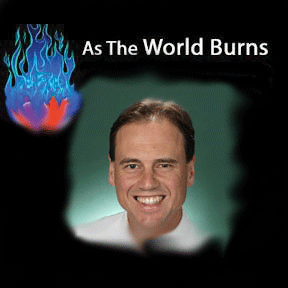
Australian Youth Climate Coalition 8 November 13 Greg Hunt MP just announced that our Government will not send an Australian Minister to the UN climate talks in Warsaw next week.
Instead they will repeal our only climate change policy.
If they won’t lead we will. November 17th we will show our Government what climate leadership looks like.
Bernie Fraser calls for political consensus on the inevitable costs of global warming
 Climate change chairman attacks policy ‘flip-flopping’ and lack of consensus, Katharine Murphy deputy political editor theguardian.com, Wednesday 30 October 2013 Bernie Fraser criticises Abbott’s ‘extreme’ position and says policy reversals create uncertainty for investors Climate Change Authority chairman and former Reserve Bank governor Bernie Fraser has criticised the lack of political consensus over climate change, arguing that rolling contention and policy “flip-flopping” is impeding Australia’s ability to deal with the inevitable costs and consequences of global warming.
Fraser told a briefing of reporters on Wednesday there was no current political consensus in Australia that the science of climate change was real, and he said policy reversals would only create uncertainty for private investors, who must do most of the “heavy lifting” in terms of investing in clean technology.
The Climate Change Authority on Wednesday concluded that Australia’s current 5% emissions reduction target was not credible, and proposed two potential alternatives: 15% or 25%. Fraser said the conclusions were not “doomsday scenarios”, they were an effort to point out that with such a slow start, Australia would not contribute a fair share to the global effort to reduce carbon pollution.
He also argued that the Abbott government’s current policy, to rely on domestic emissions reduction alone and not to purchase international carbon credits where that alternative was economically efficient, represented an “extreme” position.
Fraser said he did not intend his remarks to be provocative. He said the Climate Change Authority had no agenda beyond fulfilling its duty statement in “an objective and independent way”, and he said he anticipated a deal of community discussion about the findings and recommendations published on Wednesday.
“We are trying to provide independent advice in an objective way on what we think are important issues for the government and the community to be aware of,” he said…… http://www.theguardian.com/environment/2013/oct/30/climate-change-chairman-attacks-flip-flopping
AUDIO: climate change causes dangerous jellyfish to move South, threatening Australia’s tourism industry
 AUDIO Researchers say Irukandji jellyfish migrating further south along Qld coast http://www.abc.net.au/news/2013-10-29/irukandji-jellyfish-migrating-further-south-along-qld-coast/5051580 AM By Nance Haxton and staff 29 Oct 2013,
Marine researchers say climate change could be altering the migration patterns of the dangerous Irukandji jellyfish along Queensland’s east coast.
The Irukandji is one of the deadliest marine animals, so venomous it inflicts excruciating pain that sometimes leads to death.
It has been on a relentless march southwards down the Queensland coast.
If the Irukandji becomes established off Queensland’s south-east coast, it would be devastating for the region’s tourism industry……
Climate change brings longer bushfire season to Southern Western Australia
Fire season is longer E Daniel Mercer, The West Australian October 30, 2013 Southern WA’s bushfire season is up to six weeks longer than 20 years ago, according to a leading firefighter who has warned that preparations are increasingly being hampered by climatic and urban obstacles.
Ahead of 35C temperatures forecast for Perth today, the Department of Parks and Wildlife’s Roger Armstrong said firefighters faced a double whammy as bushfires became more extreme but prescribed burning became harder.
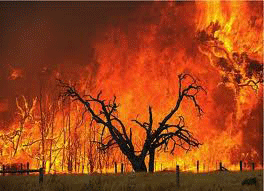
The ominous comments from Mr Armstrong, the department’s principal fire planner, come after his agency burnt just 21,000ha out of a controlled burning target of 200,000ha across the South West last year.
Mr Armstrong said though an overhaul of the department’s prescribed burning policies had contributed to the most recent shortfall, in general it was becoming more difficult to do burns.
He said this was because weather conditions most suitable for burning – which usually happens in spring and autumn – were becoming less frequent so fewer burns could be carried out. He said that added to this was a growing intolerance in urban communities such as Perth of smoke associated with prescribed burns – a trend Mr Armstrong said was exacerbated by the tree-change culture.
Amid a dramatic decline in South West rainfall and rising temperatures, the upshot was likely to be more intense bushfires that would cause more damage to lives and property, he said.
“Certainly our observations are that our bushfire season tends to be about six weeks longer now compared to what it was 20-odd years ago,” Mr Armstrong said.
“Our prescribed fire opportunities have been constrained, which means we don’t get to treat as much of the landscape as we would like to. So the potential for bushfire, the area that’s available in high-fuel condition for bushfire, is greater.
“It’s a circuitous route and it’s here to stay.
“It is challenging, particularly where people with the sea-change, tree-change thing.”………………. Weather Bureau regional manager Neil Bennett said conditions typically associated with spring and autumn were becoming rarer as winter and summer increasingly prevailed in the South West. http://au.news.yahoo.com/thewest/a/-/wa/19597504/fire-season-is-longer/
Labor likely to support axing of carbon tax
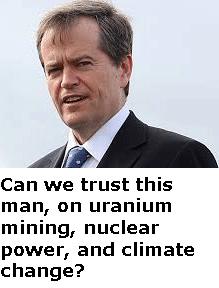 Labor’s carbon backflip October 29, 2013 The Age Tom Allard, Mark Kenny Labor is expected to support axing the carbon tax, with senior figures – including leader Bill Shorten – now convinced that its case for action on climate change is more easily sold if the politically ”toxic” tax is abolished……..
Problem with Abbott’s ‘Direct Action’ on carbon emissions – it doesn’t work
 Decades of evidence against ‘direct action’ The Age, October 29, 2013 Editorial For all the sound and fury of Australia’s debate on climate change, there is a bipartisan target for cutting greenhouse gas emissions. Tony Abbott and his colleagues say they accept the climate science, but plan to scrap their Labor predecessors’ policy of carbon pricing. The Abbott government will use a $2.88 billion fund of public money over four years to pay for ”direct action” by business, industry and landholders. The problem with this policy is that it ignores real-world experience of achieving the most cost-effective emission cuts. Economists are well aware of the evidence of successful cap-and-trade schemes and, as The Age has reported, they overwhelmingly favour the carbon pricing policy model.
Of the 35 leading economists surveyed, 30 endorsed carbon pricing and only two favoured direct action. (One regarded a ”no action” policy as right for Australia and the other doubted humans were causing climate change.) Mr Abbott has defied economists’ opinion before and in 2011 ignored a Productivity Commission report that strongly endorsed carbon pricing and trading. He has also conceded the direct action fund may not be enough to cut emissions to 5 per cent below 2000 levels by 2020, but insists the budget is fixed……….: http://www.theage.com.au/comment/the-age-editorial/decades-of-evidence-against-direct-action-20131028-2wbxt.html#ixzz2j8vd8k5z
Cut carbon emissions by 25% at least – Australia is told
 Australia should cut carbon emissions by at least 25% by 2020, says report Oliver Milman theguardian.com, Monday 28 October 2013 Target of 5% not enough, based on warming ceiling of 2C and Australia’s ‘fair share’ of global carbon budget Australia has already eaten through at least two-thirds of its share of a “carbon budget” that would keep global warming below 2C, requiring it to drastically escalate its emissions reduction target, according to a new report.
The study, conducted by consultancy firm Ecofys at the behest of WWF Australia, states that Australia should look to reduce carbon emissions by a “bare minimum” of 25% by 2020, based on 2000 levels. Continue reading
AUDIO: Australia emitting more than its fair share of greenhouse gases
AUDIO: Australia’s ‘carbon bank’ full by 2020: report http://www.abc.net.au/am/content/2013/s3877994.htm Lexi Metherell reported this story on Monday, October 28, 2013 TONY EASTLEY: A report out today suggests if carbon emissions don’t fall drastically, Australia will use up more than its fair share of the world’s carbon emissions by the end of this decade.
According to the World Wide Fund for Nature-commissioned report, Australia has already used about two-thirds of its so-called carbon budget.
And as governments prepare to meet in Warsaw for the next round of international climate talks, the environmental group is urging the Federal Government to commit to cutting emissions faster.
Lexi Metherell reports. Continue reading
Australia’s Prime Minister Abbott says climate-bushfire link is ‘complete hogwash’
Climate and fires link ‘hogwash’: PM HERALD SUN AAP OCTOBER 25, 2013 PRIME Minister Tony Abbott has described attempts to link the NSW bushfires with climate change as “complete hogwash”, as Australian scientists warn there is a clear connection between global warming and the probability of extreme fire days……
Mr Abbott ramped up the rhetoric on Friday, dismissing suggestions that climate change was behind the bushfire crisis.
“That is complete hogwash,” he told News Limited.
“I suppose, you might say, that they are desperate to find anything that they think might pass as ammunition for their cause.”
He said it was “bizarre” people were drawing parallels between the two, given there had been worse fires in Australian history, stretching back to the earliest days of European settlement. Mr Abbott said the longer the period of time, the greater the likelihood of extreme weather events, and broken records didn’t prove anything about climate change.
The prime minister earlier this week accused UN climate chief Christiana Figueres of “talking through her hat” by suggesting the fires were the result of global warming….
Greens leader Christine Milne said Mr Abbott was continuing to make a laughing stock of Australia on the world stage by ignoring the climate science. “It would be laughable if it were not so serious,” she said in a statement. Opposition leader Bill Shorten said he believed climate change was fundamentally linked to human activity, but didn’t want to speculate on the fires while people’s homes were still on the line. http://www.heraldsun.com.au/news/breaking-news/climate-and-fires-link-hogwash-pm/story-fni0xqi4-1226746632119
1 This month

of the week – Australians for War Powers Reform (AWPR)
To see nuclear-related stories in greater depth and intensity
 Antinuclear