Height of waves is increasing due to climate change
 VIDEO Climate change increasing wave height ABC News http://www.abc.net.au/news/2013-04-18/climate-
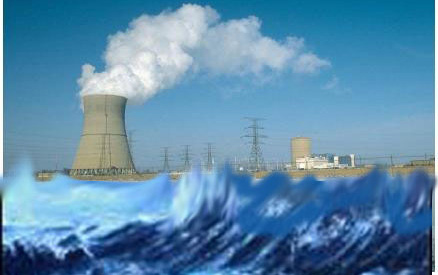 change-predicted-to-increase-wave-height/4637624 By Fiona Blackwood Apr 19, 2013 Scientists are beginning to predict how climate change will influence the height of waves.
The impact on wave height has been a neglected area of research until now.
CSIRO research scientist Mark Hemer says buoys and satellites around the world have been modelling how changes in atmospheric circulation will influence sea swells. “We see an increase in wave heights in the Southern Ocean and we see decreases in a lot of the rest of the global oceans,” he said.
Waves in the Southern Ocean could increase by half a metre over the next century.
Dr John Hunter, from the Antarctic Climate and Ecosystems CRC, says wave height will have a similar impact on coastal areas as sea level rise.”So changing waves and sea level can cause recession probably of order in some places say 100 metres this century,” he said.
“That’s quite likely a lot of houses are within 100 metres of the shoreline.” For the first time wave height will be included in a new report by the International Panel on Climate Change.
Australia’s electricity carbon emissions down, due to less demand, energy efficiency, and renewables
 Australian Electricity Generation Emissions Drop By 14 Million Tonnes http://www.energymatters.com.au/index.php?main_page=news_article&article_id=3689 16 April 13, National Greenhouse Accounts released on Monday show Australia’s carbon pollution from electricity generation fell by 14 million tonnes during 2012.
The Accounts state Australia’s total greenhouse gas emissions declined by 0.2 per cent for the year to December 2012. Annual emissions for the year to December 2012 were estimated to be 551.9 million tonnes of carbon dioxide equivalent.
The decrease in overall annual emissions for the year was largely due to a decline in emissions from electricity reflecting lower electricity demand and changes in the energy generation mix.
Over the first six months of 2012-13, electricity emissions were at their lowest level since 2001-02 states the Quarterly Update of Australia’s National Greenhouse Gas Inventory (PDF).
Over the full year, generation in the National Electricity Market from black coal reduced by 5.3% and brown coal generation emissions dropped 7.0%; with both fossil fuels seeing their lowest generation levels in more than a decade. Continue reading
Australia’s carbon emissions way down,as renewable energy rises
 Australian CO2 emissions hit 10-year low, Climate Spectator,
At the same time, the share of renewable energy in the National Electricity Market (NEM) has soared beyond 12 per cent and looks set to continue rising. Continue reading
Climate denialist Andrew Bolt doesn’t seem to understand graphs
Latham: climate lunacy, or how Bolt can’t read a graph Crikey MARK LATHAM | APR 04 How can Andrew Bolt point to a graph as showing a “pause” in global warming, when it unequivocally shows the opposite? He’s a propagandist of the highest order. It’s official: Andrew Bolt has lost the plot. On his blog on Wednesday, he presented the following graph (using UAH satellite data) as evidence of how “the pause in global warming continues”.

No intelligent person could look at these figures and see anything but a trend toward global warming.- subscription only http://www.crikey.com.au/2013/04/04/latham-climate-lunacy-or-how-bolt-cant-read-a-graph/
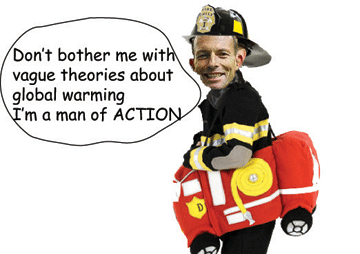
Tony Abbott would abolish the Climate Commission, sack Professor Tim Flannery
 A Climate Commission report released on Wednesday examined links between Australia’s extreme weather and human-induced climate change. It found natural events were being influenced by climate change, because greenhouse gases are accumulating and trapping extra energy in the Earth’s atmosphere and oceans.
”When the carbon tax goes, all of those bureaucracies will go and I suspect we might find that the particular position you refer to goes with them,” Mr Abbott told Macquarie Radio on Wednesday. Continue reading
Australia now in a state of permanent climate change, say scientists
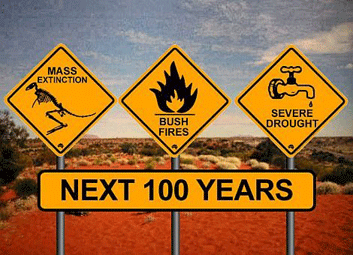 Top scientists agree climate has changed for good The nation’s top climate scientists and science bodies have for the first time endorsed a major report that says Australia’s climate has shifted permanently in some cases.
The peer-reviewed assessment notes that there is “strong consensus” around this central finding, and in some cases the weather has changed for good.http://www.abc.net.au/news/2013-04-03/scientist-endorse-report-that-says-climate-has-shifted/4606372
(Link provided to the Climate Commission’s latest report: The Critical Decade: Extreme Weather)
The pitfalls of geo-ingineering as a climate change solution
 Chilling Out Globally, Craig K Comstock, 2 Apr 13 “…….A sulfur compound injected into the middle atmosphere would mimic a massive volcanic eruption, which is known to reduce the mean surface temperature.
Geo-engineering is what humans could do after they’ve been unable to reduce emissions of greenhouse gases adequately or are afraid to try or feel that a reduction is not “cost-effective.” ….
Clive Hamilton, in Earthmasters, brings the story up to date, with a special focus on ethics. In Australia, where he lives, Hamilton is branded as a public intellectual, which means he shares his extensive knowledge not only with his colleagues but with the educated public. A skeptic about humans, Hamilton called his prior book, Requiem for a Species, which devoted part of chapter 6 to geo-engineering, the subject of the entire new book…..
Most climate scientists prefer reducing the emission of greenhouse gases to any form of geo-engineering, but this isn’t happening (except as a result of economic recession). Fossil fuel firms warn that reducing emissions might wreck the economy, depressing the standard of living. So the carbon builds up, and geo-engineering waits as the potential savior.
Why not just do it? Let’s run through several difficulties. Continue reading
New Energy Minister Gray – dubious credentials on climate change
Political moves in Australia’s renewable energy landscape, PV Magazine 25 MARCH 2013 BY: JONATHAN GIFFORD, A cabinet reshuffle in Australia results in the Department of Climate Change merging with Industry and a new Energy Minister. In the states of Queensland and Western Australia, electricity price policies remain a subject for debate.
 With renewable energy becoming an increasingly contentious issue in Australian politics, former oil and gas industry advisor Gary Gray has been appointed Australia’s new Energy Minister in a cabinet reshuffle. As a part of the changes, the Climate Change Department will be merged with the Industry Department, however minister Greg Combet will remain in charge of the portfolio.
Australian green business website Climate Spectator observed earlier today that not bringing the energy and climate change portfolios together represented a missed opportunity. It also pointed out that new energy minister Gray has dubious credentials when it comes to climate change.
“Gary Gray was one of the founders of the Lavoisier Institute, a group that has probably done more than any to spread misinformation about the science of global warming in Australia. According to The Age (newspaper), in 1993 Gray said the evidence linking human activity to climate change was ‘pop science’.”…..
The government has shown support for renewables in other ways and last week it committed to maintaining its Renewable Energy Target (RET) for 2020, a move that was welcomed by the photovoltaic and renewable energy industries…… http://www.pv-magazine.com/news/details/beitrag/political-moves-in-australias-renewable-energy-landscape_100010677/#ixzz2OxVmPPeE
Global warming is changing New South Wales south east region
Region’s weather changing http://www.abc.net.au/news/2013-03-05/region27s-weather-changing/4554482 Mar 5, 2013 A climate change expert says the New South Wales south east is becoming hotter and drier due to global warming. Climate Change Commissioner, Professor Lesley Hughes, will be in Bega next week to conduct a question and answer session on the effects of changing weather patterns.
Prof. Hughes says the region is in the midst of a long-term dry period that saw a 13-year drought and bushfires. She says there has been a one degree temperature increase in the last century with the alpine areas showing the greatest effect.
“In the terrestrial environment on land the alpine environment is probably is the most vulnerable eco-system to climate change,” Prof. Hughes said. “Our mountains in Australia are fairly short by world standards. Plants and animals can move up hill to stay in cooler climates but because our mountains are very short they don’t have very far to go.”
Prof. Hughes says the rise in temperature is being reflected among fauna and flora, and in ocean changes. “Over the last century for example in Australia we have had just a little bit under a degree of mean annual temperature rise but we are seeing plants and animals all over the place both in Australia and the rest of the world actually responding to that.
“In our marine life we are seeing lots of species moving further to the south.”
Global warming already having its impact on Australia
It is highly likely that extreme hot weather will become more frequent and severe in Australia over the coming decades. Australia’s angry summer shows that climate change is already adversely affecting Australians.
Angry summer shaped by a shifting climate, http://theconversation.edu.au/angry-summer-shaped-by-a-shifting-climate-12580 The Conversation, Will Steffen, Australian Climate Commissioner, Executive Director of the ANU Climate Change Institute at Australian National University March 4 13 The hottest summer on record. The hottest month on record. The hottest day ever recorded for the whole of Australia. Heatwaves, bushfires, record rainfall and floods – extreme events across the land. This was the angry summer.
The Climate Commission’s latest report, The Angry Summer, assesses the events of this summer and the influence of climate change on them. Continue reading
THE AUSTRALIAN’s Graham Lloyd misled readers on the truth about global warming
it does not accurately represent Pachauri’s thoughts on the subject – namely that as discussed in this post, global surface temperatures have plateaued (though over the past decade, not 17 years), and that this in no way disproves global warming.
To hear what Pachauri actually thinks about global warming without first passing through The Australian’s filter, you can listen to interviews with him on Radio Australia and ABC News. Also see a similar debunking of this myth by The Australian Climate Commission.
 Did Murdoch’s The Australian Misrepresent IPCC Chair Pachauri on Global Warming? 25 February 2013 by dana1981 As we have discussed many times at Skeptical Science, although the warming of global surface air temperatures has slowed over the past decade due to a preponderance of La Niña events, the rate of heat accumulation on Earth has not slowed at all. In fact over the past 15 years, the planet has accumulated more heat than during the previous 15 years (Figure 1). That’s global warming.
Unfortunately many people (often even including climate scientists) mistakenly equate the warming of global surface air temperatures with global warming. That is simply inaccurate. Approximately 90% of global warming goes into heating the oceans.
So the reality is that global warming continues unabated. Despite this reality, an article by Graham Lloyd in The Australian (paywalled) claims that the chairman of the Intergovernmental Panel on Climate Change (IPCC), Rajendra Pachauri agreed that there has been a 17-year pause in global temperature rises. Unfortunately we don’t know exactly what Pachauri said on the subject, because Lloyd did not quote him directly (which is a red flag). Continue reading
Christine Milne explodes Greg Hunt’s Liberal Coalition sham climate change action plan
 Treasury has said that: “Direct Action measures alone cannot do the job without imposing significant economic and budget costs…Moreover, many of the direct action measures cannot be scaled up to achieve significant levels of abatement, and for those that can be scaled up, the cost per tonne of abatement would rise rapidly.
The Coalition cannot hide from the fact that Direct Action is a slogan, not a policy. It’s time that they were called out on it.”
 Why Greg Hunt’s Direct Action policy is a sham http://reneweconomy.com.au/2013/why-greg-hunts-direct-action-policy-is-a-sham-77552 By Christine Milne on 28 February 2013
“Let’s consider Mr Hunt’s Direct Action Plan. It’s a sham.
“This week the Coalition has been all over the shop. From “we will compensate businesses” from Joe Hockey and “we will not compensate businesses” from Tony Abbott and “we will impose penalties” from Abbott and “we don’t expect to” from Mr Hunt.
The world is on a trajectory of 4 degrees of warming. The fact that Direct Action cannot be scaled up, is only intended to reduce emissions by 5% and cannot effectively achieve more is its overwhelming and fundamental failure. Who in their right mind thinks that such a weak target in any way reflects the science?
At a time when we have IMF boss Christine Lagarde saying, “Unless we take action on climate change future generations will be roasted, toasted fried and grilled” to try to suggest that an Australian target of just -5% by 2020 is acceptable is a lie. As the rest of the world move towards a legally binding global treaty and the second commitment period of the Kyoto Protocol, such a lax target will become untenable and indefensible.

To the detail of the plan, it is in essence a massive ‘competitive grant programme’ which seeks to reduce emissions by companies putting in ‘tenders’ for actions that reduce greenhouse gas emissions and the government then paying those companies which submit the lowest bids (per tonne of abatement).
There are numerous fundamental problems, many of which, while widely understood are rarely discussed. For example:
1) The Coalition expects more than 60% of the abatement to come from soil carbon – but the science to back this up is not yet solid, so this abatement would not be recognised in international treaties. That’s a showstopper. Continue reading
A win win situation – carbon economy enables conservation, with early fire practices in Australia’s Northern Territory
There is little doubt that the new carbon economy is transforming fire and biodiversity management across northern Australia. Many areas managed for biodiversity conservation can now generate a substantial income beyond the public purse. This will surely allow the further privatisation of biodiversity conservation, at a time when non-government organisations are already playing an increasingly central, and indeed successful, role in conservation in northern Australia.
Implementing biodiversity-friendly fire regimes remains an enormous management challenge in the north. Although the carbon economy is unlikely to be a panacea, it certainly provides a much-needed income stream for sustainable land management, especially for the vast lands outside of the traditional conservation estate.
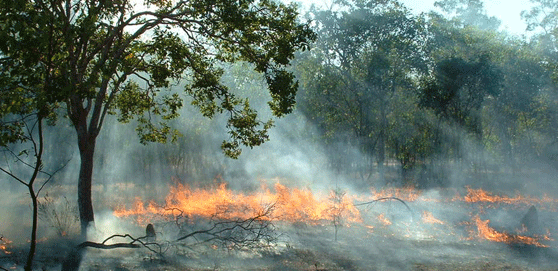
Savanna burning: carbon pays for conservation in northern Australia http://theconversation.edu.au/savanna-burning-carbon-pays-for-conservation-in-northern-australia-12185 22 Feb 13, Fire and biodiversity have a complex relationship in northern Australia. Tim Flannery and others blame the current northern biodiversity crisis, at least in part, on changed fire regimes. Improving fire management is critical to conserving savanna landscapes – but who pays for it? A new funding model, tapping into the carbon economy, has emerged in the far north and is rapidly transforming fire management and biodiversity conservation.
A new funding model for fire management
The idea that land management could be funded by carbon credits emerged from Aboriginal-owned Arnhem Land in the Northern Territory. By the 1990s it was clear that the region’s enormous biodiversity values were being eroded by frequent, intense late dry season fires.
To address this problem, a trailblazing group of Western scientists and land managers, and Aboriginal Traditional Owners developed a program of prescribed burning early in the dry season to pre-empt large, intense wildfires late in the dry season.
The most innovative part of their work was to link improvements in fire management to reductions in greenhouse gas emissions. They also realised that this emissions reduction (or abatement) could be used to secure resources for land management. The abatement occurs because early dry season fires tend to be patchier and less intense than late season fires, and therefore burn less fuel. Because less fuel is burnt, fewer emissions are produced.
The project that resulted from this early work – the 28,000 km²West Arnhem Land Fire Abatement project – has operated since 2005 and is funded by one of the world’s largest energy companies, ConocoPhillips. They provide $1 million annually in return for an abatement of greenhouse gases equivalent to 100,000 t of CO₂. Continue reading
Engineers Australia (IEAust) wants greater greenhouse cuts, and a big shift to renewable energy
Engineers Australia Advocates 80 Per Cent Reduction in Greenhouse Gas Emissions http://designbuildsource.com.au/engineers-australia-advocates-80-per-cent-reduction-in-greenhouse-gas-emissions By Marc Howe, 19 Feb 13, A submission by Engineers Australia (IEAust) to the Australian Renewable Energy Agency (ARENA) endorses ambitious new targets for reductions in the country’s greenhouse gas emissions by mid-century.
The new benchmarks target a reduction of 25 per cent of greenhouse gas emissions by 2020 and 80 per cent by 2050 based on 2000 levels. These declines are believed to be necessary for Australia to make a meaningful contribution to international efforts to keep emissions within 450 ppm of equivalent carbon dioxide (CO2-e), and ensure that global average temperature gains are kept within two degrees Celsius.
In addition to supporting the new set of targets, the Sustainable Engineering Society strongly advocates a stricter target of 350ppm CO2-e, due to uncertainty over whether the 450ppm target will be sufficient to limit worrying gains in global temperature levels.
The professional engineering body also supports the concomitant shift to renewable energies that such ambitious reductions in CO2 emissions will necessitate. Continue reading
Tony Abbott regurgitates USA’s Tea Party’s words, on climate change
A bill on a carbon price is to be introduced into the US Senate as early as today (US time) by independentSenator Bernie Sanders and Democrat Barbara Boxer. Details are scant, but it seems likely to be a form of carbon tax that would impose a “fee on carbon pollution emissions” and fund “historic investments in energy efficiency and sustainable energy technologies such as wind, solar, geothermal and biomass”. It would provide rebates to consumers to offset any efforts by oil, coal or gas companies to raise prices.
Sounds a lot like Australia’s scheme.
 Obama’s climate push leaves Abbott out in the cold, REneweconomy, By Giles Parkinson 14 February 2013 Here’s a statistic that Opposition Leader Tony Abbott, the former trainee Catholic seminarian who insists that no other nation is pricing carbon, might find interesting. The number of people living in countries with carbon taxes or emission trading schemes will rise to about one billion by the end of the year. There are almost as many of them in the world as there are Catholics.
Abbott may wish this fact out of existence, but if US President Barack Obama has his way — as announced in his State of the Union (SOTU) address yesterday – and the world’s biggest economy introduces a market-based system to limit carbon emissions, that global carbon headcount would jump by 300 million or so by the end of 2014.
If China goes ahead with its pilot carbon schemes in a bunch of provinces and cities, and prepares for a wider scheme, that would add another 1.4 billion. Abbott may find himself taking Australian voters to a double dissolution election — where he would seek to win what would would effectively be a referendum on climate action — by pretending the world is not acting on climate change. To paraphrase and lightly censor a remark made by Climate Change Minister Greg Combet yesterday, it’s a load of bollocks.
So what did Obama say yesterday?
“I urge this Congress to get together, pursue a bipartisan, market-based solution to climate change, like the one John McCain and Joe Lieberman worked on together a few years ago. But if Congress won’t act soon to protect future generations, I will. I will direct my Cabinet to come up with executive actions we can take, now and in the future, to reduce pollution, prepare our communities for the consequences of climate change, and speed the transition to more sustainable sources of energy.”
Obama was expected to focus on climate change policies in SOTU, after making it a central point of his inauguration address, but the fact that he so specifically championed cap-and-trade has taken many by surprise…….. Continue reading
1 This month

of the week – Australians for War Powers Reform (AWPR)
To see nuclear-related stories in greater depth and intensity
 Antinuclear