Victorian government decides that climate change is a low priority
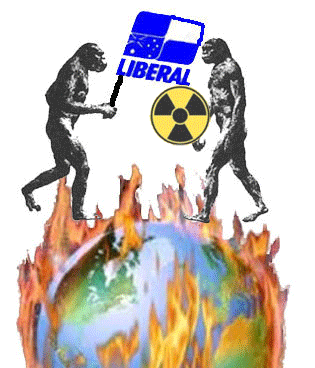 THE Victorian Government has abandoned key agricultural climate change programs. Weekly Times, 5 June 13 It comes as environment groups this week claimed rural communities were being left to “fend for themselves”. Opposition water spokesman John Lenders criticised the move. ”If Peter Walsh thinks that providing farmers with vital drought support packages is purely a climate-related matter he is living in a fantasy land.
“Labor’s $205 million Future Farming Strategy focusing around research and development initiatives was cut back to $60 million by the Napthine Government in 2012 and attempted to dress it up as a boost……Victorian Budget papers reveal a significant cut in climate change work and a continued withdrawal from the Brumby Government’s $205m Future Farms Strategy.
The Budget papers say the lower 2013-14 target “reflects the refocusing of Department of Environment and Primary Industries into higher priorities”……
“Since being elected, they have abolished nearly all state climate programs,” Mr Wakeham said.
“Deciding not to talk about or develop policy on climate change unfortunately won’t make it go away as we’re set to learn the hard way.”
The Climate Commission recently said Victoria had entered a critical decade in the race to adapt to the stresses of climate change.
Professor Tim Flannery said Victoria was very vulnerable to large swings in climate.
Meanwhile, 13 DEPI bio scientists have been made redundant. The cuts were flagged in March but the Community and Public Sector Union said staff were told last week…..http://www.weeklytimesnow.com.au/article/2013/06/05/572284_politics-news.html
Port Fairy, Victoria, vulnerable to sea level rise
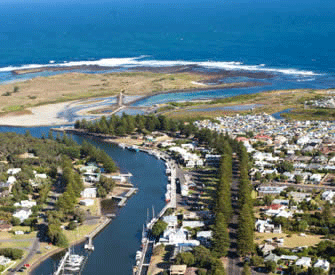 Report says hundreds of buildings vulnerable to flooding from rising sea levels at Port Fairy
http://www.abc.net.au/news/2013-05-28/report-says-hundreds-of-buildings-vulnerable-to-flooding-from-r/4716588
May 28, 2013 A report has found potentially disturbing effects of rising sea levels on the popular tourist town of Port Fairy, in south-western Victoria.
The consultants found if the sea level rises 80 centimetres by 2080, up to 390 buildings could be vulnerable to flooding.
The consultants say some of the report’s findings are disturbing and a huge amount of adaptation planning is needed.
Moyne Shire councillors will decide whether to release the full document for community consultation.
Australia to cop it most in Climate Change
Predictions Australia will be hardest hit by climate change http://www.abc.net.au/news/2013-05-17/predictions-australia-will-be-hardest-hit-by-climate-change/4695718 A national conference on mining and coal seam gas in the Hunter Valley this weekend will hear the world is past the point of preventing climate change.
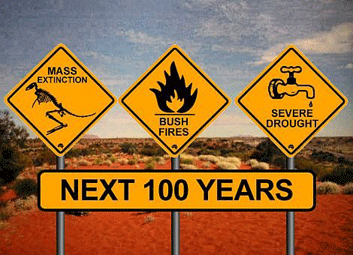
Community leaders and experts in energy policy, health and renewables are gathering for the three day forum in Kurri Kurri this weekend.
Ian Dunlop is a former senior Executive of Royal Dutch Shell and a former chair of the Australian Coal Association. He says the coal industry has known since the 1980’s climate concerns will limit its primacy.
He says the world has already left it too late to prevent the onset of major climate change, pointing to the ominous milestone reached in the last week that saw the atmospheric concentration for carbon dioxide surpassing levels not seen in millions of years. The conference will hear from community groups that have successfully opposed coal and CSG developments in NSW, Queensland and the United States.
Mr Dunlop, who’s now with the Association for the study of Peak Oil and Gas, says Australia will be one of the hardest hit by a rise in global temperatures.
“I mean this is what people don’t seam to get, you cannot continue to operate businesses of any kind in a world where the average temperature has gone up 4 degrees, it’s just not feasible for people to work in those conditions,” he said.
“We’re one of the driest continents on the earth and the effects on Australia will be more severe than elsewhere.”
Mr Dunlop says climate change will also have a negative impact on Australia’s agricultural industry.
“The much longer term problems of the sustainability of things like agriculture because if we keep on going where we’re going large parts of the country are either going to be moving back into deserts or alternatively they’ll end up subject to extreme flooding and conditions that aren’t particularly conducive to agriculture anyway,” he said.
97% of scientific opinion supports human-caused global warming: no real “debate” on the science
 Not much climate change doubt, science says : http://www.theage.com.au/environment/climate-change/not-much-climate-change-doubt-science-says-20130515-2jmup.html#ixzz2TV6hLn4F Peter Hannam Carbon economy editor, 16 May 13,
Having doubts over climate change and the role of humans? You’re unlikely to find many scientists who share your uncertainty. That is the finding of a University of Queensland-led study that surveyed the abstracts of almost 12,000 scientific papers from 1991-2011 and claims to be the largest peer-reviewed study of its kind. Of those who a stated a position on the evidence for global warming, 97.1 per cent endorsed the view that humans are to blame. Just 1.9 per cent rejected the view.
The report’s lead author, John Cook, a fellow at the University of Queensland’s Global Change Institute and founder of the website skepticalscience.com, said the scientific consensus was overwhelming, growing and had been around since the early 1990s.
He said that while the number of papers rejecting the consensus was “vanishingly small”, his research suggested the public was under the impression the debate was split 50-50. Continue reading
44 Indigenous Carbon Funding projects approved – ready to go
Successful Indigenous Carbon Farming Fund projects announced http://www.investinaustralia.com/news/successful-indigenous-carbon-farming-fund-projects-announced-12c3 24 April 13 Environment Minister Tony Burke and Parliamentary Secretary for Climate Change, Industry and Innovation Yvette D’Ath today announced the 44 successful applications under the Australian Government’s Indigenous Carbon Farming Fund Capacity Building and Business Support stream.
Mr Burke said through this program, the Australian Government is helping Indigenous Australians access carbon farming specialists, business development expertise and legal advice for their carbon farming projects. “These projects are spread across Australia and range from undertaking feasibility assessments to developing carbon farming project ideas and existing carbon farming businesses,” Mr Burke said.
“This program will not only provide benefits for our environment but also provide employment opportunities in indigenous communities.”
Other successful proposals include feasibility assessment of carbon projects, community education, and the development of businesses to provide services or undertake carbon abatement and sequestration activities under the Carbon Farming Initiative (CFI).
Mrs D’Ath said the projects have received funding to assist Indigenous communities to benefit from the Carbon Farming Initiative.
“The Research and Development stream of this initiative provides funding to underpin CFI methodologies and the development of tools for estimating and reporting on emissions,” Mrs D’Ath said. “Up on Cape York Peninsula, where the project area covers an area of up to 2,300,000 ha in Aurukun, one group aims to avoid emissions of approximately 30,000 tonnes CO2 per year.”
The Fund will provide $22.3m over five years to assist Aboriginal and Torres Strait Islander people to participate in the CFI. The CFI enables Indigenous landholders and land managers to earn carbon credits by undertaking projects to reduce emissions or store carbon. Types of projects include early season savannah burning and environmental plantings.
For more information, including a list of successful projects, go tohttp://www.environment.gov.au/cleanenergyfuture/icff/index.html.
Height of waves is increasing due to climate change
 VIDEO Climate change increasing wave height ABC News http://www.abc.net.au/news/2013-04-18/climate-
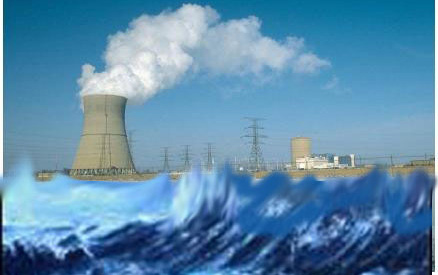 change-predicted-to-increase-wave-height/4637624 By Fiona Blackwood Apr 19, 2013 Scientists are beginning to predict how climate change will influence the height of waves.
The impact on wave height has been a neglected area of research until now.
CSIRO research scientist Mark Hemer says buoys and satellites around the world have been modelling how changes in atmospheric circulation will influence sea swells. “We see an increase in wave heights in the Southern Ocean and we see decreases in a lot of the rest of the global oceans,” he said.
Waves in the Southern Ocean could increase by half a metre over the next century.
Dr John Hunter, from the Antarctic Climate and Ecosystems CRC, says wave height will have a similar impact on coastal areas as sea level rise.”So changing waves and sea level can cause recession probably of order in some places say 100 metres this century,” he said.
“That’s quite likely a lot of houses are within 100 metres of the shoreline.” For the first time wave height will be included in a new report by the International Panel on Climate Change.
Australia’s electricity carbon emissions down, due to less demand, energy efficiency, and renewables
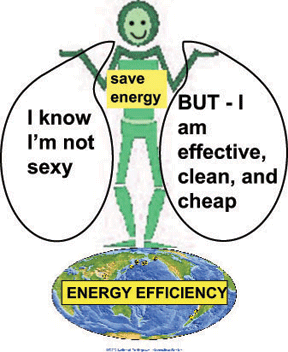 Australian Electricity Generation Emissions Drop By 14 Million Tonnes http://www.energymatters.com.au/index.php?main_page=news_article&article_id=3689 16 April 13, National Greenhouse Accounts released on Monday show Australia’s carbon pollution from electricity generation fell by 14 million tonnes during 2012.
The Accounts state Australia’s total greenhouse gas emissions declined by 0.2 per cent for the year to December 2012. Annual emissions for the year to December 2012 were estimated to be 551.9 million tonnes of carbon dioxide equivalent.
The decrease in overall annual emissions for the year was largely due to a decline in emissions from electricity reflecting lower electricity demand and changes in the energy generation mix.
Over the first six months of 2012-13, electricity emissions were at their lowest level since 2001-02 states the Quarterly Update of Australia’s National Greenhouse Gas Inventory (PDF).
Over the full year, generation in the National Electricity Market from black coal reduced by 5.3% and brown coal generation emissions dropped 7.0%; with both fossil fuels seeing their lowest generation levels in more than a decade. Continue reading
Australia’s carbon emissions way down,as renewable energy rises
 Australian CO2 emissions hit 10-year low, Climate Spectator,
At the same time, the share of renewable energy in the National Electricity Market (NEM) has soared beyond 12 per cent and looks set to continue rising. Continue reading
Climate denialist Andrew Bolt doesn’t seem to understand graphs
Latham: climate lunacy, or how Bolt can’t read a graph Crikey MARK LATHAM | APR 04 How can Andrew Bolt point to a graph as showing a “pause” in global warming, when it unequivocally shows the opposite? He’s a propagandist of the highest order. It’s official: Andrew Bolt has lost the plot. On his blog on Wednesday, he presented the following graph (using UAH satellite data) as evidence of how “the pause in global warming continues”.

No intelligent person could look at these figures and see anything but a trend toward global warming.- subscription only http://www.crikey.com.au/2013/04/04/latham-climate-lunacy-or-how-bolt-cant-read-a-graph/
Tony Abbott would abolish the Climate Commission, sack Professor Tim Flannery
 A Climate Commission report released on Wednesday examined links between Australia’s extreme weather and human-induced climate change. It found natural events were being influenced by climate change, because greenhouse gases are accumulating and trapping extra energy in the Earth’s atmosphere and oceans.
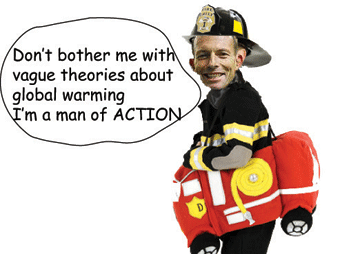
”When the carbon tax goes, all of those bureaucracies will go and I suspect we might find that the particular position you refer to goes with them,” Mr Abbott told Macquarie Radio on Wednesday. Continue reading
Australia now in a state of permanent climate change, say scientists
Top scientists agree climate has changed for good The nation’s top climate scientists and science bodies have for the first time endorsed a major report that says Australia’s climate has shifted permanently in some cases.
The peer-reviewed assessment notes that there is “strong consensus” around this central finding, and in some cases the weather has changed for good.http://www.abc.net.au/news/2013-04-03/scientist-endorse-report-that-says-climate-has-shifted/4606372
(Link provided to the Climate Commission’s latest report: The Critical Decade: Extreme Weather)
The pitfalls of geo-ingineering as a climate change solution
 Chilling Out Globally, Craig K Comstock, 2 Apr 13 “…….A sulfur compound injected into the middle atmosphere would mimic a massive volcanic eruption, which is known to reduce the mean surface temperature.
Geo-engineering is what humans could do after they’ve been unable to reduce emissions of greenhouse gases adequately or are afraid to try or feel that a reduction is not “cost-effective.” ….
Clive Hamilton, in Earthmasters, brings the story up to date, with a special focus on ethics. In Australia, where he lives, Hamilton is branded as a public intellectual, which means he shares his extensive knowledge not only with his colleagues but with the educated public. A skeptic about humans, Hamilton called his prior book, Requiem for a Species, which devoted part of chapter 6 to geo-engineering, the subject of the entire new book…..
Most climate scientists prefer reducing the emission of greenhouse gases to any form of geo-engineering, but this isn’t happening (except as a result of economic recession). Fossil fuel firms warn that reducing emissions might wreck the economy, depressing the standard of living. So the carbon builds up, and geo-engineering waits as the potential savior.
Why not just do it? Let’s run through several difficulties. Continue reading
New Energy Minister Gray – dubious credentials on climate change
Political moves in Australia’s renewable energy landscape, PV Magazine 25 MARCH 2013 BY: JONATHAN GIFFORD, A cabinet reshuffle in Australia results in the Department of Climate Change merging with Industry and a new Energy Minister. In the states of Queensland and Western Australia, electricity price policies remain a subject for debate.
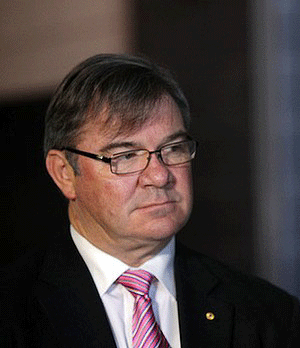 With renewable energy becoming an increasingly contentious issue in Australian politics, former oil and gas industry advisor Gary Gray has been appointed Australia’s new Energy Minister in a cabinet reshuffle. As a part of the changes, the Climate Change Department will be merged with the Industry Department, however minister Greg Combet will remain in charge of the portfolio.
Australian green business website Climate Spectator observed earlier today that not bringing the energy and climate change portfolios together represented a missed opportunity. It also pointed out that new energy minister Gray has dubious credentials when it comes to climate change.
“Gary Gray was one of the founders of the Lavoisier Institute, a group that has probably done more than any to spread misinformation about the science of global warming in Australia. According to The Age (newspaper), in 1993 Gray said the evidence linking human activity to climate change was ‘pop science’.”…..
The government has shown support for renewables in other ways and last week it committed to maintaining its Renewable Energy Target (RET) for 2020, a move that was welcomed by the photovoltaic and renewable energy industries…… http://www.pv-magazine.com/news/details/beitrag/political-moves-in-australias-renewable-energy-landscape_100010677/#ixzz2OxVmPPeE
Global warming is changing New South Wales south east region
Region’s weather changing http://www.abc.net.au/news/2013-03-05/region27s-weather-changing/4554482 Mar 5, 2013 A climate change expert says the New South Wales south east is becoming hotter and drier due to global warming. Climate Change Commissioner, Professor Lesley Hughes, will be in Bega next week to conduct a question and answer session on the effects of changing weather patterns.
Prof. Hughes says the region is in the midst of a long-term dry period that saw a 13-year drought and bushfires. She says there has been a one degree temperature increase in the last century with the alpine areas showing the greatest effect.
“In the terrestrial environment on land the alpine environment is probably is the most vulnerable eco-system to climate change,” Prof. Hughes said. “Our mountains in Australia are fairly short by world standards. Plants and animals can move up hill to stay in cooler climates but because our mountains are very short they don’t have very far to go.”
Prof. Hughes says the rise in temperature is being reflected among fauna and flora, and in ocean changes. “Over the last century for example in Australia we have had just a little bit under a degree of mean annual temperature rise but we are seeing plants and animals all over the place both in Australia and the rest of the world actually responding to that.
“In our marine life we are seeing lots of species moving further to the south.”
Global warming already having its impact on Australia
It is highly likely that extreme hot weather will become more frequent and severe in Australia over the coming decades. Australia’s angry summer shows that climate change is already adversely affecting Australians.
Angry summer shaped by a shifting climate, http://theconversation.edu.au/angry-summer-shaped-by-a-shifting-climate-12580 The Conversation, Will Steffen, Australian Climate Commissioner, Executive Director of the ANU Climate Change Institute at Australian National University March 4 13 The hottest summer on record. The hottest month on record. The hottest day ever recorded for the whole of Australia. Heatwaves, bushfires, record rainfall and floods – extreme events across the land. This was the angry summer.
The Climate Commission’s latest report, The Angry Summer, assesses the events of this summer and the influence of climate change on them. Continue reading
1 This month


Help Aunty Sue Protect Her Land and Sacred Sites From Destructive Rocket Testing.
.

Australians deserve the truth
about
AUKUS – https://aukuspublicinquiry.com/

PETITION – To: Prime Minister Anthony Albanese and the Australian Labor Government

of the week – Australians for War Powers Reform (AWPR)
To see nuclear-related stories in greater depth and intensity

