Climate Change Is a Security Threat to the Asia-Pacific
|
Climate Change Is a Security Threat to the Asia-Pacific
Climate change is likely to alter the local physical and strategic environment profoundly, and potentially catastrophically. The Diplomat, By Shiloh Fetzek and Dennis McGinn, August 10, 2020 This week the ASEAN Joint Task Force on Humanitarian Assistance and Disaster Relief (HADR) will meet via video conference, with the COVID-19 pandemic escalating just as some countries in the disaster-prone Indo-Asia Pacific enter their cyclone, drought, heatwave, or monsoon seasons. The overlaying of the pandemic with existing complex challenges is a timely reminder that planning for HADR capacities – and regional security – needs to be attuned to the increasing likelihood of multiple, overlapping hazards and converging security risks, especially in a future where climate change alters the context in which other disasters and crises take place. Developing a clearer recognition of how climate change can reshape the strategic environment will be essential for preserving regional security, stability, and prosperity in the face of complicated and interlocking challenges, as we argue in a new report on the Indo-Asia Pacific published by the International Military Council on Climate and Security (IMCCS).
The Indo-Asia Pacific is highly exposed to climate change impacts. Climate change is likely to alter the local physical and strategic environment profoundly, and potentially catastrophically. More frequent or intense extreme weather, sea level rise, and ocean acidification (among other climate impacts) will create a range of threats to the well-being and security of countries in the region, many of which are already threatened by disaster vulnerability and increasingly complex security tensions.
As well as the immediate physical impacts, climate change will increase food and water insecurity, contribute to forced migration and displacement, and challenge disaster response and recovery capabilities …….. https://thediplomat.com/2020/08/climate-change-is-a-security-threat-to-the-asia-pacific/
|
|
Australia must place climate action at centre of coronavirus recovery, chief UN economist says

|
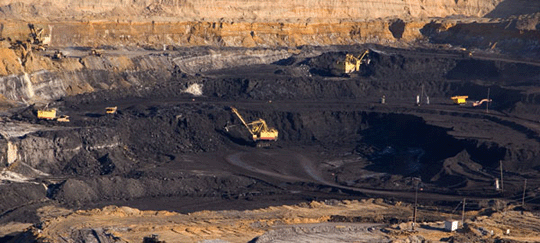
Australia must place climate action at centre of coronavirus recovery, chief UN economist says, SBS, BY TOM STAYNER 12 Aug 20, A chief economist for the United Nations has urged Australia to prioritise climate action above pouring money into fossil fuels in its coronavirus recovery.
A United Nations chief economist has urged Australia and other countries across the world to place more ambitious climate action and investment in clean energy at the centre of their COVID-19 recovery plans. Elliott Harris is helping lead the UN’s development of policy advice for nations grappling with the pandemic. Mr Harris appeared on a webinar with progressive think tank the Australia Institute on Wednesday, where he was questioned about how the Australian government should shape its recovery from the pandemic. He said developed nations such as Australia must be willing to make difficult decisions and prioritise a “green recovery”.
“What we’ve seen in this COVID crisis is that governments are indeed capable of really ambitious, rather unorthodox, extremely important and even massive interventions,” he told the webinar. “I can think of no stakes that are higher than the climate crisis that we are living in right now.” UN Secretary General Antonio Guterres has stressed coal should play no part in any country’s post-coronavirus stimulus plan, while business leaders in Australia have also been putting pressure on the federal government to prioritise renewable energy projects. The head of the federal government’s COVID advisory committee Nev Power told a Senate committee on Tuesday he has been approached about locking in a low emission future……… Mr Harris said Australia should focus on making long-term “sustainable” investments, rather than subsidising further fossil fuel projects. “This is a critical choice that all countries have to make and all investors have to make,” he said. “There is a very difficult trade-off, there is no doubt about it.” “[But] we really need to think about how we shift the flow of investment towards sustainability. “The fact of it is that, unfortunately, the world does not have the luxury of allowing itself of continuing down the path of fossil fuels.” Australia’s commitment to the Paris Agreement requires emissions reduction of at least 26 per cent by 2030, based on 2005 levels. But the government has come under scrutiny for not having a 2050 target, with the Business Council of Australia, Australian Industry Group and big miners Rio Tinto and BHP all backing a net zero-emissions goal by then. Australia is considered one of the world’s largest exporter of fossil fuels through coal and liquified natural gas projects, but also a leading investor in renewable energy. The UN has predicted the world economy will shrink by 3.2 per cent in 2020 because of the economic downturn forced by the pandemic. https://www.sbs.com.au/news/australia-must-place-climate-action-at-centre-of-coronavirus-recovery-chief-un-economist-says |
|
|
Australia’s doctors call for a climate-focused COVID-19 recovery plan
|
Medical groups call for a climate-focused COVID-19 recovery plan, https://thenewdaily.com.au/news/2020/08/11/medical-groups-climate-focused-covid-19-recovery/ Dominica Sanda Many of the medical professionals on the frontline of the COVID-19 pandemic are urging the Australian government to also act on another health crisis – climate change.Australia’s peak medical groups representing GPs, emergency doctors, obstetricians and psychiatrists have written to Prime Minister Scott Morrison urging him to make climate change action a part of the COVID-19 economic response.
The letter, co-ordinated by the Doctors for the Environment Australia, notes the COVID-19 pandemic and climate change are two global health emergencies the nation must respond to. make climate change action a part of the COVID-19 economic response. The letter, co-ordinated by the Doctors for the Environment Australia, notes the COVID-19 pandemic and climate change are two global health emergencies the nation must respond to. make climate change action a part of the COVID-19 economic response. The letter, co-ordinated by the Doctors for the Environment Australia, notes the COVID-19 pandemic and climate change are two global health emergencies the nation must respond to. The mental health impacts are likely to linger for decades, the medical groups say. The doctors argue fossil-fuel combustion is a major contributor to air pollution, while water supplies and food-growing capacity are also threatened by climate change. They’ve urged the federal government to take a health-centred approach in its COVID-19 recovery by transitioning away from fossil fuels, coal, and gas and instead turn to renewables, electric vehicles, and public transport powered by electricity. “Redirecting funds from fossil fuel subsidies towards the production of renewable energy would produce cleaner air, significantly reduce emissions and power an economic recovery,” the letter said. “Climate change is a public health emergency. Failing to mitigate and prepare for climate change risks potentially catastrophic health and economic impacts.” The Royal Australasian College of Physicians said it was vital climate change and its impacts on health are central to the COVID-19 recovery plan. “While COVID-19 poses the most immediate threat to our health, the serious and long-term health impacts of climate change still remain,” spokeswoman Associate Professor Linda Selvey said in a statement. The Australasian College for Emergency Medicine noted the lockdowns imposed on communities during the pandemic reduced CO2 emissions significantly. “The net result was remarkable, and it shows that where there is political will, it is possible to reduce emissions,” ACEM Public Health and Disaster Committee chair Dr Lai Heng Foong said. “We need collective action, including government response to reduce our CO2 emissions, transition to renewable energy sources and build community resilience. Our future is at stake, and we need action now.” |
|
|
Labor’s carbon price proves effective climate policy is possible, Julia Gillard says
 Labor’s carbon price proves effective climate policy is possible, Julia Gillard says, https://www.sbs.com.au/news/labor-s-carbon-price-proves-effective-climate-policy-is-possible-julia-gillard-says The former prime minister says Australia would be in a different place on climate if the carbon tax had continued.
Former prime minister Julia Gillard doesn’t want climate policy put in the too-hard basket, saying Australia can have a scheme that reduces emissions.
It has been almost 10 years since Ms Gillard’s federal election win, with her minority Labor government introducing a short-lived carbon price scheme that saw emissions drop.
Emissions rose again after the Abbott government repealed the policy.
Ms Gillard says Australia would be in a different place on climate if the scheme had continued.
“One of the frustrations of sliding door moments is, other than in the famous movie, you don’t actually get to go back in time and run the parallel universe,” she told a webinar hosted by the Australia Institute think-tank on Wednesday.
Australia is one of the last developed countries actively considering new coal-fired power stations
“What I hope is remembered from that period and taken forward into the future … is that it’s possible to put in place a scheme in Australia that does reduce our carbon emissions.
“The perceived history is ‘oh we’ve been fighting forever, nothing gets done, it’s all too hard’. I would like us to unpack to the next level: it can get done, it was done.
“We can be informed by past experience and we can get on with the job. So I do want to push back against that sort of received helplessness that it’s all too hard.”
To coincide with the online discussion the Australia Institute released a report mapping where the nation’s emissions would be if the carbon price had remained. “What I hope is remembered from that period and taken forward into the future … is that it’s possible to put in place a scheme in Australia that does reduce our carbon emissions. The think-tank says given the policy reduced emissions by two per cent, levels would be 25 million tonnes lower this year than they are.
A student is suing the government over the financial risks of climate change
 ‘A wake-up call’: why this student is suing the government over the financial risks of climate change, The
  Conversation
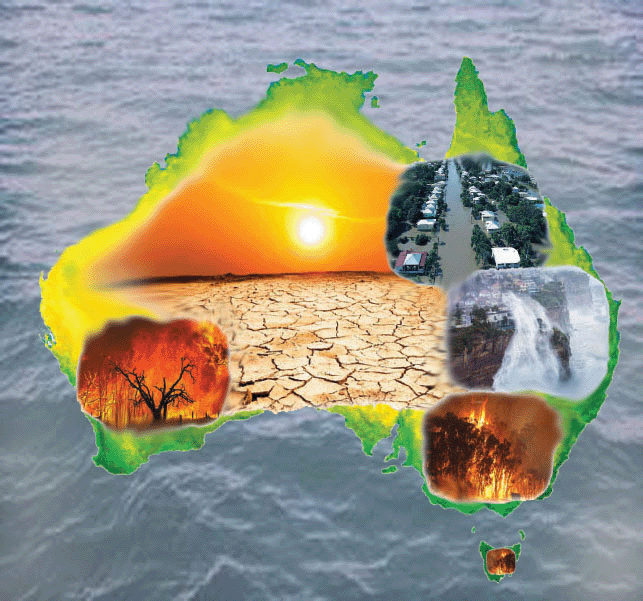
July 27, 2020 Jacqueline Peel Professor of Environmental and Climate Law, University of Melbourne, Rebekkah Markey-Towler, Research assistant, University of MelbourneAs the world warms, the value of “safe” investments might be at risk from inadequate climate change policies. This prospect is raised by a world-first climate change case, filed in the federal court last week.
Katta O’Donnell – a 23-year-old law student from Melbourne – is suing the Australian government for failing to disclose climate change risks to investors in Australia’s sovereign bonds.
Sovereign bonds involve loans of money from investors to governments for a set period at a fixed interest rate. They’re usually thought to be the safest form of investment. For example, many Australians are invested in sovereign bonds through their superannuation funds.
But as climate change presents major risks to our economy as well as the environment, O’Donnell’s claim is a wake-up call to the government that it can no longer bury its head in the sand when it comes to this vulnerability.
O’Donnell’s arguments
O’Donnell argues Australia’s poor climate policies – ranked among the lowest in the industrialised world – put the economy at risk from climate change. She says climate-related risks should be properly disclosed in information documents to sovereign bond investors.
O’Donnell’s claim alleges that by failing to disclose this information, the federal government breaches its legal duty. It alleges the government has engaged in misleading and deceptive conduct, and government officials breached their duty of care and diligence.
This is a standard similar to that owed by Australian company directors. Analysis from leading barristers indicates that directors who fail to consider climate risks could be found liable for breaching their duty of care and diligence.
O’Donnell argues government officials providing information to investors in sovereign bonds should meet the same benchmark.
Climate change as a financial risk….… https://theconversation.com/a-wake-up-call-why-this-student-is-suing-the-government-over-the-financial-risks-of-climate-change-143359
Parts of Victoria’s Bellarine Peninsula, Melbourne suburbs, at risk from sea level rise
important for local communities to know whether they were at risk so they could decide whether to invest in adaptation strategies, such as infrastructure, to protect the coastline, or simply retreat from the danger zone.
How coastal communities on Victoria’s Bellarine Peninsula are dealing with the reality of sea level rises, ABC, By Nicole Mills, 26 Jul 20, As Vicki Perrett plays with her granddaughter Rachel on the beach in front of her home on Victoria’s Bellarine Peninsula, she knows she has to cherish these moments.Key points:
And not just because children grow up so fast. She also knows the beach they play on may not be there forever. “The beach is coming closer towards us, towards the road and towards our property,” Ms Perrett says. “It’s very prone to sea level rise here and to storm surges.” This stretch of coastline at Indented Head has already been earmarked as at risk of going underwater by 2100. Ms Perrett’s house is also in the danger zone………… Councils ordered to plan for sea level risesThe Victorian Government has instructed all councils to plan for a 0.8m sea level rise by the year 2100. That figure is based on a 2007 report from the United Nations Intergovernmental Panel on Climate Change, which agreed on the projected rise, but could not rule out larger increases. Although the worst impacts of sea level rises may still be decades away, this bayside community, about an hour-and-a-half south of Melbourne, has already had a taste of what is to come………. Dr McInnes leads the CSIRO’s climate extremes and projections group, which has contributed to the mapping of high-risk areas. Publicly available mapping tools, such as Coastal Risk Australia, allow anyone to find out how their local area would fare under different sea-level rise scenarios. Dr McInnes said it was important for local communities to know whether they were at risk so they could decide whether to invest in adaptation strategies, such as infrastructure, to protect the coastline, or simply retreat from the danger zone. “Land subject to inundation is land that is low-lying, that is potentially at risk from inundation during extreme sea-level events or even potentially high-tide events in the future,” Dr McInnes said. Dr McInnes says while the worst impacts will be felt during storm surges, there might be some areas that will suffer more permanent flooding. “If [the land] is low enough, it could be permanently inundated,” she said. “Parts of Swan Bay [on the Bellarine Peninsula] could potentially become quite affected by inundation, certainly high-tide inundation, in the future.” And it’s not just regional areas. Dr McInnes says Melbourne suburbs such as Elwood, Aspendale and Mordialloc are also at risk of more-regular flooding in future……….. https://www.abc.net.au/news/2020-07-26/climate-change-sea-level-rises-prompt-action-in-coastal-towns/12383968
|
|
“Advance Australia” -the extreme right wing lobby group, says that climate change is a hoax
From Wikipedia 20 July 20 The national director of Advance Australia was Gerard Benedet, a former Liberal Party staffer who led the organisation during the 2019 Australian federal election.[3] Benedet stood down in September 2019, and was replaced by Liz Storer, former City of Gosnells councillor,[4][5] and advisor to Liberal senator Zed Seselja.[6]
High-profile backers include businessmen such as Maurice Newman, Kennards Self Storage managing director Sam Kennard, and Australian Jewish Association president David Adler.[2][3] Other members of the advisory council include security specialist Sean Jacobs and journalist Kerry Wakefield.[7] Queensland businessman James Power is also said to have been involved.[8]….
Benedet says the membership is 60 per cent male and has an average age of about 50.[1]
Advance Australia has been accused of astroturfing and being little more than a front for the Liberal Party, much as GetUp has been accused of being a front for the Australian Labor Party.[11] Advance Australia’s independence has yet to be tested, whereas GetUp has been cleared of ties to the Labor Party on three occasions by the Australian Electoral Commission.[12].
The group believes that anthropogenic climate change is a “hoax”[6], with current national director Liz Storer describing of the teaching of the predominant scientific view as “the other side of the story being shoved down their throats. It’s already happening. The left have infiltrated our education systems. Any aware parent knows that their child is being taught the left’s ideology. ”
Nuclear power, far too slow to affect global heating – theme for July 20
In recent themes I wrote about nuclear power being in fact a big contributor to global warming, and about how climate change will in fact finish off the nuclear industry.
But – let’s pretend that nuclear reactors really could reduce greenhouse gas emissions.
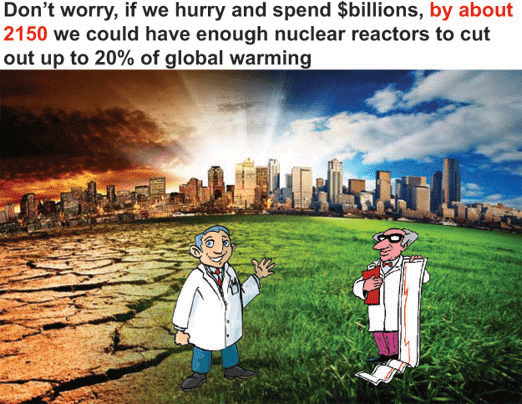
TIME: To do that, 1500 one thousand megawatt-electric new reactors would be needed within a few years to displace a significant amount of carbon-emitting fossil generation. A Massachusetts Institute of Technology Study on “The Future of Nuclear Power” projected that a global growth scenario for as many as 1500 one thousand megawatt-electric new reactors would be needed to displace a significant amount of carbon-emitting fossil generation. Average 115 built per year would reduce our CO2 use by only 16%.
But the new flavour of the month is Small Modular Nuclear Reactors (SMRs), which generate from 50 to 200 megawatts. So the world would need, quickly, to have a significant reduction of carbon emissions, i.e at least 7500 largish SMRs – or 30,000 smaller ones., (and these SMRs are already shown to be more costly than large ones,)

Meanwhile – if the nuclear “climate cure” were to be pursued, the enormous costs and efforts involved would take away from the clean, fast, and ever cheaper solutions of energy efficiency and renewable energy
Australia wants to build a huge concrete runway in Antarctica. Here’s why that’s a bad idea
July 17, 2020 Shaun Brooks, University Associate, University of Tasmania, Julia JabourAdjunct Senior Lecturer, University of Tasmania A ustralia wants to build a 2.7-kilometre concrete runway in Antarctica, the world’s biggest natural reserve. The plan, if approved, would have the largest footprint of any project in the continent’s history………
Australia: an environmental leader?
Australia has traditionally been considered an environmental leader in Antarctica. For example, in 1989 under the Hawke government, it urged the world to abandon a mining convention in favour of a new deal to ban mining on the continent.
Australia’s 20 Year Action Plan promotes “leadership in environmental stewardship in Antarctica”, pledging to “minimise the environmental impact of Australia’s activities”.
But the aerodrome proposal appears at odds with that goal. It would cover 2.2 square kilometres, increasing the total “disturbance footprint” of all nations on the continent by 40%. It would also mean Australia has the biggest footprint of any nation, overtaking the United States.
Within this footprint, environmental effects will also be intense. Construction will require more than three million cubic metres of earthworks – levelling 60 vertical metres of hills and valleys along the length of the runway. This will inevitably cause dust emissions – on the windiest continent on Earth – and the effect of this on plants and animals in Antarctica is poorly understood.
Wilson’s storm petrels that nest at the site will be displaced. Native lichens, fungi and algae will be destroyed, and irreparable damage is expected at adjacent lakes.
Weddell seals breed within 500 metres of the proposed runway site. Federal environment officials recognise the dust from construction and subsequent noise from low flying aircraft have the potential to disturb these breeding colonies.
The proposed area is also important breeding habitat for Adélie penguins. Eight breeding sites in the region are listed as “important bird areas”. Federal environment officials state the penguins are likely to be impacted by human disturbance, dust, and noise from construction of the runway, with particular concern for oil spills and aircraft operations.
The summer population at Davis Station will need to almost double from 120 to 250 during construction. This will require new, permanent infrastructure and increase the station’s fuel and water consumption, and sewage discharged into the environment……... https://theconversation.com/australia-wants-to-build-a-huge-concrete-runway-in-antarctica-heres-why-thats-a-bad-idea-139596
Global heating – Farmers can’t afford the higher insurance premiums. Fossil fuels killing agriculture
Climate change-driven disasters making insurance premiums too dear for farmers, ABC News, Vic Country Hour, By Jane McNaughton 16 July 20
Australian farmers are facing increasingly frequent droughts, floods, hailstorms and bushfires, resulting in insurance premiums rising to the point where cancelling or underinsuring are the only options.
Key points:
- A NSW farmer says the fossil fuel industry is effectively killing the agriculture sector
- Insurance premiums are being driven to unaffordable levels by the impacts of climate change
- The Insurance Council of Australia says 80 per cent of Australian homes are underinsured — and that figure’s likely higher in the bush
Climate change has already cost farmers more than $1 billion since 2000, according to ABARES.
Third-generation lamb and cropping farmer Peter Holding said government inaction on global warming could have disastrous flow-on effects to the agriculture industry.
“Climate change poses a cataclysmic set of challenges for farmers,” the Farmers for Climate Action member said.
“It’s pretty severe and it’s getting worse…………
Fossil fuels ‘undermining’ agriculture
Financial strain is not the only issue climate change has delivered to farmers.
“Unfortunately we’re getting less good years and a lot more variability,” Mr Holding said.
“There’s a lot of impacts and I can’t see it stopping any time soon.
“The droughts are just continuing, since the turn of the century we’ve had [so many years] of drought, interlaced with floods.”…….
“The fossil fuel industry is creating emissions and that is slowly but surely making agriculture unviable.
“We’ve cut the emissions from livestock probably in half, farmers in cropping areas have done all sorts of things to reduce the use of diesel and better use fertilisers.
“So farmers are working on all of these problems to cut their own emissions, but we definitely need some quick action to reduce the emissions of fossil fuel.”
Australia’s Liberal Coalition climate deniers are at it again
 COALITION DENIERS AT IT AGAIN, MARK BUTLER. July 15, 2020
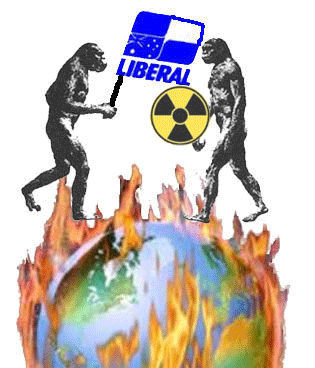
Coalition MP Craig Kelly has mounted an extraordinary attack on the Bureau of Meteorology in a Facebook post shared more than one thousand times in 36 hours.
Coalition MP George Christensen was among those who shared the post, saying: “Craig Kelly is in detective mode. Crooks within data-altering government agencies should be worried. Very worried.”
Does the Environment Minister Sussan Ley agree with these attacks on the Bureau of Meteorology? Does the Assistant Minister, Trevor Evans?
What about Mr Kelly and Mr Christensen’s backbench colleagues like Ross Vasta, Tim Wilson, Dave Sharma, Fiona Martin or Katie Allen?
If they don’t agree, what are they doing about the fact that their colleagues are using social media to spread disinformation in an attempt to discredit a government agency and undermine action on climate change?
This is beyond a joke. The Government needs to take responsibility for the actions of its own backbench.
Links to Mr Kelly and Mr Christensen’s posts:
https://www.facebook.com/CraigKellyMP/photos/a.251794581681850/1553197208208241/
https://www.facebook.com/CraigKellyMP/photos/a.251794581681850/1555461397981822/
https://www.facebook.com/gchristensenmp/posts/2988498467871728?__tn__=-R
Court action in India against Adani – allegations of ‘coercion, fraud and undue influence’
 Adani power plant and coal plans threatened by land owner court action, ABC News, By Stephen Long, 11 July 20
The case filed with the court accuses Adani and its agents of using “coercion, fraud [and] undue influence” to illegally exclude thousands of people affected by the development from a required social impact assessment.
The claimants allege that a key meeting was full of labourers “from far away” who were paid to attend a crucial public hearing about the development and — in conjunction with local police — used brutal force to keep villagers opposed to Adani’s project out.
“Thousands of people gathered to go into the venue site but they were prevented both by the police, who were acting as agents of private company Adani Power Limited, as well as by their security guards,” the writ filed with the court alleges.
“The situation was so bad that the police lathi [baton] charged the affected families. When they tried to attend the public hearing were beaten mercilessly.”
Residents challenge land acquisition
The court case also challenges the forced takeover of land for the development by the State Government on behalf of Adani.
Under Indian law, a government can only acquire land for a private company if the project is for “public purpose”.
The claimants argue the project does not meet the definition of “public purpose” under the law.
Part of their argument is that the power plant will have few local benefits, since the electricity will all be exported and the coal used to generate the power will all be imported — largely from Australia.
“It is crystal clear from the various documents of Adani Power Limited that the power which shall be generated from this private project shall be exported to Bangladesh [while] the coal shall be imported from Australia … to Dharma Port and transported to the project covering a distance of around 700km causing immense pollution in transportation.
“Thus, there is not even a semblance of public interest.”….
The irony is that Jharkhand is a resource-rich state, accounting for more than 40 per cent of the mineral resources of India, and the Adani power project is situated amid some of the richest coal deposits in the nation.
Adani’s own Jitpur coal mine is just kilometres away from the project site; when the plant was first proposed five years ago, this was to be the source of the coal.
But those plans rapidly changed, apparently because under Indian law domestic coal cannot be used for thermal power projects that will export electricity to another country.
So, Adani now appears set to transport imported coal vast distances, at extraordinary expense, into a state that is home to the biggest coal reserves in India…….
‘Land is indispensable to a Santhal’
The patriarch of the Adani business empire, Gautam Adani, is one of the richest men in India, while many of the villagers affected by the Godda power project are from the other end of the wealth spectrum.
Some are from the lowest castes in the Hindu religion and others are from an Indigenous tribal group known as the Santhal.
Archaeologists estimate that the Santhal have been in eastern India for up to 65,000 years. Like Aboriginal Australians, they have an ancient and spiritual connection to the land that has long been recognised in legislation.
“Land is indispensable to a Santhal,” a local villager explained to the independent Indian filmmaker who shared her interviews with the ABC.
“It is an intrinsic part of culture. The Santhal tribe and their land are like two sides of one coin. If land exists, Santhal exists, but if the land is taken away it just means they will be totally wiped out.”
The Santhal have a practice of burying their dead in the fields they sow, which become sacred to them.
One of them says: “We belong here, this is our ancestral land. We are buried on our land. We have no problem dying on our land but we will not give it away.”
Santhal land rights have previously been protected under a long-standing law which prohibited industrial development on their farming lands, but the laws have recently been watered down…….
those fighting the project face a race against time; the High Court case, and a separate environmental challenge before India’s National Green Tribunal — scheduled for hearings in early August — will be of no consequence if construction reaches a point where the development becomes a fait accompli.
Curiously, geopolitics is working in favour of the project’s opponents.
Adani has contracts with a Chinese firm for equipment purchases and engineering work on the power plant.
With a border conflict taking India and China close to war, Adani is facing political pressure to terminate the deal, which could further delay or even jeopardise the project. https://www.abc.net.au/news/2020-07-10/adani-godda-power-plant-threatened-by-land-owner-court-action/12439624
Australia a big world player in producing greenhouse gas emissions
 Australia: an emissions super-power https://apo.org.au/node/306756, 9 JUL 2020
Not only is Australia a laggard in meeting its UN Paris emission reduction targets, it is now the world’s largest exporter of coal and gas. In fact, the emissions from Australia’s exported fossil fuels are now greater than Germany’s domestic emissions (Hein, Peter & Graichen, 2020).
Despite federal government claims that our national emissions have only a minimal impact on the global climate, Australia is, in fact, a major contributor to global climate change. The massive emissions that result from our fossil fuel exports are not counted in Australia’s national carbon budget under our UN climate obligations, nor do we take responsibility for the impact these emissions are having globally.
Key facts:
- Australia’s exported emissions have increased 4.4% between 2018 and 2019.
- In 2019, the emissions from Australian fossil fuel exports were 1.4 times greater than Germany’s domestic emissions.
- In 2019 Australia’s exported emissions were 1.4 times greater than all the CO2 emissions produced by the 2019/2020 summer bushfires.
- Every Australian is paying $1,832 per year for fossil fuel subsidies, compared to the one-off payment of around $78 for bushfire relief.
Keep Australia’s nuclear prohibition laws: it appears that nuclear is no part of climate action, not necessary

The most important group of nuclear power advocates who have consistently promoted concerns about climate change as the main reason for their advocacy have been the self-described ‘eco-modernists’. The main organizational focus of ecomodernism is the
 Breakthrough Institute, established by Michael Shellenberger and Ted Nordhaus in 2003.
Australia now the biggest exporter of global heating- the Saudi Arabia of coal and gas
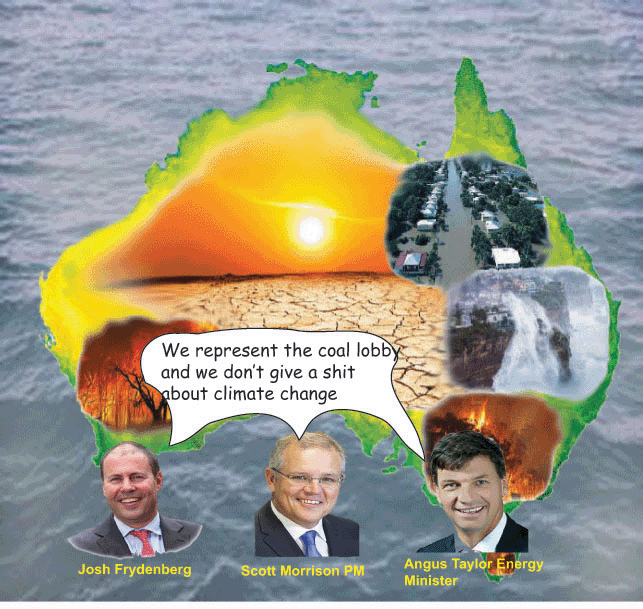 Passing the pollution: Australia becomes world’s biggest exporter of fossil fuels, https://thenewdaily.com.au/news/2020/07/09/australia-export-fossil-fuels/ Cait Kelly, Australia is now the biggest exporter of climate change, leading the world in selling fossil fuels, a new report reveals.Emissions from nations which bought our gas, coal and oil increased by 4.4 per cent between 2018 and 2019, with Australia now the world’s biggest fossil fuel producing country, the report from UNSW says. Passing the pollution: Australia becomes world’s biggest exporter of fossil fuels, https://thenewdaily.com.au/news/2020/07/09/australia-export-fossil-fuels/ Cait Kelly, Australia is now the biggest exporter of climate change, leading the world in selling fossil fuels, a new report reveals.Emissions from nations which bought our gas, coal and oil increased by 4.4 per cent between 2018 and 2019, with Australia now the world’s biggest fossil fuel producing country, the report from UNSW says.
Our exported emissions are now greater than the domestic pollution of Germany, Canada, Turkey and the UK. “Not only is Australia a laggard in meeting its UN Paris emission reduction targets, but it is also now the world’s largest exporter of coal and gas,” the authors wrote. “In fact, the emissions from Australia’s exported fossil fuels are now greater than Germany’s domestic emissions.” Australia has been on track to become the world’s bigger carbon dioxide polluter for a while, with a report from The Australian Conservation Foundation last year warning we would hit the milestone soon. Russia and Saudi Arabia were both above Australia as recently as August last year. Using new data from the Office of the Chief Economist, emissions from exported fossil fuels were 1.2 times greater than global aviation emissions in 2018 and 1.4 times greater than all the CO2 emissions produced by the summer bushfires in 2019. When Australian fossil fuels are burned overseas, the amount of carbon dioxide they produce is higher than the exported emissions of the world’s biggest oil and gas-producing nations, like Iraq and Kuwait. “Despite Federal Government claims that our national emissions have only a minimal impact on the global climate, Australia is, in fact, a major contributor to global climate change.” “The massive emissions that result from our fossil fuel exports are not counted in Australia’s national carbon budget under our UN climate obligations, nor do we take responsibility for the impact these emissions are having globally.” Australia is the world’s biggest exporter of coal and our exported emissions should be counted towards our overall emissions footprint, said lead researcher and professor of political philosophy Jeremy Moss. “We’re the Saudi Arabia of coal and gas. That’s not a good situation to be in,” he told The New Daily. “People say we’re not responsible for exports, the government spends a billion dollar to recycle our waste which otherwise would have gone to other countries. These emissions are also our problem. “Responsibility doesn’t stop at the border. We have the same view about plastic waste, uranium and live sheep exports.” The report calls for fossil fuel non-proliferation treaty, removal of the $47 billion worth of subsidies for the fossil fuel industry and phasing out production constant with climate goals,” Professor Moss said. “At least two-thirds of the known reserves of fossil fuels must be left in the ground if climate targets are to be met (IEA, 2012). “Production of fossil fuels must, therefore, be phased out rapidly. Countries such as Australia should not get a free pass to produce and export as much fossil fuels as they are able to.” The report follows the announcement that the COVID-19 economic recovery committee has made recommendations that the government underwrite a massive gas industry expansion. Australia’s Energy Minister, Angus Taylor, is proposing a gas led recovery out of the pandemic-induced recession. But a report from the Australia Institute revealed last week that fossil fuel was the worst-performing sector in the ASX 300 over the last decade. “The poor performance of fossil fuel companies is probably surprising to most Australians, who are routinely told by industry and political leaders that coal is the “bedrock” of Australia’s prosperity, or that gas will “fire” the recovery from COVID19,” it read. |
|
1 This month

of the week – Australians for War Powers Reform (AWPR)
To see nuclear-related stories in greater depth and intensity
 Antinuclear