Scott Morrison turns to socialism, with his new religion, not coal, but “gas-led recovery”
 It’s a small church that sings the gas gospel, Canberra Times, Michelle Grattan, 18 Sep 20,
If Labor were threatening to build a power station, the Liberals would likely be screaming “socialists”.
As for a Coalition government contemplating such a thing – well, to say the obvious, it hardly fits with the Liberals’ stated free-market, private-enterprise philosophy. But hey, neither does the hyper-Keynesian support package to cushion the economy through the pandemic.
The gas power plant is another matter, and it will be fascinating to see how the debate plays out if the threat turns into reality.
The threat is part of the go-with-gas policy unveiled by Scott Morrison this week, spruiked as driving a “gas-fired” recovery, especially for manufacturing. This sounds suspiciously like a three-word slogan that promises more than it is likely to deliver.
But Morrison has signed up to the church of gas, whose pastors include Nev Power, chairman of the Prime Minister’s COVID-19 commission, and Andrew Liveris, the head of its (now defunct) manufacturing taskforce, which delivered a pro-gas report.
Much of the gas plan is broad and aspirational at this stage. But the threat is specific enough.
Morrison said the electricity sector must lock in by April investments to deliver 1000MW of new dispatchable energy to replace the Liddell coal-fired power station before it closes in 2023. Or else. The government-owned Snowy Hydro was working on options, he said.
Going back to Malcolm Turnbull’s time, the government conducted – and lost – a bitter battle with AGL over the planned Liddell closure. It exerted maximum pressure on the company to extend the life of the station, or alternatively to sell it, but to no avail.
The gas policy, especially the threat, hasn’t gone down well – with the energy sector or environmentalists. And it’s come under criticism from experts and even from within Coalition ranks.
The Australian Energy Council, representing investors and generators, warned the spectre of a government gas generator could put off private investors.
Environmentalists are against gas anyway, whoever produces it, because it is a fossil fuel and therefore has emissions, albeit not as bad as coal.
The Nationals’ Matt Canavan, who not so long ago was resources minister, says if a new power station is to be built in the Hunter region it should be coal-fired.
And the director of the Grattan Institute’s energy program, Tony Wood, says the government’s claim that 1000MW of new dispatchable capacity is needed isn’t supported by the advice from its own Liddell taskforce.
More generally, Wood argues the idea of a gas-led recovery is “a mirage”.
He says east-coast gas prices are unlikely to fall to very low levels and anyway, even very low prices would not stimulate major economic activity. “Investing in more gas infrastructure in the face of climate change looks more like a herd of stampeding white elephants” is Wood’s blunt assessment…….
Critics don’t like the proposed expansion of the remit of the Australian Renewable Energy Agency and the Clean Energy Finance Corporation beyond supporting renewables. https://www.canberratimes.com.au/story/6931688/its-a-small-church-that-sings-the-gas-gospel/?cs=14230
Australia’s mainstream media dutifully parrots out Government spin about gas
|
Gas Gush: the toadies of mainstream media trot out government’s fossil fuel fracking campaign https://www.michaelwest.com.au/gas-gush-the-toadies-of-mainstream-media-trot-out-governments-fossil-fuel-fracking-campaign/
 by Michael West | Sep 15, 2020 Gas fracking and a new fossil fuel power plant got a big leg-up today as News Corp, Nine Entertainment, ABC News and Guardian Australia faithfully splashed with the latest government gas plan on their front pages today. by Michael West | Sep 15, 2020 Gas fracking and a new fossil fuel power plant got a big leg-up today as News Corp, Nine Entertainment, ABC News and Guardian Australia faithfully splashed with the latest government gas plan on their front pages today.
This is not journalism. This is stenography. This is not balanced reporting. This is reporting a government press release one day early. Australia’s captive mainstream media all splashed with the same story this morning, the Morrison Government’s fossil fuel public relations campaign. The Age, the Sydney Morning Herald, The Guardian, The Australian, the Australian Financial Review. They all featured the same story on gas. Now, breakfast TV and morning radio will be left to follow it up, unquestioning, now that it’s been “in the papers”. The gas propaganda blitz did not feature the critical facts that gas is almost as polluting as coal, that fracking the Beetaloo Basin, the Galilee Basin and the North Bowen Basin will destroy water systems and endanger wildlife and farmland. Neither did this media blitz, orchestrated by expert media manipulators in the offices of government, and keenly assisted by the gas lobby, mention that the gas multinationals which stand to benefit from this campaign have been acting as a cartel, ratcheting up gas prices at a cost to all Australians and siphoning profits offshore to tax havens. Neither did the slavishly toadying coverage in the corporate media mention how much the companies Shell, BHP, Exxon, Origin and Santos and their proxies pay political parties in donations. No, the journalists and their editors simply gush the Government’s line. “Scott Morrison will announce”, “The Government will announce”. There was, and still is, no detail, nothing official from the Government but its toadies in the mainstream media have recorded the story faithfully. They are paving the way for the Government to spend billions in taxpayer money on a new gas power plant and pipelines – for a pipeline industry controlled by Chinese and Singaporean multinationals who don’t pay tax. The only difference between the big black headlines in The Age and the SMH were the words “in NSW”. “Morrison to back construction of new gas-fired power station in NSW,” touted the SMH. The team of press secretaries in the office of Prime Minister and Cabinet – a team brimming with fossil fuel advocates – could not have asked for great loyalty and dedication to the cause. “Scott Morrison is prepared to forcefully intervene in the energy market by building a new gas-fired power station in the Hunter Valley in NSW if need be, and underwriting the construction of gas pipelines to feed a new national trading hub,” wrote the AFR‘s Canberra correspondent Phil Coorey. Although there is still no press release from the Prime Minister, and nothing official from the office of Energy Minister Angus Taylor either, the AFR had four stories on the big gas plan. “The prime minister will say the government intends to pursue 13 measures,” wrote Katherine Murphy in The Guardian. How did she know that? How did they all know it? They got “the drop”. The drop is industry parlance for a leak from government which is a favour. The political operative engineers the drop to the select journalist and the select journalist is expected, in return, to deliver favourable coverage. Morning TV and radio will follow up on cue. By this afternoon, the Government’s media campaign will have dominated the 24-hour media cycle. The actual details of the plan may be released this afternoon. Late morning perhaps. By then, independent journalists and the non-spoon-fed media may become privy to the detail and report the news properly. “Power up or we build gas plant: Morrison,” is the headline in The Australian. It is accompanied by a flattering “comment piece” by Murdoch media’s top correspondent in Canberra, Simon Benson: “Morrison move to energise industry.” Already, Australia is up there with Qatar as the world’s biggest exporter of gas. Australians pay among the highest prices in the world for gas too. This is no accident. This is a failure of government and media. The corporations that dominate the gas cartel have got the better of government, completely dominated the governments state and federal in fact. They have dominated the media too. Their advertising, their slick lobbying, craven editorial management. Australia’s politicians and media have failed the people. |
|
In tropical areas, increasing heat and humidity will make life almost unbearable
These impacts will be stronger in the seasonally wet tropics (such as the Northern Territory of Australia), where more extreme warming is expected than in the equatorial zone.
Predictions for Darwin, in northern Australia, suggest an increase in days with temperatures above 35℃ from 11 days a year in 2015 to an average of 43 days under the mid-range emission scenario (IPCC’s RCP4.5 scenario) by 2030 and an average of 111 (range 54-211) days by 2090. Under the higher emission scenario (IPCC’s RCP8.5), an average of 265 days above 35℃ could be reached by 2090.
|
Climate explained: will the tropics eventually become uninhabitable? https://theconversation.com/climate-explained-will-the-tropics-eventually-become-uninhabitable-145174 James Shulmeister, Professor, School of Earth and Environmental Sciences, University of Canterbury 16 Sept 20, What is the impact of temperature increases in the tropics? How likely is it that regions along the Equator will be uninhabitable due to high wet bulb temperatures such as 35℃ and more in places like Singapore? Do we have models that suggest how likely this is and at what time frames?More than 3.3 billion people live in the tropics, representing about 40% of the world’s population. Despite some areas of affluence, such as Singapore, the tropics are also home to about 85% of the world’s poorest people and are therefore particularly susceptible to the impacts of climate change.
The tropics are expected to experience rising temperatures and changes to rainfall, and the question is whether this could make this region uninhabitable. How would this happen? Heat stressHumans regulate their body temperature in warm conditions through sweating. The sweat evaporates and cools the skin. But if conditions are humid, sweating and evaporation are much less effective. Humans can survive and function in quite high temperatures if humidity is low, but as humidity increases our ability to function decreases rapidly. This effect is measured by a heat stress index which shows the apparent temperature you feel under different relative humidity conditions. From a human health point of view, the wet bulb temperature is critical. This is the temperature a thermometer covered in a wet cloth would measure, and it reflects the maximum amount of cooling that can be achieved by evaporation. High wet bulb temperatures are more problematic to human health than high absolute temperatures. Wet bulb temperatures above 35℃ are life-threatening because they cause hyperthermia, which means the body cannot cool down and the internal body temperature exceeds 40℃. Climate modelling predictions used by the Intergovernmental Panel on Climate Change (IPCC) for the period from 2080-2100 suggest warming in the tropics of about 1.6℃ under mid-range emissions scenarios and up to 3.3℃ under high emissions scenarios, with error margins of about 0.5℃ on both predictions. Continue reading |
‘Gas-led recovery’ may actually deter energy investment: Experts
|
‘Gas-led recovery’ may actually deter energy investment: Experts, The New Daily, Josh Butler, 16 SEp 20, Climate change and clean energy campaigners were left dismayed at the
federal government’s plans to spearhead a “gas-led recovery” from COVID-19, saying it will be ineffective and damage the prospects of meeting international emissions reduction commitments. Independent MP Zali Steggall claimed the Prime Minister’s announcement was “blackmailing private companies”, while even energy companies said the announcement – however well meaning –could actually lead to further uncertainty and less investment in the market. On Tuesday, PM Scott Morrison announced plans to lean heavily on the gas sector in the nation’s recovery from the pandemic, talking up the fuel’s potential to lower power prices and shore up reliability in the electricity grid. He also flagged the possibility of the commonwealth helping foot the cost for a new gas-fired power station in NSW, if the soon-to-be-closed Liddell plant is not replaced. But climate experts and clean energy campaigners are up in arms over the plan, which they say will be far more expensive and far worse for the environment than renewables. ….. Mr Bourne, a former regional president with BP Australasia, said gas was better for the environment than coal – but only marginally, when emissions linked to its extraction, production and transmission were factored in. “It’s not that much better than coal,” he said. The Australian Energy Council, representing major investors in power generation, said the government’s announcement may actually create more uncertainty and less investment in the sector – saying “even discussions and threats of intervention act as a deterrent”…… Labor’s shadow energy minister Mark Butler slammed gas as “the most expensive way to build new energy”……… https://thenewdaily.com.au/news/2020/09/15/gas-led-recovery-climate/ |
|
A legal win for Adani, against climate activist Ben Pennings
 Adani granted injunction to stop activist Ben Pennings using ‘confidential material’ABC 11 Sept 20, Mining giant Adani has been granted an injunction ordering an activist to stop using “confidential material” it claims is frustrating the development of its mine and rail network in the Galilee Basin.
Key points:
- The legal action is against Brisbane activist Ben Pennings
- Mr Pennings is accused of demanding contractors to cease working with Adani
- Justice Martin found the “Stop Adani” movement had caused at least three contractors to withdraw
Adani launched legal action in the Supreme Court in Brisbane against activist Ben Pennings, claiming he had continually demanded contractors who had agreements with the mining company to terminate or withdraw from negotiations.
Adani also argued Mr Pennings would encourage others to provide confidential information to an ongoing campaign —The Galilee Blockade — concerning plans and operations at the site.
Today’s order comes after Adani twice failed to secure a search order to seize evidence from Mr Penning’s home.
Activist accused of ‘intimidation and conspiracy’
Outside court, Mr Pennings said he would respect the court’s injunction but was “very concerned” about ongoing civil action in which Adani accused Mr Pennings of a “breach of confidence, inducing breach of contract, intimidation and conspiracy”.
“I have a family at home, kids, a kid with a disability,” Mr Pennings said.
“If Adani is successful with their civil action, I’ll have to sell my house, and that’s really difficult for my family, but Adani seem determined to hurt me.
“I don’t believe I should have to sell my suburban family home in Aspley to make an Indian multi-billionaire even richer.
“The ‘Stop Adani’ movement is massive. I’m just one passionate person. They really can’t sue all of us.”………. https://www.abc.net.au/news/2020-09-11/adani-granted-court-injunction-ben-pennings-galilee-basin/12654486
Australia’s nearly 2 $trillion costs by 2050 – if we continue climate change inaction
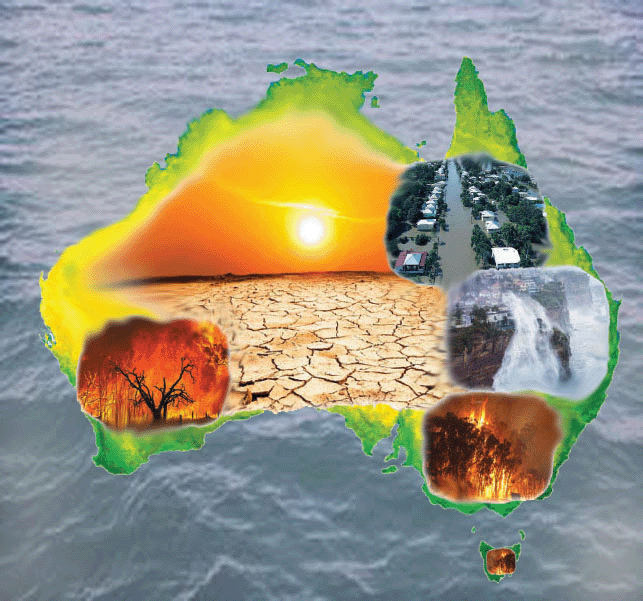 Trillions up in smoke: The staggering economic cost of climate change inaction, New Daily, Ben Silvester, 8 Sept 20, Over the next 30 years, increasing economic damages from climate change will cost the Australian economy at least $1.89 trillion – or roughly 4 per cent of projected GDP each year – if current emissions policies are maintained.New research from the University of Melbourne reveals annual economic damages by 2038 will be comparable to the current estimated annual cost of COVID-19 in Australia. Trillions up in smoke: The staggering economic cost of climate change inaction, New Daily, Ben Silvester, 8 Sept 20, Over the next 30 years, increasing economic damages from climate change will cost the Australian economy at least $1.89 trillion – or roughly 4 per cent of projected GDP each year – if current emissions policies are maintained.New research from the University of Melbourne reveals annual economic damages by 2038 will be comparable to the current estimated annual cost of COVID-19 in Australia.
There have been many attempts at estimating the economic cost of climate change, but the researchers said this is the most detailed and globally comprehensive to date. The modelling covers 139 countries in four potential warming scenarios from now to 2100. The projections draw on a modelling framework in the journal Earth’s Future in 2018 and have been continually updated through adding data points for bushfires and other ecological events. “There is no model in the world that is nearly this computationally large,” said lead researcher Professor Tom Kompas of the university’s school of biosciences. “It’s as much as 10 times larger than standard basic models.” The detail built into the projections allowed researchers to drill down and discover how each country will be affected by rising temperatures at particular points in the coming century. Previous models could only provide average damages across large regions or the world as a whole…………. If this trajectory is maintained, the research found that the economic cost of climate change for Australia alone will total at least $1.89 trillion by 2050 and exceed $100 billion in annual damages by 2038. Professor Kompas described the impact of the coronavirus pandemic as “devastating”, but he said it also puts the huge economic threat of climate change into context. “By 2038, on average projections, climate change may well be dealing a COVID-sized blow to the Australian economy every year … [it] will imply more job losses, unemployment and deeper cuts in GDP. And those damages will continue to increase disproportionately year after year,” Professor Kompas said. Much of the economic damage will be from rising sea levels wreaking havoc on property, infrastructure and agriculture along the coast. It is calculated that damages of more than $992 billion over the next three decades, or more than $30 billion a year, on average, from sea level rise and storm surge alone. The modelling also predicts productivity losses of $261 billion as rising temperatures make it harder for certain crops to grow and for outdoor labourers to work, while losses in biodiversity total $277 billion with thousands of species at risk of extinction. “Many of these damages ramp up over time,” Professor Kompas said. But he said Australia is already getting a taste of what’s around the corner, the past “Black Summer” bushfires being an example. The researchers tallied up the damage to property, infrastructure and agriculture caused by the recent bushfires, assessing the cost at $48 billion. And with research suggesting Australia will have two more “megafires” before the end of the decade, Professor Kompas calculates that by 2050 bushfires will have cost the economy about $360 billion. The $1.89 trillion cost to the economy in the next 30 years is almost certainly an underestimate, he said. His research does not yet account for damage to Australia’s major environmental assets, pollution from burning fossil fuels, tourism losses and natural disasters other than bushfires……. https://thenewdaily.com.au/news/national/2020/09/10/economic-cost-climate-change/ |
|
Scott Morrison will be praying for a Trump win: they see eye-to-eye on doing nothing about climate change


|
Scott Morrison is yearning for a Donald Trump victory The PM will be praying for a Republican win in the US to back up his inaction on climate and the Paris Agreement. The Age, Kevin Rudd 8 Sept 20, A year out from Barack Obama’s election in 2008, John Howard made a stunning admission that he thought Americans should be praying for a Republican victory. Ideologically this was unremarkable. But the fact Howard said so publicly was because he knew just how uncomfortable an Obama victory would be for him given his refusal to withdraw our troops from Iraq.Fast forward more than a decade, and Scott Morrison – even in the era of Donald Trump – will also be yearning desperately for a Republican victory come November. But this time it is the conservative recalcitrance on a very different issue that risks Australia being isolated on the world stage: climate change.
And as the next summer approaches, Australians will be reminded afresh of how climate change, and its impact on our country and economy, has not gone away. Former vice-president Joe Biden has put at the centre of his campaign a historic plan to fight climate change both at home and abroad. On his first day in office, he has promised to return the US to the Paris Agreement. And he recently unveiled an unprecedented $2 trillion green investment plan, including the complete decarbonisation of the domestic electricity system by 2035. By contrast, Morrison remains hell-bent on Australia doing its best to disrupt global momentum to tackle the climate crisis and burying our head in the sand when it comes to embracing the new economic opportunities that come with effective climate change action. As a result, if Biden is elected this November, we will be on track for a collision course with our American ally in a number of areas. First, Morrison remains recklessly determined on being able to carry over so-called “credits” from the overachievement of our 2020 Kyoto target to help it meet its already lacklustre 2030 target under the new Paris regime. No other government in the world is digging their heels in like this. None. It is nothing more than an accounting trick to allow Australia to do less. Perhaps the greatest irony is that this “overachievement” was also in large part because of the mitigation actions of our government. That aside, these carbon credits also do nothing for the atmosphere. At worst, using them beyond 2020 could be considered illegal and only opens the back door for other countries to also do less by following Morrison’s lead.
This will come to a head at the next UN climate talks in Glasgow next year. While Australia has thus far been able to dig in against objections by most of the rest of the world, a Biden victory would only strengthen the hand of the UK hosts to simply ride over the top of any further Australian intransigence. Morrison would be foolhardy to believe that Boris Johnson’s government will burn its political capital at home and abroad to defend the indefensible Australian position. Second, unlike 114 countries around the world, Morrison remains hell-bent on ignoring the central promise of Paris: that all governments increase their 2030 targets by the time they get to Glasgow. That’s because even if all those commitments were fully implemented, it would only give the planet one-third of what is necessary to keep average temperature increases within 1.5 degrees by 2100, as the Paris Agreement requires. This is why governments agreed to increase their ambition every five years as technologies improved, costs lowered and political momentum built……… Under Trump, Morrison has been able to get one giant leave pass for doing nothing on climate. But under Biden, he’ll be seen as nothing more than the climate change free-loader that he is. As he will by the rest of the world. And our economy will be punished as a result. https://www.theage.com.au/world/north-america/scott-morrison-is-yearning-for-a-donald-trump-victory-20200906-p55sxe.html |
|
Endless summers, endless wildfires,

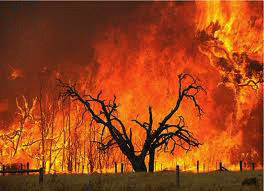
Endless summers, endless wildfires, South Wind 8 September 2020,
If leaders can’t get their heads around the wildfire-climate link, we had better prepare for many more nasty summers “…………. Now, everything is merged into one, and greatly enlarged. In my youth the places I recall having summer fires were Australia, the western United States, and odd outbreaks in Latin America, Africa and Mediterranean countries. Now we hear of fires erupting in other northern lands, as far north as the shores of the Arctic Ocean.
Looking back at this year so far we could be forgiven for thinking the whole world is ablaze. Almost as soon as wildfires are extinguished on one continent they seem to be breaking out afresh on another one.
2020 began with Australia’s record-breaking Black Summer fires destroying millions of hectares of forest and capturing global attention. Within a couple of months fires had broken out in Ukraine, threatening the abandoned Chernobyl nuclear plant.
A month later, smouldering peat that had been primed by years of drying and warming began to spark vegetation fires in Siberia that would eventually number over 600, emitting more carbon in two months than any preceding year and producing a smoke cloud spanning an area bigger than Europe.
The Siberian fires were still burning in mid-August when forests in California erupted into flames, more than a month earlier than the start of a “normal” season in that part of the world and less than two years after its previous record-breaking year.
At the end of a relatively quiet Californian fire season, in 2019-20 Australia got the benefit of that state’s large water-bombing aircraft, one of which crashed in the Australian Alps killing its US crew. Now, with California suffering similar devastation, we are battling to respond to its desperate appeal for reciprocal help.
Add to all those the perennial fires accompanying rainforest clearing in Southeast Asia and Brazil. The Amazon Basin situation is dire. August-September is the land-clearers’ peak burning period, and this year, with legal constraints all but destroyed under president Jair Bolsonaro, the area burnt and smoke generated looks like being even worse than what triggered last year’s global alarm.
Last week saw release of the interim report of the inquiry into Australia’s natural disaster management, led by former air force chief Mark Binskin, which was set up by the Morrison government after the Black Summer fires.
As the Black Summer fires showed, the report said, “bushfire behaviour has become more extreme and less predictable. Catastrophic fire conditions may become more common, rendering traditional bushfire prediction models and firefighting techniques less effective.”
No close observer of climate change would be surprised by the coronavirus pandemic’s global progress and the response to it of many political and vested interests. Those interests might wish it were otherwise, but this contagion operates without any reference to the things they hold dear.
Climate change, too, doesn’t recognise human boundaries. We set it off, and by failing to curb carbon emissions, we ensured its impact would continue to grow. Yet Australian governments, ignoring dire warnings from disaster experts, continue to behave as if it doesn’t exist.
This summer may see something of a reprieve. Weather authorities anticipate a wettish spring for eastern Australia. A moist understory is less likely to kindle fire from dry lightning, which has plagued recent fire management in both hemispheres.
But hoping for good weather doesn’t replace what the experts keep saying: a fire plan that doesn’t acknowledge the overwhelming influence of climate change is no plan at all. If partisan politics and vested interests prevent us acting on this, we’d better get ready for many more summers from hell. http://southwind.com.au/2020/09/08/endless-summers-endless-wildfires/
Joe Biden if president will push allies like Australia to do more on climate, adviser says
Joe Biden if president will push allies like Australia to do more on climate, adviser says
Jake Sullivan says the former vice-president, if elected, won’t ‘pull any punches’ on what is a global problem. Guardian Daniel Hurst @danielhurstbne, Mon 7 Sep 2020
Joe Biden will not pull any punches with allies including Australia in seeking to build international momentum for stronger action on the climate crisis, an adviser to the US presidential candidate has said.
If elected in November, Biden will hold heavy emitters such as China accountable for doing more “but he’s also going to push our friends to do more as well”, according to Jake Sullivan, who was the national security adviser to Biden when he was vice-president and is now in the candidate’s inner circle……..
While Australia’s prime minister, Scott Morrison, is likely to welcome the pledge of US coordination with allies on regional security issues, there may be unease in government ranks about the potential for tough conversations about Australia’s climate policies.
The Coalition government has resisted calls to embrace a target of net-zero emissions by 2050 and it proposes to use Kyoto carryover credits to meet Australia’s 2030 emission reductions pledge. Some Coalition backbenchers still openly dispute climate science.
Sullivan said climate change would be a big priority for Biden, both in domestic policy – with climate and clean energy issues placed at the heart of his economic recovery visions – and in foreign policy, where he would do more than just reverse Donald Trump’s decision to abandon the Paris agreement.
He has said right out of the gate, we’re not just rejoining Paris – we are going to rally the nations of the world to get everyone to up their game, to elevate their ambition, to do more,” Sullivan told the Lowy Institute. ………. https://www.theguardian.com/us-news/2020/sep/07/joe-biden-if-president-will-push-allies-like-australia-to-do-more-on-climate-adviser-says
PARLIAMENT COVERS UP AUSTRALIA’S TRUE CARBON FOOTPRINT
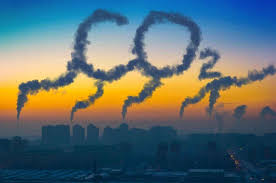 Parliament Covers Up Australia’s True Carbon Footprint, ByTasmanian Times, August 31, 2020 The House Standing Committee on the Environment and Energy today tabled its report on Andrew Wilkie MP’s National Greenhouse and Energy Reporting Amendment (Transparency in Carbon Emissions Accounting) Bill 2020 in Federal Parliament.
“Regrettably the Committee has voted to cover up Australia’s shameful role as one of the world’s biggest contributors to climate change,” Mr Wilkie said. “But the reasoning behind its recommendation for Parliament not to pass this Bill doesn’t stack up.”
Mr Wilkie’s Bill would require the Federal Government to include scope 3 emissions in reports of Australia’s carbon emissions, boosting transparency and accountability. Scope 3 emissions are the potential emissions contained in the gas and coal mined in Australia, which is then exported overseas. The Bill allows Australia to track its impact as one of the largest exporters of fossil fuels in the world, giving the public access to information about Australia’s role in very significantly contributing to global greenhouse gas emissions.
“Australia must have a clear picture of its contributions to global greenhouse gas emissions,” Mr Wilkie said. “This is essential as the world tries to limit warming to 1.5 degrees and halt catastrophic climate change. Keeping track of Australia’s scope 3 emissions is not double counting but gives a true picture of our responsibility for climate change around the globe.
The Committee can hardly argue that tracking scope 3 emissions is ‘too hard’ when the Department of Industry, Science, Energy and Resources has not even conducted an assessment of compliance costs. For goodness sake, the Committee acknowledges that more than a quarter of ASX200 companies already voluntarily report their scope 3 emissions.
“Further, the fact that this kind of tracking is not required by the Paris Agreement is beside the point. The Australian Government should be open and transparent for the sake of the community, rather than claiming that Australia can do little to influence climate change. The truth is that when the carbon in fossil fuel exports is taken into account, Australia accounts for about 5 per cent of the global total for fossil fuels.”
The full House Standing Committee on the Environment and Energy report can be found here.
2. ANALYSIS OF THE BILL………… HTTPS://TASMANIANTIMES.COM/2020/08/PARLIAMENT-COVERS-UP-AUSTRALIAS-TRUE-CARBON-FOOTPRINT/
Book: The Carbon Club -Tony Abbott and the ‘people’s revolt’ against Gillard’s climate policy
 Tony Abbott and the ‘people’s revolt’ against Gillard’s climate policy
In her new book ‘The Carbon Club’ Marian Wilkinson exposes the truth behind Australia’s inaction on climate change. Crikey, MARGOT SAVILLE, AUG 28, 2020
For several years, award-winning journalist Marian Wilkinson has been investigating the relationship between climate-sceptic politicians, business leaders and their allies. For her latest book The Carbon Club, she has conducted scores of interviews with players on both sides in order to expose the truth behind Australia’s inaction on climate change.
Bernardi teamed up with young libertarian Tim Andrews, who had trained with the Koch Brothers’ internship in the US.
“The two helped create the ‘people’s revolt’ against the climate policy, using the power of social media and the tactics of the Tea Party movement that was gaining ground in the US Republican party.
“One of the driving ideas behind the campaign was to exploit the anger and disaffection among ordinary voters towards politicians,” Wilkinson writes. …..
The “people’s revolt” against Gillard and the emissions trading scheme passed by Kevin Rudd would fundamentally fracture conservative politics in Australia, fostering splinter parties and deepening divisions in the Liberals, Wilkinson writes.
“It would destroy any chance of uniting the major political parties to face the enormous challenge of climate change.”………
Marian Wilkinson will discuss her new book at a Crikey Talks event for Inside Access members next month. Visit our Inside Access page to upgrade https://www.crikey.com.au/2020/08/28/book-review-carbon-club/
Adani quietly rebranding Abbot Point terminal as company hit with $107m damages bill
Adani quietly rebranding Abbot Point terminal as company hit with $107m damages bill
Exclusive: Queensland supreme court says company engaged in ‘unconscionable conduct’, Guardian Ben Smee @BenSmee, Fri 28 Aug 2020 Adani has quietly begun planning to rebrand its Abbot Point coal terminal – removing all reference to Adani in its company name and branding – as financiers continue to abandon the business and a Queensland court orders it to pay $106.8m in damages.
The Queensland supreme court this week ordered Adani to pay four terminal users damages for “unconscionable conduct” in a judgement that was scathing of Adani’s actions to advantage its own financial interests over other coal companies.
In the 93-page decision, the supreme court justice Jean Dalton said Adani’s ports business “attempted to disguise its behaviour in complex transactions”, engaged in conduct outside the boundaries of normal commercial behaviour, and “pleaded matters which were false”.
Name change planned as more investors pull out
Guardian Australia can reveal that Adani reserved two new company names with the Australian Securities and Investments Commission on 18 August – eight days before the court judgement. The Asic documents flag its intention to rebrand Adani Abbot Point Terminal and its holding company as the “North Queensland Export Terminal”.
In July, an Adani employee registered the web domain www.nqxt.com.au on behalf of Adani Abbot Point Operations, a separate company that manages the operations of the export terminal.
Climate campaigners say the move appears to be Adani “changing what has obviously become a toxic brand” amid its ongoing difficulties refinancing the port’s debts.
The Guardian can also reveal two additional Korean investors have, under pressure from climate activists, said they will dump their investments in Adani’s port, which has total debts of $1.5bn.
In recent days, Korean Investment Securities and Industrial Bank of Korea have written to activist groups confirming they will not offer further finance to the port, which would export coal from Adani’s controversial Carmichael coalmine………. https://www.theguardian.com/environment/2020/aug/28/adani-quietly-rebranding-abbot-point-terminal-as-company-hit-with-107m-damages-bill
Gas is not a transition fuel to a safe climate. That ship has sailed
Gas is not a transition fuel to a safe climate. That ship has sailed, https://www.theage.com.au/environment/climate-change/gas-is-not-a-transition-fuel-to-a-safe-climate-that-ship-has-sailed-20200826-p55pec.html, Penny Sackett, 27 Aug 20
Australia’s chief scientist from 2008 to 2011 If gas-fired electricity emissions can be lower than that from coal-fired plants, should Australia expand its fossil gas industry as a means of combating climate change? The answer is a clear no if we want to avoid the worst climate change outcomes.
Science has repeatedly demonstrated that the most important action to limit global warming to well below 2 degrees is to begin to reduce all fossil fuel consumption – coal, yes, but oil and gas too – in this decade.
The primary difficulty is the large mismatch between what is required to meet that stated climate goal of the Paris Agreement and what nations have actually pledged to do. Worse still, the current policies of many countries, Australia included, would increase their national production of fossil fuels, increasing emissions above their own weak pledges.
This so-called “production gap” is the subject of a recent multi-institutional, multi-national report led by the Swedish Environment Institute. Its analysis shows that governments are planning to produce about 50 per cent more fossil fuels by 2030 than would be consistent with a 2-degree pathway and 120 per cent more than would be consistent with a 1.5-degree pathway. This means that plans for fossil fuel development or extension that are already on the table must be shelved to hold warming to the Paris target range.
Consistent with other research, the report demonstrates that to have a 66 per cent chance of holding warming to well below 2 degrees, coal, oil and gas production must all decline significantly in the next decade. That is why increasing gas development to displace coal is no longer a viable approach to maintaining a reasonably safe climate.
Over the past 30 years, coal-to-gas “fuel-switching” has played a role in reducing emissions in the United States and Britain. However, the latest information from the US Energy Information Administration shows that the US energy grid has decreased its emissions from a shift to non-fossil fuel sources by almost as much as a shift to gas. Despite the shale boom, non-carbon energy sources have now overtaken any other single source of fossil fuel in supplying energy to the US grid.
In Britain, renewables played a large role in reducing emissions in the electricity grid. Between 2006 and 2016, the renewables share of electricity production rose from 2 per cent to 25 per cent, even excluding large hydro. While the 1990’s “dash for gas” was responsible for the largest cumulative amount of avoided greenhouse emissions in Britain since 1990, the situation is different now. In 2017, the transition to renewable energy was the largest driver in its electricity sector’s emission reductions. In second place was lower electricity demand (think what we could do with energy efficiency in Australia), while coal-to-gas switching came in third.
The world we live in has already changed dramatically with global average temperatures now 1.1 degrees above pre-industrial levels. Cyclones and storm surges are more intense. Droughts are more damaging. Fire seasons are longer and bushfires more fierce. Billions of animals died in last year’s Australian bushfires alone. Entire species are becoming extinct at rates far above normal. The point of no return may have already passed for Arctic sea ice – in 15 years, globes in schoolrooms may show white ice at only one pole.
At 2 degrees of warming, heatwaves would be even more severe and more deadly to humans, animals and agriculture. Sydney and Melbourne would need to brace for 50-degree days. The fire weather that produced Australia’s Black Summer would become at least four times more likely, the amount of water available to feed dams and rivers in NSW would be reduced by 30 per cent from what was typical mid last century, and coral reefs around the world would almost certainly be eliminated.
We have all the tools to avoid that future of 2 degrees of warming. What has been lacking is coherent, science-based action that does not add yet more fuel to the climate fire. Today, when the enormous human, economic and ecological costs of even 1.1 degrees of warming are so clear, when prices of renewable energy have plummeted, and several non-fossil energy storage options are available, gas is not a transition fuel to a safe climate. That ship has sailed.
Planned and rapid coal-to-renewables switching is now the responsible path. Gas will have a role in the near term, certainly, but the science is clear. The role of gas needs to be a significantly declining one, not a growing one, if we are to avoid the worst of climate change so that Australia’s future is safe, sustainable and competitively modern.
Penny Sackett was Australia’s chief scientist between 2008 and 2011. She is an honorary professor at the Climate Change Institute, Australian National University.
Nearly 90% of young Australians want real action on climate change
|
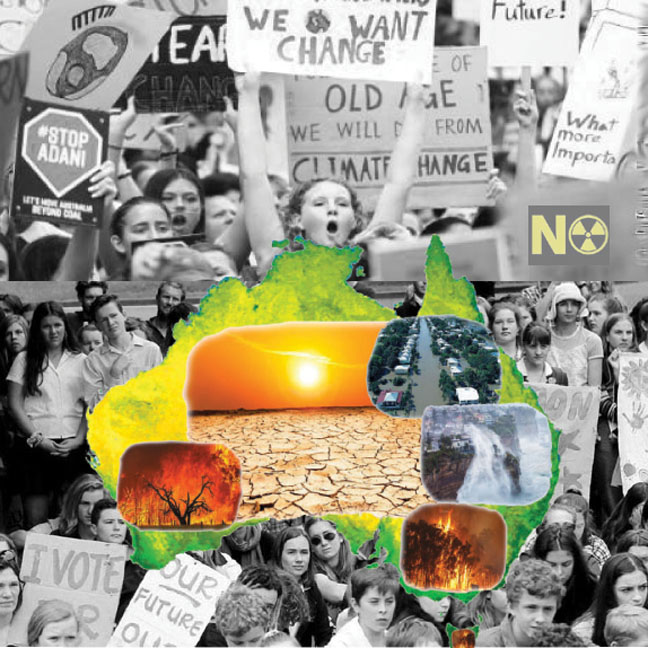
Young people send strong climate message, Pro Bono Maggie Coggan | 24 August
“We see the world in a different light. Politicians need to start listening to us and taking action,” a youth leader says.
Nearly 90 per cent of young people say they feel unprepared for future climate disasters and want politicians to give them a bigger voice on climate change, a new report finds. Conducted in the wake of the catastrophic summer bushfire season, the new Australian Institute for Disaster Resilience and World Vision Australia research found that despite hazards such as bushfires, floods, drought and tropical cyclones posing a greater threat, young people said they were more likely to learn about earthquakes at school. This left 88 per cent of survey respondents feeling unprepared and unable to protect themselves and their communities, even though nearly two-thirds (64 per cent) had experienced at least three events such as bushfires, heatwaves and drought in the past three years. “We anticipate that we will experience personal impacts from natural hazards in the future, whether we are living in capital cities, regional centres, or rural areas,” respondents said. “The 2020 bushfires demonstrated that you need not live in the bush to be affected by a bushfire. We are experiencing these persistent worries while having to contend with life, school, growing up and everything else that comes with being a young person in Australia.” It is the most comprehensive consultation of children and young people on climate change, disasters, and disaster-resilience in the country, with 1,500 people participating in the online survey, supported by UNICEF Australia, Plan International, Save the Children, Oaktree and Australian Red Cross. Young people concerned, but not heard ………… A full copy of the report can be found here. https://probonoaustralia.com.au/news/2020/08/young-people-send-strong-climate-message/ |
|
Gas is not transition energy we were promised, new research suggests
Gas is not transition energy we were promised, new research suggests, SMH, By Nick O’Malley, August 24, 2020 — The good news about natural gas is that when it is burnt it creates between 40 and 50 per cent less carbon dioxide than coal would to create the same amount of energy.This is why it has been embraced by some climate activists and governments as a useful energy source to replace coal and oil while renewable energy technologies catch up with global energy demand.
But the good news ends there, and there is a lot more to the story.
Before it is burnt natural gas is mostly made up of methane, and methane is estimated to be about 28 times more potent a greenhouse gas than carbon dioxide over a 100-year period.
Over a 20-year period – about the time scientists believe we have to try to prevent the worst impacts of global warming – it is up to 80 times more potent at warming the planet than carbon dioxide.
The United States’ Environmental Protection Agency estimates that for every cubic metre of methane extracted by the US oil and gas industry, 1.4 per cent escapes into the atmosphere as so-called fugitive emissions.
But more recent research suggests this estimate is drastically low, and that, in fact, the industry in the US is leaking 13 million metric tonnes of methane a year, or 2.3 per cent.
It is not yet clear how much fugitive methane is released by the Australian gas industry, but new technologies now allow scientists to accurately measure it and the data is expected to be published in the coming months.
The US Environmental Defence Fund estimated that, in America, if just 3 per cent of methane escapes, gas is no cleaner an energy source than coal……. https://www.smh.com.au/environment/climate-change/gas-is-not-transition-energy-we-were-promised-new-research-suggests-20200824-p55ovg.html
1 This month



Help Aunty Sue Protect Her Land and Sacred Sites From Destructive Rocket Testing.
.

Australians deserve the truth
about
AUKUS – https://aukuspublicinquiry.com/

PETITION – To: Prime Minister Anthony Albanese and the Australian Labor Government

of the week – Australians for War Powers Reform (AWPR)
To see nuclear-related stories in greater depth and intensity

