Antarctica – global heating and nuclear issues – theme for September 20
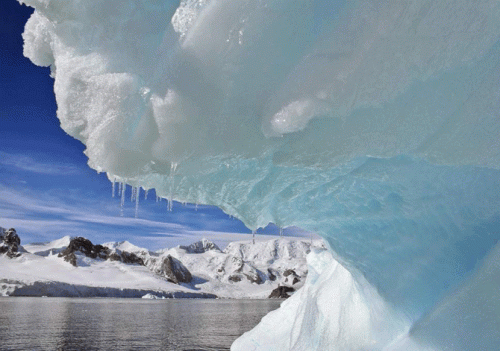
Antarctica is not in the news as much as the Arctic is, But global heating is affecting Antarctica too, and Antarctica has its nuclear issues.
Antarctica has made headlines several times this year due to extremely warmer than usual temperatures. It has been steadily heating up for decades. Antarctic ice shelves have lost nearly 4 trillion metric tons of ice since the mid-1990s, scientists say. Ocean water is melting them from the bottom up, causing them to lose mass faster than they can refreeze. As ice shelves melt, they become thinner, weaker and more likely to break. When this happens, they can unleash streams of ice from the glaciers behind them, raising global sea levels. Antarctica is also losing ice from melting ice sheets, and chunks of ice falling from glaciers.
Less studied than the Arctic region, Antarctic is now being investigated by Australian researchers, using robots to gather data from difficult to reach underwater areas. Satellite monitoring confirms the shelves’ melting trend.
Nuclear issues. From 6,000 nautical miles away, uranium mining in Australia is polluting the Antarctic. After 1945 atomic bomb testing sent radioactive pollution to the South Pole, as well as to everywhere else on the planet.
USA operated a small nuclear power plant at Antarctica’s McMurdo Sound. It was known as “nukey poo” because of its frequent radioactive leaks. It had 438 malfunctions – nearly 56 a year – in its operational lifetime, including leaking water surrounding the reactor and hairline cracks in the reactor lining. The emissions of low level waste water where in direct contravention of the Antarctic Treaty, which bans military operations as well as radioactive waste in Antarctica. After the reactor was closed down, the US shipped 7700 cubic metres of radioactive contaminated rock and dirt to California. Many USA naval workers there developed cancers.
Today, small nuclear reactors similar to this one, are being touted for remote areas in Australia and other countries. The history of this one in Antarctica, and 7 others elsewhere, was one of malfunctions, and closing down within a few years. This does not augur well for the small nuclear reactors being promoted today.
Adam Bandt urges another Labor-Greens coalition for climate action
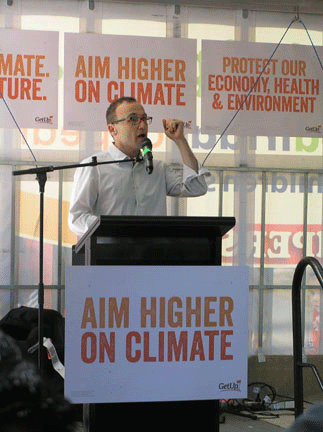 Adam Bandt urges another Labor-Greens coalition for climate action, https://www.theage.com.au/politics/federal/adam-bandt-urges-another-labor-greens-coalition-for-climate-action-20200820-p55nrc.html, By Rob Harris, August 21, 2020 —Greens leader Adam Bandt will mark 10 years since his party signed a deal to prop up the Gillard government by flagging he would be willing to again form a power-sharing deal with Labor to combat climate change.The Melbourne MP will use his address to the Greens National Conference on Saturday to urge Labor leader Anthony Albanese to commit to acting on carbon pollution by again entering into progressive pact
Labor is currently locked in a fierce internal battle over its support for coal and gas production as it wrestles with three successive election losses and poor results at the polls last year in resource-rich regional Queensland seats.
Veteran frontbencher Joel Fitzgibbon warned on Thursday his party could soon split in two, arguing it is struggling to be “all things to all people” across its inner city and regional voter bases.
Mr Bandt will tell his party faithful that it was only with the Greens holding the balance of power in both the House of Representatives and the Senate which led to “world leading climate action with a price on carbon”.
“In recent Australian history, there is one indisputable fact. The only time that climate pollution meaningfully dropped is when the Greens shared power,” Mr Bandt says in a draft copy of the speech.
“When the Greens, Labor and independents worked cooperatively and shared power like we did in 2010, we got a lot done.
As Liberal and Labor rush once more to give tax cuts to millionaires while embracing coal and gas, it is clear that Greens sharing power is the pathway to change.
Mr Bandt will also use the speech to say the climate deal reached with the Gillard government was stronger and more effective in reducing carbon emissions than the Rudd government’s scheme it blocked in the Senate.
Warning of a federal election within 12 months, Mr Bandt will say the path to climate policy progress was to put the Greens into shared power through a hung parliament.
Mr Bandt said the carbon tax legislation by Labor in 2010 with the backing of the Greens was “well-designed” and it reduced pollution for the first time in Australian industrial era history.
He will promise to “hammer” a straightforward message between now and the next election that the “only way to get real change is to vote for it and give the Greens shared power”.
“Many look longingly to New Zealand, where Jacinda Ardern leads a progressive multi-party government with Greens support, and wonder if it could happen here,” he will say.
Mr Albanese on Thursday said Labor had continually evolved and a modern party with “any self-respect” would be attempting to mitigate the effects of climate change.
In a rebuke to Mr Fitzgibbon, he said the issue of climate change was not a matter of geography because “wherever people live, they’re impacted by climate change”.
“Were about also holding the government to account. Putting forward an alternative agenda for the nation,” he said.
Torres Strait Islanders claim climate change affects their human rights – Australia govt tries to stifle their claim
Australia asks UN to dismiss Torres Strait Islanders’ claim climate change affects their human rights
Complaint argues Morrison government has failed to take adequate action on emissions or adaptation measures, Guardian, Katharine Murphy Political editor 14 Aug 20 The Morrison government has asked the human rights committee of the United Nations to dismiss a landmark claim by a group of Torres Strait Islanders from low-lying islands off the northern coast of Australia that climate change is having an impact on their human rights, according to lawyers for the complainants.
The complaint, lodged just over 12 months ago, argued the Morrison government had failed to take adequate action to reduce emissions or pursue proper adaptation measures on the islands and, as a consequence, had failed fundamental human rights obligations to Torres Strait Islander people.
But the lead lawyer for the case, Sophie Marjanac, says the Coalition has rejected arguments from the islanders, telling the UN the case should be dismissed “because it concerns future risks, rather than impacts being felt now, and is therefore inadmissible”.
Marjanac said lawyers for the commonwealth had told the committee because Australia is not the main or only contributor to global warming, climate change action is not its legal responsibility under human rights law.
“The government’s lawyers also rejected arguments that climate impacts were being felt today, and that effects constituting a human rights violation are yet to be suffered”.
A spokesman for the attorney general, Christian Porter, said submissions to the human rights committee were not publicly available……
Lawyers for the islanders have alleged that the catastrophic nature of the predicted future impacts of climate change on the Torres Strait Islands, including the total submergence of ancestral homelands, is a sufficiently severe impact as to constitute a violation of the rights to culture, family and life.
The challenges associated with sea level rise in the Torres Strait have been well documented. A report from the Climate Council on the risks associated with coastal flooding notes that Torres Strait Island communities are extremely low-lying and are thus among the most vulnerable in Australia to the impacts of climate change.
The report concludes the shallowness of the strait “exacerbates storm surges and when such surges coincide with very high tides, extreme sea levels result”. It cites sea level data collected by satellite from one location in the Torres Strait between 1993 and 2010 that indicated a rise of 6 mm per annum, “more than twice the global average”,
Although the report notes this was a single dataset, low-lying islands in the Pacific – and Torres Strait islands such as Masig and Boigu – are likely to be at the forefront of forced displacement. Some forecasts have predicted up to 150 million people could be forcibly displaced by climate change by 2040 – larger than the record number of people already forced from their homes globally.
The non-profit group ClientEarth is supporting the complaint. A spokesman for the group said: “It is shameful that Indigenous communities on Australia’s climate frontline are being told that the risk of climate change to their human rights is merely a future hypothetical issue, when scientists are clear these impacts will happen in coming decades”.
“Climate change risk is foreseeable and only preventable through immediate action in the present. States like Australia have legal duties to protect the human rights of their citizens”. https://www.theguardian.com/australia-news/2020/aug/14/australia-asks-un-to-dismiss-torres-strait-islanders-claim-climate-change-affects-their-human-rights
$6.6 trillion in annual GDP at risk as Asian climate warms – McKinsey Global Institute
 McKinsey sees $6.6 trillion in annual GDP at risk as Asian climate warms, https://www.smh.com.au/business/markets/mckinsey-sees-6-6-trillion-in-annual-gdp-at-risk-as-asian-climate-warms-20200813-p55ley.html By Bloomberg News, August 14, 2020 Lethal heatwaves, droughts, floods and typhoons will become more common in Asia-Pacific, which faces more severe potential impacts from climate change than many parts of the world, McKinsey & Co. researchers warn.Asia is particularly at risk because it has such a high number of poor people, who tend to rely more on outdoor work, living in areas most vulnerable to extreme increases in heat and humidity, McKinsey Global Institute said in a new report published on Thursday. By 2050, the loss of that labor could cost the region as much as $US4.7 trillion ($6.6 trillion) a year in GDP, about two-thirds of the global total at risk. McKinsey sees $6.6 trillion in annual GDP at risk as Asian climate warms, https://www.smh.com.au/business/markets/mckinsey-sees-6-6-trillion-in-annual-gdp-at-risk-as-asian-climate-warms-20200813-p55ley.html By Bloomberg News, August 14, 2020 Lethal heatwaves, droughts, floods and typhoons will become more common in Asia-Pacific, which faces more severe potential impacts from climate change than many parts of the world, McKinsey & Co. researchers warn.Asia is particularly at risk because it has such a high number of poor people, who tend to rely more on outdoor work, living in areas most vulnerable to extreme increases in heat and humidity, McKinsey Global Institute said in a new report published on Thursday. By 2050, the loss of that labor could cost the region as much as $US4.7 trillion ($6.6 trillion) a year in GDP, about two-thirds of the global total at risk.
The report underscores the economic risks of delaying investments that mitigate or adapt to climate change. The potential for widespread damage is similar to the region’s experience during the current pandemic, according to McKinsey. What we have seen is that countries, cities and people can take resolute actions and if we do take these actions and sustain them, we can cooperate globally and see positive outcomes,” said Oliver Tonby, McKinsey’s Asia chairman, who co-authored the report. The projections are based on a scenario in which the world fails to cut greenhouse gas emissions and Asia warms by 2 degrees Celsius. They show that by 2050, between 500 million and 700 million people living in places like India, Bangladesh and Pakistan could experience heatwaves that exceed the survivability threshold. The loss of outdoor labour during those times could shave off 7 per cent to 13 per cent off GDP in those three countries, resulting in losses of $US2.8 trillion to $US4.7 trillion across the whole of Asia on average per year, according to the report. Extreme precipitation events could rise three- or four-fold by 2050 in parts of Japan, China, South Korea and Indonesia, according to McKinsey. Increased riverine flooding could cause $US1.2 trillion in damage in Asia, about 75 per cent of the global impact. Conversely, as the earth warms, parts of southwestern Australia could spend more than 80 per cent of a decade in drought conditions by 2050 and regions of China could experience droughts 40 per cent to 60 per cent of the time. Climate change will also increase the likelihood of severe typhoon strikes from the Philippines and Vietnam to Northeast Asia. It will also create winners and losers, increasing surface water supply in parts of northern India and China while depleting reservoirs in Australia.
To face the business risks, Tonby said companies need to assess their exposure and take it into consideration when making plans. A significant opportunity lies in infrastructure development in Asia as the region is still rapidly urbanising. |
Australian government using COVID recovery strategy to bolster its mates in gas industry
There have been recent media reports that the commission advising the Morrison government on its COVID recovery strategy has recommended that taxpayers provide massive support to build gas and fuel infrastructure.
However, Australia is possibly suffering something of a “resource curse”, as capital markets increasingly won’t invest in – nor insure – new coal and gas projects.
With the world seeking to accelerate the transition to low-carbon economies and societies, this would see the Australian people being asked to invest in old-world industries and technologies, rather than new, emerging industries. Or in assisting some key industries that have been severely damaged by COVID-19 to reset.
It is not unfair to claim that Australia has never really had an effective industry policy.
Sure, we have often ridden on the backs of sheep and minerals booms, and enjoyed them while they lasted…….
The current special interest push for gas and fuel infrastructure defies common sense, is directly against our national interests.
It is to the detriment of other major export/employment sectors – such as education (especially universities) and international tourism – that have been severely impacted by the COVID-19 pandemic but are not being supported by government assistance.
Coal and gas are facing declining global demand; they are hardly “infant industries” the longer-term future of which could justify investment to assist them to grow up.
These projects just wouldn’t stack up as feasible, when full account is taken of their economic/commercial, social, and environmental costs and benefits.
Investors are also reassessing their climate risks and moving out of climate exposed investments, forcing many of the big oil, gas and coal companies to make significant write downs of the values of their assets.
By comparison, investments in renewable energy (including recognising its significant potential as an export, especially to Asia), as well as in the transition business opportunities as transport is decarbonised, in regenerative agriculture, and in a host of bioenergy/circular economy projects dealing with waste and fuel security will probably stack up on such a cost/benefit assessment…..
The tragedy is that the Morrison government gives priority to its mates. ….
Today, it’s more the mining industries and banks – and now the specific influence of some on the COVID Commission with gas and related interests.
It’s time for our government to think beyond the square, and in our national interest.
John Hewson is a professor at the Crawford School of Public Policy, ANU, and a former Liberal opposition leader. https://www.canberratimes.com.au/story/6877063/how-australia-is-suffering-a-resource-curse/?cs=14246
Climate Change Is a Security Threat to the Asia-Pacific
|
Climate Change Is a Security Threat to the Asia-Pacific
Climate change is likely to alter the local physical and strategic environment profoundly, and potentially catastrophically. The Diplomat, By Shiloh Fetzek and Dennis McGinn, August 10, 2020 This week the ASEAN Joint Task Force on Humanitarian Assistance and Disaster Relief (HADR) will meet via video conference, with the COVID-19 pandemic escalating just as some countries in the disaster-prone Indo-Asia Pacific enter their cyclone, drought, heatwave, or monsoon seasons. The overlaying of the pandemic with existing complex challenges is a timely reminder that planning for HADR capacities – and regional security – needs to be attuned to the increasing likelihood of multiple, overlapping hazards and converging security risks, especially in a future where climate change alters the context in which other disasters and crises take place. Developing a clearer recognition of how climate change can reshape the strategic environment will be essential for preserving regional security, stability, and prosperity in the face of complicated and interlocking challenges, as we argue in a new report on the Indo-Asia Pacific published by the International Military Council on Climate and Security (IMCCS).
The Indo-Asia Pacific is highly exposed to climate change impacts. Climate change is likely to alter the local physical and strategic environment profoundly, and potentially catastrophically. More frequent or intense extreme weather, sea level rise, and ocean acidification (among other climate impacts) will create a range of threats to the well-being and security of countries in the region, many of which are already threatened by disaster vulnerability and increasingly complex security tensions.
As well as the immediate physical impacts, climate change will increase food and water insecurity, contribute to forced migration and displacement, and challenge disaster response and recovery capabilities …….. https://thediplomat.com/2020/08/climate-change-is-a-security-threat-to-the-asia-pacific/
|
|
Australia must place climate action at centre of coronavirus recovery, chief UN economist says
|
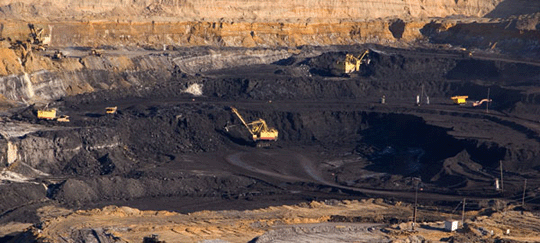
Australia must place climate action at centre of coronavirus recovery, chief UN economist says, SBS, BY TOM STAYNER 12 Aug 20, A chief economist for the United Nations has urged Australia to prioritise climate action above pouring money into fossil fuels in its coronavirus recovery.
A United Nations chief economist has urged Australia and other countries across the world to place more ambitious climate action and investment in clean energy at the centre of their COVID-19 recovery plans. Elliott Harris is helping lead the UN’s development of policy advice for nations grappling with the pandemic. Mr Harris appeared on a webinar with progressive think tank the Australia Institute on Wednesday, where he was questioned about how the Australian government should shape its recovery from the pandemic. He said developed nations such as Australia must be willing to make difficult decisions and prioritise a “green recovery”.
“What we’ve seen in this COVID crisis is that governments are indeed capable of really ambitious, rather unorthodox, extremely important and even massive interventions,” he told the webinar. “I can think of no stakes that are higher than the climate crisis that we are living in right now.” UN Secretary General Antonio Guterres has stressed coal should play no part in any country’s post-coronavirus stimulus plan, while business leaders in Australia have also been putting pressure on the federal government to prioritise renewable energy projects. The head of the federal government’s COVID advisory committee Nev Power told a Senate committee on Tuesday he has been approached about locking in a low emission future……… Mr Harris said Australia should focus on making long-term “sustainable” investments, rather than subsidising further fossil fuel projects. “This is a critical choice that all countries have to make and all investors have to make,” he said. “There is a very difficult trade-off, there is no doubt about it.” “[But] we really need to think about how we shift the flow of investment towards sustainability. “The fact of it is that, unfortunately, the world does not have the luxury of allowing itself of continuing down the path of fossil fuels.” Australia’s commitment to the Paris Agreement requires emissions reduction of at least 26 per cent by 2030, based on 2005 levels. But the government has come under scrutiny for not having a 2050 target, with the Business Council of Australia, Australian Industry Group and big miners Rio Tinto and BHP all backing a net zero-emissions goal by then. Australia is considered one of the world’s largest exporter of fossil fuels through coal and liquified natural gas projects, but also a leading investor in renewable energy. The UN has predicted the world economy will shrink by 3.2 per cent in 2020 because of the economic downturn forced by the pandemic. https://www.sbs.com.au/news/australia-must-place-climate-action-at-centre-of-coronavirus-recovery-chief-un-economist-says |
|
|
Australia’s doctors call for a climate-focused COVID-19 recovery plan
|
Medical groups call for a climate-focused COVID-19 recovery plan, https://thenewdaily.com.au/news/2020/08/11/medical-groups-climate-focused-covid-19-recovery/ Dominica Sanda Many of the medical professionals on the frontline of the COVID-19 pandemic are urging the Australian government to also act on another health crisis – climate change.Australia’s peak medical groups representing GPs, emergency doctors, obstetricians and psychiatrists have written to Prime Minister Scott Morrison urging him to make climate change action a part of the COVID-19 economic response.
The letter, co-ordinated by the Doctors for the Environment Australia, notes the COVID-19 pandemic and climate change are two global health emergencies the nation must respond to. make climate change action a part of the COVID-19 economic response. The letter, co-ordinated by the Doctors for the Environment Australia, notes the COVID-19 pandemic and climate change are two global health emergencies the nation must respond to. make climate change action a part of the COVID-19 economic response. The letter, co-ordinated by the Doctors for the Environment Australia, notes the COVID-19 pandemic and climate change are two global health emergencies the nation must respond to. The mental health impacts are likely to linger for decades, the medical groups say. The doctors argue fossil-fuel combustion is a major contributor to air pollution, while water supplies and food-growing capacity are also threatened by climate change. They’ve urged the federal government to take a health-centred approach in its COVID-19 recovery by transitioning away from fossil fuels, coal, and gas and instead turn to renewables, electric vehicles, and public transport powered by electricity. “Redirecting funds from fossil fuel subsidies towards the production of renewable energy would produce cleaner air, significantly reduce emissions and power an economic recovery,” the letter said. “Climate change is a public health emergency. Failing to mitigate and prepare for climate change risks potentially catastrophic health and economic impacts.” The Royal Australasian College of Physicians said it was vital climate change and its impacts on health are central to the COVID-19 recovery plan. “While COVID-19 poses the most immediate threat to our health, the serious and long-term health impacts of climate change still remain,” spokeswoman Associate Professor Linda Selvey said in a statement. The Australasian College for Emergency Medicine noted the lockdowns imposed on communities during the pandemic reduced CO2 emissions significantly. “The net result was remarkable, and it shows that where there is political will, it is possible to reduce emissions,” ACEM Public Health and Disaster Committee chair Dr Lai Heng Foong said. “We need collective action, including government response to reduce our CO2 emissions, transition to renewable energy sources and build community resilience. Our future is at stake, and we need action now.” |
|
|
Labor’s carbon price proves effective climate policy is possible, Julia Gillard says
 Labor’s carbon price proves effective climate policy is possible, Julia Gillard says, https://www.sbs.com.au/news/labor-s-carbon-price-proves-effective-climate-policy-is-possible-julia-gillard-says The former prime minister says Australia would be in a different place on climate if the carbon tax had continued.
Former prime minister Julia Gillard doesn’t want climate policy put in the too-hard basket, saying Australia can have a scheme that reduces emissions.
It has been almost 10 years since Ms Gillard’s federal election win, with her minority Labor government introducing a short-lived carbon price scheme that saw emissions drop.
Emissions rose again after the Abbott government repealed the policy.
Ms Gillard says Australia would be in a different place on climate if the scheme had continued.
“One of the frustrations of sliding door moments is, other than in the famous movie, you don’t actually get to go back in time and run the parallel universe,” she told a webinar hosted by the Australia Institute think-tank on Wednesday.
Australia is one of the last developed countries actively considering new coal-fired power stations
“What I hope is remembered from that period and taken forward into the future … is that it’s possible to put in place a scheme in Australia that does reduce our carbon emissions.
“The perceived history is ‘oh we’ve been fighting forever, nothing gets done, it’s all too hard’. I would like us to unpack to the next level: it can get done, it was done.
“We can be informed by past experience and we can get on with the job. So I do want to push back against that sort of received helplessness that it’s all too hard.”
To coincide with the online discussion the Australia Institute released a report mapping where the nation’s emissions would be if the carbon price had remained. “What I hope is remembered from that period and taken forward into the future … is that it’s possible to put in place a scheme in Australia that does reduce our carbon emissions. The think-tank says given the policy reduced emissions by two per cent, levels would be 25 million tonnes lower this year than they are.
A student is suing the government over the financial risks of climate change
 ‘A wake-up call’: why this student is suing the government over the financial risks of climate change, The
  Conversation
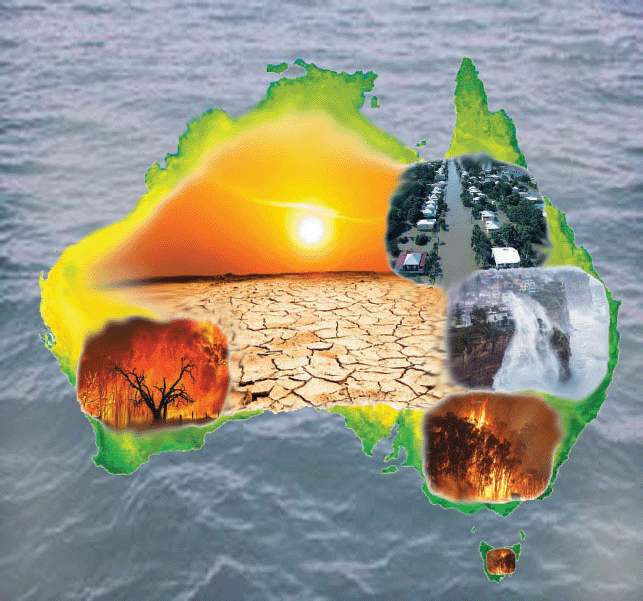
July 27, 2020 Jacqueline Peel Professor of Environmental and Climate Law, University of Melbourne, Rebekkah Markey-Towler, Research assistant, University of MelbourneAs the world warms, the value of “safe” investments might be at risk from inadequate climate change policies. This prospect is raised by a world-first climate change case, filed in the federal court last week.
Katta O’Donnell – a 23-year-old law student from Melbourne – is suing the Australian government for failing to disclose climate change risks to investors in Australia’s sovereign bonds.
Sovereign bonds involve loans of money from investors to governments for a set period at a fixed interest rate. They’re usually thought to be the safest form of investment. For example, many Australians are invested in sovereign bonds through their superannuation funds.
But as climate change presents major risks to our economy as well as the environment, O’Donnell’s claim is a wake-up call to the government that it can no longer bury its head in the sand when it comes to this vulnerability.
O’Donnell’s arguments
O’Donnell argues Australia’s poor climate policies – ranked among the lowest in the industrialised world – put the economy at risk from climate change. She says climate-related risks should be properly disclosed in information documents to sovereign bond investors.
O’Donnell’s claim alleges that by failing to disclose this information, the federal government breaches its legal duty. It alleges the government has engaged in misleading and deceptive conduct, and government officials breached their duty of care and diligence.
This is a standard similar to that owed by Australian company directors. Analysis from leading barristers indicates that directors who fail to consider climate risks could be found liable for breaching their duty of care and diligence.
O’Donnell argues government officials providing information to investors in sovereign bonds should meet the same benchmark.
Climate change as a financial risk….… https://theconversation.com/a-wake-up-call-why-this-student-is-suing-the-government-over-the-financial-risks-of-climate-change-143359
Parts of Victoria’s Bellarine Peninsula, Melbourne suburbs, at risk from sea level rise
important for local communities to know whether they were at risk so they could decide whether to invest in adaptation strategies, such as infrastructure, to protect the coastline, or simply retreat from the danger zone.
How coastal communities on Victoria’s Bellarine Peninsula are dealing with the reality of sea level rises, ABC, By Nicole Mills, 26 Jul 20, As Vicki Perrett plays with her granddaughter Rachel on the beach in front of her home on Victoria’s Bellarine Peninsula, she knows she has to cherish these moments.Key points:
And not just because children grow up so fast. She also knows the beach they play on may not be there forever. “The beach is coming closer towards us, towards the road and towards our property,” Ms Perrett says. “It’s very prone to sea level rise here and to storm surges.” This stretch of coastline at Indented Head has already been earmarked as at risk of going underwater by 2100. Ms Perrett’s house is also in the danger zone………… Councils ordered to plan for sea level risesThe Victorian Government has instructed all councils to plan for a 0.8m sea level rise by the year 2100. That figure is based on a 2007 report from the United Nations Intergovernmental Panel on Climate Change, which agreed on the projected rise, but could not rule out larger increases. Although the worst impacts of sea level rises may still be decades away, this bayside community, about an hour-and-a-half south of Melbourne, has already had a taste of what is to come………. Dr McInnes leads the CSIRO’s climate extremes and projections group, which has contributed to the mapping of high-risk areas. Publicly available mapping tools, such as Coastal Risk Australia, allow anyone to find out how their local area would fare under different sea-level rise scenarios. Dr McInnes said it was important for local communities to know whether they were at risk so they could decide whether to invest in adaptation strategies, such as infrastructure, to protect the coastline, or simply retreat from the danger zone. “Land subject to inundation is land that is low-lying, that is potentially at risk from inundation during extreme sea-level events or even potentially high-tide events in the future,” Dr McInnes said. Dr McInnes says while the worst impacts will be felt during storm surges, there might be some areas that will suffer more permanent flooding. “If [the land] is low enough, it could be permanently inundated,” she said. “Parts of Swan Bay [on the Bellarine Peninsula] could potentially become quite affected by inundation, certainly high-tide inundation, in the future.” And it’s not just regional areas. Dr McInnes says Melbourne suburbs such as Elwood, Aspendale and Mordialloc are also at risk of more-regular flooding in future……….. https://www.abc.net.au/news/2020-07-26/climate-change-sea-level-rises-prompt-action-in-coastal-towns/12383968
|
|
“Advance Australia” -the extreme right wing lobby group, says that climate change is a hoax
From Wikipedia 20 July 20 The national director of Advance Australia was Gerard Benedet, a former Liberal Party staffer who led the organisation during the 2019 Australian federal election.[3] Benedet stood down in September 2019, and was replaced by Liz Storer, former City of Gosnells councillor,[4][5] and advisor to Liberal senator Zed Seselja.[6]
High-profile backers include businessmen such as Maurice Newman, Kennards Self Storage managing director Sam Kennard, and Australian Jewish Association president David Adler.[2][3] Other members of the advisory council include security specialist Sean Jacobs and journalist Kerry Wakefield.[7] Queensland businessman James Power is also said to have been involved.[8]….
Benedet says the membership is 60 per cent male and has an average age of about 50.[1]
Advance Australia has been accused of astroturfing and being little more than a front for the Liberal Party, much as GetUp has been accused of being a front for the Australian Labor Party.[11] Advance Australia’s independence has yet to be tested, whereas GetUp has been cleared of ties to the Labor Party on three occasions by the Australian Electoral Commission.[12].
The group believes that anthropogenic climate change is a “hoax”[6], with current national director Liz Storer describing of the teaching of the predominant scientific view as “the other side of the story being shoved down their throats. It’s already happening. The left have infiltrated our education systems. Any aware parent knows that their child is being taught the left’s ideology. ”
Nuclear power, far too slow to affect global heating – theme for July 20
In recent themes I wrote about nuclear power being in fact a big contributor to global warming, and about how climate change will in fact finish off the nuclear industry.
But – let’s pretend that nuclear reactors really could reduce greenhouse gas emissions.
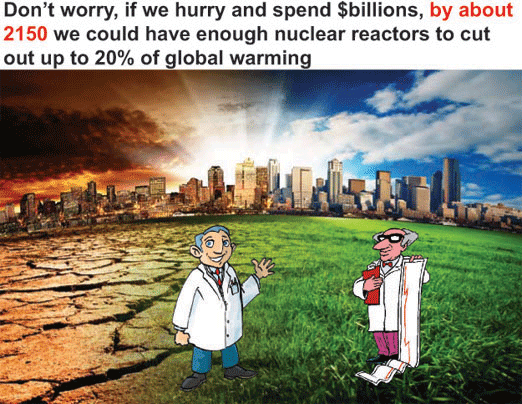
TIME: To do that, 1500 one thousand megawatt-electric new reactors would be needed within a few years to displace a significant amount of carbon-emitting fossil generation. A Massachusetts Institute of Technology Study on “The Future of Nuclear Power” projected that a global growth scenario for as many as 1500 one thousand megawatt-electric new reactors would be needed to displace a significant amount of carbon-emitting fossil generation. Average 115 built per year would reduce our CO2 use by only 16%.
But the new flavour of the month is Small Modular Nuclear Reactors (SMRs), which generate from 50 to 200 megawatts. So the world would need, quickly, to have a significant reduction of carbon emissions, i.e at least 7500 largish SMRs – or 30,000 smaller ones., (and these SMRs are already shown to be more costly than large ones,)

Meanwhile – if the nuclear “climate cure” were to be pursued, the enormous costs and efforts involved would take away from the clean, fast, and ever cheaper solutions of energy efficiency and renewable energy
Australia wants to build a huge concrete runway in Antarctica. Here’s why that’s a bad idea
July 17, 2020 Shaun Brooks, University Associate, University of Tasmania, Julia JabourAdjunct Senior Lecturer, University of Tasmania A ustralia wants to build a 2.7-kilometre concrete runway in Antarctica, the world’s biggest natural reserve. The plan, if approved, would have the largest footprint of any project in the continent’s history………
Australia: an environmental leader?
Australia has traditionally been considered an environmental leader in Antarctica. For example, in 1989 under the Hawke government, it urged the world to abandon a mining convention in favour of a new deal to ban mining on the continent.
Australia’s 20 Year Action Plan promotes “leadership in environmental stewardship in Antarctica”, pledging to “minimise the environmental impact of Australia’s activities”.
But the aerodrome proposal appears at odds with that goal. It would cover 2.2 square kilometres, increasing the total “disturbance footprint” of all nations on the continent by 40%. It would also mean Australia has the biggest footprint of any nation, overtaking the United States.
Within this footprint, environmental effects will also be intense. Construction will require more than three million cubic metres of earthworks – levelling 60 vertical metres of hills and valleys along the length of the runway. This will inevitably cause dust emissions – on the windiest continent on Earth – and the effect of this on plants and animals in Antarctica is poorly understood.
Wilson’s storm petrels that nest at the site will be displaced. Native lichens, fungi and algae will be destroyed, and irreparable damage is expected at adjacent lakes.
Weddell seals breed within 500 metres of the proposed runway site. Federal environment officials recognise the dust from construction and subsequent noise from low flying aircraft have the potential to disturb these breeding colonies.
The proposed area is also important breeding habitat for Adélie penguins. Eight breeding sites in the region are listed as “important bird areas”. Federal environment officials state the penguins are likely to be impacted by human disturbance, dust, and noise from construction of the runway, with particular concern for oil spills and aircraft operations.
The summer population at Davis Station will need to almost double from 120 to 250 during construction. This will require new, permanent infrastructure and increase the station’s fuel and water consumption, and sewage discharged into the environment……... https://theconversation.com/australia-wants-to-build-a-huge-concrete-runway-in-antarctica-heres-why-thats-a-bad-idea-139596
Global heating – Farmers can’t afford the higher insurance premiums. Fossil fuels killing agriculture
Climate change-driven disasters making insurance premiums too dear for farmers, ABC News, Vic Country Hour, By Jane McNaughton 16 July 20
Australian farmers are facing increasingly frequent droughts, floods, hailstorms and bushfires, resulting in insurance premiums rising to the point where cancelling or underinsuring are the only options.
Key points:
- A NSW farmer says the fossil fuel industry is effectively killing the agriculture sector
- Insurance premiums are being driven to unaffordable levels by the impacts of climate change
- The Insurance Council of Australia says 80 per cent of Australian homes are underinsured — and that figure’s likely higher in the bush
Climate change has already cost farmers more than $1 billion since 2000, according to ABARES.
Third-generation lamb and cropping farmer Peter Holding said government inaction on global warming could have disastrous flow-on effects to the agriculture industry.
“Climate change poses a cataclysmic set of challenges for farmers,” the Farmers for Climate Action member said.
“It’s pretty severe and it’s getting worse…………
Fossil fuels ‘undermining’ agriculture
Financial strain is not the only issue climate change has delivered to farmers.
“Unfortunately we’re getting less good years and a lot more variability,” Mr Holding said.
“There’s a lot of impacts and I can’t see it stopping any time soon.
“The droughts are just continuing, since the turn of the century we’ve had [so many years] of drought, interlaced with floods.”…….
“The fossil fuel industry is creating emissions and that is slowly but surely making agriculture unviable.
“We’ve cut the emissions from livestock probably in half, farmers in cropping areas have done all sorts of things to reduce the use of diesel and better use fertilisers.
“So farmers are working on all of these problems to cut their own emissions, but we definitely need some quick action to reduce the emissions of fossil fuel.”
1 This month


Help Aunty Sue Protect Her Land and Sacred Sites From Destructive Rocket Testing.
.

Australians deserve the truth
about
AUKUS – https://aukuspublicinquiry.com/

PETITION – To: Prime Minister Anthony Albanese and the Australian Labor Government

of the week – Australians for War Powers Reform (AWPR)
To see nuclear-related stories in greater depth and intensity

