NUCLEAR’s WHOPPING CLIMATE LIE – theme for July 2020
 “If you tell a lie big enough and keep repeating it, people will eventually come to believe it. A lie told once remains a lie but a lie told a thousand times becomes the truth ”
Dr Goebbels would be delighted with the nuclear lobby’s lie that nuclear power is zero carbon and will fix climate change. He would be even more delighted with the current success of this lie.
“Think of the press as a great keyboard on which the government can play.”
The failing nuclear industry is fighting for its life. It now pitches its salvation on its claim to halt climate change. Even if
that were true (which it isn’t) the world would have to construct several thousand ‘conventional’ reactors, or 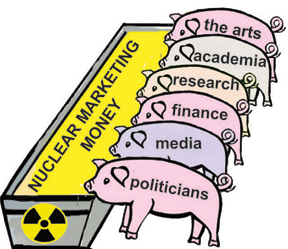 several millions of Small Modular Reactors (SMRs) very quickly, within a decade or two.
How is it that politicians , media, academics have swallowed this lie?

Australia seen as successful in Covid-19 response, deplorable in climate response
 Global report gives Australia an A for coronavirus response but a D on climate https://theconversation.com/global-report-gives-australia-an-a-for-coronavirus-response-but-a-d-on-climate- Global report gives Australia an A for coronavirus response but a D on climate https://theconversation.com/global-report-gives-australia-an-a-for-coronavirus-response-but-a-d-on-climate- 141982 John Thwaites Chair, Monash Sustainable Development Institute & ClimateWorks Australia, Monash University 6 July 20 The global Sustainable Development Report 2020, released this week in New York, ranks Australia third among OECD countries for the effectiveness of its response to the COVID-19 pandemic, beaten by only South Korea and Latvia.Yet Australia trundled in at 37th in the world on its overall progress in achieving the United Nations’ Sustainable Development Goals, which cover a range of economic, social and environmental challenges – many of which will be crucial considerations as we recover from the pandemic. Australia’s worst results are in climate action and the environment, where we rate well below most other OECD countries. 141982 John Thwaites Chair, Monash Sustainable Development Institute & ClimateWorks Australia, Monash University 6 July 20 The global Sustainable Development Report 2020, released this week in New York, ranks Australia third among OECD countries for the effectiveness of its response to the COVID-19 pandemic, beaten by only South Korea and Latvia.Yet Australia trundled in at 37th in the world on its overall progress in achieving the United Nations’ Sustainable Development Goals, which cover a range of economic, social and environmental challenges – many of which will be crucial considerations as we recover from the pandemic. Australia’s worst results are in climate action and the environment, where we rate well below most other OECD countries.
South Korea tops the list of effective COVID-19 responses, whereas New Zealand (which declared the coronavirus eliminated on June 8, albeit with a few sporadic cases since) is ranked sixth. Meanwhile, the United States, United Kingdom and several other Western European countries rank at the bottom of the list. South Korea, Latvia and Australia did well because they not only kept infection and death rates low, but did so with less economic and social disruption than other nations. Rather than having to resort to severe lockdowns, they did this by testing and tracing, encouraging community behaviour change, and quarantining people arriving from overseas. Using smartphone data from Google, the report shows that during the severe lockdown in Spain and Italy between March and May this year, mobility within the community – including visits to shops and work – declined by 62% and 60%, respectively. This shows how much these countries were struggling to keep the virus at bay. In contrast, mobility declined by less than 25% in Australia and by only 10% in South Korea. Why has Australia performed well?There are several reasons why Australia’s COVID-19 response has been strong, although major challenges remain. National and state governments have followed expert scientific advice from early in the pandemic. The creation of the National Cabinet fostered relatively harmonious decision-making between the Commonwealth and the states. Australia has a strong public health system and the Australian public has a history of successfully embracing behaviour change. We have shown admirable adaptability and innovation, for example in the radical expansion of telehealth. We should learn from these successes. The Sustainable Development Goals provide a useful framework for planning to “build back better”. The Sustainable Development Goals, agreed by all countries in 2015, encompass a set of 17 goals and 169 targets to be met by 2030. Among the central aims are economic prosperity, social inclusion, and environmental sustainability. They are arguably even more important than before in considering how best to shape our post-pandemic world. As the report points out, the fallout from COVID-19 is likely to have a highly negative impact on achievement of many of the goals: increased poverty due to job losses (goal 1), disease, death and mental health risks (goal 3), disproportionate economic impacts on women and domestic violence (goal 5), loss of jobs and business closures (goal 8), growing inequality (goal 10), and reduction in use of public transport (goal 11). The impact on the environmental goals is still unclear: the short-term reduction in global greenhouse emissions is accompanied by pressure to reduce environmental safeguards in the name of economic recovery. How do we ‘build back better’?The SDGs already give us a roadmap, so really we just need to keep our sights set firmly on the targets agreed for 2030. Before COVID-19, the world was making progress towards achieving the goals. The percentage of people living in extreme poverty fell from 10% in 2015 to 8.6% in 2018. Access to basic transport infrastructure and broadband have been growing rapidly in most parts of the world. Australia’s story is less positive, however. On a composite index of performance on 115 indicators covering all 17 goals, the report puts Australia 37th in the world, but well behind most of the countries to which we like to compare ourselves. Sweden, Denmark and Finland top the overall rankings, followed by France and Germany. New Zealand is 16th. It is not surprising, in light of our performance during the pandemic, that Australia’s strongest performance is on goal 3: good health. The report rates Australia as on track to achieve all health targets. Australia also performs strongly on education (goal 4), and moderately well on goals relating to water, economic growth, infrastructure and sustainable cities. However, we perform extremely poorly in energy (goal 7), climate change (goal 13) and responsible consumption and production (goal 12), where our reliance on fossil fuels and wasteful business practices puts us near the bottom of the field. On clean energy (goal 7), the share of renewable energy in total primary energy supply (including electricity, transport and industry) is only 6.9%. In Germany it is 14.1%, and in Denmark an impressive 33.4%. Australia rates poorly on goal 12, responsible consumption and production, with 23.6kg of electronic waste per person and high sulfur dioxide and nitrogen emissions. Australia’s performance on goal 13, climate action, is a clear fail. Our annual energy-related carbon dioxide emissions are 14.8 tonnes per person – much higher than the 5.5 tonnes for the average Brit, and 4.3 tonnes for the typical Swede. And whereas in the Nordic countries the indicators for goal 15 — biodiversity and life on land — are generally improving, the Red List measuring species survival is getting worse in Australia. There are many countries that consider themselves world leaders but now wish they had taken earlier and stronger action against COVID-19. Australia listened to the experts, took prompt action, and can hopefully look back on the pandemic with few regrets. But on current form, there will be plenty to regret about our reluctance to follow scientific advice on climate change and environmental degradation, and our refusal to show anything like the necessary urgency. |
|
It’s time to get emotional about climate change
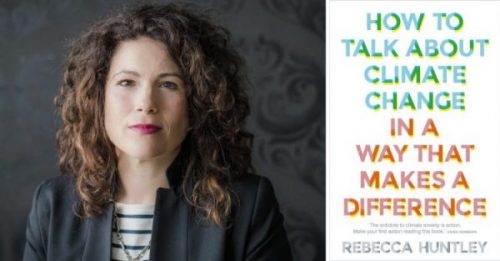
Rebecca Huntley on why it’s time to get emotional about climate change, SMH, By Caitlin Fitzsimmons, June 28, 2020 —Rebecca Huntley had to submit her manuscript for her new book on climate change just as the country was entering lockdown for coronavirus.
The book, How to Talk about Climate Change in a Way that Makes a Difference, to be published this Thursday July 2, is based on social science rather than science. What scientists know about climate change is the jumping off point for Huntley’s exploration of the psychology behind activism, disengagement and denial.
“I nearly called it How to Talk about Climate Change with Your Drunk Uncle,” says Huntley, a social researcher and author. “It’s a bit derogatory but it’s about the idea that everybody who is concerned about climate change has somebody in their life who wants to pick a fight with them about it. Do we fight them or not?”
If the book is about the human factor in the climate change equation and society has just been through major disruption in the form of the pandemic and lockdown, it begs the question whether anything has changed since April, when she submitted her final edits.
The short answer is yes. Huntley says the way the pandemic has played out, at least in Australia, has given her unexpected hope.
She knew greenhouse emissions would go down if people stayed at home, industry was closed and flights were grounded and she knew there would be stories, some of them apocryphal, about wildlife reclaiming human spaces.
stories about low emissions and environmental rejuvenation would mean that people associated climate action with personal deprivation, that we’ve all got to be locked in our homes, losing our jobs, not being able to hug our aunt and uncle and not being able to go on holidays … or out to dinner and the movies,” Huntley says. “I thought if people thought that was the sacrifice we have to make in order to do something about climate change, it would be hugely detrimental.”
The book’s thesis is that the climate change argument won’t be won by reason alone: it’s time to get emotional. Huntley writes about her own emotional transformation from a citizen who believed in the science of climate change and tried to act accordingly to a citizen who believed in the science of climate change and organised her entire personal and professional life accordingly. Her belief in the scientific consensus did not shift, her world-view did……. https://www.smh.com.au/environment/climate-change/rebecca-huntley-on-why-it-s-time-to-get-emotional-about-climate-change-20200625-p5561z.html
Julian Assange’s fiancé calls on the Australian government to secure his freedom
 Julian Assange’s fiancé calls on the Australian government to secure his freedom, https://www.wsws.org/en/articles/2020/06/22/assa-j22.html, By Oscar Grenfell, 22 June 2020Stella Morris, the fiancé of Julian Assange and mother of his two young children, issued a powerful call last night for the Australian government to secure the WikiLeaks founder’s freedom and prevent his extradition to the US, where he faces life imprisonment for exposing American war crimes. Julian Assange’s fiancé calls on the Australian government to secure his freedom, https://www.wsws.org/en/articles/2020/06/22/assa-j22.html, By Oscar Grenfell, 22 June 2020Stella Morris, the fiancé of Julian Assange and mother of his two young children, issued a powerful call last night for the Australian government to secure the WikiLeaks founder’s freedom and prevent his extradition to the US, where he faces life imprisonment for exposing American war crimes.
Morris was featured on Channel Nine’s “60 Minutes” program. The 24-minute segment provided an objective account of Assange’s decade-long arbitrary detention, first in Ecuador’s London embassy where he was a political refugee, and since April 2019 in the maximum-security Belmarsh Prison. The program, presented by Tara Brown, was the first substantive examination of Assange’s plight by the Australian media since the coronavirus pandemic began. Despite the fact that he is an Australian journalist being persecuted by the most powerful governments in the world for his publishing activities, corporate media outlets have maintained an effective D-notice on Assange for more than three months. This has dovetailed with the refusal of the Australian government, the Labor opposition and all of the official parties to defend the WikiLeaks founder. Morris warned that Assange’s incarceration in Belmarsh, which she noted has been dubbed the “UK’s Guantanamo Bay,” is exacerbating physical and psychological health issues stemming from his protracted persecution. “He’s very unwell and I’m very concerned for his ability to survive this,” she said. “Now he’s in the UK’s worst prison. It’s a high-security prison. One in five prisoners are murderers. He shouldn’t be there. He’s not a criminal, he’s not a dangerous person, he’s a gentle intellectual thinker and a journalist. Those people are not the people who belong in prison.” Morris stated that she was “very worried” about Assange’s circumstances. She has been unable to visit him since February, as a result of coronavirus lockdown measures. Despite widespread infections throughout the British penitentiary system, including in Belmarsh, and Assange’s vulnerability to the virus as a result of a chronic lung condition, he has been refused bail. “If you’re separated from your family and you’re alone in a tiny, dark room for 23-hours a day, with no control over your surroundings, I think people can imagine what that is like,” Morris said. Brown stated that in such circumstances, “most people would probably go mad.” Morris responded: “I think any person would get very severely depressed and he is very depressed.” “60 Minutes” showed Morris and her two young children speaking with Assange on the phone. The older of the two asked Assange when he was coming home. Morris, a 37-year-old lawyer, recounted the circumstances of her relationship with Assange. They had grown close when she was working on his legal cases after he had successfully sought political asylum in the Ecuadorian embassy. When the couple’s two children were born in 2017 and 2018, the new Ecuadorian government had initiated closer relations with the US and was increasingly hostile to Assange. UC Global, a Spanish firm contracted to manage the embassy’s security, was surveilling every aspect of Assange’s life and was passing the the material gathered to the US Central Intelligence Agency. When she fell pregnant, Morris informed Assange by writing the news on a piece of paper. They were fearful that any conversation about their personal life would be picked up by the audio recording devices placed throughout the embassy by UC Global. Morris sought to hide her pregnancies from the embassy staff and after the children were born, a friend of Assange pretended to be their father and brought them to the embassy. “The real issue was I thought that our family would be targeted by the same people that were trying to harm Julian,” Morris stated. The program featured news clips of senior US government figures denouncing Assange in hysterical terms and calling for him to be silenced. Morris noted that UC Global had considered stealing the diaper of one of her children to confirm his paternity, and had even discussed plans to kill Assange or allow American agents to kidnap him. Morris commented that it would be difficult for many people to appreciate the lawlessness that had characterised Assange’s persecution. “There’s incredible criminality that has been going on in order to gather information about Julian’s lawyers, and his family, and journalists who were visiting him,” she said. “I’ve been in a permanent state of fear for years and now it’s slowly playing out.” Significantly, the politically-motivated character of Swedish sexual misconduct allegations against Assange was made clear in the program. The allegations were concocted by that country’s police and judiciary, in the midst of a frenzied US campaign against WikiLeaks’ exposure of war crimes in Iraq and Afghanistan. Brown noted that Assange had never been charged with a crime in Sweden, and that the Swedish investigation had been dropped. Australian independent parliamentarian Andrew Wilkie pointed out that documents had shown that the British government used the allegations to enforce Assange’s arbitrary detention in the Ecuadorian embassy. The British authorities had been aware that the Swedish claims were a smokescreen for plans to dispatch Assange to his US persecutors. The program concluded with an appeal from Morris to the Australian government. She said: “I want people to understand that we’re being punished as a family. It’s not just Julian in the prison. The kids are being deprived of their father. I need Julian and he needs me.” Morris declared: “I’d like to ask [Australian Prime Minister] Scott Morrison to do everything he can to get Julian back to his family. If Australia doesn’t step in I’m very fearful this wrong won’t be righted. It’s a nightmare.” Tellingly, Brown stated that Morrison, Foreign Minister Marise Payne and Christian Porter refused to be interviewed. This was in line with the ten-year collaboration of Australian governments in the US-led vendetta against Assange. Beginning with the Greens-backed Labor government of Julia Gillard, they have rejected calls to defend the WikiLeaks’ founder, instead participating in the campaign against him. The official hostility to Assange is bound up with the Australian ruling elite’s unconditional support for the US military alliance and all of American imperialism’s illegal wars and military preparations and dovetails with a domestic assault on democratic rights, including attacks on press freedom and laws increasing punishments for whistleblowers. It is facilitated by the refusal of the Greens, the pseudo-left groups and the unions to mount any campaign for Assange’s rights. This underscores the fact that the fight for Assange’s freedom and for the defence of all civil liberties requires the mobilisation of the working class. The international protests over recent weeks against police violence have demonstrated the objective basis for building such a movement. |
|
Pacific leaders do not want the coronavirus pandemic to distract from work on climate change
|
Pacific leaders fear climate change campaign will ‘lose momentum’ amid COVID-19 pandemic, ABC, By foreign affairs reporter Melissa Clarke 19 June 20
Pacific leaders have said action on climate change “cannot and should not” take a back seat during the COVID-19 pandemic and have appealed for Australia to help rally global support for more emissions cuts.
Key points:
Senior political leaders from both the Fijian and Samoan governments have raised concerns that climate change is being overlooked while global leaders and the media focus on the coronavirus. The Fijian Government, which has been a strong critic of Australia for not doing more to reduce carbon emissions, has said the urgency for addressing climate change has not abated. “It may appear that climate change has taken a back seat, but it cannot and should not,” Fiji’s Attorney-General Aiyaz Sayed-Khaiyum said. Coronavirus update: Follow all the latest news in our daily wrap.Taking part in an online forum hosted by the Australian National University (ANU) on Thursday, Mr Sayed-Khaiyum said the impacts of climate change were being felt every day by Fijians.
Pacific nations regard climate change as an existential threat, with changing weather systems affecting sea levels, fish stocks, water quality and the frequency of severe weather events. Samoa’s Deputy Prime Minister Fiame Naomi Mata’afa, speaking on the same forum, said it is important attention isn’t diverted from climate change. “We’re talking about a pandemic, but… climate change impacts us in all aspects of our lives, including health as well.”…….. Pacific Island nations have been trying to get all countries to agree to register more ambitious emissions reductions targets under the Paris Agreement on climate change. Ms Mata’afa is concerned their campaign could “lose momentum” during the pandemic and appealed for Australia’s help. “I think it is very important for Australia, as a member of the Pacific [Islands] Forum, that it comes in strongly as one of our larger members, with the Pacific and the message: to ensure that the 1.5 [degree] objective that we’ve been advocating for and that we raise the global ambition in regards to [cutting] emissions.” Pacific nations have previously expressed their disappointment that Australia has not fully embraced their calls for more global action……… https://www.abc.net.au/news/2020-06-18/pacific-leaders-fear-coronavirus-distraction-climate-change/12371182 |
|
Morrison government just doesn’t get it, on climate change
Hewson’s View: How long can Morrison deny the undeniable? https://www.canberratimes.com.au/story/6793657/how-long-can-the-pm-deny-the-undeniable/?cs=14246#gsc.tab=0
John Hewson, 19 June 20, The government is doing little to ensure that our soils are more drought resistant and resilient.
Unfortunately, the Morrison government just doesn’t get it when it comes to the imperative for urgent climate action.
Sure, the worst of the drought is over. Sure, the bushfire season has ended. Sure, Morrison has handled the COVID-19 pandemic well, certainly better than expected, but only so far – the more difficult economic and social challenges are yet to come, and the risk of a pick-up in the infection rate is omnipresent.
But, what has the government actually learned from these experiences such as to encourage them to embrace longer-term strategic thinking and planning to better respond to the inevitability of more of these crises in the future? Apparently, very little!
Climate was an important cause of the drought, and the climate predictions are that droughts will occur more frequently and with even greater intensity. Climate was an important cause of the bushfires, again the predictions are for more and worse to come. COVID-19 was very much a dress rehearsal for what awaits us if we continue to ignore the science and the urgent demands of the climate threat. The government has a “tin ear” to all this, not really accepting the significance of the science; certainly not doing much to ensure that our soils are more drought resistant and resilient, or to better prepare for the next bushfire season; and clearly failing to seize the opportunity in developing its COVID Recovery Strategy to accelerate our transition, sector by sector, to a low carbon Australia by mid-century.
They are totally self-absorbed in short-term politics, cynically relieved that they have been able to “survive” their mismanagement of both the drought and the fires, and are now making anti-climate decisions, perceiving some sort of short-term political advantage from paying out to certain vested interests and political supporters, against our longer-term national interest.
Australia is now clearly a laggard in response to climate ...
Australia is now clearly a laggard in response to climate, having squandered the opportunities to lead over the last three decades, thereby forgoing billions of dollars of investment and growth, and hundreds of thousands of jobs.
A new survey (based on digital news) released this week by the University of Canberra and conducted at the end of the bushfire season earlier this year, found that the number of climate deniers (8 per cent) in Australia is more than double the global average (3 per cent), and of the 40 countries surveyed, behind only the US (12 per cent) and Sweden (9 per cent).
While 58 per cent think climate is an “extremely or very serious problem”, this is lower than the global average of 69 per cent, and only one-quarter of the countries surveyed are less concerned than we are.
This clearly reflects the reliance on commercial AM radio and Sky/Fox News – more than one-third who listen to these outlets consider climate to be “not at all” or “not very” serious. It also reflects the government’s failure to encourage and sustain a mature debate on climate, including “threats” of job losses and disruption.
Moreover, as our government is sticking with support for more coal and gas projects, including new coal and gas-fired power projects, large fossil fuel companies are accelerating the transition away from fossil fuels. Following on from the likes of BHP and Rio Tinto, global oil giant BP this week announced the write down of its exploration and production assets by some A$25 billion, as it reassesses the global energy market – post COVID – and the increasingly rapid shift to clean energy.
The finance and investment sectors are also driving the essential climate transitions, with most major banks refusing to finance new fossil fuel or dirty energy projects; major insurers becoming increasingly reluctant to insure them; and the big global investors, fearing the possibility of “stranded assets”, are shifting their investments towards less climate-exposed assets – for example, the largest sovereign wealth fund, the Norwegian Fund, has quit coal, and Blackrock, the world’s largest funds manager, has adopted its Climate Action Strategy. Also, major corporates such as Unilever have urged Morrison to join the climate fight.
Morrison is clearly focused within the “Canberra Bubble”, mostly taking his much lauded “Quiet Australians” for granted. His short-term political game is grossly irresponsible, selling out our national interest, and stealing from future generations, to whom he will happily leave the increasingly difficult task of cleaning up his mess, probably in the context of lower living standards.
John Hewson is a professor at the Crawford School of Public Policy, ANU, and a former Liberal opposition leader.
Another Australian wonderful lead – in CLIMATE DENIAL!!!!
 The number of climate deniers in Australia is more than double the global average, new survey finds, The Conversation, Caroline Fisher, Co-author of the Digital News Report: Australia 2020, Deputy Director of the News and Media Research Centre, and Assistant Professor of Journalism, University of Canberra, Sora Park, Lead Author of Digital News Report: Australia 2020, Associate Dean of Research, Faculty of Arts & Design, University of Canberra, June 16, 2020 Australian news consumers are far more likely to believe climate change is “not at all” serious compared to news users in other countries. That’s according to new research that surveyed 2,131 Australians about their news consumption in relation to climate change.
The Digital News Report: Australia 2020 was conducted by the University of Canberra at the end of the severe bushfire season during January 17 and February 8, 2020.
Read more: Media ‘impartiality’ on climate change is ethically misguided and downright dangerous
It also found the level of climate change concern varies considerably depending on age, gender, education, place of residence, political orientation and the type of news consumed.
Young people are much more concerned than older generations, women are more concerned than men, and city-dwellers think it’s more serious than news consumers in regional and rural Australia.
15% don’t pay attention to climate change news
More than half (58%) of respondents say they consider climate change to be a very or extremely serious problem, 21% consider it somewhat serious, 10% consider it to be not very and 8% not at all serious.
Out of the 40 countries in the survey, Australia’s 8% of “deniers” is more than double the global average of 3%. We’re beaten only by the US (12%) and Sweden (9%).
While most Australian news consumers think climate change is an extremely or very serious problem (58%), this is still lower than the global average of 69%. Only ten countries in the survey are less concerned than we are.
Strident critics in commercial media
There’s a strong connection between the brands people use and whether they think climate change is serious.
More than one-third (35%) of people who listen to commercial AM radio (such as 2GB, 2UE, 3AW) or watch Sky News consider climate change to be “not at all” or “not very” serious, followed by Fox News consumers (32%)……. https://theconversation.com/the-number-of-climate-deniers-in-australia-is-more-than-double-the-global-average-new-survey-finds-140450
Australian Government’s Covid-19 advisory body – stacked with fossil fuel big-wigs, but their conflicts of interest kept secret
 Just one of six Covid commission members volunteers to release conflict-of-interest declaration Just one of six Covid commission members volunteers to release conflict-of-interest declaration
Federal government refuses to release disclosures, saying they were made ‘in confidence’, amid calls for greater transparency, Guardian, Christopher Knaus @knausc Fri 12 Jun 2020 Only one of the six commissioners on Scott Morrison’s Covid-19 commission has volunteered to release their conflicts of interest, prompting calls for greater transparency from the publicly funded body.The government has refused to release the conflict-of-interest declarations for members of its National Covid-19 Coordination Commission (NCCC), a prominent advisory body shaping non-health aspects of Australia’s Covid-19 strategy. There have been increasing concerns about a lack of proper governance structures around the taxpayer-funded commission, which operates with a broad remit and a budget of more than $5m. The commission is headed by Nev Power, the former head of Fortescue Metals, and other commissioners include the Industry Super chair Greg Combet, former health department secretary Jane Halton, rich-lister Paul Little, EnergyAustralia chair Catherine Tanna and CSIRO chair David Thodey Officials from the Department of Prime Minister and Cabinet said it could not release their conflict-of-interest declarations because they were provided “in confidence”. The Guardian approached each of the commissioners and asked whether they would release their interests of their own volition. Only Combet agreed to do so. A spokesman told the Guardian Combet’s “interests are already publicly available and widely known”, and provided a list including his chairmanship of Industry Super Australia and IFM Investors, as well as his membership of the Invest Victoria advisory board and occasional consulting roles. The interests he declared had already been published on the NCCC’s website, where others had also published their public directorships……. The Australia Institute’s climate and energy program director, Richie Merzian, said publicly disclosing conflicts was “the least the government commissioners” could do, given they had been handpicked to advise the government on spending billions of dollars taxpayer funds. “The roles of the NCCC commissioners are, by design, intended to influence government,” Merzian said. “It is clearly in the public interest for any conflicts of interest to be publicly declared. There is no excuse for any potential conflicts of interest to remain secret.” Crossbench senator Rex Patrick also urged “full disclosure” of the commissioners’ interests. “The commissioners are being paid from the public purse, are performing public activities and their output may have significant influence over the future expenditure of public money,” he said…….. https://www.theguardian.com/australia-news/2020/jun/12/just-one-of-six-covid-commission-members-volunteers-to-release-conflict-of-interest-declaration |
|
Australia must plan for future disasters, bushfires, floods – NSW Resilience Commissioner
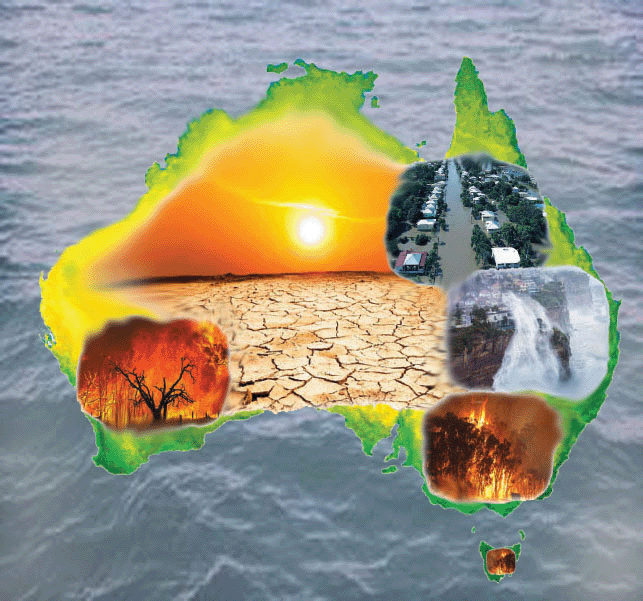 NSW Resilience Commissioner Shane Fitzsimmons is urging Australians to start planning now for future disasters. SBS, 5 June 20, Resilience NSW Commissioner Shane Fitzsimmons says Australia’s disaster recovery will be “quite significant” and that people should start planning for future disasters.
The former NSW Rural Fire Service boss says the country has faced unprecedented damage and destruction during the bushfire season, which was compounded by storms and floods and the COVID-19 pandemic.
“There are communities that have been so profoundly impacted and affected, and whilst there’s a tremendous focus on the rebuilding of infrastructure, on people’s homes, it’s a massive undertaking,” he said in an online webinar on Friday.
The commissioner is urging individuals, families, businesses, industries, and governments to begin having conversations about how they might respond to disruptions caused by disasters in the future to build resilience…….. https://www.sbs.com.au/news/australians-told-to-start-planning-for-future-disasters-following-profound-bushfire-impact
COVID-19 Commission stacked with fossil-fuel bigwigs. Surprise surprise -they find gas is the answer
 Transparency called for in fossil fuel-stacked COVID-19 Commission, Independent Australia, Martin Hirst | 2 June 2020 Who’s running the country and where are they taking us? Dr Martin Hirst thinks the Canberra bubble is filling with gas.
IN THE LAST WEEK of March, right at the start of Australia’s response to the coronavirus pandemic, Prime Minister Scott Morrison announced the formation of the National COVID-19 Coordination Commission (NC-19CC). He said it would “solve problems” so “we all get through to the other side”.
Now, at the start of June, we have some idea of what the “other side” looks like according to the leading figures on the Coordination Commission. From what we can glean from the cheap seats in the bleachers, the future is going to be a gas — literally gas……
For a start, the NC-19CC is an energy sector lovefest.
The Commission chair is Neville (Nev) Power and he’s well connected to the Australian energy and mining industries. He is Deputy Chairman of Strike Energy Ltd and for nearly a decade was managing director and CEO of Fortescue Metals Group.
Catherine Tanna is the managing director of Energy Australia, ‘one of Australia’s leading electricity and gas retailers’ according to the helpful but rather anodyne biographies provided on the commission’s website.
The commission’s “special advisor” is the American chemical industry leader, Andrew Liveris, a former CEO and chairman of the Dow Chemical Company and on the board of a major Saudi oil company.
There are two other important members of NC-19CC: the head of the Department of Prime Minister and Cabinet, Phil Gaetjens and the head of Home Affairs, Mike Pezzulo. These are also political appointments — Gaetjens is a loyal fixer for Morrison and Pezzulo is Home Affairs Minister Peter Dutton’s lieutenant.
Who does the Commission report to?
Australians first heard of the Coordinating Commission when Morrison announced it at a media event on 25 March, but he didn’t tell us how the members were selected, or why, or by whom.
Presumably, it was a “captain’s pick” by Morrison……
In mid-May, the Senate select committee that is holding an ongoing inquiry into the Government’s response to the pandemic requested Mr Power come and chat with it, but he didn’t show up. Instead, the PM’s protector, Phil Gaetjens and Peter Harris, the CEO of the Commission, came to block any real scrutiny of the Commission.
All that the senators were able to learn was that there are no rules in place for managing conflicts of interest and that the Commission’s members and advisors were being handsomely paid for their time and service. According to the transcript, almost every other question was stonewalled.
Apparently, the commissioners are also recruiting other people “through their own networks” according to Phil Gaetjens, but who remain largely unknown to the public — to help across various things to do with the economy re-opening.
Greens Senator Peter Whish-Wilson grilled Phil Gaetjens about the advice the commissioners might provide, but the PM’s advisor would only say that most advice would be confidential.
This has not satisfied a coalition of public interest watchdog groups who collectively issued a statement calling for greater transparency round the discussions and decisions of the NC-19CC………
I should mention that many environmental groups are concerned that the COVID-19 Commission is stacked with fossil fuel advocates, and with good reason. …… https://independentaustralia.net/politics/politics-display/transparency-called-for-in-fossil-fuel-stacked-covid-19-commission,13954
Southern Australia to be among the worst-hit by global heating
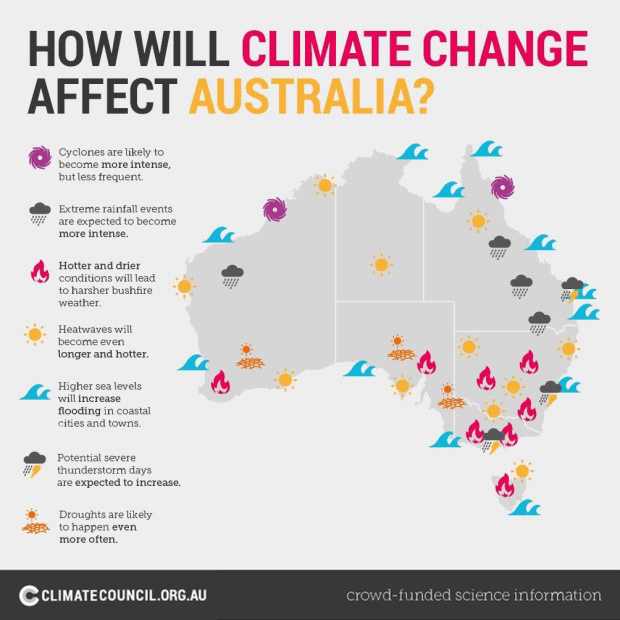 Australia among global ‘hot spots’ as droughts worsen in warming world, The Age, By Peter Hannam, June 1, 2020 The world’s major food baskets will experience more extreme droughts than previously forecast as greenhouse gases rise, with southern Australia among the worst-hit, climate projections show.
Scientists at the Australian National University and the University of NSW made the findings after running the latest generation of climate models used by the Intergovernmental Panel on Climate Change (IPCC). Future drought changes were larger and more consistent, the researchers found.
“Australia is one of the hot spots along with the Amazon and the Mediterranean, especially,” said Anna Ukkola, a research fellow at the ARC Centre of Excellence for Climate Extremes and lead author of the paper published in Geophysical Research Letters.
For southern Australia, the shift to longer, more frequent and more intense droughts up to 2100 will be due to greater variability in rainfall rather than a reduction in average rainfall. For the Amazon, both mean rain and variability changes…….
One reason for the prediction of worse droughts is that the latest models assume the climate will respond more than previously understood to increased atmospheric levels of carbon dioxide and other greenhouse gases.
Australia’s vulnerability to big shifts in annual rainfall already challenge the country’s farming sector, while also leaving much of the country’s south more at risk of bad bushfire seasons – such as last summer’s – as forests dry out.
The CSIRO has long forecast a large reduction in stream flows in the Murray-Darling Basin, for instance, as reduced cool-season rainfall combines with higher temperatures. Such a trend appears to have already begun.
While a more moderate emissions trajectory will still produce more intense, frequent and longer lasting droughts in most of the world’s mid-latitude regions than current conditions, the shift will be less than if carbon emissions remain near the top of forecasts. ……..https://www.theage.com.au/environment/climate-change/australia-among-global-hot-spots-as-droughts-worsen-in-warming-world-20200601-p54ydh.html
Covert-19: Government stacks Covid Commission with oil and gas mates
Covert-19: Government stacks Covid Commission with oil and gas mates, cosy deals follow, Michael West Media, by | May 13, 2020
The Government is quietly blowing away years of environmental protections under cover of Covid. Its Covid Commission (NCCC) is stacked with executives from the gas and mining lobbies in what is turning out to be a bonanza for multinationals and yet another destructive blow to Australia’s efforts to curb global warming. Sandi Keane investigates.
His declaration in Parliament, “This is coal; don’t be scared”, came back to haunt Prime Minister Scott Morrison when summer’s catastrophic wildfires brought global media attention over his handling of the crisis and Australia’s response to climate change.
Fast forward from bushfires to COVID-19 and his reputation has reversed thanks to the handling of the virus. Yet, while the attention of the nation has been drawn to the daily COVID-19 count and embracing the digital world of schooling, working and socialising from home, the fossil fuel industry – with help from the Morrison Government – has quietly seized the opportunity to entrench its power and profits.
A report from environmental advocacy group 350 Australia has detailed 36 individual policy changes or requests for project-specific support — all under cover of COVID-19. SEE THE EXCELLENT TABLE ON THE ORIGINAL
-
Tax cuts and other financial concessions = 💸
-
Slashing environmental or other corporate regulation = ✄
-
Fast-track project approvals = ✅
-
Delay or rollback of climate and renewables policies = 🔥
-
Attacks on charities and right to protest = 🚫
-
Undermining local communities and workers rights =
The findings are shocking. While we’ve been in a deep funk, as of May 7, 69% of demands from the fossil fuel sector have already been enacted or agreed to by the Government. Concessions and sweetheart deals include 14 requests to slash important environmental or corporate regulations, 11 requests for tax cuts and financial concessions, and 12 instances of requests to fast-track project assessment.
Lucy Manne, CEO of 350 Australia, called it out:
“It is rank opportunism for the fossil fuel lobby to call for slashing of corporate taxes and important environmental protections under the cover of COVID-19.”
Taking a cue from Howard’s love-in with the mining industry when alone among the rest of the developed world, he took key mining lobbyists to Kyoto rather than climate scientists, Morrison awarded key positions in the PM’s office to former mining executives and lobbyists. It, therefore, comes as no surprise that the National COVID-19 Co-ordination Committee (NCCC) has been:
COVID-19 National Co-ordination Committee’s links to fossil fuels
The NCCC was set up on March 25 with no terms of reference, no register of conflicts of interest with even less divulged about its financial resources. So let’s look at what 350 Australia has dug up on its links to fossil fuels.
Its six-strong Executive Board of Directors is supported by the Secretaries of the Department of the Prime Minister and Cabinet, Philip Gaetjens, and Home Affairs Mike Pezzullo. Gaetjens was intimately involved with the controversial community grants pre-Election. NCCC’s role is described as two-fold … “to help minimise and mitigate the impact of COVID-19 on jobs and businesses and to facilitate the fastest recovery possible once the virus has passed.”
Here are the key players:………https://www.michaelwest.com.au/covert-19-government-stacks-covid-commission-with-oil-and-gas-mates-cosy-deals-follow/
In 2019, fire chiefs were ‘gagged’ when trying to give climate change warnings to government
|
Asked by Victorian Liberal senator James Paterson if he thought “the current serving fire chiefs are gagged in some way”, Mr Mullins replied: “yes”. Mr Mullins, a former Fire and Rescue NSW commissioner, said when he was in the role “some things were out of bounds and often climate change was one of those issues, even to the point of having to work around it when preparing documents, and I think that is a tragedy”. Greens senator Janet Rice asked Mr Mullins if it was “still the case” that fire chiefs were discouraged from raising the effect of climate change on bushfire risks with politicians. “I know it’s the case,” Mr Mullins said. “I’ve had a number of discussions and it’s clear.” Mr Mullins had a 39-year career in NSW Fire and Rescue, and was appointed commissioner in 2003. He retired in 2017. Mr Mullins was representing the Emergency Leaders for Climate Action group, which comprises 33 former fire and emergency service leaders from around the country. Mr Mullins said he was pressured not to speak out on climate change when he was a public servant. “We self-censored because we knew what would be acceptable, and what would not, for certain political masters and if you went outside those bounds life could be made very unpleasant for you,” he said. The Emergency Leaders for Climate Action unsuccessfully sought meetings with Prime Minister Scott Morrison in April and again in May last year, ahead of the long 2019-20 summer bushfire season about the looming “catastrophic” fire season…….https://www.theage.com.au/politics/federal/some-things-were-out-of-bounds-fire-chiefs-gagged-on-climate-change-warnings-to-government-commission-told-20200527-p54wxv.html |
|
Australia, and other countries – deaths from global heating are being underestimated

|
Experts Warn Climate Change Is Already Killing Way More People Than We Record, Science Alert ,CARLY CASSELLA, 25 MAY 2020
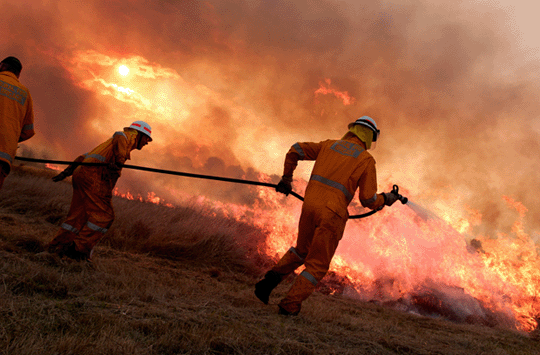
People around the world are already dying from the climate crisis,and yet all too often, official death records do not reflect the impact of these large-scale environmental catastrophes. According to a team of Australian health experts, heat is the most dominant risk posed by climate change in the country. If the world’s emissions remain the same, by 2080 Australian cities could see at least four times the number of deaths from increasing temperatures alone. “Climate change is a killer, but we don’t acknowledge it on death certificates,” says physician Arnagretta Hunter from the Australian National University. That’s a potentially serious oversight. In a newly-published correspondence, Hunter and four other public health experts estimate Australia’s mortality records have substantially underreported heat-related deaths – at least 50-fold. While death certificates in Australia do actually have a section for pre-existing conditions and other factors, external climate conditions are rarely taken into account. Between 2006 and 2017, the analysis found less than 0.1 percent of 1.7 million deaths were attributed directly or indirectly to excessive natural heat. But this new analysis suggests the nation’s heat-related mortality is around 2 percent. “We know the summer bushfires were a consequence of extraordinary heat and drought and people who died during the bushfires were not just those fighting fires – many Australians had early deaths due to smoke exposure,” says Hunter……. “Death certification needs to be modernised, indirect causes should be reported, with all death certification prompting for external factors contributing to death, and these death data must be coupled with large-scale environmental datasets so that impact assessments can be done.” …… Such action, they say, is imperative. Not only for Australia but many other countries in the world. The United Kingdom has documented some problems with accurately filling out death certificates, and cities in several parts of the world are on track for similar heat-related mortality rates as Australia. But there are some places that will need to do more than just update their current system. In the tropics, there’s little valid mortality data on the more than 2 billion people who live in this heat-vulnerable region. And that makes predicting what will happen to these communities in the future much trickier. “Climate change is the single greatest health threat that we face globally even after we recover from coronavirus,” says Hunter. “We are successfully tracking deaths from coronavirus, but we also need healthcare workers and systems to acknowledge the relationship between our health and our environment.” In an unpredictable world, if we want to know where we’re going, we have to know where we’ve been. Figuring out how many of us have already died from climate change will be key to that process. We can’t ignore it any longer. The correspondence was published in The Lancet Planetary Health. https://www.sciencealert.com/official-death-records-are-terrible-at-showing-how-many-people-are-dying-from-the-climate-crisis |
|
|
Australian government’s climate and post-Covid policy is a sop to the fossil fuel industries
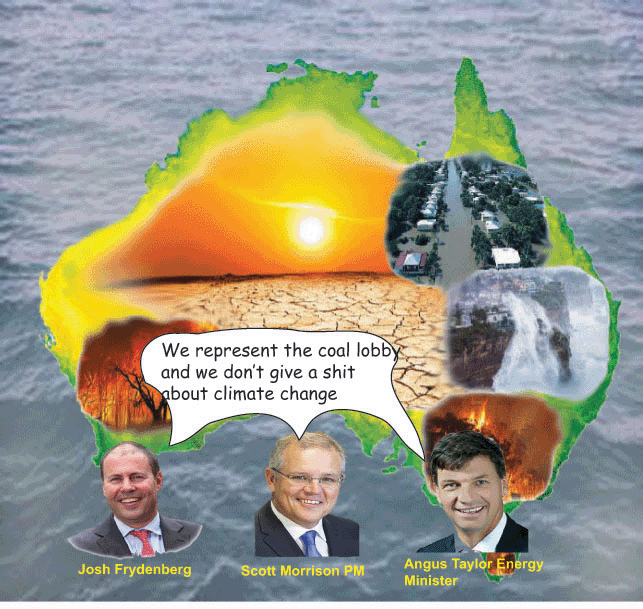
Angus Taylor suggesting it is not government policy to achieve net zero emissions by 2050, and the government giving in-principle support to recommendations made by a panel headed by a former CEO of Origin Energy, Grant King, to allow the Australian Renewable Energy Agency and the Clean Energy Finance Corporation fund projects involving carbon capture and storage.
pushes for the same energy mixes that were being advocated a decade ago – more gas, the discredited carbon capture, as well as nuclear power.
The climate crisis looms as the Coalition fiddles with fossil fuels https://www.theguardian.com/commentisfree/2020/may/24/the-climate-crisis-looms-as-the-coalition-fiddles-with-fossil-fuelsGreg Jericho The government is like a smoker switching to low-tar cigarettes. Its energy policy is just a sop
We may be dealing with a health crisis, but the climate change crisis has not gone away, nor become any less urgent. In fact, the opposite.
A few conservative commentators have suggested Covid-19 shows what a real crisis looks like compared with, in their opinion, the hyperventilating over climate change.
What bollocks.
Nasa estimates that last month was the hottest April on record and the first four months of this year are the second hottest start to a year.
The past seven months have all been 1C or higher than the 1951-1980 average (roughly around 1.3C above the pre-industrial average) – tied with the longest streak set from October 2015 to April 2016. But unlike in 2015 and 2016 the Bureau of Meteorology records we are currently not in El Niño.
That very much suggests the pace of warming is speeding up.
The linear trend of temperatures over the past 60 years suggests we will hit 2C above pre-industrial levels in 50 years; the trend of the past 20 years has it happening in around 30 years, but the trend of the past decade would see us hit that level in 2038 –just 18 years’ time.
And no, the virus has not bought us more time.
A study published this week in Nature Climate Change estimates the annual global drop in emissions due to virus shutdowns will be “comparable to the rates of decrease needed year-on-year over the next decades to limit climate change to a 1.5°C warming”.
That it took forcing people to stop their lives to achieve such cuts highlights just how big the job ahead of us is and how it cannot be done through individual action alone.
Cutting emissions without crippling the economy requires not everyone self-isolating, but changing industries and the very foundations of our economy.
We need to move away from oil, coal and gas to renewable energy.
And so it should be of great concern that the government is using the coronavirus as cover to push fossil fuels.
This week Adam Morton revealed that a manufacturing taskforce, headed by Dow Chemical executive and Saudi Aramco board member Andrew Liveris, is recommending to the National Covid-19 Coordination Commission (itself headed by the current deputy chairman of Strike Energy, Neville Power) that “the Morrison government make sweeping changes to ‘create the market’ for gas and build fossil fuel infrastructure that would operate for decades”.
It comes off the back of Angus Taylor suggesting it is not government policy to achieve net zero emissions by 2050, and the government giving in-principle support to recommendations made by a panel headed by a former CEO of Origin Energy, Grant King, to allow the Australian Renewable Energy Agency and the Clean Energy Finance Corporation fund projects involving carbon capture and storage.
Taylor also this week released a discussion paper for a “framework to accelerate low emissions technologies”. While suggesting renewables are vital, it essentially pushes for the same energy mixes that were being advocated a decade ago – more gas, the discredited carbon capture, as well as nuclear power.
It’s the wrong policy at precisely the wrong time.
As Morton has reported, organisations and governments around the world are advocating using economic stimulus measures to push towards a greener economy.
A report released this week by the Australian Conservation Foundation echoed the Grattan Institute’s recent “Start with steel: A practical plan to support carbon workers and cut emissions” report, arguing that we should see the virus as an opportunity to transform our economy and invest in renewable energy.
But no. It is clear the government remains wedded to a fossil-fuel based economy in which its climate change policy is merely a sop rather being designed to deal with a major crisis that is only becoming more urgent.
1 This month

of the week – Australians for War Powers Reform (AWPR)
To see nuclear-related stories in greater depth and intensity
 Antinuclear
