Australia’s climate experts urge govt to use rebuilding economy to combat global heating.
|
Climate scientists say coronavirus could be Australia’s golden opportunity— SBS News
Climate experts say the way Australia chooses to rebuild its economy after the COVID-19 pandemic will seal its climate change fate. BY CLAUDIA FARHART, 22 APR 20
Australian climate scientists are urging the government to recognise the similarities between the COVID-19 pandemic and climate change, arguing they could be the key to stopping global warming. Professor Matthew England from the University of New South Wales’ Climate Change Research Centre said acting early, listening to expert advice and mitigation were the keys to solving both crises.
While the coronavirus is posing a serious risk to millions of lives right now, Professor England said climate change will threaten even more lives over the next five decades. “We’ve seen all around the world that the nations ignoring the best advice of their scientists are suffering the most, and climate change is no different,” he told SBS News. “We have expert reports that have been tabled for the last three or four decades, but many nations are ignoring those, so I think that COVID-19 provides a wake up call for what happens if you do ignore the best scientific advice.”………
While these significant improvements in air and water quality are showing people around the globe what is possible when emissions are reduced, Professor England said it is not time to celebrate yet. Instead, he says Australia needs to recognise the opportunity COVID-19 presents to rebuild in a more environmentally friendly way. “This is going to be a major stall in the global economy, but out of this pandemic we’re certainly going to see a huge economic boom and it’s going to be a real chance to make that boom a low-carbon boom,” he said.
“To solve climate change, we actually need large scale innovation and the huge economic boom that is poised to happen out of this pandemic.” ‘Fight or flight’While COVID-19 has already killed at least 90,000 people, the World Health Organisation has warned that climate change will kill as many as 250,000 people per year by 2030………https://www.sbs.com.au/news/climate-scientists-say-coronavirus-could-be-australia-s-golden-opportunity |
|
PLanning for waterways – a vital need, as Australia’s river systems are affected by global heating
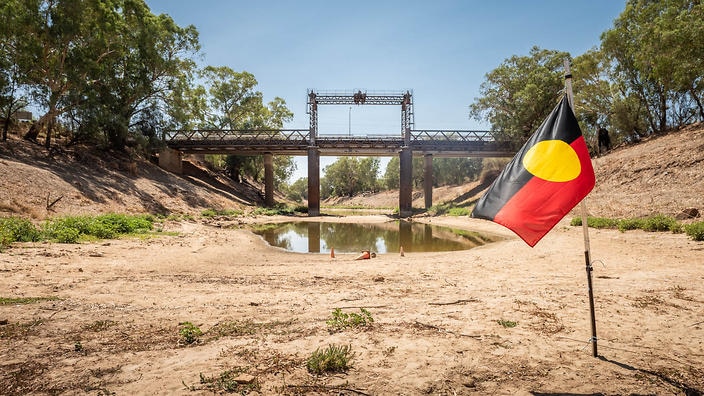 Australia’s inland rivers are the pulse of the outback. By 2070, they’ll be unrecognisable, The Conversation, Australia’s inland rivers are the pulse of the outback. By 2070, they’ll be unrecognisable, The Conversation, April 21, 2020 Zacchary Larkin, Postdoctoral Researcher in Environmental Sciences, Macquarie University, Stephen Tooth, Professor of Physical Geography, Aberystwyth University, Timothy J. Ralph, Senior Lecturer in Environmental Sciences, Macquarie UniversityInland Australia’s complex system of winding rivers, extensive wetlands, ancient waterholes and seemingly endless parched floodplains are rarely given more than a passing thought by many Australians who live on the coastal fringes. Yet these waterways are lifelines along which communities, agriculture and trade have flourished. Etched into the psyche of regional Australia, these river systems are the pulse of the outback. Before asking a local how things are going, peek over the bridge in town for an indication. When relaxing in the shade of an old river red gum alongside one of Australia’s lazy inland rivers, it’s natural to think of them as timeless and resilient to environmental change. Yet, these rivers evolved over millennia and continue to change over years and decades. And we already know from previous studies that future climate change is likely to reduce stream flow and water availability in drylands around the world. But what our new research has shown, for the first time, is that these declines in stream flow may trigger a dramatic change in the physical structure and function (the geomorphology) of Australia’s inland rivers. Meandering rivers and flat, wide floodplainsThe physical structure of a river depends on how much water flows through it, and the sediment that water carries. Reductions in water flow – as expected due to climate change – can lead to a build-up of sediment downstream. In extreme cases, this “silting up” can cause complete disintegration of river channels, where water flows out across the floodplain. Not all rivers are alike, and the rivers of the Murray-Darling and Lake Eyre basins (covering 1.8 million square kilometres) are particularly diverse. Many of these rivers and wetlands are internationally recognised for their hydrological and ecological importance. They range from large meandering rivers swollen by seasonal spring flows (the Upper Murray, Mitta Mitta, Kiewa, and Ovens rivers), to rivers that progressively get smaller until they become exhausted on flat, wide floodplains and disintegrate into large, boom-and-bust wetlands (the Lachlan, Macquarie, and Gwydir rivers). In the drier areas of central Australia, rivers typically persist as a string of isolated waterholes for years at a time, occasionally punctuated by very large floods (Warrego, Paroo, Diamantina, and Cooper Creek). A sobering futureFor Australia’s inland rivers, the average dryness, or “aridity”, of the catchment is the best predictor of what the overall structure and function of the rivers within look like. Compiling a range of climatic data, we modelled aridity for the Australian continent in 2070 under a relatively moderate climate change scenario. The results are sobering. Over the next 50 years, the arid zone – containing the areas of true desert – is projected to expand well into the Murray-Darling Basin and almost entirely envelope the Lake Eyre Basin. At the same time, the humid and dry subhumid fringes around the Great Dividing Range and coastal areas are expected to contract. This is concerning because the relatively wet western slopes of the Great Dividing Range are where many inland Australian rivers begin, with most of their water sourced in these smaller sub-catchments. Evolution of our inland riversThe impact of this projected drying pattern on Australia’s inland rivers is expected to be profound……. A parched futureWhile our research hasn’t investigated the potential ecological, socio-economic or cultural effects of structural changes, we can expect them to be very significant, and potentially irreversible. Many of Australia’s native aquatic and dryland flora and fauna are adapted to a highly variable climate regime, but there are limits beyond which these ecosystems cannot recover or survive. For example, seeds and invertebrate eggs can survive many years buried in dry soil waiting for a flood, but if water doesn’t come, eventually they won’t be viable. What’s more, extracting too much water from our inland river systems for agriculture or other uses will exacerbate the threats posed by a drying climate. Given the complexity and tensions surrounding water use and water sharing in Australia’s inland rivers, particularly in the Murray-Darling Basin, understanding how these critical systems might respond in the future is now more important than ever. Water is one of the most contested resources in Australia, and it’s the fundamentally important river and wetland ecosystems and agricultural industries that will bear the brunt of a drying climate. To make sure outback communities can continue to survive, it’s vital we protect their lifeline. Water resource planning must include consideration of climate change, as the projected changes will likely increase pressure on already vulnerable systems. https://theconversation.com/australias-inland-rivers-are-the-pulse-of-the-outback-by-2070-theyll-be-unrecognisable-136492 |
|
Bushfire Survivors for Climate Action taking legal action against NSW Environment Protection Authority
  ‘Kick them into action’: Fire group takes EPA to court over climate, SMH, By Peter Hannam, April 20, 2020 Lisa Roberts spent 25 years building a native plant business that was as sustainable as they come, with off-grid solar power and water harvesting, only to see it go up in flames in the recent bushfires.Her home and nursery in Wandella in southern NSW reduced to rubble, Ms Roberts fled to Canberra, powerless to act as fires threatened another venture in nearby Pialligo. Living in the smoke-choked capital also damaged her vocal cords, which have still not recovered. ‘Kick them into action’: Fire group takes EPA to court over climate, SMH, By Peter Hannam, April 20, 2020 Lisa Roberts spent 25 years building a native plant business that was as sustainable as they come, with off-grid solar power and water harvesting, only to see it go up in flames in the recent bushfires.Her home and nursery in Wandella in southern NSW reduced to rubble, Ms Roberts fled to Canberra, powerless to act as fires threatened another venture in nearby Pialligo. Living in the smoke-choked capital also damaged her vocal cords, which have still not recovered.
“A part of me totally rages at the world for its totally inadequate response to climate change,” Ms Roberts said. “Everybody’s safety is at risk.” That anger is being now channelled into a legal challenge against the NSW Environment Protection Authority. Bushfire Survivors for Climate Action, of which Ms Roberts is a member, began the suit last week with the NSW Environmental Defenders Office “to kick [the EPA] into action”, she said. EDO chief executive David Morris said the case, in the Land and Environment Court, would seek to force the EPA, which does not have a climate policy, to use its powers to keep communities safe from the increasingly severe impacts of a warming world. Mr Morris said the EPA was chosen as a test case among similar agencies nationally in part because of a section of the Protection of the Environment Operations Act 1997. That section requires the agency to “develop environmental quality objectives, guidelines and policies to ensure environment protection”. “It’s an opportunity for the EPA to recognise they have a legal obligation to take action,” he said. “They should have a policy and a plan to address the greatest threat to the environment.”…….. https://www.smh.com.au/environment/climate-change/kick-them-into-action-fire-group-takes-epa-to-court-over-climate-20200418-p54kzl.html
|
|
Amid climate change threat to the Murray Darling river system, the States haggle
|
No water, no leadership: new Murray Darling Basin report reveals states’ climate gamble, The Conversation
April 17, 2020 Daniel Connell, Research Fellow, Crawford School of Public Policy, Australian National University A report released today investigating how states share water in the Murray Darling Basin describes a fascinating contrast between state cultures – in particular, risk-averse South Australia and buccaneering New South Wales. Perhaps surprising is the report’s sparse discussion of the Murray Darling Basin Plan, which has been the focus of irrigators’ anger and denunciation by National Party leaders: Deputy Prime Minister Michael McCormack and NSW Deputy Premier John Barilaro. In general terms, the Murray Darling Basin Plan was originally intended to make water management in the Murray Darling Basin more environmentally sustainable. Its critics see it as a restraint on development, and complain it has taken water away from irrigators during a time of extreme drought. In response to McCormack and Barliaro’s criticisms of the plan in late 2019, federal water minister (and senior National Party figure) David Littleproud commissioned Mick Keelty as Interim Inspector General of MDB Water Resources. For the new report, Keelty investigated the changing distribution of “inflows” – water flowing into the River Murray in the southern states. Climate change has brought the inflow to just a trickle. This dramatic reduction over the past 20 years is what Keelty has described as “the most telling finding”. He also investigated the reserve policies under which the three states choose – or don’t choose – to hold back water in Hume and Dartmouth Dams to manage future droughts. Keelty says there’s little transparency or clarity about how much water states are allocated under the Murray Darling Basin Agreement (the arrangement for sharing water between the states which underpins the Basin Plan). This failure in communication and leadership across such a vital system must change. Sharing water across three statesOne major finding of Keelty’s inquiry is that the federal government has little power to change the MDB Agreement between the three states, which was first approved in 1914-15. Any amendment requires the approval of all three governments. To increase the volume of water provided to NSW irrigators, South Australia and Victoria would need to agree to reduce the volumes supplied to their own entitlement holders. That will not happen. Why has the agreement lasted so long? Over the past century it has proved robust under a wide range of conditions. Its central principle is to share water with a proportion-of-available-flow formula, giving each state a percentage of whatever is available, no matter whether it’s a lot, or not much. After receiving its share of the River Murray flows, each state is then free to manage its allocation as it wishes. …… Reliability of water supply What’s more, each state makes its own decision about how its state allocation is shared between its entitlement holders (95% of water goes to irrigators the rest supplies towns and industry). South Australia chooses to distribute a much smaller proportion to its entitlement holders than New South Wales. It also restricted the number of licences in the 1970s. That combination ensures a very high level of reliability in supply. Victoria took a similar approach…….. When climate change is taken into account these differences between the three states result in their irrigators having significantly different risk profiles. The climate change threat to the basin is very realDespite climate denial in the National Party, the threat is very real in the MDB. The report describes a massive reduction in inflows over the past 20 years, approximately half compared with the previous century. One drought could be an aberration, but two begins to look like a pattern. The report also suggests that in many cases irrigator expectations of what should be normal were formed during the wet period Australia experienced between the second world war and the 1990s. Added to this have been business decisions by many irrigators to sell their entitlements and rely on the water market, a business model based on what now seems like unrealistic inflow expectations. In effect, successive New South Wales governments – a significant part of the state’s irrigation sector in the southern part of the state and the National Party – gambled against the climate and are now paying a high price. In desperation, they’re focusing on alternative sources. This includes the water in Hume and Dartmouth held under the reserves policy of the two other states; environmental entitlements managed by the Commonwealth Environmental Water Holder; the very large volume of water lost to evaporation in the lower lakes in South Australia; and the possibility of savings resulting from changes to management of the system by the Murray-Darling Basin Authority. Failure in leadership and communicationFor reasons already outlined, the state reserves policy is not likely to change and use of the Commonwealth Environmental Water Holder environmental water entitlements would not be permitted under current legislation. Management of the lower lakes is being reviewed through another investigation so is not discussed in the report. The report also states that management of the MDB Authority is subject to regular detailed assessment by state governments, and they have assessed its performance as satisfactory. However the report was critical of the performance of all MDB governments with regard to leadership and communications suggesting that failures in those areas were largely responsible for the public concern which triggered its investigation. https://theconversation.com/no-water-no-leadership-new-murray-darling-basin-report-reveals-states-climate-gamble-136514 |
|
Study finds that New South Wales rivers, lakes and lagoons are warming twice as fast as ocean
 NSW rivers, lakes and lagoons warming twice as fast as ocean, finds 12-year study ABC NSW rivers, lakes and lagoons warming twice as fast as ocean, finds 12-year study ABC
By Amy Greenbank 16 Apr 20, Dominic Boyton’s Merimbula oyster farm in southern NSW has been in the family for four decades.
His father passed it onto him seven years ago but he’s worried about its future viability given the latest findings from the University of Sydney (USYD). Key points:
Researchers discovered the state’s coastal rivers, lakes and lagoons were warming twice as fast as the ocean. The average temperatures in those marine ecosystems were up 2.16 degrees Celsius, making breeding harder for some aquatic life. “Warmer waters could mean we’ll see oysters disappearing up the coast or a new outbreak of algae blooms and disease we haven’t seen before,” Mr Boyton said. Oysters, he said, were sensitive to heat and because they were difficult to relocate it put growers like him in a vulnerable position. The world-first study also posed a big problem for the state’s multi-million-dollar fishing and aquaculture industry, which underpinned the economies of many coastal towns. Marine biologist Elliot Scanes analysed 12 years of data from 166 NSW estuaries and found the composition of those waterways was shifting. “We didn’t expect it to be so fast,” he said.
Acidity also rose in all waterways and at the same time creeks and lagoons were becoming less salty. “This study is the first major evidence we have to show estuaries are changing on this scale,” Dr Scanes said. The marine biologists said coastal ecosystems were being forced to adapt and there would be winners and losers. While some species of fish and prawns are likely to be more resilient, shellfish like oysters could be badly affected…… https://www.abc.net.au/news/2020-04-14/nsw-inland-water-ways-warming-twice-rate-of-ocean-study-finds/12147462 |
|
While we focus on coronavirus, the planet is still heating
 All eyes are on coronavirus… but what about the planet? With COVID-19 all anyone is talking about at the moment, we take a look at where that leaves the environment, Pro Bono Australia, 14th April 2020 Maggie Coggan As many countries shut their borders, impose heavy-duty lock down laws, and scramble to deal with the financial and social implications of coronavirus, the climate crisis has shifted out of focus.
But environmental advocates warn that just because attention is elsewhere it doesn’t mean the environment isn’t suffering, or that action to mitigate the impacts of climate change should come to a grinding halt.
The crisis is still happening
At the end of March, the Great Barrier Reef experienced its third major bleaching event in the last five years.
 The Great Barrier Reef Marine Park Authority confirmed soon after that the bleaching was caused by warming waters associated with climate change.
Nathaniel Pelle, a senior Greenpeace campaigner, told Pro Bono News that while the reef could recover, it needed drastic emission reductions globally and in Australia.
He said something that wouldn’t help was the fossil fuel industry actively trying to weaken environmental protections, attracting corporate subsidies from government stimulus packages and forging ahead with mining projects.
“We’ve seen the petroleum exploration licence fees suspended in South Australia and a lot of oil and gas companies calling for assistance as well,” Pelle said.
“Controversial coal and gas projects like the Metropolitan mine, the Vicary Coal Mine, the Glendale mine, and the Narrabri Mine are continuing apace, even while communities don’t have the opportunity to participate, while expert witnesses aren’t necessarily going to be available and scientific investigation is impossible.”
The Victorian Premier Daniel Andrews, also recently came under fire for lifting the ban on onshore gas exploration in mid-March, a move environment groups warned could lead to worse bushfires and droughts.
Gavan McFadzean, the Australian Conservation Foundation climate change program manager, also said it was critical that a close eye was kept on the fossil fuel industry.
“These are times often when the fossil fuel sector may attempt to entrench its longevity as an economic powerhouse,” McFadzean told Pro Bono News.
“They have been ramping up their political donations federally in recent years and have the kind of political access that could shape economic reform as we come out of this crisis.”
He added that the postponement of climate talks such as the United Nations Intergovernmental Panel on Climate Change and the Cop26 in Glasgow meant that global targets and action would have to hold off until at least 2021.
He said while it was understandable the events were postponed, it was critical that once the virus was under control climate action once again took centre stage.
“The Cop26 event was going to be the most important conference since Paris in 2016… it was the conference where countries were going to be setting targets,” McFadzean said.
“It’s going to be really important that climate issues return to the national stage as COVID-19 gets under control, because climate change is also a central threat to society and the global economy as we know it.”
Emissions are going down – But not for long …….
Pelle said that if Australia and the rest of the world emerged from the crisis looking towards the energy solutions of the 21st century then the globe could see a recovery that worked for everyone.
“We could see a recovery that works for communities, that works for people, that makes people’s lives better and tackles the climate crisis at the same time, instead of a deliberate economic contraction and disruption to everyone’s lives,” he said.
A chance to start again
McFadzean said while the COVID-19 crisis was far from over, it was a good time to start imagining what a different kind of economy and climate future might look like if things were done differently.
“This means positioning ourselves to be an exporter of renewable energy to the world as we strive to make our future energy needs from low emission sources, recover our transport sector and move towards lower emissions vehicles, stronger pollution standards and electric vehicles,” he said………
https://probonoaustralia.com.au/news/2020/04/all-eyes-are-on-coronavirus-but-what-about-the-planet/
Coronavirus action: Australia’s moment to change course for a clean environment, slowing global heating

 Climate scientists say coronavirus could be Australia’s golden opportunity, https://www.sbs.com.au/news/climate-scientists-say-coronavirus-could-be-australia-s-golden-opportunity Climate experts say the way Australia chooses to rebuild its economy after the COVID-19 pandemic will seal its climate change fate. BY CLAUDIA FARHART, 10 Apr 20,
Australian climate scientists are urging the government to recognise the similarities between the COVID-19 pandemic and climate change, arguing they could be the key to stopping global warming.
Professor Matthew England from the University of New South Wales’ Climate Change Research Centre said acting early, listening to expert advice and adaptation were the keys to solving both crises.
While the coronavirus is posing a serious risk to millions of lives right now, Mr England said climate change will threaten even more lives over the next five decades.
“We’ve seen all around the world that the nations ignoring the best advice of their scientists are suffering the most, and climate change is no different,” he told SBS News.
“We have expert reports that have been tabled for the last three or four decades, but many nations are ignoring those, so I think that COVID-19 provides a wake up call for what happens if you do ignore the best scientific advice.”
Revealing the possibilities
Emissions around the globe are already dropping significantly as the world stays home and production grinds to a halt, with China already recording a 25 per cent drop in emissions in the first quarter of 2020.
Photographs of smog-free Los Angeles skies, crystal clean canals in Venice and clear views of the snow-capped Himalayas from India have circulated online, showing visible improvements.
While these significant improvements in air and water quality are showing people around the globe what is possible when emissions are reduced, Mr England said it is not time to celebrate yet.
Instead, he says Australia needs to recognise the opportunity COVID-19 presents to rebuild in a more environmentally friendly way.
“This is going to be a major stall in the global economy, but out of this pandemic we’re certainly going to see a huge economic boom and it’s going to be a real chance to make that boom a low-carbon boom,” he said.
“To solve climate change, we actually need large scale innovation and the huge economic boom that is poised to happen out of this pandemic.”
‘Fight or flight’
While COVID-19 has already killed at least 90,000 people, the World Health Organisation has warned that climate change will kill as many as 250,000 people per year by 2030.
Professor Mark Howden of the Climate Change Institute said governments’ differing approaches to the two crises was as simple as how our brains are wired.
“The coronavirus is appealing to our hindbrain, our fight or flight responses, rather than our forebrain, our planning and strategic responses,” he told SBS News.
“Humans are much more attuned to responding to the short-term rather than the long-term.”
While Mr Howden is expecting to see a drop in Australian carbon emissions of roughly five per cent due to COVID-19, he said this will not be the first time such a drop has occurred.
Australia’s emissions saw a similar drop during the global financial crisis of 2009, but were back to their normal levels within two years.
“This is simply because we’re much less active economically, and emissions are fairly closely tied to GDP, so the big challenge will be what happens after the coronavirus,” he said.
However, unlike during the GFC, Mr Howden said coronavirus has now given governments the proof that a health crisis can be halted by an all-in effort.
“Coronavirus has meant that governments have ditched often long-held ideologies and been forced into very pragmatic responses,” he said.
“I think climate change actually needs that – it needs to move away from ideological positions into responses which are informed by the evidence, the science.”
SBS News contacted the Department of Industry, Innovation and Science for comment but did not receive a response.
Climate threat underlies the pandemic emergency
 Beneath the virus lurks a bigger emergency, but the world is distracted from the climate threat, SMH, Bob Carr 2 Apr 20, What did our battered old planet do to bring this run of wretchedly bad luck? Just before the 2008 Wall Street disaster, Washington was about to force emitters to pay for the privilege of dumping carbon waste in the upper atmosphere. Congress approved a cap and trade scheme so its economy could trade its way to a low carbon future. In a similar spirit the Rudd government was legislating its own carbon trading model. Beneath the virus lurks a bigger emergency, but the world is distracted from the climate threat, SMH, Bob Carr 2 Apr 20, What did our battered old planet do to bring this run of wretchedly bad luck? Just before the 2008 Wall Street disaster, Washington was about to force emitters to pay for the privilege of dumping carbon waste in the upper atmosphere. Congress approved a cap and trade scheme so its economy could trade its way to a low carbon future. In a similar spirit the Rudd government was legislating its own carbon trading model.
Then the financial crisis knocked everyone sideways. The carbon lobby in both countries was able to talk job losses and higher taxes. The propaganda was a pushover. Legislation died in the US and Australian senates. And the world kept warming.
Last month the temperature on the Antarctic peninsular hit 65 degrees Fahrenheit, beating all previous records. For the globe, 2019 was the second hottest year on record, and the hottest without the contribution of a big El Nino. The coming decade may be our last chance to contain the chaos driven by humankind’s craziest experiment: the idea that carbon can be stored in the thin filigree of air around the planet. The Paris Agreement provides a road map and the falling price of renewables a market impulse. …. In the middle of the coronavirus crisis, The Sydney Morning Herald and The Age, to their credit, still find space to record the conclusion of leading reef scientist, Terry Hughes, that there is a third major bleaching of the Great Barrier Reef now under way. This follows the bleachings of 2016 and 2017. This is every bit a climate event as were the mega fires over Christmas. Yet the irrevocable loss of healthy coral may not galvanise the way fires did….. Meanwhile, the pandemic emergency may kill off the Glasgow conference on climate planned for November. The UN event is aimed at averting runaway climate change by keeping the temperature rise to 1.5 degrees. …… if the breaking up of permafrost in the Arctic circle assumes an extra ferocity. That would release plumes of methane, 30 times more lethal at trapping heat than carbon, but on a scale to blow apart every calibration of how fast climate is shifting. For Australia, Black Swan climate events could include a cyclone beyond what we have seen before, hitting the Queensland coast. Experts say there is still enough unburnt bush to give us a fire season as bad as the last, even next season – if we suffer the same malevolent mix of heat, low humidity and strong wind…… Beneath news of virus and slump there simmers an even bigger story. The planet keeps warming. And there’s no guarantee the rate may not pick up alarmingly. ……https://www.smh.com.au/environment/climate-change/beneath-the-virus-lurks-a-bigger-emergency-but-the-world-is-distracted-from-the-climate-threat-20200328-p54et4.html |
|
Tax-payers funded Matt Canavan’s expensive trip to attend coalmine opening
The former resources minister used the occasion to give a speech attacking ‘self-indulgent’ environmentalists, Guardian, Christopher Knaus, Wed 25 Mar 2020
The former resources minister Matt Canavan billed taxpayers for a $5,390 charter flight to travel 150km to attend the opening of a coalmine, where he gave a speech attacking “self-indulgent” environmental activists.
Canavan took the private charter flight from Mackay to Colinsville, a three-hour drive, so he could get to the opening of the $1.76bn Byerwen mine in north Queensland.
At the opening, Canavan gave a speech attacking what he described as “hypocritical, self-indulgent activists” holding back the dreamers of the mining industry…….
The most recent parliamentary expense reports, released last week, show Canavan later billed taxpayers for the $5,390 charter flight ….. The expense was listed as “unscheduled travel” by the independent parliamentary expenses authority and the finance department…….
The expense is roughly the same as that incurred by the former Liberal MP Bronwyn Bishop, who chartered a $5,227 helicopter for a return trip from Melbourne to a golf course near Geelong for a Liberal party function.
Canavan quit as minister last month to support Barnaby Joyce’s bid to return to the leadership position. He has described himself as running on an “unashamedly pro-coal” platform.
 The Guardian previously reported that Canavan had omitted two properties worth more than $1m from his current declaration of interests to parliament. He declared “nil” interests in real estate despite owning two houses in Yeppoon, Queensland and Macquarie in Canberra.
Canavan said he was not required to declare the interests to the 46th parliament because they’d been declared to the previous parliament, an argument that conflicts with official advice. https://www.theguardian.com/australia-news/2020/mar/25/matt-canavan-billed-taxpayers-5390-for-charter-flight-to-attend-coalmine-opening
Carbon capture and storage (CCS) is a silly scheme
The carbon capture con, Online Opinion, By Viv Forbes 19 March 2020
Carbon capture and storage (CCS) tops the list of silly schemes to reduce man-made global warming. The idea is to capture carbon dioxide from power stations and cement plants, separate it, compress it, pump it long distances and force it underground, hoping it will never escape………
The quantities of gases that CCS would need to handle are enormous and capital and operating costs will be horrendous. For every tonne of coal burnt in a power station, about 11 tonnes of gases are exhausted – 7.5 tonnes of nitrogen from the air used to burn the coal, plus 2.5 tonnes of CO2 and one tonne of water vapour from the coal combustion process….., CCS also requires energy to produce and fabricate steel and erect gas storages, pumps and pipelines and to drill disposal wells. This will chew up more coal resources and produce yet more carbon dioxide, for zero benefit.
But the real problems are at the burial site – how to create secure space for the CO2 gas.
There is no vacuum occurring naturally anywhere on earth – every bit of space is occupied by solids, liquids or gases. Underground disposal of CO2 requires it to be pumped AGAINST the pressure of whatever fills the pore space of the rock formation now – either natural gases or liquids. These pressures can be substantial, especially after more gas is pumped in.
The natural gases in rock formations are commonly air, CO2, CH4 (methane) or rarely, H2S (rotten egg gas). The liquids are commonly salty water, sometimes fresh water or very rarely, liquid hydrocarbons.
Pumping out air is costly; pumping natural CO2 out to make room for man-made CO2 is pointless; and releasing rotten egg gas or salty water on the surface would create a real problem, ……
Then there is the dangerous risk of a surface outburst or leakage from a pressurised reservoir of CO2. The atmosphere contains 0.04% CO2 which is beneficial for all life. But a CCS reservoir would contain +90% of this heavier-than-air gas – a lethal, suffocating concentration for nearby animal life if it escaped. ….
NSW Environment Minister Matt Kean contradicts the Coalition party line – wants climate action and NO nuclear
 It’s time to win climate wars, Kean says https://www.canberratimes.com.au/story/6674567/its-time-to-win-climate-wars-kean-says/?cs=14231, Jodie Stephens, 11 Mar 20, It’s time to win climate wars, Kean says https://www.canberratimes.com.au/story/6674567/its-time-to-win-climate-wars-kean-says/?cs=14231, Jodie Stephens, 11 Mar 20,
Outspoken NSW Environment Minister Matt Kean says it’s time to “win the climate wars” and for the political right to show better leadership on the issue. In the wake of a devastating bushfire season, Mr Kean wants an end to “futile arguments” about whether climate change exists. He told an Affinity Intercultural Foundation event on Wednesday people had weaponised climate change for too long and to the country’s detriment.
He stressed reducing emissions didn’t need to come at the expense of the economy. “That’s something that has been absent from the debate for a long time. The economics have changed dramatically,” Mr Kean said at the Sydney event. “Right now, it presents an enormous economic opportunity for our nation that’d be too good to miss.” Mr Kean said renewables backed up by pumped hydro offered the cheapest way to deliver electricity, adding, “It’s not nuclear, it’s not coal, it’s not gas.” He said the global push to reduce emissions would require trillions of dollars of investment in low-emissions technology and he wanted a big slice of that money coming into NSW. “There’s no country on the planet better placed to take advantage of a low-carbon world than Australia,” he said. “We’ve got masses of land, we’ve got some of the best wind and solar sources anywhere on the planet.” Criticised earlier this year for linking bushfires to climate change, Mr Kean said at the time federal cabinet ministers wanted stronger action. Prime Minister Scott Morrison responded by claiming most of his colleagues didn’t know who Mr Kean was and that he “doesn’t know what he’s talking about”. Mr Kean on Wednesday said he was glad he raised the issue because it demonstrated “that the sensible people in this discussion need to stand up”. “The centre of Australian politics has vacated the field when it comes to climate change for too long,” he said. He said the right of Australian politics hadn’t been showing the leadership they should have for a long time. “It’s time for that to change. “As someone on the right of Australian politics, the reason I’m there is because I believe in the power of markets. I’m a capitalist.” Mr Kean told the event he intended to win the nuclear debate, after Deputy Premier John Barilaro said the Nationals would support a bill to repeal state bans on uranium mining and nuclear facilities. “For the people arguing for nuclear, you’re actually arguing for more expensive electricity which is less safe and dirtier. I don’t think that’s a good argument,” he said. |
|
Global heating is intensifying a rare natural phenomenon that brings severe drought to Australia.
A rare natural phenomenon brings severe drought to Australia. Climate change is making it more common, The Conversation, Nicky Wright, Research Fellow, Australian National University, Bethany Ellis, PhD Candidate, Australian National University, Nerilie Abram, Professor; ARC Future Fellow; Chief Investigator for the ARC Centre of Excellence for Climate Extremes, Australian National University, March 10, 2020
Weather-wise, 2019 was a crazy way to end a decade. Fires spread through much of southeast Australia, fuelled by dry vegetation from the ongoing drought and fanned by hot, windy fire weather.
On the other side of the Indian Ocean, torrential rainfall and flooding devastated parts of eastern Africa. Communities there now face a locust plague and food shortages.
These intense events can partly be blamed on the extreme positive Indian Ocean Dipole, a climate phenomenon that unfolded in the second half of 2019.
The Indian Ocean Dipole refers to the difference in sea surface temperature on either side of the Indian Ocean, which alters rainfall patterns in Australia and other nations in the region. The dipole is a lesser-known relative of the Pacific Ocean’s El Niño.
In research published today in Nature, we reconstructed Indian Ocean Dipole variability over the last millennium. We found “extreme positive” Indian Ocean Dipole events like last year’s are historically very rare, but becoming more common due to human-caused climate change. This is big news for a planet already struggling to contain global warming.
So what does this new side-effect of climate change mean for the future?
The Indian Ocean brings drought and flooding rain
First, let’s explore what a “positive” and “negative” Indian Ocean Dipole means.
During a “positive” Indian Ocean Dipole event, waters in the eastern Indian Ocean become cooler than normal, while waters in the western Indian Ocean become warmer than normal.
Warmer water causes rising warm, moist air, bringing intense rainfall and flooding to east Africa. At the same time, atmospheric moisture is reduced over the cool waters of the eastern Indian Ocean. This turns off one of Australia’s important rainfall sources.
In fact, over the past century, positive Indian Ocean Dipoles have led to the worst droughts and bushfires in southeast Australia.
The Indian Ocean Dipole also has a negative phase, which is important to bring drought-breaking rain to Australia. But the positive phase is much stronger and has more intense climate impacts.
We’ve experienced extreme positive Indian Ocean Dipole events before. Reliable instrumental records of the phenomenon began in 1958, and since then a string of very strong positive Indian Ocean Dipoles have occurred in 1961, 1994, 1997 and now 2019.
But this instrumental record is very short, and it’s tainted by the external influence of climate change.
This means it’s impossible to tell from instrumental records alone how extreme Indian Ocean Dipoles can be, and whether human-caused climate change is influencing the phenomenon.
Diving into the past with corals
To uncover just how the Indian Ocean Dipole has changed, we looked back through the last millennium using natural records: “cores” taken from nine coral skeletons (one modern, eight fossilised)……….
positive Indian Ocean Dipole events have been occurring more often in recent decades, and becoming more intense…….
climate change is causing the western side of the Indian Ocean to warm faster than in the east, making it easier for positive Indian Ocean Dipole events to establish.
In other words, drought-causing positive Indian Ocean Dipole events will become more frequent as our climate continues to warm. In fact, climate model projections indicate extreme positive Indian Ocean Dipole events will occur three times more often this century than last, if high greenhouse gas emissions continue.
This means events like last year will almost certainly unfold again soon, and we’re upping the odds of even worse events that, through the fossil coral data, we now know are possible.
Knowing we haven’t yet seen the worst of the Indian Ocean Dipole is important in planning for future climate risks. Future extremes from the Indian Ocean will act on top of long-term warming, giving a double-whammy effect to their impacts in Australia, like the record-breaking heat and drought of 2019.
But perhaps most importantly, rapidly cutting greenhouse gas emissions will limit how often positive Indian Ocean Dipole events occur in future.https://theconversation.com/a-rare-natural-phenomenon-brings-severe-drought-to-australia-climate-change-is-making-it-more-common-133058
Christiana Figueres- “Australia, you’re not ‘meeting and beating’ your emissions targets”

Be honest Australia, you’re not ‘meeting and beating’ your emissions targets https://www.smh.com.au/environment/climate-change/be-honest-australia-you-re-not-meeting-and-beating-your-emissions-targets-20200307-p547u1.html 8 Mar 20, Optimistic. Prosperous. A country of rare beauty, blessed with abundant natural resources. Australia has all the “golden eggs” needed to position itself as a global leader, to help its Asia-Pacific region leapfrog to a new energy future, and to guarantee Australian prosperity in the process.
Watching this summer’s unprecedented firestorms, I was heartbroken by the sheer scale of the human and ecological tragedy. “This must be the tipping point on climate politics in Australia,” I said to myself. “Surely now the politicians will join hands and forge a bipartisan plan for a better future.”
Instead, the climate wars have returned, driven by a handful of deniers afraid to let go of longstanding vested interests, and given air by powerful media sympathisers and a Prime Minister unwilling to fully embrace the science and stare them down.
For Australia, the choice between danger and opportunity is clear, and that choice must be made now. Since the 2008 Stern Review, the world has known that the cost of not acting is much greater than the cost of our current path. And since the 2008 Garnaut Review, Australians have known that without stronger action, droughts and bushfires would become more frequent and intense, and “observable by 2020”. It is time to move on from denial, delusion and delay towards preparedness, productivity and prosperity.
The following three steps will put Australia on track to the future we must create.
First, be honest about where Australia is at. Your country is much more than 1.3 per cent of the global climate problem. Carbon emissions from Australia’s use and export of fossil fuels account for about 5 per cent of the global fossil fuel footprint. With exports included, Australians have the biggest per capita carbon footprint in the world.
Australia is not “meeting and beating” its emissions targets. Emissions have increased in every calendar year since 2014. The government’s own projections say Australia will reduce emissions by only 16 per cent by 2030, not the 26 to 28 per cent it promised in Paris, nor the 50 per cent required by science to limit warming to 1.5 degrees. Kyoto “carryover” can’t be used to make up the gap. The Paris Agreement doesn’t allow it. To suggest otherwise is at best an attempt to paper over Australia’s lagging efforts; and at worst, a legally baseless ploy that encourages cheating and holds back development of the next phase of carbon markets.
A highly vulnerable Australia cannot address climate change on its own, but its heel dragging leaves it without the international credibility to drive a stronger global response. The Australian government must look seriously at how to really meet and beat its 2030 target, and ask other major emitters to join it in an alliance for higher ambition at the COP26 climate summit in Glasgow this November.
Second, Australia needs a bipartisan, long-term vision for decarbonisation. Rattled by the bushfires and growing evidence of climate-related risks and stresses, Australia’s biggest corporations – including Rio Tinto, Qantas, Telstra and BHP – have announced support for a national net zero target for 2050. For them, legislating this target is important to finally end the climate wars, and provide the necessary certainty to underpin investment in the transition.
All states and territories have 2050 net zero targets, as do 73 other nations, including Britain and Canada. British Prime Minister Boris Johnson would welcome Australia joining these ranks ahead of the COP26, and giving consideration to the British model of using an independent expert body to advise government on five-yearly carbon budgets en route to net zero by 2050. Independent MP Zali Steggall’s private members’ bill does exactly that.
Third, Australia must embrace net zero by 2050 as a central pillar of its economic plan for the future. The plan must prioritise the policies, industries and technologies that are scientifically aligned with the 1.5 degree temperature limit, and retire those that are not, albeit with gratitude for the service provided in the past.
Despite a booming renewables industry, coal still accounts for around 60 per cent of Australia’s energy mix. But the technology is tired and unreliable in the summer, highly polluting, and no longer price competitive with solar and wind, firmed up by big batteries or pumped hydro. There is no place for governments signed up to the Paris Agreement to provide subsidies for dying coal. We must instead invest in the future.
These ground-breaking projects are just three examples of how Australia can lead and prosper. With political honesty and vision, ambitious targets, and a stubborn commitment to innovation, Australia stands ready to assume its rightful place as a clean energy superpower of the world. With the right choices, the future is bright.
Christiana Figueres is the former UN climate chief who oversaw the negotiation of the 2015 Paris Agreement, and is convenor of the Mission 2020 climate campaign. She is co-author of The Future We Choose and is visiting Australia this week.
Why don’t we treat the climate crisis with the same urgency as coronavirus?
 Why don’t we treat the climate crisis with the same urgency as coronavirus? Owen Jones Guardian, 6 Mar 2020 No Cobra meetings, no sombre speeches from No 10, yet the consequences of runaway global heating are catastrophic, It is a global emergency that has already killed on a mass scale and threatens to send millions more to early graves. As its effects spread, it could destabilise entire economies and overwhelm poorer countries lacking resources and infrastructure. But this is the climate crisis, not the coronavirus. Governments are not assembling emergency national plans and you’re not getting push notifications transmitted to your phone breathlessly alerting you to dramatic twists and developments from South Korea to Italy.More than 3,000 people have succumbed to coronavirus yet, according to the World Health Organization, air pollution alone – just one aspect of our central planetary crisis – kills seven million people every year. There have been no Cobra meetings for the climate crisis, no sombre prime ministerial statements detailing the emergency action being taken to reassure the public. In time, we’ll overcome any coronavirus pandemic. With the climate crisis, we are already out of time, and are now left mitigating the inevitably disastrous consequences hurtling towards us. While coronavirus is understandably treated as an imminent danger, the climate crisis is still presented as an abstraction whose consequences are decades away. Unlike an illness, it is harder to visualise how climate breakdown will affect us each as individuals. Perhaps when unprecedented wildfires engulfed parts of the Arctic last summer there could have been an urgent conversation about how the climate crisis was fuelling extreme weather, yet there wasn’t. In 2018, more than 60 million people suffered the consequences of extreme weather and climate change, including more than 1,600 who perished in Europe, Japan and the US because of heatwaves and wildfires. Mozambique, Malawi and Zimbabwe were devastated by cyclone Idai, while hurricanes Florence and Michael inflicted $24bn (£18.7bn) worth of damage on the US economy, according to the World Meteorological Organization.As the recent Yorkshire floods illustrate, extreme weather – with its terrible human and economic costs – is ever more a fact of British life. Antarctic ice is melting more than six times faster than it was four decades ago and Greenland’s ice sheet four times faster than previously thought. According to the UN, we have 10 years to prevent a 1.5C rise above pre-industrial temperature but, whatever happens, we will suffer.
Pandemics and the climate crisis may go hand in hand, too: research suggests that changing weather patterns may drive species to higher altitudes, potentially putting them in contact with diseases for which they have little immunity. “It’s strange when people see the climate crisis as being in the future, compared to coronavirus, which we’re facing now,” says Friends of the Earth’s co-executive director, Miriam Turner. “It might be something that feels far away when sitting in an office in central London, but the emergency footing of the climate crisis is being felt by hundreds of millions already.”
Imagine, then, that we felt the same sense of emergency about the climate crisis as we do about coronavirus. What action would we take? ….. https://www.theguardian.com/commentisfree/2020/mar/05/governments-coronavirus-urgent-climate-crisis
Morrison to cancel Australia’s participation in the Energy Transition Hub
 Morrison government to stop funding international collaboration on shift to zero emissions. The five-year Australian-German initiative to transition to new energy and low emissions was due to end in 2022, Guardian , Adam Morton Environment editor @adamlmorton Fri 6 Mar 2020 The Morrison government has told researchers at two of Australia’s leading universities it will break a commitment to fund an international collaboration into what is required to shift to a zero emissions future. Morrison government to stop funding international collaboration on shift to zero emissions. The five-year Australian-German initiative to transition to new energy and low emissions was due to end in 2022, Guardian , Adam Morton Environment editor @adamlmorton Fri 6 Mar 2020 The Morrison government has told researchers at two of Australia’s leading universities it will break a commitment to fund an international collaboration into what is required to shift to a zero emissions future.
The Australian-German Energy Transition Hub was announced in 2017 by then prime minister Malcolm Turnbull and German chancellor Angela Merkel as a collaboration that would “help the technical, economic and social transition to new energy systems and a low emissions economy”. Based at the University of Melbourne, the Australian National University and three German institutions, it was to receive $4m over five years from the Department of Foreign Affairs and Trade as part of an eventual full cross-country funding of $20m. But in an email to staff on Friday afternoon, hub managers said the department had told them the government had decided it would “not follow through on its original commitment to fund the hub until 2022”. Government funding for the hub will end in June. Guardian Australia has been told there is $1.75m unpaid from the original agreement. Some researchers said the decision made little sense given the hub’s work included areas of government interest, particularly the development of a clean hydrogen industry. Other hub projects focus on energy storage, energy system modelling, plans for a just transition to clean energy and integrating solar energy into the grid……..https://www.theguardian.com/environment/2020/mar/06/morrison-government-to-stop-funding-20m-international-collaboration-on-shift-to-zero-emissions |
|
|
1 This month



Help Aunty Sue Protect Her Land and Sacred Sites From Destructive Rocket Testing.
.

Australians deserve the truth
about
AUKUS – https://aukuspublicinquiry.com/

PETITION – To: Prime Minister Anthony Albanese and the Australian Labor Government

of the week – Australians for War Powers Reform (AWPR)
To see nuclear-related stories in greater depth and intensity

