Cosy little cocktail party for Liberal and Labor MPs, with coal industry bigwigs
Climate campaigners condemn ‘insidious’ cocktail party for MPs and coal industry
Parliament House event represents an effort to undermine climate action, environmental group 350 Australia says, Guardian, Christopher Knaus @knauscWed 4 Mar 2020 Environmental campaigners say a cocktail night involving the fossil fuel industry and federal politicians represents an “insidious” lobbying effort to undermine climate action.
The pro-coal Liberal MP Craig Kelly and Labor’s Joel Fitzgibbon hosted a cocktail event at Parliament House to discuss carbon capture and storage with industry leaders on Wednesday night.
An invite seen by the Guardian was sent out by Kelly and Fitzgibbon, who chair the parliamentary friends of resources, together with representatives of Santos and the carbon capture body CO2CRC. The event is described as a “cocktail event to mark the inaugural meeting of the CO2CRC Carbon Capture and Storage Policy Forum”.
That forum features companies such as BHP, Chevron, Coal21, ENI, Exxon, the Global Carbon Capture and Storage Institute, JPower, Shell and Woodside.
The invite says the forum aims to “work with governments, industry and other stakeholders” to create “suitable policy settings and a regulatory framework to accelerate the development and deployment of CCS technology in Australia”…..
Environment group 350 Australia says the event shows the need to “crack down on the undue influence of lobby groups on our democracy”.
The 350 Australia chief executive, Lucy Manne, said the event was an “insidious effort by the fossil fuel lobby to undermine action on the climate crisis”.
Manne said carbon capture and storage had proven a “pipe dream of the coal and gas lobby” and diverted millions away from proven renewables…..
“It’s outrageous that instead of working out how to rapidly transition to the renewable energy future the vast majority of Australians and businesses want, our elected representatives will tonight be sipping cocktails with the coal lobby and discussing how to extend the life of dirty coal-burning power stations.”
Such lobbying is generally hidden from the public unless revealed by the media. The Fitzgibbon-Kelly cocktail event was reported in News Corp papers.
It does not appear in any of the transparency measures governing lobbying. Federal ministers are also not required to disclose who they have met with, unlike in states like Queensland and New South Wales. ……https://www.theguardian.com/australia-news/2020/mar/04/climate-campaigners-condemn-insidious-cocktail-party-for-mps-and-coal-industry
Greens leader Adam Bandt introduces climate emergency Bill
 ‘People are angry and anxious’: Adam Bandt introduces climate emergency
 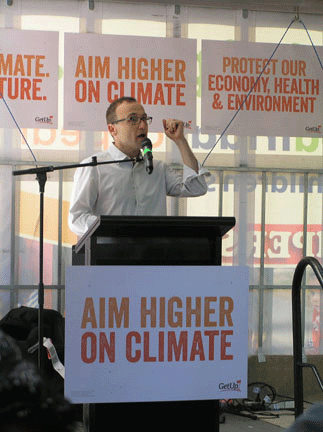 bill, https://www.sbs.com.au/news/people-are-angry-and-anxious-adam-bandt-introduces-climate-emergency-bill Greens leader Adam Bandt has introduced a bill to formally declare a climate emergency and set up a ‘war cabinet’ to tackle the crisis.
Greens leader Adam Bandt has painted a post-apocalyptic future for Australia unless the government declares a climate emergency.
Mr Bandt told parliament on Monday that “environmental collapse was here” as he introduced his bill to formally declare the crisis.
“It is not scaremongering, it is hard physics and we have just had a taste of it over the last summer,” he said.
He said northern Australia would be inhospitable for parts of the year, one-in-six native species would be extinct, mosquito-borne diseases will travel south and the country’s river systems will see more algal blooms that lead to mass fish kills in the Murray-Darling.
Under the bill, the government would be required to set up a “war cabinet” to tackle the crisis, government agencies would refer to the declaration of a climate emergency when developing policy and table annual reports on how they were meeting their obligations.
Mr Bandt’s bill was seconded by independent MP Zali Steggall, who knocked off former Liberal prime minister Tony Abbott for the NSW seat of Warringah at the last election.
“There is no doubt we are in the midst of a climate emergency,” Ms Steggall said.
We have a duty to Australian people … it is time for us all to be accountable.”
A climate emergency motion moved in October fell four votes short.
So-called ‘Ethical’ super funds invest in coal, oil, gas
 ‘Ethical’ super funds invest in coal, oil, gas, SMH, Charlotte Grieve, March 3, 2020 Sustainable investment options offered by two major industry superannuation groups and wealth giant AMP have millions invested in the fossil fuel industry, despite pledging to apply strict screening based on environmental, social and governance standards.
AustralianSuper’s “socially aware investment option” claims it does not invest in Australian or international companies that directly own fossil fuels while disclosures of its portfolio holdings show it has at least $39 million invested in more than 20 global coal, oil and gas projects. These include Marathon Petroleum Corp, Indian thermal coal plant Adhunik Power and Natural Resources and oil, gas and chemicals company, WorleyParsons.
Latest figures show the fund has more than $2.4 billion invested on behalf of 38,000 members, less than 2 per cent of the $172 billion superannuation giant’s total membership pool.
After conducting a survey of members’ interests, the top investment concern for those wanting an ethical alternative was exposure to coal and other fossil fuels. The socially aware option pledges to screen out companies that own reserves of fossil fuels or uranium, regardless of the size of its ownership.
This screen is not applied to private equity, which makes up 4 per cent of total investments and the fund’s fact-sheet explains it can still invest in companies that provide services to, buy, process or sell products from or invest in the excluded companies.
The fund has a stake in 24 companies that either produce fossil fuels or rely on their production. These include: thermal coal producer Westmoreland Mining that in December announced a six-year coal supply agreement in middle America; $9.6 million in Halliburton, one of the world’s largest providers of drilling and production services for oil, gas and coal companies; and $9.6 million in Marathon Petroleum, the largest refining company in America that produces more than 3 million barrels of crude oil per day.
Other oil and gas companies AustralianSuper’s sustainable fund bankrolls include Fieldwood Energy, a company that claims to be one of the largest producers of oil and gas in the Gulf of Mexico, Perth-based Northern Oil and Gas and Ajax Resources, recently acquired by Texas oil and gas company, Diamondback.
AustralianSuper declined to answer questions about its screening process or if it had plans to create a fund that applies a hard screen to the fossil fuel industry.
Similarly, the 2019 portfolio holdings for $54 billion Hostplus’s sustainable investment option launched in March 2017 includes at least eight oil and gas companies, including Oil Search, Santos and Woodside Petroleum.
Hostplus was contacted for comment.
However, AMP invests in at least nine oil and gas companies, including Oil Search, Woodside Petroleum and Santos……. https://www.smh.com.au/business/banking-and-finance/ethical-super-funds-invest-in-coal-oil-gas-20200228-p545ja.html
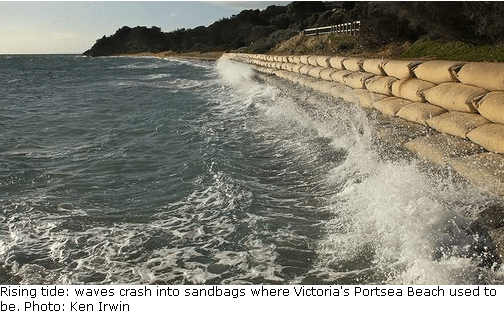
Australia’s disappearing beaches, as global heating causes sea level rise
|
Thousands of kilometres of Australia’s beaches at risk from rising seas, SMH, By Peter Hannam, March 3, 2020 More than 12,000 kilometres of Australia’s sandy beaches are threatened by coastal erosion by the end of the century, with greater losses predicted if greenhouse gas emissions remain high.The projections, made by European researchers and published in Nature Climate Change on Tuesday, used satellite data that tracked shoreline change from 1984 to 2015. They found a “substantial proportion” of the world’s sandy coastline is already eroded, a trend that could worsen as climate change pushes up sea levels.
Under a “moderate” effort to curb emissions – with carbon pollution peaking at 2040 and then declining – at least 12,324 kilometres of Australia’s sandy coast will be threatened with erosion by 2100. That tally is the most of any nation, and would amount to about 40 per cent of the country’s sandy beaches. Should greenhouse gas emissions continue to rise through the century – the so-called 8.5 Representative Concentration Pathway – Australia’s sandy coastline at risk increases to 15,439 kilometres, the paper said. “You have a long coastline and part of the coast is very mildly sloping” and is therefore susceptible to erosion, said Michalis Vousdoukas, a coastal oceanographer at the European Commission and the paper’s lead author. “Melbourne is worse than Sydney,” Dr Vousdoukas told the Herald and The Age, adding Brisbane and Adelaide’s beaches fell between the two in terms of vulnerability to erosion. The researchers said global sea levels had been increasing “at an accelerated rate during the past 25 years and will continue to do so with climate change”. So far, most of the increase had come from the thermal expansion of warmer water but, by mid-century or so, the increase in sea levels would likely come more from melting ice sheets, Dr Vousdoukas said……..https://www.smh.com.au/environment/climate-change/thousands-of-kilometres-of-australia-s-beaches-at-risk-from-rising-seas-20200302-p5463p.html |
|
|
#ScottyFromMarketing a ‘predatory’ centrist on climate policy with no plans for meaningful emissions reduction
 Wayne Swan Morrison a ‘predatory’ centrist on climate policy with no plans for meaningful emissions reduction, says Swan Wayne Swan Morrison a ‘predatory’ centrist on climate policy with no plans for meaningful emissions reduction, says SwanLabor president says party must work against PM’s PR strategy and get on with ‘solving the bloody problem’, Katharine Murphy Political editor, Sun 1 Mar 2020
Labor federal president Wayne Swan says Morrison does not have a serious climate policy ‘but as you would expect from a marketing guy, [he has] a clearly articulated PR strategy to use climate as a wedge. Labor’s federal president Wayne Swan will accuse Scott Morrison of engaging in “predatory centrism” on climate policy by styling himself as the pragmatist between the extremes of climate emergencies and denialism, when the government has no intention of driving meaningful emissions reduction. In a speech to be delivered on Sunday, Swan will argue Labor will only win the decade-long climate wars if it approaches the challenge with “pragmatic policy and ruthless organisation”. According to speech notes, Swan will say Labor needs to articulate a roadmap for the domestic coal powered industry “which manages its decline”……. https://www.theguardian.com/world/2020/mar/01/morrison-a-predatory-centrist-on-climate-policy-with-no-plans-for-meaningful-emissions-reduction-says-swan |
|
Global heating, rising seas, and the plight of Torres Strait Islanders
It’s our right to be here’: the Torres Strait Islanders fighting to save their homes from a rising sea
An entire way of life is under threat in the Torres Strait, where locals have taken their case to the United Nations, Guardian Jack Banister, 1 Mar 20
Kabay Tamu slows his dusty white ute to walking speed on the dirt road that runs along the south-western shoreline of Warraber, a tiny coral cay in the Torres Strait that is home to about 250 people.
“This was the best spot for a day out,” 28-year-old Tamu says, recalling his childhood.
Most of the beach where Tamu used to play is gone, along with several enormous wongai trees that were a barrier of sorts, protecting the dirt road and the nearby dam, which supplies the island’s drinking water, from the sea.
Warraber is just 1.4km long, and half as wide, but shrinking fast. Some data suggests that sea levels in the Torres Strait could be rising at twice the global rate.
Now, Islanders dump their green waste to hold back the rising sea. The Intergovernmental Panel on Climate Change (IPCC) estimates that by 2100 tides will rise 30–60cm with immediate cuts to carbon emissions, and 61-110cm without…….
The Billy family also live on nearby Poruma island, where Danny spent part of his childhood. Just a 15-minute flight away, Poruma is smaller and thinner. On the western shore, a road and buildings are threatened, and 250 coconut trees – a source of food, shelter and leaves used in traditional ceremonies – have already been washed away.
Local man Phillemon Mosby feels that loss keenly. The picturesque plantation should be a place to share with children and grandchildren, who would ordinarily take over the nurturing of the site.
“That experience was taken away because of climate change, because of the rising sea levels. We’ve seen areas where we used to go fishing that are no longer there. We’ve seen rocks where people used to go diving that are covered.”…….
Tamu, Billy, and Uncle Frank’s cousin, Nazareth Fauid, are among the eight Torres Strait Islanders who lodged a complaint last May with the United Nations human rights committee against the Australian government, alleging that its failure to reduce emissions, or pursue proper adaptation measures across the region impedes their human rights, to culture and life.
Sophie Marjanac, a lawyer with environmental non-profit ClientEarth, is representing the group, who want the government to meet its targets under the Paris Agreement, to reach net zero emissions by 2050 and to phase out thermal coal.
In December, the federal government matched an earlier commitment of $20 million from the Queensland governmentto build new seawalls. But there is widespread scepticism among Islanders about when the new walls will be constructed.
Other islands including Boigu, Masig, and Iama need new seawalls. It is unclear which islands will be prioritised, and if the new funding will cover them all.
Tamu is quick to point out that “sea walls are only to buy us time” – the best fix is emissions reduction.
“The thing that got me was [the federal government] didn’t announce [the new funding] as seawalls to combat climate change. They said it was ‘an infrastructure development in the community’. They’re still trying to cover up climate change and the rising sea levels here.”
Tamu gained international headlines when he asked prime minister Scott Morrison to visit Warraber during the UN climate summit in New York last September. He maintains that the damage visible on Warraber and other islands would shock them into action on climate and coal…….
The invitation was rejected via email in November, and Tamu says that the government is still “hearing, but not listening” when it comes to nationwide pleas for climate action. ……
While the UN complaint won’t be settled until 2021, Danny Billy says islanders won’t stop making noise until Australia finally offers global leadership on climate change…https://www.theguardian.com/australia-news/2020/mar/01/its-our-right-to-be-here-the-torres-strait-islanders-fighting-to-save-their-homes-from-a-rising-sea
Darebin Council, Melbourne – a world first on Climate Emergency
 This Melbourne council declared the world’s first climate emergency – now 28 countries are on board, Local and national governments in 28 countries have declared climate emergencies since Melbourne’s Darebin Council in 2016. Many now hope after this summer’s bushfires, Australia may declare a national emergency. SBS, BY EVAN YOUNG 1 Mar 20, On 5 December 2016, Melbourne’s Darebin Council made history.
Councillor Trent McCarthy put forward a motion that the council vote on declaring a state of climate emergency.
Though it would be merely symbolic, it was thought a declaration could still have practical use.
“Before the vote, residents were very much telling us climate change mattered more than anything else to them,” Darebin Mayor Susan Rennie told SBS News……..
Since 2016, Ms Rennie said Darebin Council has begun work on a number of green initiatives, including programs to subsidise solar panels for residents and businesses, working to make all council operations carbon-neutral, introducing a food waste recycling program and resurfacing roads with recycled material.
Making the declaration in 2016 “set the council on a path” to develop a climate plan, she said.
“Staff in all different parts of the organisation understand that looking at their work through the lens of a climate emergency is critical and it’s a core part of their jobs.”
“Our community expects action … so we also invite them to be much more vocal in what responses they want to see.”……
Where have climate emergencies been declared?
Ninety-four Australian jurisdictions have declared a climate emergency, according to Climate Emergency Declaration and Mobilisation in Action (CEDMA).
The ACT parliament declared a climate emergency in May 2019, becoming the first Australian state or territory to do so, while South Australia’s Upper House followed suit four months later.
More than 800 million citizens across 28 countries are estimated to live in jurisdictions that have declared climate emergencies, according to CEDMA.
Britain, France, Portugal and Argentina are among the national governments to make climate emergency declarations.
Pope Francis also made a declaration in June 2019, while in November, more than 11,000 scientists around the world signed a scientific paper stating that the planet was facing a climate emergency, “clearly and unequivocally”.
Could Australia declare a national climate emergency?
In October 2019, an e-petition calling on the federal government to declare a national climate emergency reached a record-breaking 404,538 signatures.
It received more than three times the number of signatures on a petition which held the previous record, calling for the removal of GST on menstrual products.
The same month, Greens MP Adam Bandt brought a vote to the House of Representatives on whether to declare a national climate emergency. His motion was defeated 72-65, with Emissions Reduction Minister Angus Taylor labelling it a “grand symbolic gesture”…….HTTPS://WWW.SBS.COM.AU/NEWS/THIS-MELBOURNE-COUNCIL-DECLARED-THE-WORLD-S-FIRST-CLIMATE-EMERGENCY-NOW-28-COUNTRIES-ARE-ON-BOARD
Legislation banning nuclear power in Australia should be retained
| Jim Green, Online Opinion, 27 Feb 2020, https://onlineopinion.com.au/view.asp?article=20758&page=0
Nuclear power in Australia is prohibited under the Environmental Protection and Biodiversity Conservation (EPBC) Act 1999. A review of the EPBC Act is underway and there is a strong push from the nuclear industry to remove the bans. However, federal and state laws banning nuclear power have served Australia well and should be retained.
There are many other examples of shocking nuclear costs and cost overruns, including: * The cost of the two reactors under construction in the US state of Georgia has doubled and now stands at A$20.4‒22.6 billion per reactor. * The cost of the only reactor under construction in France has nearly quadrupled and now stands at A$20.0 billion. It is 10 years behind schedule. * The cost of the only reactor under construction in Finland has nearly quadrupled and now stands at A$17.7 billion. It is 10 years behind schedule. * The cost of the four reactors under construction in the United Arab Emirates has increased from A$7.5 billion per reactor to A$10‒12 billion per reactor. * In the UK, the estimated cost of the only two reactors under construction is A$25.9 billion per reactor. A decade ago, the estimated cost was almost seven times lower. The UK National Audit Office estimates that taxpayer subsidies for the project will amount to A$58 billion, despite earlier government promises that no taxpayer subsidies would be made available. Nuclear power has clearly priced itself out of the market and will certainly decline over the coming decades. Indeed the nuclear industry is in crisis ‒ as industry insiders and lobbyists freely acknowledge. Westinghouse ‒ the most experienced reactor builder in the world ‒ filed for bankruptcy in 2017 as a result of catastrophic cost overruns on reactor projects. A growing number of countries are phasing out nuclear power, including Germany, Switzerland, Spain, Belgium, Taiwan and South Korea. Rising power bills: Laws banning nuclear power should be retained because nuclear power could not possibly pass any reasonable economic test. Nuclear power clearly fails the two economic tests set by Prime Minister Scott Morrison. Firstly, nuclear power could not possibly be introduced or maintained without huge taxpayer subsidies. Secondly, nuclear power would undoubtedly result in higher electricity prices.
Former US Vice President Al Gore summarised the proliferation problem: “For eight years in Too slow: Expanding nuclear power is impractical as a short-term response to climate change. An analysis by Australian economist Prof. John Quiggin concludes that it would be “virtually impossible” to get a nuclear power reactor operating in Australia before 2040. More time would elapse before nuclear power has generated as much as energy as was expended in the construction of the reactor: a University of Sydney report concluded that the energy payback time for nuclear reactors is 6.5‒7 years. Taking into account planning and approvals, construction, and the energy payback time, it would be a quarter of a century or more before nuclear power could even begin to reduce greenhouse emissions in Australia (and then only assuming that nuclear power displaced fossil fuels).
Water consumption of different energy sources (litres / kWh): * Nuclear 2.5 * Coal 1.9 * Combined Cycle Gas 0.95 * Solar PV 0.11 * Wind 0.004 Climate change and nuclear hazards: Nuclear power plants are vulnerable to threats which are being exacerbated by climate change. These include dwindling and warming water sources, sea-level rise, storm damage, drought, and jelly-fish swarms. Nuclear engineer David Lochbaum states. “I’ve heard many nuclear proponents say that nuclear power is part of the solution to global warming. It needs to be reversed: You need to solve global warming for nuclear plants to survive.”
By contrast, the REN21 Renewables 2015: Global Status Report states that renewable energy systems “have unique qualities that make them suitable both for reinforcing the resilience of the wider energy infrastructure and for ensuring the provision of energy services under changing climatic conditions.”
To give one example (among many), the National Radioactive Waste Management Act dispossesses and disempowers Traditional Owners in many respects: the nomination of a site for a radioactive waste dump is valid even if Aboriginal owners were not consulted and did not give consent; the Act has sections which nullify State or Territory laws that protect archaeological or heritage values, including those which relate to Indigenous traditions; the Act curtails the application of Commonwealth laws including the Aboriginal and Torres Strait Islander Heritage Protection Act 1984 and the Native Title Act 1993 in the important site-selection stage; and the Native Title Act 1993 is expressly overridden in relation to land acquisition for a radioactive waste dump. No social license: Laws banning nuclear power should be retained because there is no social license to introduce nuclear power to Australia. Opinion polls find that Australians are overwhelmingly opposed to a nuclear power reactor being built in their local vicinity (10‒28% support, 55‒73% opposition); and opinion polls find that support for renewable energy sources far exceeds support for nuclear power (for example a 2015 IPSOS poll found 72‒87% support for solar and wind power but just 26% support for nuclear power). As the Clean Energy Council noted in its submission to the 2019 federal nuclear inquiry, it would require “a minor miracle” to win community support for nuclear power in Australia. The pursuit of nuclear power would also require bipartisan political consensus at state and federal levels for several decades. Good luck with that. Currently, there is a bipartisan consensus at the federal level to retain the legal ban. The noisy, ultra-conservative rump of the Coalition is lobbying for nuclear power but their push has been rejected by, amongst others, the federal Liberal Party leadership, the Queensland Liberal-National Party, the SA Liberal government, the Tasmanian Liberal government, the NSW Liberal Premier and environment minister, and even ultra-conservatives such as Nationals Senator Matt Canavan.
Australia can do better than fuel higher carbon emissions and unnecessary radioactive risk. We need to embrace the fastest growing global energy sector and become a driver of clean energy thinking and technology and a world leader in renewable energy technology. We can grow the jobs of the future here today. This will provide a just transition for energy sector workers, their families and communities and the certainty to ensure vibrant regional economies and secure sustainable and skilled jobs into the future. Renewable energy is affordable, low risk, clean and popular. Nuclear is not. Our shared energy future is renewable, not radioactive. More Information * Don’t Nuke the Climate Australia, www.dont-nuke-the-climate.org.au * Climate Council, 2019, ‘Nuclear Power Stations are Not Appropriate for Australia – and Probably Never Will Be’, https://www.climatecouncil.org.au/nuclear-power-stations-are-not-appropriate-for-australia-and-probably-never-will-be/ * WISE Nuclear Monitor, 25 June 2016, ‘Nuclear power: No solution to climate change’, https://www.wiseinternational.org/nuclear-monitor/806/nuclear-power-no-solution-climate-change Dr. Jim Green is the national nuclear campaigner with Friends of the Earth Australia. |








Nuclear power, climate change and water use
 Nuclear lobby takes aim at Victoria to tackle prohibitions, Michael West Media, by Noel Wauchope | Feb 26, 2020 “…………Nuclear power is vulnerable to climate change. Increasing temperatures can result in reduced nuclear reactor efficiency by directly impacting nuclear equipment. It is uniquely vulnerable to increasing temperatures because of its reliance on cooling water to ensure operational safety within the core and spent fuel storage. As the most water-intensive energy generation technology, nuclear reactors are located near a river or the ocean to accommodate hefty water usage, which averages between 1,101 gallons per megawatt of electricity produced to 44,350 gal/MWh depending on the cooling technology.
Inland reactors that use rivers as a source for cooling water are the most at risk during heat waves, which according to the Intergovernmental Panel on Climate Change (IPCC) are “very likely” to occur more often and last longer in the coming decades.
In view of Australia’s growing bushfire threats, the introduction of nuclear power technology of any type is questionable. The safety of the Lucas Heights nuclear reactor was cause for concern when bushfires occurred in its vicinity. The transport of nuclear wastes would also be threatened by bushfires .
Whilst the operation of nuclear reactors themselves release few greenhouse emissions, nuclear power plants require huge amounts of water to prevent fission products in the core and spent nuclear fuel from overheating. Nuclear is the most water intensive energy source in terms of consumption and withdrawal per unit of energy delivered. Unlike thermal power plants, solar and wind power can help alleviate water stress……https://www.michaelwest.com.au/nuclear-lobby-takes-aim-at-victoria-to-tackle-prohibitions/
Celebrities urge ScottyFromMarketing to to shift from coal to renewable energies.
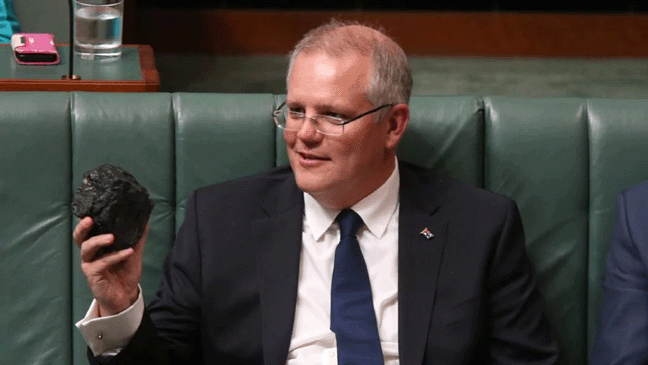 Aussie celebrities appeal to Prime Minister on climate policies, https://thenewdaily.com.au/news/national/2020/02/24/greenpeace-celebrities-climate-policies/ Australian celebrities are calling on Prime Minister Scott Morrison to take action on the nation’s energy policies in a campaign aimed at preventing new bushfires.Voices such as actor Simon Baker, musician Julia Stone and footy player Dyson Heppell have appeared in a Greenpeace video released on Monday, ask Scott Morrison to shift from coal to renewable energies. Aussie celebrities appeal to Prime Minister on climate policies, https://thenewdaily.com.au/news/national/2020/02/24/greenpeace-celebrities-climate-policies/ Australian celebrities are calling on Prime Minister Scott Morrison to take action on the nation’s energy policies in a campaign aimed at preventing new bushfires.Voices such as actor Simon Baker, musician Julia Stone and footy player Dyson Heppell have appeared in a Greenpeace video released on Monday, ask Scott Morrison to shift from coal to renewable energies.
The new campaign features bushfire survivors and Aussie personalities asking the Prime Minister “what sort of world” he wants his daughters to grow up in as a family man. Imploring Mr Morrison to act so Australia stops “falling behind the rest of world”, the video lists the “unprecedented fires”, “extreme drought” and “flash flooding” that have devastated communities in a “black summer”. The message from the Dear Scotty campaign claims to be directed to “both sides of politics” and calls for “change, unity, and leadership” to tackle the country’s future. “People have lost their lives, families have lost their homes, and koalas have burnt alive all over Australia,” Greenpeace Australia Pacific Senior Campaigner Nathaniel Pelle said. “Everyone is feeling the impacts of this coal-fueled bushfire crisis and we need Scott Morrison to act for their future and the future of all Australians.” |
|
#ScottyFromMarketing dodges the question of how much “climate business as usual will cost the economy
Morrison admits there are climate costs, but won’t say what 3C heating would do to economy
Ahead of the release of its technology roadmap, the Coalition tries to ramp up pressure on Labor over its net zero emissions target, Guardian, Katharine Murphy Political editor, @murpharoo, Mon 24 Feb 2020 Scott Morrison has acknowledged there are “costs associated with climate change” but has declined to spell out what 3C heating would do to job creation and economic growth in Australia.
Ahead of the release of its technology roadmap, the federal government is attempting to ramp up political pressure on Labor over its commitment to a net zero target by 2050, blasting the opposition for adopting a target without a fleshed-out strategy to meet it, and pointing out that CSIRO research cited positively by Labor assumes a carbon price of more than $200 to drive the transition.
But the government is also having to fend off sustained questions about basic contradictions in its own messaging…….
While keeping all its options open, the government has been signalling for some days it is unlikely to adopt a 2050 target. …… https://www.theguardian.com/australia-news/2020/feb/24/morrison-admits-there-are-climate-costs-but-wont-say-what-3c-heating-would-do-to-economy
Conflict in the COALition over climate change and emissions reduction

Mathias Cormann says Coalition will ‘finalise longer-term target in time for Cop26’ but Angus Taylor commits only to ‘long-term strategy’, Guardian, Paul Karp @Paul_Karp – 21 Feb 20 Senior Morrison government ministers are publicly at odds about whether Australia will take a long-term emissions reduction target to global climate talks in November after Labor unveiled a target of net zero emissions by 2050.On Friday the finance minister Mathias Cormann confirmed the government “will be finalising a longer-term target in time for Cop26” but the emissions reduction minister would commit only to “a long-term strategy” despite repeatedly being asked about a new target.
As revealed by Guardian Australia, Anthony Albanese used a speech to a progressive thinktank on Friday to commit the ALP to adopting a net zero target by 2050 if it wins the next federal election, without the use of carryover credits from the Kyoto period.Senior Morrison government ministers are publicly at odds about whether Australia will take a long-term emissions reduction target to global climate talks in November after Labor unveiled a target of net zero emissions by 2050.
On Friday the finance minister Mathias Cormann confirmed the government “will be finalising a longer-term target in time for Cop26” but the emissions reduction minister would commit only to “a long-term strategy” despite repeatedly being asked about a new target.
As revealed by Guardian Australia, Anthony Albanese used a speech to a progressive thinktank on Friday to commit the ALP to adopting a net zero target by 2050 if it wins the next federal election, without the use of carryover credits from the Kyoto period.
Scott Morrison is holding off from making a commitment to carbon neutrality by 2050, partly because of an internal brawl within the Coalition and partly because the prime minister says Australia should not sign up to targets in the absence of costings.
Some in the government have noted publicly in recent weeks that Australia implicitly accepted the net zero pathway when the Coalition signed and ratified the Paris agreement, and Liberal moderates are now pushing to make net zero an explicit target beyond the 26-28% emissions reduction promised by 2030…..
Despite the Coalition criticism, business rode to Labor’s defence. Australian Industry Group chief executive Innes Willox said the net zero target “is increasingly widely supported by Australian businesses, industry advocates such as Ai Group, the wider community and governments of all complexions”.
“That growing consensus is important to guide and discipline the development of efficient, trade neutral and fair policies to get there,” he said.
“We shouldn’t underestimate the challenge of net zero, which goes well beyond generating cleaner electricity……
Every state and territory has expressed at least an aspirational objective of achieving net zero emissions by 2050, and Australia has been urged by the UK and its Pacific neighbours to sign up to that target.
Albanese noted on Friday that the Business Council of Australia is calling for it as well as major corporates including AGL, Santos, BHP, Amcor, BP, Wesfarmers and Telstra.
“Seventy-three countries, including the UK, Canada, France and Germany, many with conservative governments, have already adopted it as their goal,” he said. “Australia should too
Earlier, Labor’s climate change spokesman, Mark Butler, told Radio National the opposition would set out a detailed policy about how to achieve targets and its cost “well before” the next election.
Butler argued that the cost of reducing emissions should not be divorced from the cost of inaction and noted Melbourne University research had found actions to reduce emissions have a benefit cost ratio of 20 to one. https://www.theguardian.com/australia-news/2020/feb/21/coalition-ministers-at-odds-over-emissions-target-after-labor-commits-to-net-zero-by-2050
Australia the ‘poster child’ for climate change inaction
 Paris Agreement architect Christiana Figueres says Australia the ‘poster child’ for climate inaction
The bushfire crisis made Australia the “poster child” for climate change inaction – but the fires should force the world to act, the architect of the Paris Agreement says. https://www.adelaidenow.com.au/technology/paris-agreement-architect-christiana-figueres-says-australia-the-poster-child-for-climate-inaction/news-story/e1798a8339a817804c2330731f11775f, Tory Shepherd, State Editor, The Advertiser, 21 Feb 20
Devastating bushfires have made Australia the “poster child” for climate change inaction and the world is weeping for us, the architect of the Paris Agreement says.
Christiana Figueres was the executive secretary of the United Nations Framework Convention on Climate Change when it brought almost 200 nations together to commit to the historic agreement in 2015.
The global goal is to reach net zero emissions by 2050 in order to cap temperature rises, and Ms Figueres’ comments come as federal Labor commits to that goal.
“Any time the word Australia is uttered outside of Australia we all have to contain our tears,” she told The Advertiser.
“This has been so painful, so deeply painful to witness in the news every day the destructive power of bushfires that have gone completely out of control despite the heroic efforts of the firefighters.”
Ms Figueres is coming to Womadelaide in two weeks to talk about her new book The Future We Choose: Surviving the climate crisis.
The lives lost – including a billion animals – and the destruction of the environment and property are just “completely irreplaceable”, she said.
“This is not normal. This is so tragic that Australia is now the poster child, the example of irresponsible management and of undue care on climate change measures.
“I think history will be (divided into) before the Australian fires and after the Australian fires.”
Despite those words, Ms Figueres is optimistic the world can meet the Paris targets, although she is still concerned it won’t happen fast enough.She welcomed Labor leader Anthony Albanese’s commitment to the 2050 target. In a major policy speech today, the Opposition Leader said Australia had always prided itself on pulling its weight.
“We have seen climate change be a factor in our devastating bushfires. We could see it, smell it, even touch it,” he said.
”Our amazing continent is particularly vulnerable, so we have a lot to lose. But the good news is we also have a lot to gain. Action on climate change will mean more jobs, lower emissions and lower energy prices.”
Ms Figueres said it had been “rather odd” that Australia had seemed to be stepping away from the agreement, as the Federal Government battles a split on the issue.
Energy Minister Angus Taylor says the government is not going to “commit to a target without costings and without a clear plan”.
She said Mr Albanese’s commitment was “the only responsible target”.
“It’s the target stipulated in the Paris agreement. The Paris agreement is science based,” she said.
The Federal Government is setting up a Royal Commission on the summer’s devastating bushfires.
#ScottyFromMarketing ‘s hypocritical ploy to do nothing effective against climate change
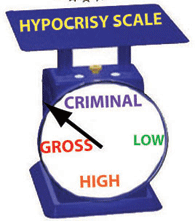 The government’s sudden passion for climate technology is newfound and insincere, The call for technology before action is a specious distraction designed to paper over the plan to take no action Guardian, Simon Holmes à Court– @simonahac 21 Feb 2020 The government’s sudden passion for climate technology is newfound and insincere, The call for technology before action is a specious distraction designed to paper over the plan to take no action Guardian, Simon Holmes à Court– @simonahac 21 Feb 2020
If you’re committed to the Paris agreement – to keep the increase in global average temperature to well below two degrees above pre-industrial levels, and pursue efforts to limit the increase to 1.5 degrees – then at a minimum, logically, scientifically, you’re committed to net-zero carbon emissions by 2050. So far, at least 77 countries have committed to the target, as has every state and territory in Australia. The fact that prime minister Scott Morrison is pushing back hard against the calls for such a target sends yet another strong signal that his government still denies the need to tackle climate change. Sensing it must be seen to do something, but committed to doing nothing substantive, the government is arguing that investing in technology is the superior pathway to… to… to what? Are billions of dollars of public funds about to be allocated to a strategy that delivers on an unspoken goal? This passion for technology is newfound and insincere. In truth, our government has a long history of undermining climate technologies. In the three years to 2016, the government ripped just shy of $1bn from the Australian Renewable Energy Agency (Arena), the body charged with helping early stage technologies through to commercial launch. The funding of a feasibility study for a coal power station in Collinsville and the foreshadowed gift of $11m to extend the life of the 42 years old Vales Point coal power station in the Hunter, demonstrate just how reluctant the Coalition is to let go of last century’s energy technologies. One of the most promising and critical new technologies is the rapid maturation of the electric vehicle, but who can forget the government’s pushback against EVs during last year’s election?…… Mike and Annie Cannon-Brooke’s Resilient Energy Collective is a case study for how far we’ve come. In just a handful of weeks the group has put together an emergency power product for restoring power to bushfire affected communities. The solar-powered, battery-backed system can be installed in a single day, and will be rolled out to 100 communities in as many days. The energy supply companies partnering in the project are stunned that the infrastructure is being rolled out in hours not months. Community members are amazed that they’re using solar power at night. ….. In reality, the call for technology before action is a specious distraction designed to paper over the plan to take no action. The greatest proponent of the frame is Danish political scientist Bjorn Lomborg, one of a small cadre of almost respectable climate obfuscationists. …… The first three years of the Coalition government focussed on tearing down climate policy. The next three used endless reviews that came to nothing – as intended. In July 2014, Tony Abbott finally made good on his promise to dismantle Australia’s carbon price mechanism, our most effective and efficient climate policy. In doing so, not only did he throw away the best tool we had, he cheated Australian farmers out of earning billions from exporting carbon credits to Europe. In 2015, Abbott managed to slash the renewable energy target – assisted in the background by Angus Taylor, the man now charged with reducing emissions – cutting future activity under the target by 40%…… In July 2014, Tony Abbott finally made good on his promise to dismantle Australia’s carbon price mechanism, our most effective and efficient climate policy. In doing so, not only did he throw away the best tool we had, he cheated Australian farmers out of earning billions from exporting carbon credits to Europe. In 2015, Abbott managed to slash the renewable energy target – assisted in the background by Angus Taylor, the man now charged with reducing emissions – cutting future activity under the target by 40%….. So here we are again. Another strategy to kick the can down the road……https://www.theguardian.com/commentisfree/2020/feb/21/the-governments-sudden-passion-for-climate-technology-is-newfound-and-insincere |
|
Religious leaders urge ScottyFromMarketing to move Australia away from fossil fuels
|
Faith leaders press PM on climate action, Herald Sun Heather McNab, Australian Associated Press
February 20, 2020 Religious leaders have appealed to Prime Minister Scott Morrison as a “fellow person of faith” to heed climate science following the country’s catastrophic bushfire season. The open letter – signed by 18 Christian, Hindu, Buddhist, Jewish, Muslim and other faith leaders – urges Mr Morrison to show leadership and urgently transition Australia away from fossil fuels. The signatories include: Dr Peter Catt, the Dean of St John’s Anglican Cathedral in Brisbane, the Most Reverend Vincent Long Van Nguyen OFM, Chair of the Catholic Bishops Commission on Justice, Mission and Service Muslims Australia president Dr Rateb Jneid and Buddhist Council of NSW Religious leaders have appealed to Prime Minister Scott Morrison as a “fellow person of faith” to heed climate science following the country’s catastrophic bushfire season. The open letter – signed by 18 Christian, Hindu, Buddhist, Jewish, Muslim and other faith leaders – urges Mr Morrison to show leadership and urgently transition Australia away from fossil fuels. The signatories include: Dr Peter Catt, the Dean of St John’s Anglican Cathedral in Brisbane, the Most Reverend Vincent Long Van Nguyen OFM, Chair of the Catholic Bishops Commission on Justice, Mission and Service Muslims Australia president Dr Rateb Jneid and Buddhist Council of NSW president Dr Gawaine Powell Davies…. https://www.heraldsun.com.au/news/breaking-news/faith-leaders-press-pm-on-climate-action/news-story/48ebb95e2fdee026ccc593583ea622ab |
|
1 This month



Help Aunty Sue Protect Her Land and Sacred Sites From Destructive Rocket Testing.
.

Australians deserve the truth
about
AUKUS – https://aukuspublicinquiry.com/

PETITION – To: Prime Minister Anthony Albanese and the Australian Labor Government

of the week – Australians for War Powers Reform (AWPR)
To see nuclear-related stories in greater depth and intensity

