Adani about to receive criminal conviction over false documents
 Adani agrees to plead guilty to giving ‘false or misleading documents to an administering authority’, may be fined up to $3m
Key points:
- The company’s Australian arm, Adani Mining Pty Ltd, is listed for sentencing in the Brisbane Magistrates Court
- It belatedly declared clearing land on its mine site after environmentalists complained to the government
- The company says it has been prosecuted for an “an administrative error”
Adani has agreed to plead guilty to giving “false or misleading documents to an administering authority”, according to the court file and sources familiar with the case.
The company’s Australian arm, Adani Mining Pty Ltd, is listed for sentencing today in the Brisbane Magistrates Court.
It faces a fine of up to $3 million if convicted under the Environmental Protection Act.
According to notes in the court file made by Magistrate Stephen Courtney and seen by the ABC, the matter is “to be [a] plea of guilty”.
In court papers, the Department of Environment and Science (DES) says Adani filed its annual return in March 2018 with a graph declaring it cleared no land on the Carmichael mine site, north-west of Clermont, in 2017-18.
The DES alleged it became aware of the offence six months later. It alleged Adani “knew or ought reasonably to have known [the document] was false or misleading” because it had planned and carried out land clearing before and during the reporting period.
On September 6, 2018, conservation group Coast and Country raised land clearing allegations with the State Government, citing satellite imagery.
State and federal environment department officials then inspected the site within days……..https://www.abc.net.au/news/2020-02-06/adani-to-plead-guilty-court-qld/11932640
Greens leader Adam Bandt vows to hold torch to Coalition on climate
 Greens leader Adam Bandt vows to hold torch to Coalition on climate, The New Daily, 3 Feb 20, Adam Bandt has been elected unopposed as Greens leader following the surprise resignation of Richard Di Natale Greens leader Adam Bandt vows to hold torch to Coalition on climate, The New Daily, 3 Feb 20, Adam Bandt has been elected unopposed as Greens leader following the surprise resignation of Richard Di Natale
The only Greens member in the lower house, Mr Bandt was formally endorsed by his federal party room colleagues in Canberra on Tuesday morning. He has promised to pursue a “Green New Deal” focused on including dental treatment in Medicare, making education free by abolishing public school fees, and replacing fossil fuels with renewable energy. Mr Bandt aims to win the balance of power in the upper and lower houses of federal parliament at the next election. In the meantime, he intends to pressure the Morrison government to take stronger action on climate change. Mr Bandt labelled the Coalition government “criminal” for abolishing the carbon price under Tony Abbott and argued climate inaction was fanning the ongoing bushfire crisis. He also claimed big businesses were “killing people” by contributing to a “climate catastrophe”. Mr Bandt said the Greens would provide “real opposition” and hold the government to account He said the major parties were “singing from the same song sheet” on coal mining. “I’m not one of those people who says that Labor and the Liberals are the same,” he said, shortly after his election to the leadership. “But when it comes to coal, Labor is now using exactly the same terminology as the Liberals.” Queensland senator Larissa Waters will remain co-deputy of the party and will share the role with Tasmanian senator Nick McKim. Senator Waters will also be the Greens leader in the Senate……https://thenewdaily.com.au/news/politics/australian-politics/2020/02/04/adam-bandt-greens-leader/ |
|
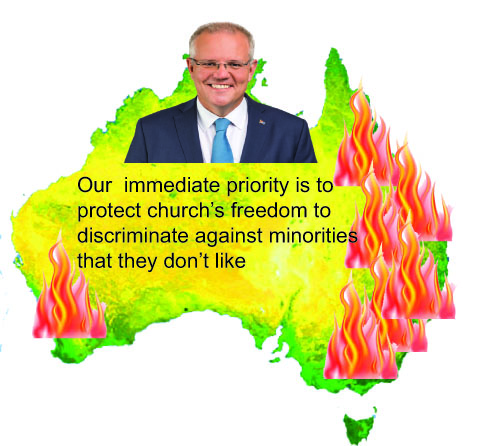
#ScottyFromMarketing has no climate target, because he is controlled by climate denialists
|
Scott Morrison’s missing target: climate https://www.afr.com/policy/energy-and-climate/scott-morrison-s-missing-climate-target-20200203-p53x5g
If he is going to appease noisy climate change denialists, it would be better if the Prime Minister left emissions reduction policy to the states. Richard Denniss Columnist Scott Morrison loves long-run targets for everything except climate policy.The federal government has long-run targets for inflation (2 to 3 per cent), the budget surplus (1 per cent of gross domestic product) and net debt (zero). It’s got a long-run target for defence spending (2 per cent of GDP) and countless long-run targets when it comes to Indigenous disadvantage, education performance, aged care quality and foreign aid. But when it comes to reducing the amount of coal, oil and gas Australia burns, apparently long-run targets are an unnecessary distraction for an “action man” like Scotty from Marketing. Targets give business, consumers and other levels of government something clear to work towards. Energy sources, especially the coal and nuclear power stations that the Prime Minister likes the sound of, take years to plan, years to build and decades to pay for themselves. Targets give business more certainty but they also make governments accountable for performance, which is presumably why the Prime Minister is so determined to avoid them when it comes to carbon emissions. In his sermon to the National Press Club last week, he avoided committing to net zero emissions by 2050 on the basis that his “climate action agenda is a practical one, it goes beyond targets and summits”. But you can’t go “beyond” long-run targets without having first set them.
Morrison knows targets matter. That’s why his government targeted so many sports grants to marginal electorates, and it’s why he spends so much time talking about meeting and beating Tony Abbott’s 26 to 28 per cent Paris target. Scott knows that if you set the bar low enough you can easily clear it, and if you don’t set the bar at all you can do nothing at all. After six years in office, continuing to avoid long-run emissions targets makes the government’s job easier and the energy industry’s harder. The Prime Minister’s real problem with long-run climate targets is the long-run climate change deniers in the party he’s trying to lead. For 10 years the only way for a Liberal leader to survive has been to publicly promise to do something about climate change while privately promising not to. Morrison waved a lump of coal in Parliament when he wanted to destabilise Malcolm Turnbull, but today he waves his “climate action now” slogan to stabilise his slide in the polls. Ultimately, like the last five Liberal leaders, he will be impaled on the fence his party insists he sit on. Morrison’s new-found interest in hazard reduction is no substitute for spending his prime ministerial capital in international forums, trying to steer the world away from the 3 degrees of warning we are currently on track to experience. The state premiers are perfectly capable of raking the leaves, but only the federal government can negotiate on the nation’s behalf for more ambitious action. Which brings me back to targets. Back in 2016, the ACT set a target to source 100 per cent of its electricity from renewable sources by 2020, and it’s already “meeting and beating” that goal and providing some of the cheapest electricity in Australia. The City of Sydney will be 100 per cent renewable by the end of this year and the state Coalition government of Gladys Berejiklian has committed NSW to net-zero emissions by 2050. In fact, every state in Australia is committed to carbon neutrality by 2050 – which, whether Scott Morrison likes it or not, means that Australia has committed to being carbon neutral by 2050. But rather than using those targets as leverage on the international stage, Morrison is undermining them on the domestic stage. If the Prime Minister was as interested in appeasing the quiet Australians as he was in appeasing the noisy climate denialists, he would welcome the bear hug the state premiers have wrapped him in and take credit for their ambition on the world stage while holding the premiers to account for their commitments back home. While a national approach to emissions reduction would be nice, the federal Coalition has shredded every initiative that has been put forward. Rather than take over more responsibilities from the states, Morrison would do better to leave climate and energy policy to them. The only thing stopping him from showing up at the next global climate talks and putting the states’ target of net zero by 2050 on the table is his backbench. |
|
|
A clear path to climate action for Australia
 The Princes Highway to climate action, SMH, Jono La The Princes Highway to climate action, SMH, Jono La Nauze 2 Feb 2020 In the past few weeks a clear path to real action on climate change has emerged. State and territory governments are aligning on the need for stronger climate policy.If the states act decisively and act together on setting emissions targets they can reduce pollution through an alternative route. Let’s call it the Princes Highway to climate action, because, like the famous road, it passes through the eastern capitals and deliberately avoids Canberra. Nauze 2 Feb 2020 In the past few weeks a clear path to real action on climate change has emerged. State and territory governments are aligning on the need for stronger climate policy.If the states act decisively and act together on setting emissions targets they can reduce pollution through an alternative route. Let’s call it the Princes Highway to climate action, because, like the famous road, it passes through the eastern capitals and deliberately avoids Canberra.
The biggest barrier to action has been a lack of political will and outright climate denialism in Federal Parliament, mainly from the Liberal and National parties. Even after the bushfires, the Prime Minister has tried to deflect attention from his party’s failure by focusing the debate on how we can “adapt” to a hotter, more chaotic climate, rather than cutting the pollution that causes it. But at the state level, things have been different. In recent weeks, senior Liberals have been speaking out about the need to cut pollution and have called for stronger climate policy – including the South Australian Premier, the outgoing and incoming Tasmanian premiers, the Victorian Opposition Leader and the NSW Climate and Energy Minister. In South Australia, the Liberal Party shifted a long time ago. When a freak storm toppled transmission lines and blacked out the state, the federal Coalition rolled out an aggressive misinformation campaign blaming the then Labor government’s renewable energy leadership. But when the Liberals came to power they didn’t follow their federal counterparts in trashing wind and solar – instead, they embraced it. “A lot of people thought when I got elected that we would be scaling back the state’s focus on renewable energy, when in fact we are putting the foot to the floor,” said Liberal Premier Steven Marshall on Friday. South Australia is now on track for 75 per cent renewable energy by 2025, and the Premier has linked the recent bushfires to climate change. Every single state and territory in the country has now set a goal of net zero emissions by 2050 – a long-term target the Prime Minister has so far rejected. Of course, the reality is that emissions cuts in the next five and 10 years will count the most. That’s why it’s critical that premiers such as Gladys Berejiklian and Daniel Andrews seize this moment to work with their fellow premiers on a national climate change strategy…….. This is a critical moment that could shift the national debate. If Victoria adopts emissions targets in line with the Paris Agreement, it is possible for other states to follow suit, passing similar legislation and creating a de-facto national climate change strategy – whether Scott Morrison decided to help out or not. In a few years, rather than being stuck in a stalemate at the federal level while temperatures rise and the country burns, we could have agreement between states and territories to get on with the job of lowering emissions and creating a safer future. https://www.smh.com.au/national/the-princes-highway-to-climate-action-20200131-p53wg6.html |
|
|
Australia’s extreme bushfires – forests might not recover
 Wildfires have spread dramatically—and some forests may not recover. An explosion in the frequency and extent of wildfires worldwide is hindering recovery even in ecosystems that rely on natural blazes to survive. https://www.nationalgeographic.com/science/2020/01/extreme-wildfires-reshaping-forests-worldwide-recovery-australia-climate/
|
BY JOHN PICKRELL, JANUARY 30, 2020, Pungent and damp, the so-called tall, wet forests of southeastern Australia are home to the tallest flowering plants on Earth. Eucalyptus regnans, the Latin name of the mountain ash, means “ruler of the gum trees”—which is fitting, given these giants can reach more than 300 feet high.
Many of Australia’s gum trees, particularly those in drier forest types, are famously able to tolerate fire, throwing out new buds and shoots within weeks of being engulfed in flames. But even these tenacious species have their limits. Old-growth forests of the mountain ash and a related species, the alpine ash, are among the gum trees that are less tolerant of intense blazes. In the state of Victoria, these trees had already been severely depleted by logging and land clearing. Now, the bushfires that have burned more than 26 million acres of eastern Australia in recent months are putting the forests at even greater risk. Some of the forests razed this year have experienced four bushfires in the past 25 years, meaning they’ve had no chance to recover, says David Lindenmayer, an ecologist at the Australian National University in Canberra. “They should be burning no more than every 75 to 125 years, so that’s just an extraordinary change to fire regimes,” he says. “Mountain ash need to be about 15 to 30 years old before they can produce viable amounts of seed to replace themselves following fire.” The loss of these dominant trees is a significant problem, since they provide vital habitat for threatened animal species such as the sooty owl, the giant burrowing frog, and a fluffy arboreal marsupial called the greater glider. (Also find out how Australia’s fires can create big problems for freshwater supplies.) |
|
Bushfire state of emergency in Australian Capital Territory (ACT)
Times 2nd Feb 2020, An inferno was raging near the Australian capital, Canberra, yesterday as a heatwave combined with high winds to prolong the country’s devastating bushfire season. The tiny Australian Capital Territory (ACT), between Sydney and Melbourne, declared a state of emergency as the fire, covering 140 square miles, threatened Canberra’s southern suburbs.
Drinking water threatened by forest fires
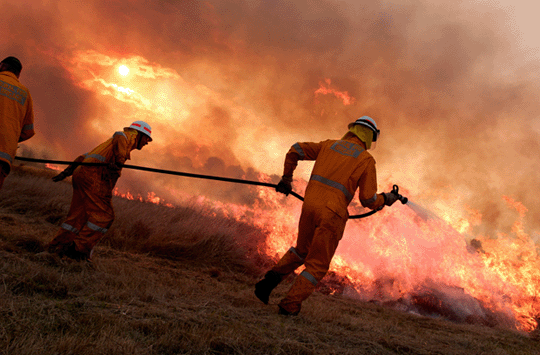 As forests burn around the world, drinking water is
  at risk https://www.westhawaiitoday.com/2020/01/31/features/as-forests-burn-around-the-world-drinking-water-is-at-risk/
In Australia’s national capital of Canberra, where a state of emergency was declared on Friday because of an out-of-control forest fire to its south, authorities are hoping a new water treatment plant and other measures will prevent a repeat of water quality problems and disruption that followed deadly wildfires 17 years ago.
|
“The forest area burned in Australia within a single fire season is just staggering,” said Stefan Doerr, a professor at Swansea University in England who studies the effects of forest fires on sediment and ash runoff. “We haven’t seen anything like it in recorded history.” The situation in Australia illustrates a growing global concern: Forests, grasslands and other areas that supply drinking water to hundreds of millions of people are increasingly vulnerable to fire due in large part to hotter, drier weather that has extended fire seasons, and more people moving into those areas, where they can accidentally set fires. More than 60% of the water supply for the world’s 100 largest cities originates in fire-prone watersheds — and countless smaller communities also rely on surface water in vulnerable areas, researchers say. Continue reading |
Australia’s options for climate change action
 What is ‘real’ action on climate change? SMH , What form would greater climate change action take – and what would it cost? By Staff reporters
What does climate action actually mean?
Climate change action takes two forms: mitigation, which means reducing greenhouse gas emissions at a rate fast enough to prevent massive damage to our environment in the future; and adaptation, which means bracing and preparing for the changes that are happening and which will intensify.
Adapting to climate change is essential and there are many ways to do so, such as beefing up emergency services and strengthening farms and infrastructure against fires, storms and rising sea levels.
But the source of the problem is the rising emissions that are trapping heat in the atmosphere and oceans. In Australia, emissions come from electricity, industry, transport and agriculture as well as other sectors.
If we are serious about tackling climate change, we must reduce emissions faster than we are doing now. That’s the view of the world’s leading scientific bodies as well as the key expert bodies in Australia, including the CSIRO and the Australian Academy of Science. Their advice is clear: Australia needs to be close to carbon neutral by the middle of the century.
It would be nice to be able to flick a switch and change to zero emissions next week. In practice, decarbonising the nation will be a long, complex process.
The Garnaut Review, led by senior economist Ross Garnaut almost a decade ago, is still the most comprehensive assessment of Australia’s options for climate change action. It drew on leading Australian research on bushfire impacts to forecast an increase in bushfire danger by 2020. On our current trajectory, we are on track to see catastrophic fire days increase by 300 per cent by the second half of this century.
The review outlines various types of policy that can help cut emissions, both “carrots” and “sticks”. There are public subsidies, such as government funding for wind and solar farms; or special tariffs to pay householders with solar panels. Then there are systems for making polluters pay, such as a carbon price implemented through a carbon tax or an emissions trading scheme. There are also policies that rely on regulating an industry, such as the now-abandoned National Energy Guarantee policy, under which companies would be required by law to use a mix of different technologies.
Several types of policy can operate at the same time. Australia had a carbon price from 2012 to 2014 before it was repealed after a change of government. Currently, it has some direct subsidies for emissions reduction projects but no mechanism for cutting greenhouse gases at the speed required.
The Garnaut Review found – and other studies, including by the OECD and by the Australian National University, have since agreed – that a carbon price coupled with an emissions trading scheme and a cap on greenhouse gas emissions would be the most effective and efficient way of cutting emissions.
The Prime Minister, Scott Morrison, has ruled out a “carbon tax” or other action that would raise electricity prices or affect polluting industries. In the wake of the fires, Mr Morrison has flagged “resilience” and “adaptation” as the areas he wants to focus on……..
Australia currently has no mechanism for controlling its greenhouse gas emissions and may not meet its Paris commitments……. https://www.smh.com.au/national/what-is-real-action-on-climate-change-20200115-p53rok.html
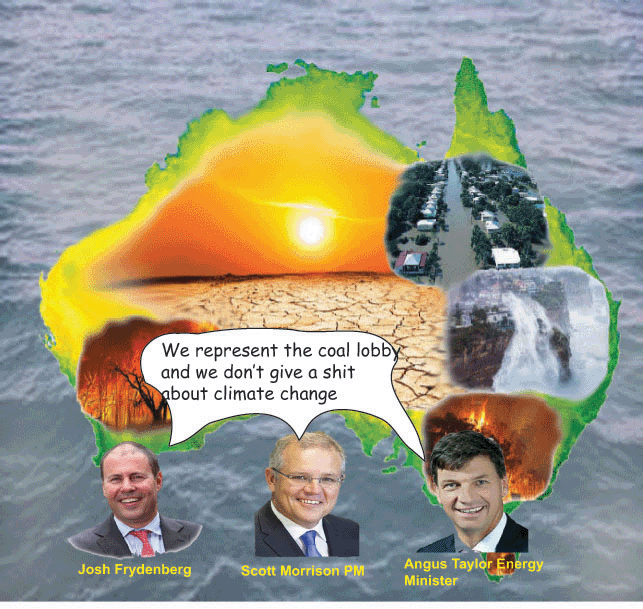
#ScottyFromMarketing is dodging the need for real action on climate change
|
Climate change calls for action, not adaptation, SMH January 31, 2020 Judy Dillon, Garran ACT In the midst of our horrific summer, polls show the majority of people want to see urgent action on climate change, (”PM’s bushfire response must include climate change: experts”, January 30). We don’t want a focus on ”resilience and adaptation” or ”meeting and beating” pathetically low targets with the use of accounting tricks. Emissions are continuing to rise while the Morrison government uses weasel words to pretend they are doing something effective, all while handing billions to the fossil fuel industry.
The House of Representatives is scheduled to sit for a total of 72 days in 2020, so politicians have no time to lose. If they are not prepared to get on with the mammoth task of taking real and significant climate action in the interests of all Australians, and indeed the whole world, then they should get out of the way now so politicians who are so motivated can take their place. Quiet Australians have had enough – we will not be silent. –
– Peter Spencer, Castle Hill The PM is setting up an inquiry that avoids the real cause of of this and future bushfires – climate change. Once again, he gives the impression he is doing something when he is avoiding the real issue. Another opportunity wasted.
Adrian Owen, Killawarra , The PM now reluctantly concedes our continent is warming and drying. By saying the effects of the emissions already in the atmosphere will be felt for decades regardless of any action, he seeks to portray emissions mitigation as a lost cause. He must imagine the public will willingly surrender to warming beyond two degrees. His new focus on resilience and adaptation will lead to the absurd situation in which the coal industry will continue apace while federal government will spend money elsewhere to try to protect the rest of us from the ravages of a warming climate. –
– Mike Reddy, Vincentia After listening to Morrison talk about climate change action, I think his government is focused on hope. Hope that individuals keep putting solar panels up. Hope that the states keep pulling their weight. Hope that the rest of the world reduces its emissions. Hope that no one notices he is doing nothing. Hope that rising sea levels don’t swamp Waikiki.
Graham Lum, North Rocks Barilaro claims that Matt Kean’s comments on climate change are unhelpful and do not represent the whole of government. That may be so, but I suggest they do represent the views of the majority of Australians. -… https://www.smh.com.au/national/nsw/climate-change-calls-for-action-not-adaptation-20200129-p53vwp.html
|
|
Aboriginal peoples must be restored as custodians of Country
Research Fellow, University of Melbourne, January 31, 2020 In the wake of devastating bushfires across the country, and with the prospect of losing a billion animals and some entire species, transformational change is required in the way we interact with this land.Australia’s First Peoples have honed and employed holistic land management practices for thousand of generations. These practices are embedded in all aspects of our culture. They are so effective, so perfectly suited to this harshest of continents, that we are the oldest living culture in the world today.
A reintroduction of traditional land management is essential if we want to address the ecological crisis we now face.
Not just ‘consultants Continue reading
Adaptation to bushfires might not be achievable without stronger action to curb emissions
 (Cartoon above, courtesy of Independent Australia and Mark David)
Australia is ‘ground zero’ in climate crisis and must show leadership, top researchers say https://www.theguardian.com/australia-news/2020/jan/29/australia-is-ground-zero-in-climate-crisis-and-must-show-leadership-top-researchers-say Lisa Cox, Wed 29 Jan 2020, Adaptation to bushfires might not be achievable without stronger action to curb emissions, letter warns, Lisa Cox Australia’s current position as “ground zero” for both the impacts of climate change and policy uncertainty presents an opportunity for the country to emerge as a leader in responding to the climate crisis, according to Australian Research Council laureates.
In a letter signed by 80 ARC laureate fellows, some of Australia’s top researchers said claims strong action to cut emissions would be economically destructive have no basis and are not “consistent with Australia’s traditional optimism and ingenuity, nor with historical experience”.
“Reducing emissions is a global challenge that requires collective action,” the letter said.
“But Australia’s current visibility as ground zero for both climate impacts and climate policy uncertainty presents a unique opportunity for us to emerge as a leader on this challenge.”
The ARC laureate fellows are a small group of researchers selected by the ARC as the top researchers across all fields in Australia.
The letter, whose signatories include decorated academics in mathematics, science, economics, and language and culture, said the government’s focus on adapting to changed fire patterns “is not enough”.
It was written as the country’s unprecedented bushfire season continues, with emergency warnings in place on Tuesday for a fire burning in the Namadgi national park near Canberra.
“We welcome government actions to help current victims and improve adaptation to future fires, as well as its acceptance of a role for climate change in the catastrophe,” the letter said.
“But this is not enough, because the greenhouse gas amounts driving warming are still rising: the world is only at the beginning of the climate change phenomenon.”
The bushfire emergency has brought the Coalition government’s climate policies into sharp focus.
The prime minister, Scott Morrison, was criticised for his handling of the crisis through Christmas and early January, and for his failure to meet with former emergency chiefs who warned of the coming catastrophe last year.
Morrison said this month that the government’s response to the increasingly visible effects of the climate crisis would be to address “adaptation and resilience” rather than strengthening policies to reduce emissions.
But the letter warns that without stronger action to curb emissions, the impacts of further temperature rises could be such that adaptation is not achievable.
“This dire outlook demands stronger mitigation of carbon emissions,” it said.
“Many argue that actions to achieve this would be economically destructive. This claim has no basis, nor is it consistent with Australia’s traditional optimism and ingenuity, nor with historical experience.”
They wrote that achieving net zero emissions was a large but achievable task, and “far less risky and irresponsible” than allowing continued global heating.
Australia faced international criticism as one of a handful of countries at the United Nations climate conference in Madrid in December that were responsible for thwarting a deal on the rulebook for the Paris climate agreement.
Australia is the only country that plans to use carryover credits from the Kyoto period to meet its targets under the Paris agreement.
In Australia, legal action over climate change is on the rise
A class action might be out of the question but climate change litigation, at least against companies, is on the rise.
Australia has so far had the second-highest number of climate cases globally after the United States and the nation’s financial regulators have been warning about an increase of litigation for years now.
On top of that, in 2016 a legal opinion by Noel Hutley QC and Sebastian Hartford-Davis identified climate change as a material financial risk to businesses. As a result, Australian company directors might be legally obliged to consider and report on the risks.
|
Climate activists and lawyers itching to sue Australia government, https://thenewdaily.com.au/news/2020/01/25/climate-change-class-action/ Cait Kelly
As Australia experiences the worst bushfire season on record there are growing calls for a class action against the federal government for the lacklustre response to climate change. Emboldened by a recent case in the Netherlands where citizens successfully mounted a class action against their government for its failure to act on the climate crisis, there are mounting calls to do the same here. One change.org.au petition to rally support for a class action has received more than 63,000 signatures. “The government has failed to increase its emissions targets,” it reads. “Failed to increase the renewable energy target and failed the people of Australia. “We are now witnessing the effects of the climate emergency first hand, and still the government sits on its hands.” But mounting a class action against the government over the issue is “uncharted territory” and highly complicated, said Australian Lawyers Alliance’s Greg Barns. “There is certainly a strong and compelling moral argument that government inaction, in the face of uncontradicted expert evidence warning about the increased risk of number or, and magnitude of fires, should compel it to pay compensation to those impacted by the fires,” he told The New Daily. One argument thrown around for a class action is the historical precedent taken after Black Saturday fires in which 173 people died. Continue reading |
Climate and the Coalition’s new denialism
Nick Feik, In recent months the federal government’s position on climate change has shifted. Not in policy terms: the change has been restricted to its rhetoric. It has a new strategy to avoid responsibility. Prime Minister Scott Morrison has become adept at evading questions on climate change and its links to bushfires and judging by his satisfied expression as he fronted up for ABC’s 7.30 recently, he remains confident he has a form of words that, like armour, journalists will be unable to penetrate…. (subscribers only – or buy the print version) https://www.thesaturdaypaper.com.au/opinion/topic/2020/01/25/climate-and-the-coalitions-new-denialism/15798708009296
Australia’s megafires a wake-up call on the climate-nuclear danger
the task of civil society is to organize more strongly in order to increase awareness regarding the link between the climate crisis and the vulnerability of nuclear facilities so that public opinion may begin to be altered and political powers may be pressured to begin an exit from the innately dangerous nuclear path.
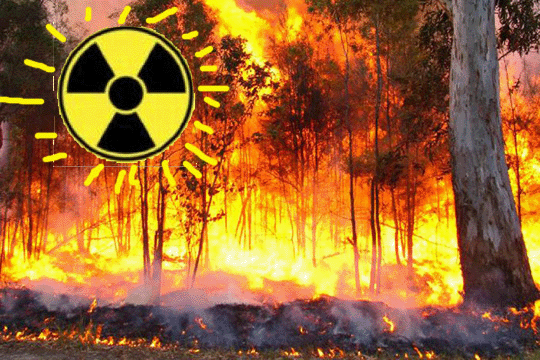
What Australia type fire may tell us about the possibility of nuclear disasters, https://www.dianuke.org/what-australia-type-fire-may-tell-us-about-the-possibility-of-nuclear-disasters/ JANUARY 22, 2020 Australia is one of the countries that have experienced extreme weather events, especially in the last decade due to the effect of global warming. According to experts, system interactions triggered global warming, and extinguishing fires has become impossible due to reduced water resources as a result of excessive evaporation and mismanagement of these resources in the last decade in the country. It is estimated that nearly 1.25 billion animal species and at least 27 people have lost their lives, in addition to annihilation of forests and vegetation due to the fires which could not be controlled for almost four months; other species are threatened with extinction and 1800 houses have reportedly burned down.
Unfortunately, the impact of the events is not limited to the period of their occurrence – while four months of carbon emissions, as much as the annual carbon emission amount to the atmosphere, there are scientific studies indicating that there may be an increase in various diseases, especially asthma, especially among children, with the air quality rising to nearly 21 times the dangerous level. Things could have been much worse if the fires had reached the region where uranium mines are located in Australia, which supplies 12% of the uranium fuel used in nuclear power plants operating worldwide; Australia however, has no nuclear power plant of its own. Continue reading
Former Prime Minister Turnbull scathing about #MorrisonFromMarketing, on the climate issue
Last year, The New Daily revealed the Prime Minister had embarked on a secret trip to Hawaii while fires were devastating Australian communities.
The former prime minister, who has a new book out this year, also slammed the US President Donald Trump for playing a “very destructive” role in the climate debate.
“Trump makes no bones about it. He says global warming is rubbish,” Mr Turnbull said.
“Trump is trying to put a brake on global action to reduce emissions. The lack of American leadership is extremely damaging.
Mr Turnbull also accused his own predecessor, Tony Abbott, of being the nation’s most prominent climate denier in Australian politics, who was joined by others in a shameful “war against science”.
“It is an extraordinarily irrational and self-destructive approach,” Mr Turnbull said.
“The right [wing] in the Liberal Party essentially operate like terrorists,” he said.
“Now I’m not suggesting that they use guns and bombs or anything like that, but their approach is one of intimidation.
“And they basically say to the rest of the party… if you don’t do what we want, we will blow the show up. Famously one of the coup leaders said to me, ‘you have to give in to the terrorists’.” https://thenewdaily.com.au/news/world/2020/01/23/malcolm-turnbull-scott-morrison-climate-denial/
1 This month.

Australians deserve the truth
about
AUKUS – https://aukuspublicinquiry.com/


PETITION – To: Prime Minister Anthony Albanese and the Australian Labor Government

of the week – Australians for War Powers Reform (AWPR)
To see nuclear-related stories in greater depth and intensity
 Antinuclear