Former Prime Minister Turnbull scathing about #MorrisonFromMarketing, on the climate issue
Last year, The New Daily revealed the Prime Minister had embarked on a secret trip to Hawaii while fires were devastating Australian communities.
The former prime minister, who has a new book out this year, also slammed the US President Donald Trump for playing a “very destructive” role in the climate debate.
“Trump makes no bones about it. He says global warming is rubbish,” Mr Turnbull said.
“Trump is trying to put a brake on global action to reduce emissions. The lack of American leadership is extremely damaging.
Mr Turnbull also accused his own predecessor, Tony Abbott, of being the nation’s most prominent climate denier in Australian politics, who was joined by others in a shameful “war against science”.
“It is an extraordinarily irrational and self-destructive approach,” Mr Turnbull said.
“The right [wing] in the Liberal Party essentially operate like terrorists,” he said.
“Now I’m not suggesting that they use guns and bombs or anything like that, but their approach is one of intimidation.
“And they basically say to the rest of the party… if you don’t do what we want, we will blow the show up. Famously one of the coup leaders said to me, ‘you have to give in to the terrorists’.” https://thenewdaily.com.au/news/world/2020/01/23/malcolm-turnbull-scott-morrison-climate-denial/
Australia’s Finance Minister Mathias Cormann spruiks for coal and for Trump at Davos summit
 Davos 2020: Climate critics are wrong, says Matthias Cormann THE AUSTRALIAN, 22 Jan 2020
Finance Minister Mathias Cormann has declared global perceptions of Australia’s climate action are “false” as he defended both the coal industry and US President Donald Trump in front of world leaders at the Davos summit…. (subscribers only)
Australia’s billion of animal deaths – conservationists must not give up

|
Conservation scientists are grieving after the bushfires – but we must
not give up, The Conversation, January 21, 2020 Stephen Garnett,
Professor of Conservation and Sustainable Livelihoods, Charles Darwin
John Woinarski, Professor (conservation biology), Charles Darwin University,
Sarah Legge, Professor, Australian National University
That a billion animals may die as a result of this summer’s fires has horrified the world. For many conservation biologists and managers, however, the unprecedented extent and ferocity of the fires has incinerated much more than koalas and their kin.The scale of the destruction has challenged what is fundamentally an optimistic worldview held by conservationists: that with sufficient time, love and money, every species threatened by Australia’s 250 years of colonial transformation cannot just be saved from extinction, but can flourish once again. The nation’s silent, apocalyptic firescapes have left many conservation biologists grieving – for the animals, the species, their optimism, and for some, lifetimes of diligent work. So many of us are wondering: have lives spent furthering conservation been wasted? Should we give up on conservation work, when destructioncan be wrought on the environment at such unprecedented scales? The answer is, simply, no. Acknowledge the grief Federal government figures released on Monday showed more than half of the area occupied by about 115 threatened species has been affected by fire. Some of these species will now be at significantly greater threat of extinction. They include the long-footed potoroo, Kangaroo Island’s glossy black-cockatoo and the East Lynne midge orchid………. 1.action is an effective therapy for grief. There is plenty to do: assess the extent of damage, find and nurture the unburned fragments, and feed the survivors. The official recovery response has been swift. Victoria, New South Wales and now the Commonwealth have all issued clear statements about what’s happened and how they’re responding. The determination and unity among government agencies, researchers and conservation groups has been remarkable……. |
|
Bangladesh and Australia- both vulnerable to climate change – but will that stop the coal lobby?
 Despite climate impact, Bangladesh wants Australian coal to fire 29 new power stations, https://www.theage.com.au/politics/federal/rba-told-to-mobilise-all-forces-to-save-the-economy-from-climate-change-20200120-p53szi.html Bangladesh has been criticised for its ambitious plans to build 29 new coal-fired power stations, but its high commissioner to Australia believes the new projects could be an opportunity for greater trade between the two nations. 20 Jan 2020 , BY BRETT MASON SBS chief political correspondent Brett Mason reports from Dhaka, Bangladesh Despite climate impact, Bangladesh wants Australian coal to fire 29 new power stations, https://www.theage.com.au/politics/federal/rba-told-to-mobilise-all-forces-to-save-the-economy-from-climate-change-20200120-p53szi.html Bangladesh has been criticised for its ambitious plans to build 29 new coal-fired power stations, but its high commissioner to Australia believes the new projects could be an opportunity for greater trade between the two nations. 20 Jan 2020 , BY BRETT MASON SBS chief political correspondent Brett Mason reports from Dhaka, Bangladesh
Bangladesh’s high commissioner to Australia has urged the Australian government to consider new trade opportunities with the country, including the potential to supply it with 80 million tonnes of coal over the next five years. SBS News is currently in Bangladesh as part of a parliamentary learning tour organised by Save the Children. Speaking to SBS News ahead of the trip, Mohammad Sufiur Rahman said Bangladesh’s controversial plans to construct 29 new power stations over the next two decades would require a “huge quantum” of coal to power them. “We’ll have to source it from places, either Indonesia, or Australia, or maybe South Africa,” he said. Mr Rahman began spruiking the “enormous” export opportunity to the Australian media last year and doubled down on it in his interview with SBS News. “The quality and calorific value of Australian coal is much better in comparison to other sources,” he said. Climate impactBangladesh has the sixth-highest number of current and proposed coal-powered projects compared to the rest of the world, according to environmental advocacy group Market Forces. But the nation is also particularly vulnerable to climate change, with fears a projected half a metre sea-level rise by 2050 could leave 11 per cent of the country’s landmass underwater and 15 million people displaced. Continue reading |
Morrison says NSW minister “doesn’t know what he’s talking about.” Does Morrison? — RenewEconomy

Morrison misrepresents federal emissions targets and renewables investment while trying to chastise NSW energy minister Matt Kean over climate. The post Morrison says NSW minister “doesn’t know what he’s talking about.” Does Morrison? appeared first on RenewEconomy.
Morrison says NSW minister “doesn’t know what he’s talking about.” Does Morrison? — RenewEconomy
Fire fighter’s anger at Scott Morrison, over climate change

cartoon – Reproduced with permission from Mark David and Independent Australia.
The Firefighter Whose Denunciation of Australia’s Prime Minister Made Him a Folk Hero New Yorker, By Amanda Schaffer, January 18, 2020
Since September, millions of acres of land have burned, thousands of people have lost their homes and businesses, and at least twenty-eight have perished.
Morrison’s history of skepticism toward climate change and the government’s record of inaction have infuriated Australians who understand that record-breaking heat and dryness, symptomatic of a warming planet, are fuelling the crisis. On Sunday, Morrison announced an inquiry into the country’s fire response, nodding to the role of climate change but failing to support policies to decrease fossil-fuel use or promote renewable energy……
“Then the wind changed, so the flames were fully involved across the road, and we had to drive the truck through the fire front to get ourselves out. We were driving to stop the fire from going into the village, and we saw a TV-news team down on one of the access roads. It just was a boiling point for me. I said, ‘Are you from the media? Tell the Prime Minister to go and get fucked, from Nelligen. . . . We really enjoy doing this shit.’
“A couple of weeks earlier, the Prime Minister commented that Rural Fire Service members enjoy going out and fighting fires. He’s just got no understanding of what it’s all about. We don’t enjoy fighting bushfires and saving people’s homes. We do it because we have to. He’s got no understanding of what real people in Australia go through. And he doesn’t care anyway. Any real man would never have left the country while his country was in turmoil…….
“Climate change is also a real thing. It’s not something that can be fixed overnight, and the government’s got to make a stand at some stage. Scott Morrison doesn’t even believe in climate change. I don’t think he even considers that we are going through climate change……. https://www.newyorker.com/news/as-told-to/the-firefighter-whose-denunciation-of-australias-prime-minister-made-him-a-folk-hero

Australia reMade – a primer for our climate action future
ReMAKERS’ MEMO #1, January 2020 An Australia reMADE primer to talking about the bushfires and where to from here *V2, updated 14th  Jan 2020
…………..Conclusion https://www.australiaremade.org/
We get told that now is not the time, or we have to be ever wealthier first, before we can decide to care for people and planet. We’ve already seen the hollowness of the ‘cost of action’ argument in light of the ‘cost of inaction’ reality. Business as usual is no longer an option. Let’s name what we want, and talk about the transformation required to get there. https://antinuclear.net/wp-content/uploads/2020/01/578d2-remakersmemo_1_14jan2020.pdf
Liberal Party misinformation on climate change
 Notorious climate denier Craig Kelly at it again, Independent Australia, By Steve Bishop | 19 January 2020, Official figures reveal the Liberals’ foremost climate change denying MP, Craig Kelly, resorted to lies and misinformation to dispute factual evidence in his presentation to a Sky News program.Kelly and other MPs such as George Christensen, have helped sabotage the Federal Government’s climate change policy to a point where it is viewed as the worst in the world.
Just examine the absurd whoppers Kelly told in claiming most of the U.S.’s hottest years on record had occurred in the 1930s.
He used these lies to justify an even bigger lie: Here’s a transcript of Kelly’s snake-oil claims:
……… The United States’ climate records are kept by the National Oceanic and Atmospheric Administration (NOAA).
I have searched the records, which go back to 1895, and can find no statistics to support Kelly’s claims.
The only set of figures which bear any resemblance to Kelly’s fake news are for one-off freak temperature extremes in each state……….
All Australians should be concerned by Kelly’s lies because he has the personal backing of Prime Minister Scott Morrison, who intervened before the last election to ensure the climate change denier was selected as the candidate for Hughes.
This gives Kelly credibility with the ridiculous right of the party when coal-loving Morrison, as PM, has to appeal to a broad church….. https://independentaustralia.net/politics/politics-display/notorious-climate-denier-craig-kelly-at-it-again,13501
Australia led the world in climate action, in 2012 with the Gillard Labor government
Who to Blame for Australia’s Bullshit Approach to Climate Change https://www.vice.com/en_au/article/dygvjy/who-to-blame-for-australia-coal-mining-lobbyists-fires-bushfires-bullshit-approach-to-climate-change
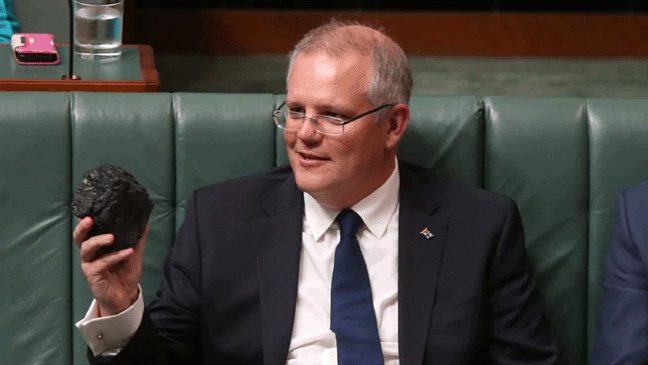 Look these coal lobbyists in the eye. Remember their names. By Royce Kurmelovs, 16 January 2020,
Now people are asking: “why?”
The answer, for many, is that we’ve begun a long and unnerving slide into a world of supercharged weather. The CO2 humanity had been pumping into the atmosphere for decades is now affecting our seasons in precisely all the ways we were warned. For Australia, that means hotter summers with less rainfall, which is exactly what 2019 delivered.
Australia just sweltered through its hottest year on record with temperatures averaging 1.52C above the 1961—1990 average, according to data from the Bureau of Meteorology. This came after an unprecedented period of drought across much of the country’s east, which unsurprisingly led to widespread fires.
But even if the science is clear, the reality seems lost on those who hold the country’s highest political offices. When confronted with the suggestion his government was not acting in a meaningful way on climate change, Prime Minister Scott Morrison has simply said he “did not accept that” and insisted, like his Minister for Emissions Reduction Angus Taylor, that Australia has been “doing its part”.
he truth is that Australia is the fourth largest coal producer in the world, and has relied on tricky accounting practices to book progress toward reducing its carbon emissions while actually doing the bare minimum.
Because of this, Australia was recently rated 57th on a list of countries for its handling of climate change—placing it just slightly above Iran with its oil-dependent national economy.
 And yet just eight years ago, Australia was leading the world on climate change action. In 2012 we’d achieved what many pundits believed was a political impossibility. Australia had levied a tax on carbon that forced an almost immediate drop in the country’s CO2 emissions. That was until a new conservative government took power and repealed the carbon tax a short two years later.
Scott Morrison probably intransigent on climate policy
 If the bushfires won’t force climate policy change, we need to circumvent Scott Morrison. Guardian, Lenore Taylor The cabal of Coalition denialists calling the shots are still impervious to facts. But it’s not yet time to despair @lenoretaylor, Fri 17 Jan 2020 It’s time to face a dreadful truth. If this bushfire crisis, this nation-wide trauma, can’t loosen the denialists’ grip on Coalition climate policy, then maybe nothing will.
That would mean everyone sifting through Scott Morrison’s verbiage for signs that he might really be intending to change direction is searching in vain, because he’s just trying to talk himself out of political trouble.
It would mean everyone patiently pointing out that the prime minister could quite easily “evolve” his current policies into something that actually reduced Australia’s greenhouse emissions could save their breath, because that isn’t the kind of evolution he is considering.
And it would mean there’s no point reprising the facts, that Australia’s emissions are flatlining, not falling, that we could seize an economic advantage in a low-carbon world and at the same time help the globe avoid the all too obvious costs of inaction. The Coalition cabal who apparently still call the shots thinks climate science is “voodoo”. They’re impervious to facts. They are already threatening, via anonymous quotes to the Australian, to “blow the place up”. Again. Just like they’ve been blowing up national climate action for more than a decade.
And as this week’s Guardian Essential poll showed, despite the widespread sense that the fires are a tipping point, despite global outrage at the self-defeating stupidity of our policies, despite the world’s largest fund manager ditching thermal coal, despite the wave of grief and anger from around the world – even from James Murdoch – it’s still not clear that Australian public opinion will force this government to change.
Sure, Morrison’s mishandling of this crisis has cost him. His overall approval ratings have dived but his numbers have held fairly steady in his base. The strategists – who always pay more heed to those numbers than to other benchmarks, like, say, a country in ashes – no doubt believe that, with enough confusing obfuscation about “meeting and beating” targets, enough revising of the figures, enough serious practical efforts to help burnt-out communities, and just enough rhetoric conceding the reality of global heating, all will be well in time, without promising to do anything about it. All will be well for the poll numbers that is. Not for the nation.
This is not, repeat not, an argument for abandoning the arguments in favour of climate action. It is not a counsel to cop out in despair. …………
Maybe, under the current political pressure, something will give. But we’ve been fooled before and there’s no time to be fooled again. So that means it’s time to think of ways around the federal Coalition’s intransigence, because those deniers will never be swayed, and we can’t allow them to dictate our future. https://www.theguardian.com/australia-news/2020/jan/17/if-the-bushfires-wont-force-climate-policy-change-we-need-to-circumvent-scott-morrison
Much of Australia might simply become too hot and dry for human habitation
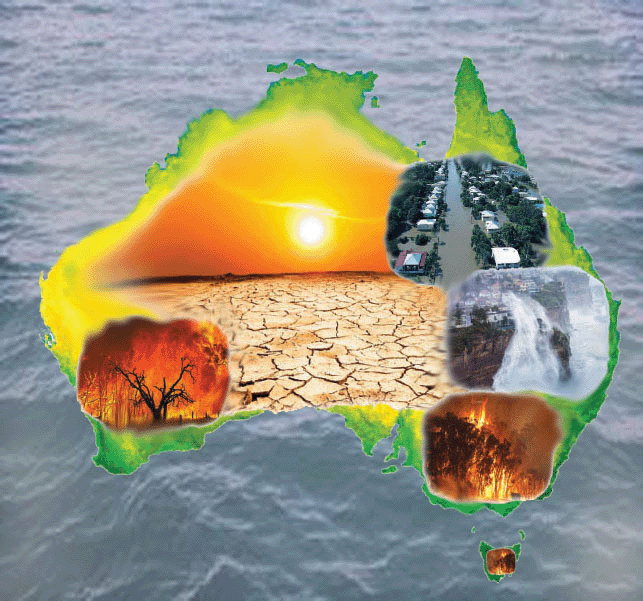 Australians ‘may become climate refugees’ as global temperatures soar: US expert, https://www.sbs.com.au/news/australians-may-become-climate-refugees-as-global-temperatures-soar-us-expert Australians ‘may become climate refugees’ as global temperatures soar: US expert, https://www.sbs.com.au/news/australians-may-become-climate-refugees-as-global-temperatures-soar-us-expertA visiting US climatologist says it’s “conceivable that much of Australia simply becomes too hot and dry for human habitation”. As global temperatures soar, Australia could become so hot and dry that the country’s residents could become climate refugees, US climatologist and geophysicist Michael Mann says. Australia is in the midst of one of its worst fire seasons on record, with bushfires burning since September and claiming nearly 30 lives, killing more than a billion animals and razing forests and farmland the size of Bulgaria. Some fires were so monstrous that they created their own weather pattern causing dry lightning and fire tornadoes as a three-year drought left woods tinder-dry. “It is conceivable that much of Australia simply becomes too hot and dry for human habitation,” Dr Mann, who is director of the Earth System Science Center at Pennsylvania State University, told Reuters. “In that case, yes, unfortunately, we could well see Australians join the ranks of the world’s climate refugees.” Climate refugees, or environmental migrants, are people forced to abandon their homes due to change in climate patterns or extreme weather events. Dr Mann, the recipient of last year’s Tyler Prize for Environmental Achievement, is on a sabbatical in Australia where he is studying climate change. The co-founder of the award-winning science website RealClimate.org said the brown skies over Sydney in recent days were a result of human-caused climate change led by record heat and unprecedented drought. The remarks resonate with his peers who published a review of 57 scientific papers suggesting clear links. Climate change has led to an increase in the frequency and severity of what scientists call “fire weather” – periods with a high fire risk due to some combination of higher temperatures, low humidity, low rainfall and strong winds, the review found. Prime Minister Scott Morrison has repeatedly said his government would “meet and beat” a 26 per cent global emissions reduction target agreed in Paris, albeit with a caveat that such goals should not come at the cost of jobs and the economy. Dr Mann, the author of four books including The Madhouse Effect, said Australia could still “easily achieve” the target by shifting towards renewable energy. “It’s possible to grow the economy, create jobs, and preserve the environment at the same time. These are things that all Australians could embrace,” he said. “They just need a government that’s willing to act on their behalf rather than on behalf of a handful of coal barons.”
|
|
Australia’s fire-driven storms are pumping smoke into the stratosphere
Blazes across the country in the past few weeks have been so intense they have generated their own weather. They create rising air mixed with ash and smoke that results in thunderstorm clouds above the fires called pyrocumulonimbus (pyroCbs).
Some of these are strong enough and rise high enough to have channelled smoke into the stratosphere, a plume of which has crossed the Atlantic Ocean in an eastward direction. NASA says this plume has now made a full circuit around the Earth. There were at least 20 pyroCbs between 28 and 31 December, and more on 4 January, some of which injected smoke into the stratosphere.
The scale of the smoke in the stratosphere has now been calculated by David Peterson at the US Naval Research Laboratory, who is presenting his preliminary findings to the American Meteorological Society at a meeting in Boston later today.
“It’s very likely on a volcanic scale,” he says. “The big thing here is really the impact that this is having on the stratosphere.” Although not of the scale of the 1991 eruption of Mount Pinatubo, the largest in modern history, the effect is similar to a more moderate eruption, Peterson says.
In 2017, Peterson found that Canadian wildfires put as much smoke as a volcano into the stratosphere. He is now working to apply the same technique to the Australian fires and thunderstorms. “At this point I can tell you that this event is one of the largest, it’s very near the top. I can’t say for sure if it’s the biggest,” he says, in terms of the amount of smoke injected into the stratosphere.
While it is well known that a volcanic eruption can put enough aerosols into the atmosphere to have a cooling effect, the different chemistry of pyroCbs means the impacts of the fires on global temperatures aren’t yet entirely clear.
They may have a warming or cooling effect, and it isn’t known how long the smoke will persist at heights of between around 10 and 50 kilometres high, which is roughly where the stratosphere starts and finishes. Peterson says the biggest question is what role proyCbs are playing in the climate system. Some of the smoke plumes are also getting high enough to affect the ozone layer.
We may have answers to some of these unknowns soon though, thanks to NASA flying a plane earlier this year through the upper level of a pyroCb generated by US wildfires. “It wasn’t as massive as these Australia plumes but fortunately at an altitude the aircraft could get to it,” says Peterson. The resulting direct observations of the chemistry will, along with satellite measurements, help unlock the answers.
Alan Robock at Rutgers University in New Jersey says any potential cooling effect from the bushfire smoke is unlikely to be huge at a global level, but could cause cooling of several degrees Celsius at a local level. If the Australian pyroCbs produce twice as much smoke as those from Canada in 2017, “it still would not be a large or long-lasting impact on climate,” he says.
However, the smoke can persist in the stratosphere for half a year or longer, as at such heights it can be heated by the sun and lofted even further up, prolonging its lifetime.
“This is the same process we have modelled in our studies of the climatic consequences of nuclear war in which much more smoke from burning cities and industrial areas would be lofted into the stratosphere and last for years,” says Robock. As such, analysis of the smoke from the bushfires could help improve simulations of the impact of nuclear Armageddon.
Our knowledge of pyroCbs is at an early stage. These thunderstorms and the smoke they put into the stratosphere have only been detectable via satellite instruments since the early 2000s, and previously were thought to be the result of volcanic eruptions, until analysis traced them back to wildfires.
World Economic Forum focusses on climate change, Australia snubs the Forum
|
Australia snubs Davos session on Australian fires https://www.politico.eu/article/australia-snubs-davos-session-australian-fires/
A new report, meanwhile, found that the Top 5 global risks are all climate-related. By RYAN HEATH 1/15/20 That marks “the first time in the survey’s history that one category has occupied all five of the top spots,” according to Børge Brende, the WEF’s president.
The WEF surveyed 1,047 members of its networks — 44 percent were from climate-conscious Europe — and asked them to rate 30 possible risks. The organization is so alarmed at governments and companies failing to heed its climate warnings that it decided to invite climate activist Greta Thunberg back to its stage next week, and has begun sharing her slap-downs of global leaders through its official channels. While the WEF survey was concluded October 22, before the worst of the Australian fire season, those fires have brought the three biggest overall risks identified by the WEF to the world’s attention: extreme weather, climate policy failure and biodiversity loss. The fires have decimated an area twice the size of Belgium and killed millions of animals, putting Australia in the Davos firing line next week. There’s only one problem: Canberra isn’t playing ball. The WEF session on the Australian fires doesn’t include any Australian speakers.
|
|
|

Australian Nuclear Technology and Science Organisation, (ANSTO), jumps on the bushfire propaganda bandwagon
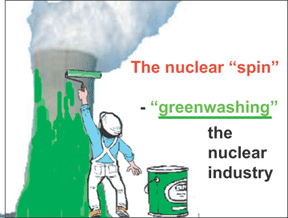
Today, 15 January, there was a ’round table” meeting, (I think in Canberra) of “top scientists” on the urgent need to develop new bushfire adaptation and mitigation techniques.
And guess who’s at the top of the list in these TOP SCIENTISTS ON CLIMATE CHANGE. Why, none other than The Australian Nuclear Technology and Science Organisation, (ANSTO)
Of course, ANSTO is prominent in promoting the lie that nuclear power is the solution to climate change. They’ve put in submissions to parliamentary inquiries, You can bet that they’ve got one in now, to the Victorian Inquiry (submissions close 28 February.) One must admire the timing of the nuclear lobby’s manipulations, and the speed with which they are jumping on the bushfire-fix bandwagon.
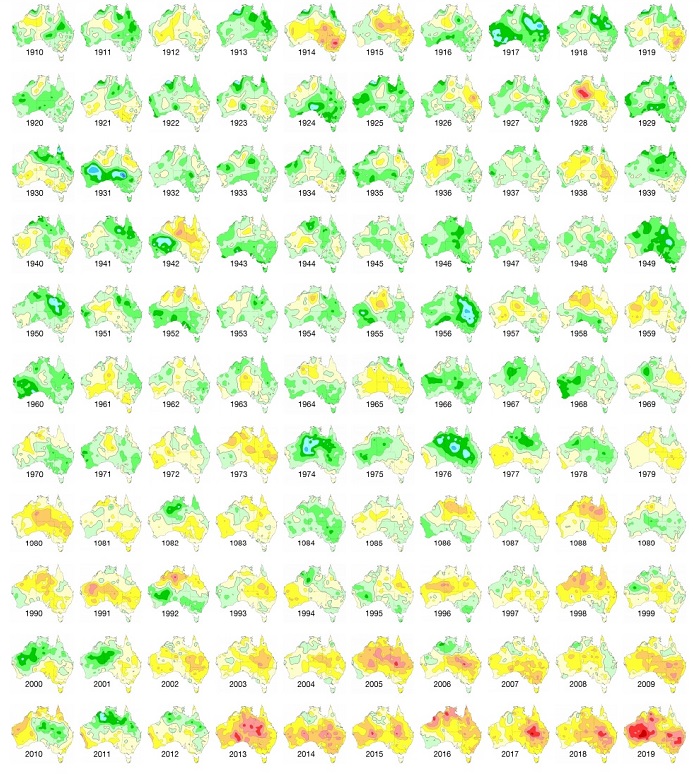
Bureau of Meteorology chart shows how temperatures have soared in Australia over the past century
|
Key points:
A chart produced by the bureau and updated with 2019 figures (shown above) displays a stark transformation over the past century. It shows the anomaly of mean temperature for each calendar year from 1910 to 2019, compared to the average over the standard reference period of 1961–1990. The colours range from dark blue (more than 3 degrees Celsius below average), through blues and greens (below average), yellow and orange (above average), and then brown (more than 3C above average). “Australia’s climate has warmed by more than a degree since 1910, which means very warm years like 2019 are now more likely to occur,” said Karl Braganza, the bureau’s head of climate monitoring.
Dr Braganza said alongside warmer temperatures, we were also seeing a trend in recent decades towards drier winter and spring seasons in some parts of the country. Andrew Watkins, manager of long-range forecasting at the bureau, said the hot 2019 — which had an average mean temperature 1.52C above average — was front of mind for many. “It was the talking point of all last year,” he said. “All the states and territories were in the top handfuls of temperature. Hot everywhere, pretty much. “Almost by definition if they’re records they are unusual.” The bureau has also produced another chart showing rainfall in each year since 1900. [on original]…..https://mobile.abc.net.au/news/2020-01-14/bureau-of-meteorology-chart-shows-how-temperatures-soared/11857404
|
|

1 This month


Help Aunty Sue Protect Her Land and Sacred Sites From Destructive Rocket Testing.
.

Australians deserve the truth
about
AUKUS – https://aukuspublicinquiry.com/

PETITION – To: Prime Minister Anthony Albanese and the Australian Labor Government

of the week – Australians for War Powers Reform (AWPR)
To see nuclear-related stories in greater depth and intensity

