In the interests of the coal lobby, Australia sabotaged the UN climate talks
Australia took a match to UN climate talks while back home the country burned https://www.theguardian.com/commentisfree/2019/dec/16/ australia-took-a-match-to-un-climate-talks-as-back-home-the-country-burned Julie-Anne Richards The gleeful coal lobby stalked the Madrid COP25 meeting halls as the Morrison government threw out compassion and international citizenship. I’ve been at the climate summit in Madrid for the past two weeks. The question I was constantly asked was: “What will it take for Australia to treat the climate crisis seriously?” International friends, colleagues and strangers looked on in horror at the effects of the bushfires and outright amazement at the Morrison government’s denial of the link between the fires and Australia’s coal industry, and seeming lack of concern at this extreme impact of climate change.
The ray of hope is the youth, demanding their future back. The rest of us have a responsibility to join them, to back their calls however we can. Force our government to show compassion. Demand genuine climate action. We can do this. Other governments are – New Zealand is showing us up. It is our government that is failing us, failing our neighbours, failing our youth. We’ve got no choice but to demand they act, and refuse to give up until they do. See you at a youth-led climate rally soon.
• Julie-Anne Richards is executive director of Climate Action Network Australia
Bushfire near power plant (just as well it’s not a NUCLEAR power plant)
| Blaze burns near power plant as another fire destroys homes, SMH 17 Dec 19 |
| A fire that has burnt almost 400,000 hectares in the Hawkesbury is burning in the vicinity of a power station responsible for 10 per cent of NSW’s electricity. The area, north-west of Lithgow, is home to the Mount Piper Power Station, the fourth-largest in the state, and the Springvale coal mine. |
An emergency warning was issued for the Gospers Mountain fire about 4pm on Monday as it headed towards Wallerawang, Lidsdale and Blackmans Flat, in the state’s Central Tablelands.
This area, north-west of Lithgow, is home to the Mount Piper Power Station and the Springvale coal mine.
Mount Piper is the fourth-largest power station in the state and has large stockpiles of coal……
NSW RFS Inspector Ben Shepherd said crews were aware that the fire was burning just six kilometres east of the station, but believed there was “no current threat”. …. https://www.smh.com.au/environment/weather/blaze-approaches-power-plant-as-another-fire-destroys-homes-20191216-p53khc.html
While ignorant tunnel-visioned politicians kowtow to irrigators, the Murray River system faces death
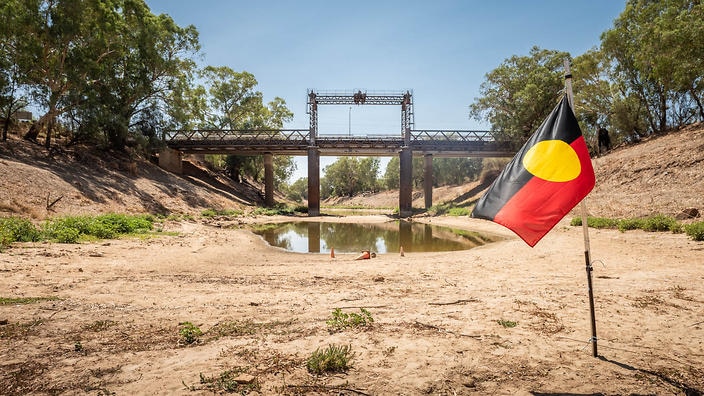
Water wars: will politics destroy the Murray-Darling Basin plan – and the river system itself?
Drought is not the only threat to the river system: the plan to save it is in doubt as states spar over the best way forward, Guardian, Anne Davies
The basin states – Queensland, New South Wales, Victoria and South Australia – as well as the federal government, are due to meet on Tuesday in Brisbane amid threats from the NSW Nationals that it will walk away from the plan unless major changes are made.
“We simply can no longer stand by the Murray-Darling Basin plan in its current form, the plan needs to work for us, not against us,” NSW Nationals’ leader John Barilaro warned last week.
“NSW is being crippled by the worst drought on record and our future is at risk. The plan should be flexible, adaptive and needs to produce good environmental outcomes for this state.”
NSW has already flagged that it will be asking to be relieved of its remaining contributions towards the environmental water target – it has committed to saving a further 450GL – while Victoria is balking at meeting its commitments as well.
There have also been calls from various ministers to end environmental flows during the drought and to instead allocate more water for agriculture. In particular is unhappiness from NSW at the amount of water stored in the lower lakes in South Australia. That will be fiercely resisted by SA. Continue reading
New South Wales’ bushfire conditions are getting worse
|
NSW bushfire conditions about to go from bad to much worse, https://thenewdaily.com.au/news/state/nsw/2019/12/14/nsw-bushfire-conditions-to-worsen/ Firefighters battling more than 100 blazes across NSW have seen their chances of respite vanish, with the latest weather forecasts predicting conditions will worsen again early next week as temperatures rise.Smoke from bush and grass fires burning around Sydney will see the city endure another hazy day on Sunday, the Rural Fire Service says.
More than 110 fires were burning across the state on Saturday night, 60 of which were not contained. Some 1500 firefighters were tackling the blazes, with no let-up on the horizon, Greg Allan from the RFS said. “Tomorrow we’re seeing a lot more widespread very high fire danger,” he told AAP. “We will see conditions deteriorate with worsening weather early into mid-next week. We’re going to be seeing a lot more higher temperatures across the state.” Total fire bans have been issued for the Central Ranges, Northern Slopes and North Western areas amid very high fire danger ratings on Sunday and more bushfire smoke will affect the Sydney Basin, the fire service said. “Smoke from fires burning on the outskirts of Sydney will settle across the Sydney Basin again overnight and tomorrow,” the RFS tweeted. “There is a possibility the smoke will clear slightly but remaining dense throughout the day.” An emergency warning issued on Saturday afternoon for the Gospers Mountain fire in Wollemi National Park northwest of Sydney was later downgraded to advice level. The Ruined Castle fire in the Blue Mountains remained at watch and act level on Saturday night. Maximum temperatures next week are forecast to reach the high 30s or early 40s in areas including Dubbo, Orange, Mudgee, Moree, Bourke, Parkes and on Sydney’s western fringe at Penrith. Authorities have warned people to remain vigilant about their health as air quality remains poor in parts of Sydney. Some 724 homes, 49 facilities and 1582 outbuildings had been destroyed so far this fire season. Six people have died and 2.7 million hectares have been scorched. |
|
In blistering heat, Perth’s bushfire will keep burning for days
Perth bushfire emergency continues as firefighters spend a fourth day trying to protect lives, homes, BY GIAN DE POLONI AND JAMES CARMODY, ABC, 16 Dec 19, A bushfire threatening lives and homes in Perth’s north has remained at emergency level for a fourth consecutive day — and it may stay there for several more, with flames being fanned further up the coast.
Key points:
- The fire has burnt through 12,000 hectares, destroying several structures
- DFES’ commissioner says difficult times are ahead and warns of further damage
- Authorities say they don’t believe arson is to blame for the fire
Hundreds of firefighters battling the blaze were able to slow its spread on Friday night but they spent Saturday dealing with changes in wind direction and another day of blistering heat.
The emergency warning is in place for a 45-kilometre stretch of coast including the towns of Guilderton, Seabird and parts of Two Rocks.
The smaller communities of Woodridge, Caraban, Gabbadah, Neergabby, Wilbinga, Yeal, Redfield Park, Sovereign Hill, the Seatrees and Breakwater estates and parts of Beermullah, Muckenburra, Wanerie, Neergabby and Yanchep remained in the the emergency warning zone on Sunday morning.
Fire danger has been declared for the metropolitan region, the Pilbara, Goldfields Midlands, the Great Southern, the mid-west Gascoyne, as well as the south-west and lower south-west of the state. ……..
Fire will burn for days
Department of Fire and Emergency Services (DFES) superintendent Gary Baxter said the fire could burn for more than a week.
“I don’t suspect that we’re going to extinguish it anytime in the next week or so but certainly we’ll try and get containment lines strengthened,” he said.
“Controlling it is a different thing but containing it over the next few days is an objective you’d hope in the next couple of weeks to fully extinguish the fire.
“That’s to completely extinguish 100 per cent of the fire ground — that’s a complete blackout — so that over the next few weeks and into the next couple of months of over summer we don’t have to revisit the same patch.”……
No relief from blistering heat
The fire has been fuelled by heatwave conditions that saw temperatures in the city top 40 degrees Celsius on Friday and Saturday, with similar conditions expected for Sunday.
The blaze has so far burnt through close to 12,000 hectares of bushland, tearing through the Yanchep National Park………
Yanchep National Park and the Wilbinga Conservation Park remains closed.
There was a total fire ban across the Perth metropolitan area on Saturday.
The Red Cross has established a hotline number for people affected by the fire to get in touch with family and friends; 1800 351 375 https://mobile.abc.net.au/news/2019-12-14/yanchep-and-two-rocks-bushfire-could-burn-for-days/11800060
Australia on the nose at UN climate talks
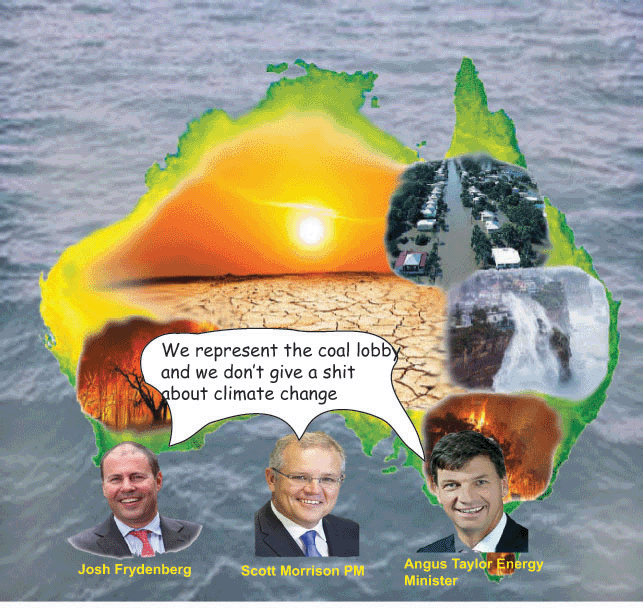 Not winning friends’: Australia cops blame as climate talks extended, SMH, By Peter Hannam. December 14, 2019 Global climate talks have been extended into the weekend as nations wrangle over carbon accounting issues, including whether Australia should be able to slash its Paris emissions reduction goals using a surplus from an earlier era….. Not winning friends’: Australia cops blame as climate talks extended, SMH, By Peter Hannam. December 14, 2019 Global climate talks have been extended into the weekend as nations wrangle over carbon accounting issues, including whether Australia should be able to slash its Paris emissions reduction goals using a surplus from an earlier era…..
International media singled out Australia’s insistence it be allowed to count “over-achievement” during the 2012-20 Kyoto Protocol period to reduce its abatement task during the 2021-30 Paris accord as one brake on progress. Sweden’s TT News Agency blamed the stalled talks on Australia, Saudi Arabia and Brazil. https://www.smh.com.au/environment/climate-change/not-winning-friends-australia-cops-blame-as-climate-talks-extended-20191214-p53jyk.html |
|
Climate change, bushfires, and Australia’s lack of climate policy
|
The link between climate change and our bushfire holocaust, New Daily, Michael Crooks-15 Dec 19, On December 10, an Liberal MP bucked a trend: he put climate change and the eastern Australian bushfire crisis in the same sentence.“These bushfires have been caused by extreme weather events … the exact type of events scientists have been warning us about for decades that would be caused by climate change,” said NSW Environment Minister Matt Kean at the Smart Energy Summit in Sydney, where he pushed for the nation to be more reliant on renewable energy.
“We cannot allow ideology and politics to get in the way of … the health of our planet for generations of Australians.” Climatologists worldwide agree that the perilous journey of climate change is underway, unfolding in Australia as hotter summers, bleached tropical reefs and, according to some, the bushfires still raging in NSW and Queensland……. Is climate change causing the current bushfires?It’s hard to say definitively, according to the scientists TND interviewed. “The answer is probably yes,” said Dr Floris van Ogtrop, an environmental scientist at the University of Sydney. “We will most likely experience longer and more intense droughts as the climate warms. And hotter, dryer conditions lead to increased bushfire risk.”….. Is Australian policy behind the rest of the developed world with regards to reducing greenhouse emissions?Yes, according to a new report co-prepared by think tanks the NewClimate Institute, the Climate Action Network and Germanwatch. “Australia is one of the largest exporters of fossil fuels in the world,” said Prof Hughes. “So it’s not just what we burn, it’s what we ship off elsewhere. “We have some of the best renewable resources anywhere. We have no excuse.”…..https://thenewdaily.com.au/news/national/2019/12/14/bushfires-climate-change-or-not/
|
|
|
Australia’s rainforests used to be too wet to burn. Not now.
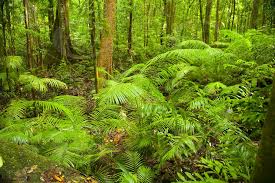
Scientists thought Australia’s rainforests were too wet to burn – then climate change hit, SBS News visits the Paluma Range National Park in Queensland to see firsthand how the trees and species inhabiting the area have been impacted. SBS NEWS, BY RACHEL CARY 15 Dec 19,
The Great Barrier Reef is currently the poster child for the impacts of climate change, but just inland from the coast, Queensland’s rainforests are being hit just as hard.
Forests that were once considered too wet to burn are more increasingly doing exactly that.
Professor Steve Williams from James Cook University has been observing the Paluma Range National Park, near Townsville, for 25 years. In that time, he says the area has changed a lot.
That’s not really that normal,” Professor Williams says.
“We were right on the edge, so that’s kind of within the range of possibility, but it’s basically a sign of what’s been happening and a sign of what’s to come.”
The Australian Conservation Foundation says rainforests were once considered too wet to burn.
Its CEO Kelly O’Shanassy says the Paluma Range National Park rainforest isn’t the only one now affected.
“Just in the last few years, we’ve seen rainforests in northern Australia burning,” she says.
“In the last few weeks we’ve been seeing rainforest in Queensland and New South Wales burning and a few years ago we saw very wet forests in Tasmania burning.”…….
The Wet Tropics Management Authority says climate change is the biggest threat to rainforests.
It released a climate adaption plan earlier this year and is calling for urgent action from governments and communities to limit climate change impacts.
The ACE says if we lose the rainforests it will severely impact the ecosystem.
“Rainforests are like the air conditioners for our planet,” Ms O’Shanassy says.
“Rainforests attract water so they attract rain for our planet.” ……
Professor Williams fears a longer drier dry season will see more fires impacting the Paluma Range National Park.
“Rainforests have been mostly considered to be fireproof, but if you get a long enough dry season that’s dry enough… and especially if you combine that with the impacts of a cyclone… then you’ve got the possibility of really severe fires going through.
“That’s a complete game-changer”. HTTPS://WWW.SBS.COM.AU/NEWS/SCIENTISTS-THOUGHT-AUSTRALIA-S-RAINFORESTS-WERE-TOO-WET-TO-BURN-THEN-CLIMATE-CHANGE-
Is the Minister Against the Environment, Angus Taylor, really bad at arithmetic, or just a liar?
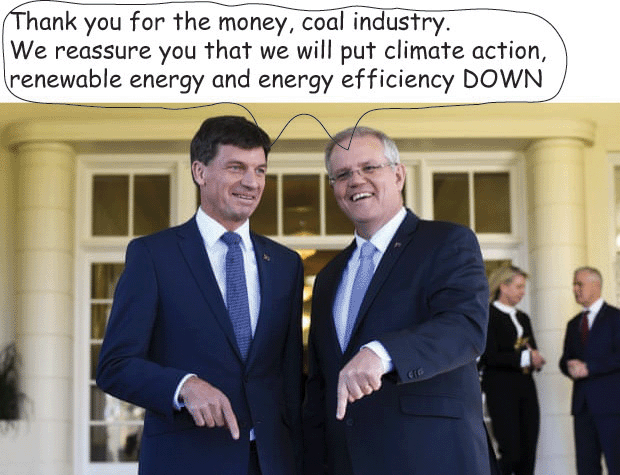 Angus Taylor spotted fiddling more figures, New Daily, 15 Dec 19 Angus Taylor spotted fiddling more figures, New Daily, 15 Dec 19The Minister for the Environment and Energy, Angus Taylor, seems to have a problem with numbers, whether it’s the Sydney City Council’s travel budget or what year Naomi Wolf was at Oxford. His latest figure fiddling though is much bigger and more serious than either of those embarrassments. And it’s possibly more absurd. At the COP25 climate summit in Madrid last week, Mr Taylor was pushing the government line that Australia would meet and exceed its Paris agreement to reduce greenhouse gas emissions by 26 per cent from 2005 levels by 2030 – “in a canter”, according to Prime Minister Scott Morrison. But all the while, Mr Taylor had a graph from his department showing the claim was, shall we politely say, “false”. Without much fanfare, the Department of Environment and Energy earlier this month published its annual emissions projections. At the core of the report is the accompanying graph of Australia’s emissions of millions of tonnes of CO2-equivalent from 1990 projected out to 2030. Blind Freddy can see the government’s forecast reduction from nearly 600Mt in 2005 to 511Mt in 2030 does not represent 26 per cent. It’s actually less than 15 per cent. But with Mr Taylor’s talent for figure fiddling, the sun rises in the west, bears no longer defecate in the woods, and somehow less than 15 per cent is turned into more than 26 per cent. Because he says so. Blind Freddy can see the government’s forecast reduction from nearly 600Mt in 2005 to 511Mt in 2030 does not represent 26 per cent. It’s actually less than 15 per cent. But with Mr Taylor’s talent for figure fiddling, the sun rises in the west, bears no longer defecate in the woods, and somehow less than 15 per cent is turned into more than 26 per cent. Because he says so.\The government attempts this particular distortion of reality by claiming “carry-over credits” from overachieving in the previous Kyoto agreement reached in 1997. (That ‘overachievement’ was totted up primarily in LULUCF – “land use, land use change and forestry” – an area particularly prone to creative accounting as it involves such things as promising not to clear bush at some stage in the future.) How inconvenient that the government’s graph, including buying some for LULUCF, goes back to 1990 and shows our emissions reduction from then, or from the 611Mt peak in 2006, is still less than 15 per cent. [graph on original] The government’s claim is an international joke. What’s worse is that the Madrid meeting was supposed to be about moving the needle on from the Paris agreement. Salient nations were supposed to be able to feel the heat, smell the smoke, see the glaciers melt and therefore work to achieve more than Paris. Instead, Mr Taylor led Australia as one of the recalcitrant countries sabotaging that reasonable aim. And claiming black was white, or at least that coal isn’t a problem, wasn’t the Environment Minister’s only fiddle. He also declared that Australia is backing an unprecedented wave of clean energy investment. Well, yes – and no. Australia is enjoying a surge in clean energy generation investment this year, but then it falls away quite rapidly, as shown in another graph, this time by the construction industry analysts at Macromonitor. [graph on original] Macromonitor reckons the next clean energy investment boom doesn’t kick in until the middle of the decade when the need for storage – pumped hydro, batteries – is more acute. … https://thenewdaily.com.au/news/politics/australian-politics/2019/12/16/angus-taylor-emmissions-numbers/ |
|
Scott Morrison, comfy in his Morrison bubble, trashes Environment Department
 Morrison torches Environment Department, Independent Australia, By Stephen Saunders | 15 December 2019, For a time, Arts and Environment were in the same federal department. Both functions have taken a hit, in Scott Morrison’s Christmas departmental reshuffle.
Australia’s first federal Environment Department debuted 1971. The function has carried forward to this day, under varying departmental banners. Since 1993, “Environment” (or “Sustainability, Environment”) has always been the leading item in a departmental title.
Not any more. “Busting” congestion, blindsiding the public service, Morrison has reversed recent history. The Environment function of the previous Environment and Energy Department goes into the Agriculture Department. It’s never been parked there before. The Industry Department mops up most of Energy and Climate.
Apparent wins there, for fossil fuels and land conversion. And never mind the fire and smoke. Brand-new Environment chief David Fredericks has been recycled as Industry chief…….
With endless growth running the show, the Department has won battles and lost wars. Our first State of the Environment report surfaced in 1986. When you decode the polite language of the scientific committees, successive reports reveal steady decline up to 2016.
It’s simplistic to say, but the Department has prospered more under Labor……
In his [Morrison’s] inflated opinion, ministers can always be relied on to “set the policy direction” correctly. As they surround themselves with increasingly docile public service chiefs.
On top of all this, he cashiers the Environment Department. And puts Energy and Climate under Industry. His religion and ideology seem to be clobbering reason and science.
Labor’s bulldog adherence to Big Coal and Big Australia undermines their credibility to oppose environmental overreach. Still, Morrison’s arrogance might come back to bite him.
Over its first 30 or 40 years, the Federal Environment Department attracted a keen cadre of officials, whose commitment and knowledge could be turned to disparate environmental issues at short political notice. They had notable successes and signal failures. But their relationships with ministers held more nuance than the feudal deference that Morrison now demands.
You can’t throw the switch, to recharge independent and vigorous environment policy advice at a moment’s notice. Rationally speaking, we need those skills, more than ever.
Weather, rain and fire are visibly different, within our own short lifetimes. Environment and growth problems have never been more obvious. The environment has returned to the public consciousness bigtime.
The “bubble” isn’t around Canberra. It’s around Morrison himself. Sure, the weakened Environment and Climate bureaus will have to answer, to him and his ministers. The physical environment may not be so obliging. https://independentaustralia.net/environment/environment-display/morrison-torches-environment-department,13415
250m tonnes of CO2 emitted from Australia’s bushfires
Australia’s bushfires have emitted 250m tonnes of CO2, almost half of country’s annual emissions. Forest regrowth can reabsorb emissions from fires but scientists fear natural carbon ‘sinks’ have been compromised, Guardian,Graham Readfearn @readfearn, Fri 13 Dec 2019
Bushfires in New South Wales and Queensland have emitted a massive pulse of CO2 into the atmosphere since August that is equivalent to almost half of Australia’s annual greenhouse gas emissions, Guardian Australia can reveal.
Analysis by Nasa shows the NSW fires have emitted about 195m tonnes of CO2 since 1 August, with Queensland’s fires adding a further 55m tonnes over the same period.
In 2018, Australia’s entire greenhouse gas footprint was 532m tonnes of carbon dioxide equivalent.
Experts say the pulse of CO2 from this season’s bushfires is significant, because even under normal conditions it could take decades for forest regrowth to reabsorb the emissions.
But scientists have expressed doubt that forests already under drought stress would be able to reabsorb all the emissions back into soils and branches, and said the natural carbon “sinks” of forests could be compromised.
The figures were provided to Guardian Australia by Dr Niels Andela, a scientist at the Nasa Goddard Space Flight Center and a collaborator in the Global Fire Emissions Database……….
Prof David Bowman, a fire ecologist at the University of Tasmania, said that under normal conditions the regrowth would reabsorb the CO2. But he said the ongoing drought, combined with climate change, meant conditions were not normal.
“Drought-stressed trees recover less well – carbohydrates reserves are exhausted – and under climate change tree growth may be slow and fires more frequent, meaning less tree biomass and even loss of forest cover.
“This is a nasty negative feedback cycle of a biosphere carbon sink becoming a source [of carbon].” https://www.theguardian.com/environment/2019/dec/13/australias-bushfires-have-emitted-250m-tonnes-of-co2-almost-half-of-countrys-annual-emissions
Coalition MPs squabble over climate science as Australia burns
 , New Daily, Daniel McCulloch 13 Dec 19, Nationals deputy leader Bridget McKenzie has blasted an “irrational” state colleague for daring to link the NSW bushfires to climate change.
Their ugly public stoush has dragged on for several days.
He inflamed the internal spat after suggesting he would rather listen to climate scientists than the federal frontbencher on the effects of global warming.
But Senator McKenzie said “I actually have a science degree – I am one of the few in parliament that does”.
Scott Morrison and the Coalition are fiddling as Australia burns
|
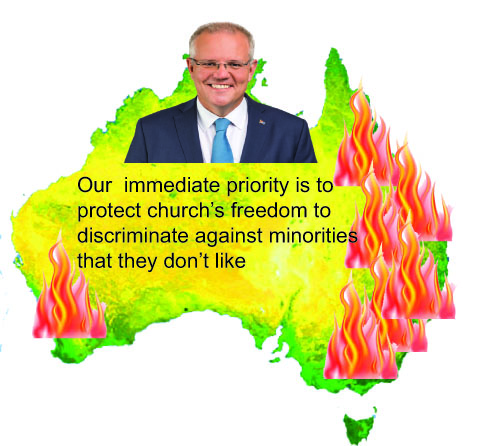
Scott Morrison and the Coalition are fiddling as Australia burns On climate action, the Coalition is the party of wreck, defer and obfuscate, the party with a shameful and indefensible record, Guardian Katharine Murphy Political editor, @murpharoo, Tue 10 Dec 2019 “………… Swathes of the country are burning, and we’ve only just entered summer. While Christian Porter was working through his various concessions on religious discrimination on Tuesday, trying to contain blowback from the churches and from colleagues, dot point by dot point, thick smoke was choking Sydney. In Canberra, the heat is also blistering, and the smoke from Braidwood rolls in and out, triggering memories of that traumatic January in 2003 that many of us lived through, our treasured possessions tucked in boxes, babies on hips, sheltering friends displaced from the western suburbs of the city; a city ready to flee, watching a red sky, raining ash and burning cinders, houses on fire, trees on fire. I flew to Brisbane on Sunday. The ground below me was dust for a thousand kilometres and the sky was a milky fog of smoke and heat haze. Dear prime minister. The country is not parched but desiccated, and it is burning like a tinderbox, and people are frightened. They are frightened about today and the terrible business of defending property and saving lives, and they are frightened about whether this is what spring and summer in Australia now looks like as droughts lengthen and deepen, and the fire season extends and intensifies because of climate change – which is what scientists have been trying to tell us all these years, so many times, in so many different ways, experts maligned and mangled in a culture war, pleading to be understood. Fear has accompanied the dry, and the heat and the flames, and that is a difficult and frankly politically unwelcome development for a prime minister who won an election just a few months ago at least in part by telling people to calm down about climate change, because the Coalition had things under control. It wasn’t true of course. That pitch has no basis in fact because the Coalition has done more than any other political party in Australia to frustrate climate action. If anyone is inclined to think wrecking is behaviour of the past, a vestige of Abbottism rather than behaviour of the present, because Morrison is so much more sensible, just remember this very week, in Madrid, Australian officials are making the case we need to use an accounting loophole to meet our Paris target. Far from meeting our 2030 target in a canter, Australia will not meet the target at all unless we invoke carryover credits to carry about half the abatement load. By taking this stance, we not only defer corrective action in our own country that should be happening now, in orderly fashion over this decade, we also validate the inclination of other countries, with higher emissions than us, to hunt for workarounds too. To cut a long story short, we make it less likely that the world will deliver the ambition we need to avert the worst of warming. So let’s be very clear. On climate action, the Coalition is the party of wreck, defer and obfuscate, the party with a shameful and indefensible record, the party that only last year bundled Malcolm Turnbull out of office in part because of a policy idea that might have settled a decade of partisan warfare that the Coalition believes is helpful to its re-election prospects. Morrison pursued an electoral strategy in May of telling voters in the cities the Coalition had climate under control, there was no need for hysterics, while in the regions, out of sight of the metro campaigns, the government weaponised climate change against Labor. So the Coalition in 2019 is the party of placate where necessary and punch on where politically profitable – which feels like the grimmest story of all. It might be grim, but it will remain the model as long at there’s enough voters in enough regional seats either not buying the science, or more worried about their immediate material circumstances than the science, to swing an election in the Coalition’s favour. As long as the status quo delivers a pathway to victory, the climate war in Australia will go on being an artefact of partisan politics rather than a practical problem to be solved. It’s hard, that truth, so hard I flinch. But truth is hard, and it’s past time truth won this argument rather than being obscured in the emoting, and the bobble head ranting, and the posturing, and the dissembling, and the clever strategising. Now by carrying on resolutely while the country burns, and being seen to carry on while things are being managed, Morrison is not avoiding the issue so much as trying to set the tone. The prime minister doesn’t want to validate the rising fear in the community by looking perturbed about the disaster currently in progress, because that obviously makes a lie of the Coalition’s “everything is fine” messaging. He wants to be getting on with ordinary business in full public view, not flapping about with special summits with the premiers just because Turnbull said he should do it on Q&A. …… The obfuscation, the false comfort, the changing of the subject, the head-patting, will keep happening as long as we let it. It will keep happening as long as soft and hard denialism is enabled in mainstream media outlets, as long as journalists prioritise other lines of inquiry over rigorously pursuing accountability on this issue, and as long as Australian voters abdicate responsibility by telling themselves all political parties are as bad as each other so it doesn’t matter who you vote for. The only way things will change is if we choose, as a country, to do something else. To take responsibility. To demand something better. Because, ultimately, this, the future, is on us. https://www.theguardian.com/australia-news/2019/dec/10/australia-is-burning-like-a-tinderbox-and-the-coalition-wont-acknowledge-voters-rising-fears |
|
Australia at the bottom of the list in global assessment of climate action
|
‘Cause for great concern’: Australia ranked last in global assessment on climate action, Australia’s record on climate change has been panned in the latest Climate Change Performance Index tracking nation’s efforts to combat global warming, SBS NEWS, BY TOM STAYNER, 1 Dec 19, Australia’s climate change record has been ranked among the bottom five nations in the world in a global assessment of countries’ emissions trajectories.
The Climate Change Performance Index (CCPI) measures the emissions, renewable energy share and climate policies of 57 countries and the European Union. It has been released at COP25, the UN climate summit being held in Madrid, as nations attempt to thrash out the way forward on the global Paris framework responding to the crisis. According to the report, Australia, Saudi Arabia, and the United States give “cause for great concern” over their performance on emissions, renewable energy development and climate policy. Australia’s climate policy rating was ranked the lowest in the world with analysts noting that “the newly elected government continued to worsen performance at both national and international levels.” Its policies were given a 0.0 rating, in comparison the United Stated ranked one position higher held a 2.8 rating and the top-performing nation Portugal received a 98.7. National experts observe a lack of progress in these areas with the [Australia] government failing to clarify how it will meet the country’s insufficient 2030 emissions reduction target and inaction in developing a long-term mitigation strategy,” the report reads. “While the government is not proposing any further targets for renewable energy beyond 2020, it continues to promote the expansion of fossil fuels and in April 2019 approved the opening of the highly controversial Adani coalmine.” Across the assessment, Australia ranked 44th on emissions, 50th on renewable energy, 52nd on energy use and 61st on climate policy. National experts observe a lack of progress in these areas with the [Australia] government failing to clarify how it will meet the country’s insufficient 2030 emissions reduction target and inaction in developing a long-term mitigation strategy,” the report reads. “While the government is not proposing any further targets for renewable energy beyond 2020, it continues to promote the expansion of fossil fuels and in April 2019 approved the opening of the highly controversial Adani coalmine.” Across the assessment, Australia ranked 44th on emissions, 50th on renewable energy, 52nd on energy use and 61st on climate policy……. HTTPS://WWW.SBS.COM.AU/NEWS/CAUSE-FOR-GREAT-CONCERN-AUSTRALIA-RANKED-LAST-IN-GLOBAL-ASSESSMENT-ON-CLIMATE-ACTION |
|
A foreign corporation gets 89 BILLION litres of Australia’s water, as drought worsens
|
Water restrictions for you, an endless supply for them: How a foreign corporate giant is snapping up 89 BILLION litres of Australia’s H20 as the country suffers its worst drought ever
By ALISHA ROUSE FOR DAILY MAIL AUSTRALIA DAILY MAIL UK 12 December 2019 |A multi-billion dollar Singaporean food company is selling 89,000 megalitres of Australian water to a Canadian pension fund. The mega sale of Australian permanent water rights comes as the country is crippled by one of the worst droughts in its history. On Tuesday, NSW brought in a complete ban on hoses as part of the toughest water restrictions implemented for more than a decade. But no such problem existed for food and agriculture giant Olam International, which sold the 89billion litres of permanent water rights for an astonishing $490 million. The company sold it to an entity associated with the Public Sector Pension Investment Board, one of Canada’s largest pension investment managers, according to Straits Times. It will use the water to irrigate almond trees, in a business venture likely to draw criticism over foreign ownership of farms and water. The water rights are in the lower Murray-Darling Basin. The chairman of the Victorian Farmers Federation’s water council, Richard Anderson, told the Sydney Morning Herald: ‘Really, all you’ve got is a change of ownership, it (the water) has gone from a Singapore-owned company to a Canadian pension fund……. Water restrictions in Sydney, the Blue Mountains and Illawarra were upgraded to level two as dam levels in the region sank to just 45 per cent capacity, the lowest levels since the Millennium Drought took hold in 2003….. The Bureau of Meteorology has predicted a hot-than-usual summer, with no forecast for significant rain. The sale is understood to be giving Olam a ‘one-time pre-tax capital gain of about $311 million’, the paper reported. The agreement is for 25 years, with the option to renew for another 25. In March, the government released its foreign ownership of water entitlement register, showing that investors from China and the US had the largest stake in Australia’s foreign-owned water entitlements. It showed that one in 10 water entitlements is foreign owned. A water entitlement is the right to an ongoing share of water, which can be sold by irrigators, companies or investors. Acting as a property right, it gives access to an exclusive share of water from a water resource. This is different to a water allocation, which is the right to access a volume of water for use or trade. https://www.dailymail.co.uk/news/article-7780983/Foreign-company-sells-89-billion-litres-Australian-water-rights-490m-drought.html?fbclid=IwAR3wKbYP6OnXTEPhNoZiDeQ2Oj1o6uMzWUmkQSOgMxYjkZn6i0cJFj60Zo4&fbclid=IwAR3oHKAi9vQG4MctY4LMYNppX-pbY88hw0Zj4ACzypNTB_WI9nTtkc710bc |
|
1 This month

of the week – Australians for War Powers Reform (AWPR)
To see nuclear-related stories in greater depth and intensity
 Antinuclear