More than 160 bush and grass fires are burning across New South Wales
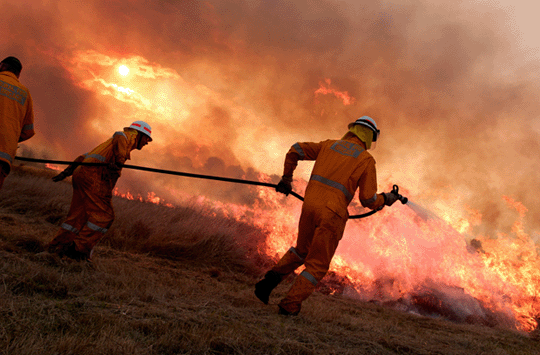
NSW firefighters battle 100 new blazes, Herald Sun, Heather McNab, 27 Nov 19, More than 160 bush and grass fires are burning across NSW after about 100 fresh blazes ignited in a 24-hour period.
The NSW Rural Fire Service on Wednesday evening said 163 fires were burning in NSW with 75 uncontained. There were more than 2200 personnel in the field working to slow the progress of the blazes.
The Bureau of Meteorology said thunderstorms which hit Sydney on Tuesday afternoon and the state’s northeast in the evening had produced large hailstones and damaging winds – while lightning also sparked fresh fires.
“Over the past 24 hours, around 100 new fires kicked off,” the RFS posted on Twitter at 5.30pm on Wednesday.
“Crews will work over coming days to control this large number of fires ahead of forecast elevated fire danger on Saturday,” the agency posted later that evening…….. https://www.heraldsun.com.au/news/breaking-news/almost-130-fires-burning-across-nsw/news-story/67d86650512ce39d8af0cb2e34109b21
Australia’s ‘permanently wet’ rainforests now burning for the first time
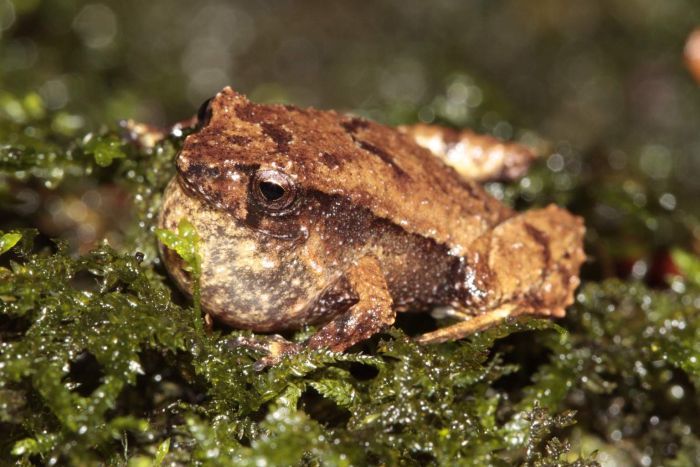
Bushfires devastate rare and enchanting wildlife as ‘permanently wet’ forests burn for first time ABC, RN BY ANN ARNOLD 27 NOV 19 The rainforests along the spine of the Great Dividing Range, between the Hunter River and southern Queensland, are remnants of Gondwana, the ancient supercontinent that broke up about 180 million years ago.
“Listening to the dawn chorus in these forests is literally an acoustic window back in time,” ecologist Mark Graham tells RN’s Saturday Extra.
“It’s like listening to what the world sounded like in the time of the dinosaurs.”
The forests are mountaintop islands that have been “permanently wet” for tens of millions of years.
But now, these forests are being burnt for the first time.
“We are seeing fire going into these areas where fire is simply not meant to go,” says Mr Graham, a fire specialist with the Nature Conservation Council.
Most of the focus of Australia’s catastrophic fires has been on people and property — with the exception of koalas, which have come to symbolise the non-human costs.
Beyond the koalas are many rare and fascinating creatures whose lives and homes have been destroyed, or remain threatened.
“The fauna in these landscapes requires permanently wet conditions, and many of the fauna species in these landscapes simply have no tolerance to fire,” Mr Graham says.
The most ancient birds on the planet
The songbirds that live in these ancient wet forests have always lived there…….
One reason the north coast of New South Wales is a global biodiversity hotspot is it has the most species of eucalypts in the world, and the best areas of Antarctic Beech forest.
“These forests are recognised globally for their outstanding universal values because they are essentially the oldest forests remaining on the planet,” Mr Graham says.
The tree hollows host many fauna species, for shelter and breeding. The hollows take centuries to develop to full size. They can’t be replaced.
“You have to wait 200 to 400 years until they develop again,” Mr Graham says.
One of two nature conservation areas he privately owns, and manages for their natural values, has been almost obliterated by fire.
He wants to present only the facts, and avoid fuelling a media and political circus around the fires……https://mobile.abc.net.au/news/2019-11-27/bushfires-devastate-ancient-forests-and-rare-wildlife/11733956
Religiosity of Scott Morrison – about global heating and bushfires
 Scott Morrison’s religion and the bushfire crisis https://independentaustralia.net/politics/politics-display/scott-morrisons-religion-and-the-bushfire-crisis,13344, By Jennifer Wilson | 25 November 2019, As firefighters in four Australian states struggled to contain unprecedented bushfires that threatened life, property and wildlife, Prime Minister Scott Morrison argued that there is no direct link with Australia’s greenhouse gas emissions.
Morrison claimed there is no “credible scientific evidence” that cutting our emissions could reduce the intensity of bushfires.
The Prime Minister even went so far as to suggest that we could
“… increase our emissions without making the current fire season worse.”
This last claim is a bizarre one to make, obviously calculated to appeal to a base that apparently doesn’t know very much about these matters. Yes, we likely could increase our emissions without impact on the current Australian bushfires. However, emissions must be accounted for on a global scale and, while central, are one part of the complex story of the impact of climate change.
Morrison was swiftly contradicted by Climate Council head of research Dr Martin Rice. Dr Rice stated that there is indeed a direct link between climate change and heightened bushfire risk. CSIRO research scientist Dr Pep Candell agreed with Dr Rice. Morrison did not cite any scientific research to back up his claim that the two are not linked, leaving the impression that it is little more than his opinion. If politicians do have evidence to back up their claims, they are not usually coy about revealing it.
It is well established by major science agencies that while climate change does not create fires it can and does make them worse. The above link is an excellent explainer of a complex situation.
It’s high time that any statement by Morrison on emissions and their effects on climate is required to include a disclaimer noting that the Prime Minister is a follower of the evangelical Pentecostal religion. This sect is not known for its interest in science, and some followers believe the Earth is only 6,000 years old.
As James Boyce wrote in his Monthly essay, ‘The Devil and Scott Morrison’:
Belief in Satan and the imminent return of Christ also helps explain the Prime Minister’s less-than-passionate response to the most pressing environmental issue of our time. It is not surprising that Pentecostal activism about climate change is non-existent — the end of the known world is not a matter for mere mortals to decide. When Morrison proudly showed off a piece of coal in parliament, there is no reason to doubt that he believed what he held in his hand was a gift from God.
Morrison also shares the Pentecostal belief in “divine providence” — that is, everything under the sun – past, present, and future – is the will of God, including natural disasters, such as we are currently experiencing in four states.
his goes some way to explaining why
… taking further action on reducing carbon emissions to counter the environmental damage wrought by climate change may have little intellectual purchase with the PM. If the end of the world through climate change is part of God’s providential plan, there is precious little that we need to or can do about it.
Given these beliefs are core contributors to the Prime Minister’s environmental agenda it seems reasonable to demand they be disclosed whenever he comments on climate, emissions, bushfires or other natural disasters. A man who is convinced that everything is God’s will is unlikely to take any action he perceives might thwart that will.
He is also unlikely to be overly troubled, and there is no doubt that since the first bushfire broke out, Morrison has appeared largely untroubled, even going so far as to post this jolly tweet as people in four states endured all manner of horror and fear:
It’s tempting to conclude that Morrison is too stupid to understand the magnitude of what we are facing this summer, however, I’d argue that his belief in the tenets of Pentecostalism has granted him immunity against mere human concerns, particularly when they don’t directly affect him and his family.
But that’s not all. In Morrison, we see the confluence of religious belief and venal profitability that results from his passionate belief in the fossil fuel industry. This is one example of how neoliberalism and evangelical Christianity most conveniently complement one another. Coal is “God’s will”.
In the Prime Minister we encounter a most unholy alliance of the fossils fuel industry and religion.
Morrison is in deep with the coal industry — many of his closest advisors come from that industry.
We have not seen any leadership from the Prime Minister during this current outbreak of bushfires. Leadership might include immediate consultation with a wide range of experts in an effort to prepare as best we can for the coming conflagrations, of which there are likely to be many across the country. It might be a commitment to the purchase of more aircraft capable of dumping fire retardant. It might be a commitment to a system of payment for volunteer firefighters, who currently give up their jobs, holidays and family time to do their absolute best for the rest of us.I cannot think of one reason why women and men who do a far more significant, dangerous and essential job than Scott Morrison should be expected to continue to do it for free. Given the horrific projections for the coming summer, volunteer firefighters are going to be busy. While he’s at it, Morrison could organise some one-off payments to the states to fund the purchase of equipment for the volunteers, so they don’t have to send what time they have left between fighting fires, doing their day jobs and being with their families, organising cake stalls and raffles to raise money for some new hoses.
One odd thing about Morrison’s attitude is that most politicians do not turn down the opportunity to appear heroic, especially in catastrophes such as this one. He has not availed himself of any such opportunities. One can only conclude that the combination of his religion and his commitment to the coal and extraction industries take precedence over his desire to shine. Sadly, he must rely on carrying water for football teams.
None of this augurs well for our future. If, like me, you are affected by the bushfires in any way, you may have the sense that you have been utterly abandoned by Coalition politicians, on a state and Federal level. No word of what these governments plan to do over the coming summer — no word because they haven’t planned anything. It beggars belief. It breaks the heart. And it fills any sensible person with foreboding. Fasten your seatbelts. It’s going to be a bumpy ride.
Cuddling coal and people: does Scott Morrison think that Australians are that stupid about climate change?
 Scott Morrison and the big lie about climate change: does he think we’re that stupid? Guardian, Richard Flanagan, 25 Nov 19, Australians everywhere are ready to get on with the job of dealing with the climate crisis. We just need a prime minister to lead us
Of all the horrors that might befall the burnt out, the flooded, the cyclone ravaged and the drought stricken Australian this summer, perhaps none could be viewed with more dread than turning from their devastated home to see advancing on them a bubble of media in which enwombed is our prime minister, Scott Morrison, arriving, as ever, too late with a cuddle….
In Australia we are all now being treated as children, quietened Australians, most especially on the climate crisis. While the climate crisis has become Australians’ number one concern, both major parties play determinedly deaf and dumb on the issue while action and protest about the climate crisis is increasingly subject to prosecution and heavy sentencing.
In Tasmania, the Liberal government intends to legislate sentences of up to 21 years – more than many get for murder – for environmental protest, legislation typical of the new climate of authoritarianism that has flourished under Morrison. As Australia burns, what we are witnessing nationally is no more or less than the criminalisation of democracy in defence of the coal and gas industries.
n this regard, the climate crisis is a war between the voice of coal and the voice of the people. And that war is in Australia being won hands down by the fossil fuel industry.
Which brings us back to that industry’s number one salesman, the prime minister, standing there in the ash in the manner of Humphrey B. Bear on MDMA, as, mollied up, he pulls another victim in the early stages of PTSD into his shirt, his odour, his aura – such as it is – and holds them there perhaps just a little too long. Sometimes, at his most perplexing, he lets that overly large head loll on the victim’s shoulder and leaves it there. Prayers and thoughts naturally follow.
Perhaps it is just his way. Certainly, the prime minister is an unusual issue of two stock types frequently derided in broader Australian culture: the marketing man and the happy-clappy. But in fairness to both tribes, he seems to draw on the worst in both traditions and make of them something at once insincere, sinister and vaguely threatening…..
All this theatre hides a deeply cynical calculation: that Australians will keep on buying the big lie, a lie given historic expression last Thursday morning when on national radio the prime minister declared that Australia’s unprecedented bushfires were unconnected to climate change…….
Two days before saw the release of a major UN report that forecast Australia to be the sixth largest producer of fossil fuels by 2030. Between 2005 and 2030 Australia’s extraction-based emissions from fossil fuel production will have increased by 95%. By 2040, according to the report, on current projections the world’s annual carbon emissions will be 41 gigatonnes, four times more than the maximum amount of 10 gigatonnes required to keep global heating below 1.5 C.
According to the Economist: “The report lays much blame on governments’ generosity to fossil-fuel industries.” The report details at length how Australia supports its fossil fuel industries.
Actively working through legislation, subsidy, and criminalisation of opposition to enable Australia to become one of the world’s seven major producers of fossil fuels makes Australia’s actions directly and heavily responsible for the growing climate catastrophe we are now witnessing in Australia. It gives the lie to the nonsense that we will make our Paris commitments “in a canter”.
It cannot be explained away. It cannot be excused. Australia is actively working hard to become a major driver of the global climate crisis. That is what we have become.
The same day Morrison went to the Gabba, got photographed with cricketers and tweeted: “Going to be a great summer of cricket, and for our firefighters and fire-impacted communities, I’m sure our boys will give them something to cheer for.”
To the question does he think we are that stupid, the answer was implicit in an interview the same day when the prime minister justified not meeting with 23 former fire chiefs and emergency services leaders calling for a climate emergency declaration in April, claiming the government had the advice it needed.
He went on to say that: “We’re getting on with the job, preparing for what has already been a very devastating fire season.”
Only he’s not.
Getting on with the job would be calling a moratorium on new thermal coalmines and gas fracking. Getting on with the job would be announcing a subsidised transition to electric vehicles by 2030. Getting on with the job would be working to close down all coal-fired powered stations as a matter of urgency. Getting on with the job would be calling a summit of the renewable energy industry and asking how the government can help make the transition one that happens now and one that creates jobs in the old fossil fuel energy communities.
And getting on with the job would be going to the world with these initiatives and arguing powerfully, strongly, courageously for other countries to follow as we once led the way on the secret ballot, women’s suffrage, Antarctic protection, the charter of human rights.
We are not a superpower, but nor are we a micronation. We have an economy the size of Russia’s. Our stand on issues whether good or bad is noted and quoted and used as an example. And one only has to look at the global standing of New Zealand to see the power of setting a moral and practical example, and the good that flows from it for a nation and its people. Australians everywhere are ready to get on with the job of dealing with climate change. We just need a prime minister to lead us. In the meantime though we are left with a mollied-up Humphrey B. Bear……
The man who brandished a lump of coal and told us not to be scared, the man who last October told farmers to pray for rain, the man who says there is no link between the climate emergency and bushfires, the man whose party has for 30 years consistently and effectively sought to prevent any action on carbon emissions nationally and internationally will finally have to answer for the growing gap between his party’s ideological rhetoric and the reality of a dried out, heating, burning Australia. And as the climate heats up ever quicker, and as the immense costs to us all become daily more apparent, that day draws ever closer. …..https://www.theguardian.com/australia-news/2019/nov/25/scott-morrison-and-the-big-lie-about-climate-change-does-he-think-were-that-stupid
Scott Morrison’s devious and incorrect claim about emissions and bushfires
 Scott Morrison contradicted on link between emissions and bushfires, https://www.brisbanetimes.com.au/politics/federal/scott-morrison-incorrect-on-link-between-emissions-and-bushfires-20191121-p53crh.html, By Mike Foley Scott Morrison contradicted on link between emissions and bushfires, https://www.brisbanetimes.com.au/politics/federal/scott-morrison-incorrect-on-link-between-emissions-and-bushfires-20191121-p53crh.html, By Mike Foley
November 21, 2019 Experts have contradicted Scott Morrison’s claim that Australia’s level of greenhouse gas emissions could not have increased the current level of risk from bushfires.
The Prime Minister said on Thursday climate change is a “global phenomenon” and Australia is doing its bit to reduce emissions. He has acknowledged that climate change increases bushfire risk, but said there could be no link drawn between our emissions and any current bushfires. “To suggest that with just 1.3 per cent of global emissions that Australia doing something differently, more or less, would have changed the fire outcome this season, I don’t think that stands up to any credible scientific evidence at all,” Mr Morrison said. “If anything Australia is an over-achiever on global commitments.” Mr Morrison made the comments on a day when several homes were lost to fires in South Australia while Melbourne recorded its hottest November day since 1894 when the mercury hit 40.9 degrees at Olympic Park in the mid-afternoon. Climate Council head of research Dr Martin Rice said there was a direct link between climate change and heightened bushfire risk. Global carbon project executive director and CSIRO research scientist Pep Canadell said Mr Morrison was “incorrect” to argue there was no link between Australia’s emissions and climate change. “It’s the tragedy of the commons. Below the biggest emitters in China and the US you have dozens and dozens of countries contributing between 1.5 and 0.8 million tonnes, which adds up to the climate problem,” Dr Canadell said. Because all the individual contributions are small no one feels responsible. “Another way to put it is on my next tax bill, because my contribution to the country’s revenue is so small, that it doesn’t matter if I don’t pay.” A recent analysis by RMIT ABC Fact Check estimated Australia’s domestic emissions of about 1.3 million tonnes, coupled with the emissions embedded in its exports, represented about 3.6 per cent of global emissions in 2016. CSIRO’s most recent State of the Climate report found “there has been a long-term increase in extreme fire weather and in the length of the fire season across large parts of Australia since the 1950s”. Eight of Australia’s 10 warmest years on record have occurred since 2005 and since the late 1990s there has been about an 11 per cent decline in cool-season rainfall between April and October in the south-east of the country. |
|
Launch of Australia’s National Environmental Defenders Office
 National Environmental Defenders Office launches https://www.lawyersweekly.com.au/sme-law/26968-national-environmental-defenders-office-launches, By Jerome D, oraisamy|21 November 2019 The new EDO will have offices in Adelaide, Brisbane, Cairns, Canberra, Darwin, Hobart, Perth and Sydney, with all state and territory EDOs finalising their merger process over the coming months.
Launched yesterday, the national Environmental Defenders Office will “take high-impact enforcement cases to the courts to make sure the public interest is upheld, and our communities are properly protected by our environmental laws”, it said in a statement.
In explaining why the former environmental legal centres were now coming together under one roof, EDO CEO David Morris said that the environmental problems facing Australia are not bound by our state and territory borders.
“The Murray-Darling crisis spans four jurisdictions. Our iconic koalas are dying right up and down the east coast. Climate change doesn’t stop at any border,” he said.
“Now more than ever, national leadership is required to protect Australia’s natural and cultural heritage. That’s where the new national EDO steps in.”
Moreover, the merger will see us the new EDO become the “largest public interest environmental law centre in the Australia-Pacific region”, Mr Morris told Lawyers Weekly.
“With that additional scale comes opportunities to play a bigger role empowering communities and protecting places. We see big opportunities to increase our presence in the Pacific and to better serve local communities in remote parts of Australia, including northern Australia,” he said.
“Increasingly communities across northern Australia are seeking legal assistance in respect of gas developments and we intend to ensure that our expert lawyers are available to assist them.” Merging also allows the EDO, Mr Morris added, to address the “problems of scale” identified by the Productivity Commission in its Access to Justice Arrangements report.
“That is, we’re able to centralise much of the offices’ administrative, financial and communications work freeing up our legal staff to provide better services to the community. The opportunity is that as a much bigger organisation we can play a bigger role at a national level on national issues, but at the same we’re committed to maintaining and strengthening connections to grass roots communities,” he said.
Another challenge and opportunity I expect will be big issues for us in the next twelve months will be coming to grips with what it means to be a distributed national team across a large area and multiple time-zones and multiple jurisdictions. We’ve got some tools and we’ve got some resourcing to improve our legal technology, rolling that out and implementing it will be crucial to the merger’s success.”
Australia is one of the “most naturally beautiful and biologically diverse places on Earth”, EDO’s statement continued, “but our environment is in decline”.
“There are more than 1,700 threatened species in Australia, we have lost more animals to extinction than any other country in the world. And while the Australian community expects robust accountability and oversight when it comes to environmental protection, trust in government processes and institutions has eroded to an all-time low.
Mr Morris said: “Regulations are regularly not enacted or enforced. Governments have cut resources to departments that are supposed to monitor breaches of environment law.”
“Companies routinely and intentionally breach state and federal environment laws. The problem is systemic and widespread because there is no clear legal deterrent.
“As a merged, national organisation we can share expertise, more closely scrutinise projects and address the widespread culture of non-compliance with environment laws.”
Australia must stop burning coal by 2030- report from Climate Analytics
|
Climate science institute suggests Australia must stop burning coal by 2030, https://www.sbs.com.au/news/climate-science-institute-suggests-australia-must-stop-burning-coal-by-2030 Australia must stop burning coal by 2030 if it is to help contain warming to a 1.5-degree rise, a new climate report suggests. Australia needs to stop burning coal by 2030 if it wants to help limit global warming to 1.5 degrees, a new report warns.Non-profit climate science and policy institute Climate Analytics says the government needs a national plan to phase out remaining coal-fired plants – and must take them offline faster than already planned.
Such considerations would help provide the energy sector with certainty, the report released on Thursday says. The organisation’s chief executive Andrew Hare pointed to the current bushfires in New South Wales and Queensland as a sign the country needed to curb emissions rapidly. The realisation that climate change poses an existential threat to Australia is certainly hitting home right now,” Mr Hare said. “Australia must play its part in fighting climate change, and it could start by switching from coal to renewables in its own electricity system.” The report, using data from the recent report by the Intergovernmental Panel on Climate Change, says phasing coal out completely by 2030 would allow Australia to do its bit. It warns just half a degree more warning above 1.5C would see the death of nearly all of Australia’s coral reefs.t says at the slow rate coal fired plants were being shut down across the country, Australia would still emit twice more than what it was allowed to under the Paris Agreement. The report said 10 plants had closed since 2012 with the 19 remaining plants feeding Australia 60 per cent of its electricity. This made it the only OECD country in the G20 that relied on coal fire more than half of its energy supply. In a decade half of these plants, which the report says were already technically obsolete, would be 40 to 60 years old. The report says Australia had natural advantage when it came to renewable energy resources and should jump on this to move to a carbon free energy system. It warns Australia faced longer bushfire seasons, less rain and more drought due to climate change. |
|
Survey showed environment and climate to be Australian children’s top concerns
|
Environmental issues and climate change are Australian children’s top concerns, https://www.sbs.com.au/news/environmental-issues-and-climate-change-are-australian-children-s-top-concerns The environment has topped the list of concerns of Australians aged between 10 and 16 as children fight for a bigger say.
BY ROSEMARY BOLGER 21 Nov 19,The environment is the greatest concern for Australian children aged between 10 and 16, a national survey has found.
The results of the Unicef survey, released on Wednesday to mark World Children’s Day, showed 28 per cent of respondents named treatment of the environment as the most pressing issue for the world. The issue, which encompassed water and other forms of pollution, climate change and extinction rates, was also the number one concern when asked to consider what needed to be improved in their own lives, their local area and Australia. Unicef Australia’s young ambassador Josh Brittain said views on the environment tended to become bleaker as children got older. “You could track how their optimism falters as they get older,” he said. The 20-year-old said children and young people were asked to name the first thing that popped into their head when they thought of the environment. “As we were talking to younger kids they’d say things like animals, plants, turtles and as we talked to older kids, maybe around year 6 or 7, they’d say things like littering or sustainability,” he said. “And as we got to the later years like 11 or 12 exclusively like death destruction, hopelessness.” The 602 children and young people in Australia surveyed for the report strongly rejected the notion their views were manipulated or a regurgitation of their parents or teachers’ ideas. Eighty-five per cent said that they solidly held their own views, with 37 per cent saying adults encourage them to think for themselves. But Mr Brittain said many felt their views on issues like climate change were not taken seriously, particularly by political leaders, reflected in the massive climate strikes in Australia led by young people in September. “We needed to be included in the decision making because nobody is more invested than we are. This idea that young people are not capable of coming up with solutions or we do come up are just products of their parents … is an absolute fantasy,” he said. Unicef Australia director Nicole Breeze said the survey results reinforced the need for a national youth peak body to be funded to provide a channel for children and young people to directly influence policies that matter to them. “They are feeling frustrated by the political process and many of them are seeing that their last resort or only option is to step more into this strike mode,” Ms Breeze said. Unicef has conducted similar surveys in other countries. “What we do see is the level of disengagement and worry about the political level of engagement is very high in Australia in contrast to countries like Canada and elsewhere,” she said. Despite their concerns, the majority of children and young people said they enjoyed growing up in Australia. |
|
Climate change will make fire storms more likely in southeastern Australia
Climate change will make fire storms more likely in southeastern Australia https://theconversation.com/climate-change-will-make-fire-storms-more-likely-in-southeastern-australia-127225, Giovanni Di Virgilio, Research associate, UNSW, Andrew Dowdy, Senior Research Scientist, Australian Bureau of Meteorology, Jason Evans, Associate Professor, UNSW, Jason Sharples, Associate Professor, School of Physical, Environmental and Mathematical Sciences, UNSW Australia, UNSW, Rick McRae, Researcher, Bushfire Cooperative Research Centre, ACT Emergency Services Agency
November 20, 2019 Temperatures across many regions of Australia are set to exceed 40℃ this week, including heatwaves forecast throughout parts of eastern Australia, raising the spectre of more devastating bushfires.
We have already heard warnings this fire season of the possibility of firestorms, created when extreme fires in the right conditions form their own weather systems.
Firestorms are the common term for pyrocumulonimbus bushfires – fires so intense they create their own thunderstorms, extreme winds, black hail, and lightning.
While they are very rare, our research published earlier this year, found climate change is making it likely they will become more common in parts of southeast Australia.
We also identified certain regions in southern and eastern Australia, including near Melbourne’s fringe, that in the second half of this century will be far more vulnerable to these events than others. Continue reading
Record heat, catastrophic fire danger for South Australia – what a great place to plan transport and dumping of nuclear waste -NOT
|
Total fire bans declared across SA ahead of catastrophic conditions on Wednesday, ABC , 19 Nov 19 By Eugene Boisvert A total fire ban has been declared for South Australia on Tuesday ahead of catastrophic conditions expected on Wednesday.
Key points:
It is one of the first times the Country Fire Service (CFS) has declared a pre-emptive fire ban 24 hours before a hot and windy day, the agency’s head said. “It’s pretty unusual that we take a precautionary fire ban and I hope that people will realise we’ve done so in response to the severity of the conditions which are forecasted for Wednesday,” CFS chief officer Mark Jones said. Catastrophic fire conditions are expected on Wednesday for the lower Eyre Peninsula, the Yorke Peninsula, the Mid North and the Mount Lofty Ranges, when a total fire ban will also be in place All other regions have severe or extreme ratings, including the Adelaide metropolitan area. The Bureau of Meteorology has forecast a top of 42 degrees Celsius for Adelaide on Wednesday, after a high of 29C on Tuesday….. Fire season already started in SA The fire danger season has officially started in all of South Australia’s fire ban districts, apart from the lower South-East, where the season starts on Friday…… https://www.abc.net.au/news/2019-11-18/total-fire-bans-across-sa-on-tuesday-ahead-of-catastrophic-day/11713696 |
|
How does the climate denialist Institute of Public Affairs (IPA) get away with being a “charity”?
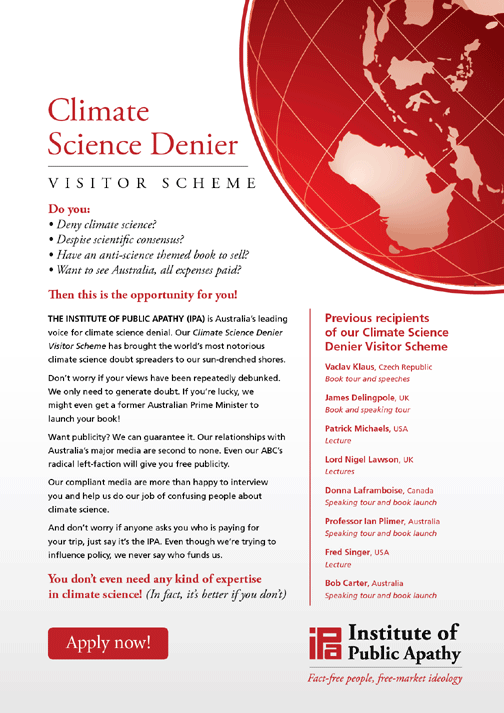
The climate denialist IPA and its ‘public interest’ charity status, Independent Australia, By David Paull | 19 November 2019, Since the IPA and CIS organisations argue against the scientific consensus on the climate change emergency isn’t that against the public interest? Why, then, are they classified as ‘charities’? David Paull reports.
The Prime Minister’s recent comments on the rights of individuals to undertake actions, such as boycotts, that may adversely affect “secondary” company interests raises questions of free speech and public interest.
But the increasingly shrill advocacy for climate denial in the public sphere in this country has reached a stage where it seems that substantive scientific arguments regarding future Earth scenarios are being drowned out.
The debate has descended – thanks in no small part to Murdoch media and political pundits – so that now it’s a “conspiracy” by the Bureau of Meteorology and NASA, or it’s “sun-spots”, which will initiate a new “ice-age”. Even the line, “We must take a balanced view” provides anti-science advocates with a platform.
Which raises the clear question: Is climate change denial of benefit to our community? Or, to put it another way, if some are still arguing against the scientific consensus on the climate change emergency we are confronting, isn’t that against the public interest?
What does it take to be a charity?
As it turns out, not if you are a “charity” registered with the Australian Charities and Not-for-profit Commission (ACNC). When talking about climate denialist organisations, key among those in Australia is the Institute of Public Affairs (IPA) and the Centre for Independent Studies (CIS). Both have generated substantial public communication, which is “climate sceptical” in nature and at deviance from the consensus scientific view. Yet both organisations – particularly the IPA – and through their front groups such as the Australian Environment Foundation, have been at the forefront of promoting the idea that global warming is a conspiracy. Examples are the recent book published by the IPA and edited by Dr Jennifer Marohasy who is working on releasing a new edition next year.
The CIS, while not being a loud advocate of climate scepticism, has certainly hosted talkfests which have articulated these views. Both organisations are also within the international Atlas Network, which channels money into groups around the world that seek to further the climate denialist and libertarian agendas. And both have registered charities with the Australian Charities and Not-For-Profits Commission (ACNC).
The IPA’s registered charity is called Trustee For Institute Of Public Affairs Research Trust, while the CIS has registered a charity under the name of, The Centre For Independent Studies Ltd……
Follow the money
The IPA receives only about ten to 20 per cent of its annual income through its charity, most of which is spent each year, amounting to some $800,000 in 2017-18. These are nearly all classed as “donations” under the ACNC disclosure requirements — though of course “donors” are not required to be identified…….
Both charities claim they are benefiting the “general community of Australia”. However, given the difficulty in matching a climate denialist agenda with a supposed community benefit, this simply does not stack up anymore.
The reviews by the ACNC in January 2014 of the charitable status of these two registered charities, in this light, needs to be reviewed again. This is particularly so of the IPA with its increasing focus on spreading misinformation (none of which stands up to proper scientific scrutiny) since 2014.
But there are also other issues which need clarification in order that better transparency occurs, such as better definitions of income and expenditure, the question of influence by foreign entities and perhaps what is key: whether charity funds being used by these organisations is for a purpose that may be deemed as being of detriment to the community. Charitable status should be relinquished under these circumstances.
I have written to the Australian Charities and Not-for-profit Commission (ACNC) to undertake a fresh review of these charities and await a response in anticipation. You can make a complaint to the ACNC HERE. David Paull is an Australian ecologist . You can follow David on Twitter @davesgas. https://independentaustralia.net/politics/politics-display/the-climate-denialist-ipa-and-its-public-interest-charity-status,13325
50 bushfires continue to rage across New South Wales
 Sydney smoke: city covered in thick haze as more than 50 bushfires burn across NSW People with asthma or respiratory illness should stay inside, health authorities warn, Guardian Australian Associated Press, Tue 19 Nov 2019 Sydney woke up to a thick blanket of smoke over the city on Tuesday as New South Wales headed into the first of two “tough days” this week, with temperatures likely to rise to the 40s and little-to-no rainfall forecast.Most of the state’s east coast was under severe or very high fire danger ratings, with more than 50 bushfires burning, of which 28 remained uncontained. Sydney smoke: city covered in thick haze as more than 50 bushfires burn across NSW People with asthma or respiratory illness should stay inside, health authorities warn, Guardian Australian Associated Press, Tue 19 Nov 2019 Sydney woke up to a thick blanket of smoke over the city on Tuesday as New South Wales headed into the first of two “tough days” this week, with temperatures likely to rise to the 40s and little-to-no rainfall forecast.Most of the state’s east coast was under severe or very high fire danger ratings, with more than 50 bushfires burning, of which 28 remained uncontained.
All were at “advice” level on Tuesday morning, with more than 1,300 firefighters on the ground. Six lives and 530 homes have been lost since NSW bushfire season hit, with more than 420 homes destroyed in the past fortnight alone. “More than 1,300 firefighters continue work on these fires tonight, ahead of forecast hot, dry and windy conditions tomorrow,” the Rural Fire Service said. Winds dragged smoke from a huge fire at Gospers Mountain north-west of the Sydney over the city on Tuesday morning, and the haze was not likely to dissipate until a southerly change in the afternoon…… Parts of the state under severe fire danger on Tuesday included Greater Sydney, Greater Hunter, Illawarra/Shoalhaven, Southern Ranges and Central Ranges fire regions. These regions, along with the Northern Slopes and North Western regions, were also under a total fire ban. Much of the rest of eastern NSW and the Australian Capital Territory were under very high fire danger. Some 1.6m hectares of land have been burnt so far – more than the entire 1993-94 bushfire season……https://www.theguardian.com/australia-news/2019/nov/19/sydney-smoke-city-covered-in-thick-haze-as-more-than-50-bushfires-burn-across-nsw |
|
A twisted and so-called religious view of bushfires and climate change
|
Israel Folau links bushfire crisis to same-sex marriage and abortion, SMH, By Megan Gorrey, November 17, 2019 Sacked rugby union star Israel Folau has linked the NSW bushfire crisis and drought to legalising same-sex marriage and abortion, warning the disasters are a “little taste of God’s judgment”.Speaking at his church in north-west Sydney, Folau said his remarks were a “message mainly for the people that are outside [the church], within the world”. The video footage was posted online on Sunday….
“Look how rapid, these bushfires, these droughts, all these things have come, in a short period of time. You think it’s a coincidence or not? God is speaking to you guys, Australia, you need to repent. “What you see right now in the world is only a little taste of God’s judgment that’s coming, it’s not even a big thing.” Folau said the natural disasters were “no coincidence” and the solution was for people to “turn from their wicked ways”…… https://www.smh.com.au/national/israel-folau-links-bushfire-crisis-to-same-sex-marriage-and-abortion-20191117-p53bf4.html?list_name=40_smh_newsalert&promote_channel=edmail&utm_campaign=smh-am-newsletter&utm_content=TOP_STORIES&utm_medium=email&utm_source=newsletter& |
|
A cauldron of extreme heat developing in Western Australia is heading straight for the east coast bushfire zone
A cauldron of extreme heat developing in WA is heading straight for the east coast bushfire zone, ABC News, By Irena Ceranic 15 Nov 19, A build-up of intense heat that will see temperatures in WA soar into the mid 40s this weekend will be dragged across the country next week, right into parts of New South Wales and Queensland devastated by bushfires this week.
Key points:
- Four lives and hundreds of homes have been lost in NSW and Queensland fires
- Milder temperatures should provide some relief for NSW in the coming days
- But intense heat from WA is likely to be dragged across the country next week
The NSW and Queensland bushfires have already burnt through more than a million hectares of land, killing four people and destroying more than 300 homes.
Bureau of Meteorology spokesman Neil Bennett said milder temperatures were expected to provide some relief to parts of NSW where fires continue to burn over the next few days, but the bushfire threat was far from over with the heat expected to ramp up again.
The areas in dark red on the map below [on original] show parts of WA will bake in temperatures above 45 degrees Celsius over the weekend, before the hot air mass bears down on the east coast by Tuesday. ……. https://www.abc.net.au/news/2019-11-15/wa-hot-air-mass-will-head-to-the-east-coast-bushfire-zone/11705750
Meterologist shocked at prospect of Australia’s coming summer of heat and drought

|
‘A horrible map to look at’: No rain as Australia enters grim summer, https://thenewdaily.com.au/news/national/2019/11/14/a-horrible-map-to-look-at-no-rain-as-australia-enters-grim-summer/
Robyn Wuth Australia is staring down the barrel of a horrific summer season that will drag scorching temperatures and extreme conditions well into the new year.Livio Remano has never seen such extreme conditions in the 20 years he has worked with the Bureau of Meteorology, comparing the long term seasonal outlook to a bad chest X-ray. “It’s horrible, it’s a horrible map to look at,” he said on Thursday. “I have never seen this before in my life … the entire country of Australia is covered in deep red.” That red colour means 70 to 80 per cent of the country is experiencing above-average temperatures, and is being blamed on something called an extremely positive Indian Ocean Diode. Westerly winds weaken along the equator and push warm water to shift towards Africa during a typical IOD. The wind changes allow cool water to rise from the depths of the ocean in the east, causing a temperature difference across the tropical Indian Ocean, with unusually cooler water in the east and warmer in the west. It means atmospheric moisture levels drop in Australia’s northwest, which alters the path of weather systems coming from Australia’s west. The result is less rainfall and higher than normal temperatures over parts of Australia. Queensland is moving into its wet season but there is little chance of significant rainfall until January. But eventually, Mr Remano says the rain will come. Whatever rain does fall will be isolated and could cause more harm than good with the threat of dry lightning strikes sparking new fires. “What we need is English rain, but it is not forthcoming – certainly not anytime soon,” he added. |
|
1 This month

of the week – Australians for War Powers Reform (AWPR)
To see nuclear-related stories in greater depth and intensity
 Antinuclear