Climate Change Authority head Matt Kean contradicts Peter Dutton’s claim on nuclear and renewables working together

ABC News, By 7.30 chief political correspondent Laura Tingle
The head of the Climate Change Authority has contradicted the claim of Opposition Leader Peter Dutton that renewables and nuclear power can be ‘companions not competitors’, a claim that suggests a commitment to nuclear power will not derail the current transition to renewable energy.
Matt Kean is a former NSW Liberal energy minister and Treasurer, appointed by the Albanese government to chair the Climate Change Authority (CCA) earlier this year.
The Authority is due to make a recommendation to the government next month on what Australia’s 2035 emissions reduction target would be.
Mr Kean committed to making that target public.
On Monday, Mr Dutton spelt out some of his arguments in favour of nuclear energy, though he continues to decline to outline its cost.
The Opposition leader conceded on Monday that the upfront costs would be substantial but would ultimately prove cheaper than the cost of a transition to renewables, which he said was up to $1.5 trillion, partly because of the need to rewire the electricity system.
However, Climate Change and Energy Minister Chris Bowen has repeatedly quoted “the best guide to the cost” of the transition scheme being overseen by Labor was the Australian Energy Market Operator’s “integrated systems plan”, which he said “looked at the total cost out to 2050 of the entire generation, storage and transmission and came up at $121 billion”.
Asked on 7.30 whether nuclear had a role to play in Australia’s best energy mix, Mr Kean said that in the CCA’s recent review of pathways to net zero, “the CSIRO clearly set out the pathway to transition our electricity system and meet our commitments, international and domestic commitments, was renewables that are firmed up with technologies like batteries and storage.”
“That’s the pathway that’s been set out by the CSIRO that’s backed up by the Australian Energy Market Operator,” Mr Kean said…………………………………………………………………………………………………………….. more https://www.abc.net.au/news/2024-09-23/matt-kean-expert-advice-differs-peter-dutton-nuclear-plan/104386552?utm_source=abc_news_app&utm_medium=content_shared&utm_campaign=abc_news_app&utm_content=other&fbclid=IwY2xjawFgNZBleHRuA2FlbQIxMQABHd_YcXBdgR0x85pH_9LerLMxZMbM4Pcqj1mtf4s4-_JFiJSf218SwO5KUg_aem_Zu8m5MVQhLz_j1FEJkC4PQ
Climate review backs solar, wind, hydrogen, not nuclear
Marion Rae, Sep 05, 2024, https://www.thenewdaily.com.au/news/national/2024/09/05/climate-review-backs-solar-not-nuclear
An independent review of Australia’s climate response has found no need, or time, for nuclear to be added to the energy mix to reduce emissions.
The Climate Change Authority on Thursday released its review of the ways big-emitting industries must change for the country to reach net zero emissions by 2050.
“We need to seize this once in a generation opportunity to ensure Australia’s rapid and orderly transition as the world transforms to avert the worst impacts of climate change,” chair of the authority Matt Kean said.
But developers of renewable energy projects need to engage with regional communities about the energy transition, and better explain the benefits that can be shared, he said.
As well as solar and wind for electricity generation and batteries for energy storage, the rapid development of emerging technologies such as hydrogen will play a part, the review finds.
The authority steers clear of nuclear power, citing federal and state bans, other available technologies, the long lead time and the premium it would cost for a first-of-a-kind reactor deployed in Australia.
Energy Minister Chris Bowen said the independent advice confirms nuclear could not replace aging coal capacity fast enough to support Australia’s 2050 target.
“Any delay risks not just our energy reliability and security but our ability to act on emissions reduction and secure the future for the next generation,” he said.
But Kean warned the nation must overhaul supply chains, production systems, public and private finance, and workforces.
The advice comes as the federal government faces a deadline on declaring an emissions reduction target for 2035, with Australia within striking range of its legislated target of 43 per cent of emissions cut by 2030.
The Australian Conservation Council welcomed the analysis showing the country can meet and beat its 2030 ambitions and accelerate towards a 75 per cent by 2035 target.
The modelled scenarios make it clear the extraction of fossil fuels will need to be reduced and ultimately phased out, spokesman Paul Sinclair said.
“A high ambition 2035 target is critical to set a clear goal for the government’s Future Made in Australia strategy,” Sinclair said.
The Pathways Review was commissioned by parliament to provide independent and technical advice on decarbonising the economy.
Sectors covered include energy and electricity, transport, industry and waste, agriculture and land, resources, and the built environment.
The Greens said Australia could hit net-zero by 2035 but Labor was “crab-walking away from strong climate targets” while approving coal and gas projects that will run through to 2080.
“Labor are climate frauds. Small targets won’t stop the climate crisis,” leader Adam Bandt said.
How much water does nuclear really need?
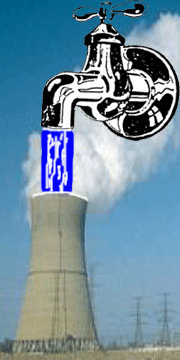
The Coalition’s plan for atomic energy has raised concerns about the amount of water that reactors will use in a hotter and drier Australia.
AFR, Christopher Niesch, 5 Sept 24 .
Opposition Leader Peter Dutton’s proposal to build seven nuclear reactors in five states has put nuclear energy in the spotlight. While Dutton claims nuclear power is a zero emissions solution to the energy transition, Anthony Albanese’s Labor government says it will take too long to build, be too costly, and will use too much water.
Under the Coalition plan, there would be five large-scale power plants and two small modular reactors, with the first to be operational by either 2035 or 2037.
Based on the scant detail so far available, the CSIRO has estimated a total build cost of about $60 billion in today’s dollars for these facilities. Other estimates, based on actual build costs abroad, are much higher.
But Labor has raised concerns about the amount of water that the reactors would consume, especially in a hotter and drier climate more prone to drought in the 2030s and 2040s…………………………………………………………………………………………………………………..
In an interview with Sky News in July, then agriculture minister Murray Watt said nuclear power uses “substantially more” water than coal does.
“There’s a real question about where that water is going to come from, whether some of that water is going to need to be taken off farmers, and what farmers are going to have to pay for their water if there’s a competing use for that water,” he said.
Watt also said that based on international practice, farmers would need to take expensive steps during a nuclear leak and would need to inform their customers that they operate within the fallout zone.
Queensland Premier Steven Miles has also said nuclear power could risk the state’s water security, with water consumption at the proposed stations depleting water reserves during droughts.
As coal stations were decommissioned they would have given up their water rights, but nuclear power stations would have to use that water for their 80-year lifetime, Miles says.
…………………………………………………………………………Where will water for the reactors come from?
The water would be from the same sources that existing coal-fired plants use.
Dutton says that if elected to government the Coalition would build nuclear reactors at locations where there are closed or scheduled-to-close coal-fired power stations.
“Each of these locations offer important technical attributes needed for a zero-emissions nuclear plant, including cooling water capacity and transmission infrastructure,” he says. “That is, we can use the existing poles and wires, along with a local community which has a skilled workforce.”
None are now owned by the commonwealth, which Dutton suggests could be overcome by compulsorily acquiring the sites.
Five full-scale reactors would be built in NSW, Victoria and Queensland, with small modular reactors in Western Australia and South Australia.
How much water does green power use?
Johanna Bowyer, an analyst at the Institute for Energy Economics and Financial Analysis, notes that solar and wind energy don’t rely on water and so the water currently used by coal-fired power stations could be used for agriculture instead.
And wind and solar energy could keep running at full capacity during times of drought, unlike coal or nuclear power.
Bowyer notes that there have been instances where coal-fired power stations have had to reduce their output during drought.
In 2007, the Tarong Power Station in Queensland cut its generation by 25 per cent in January and followed up with another 45 per cent cut in March to save water during the drought.
That water was also being used for drinking, so they prioritised that usage over the power station usage,” she says.
“Who knows what the future holds, but there’s some historical basis there for potential challenges, particularly during droughts. But it all depends on … the water cooling design for the nuclear power plant and it depends on how exactly they satisfy their water cooling requirements.
“That’s all really yet to be detailed in the Coalition’s plan.”
Where does all this leave the Coalition’s plan?
Dutton hasn’t released much more detail about his plans, so we can’t know exactly how much water they will use.
Nor is it clear how much water the small modular reactors (SMR) the Coalition is planning will use. more https://www.afr.com/companies/energy/how-much-water-does-nuclear-really-need-20240826-p5k5b6
Surging seas are coming for us all, warns UN chief

Katy Watson, 26 Aug 24
The United Nations Secretary-General António Guterres has said that big
polluters have a clear responsibility to cut emissions – or risk a
worldwide catastrophe.
“The Pacific is today the most vulnerable area of
the world,” he told the BBC at the Pacific Island Forum Leaders Meeting
in Tonga. “There is an enormous injustice in relation to the Pacific and
it’s the reason I am here.” “The small islands don’t contribute to
climate change but everything that happens because of climate change is
multiplied here.”
But eventually the “surging seas are coming for us
all,” he warned in a speech at the forum, as the UN releases two separate
reports on rising sea levels and how they threaten Pacific island nations.
The World Meteorological Organization’s State of the Climate in the South
West Pacific, external report says this region faces a triple whammy of an
accelerating rise in the sea level, a warming of the ocean and
acidification – a rise in the sea’s acidity because it’s absorbing
more and more carbon dioxide.
“The reason is clear: greenhouse gases –
overwhelmingly generated by burning fossil fuels – are cooking our
planet,” Mr Guterres said in a speech at the forum. “The sea is taking
the heat – literally.”
BBC 27th Aug 2024
Chair of Nuclear for Australia denies that calling CO2 ‘plant food’ means he is a climate denier

Dr Adi Paterson’s statements are apparently at odds with the group’s official position, which says nuclear is needed to tackle the climate crisis
Graham Readfearn, 17 Aug 24, https://www.theguardian.com/environment/article/2024/aug/17/dr-adi-paterson-nuclear-for-australia-climate-change
The chair of a leading Australian nuclear advocacy group has called concerns that carbon dioxide emissions are driving a climate crisis an “irrational fear of a trace gas which is plant food” and has rejected links between worsening extreme weather and global heating.
Several statements from Dr Adi Paterson, reviewed by the Guardian, appear at odds with statements from the group he chairs, Nuclear for Australia, which is hosting a petition saying nuclear is needed to tackle an “energy and climate crisis”.
Nuclear for Australia was founded by 18-year-old Queensland nuclear advocate Will Shackel, who has said repeatedly he believes reactors are needed to fight “the climate crisis”.
Two climate science experts told the Guardian that Paterson’s statements were misguided and typical of climate science denial.
Paterson defended his statements, telling the Guardian he was “not a climate denier”. He described himself as “a climate realist” and an “expert on climate science”.
In May, Paterson, who resigned in 2020 as the chief executive of the government’s Australian Nuclear Science and Technology Organisation, suggested on LinkedIn that concerns about climate change were “an irrational fear of a trace gas which is plant food”. He has been a regular guest on right-wing media outlets since the Coalition earlier this year said it wanted to lift the ban on nuclear and build reactors in seven locations.
On his Facebook page, Paterson has said that “cold is more dangerous than warm” and described a leading scientist as a “climate creep”.
On LinkedIn, he said US space agency Nasa was “deliberately confusing public understanding by publishing ground surface temperatures”, saying the agency’s climate work “should be given to a credible independent group. Defund NASA!”
In April, Paterson told an audience at the Centre for Independent Studies that “you can’t make a correlation between extreme events and climate” and said “no matter what you believe about carbon dioxide – it is plant food”.
“Increasing carbon a little bit is not going to dramatically change the climate. The plants will grow better,” he said, saying the planet was in a period of low CO2.
Prof David Karoly, a councillor at the Climate Council and a respected atmospheric scientist who has been studying the affects of CO2 on the climate since the late 1980s, said Paterson’s statements were typical of those from climate science deniers.
He said while CO2 levels were currently low in comparison to other times in Earth’s history, they were higher than at any time since the emergence of homo sapiens.
“He is misguided,” Karoly said. “CO2 has led to increases in temperature extremes, extreme rainfall, sea level rise and increases in bushfires and fire weather. CO2 has already dramatically changed the climate.”
Dr John Cook, an expert on climate change misinformation at the University of Melbourne, said Paterson was “regurgitating arguments” across a range of “thoroughly debunked talking points”.
He said: “It’s inconsistent to argue that CO2 is a trace gas which can’t possibly make any difference but at the same time claim that CO2 is going to green the planet.”
Shackel did not respond to questions. In an interview with the Guardian, Paterson argued the UN’s climate change panel “has made it very clear” that it was “not possible at this point” to link extreme events to changes in the climate.
But the panel’s latest report said it was “an established fact that human-induced greenhouse gas emissions have led to an increased frequency and/or intensity of some weather and climate extremes”, with evidence for rising temperature extremes, extreme rainfall, droughts, tropical cyclones and more dangerous fire weather.
Paterson said he did think rising levels of CO2 were a problem and that fossil fuels needed to be limited “as soon as we can”. “It is a very, very serious problem but it is not a climate crisis,” he said.
He said he had been concerned about climate change for many years but said unduly worrying children over the issue was “a form of child abuse”, and “the chance of significant catastrophic events” occurring in the next 30 years “related to an increase of CO2 in the atmosphere in the southern hemisphere” was “small”.
Paterson added he was more concerned about the “ecocide” from building wind and solar farms” than about climate change.
When glaciers calve: Huge underwater tsunamis found at edge of Antarctica, likely affecting ice melt.
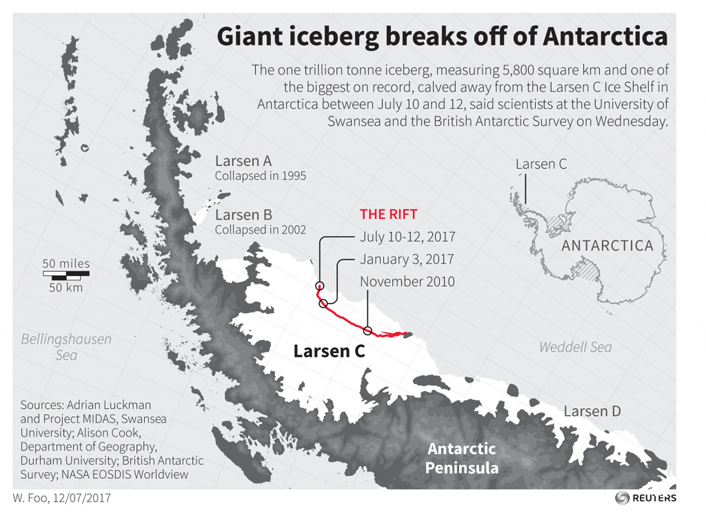
Bulletin, By Michael Meredith | July 15, 2024
Antarctica is huge, it affects pretty much every place and every living thing on our planet, and it is changing. This should be a concern for all of us, and yet we know troublingly little about some key aspects of the great white continent.
Despite its position in the far distant south, Antarctica is a vital component in the functioning of the planet. It is central to global ocean circulation, thus exerting a profound influence on the world’s climate (Figure 1 on original). The vast Southern Ocean that surrounds Antarctica absorbs huge quantities of heat and carbon dioxide from the atmosphere and distributes them around the rest of the world, thereby slowing the rate of global warming elsewhere. This “climate favor” has comes at a cost, however—the Southern Ocean is overheating and acidifying, with marked impacts on the marine ecosystem. The extra heat in the ocean is also melting the fringes of the Antarctic Ice Sheet, destabilizing its glaciers, and increasingly pushing up sea levels worldwide. The sea ice around Antarctica—formed in the fall and winter of the Southern Hemisphere, when the ocean surface freezes—has now reached record low extents, affecting the Earth’s energy budget and acting to further accelerate climate change.
All the information we have from Antarctica comes from sparse networks of sensors and equipment deployed directly, augmented with satellite measurements of the ice and ocean surface and computer simulations. While we know more about Antarctica and the Southern Ocean than ever before, it is still one of the least-well measured places on our planet, with some areas still remaining “data deserts.” We need to know more, so that we can better understand the causes of the changes happening here, how they will continue to change in future, and hence what the global impacts are likely to be.
One feature of the Southern Ocean that is often overlooked is how (and how strongly) it is mixed. This is a key process that redistributes heat, carbon, nutrients, plankton, and all other things in the sea, with profound consequences.
………………………………………glacier calving event had caused a sudden massive burst in the mixing of the ocean, stretching many kilometers from the ice front.
How did it do this? The data revealed that the glacier calving had triggered an underwater tsunami event. In essence, large waves (the height of a two-story house) were generated and moved rapidly away from the glacier, riding the interface between layers in the ocean that were tens of meters down. When these internal tsunami waves finally broke—like surface waves on a beach—they caused massive churn and mixing…………………………………………………………………………
This process—of glacier calving generating internal tsunamis and bursts of ocean mixing—is entirely absent from the computer models that are used to simulate our climate and ecosystem, hampering our ability to reliably project future changes. We need to know more about how this process works, how it will change, and what its consequences will be. ……. https://thebulletin.org/premium/2024-07/when-glaciers-calve-huge-underwater-tsunamis-found-at-edge-of-antarctica-likely-affecting-ice-melt/?utm_source=Newsletter&utm_medium=Email&utm_campaign=ThursdayNewsletter08152024&utm_content=ClimateChange_HugeUnderwaterTsunamis_07152024&utm_source=Newsletter&utm_medium=Email&utm_campaign=ThursdayNewsletter08152024&utm_content=ClimateChange_HugeUnderwaterTsunamis_07152024
Now is not the time for nuclear energy
Ian Thistlethwayte, Wyong, August 5, 2024, https://coastcommunitynews.com.au/central-coast/news/2024/08/now-is-not-the-time-for-nuclear-energy/
I agree with Gaye Clark (CCN 449) that “technology has advanced significantly” in the field of nuclear energy and have no doubt that it could, and maybe should, be in the energy mix in the future.
I contend, however, that now is not the time for this.
Many of us are unwittingly lending weight to the imbroglio which is “post truth politics”.
Hopefully, the advice of experts with backgrounds in science, engineering and thermo-nuclear energy production is of far greater value than what we are told by some politicians, the mainstream media and social media.
This advice includes observations that if Australia was to plan for nuclear power in 2025, we’d be unlikely to see any production from its source before 2040.
Further, what is being proposed so far will meet no better than seven per cent of the nation’s energy needs in 2040.
It has been widely agreed that an average 1.5-degree-Celsius rise in global temperatures since the beginning of the Industrial Revolution is the upper limit of what can be quite realistically managed.
The current trajectory of warming could lead to runaway climate change.
It’s likely the 1.5-degree rise has either been reached, or will be very soon.
While greenhouse emissions continue almost unabated, we now have renewables.
They work, are working, and are already helping.
Investment diverted from renewables towards nuclear power now and into the near future will result in greater rates of environmental destruction.
We still don’t know whether nuclear power will be affordable.
In Germany, nuclear has effectively been abandoned and renewables now produce more electricity than all forms of fossil fuel combined – 57 per cent at the beginning of 2024, up from 45 per cent in 2019.
The UK is not far behind this trajectory.
We’re at 35 per cent renewables, aiming for 82 per cent by the end of 2030.
In 2030, there won’t be a single nuclear power reactor on Australia’s horizon even if we start planning for one today.
The USA is at 22 per cent renewables, while each year, to pay for secure storage of radioactive waste, its citizens are taxed a total of $6B US and rising.
Clean? Yeah… nah! Eventually, yes?
Technology keeps advancing, but for governments worldwide to provide for the future safety and wellbeing of their citizens, the phrase “time is of the essence” seems most apt.
My final thoughts about Australia’s immediate future with nuclear: unclear.
Furphies being advanced by some people seeking to hamper the adoption of renewable energy.
Ultimately, they would undermine (pun intended) Australia’s clean energy sovereignty and exacerbate damage to our environment.
Australia’s ‘carbon budget’ may blow out by 40% under the Coalition’s nuclear energy plan – and that’s the best-case scenario
The Conversation, Sven Teske, Research Director, Institute for Sustainable Futures, University of Technology Sydney July 2, 2024
The Coalition’s pledge to build seven nuclear reactors, if elected, would represent a huge shift in energy policy for Australia. It also poses serious questions about whether this nation can meet its international climate obligations.
If Australia is to honour the Paris Agreement to limit global average temperature rise to 1.5˚C by mid-century, it can emit about 3 billion tonnes, or gigatonnes, of carbon dioxide (CO₂) over the next 25 years. This remaining allowance is what’s known as our “carbon budget”.
My colleagues and I recently outlined the technological options for Australia to remain within its carbon budget. We did this using a tool we developed over many years, the “One Earth Climate Model”. It’s a detailed study of pathways for various countries to meet the 1.5˚C goal.
So what happens if we feed the Coalition’s nuclear strategy into the model? As I outline below, even if the reactors are built, the negative impact on Australia’s carbon emissions would be huge. Over the next decade, the renewables transition would stall and coal and gas emissions would rise – possibly leading to a 40% blowout in Australia’s carbon budget.
Australia has a pathway to 1.5˚C
Earlier this year, my colleagues and I analysed the various ways Australia could reduce emissions in line with the 1.5˚ goal…………………………………………………………………………. more https://theconversation.com/australias-carbon-budget-may-blow-out-by-40-under-the-coalitions-nuclear-energy-plan-and-thats-the-best-case-scenario-233108
Does the nuclear ‘plan’ add up? Australia’s carbon emissions under the Coalition’s proposal

Professor Clive Hamilton, 2 July 24, https://news.csu.edu.au/latest-news/does-the-nuclear-plan-add-up-australias-carbon-emissions-under-the-coalitions-proposal
The recent proposed nuclear power plan announcement by the federal Opposition prompted a Charles Sturt University climate change analyst and a colleague to model the necessary energy sources implied by the plan. They found that it doesn’t add up.
- A Charles Sturt University analysis of the Opposition’s nuclear power proposal finds that relying on nuclear power to attain net zero by 2050 would require four times as many nuclear power plants to be built in the 2040s as the Coalition currently plans
- The analysis indicates that the increasing reliance on gas generation implied under the Coalition’s plan would result in Australia having much higher carbon emissions through to 2050 than under the current renewables roll-out trajectory
- The analysis indicates that slowing the pace of the renewables roll-out implied or stated by the Coalition would have a severe negative impact on the renewables industries but would be a major boost to the gas industry
The recent proposed nuclear power plan announcement by the federal Opposition prompted a Charles Sturt University climate change analyst and a colleague to model the necessary energy sources implied by the plan. They found that it doesn’t add up.
Charles Sturt University Vice-Chancellor’s Chair of Public Ethics Professor Clive Hamilton and colleague the highly respected energy expert Dr George Wilkenfeld have analysed the implications for Australia’s emissions path of the Coalition’s nuclear plan and how it might help to meet the commitment to net zero by 2050.
The Coalition announced that it plans to commission seven nuclear power stations by 2050 and said it would abandon the government’s 2030 target of reducing the nation’s emissions by 43 per cent (compared with 2005 levels).
Professor Hamilton said their analysis shows that the Coalition’s nuclear strategy, if it met its stated aims, would see nuclear plants account for approximately 12 per cent of total electricity generation by 2050.
“The slowed pace of the renewables roll-out implied or stated by the Coalition would result in renewables supplying 49 per cent of total supply, compared with 98 per cent under Labor’s plan, and gas generation supplying approximately 39 per cent, compared with two per cent under Labor’s plan,” he said.
“It would likely have a severe negative impact on the renewables industries but would be a boon to the gas industry.
“With high continued supply of electricity from gas under the Coalition’s plan, attaining net zero emissions by 2050 would be out of the question.”
Professor Hamilton said the modelling indicates that attaining net zero by 2050 would require four times as many nuclear power plants to be built in the 2040s as the Coalition currently plans.
“Under Labor’s renewables plan, Australia’s electricity emissions are expected to decline year on year until they reach almost zero on 2050,” he said.
“Under the Coalition’s plan for nuclear power, a declining emphasis on renewables and an unavoidably greater role for fossil fuels means emissions from the electricity sector in 2050 would be nearly 19 times higher than under Labor’s plan.”
The full analysis was published in Renew Economy on Thursday 27 June.
Newly identified tipping point for ice sheets could mean greater sea level rise
Small increase in temperature of intruding water could lead to very big increase in loss of ice, scientists say
A newly identified tipping point for the loss of ice sheets in Antarctica and elsewhere could mean future sea level rise is significantly higher than current projections.
A new study has examined how warming seawater intrudes between coastal ice sheets and the ground they rest on. The warm water melts cavities in the ice, allowing more water to flow in, expanding the cavities further in a feedback loop. This water then lubricates the collapse of ice into the ocean, pushing up sea levels.
The researchers used computer models to show that a “very small increase” in the temperature of the intruding water could lead to a “very big increase” in the loss of ice – ie, tipping point behaviour.
It is unknown how close the tipping point is, or whether it has even been crossed already. But the researchers said it could be triggered by temperature rises of just tenths of a degree, and very likely by the rises expected in the coming decades.
Sea level rise is the greatest long-term impact of the climate crisis and is set to redraw the world map in coming centuries. It has the potential to put scores of major cities, from New York City to Shanghai, below sea level and to affect billions of people.
The study addresses a key question of why current models underestimate the sea level seen in earlier periods between ice ages. Scientists think some ice sheet melting processes must not be yet included in the models.
“[Seawater intrusion] could basically be the missing piece,” said Dr Alexander Bradley of the British Antarctic Survey, who led the research. “We don’t really have many other good ideas. And there’s a lot of evidence that when you do include it, the amount of sea level rise the models predict could be much, much higher.”
Previous research has shown that seawater intrusion could double the rate of ice loss from some Antarctic ice shelves. There is also real-world evidence that seawater intrusion is causing melting today, including satellite data that shows drops in the height of ice sheets near grounding zones.
“With every tenth of a degree of ocean warming, we get closer and closer to passing this tipping point, and each tenth of a degree is linked to the amount of climate change that takes place,” Bradley said. “So we need very dramatic action to restrict the amount of warming that takes place and prevent this tipping point from being passed.”
The most important action is to cut the burning of fossil fuels to net zero by 2050.
Bradley said: “Now we want to put [seawater intrusion] into ice sheet models and see whether that two-times sea level rise plays out when you analyse the whole of Antarctica.”
Scientists warned in 2022 that the climate crisis had driven the world to the brink of multiple “disastrous” tipping points, including the collapse of Greenland’s ice cap and the collapse of a key current in the north Atlantic, disrupting rains upon which billions of people depend for food.
Research in 2023 found that accelerated ice melting in west Antarctica was inevitable for the rest of the century, no matter how much carbon emissions are cut, with “dire” implications for sea levels.
The new research, published in the journal Nature Geoscience, found that some Antarctic ice sheets were more vulnerable to seawater intrusion than others. The Pine Island glacier, currently Antarctica’s largest contributor to sea level rise, is especially vulnerable, as the base of the glacier slopes down inland, meaning gravity helps the seawater penetrate. The large Larsen ice sheet is similarly at risk.
The so-called “Doomsday” glacier, Thwaites, was found to be among the least vulnerable to seawater intrusion. This is because the ice is flowing into the sea so fast already that any cavities in the ice melted by seawater intrusion are quickly filled with new ice.
Dr Tiago Segabinazzi Dotto, of the UK’s National Oceanography Centre, welcomed the new analysis of the ocean-ice feedback loop under ice sheets.
“The researchers’ simplified model is useful for showing this feedback, but a more realistic model is highly needed to evaluate both positive and negative feedbacks,” he said. “An enhancement of observations at the grounding zone is also essential to better understand the key processes associated with the instability of ice shelves.”
Nuclear more costly and could ‘sound the death knell’ for Australia’s decarbonisation efforts, report says
Peter Hannam Economics correspondent, Guardian, Fri 28 Jun 2024
A nuclear-powered Australian economy would result in higher-cost electricity and would “sound the death knell” for decarbonisation efforts if it distracts from renewables investment, a report by Bloomberg New Energy Finance (BNEF) argues.
The report comes as ANZ forecast September quarter power prices will dive as much as 30% once government rebates kick in. A separate review by the market watchdog has found household energy bills were 14% lower because of last year’s rebates.
BNEF said the federal opposition’s plan to build nuclear power stations on seven sites required “a slow and challenging” effort to overturn existing bans in at least three states, for starters.
Even if they succeeded, the levelised cost of electricity – a standard industry measure – would be far higher for nuclear power than renewables. Taking existing nuclear industries in western nations into account, their cost would still be “at least four times greater than the average” for Australian wind and solar plants firmed up with storage today, Bloomberg said.
“Nuclear could play a valuable, if expensive, role in Australia’s future power mix,” the report said. “However, if the debate serves as a distraction from scaling-up policy support for renewable energy investment, it will sound the death knell for its decarbonisation ambitions – the only reason for Australia to consider going nuclear in the first place.”
Bloomberg’s analysis complements CSIRO’s GenCost report that also found nuclear energy to be far more costly than zero-carbon alternatives. Australia’s lack of experience with the industry would result in a learning “premium” that would double the price of the first nuclear plant, according to the CSIRO.
Bloomberg also found that assuming the opposition’s seven plants had a generation capacity of 14 gigawatts, they would supply only a fraction of the total market.
If governments tried to rely on inflexible generators – whether coal-fired or nuclear – as renewables increased, they would have to resort to subsidies and other market interventions at a cost to taxpayers, Bloomberg said.
“This report speaks for itself,” the energy minister, Chris Bowen, said. “It’s another example of experts confirming that nuclear energy is too slow, too expensive and too risky for Australia.
“The Albanese government’s plan is the only plan backed by experts to deliver clean, cheap, renewable power available 24/7, and get us to net zero by 2050.”
Guardian Australia sought comment from the opposition energy spokesperson, Ted O’Brien.
ANZ, meanwhile, expects residential electricity prices to begin to see big falls starting from next month as federal and state rebates take effect.
@ANZ_Research predicts electricity prices in the September quarter could fall by 30% as fresh rebates kick in. That would lop a large 0.7 percentage points off the inflation rate (to be recovered later unless the rebates continue). pic.twitter.com/fjHWP8duEn— @phannam@mastodon.green (@p_hannam) June 27, 2024
From 1 July, all households in Queensland get a $1,000 rebate, those in Western Australia the first of two $200 rebates and nationally the first of four $75 rebates from the federal government will arrive.
In the September quarter, ANZ estimates consumer prices will fall 0.7 percentage points, temporarily dampening overall inflation – assuming those rebates aren’t extended again.
The Australian Competition and Consumer Commission will also release its annual market inquiry report on Friday. It showed that without the federal government’s energy rebates in the May 2023 budget the median residential energy bill would have been 14%, or $46.64, higher across all regions…………………………………….more https://www.theguardian.com/australia-news/article/2024/jun/28/nuclear-energy-report-australia-expensive-decarbonisation-renewables
Matt Kean to helm Climate Change Authority, says no to nuclear

Rachel Williamson, Jun 24, 2024, ReNewEconomy
The architect of New South Wales’ (NSW) renewable energy transition is set to be the next Climate Change Authority (CCA) chair, with Matt Kean stepping up to take on the job of advising on the options and pace of the national shift to decarbonisation.
The former NSW Liberal MP and state energy minister – who only stepped down from politics late last week – will combine decarbonisation with economic policy in his new role, a job whose importance is taking on an outsized importance in advance of an election set to be fought on how to get to net zero.
The CCA advises the government on climate change policy.
He then handled the NSW emissions reductions target of 70 per cent by 2035.
Today, Kean rejected nuclear as a solution the CCA will support, saying that his department looked into the energy source for NSW and advice was that it would take too long and be too expensive.
He says the advice was from professor Hugh Durrant-Whyte, who was responsible for the British government’s nuclear defence program and is one of the few people in Australia to have actually run a nuclear program.
Retiring chair Grant King restored the agency to “its proper role” supporting the government’s climate goals, says energy and climate change minister Chris Bowen.
“Good climate and energy policy is good economic policy – the Albanese government gets that and so does Matt Kean,” he said in a statement.
“Our ambitious but achievable policies are ensuring our approach is credible and delivers benefits for all Australians. The Climate Change Authority is critical to this agenda.
“Matt Kean’s time in public office was marked by reform and the ability to bring people from across the political spectrum with him for the good of the community.”…………………………………………………………………. more https://reneweconomy.com.au/matt-kean-to-helm-climate-change-authority-says-no-to-nuclear/
Here’s how bad the climate crisis will get before Dutton builds his first nuclear reactor
Fires, droughts, dead reefs, rising sea levels and 1.5 degrees of global warming. It’ll all happen before Dutton’s first nuclear plant is even opened.
CAM WILSON, JUN 20, 2024
Setting aside the numerous other criticisms of Peter Dutton’s one-page, uncosted nuclear plan, it’s worth pointing out that it completely relies on a crucial, non-renewable resource: time.
The Coalition’s plan is to get one nuclear power plant up and running by 2035, with more to come soon after. Experts say this timeline is implausible. But even if we take the word of a politician promising to deliver an enormous and technically challenging project far in the future over the expertise of subject matter authorities, 2035 is still more than a decade away……………………………… (Subscribers only) https://www.crikey.com.au/2024/06/20/peter-dutton-nuclear-power-climate-change-timeline/
Peter Dutton’s flimsy charade is first and foremost a gas plan not a nuclear power plan

Dutton’s nuclear castle is made of cardboard. Close questioning over the many months until election day will show that behind the costly facade, it’s not so much a nuclear plan, as a plan to give up on our climate targets, turn our back on a clean energy future and burn a lot more gas (and money).
Simon Holmes à Court, 21 June 24, https://www.theguardian.com/commentisfree/article/2024/jun/21/peter-dutton-nuclear-power-plan-gas-energy
Straight from the Donald Trump playbook the opposition leader left Australia with more questions than answers.
Finally, on Wednesday morning Peter Dutton announced his nuclear plan … well, it’s more a vibe than a plan – a flimsy announcement leaving us with more questions than answers.
If there’s any doubt that Dutton has internalised the Trump playbook, here’s an example of how he’s deployed the infamous Steve Bannon technique: “flood the zone with shit”.
The media conference was a stream of falsehoods, empty rhetoric and veiled swipes, deftly delivered with unwavering confidence.
As an energy nerd, there’s a lot I like about nuclear technology, and my long-held interest has led me to visit reactors in three countries. Last year I took a nuclear course at MIT and met nuclear developers, potential customers, innovators and investors, tracing many footsteps of the shadow energy minister, Ted O’Brien.
I strongly believe nuclear power is an important technology – but it has to make sense where it’s used and that requires close questioning. Here are some important questions, and what we know so far.
How to remove the current bans?
Nuclear is banned in Australia by two acts of parliament. Naturally, to repeal the ban the Coalition would need to win back control of the house – a daunting task when they are 21 seats shy of a majority – and control of the Senate, power it hasn’t held since the end of the Howard era.
Once the federal ban is lifted, Dutton needs a plan for lifting state bans in Victoria, New South Wales and Queensland.
The leaders of the Labor governments and their Coalition oppositions in each of these key states have expressed their clear opposition. Dutton rehashed the old quip that you wouldn’t want to stand between a state premier and a bucket of money, indicating that he thinks dangling commonwealth carrots will solve the issue.
They will not be cheap carrots!
Where will the reactors go?
The Coalition has named seven specific locations, two in Queensland, two in New South Wales and one each in Victoria, South Australia and Western Australia, all on sites of retired or soon-to-be-retired coal power stations.
One big problem – the commonwealth doesn’t own any of these sites, and in many cases the owners of the sites have plans to redevelop the sites, such as a $750m battery on the site of the old Liddell power station being built by AGL.
On Wednesday Dutton hinted that if the owners wouldn’t sell the sites, he had legal advice that the commonwealth could compulsorily acquire them. That’ll go down well.
How do we keep the lights on?
Australia’s 19 coal power stations generated 125 TWh of electricity last year. The Australian Energy Market Operator expects all will be retired by 2037. On top of that, our energy demand is expected to increase by more than 230 TWh by 2050. Over the next 25 years we need to build facilities that generate at least 355 TWh every year.
Dutton announced that the Coalition would build five large reactors and two small modular reactors by 2050. This would be about 6.5 GW of new capacity, which at best could be expected to generate 50 TWh a year – less than 15% of the new generation needed.
The Coalition has been quite clear that it wants to see renewable energy development slowed to a crawl. This would leave a massive hole in our energy supply, which could only be filled by extending the life of coal and a massive increase in gas power generation.
This is first and foremost a gas plan, not a nuclear plan.
What will it cost?
Gas is the most expensive form of bulk energy supply in the electricity market … at least until nuclear is available.
Replacing the cheapest form of energy – wind and solar, even including integration costs – with the two most expensive forms can only send energy prices higher.
The Coalition’s announcement is too vague to cost precisely and nobody really knows what SMRs will cost, but a reasonable estimate using assumptions from CSIRO’s GenCost would be in the order of $120bn, or to coin a new unit of money, one-third of an Aukus.
What does this mean for emissions?
An analysis by Solutions for Climate Australia, released before Wednesday’s announcement and which assumes a much more aggressive nuclear build, shows an aggregate increase in emissions by 3.2bn tonnes of carbon dioxide by 2050 – the emissions equivalent of extending the life of our entire coal fleet by 25 years.
While the Coalition has turned its back on Australia’s legislated 2030 target, their talking points say they’re still committed to net zero emissions by 2050. This does not compute. Dutton’s proposal would see high emissions in the electricity sector all the way to 2050 and beyond, blowing our carbon budget and every emissions target along the way.
What if locals object?
For years Coalition members have been running around the country fomenting then amplifying community concern around wind and solar farms. Genuine community consultation, which has sometimes been lacking, is the best antidote to opposition.
Yet the Coalition has made a massive blunder in telling communities exactly where they’ll go before any consultation. Worse, it has adopted a strong-man posture that communities will have to accept that the reactors are in the national interest. It will be fascinating to watch how the Coalition handles local opposition over the coming months.
How will they be built?
With a combination of astronomical costs and zero interest by energy companies, there only ever was one possible owner of a nuclear power station in Australia: the commonwealth government.
One of the biggest challenges will be locking in major contractors. With the high likelihood that a future Labor government would cancel any contracts, no contractor would proceed without very expensive cancellation protection.
When will the reactors come online?
We often hear that a nuclear reactor can be built in eight years. In reality it takes three to four years from signing the contract to completing the civil works to begin ‘construction’, and it would very optimistically take four years to complete site selection, planning, licensing, vendor selection and contracting. Add in the inevitable legal challenges and it’s highly unlikely a reactor could be delivered by 2035 – as Dutton claimed – let alone before the early 2040s.
The newest reactors in the United States took 18 years from announcement to commercial operation, while in the UAE, it took 13 years under an authoritarian regime … and I’m being kind by not mentioning contemporary projects in France, the UK, Finland and Argentina.
Dutton has said he favours the Rolls-Royce SMR, tweeting an artist’s rendering on Wednesday.
These SMRs exist only on paper, yet Dutton wants us to believe he can provide one by 2035. Remember, this is the mob that brought us the NBN and the Snowy 2.0 disaster. This is the team that couldn’t even build commuter car parks.
What about the water and the waste?
I think we can relax a little about water and waste. Yes, nuclear power stations generally require large volumes of water for cooling, but so do coal power stations. By choosing sites with existing access to cooling water, the Coalition has sidestepped this concern.
Public concern around nuclear waste is high, but ultimately the problem is manageable. The waste will be kept on site, likely in dry casks and eventually moved to wherever Australia decides to store its waste from the Aukus program. Nobody has ever been harmed by spent nuclear fuel.
Who will provide disaster insurance?
While serious nuclear accidents are very rare, their costs can be astronomical. The Japan Centre for Economic Research has estimated that total costs related to the 2011 Fukushima Daiichi nuclear accident may reach $350 to 750bn. The only viable solution is for the commonwealth to accept liability.
For a long time the Coalition’s nuclear plan sat beyond the horizon, to be unveiled before the election. But now Dutton’s built a castle and he has to defend it.
Dutton is still learning about nuclear. On Wednesday he said that an SMR would emit only a “coke can” of nuclear waste a year. In reality it would probably produce more than 2,000 times that.
Nuclear energy is complex. He and his team will keep making mistakes. Keith Pitt, a Nationals backbencher told RN Breakfast on the same day that the grid couldn’t handle more than 10% wind and solar power combined. Over the past year the grid has averaged 31% wind and solar.
Some people want to believe there are simple solutions to the complex solutions behind the cost of living crisis, and like his political forebear Tony Abbott, Dutton has a knack for delivering simple messages with cold competence.
But Dutton’s nuclear castle is made of cardboard. Close questioning over the many months until election day will show that behind the costly facade, it’s not so much a nuclear plan, as a plan to give up on our climate targets, turn our back on a clean energy future and burn a lot more gas (and money).
- Simon Holmes à Court is a Director of The Superpower Institute, the Smart Energy Council and convener of Climate 200. Contrary to Coalition belief, he is not a large investor in renewable energy.
Dutton’s nuclear plan wouldn’t even meet net zero by 2050 target, report finds

“The proposal by the federal Coalition would not significantly reduce emissions until the late 2040s, by which time catastrophic impacts would be almost certain.”
Giles Parkinson, Jun 11, 2024, https://reneweconomy.com.au/duttons-nuclear-plan-wouldnt-even-meet-net-zero-by-2050-target-report-finds/
The federal Coalition’s nuclear energy proposal would not just result in the tearing up of Australia’s commitment to the Paris climate treaty, it wouldn’t even be able to deliver net zero emissions on Australia’s main electricity grid by 2050, according to a new report.
Opposition leader Peter Dutton’s admission on the weekend that the Coalition’s energy plan – to stop the roll out of renewables, keep coal fired power stations online, and build more gas while waiting for nuclear – would render Australia’s interim emissions target for 2030 impossible to meet.
Dutton suggested that the Coalition would be willing to tear up that agreement, but would still seek to honour the later 2050 net zero target once nuclear power generators could be rolled out in the country in the 2040s.
A report prepared by Solutions for Climate Australia, led by Barry Traill, says Dutton’s proposal would result in some 2.3 billion tonnes of additional carbon emissions over the Australian Energy Market Operator’s step change scenario.
That is bad enough, because it would mean Australia walking away from its international commitments – the Paris treaty that Australia signed up to requires no backtracking because of the urgency of emissions reduction – and becoming a pariah once again on the international stage.
Worse than that, SCA says that even rolling out nuclear as early as 2040/41 – which it does not believe is feasible, but is using that date for the sake of modelling – and rolling it out as quickly as France (also questionable), would still leave Australia well short of reaching net zero by 2050.
The Coalition energy plan remains vague, but to fill the gap created by the lack of renewables and the shutting down of ageing coal fired power stations would require a 10-fold increase in gas generation, which with its newly understood methane leaks and ambitions is barely cleaner than coal.
“The calculations in this paper use a series of assumptions based on what the federal Coalition has said their nuclear reactors plan would achieve,” the report says.
“Many of these assumptions are not considered feasible by energy experts: it is near impossible that nuclear reactors could come online in 2040, nor that Australia could build nuclear reactors at one of the fastest rates in
history.
“The build rate used in this analysis generously matches the relatively fast rate achieved by France from 1978, which had a population of 53 million, and had already been building nuclear power reactors for 23 years.
“It is extremely unlikely that Australia could match this build rate, but this has been used as a proxy for the purposes of the analysis. Even with this scenario’s very ambitious build rate of nuclear reactors, the National Electricity Market would
not reach net zero by 2050.”
“Drastically reducing carbon emissions this decade is essential to avoiding more extreme fires, heatwaves, floods and droughts as the impacts of climate intensify.
“The proposal by the federal Coalition would not significantly reduce emissions until the late 2040s, by which time catastrophic impacts would be almost certain.
“The proposal would break Australia’s existing international commitments to both the current 2030 target and its obligations under the Paris Agreements.
“Any proposal to introduce nuclear reactors to Australia is therefore not a climate policy, but rather a policy to increase emissions, acting to distract from urgent climate action over the coming decades.”
1 This month

of the week – Australians for War Powers Reform (AWPR)
To see nuclear-related stories in greater depth and intensity
 Antinuclear