
Australia to attend climate summit empty-handed despite UN pleas to ‘come with a plan’ The Conversation, Frank Jotzo, Director, Centre for Climate and Energy Policy, Crawford School of Public Policy, Australian National University
September 16, 2019 This story is part of Covering Climate Now, a global collaboration of more than 250 news outlets to strengthen coverage of the climate story.Climate action will be on the world stage again at a meeting of world leaders in New York on September 23. The United Nations has convened the event and urged countries to “come with a plan” for ambitious emissions reduction.
UN Secretary-General António Guterres called the meeting because he says global efforts to tackle climate change are running off-track. He wants leaders to present concrete, realistic pathways to strengthen their existing national emissions pledges and move towards net zero emissions by 2050.
Australia is not expected to propose any significant new actions or goals. Prime Minister Scott Morrison – in the US at the time to visit President Donald Trump – will not attend the summit. Foreign Minister Marise Payne will attend, and is likely to have to fend off heavy criticism over Australia’s slow progress on climate action.
Australia has gained an international reputation as a climate action laggard – plagued by political acrimony over climate change, offering few policies to reduce emissions and embroiled in diplomatic rifts with our Pacific neighbours over, among other things, support for coal.
For many afar, it is difficult to understand the policy vacuum in a country so vulnerable to climate change……..
Come with a plan, and make it good
The landmark Paris agreement includes a global goal to hold average temperature increase to well below 2°C and pursue efforts to keep warming below 1.5°C above pre-industrial levels.
Countries set so-called “nationally determined contributions” (NDCs) outlining an emissions reduction target and how they will get there.
…… Australia’s emissions are rising
Australia’s annual greenhouse gas emissions are about 12% lower than in 2005, the base year for the Paris target. But since 2013 they have steadily risen, and are continuing to rise…….
We could do so much better
With meaningful policy effort, Australia could meet the Paris target without resorting to Kyoto credits, and possibly meet a much more ambitious target………
2050: defining a strategy
Limiting the risk of catastrophic climate change demands that global emissions fall rapidly in coming decades. Keeping temperature rise to 2°C or less means reducing emissions to net-zero.
Australia will be expected to table strategies to get to net-zero by 2050 next year, at the UN’s climate COP, or “conference of the parties”.. That process should be a chance for Australian governments, industry and civil society to put heads together about how this could work.
The year 2050 is beyond the horizon of most corporate interests vested in existing assets, and it allows greater emphasis on long term opportunities than on short term adjustments. This should encourage a more open discussion than the often acrimonious debates about 2030 emissions targets and short-term policies.
Australia should show the world it can imagine a zero-emissions future, and hatch the beginnings of a plan for it. It would help position the nation’s resources industries for the future and help with our international reputation. https://theconversation.com/australia-to-attend-climate-summit-empty-handed-despite-un-pleas-to-come-with-a-plan-123187
September 16, 2019
Posted by Christina Macpherson |
AUSTRALIA - NATIONAL, climate change - global warming, politics |
1 Comment
Fear of drought, flood and fires leads farmers to plea for urgent action on climate change ABC, NSW Country Hour, By Tim Fookes 13 Sep 19
Extreme weather variabilities have farmers like Robert Lee, who has just watched more of his cattle leave for greener pastures, on edge.
Key points:
- A group of farmers concerned about the future has formed a lobby group, Farmers for Climate Action
- About 200 farmers from around NSW attended a conference this week to lobby for more action on climate change
- A climate scientist says farmers bring new perspectives that people may not have considered
The farmer from Larras Lee, in central west New South Wales, has lived through drought before, but not like this.
“The cattle I had were about to start calving, and I just haven’t got enough to feed them,” he said.
“I was proud of those cows that have gone this week; I bred them, and I regret I have to sell them.”
Having already destocked, Mr Lee knows of other farmers destocking because there is a better opportunity for them in southern NSW and Victoria where they have had rain.
“The agents tell me how embarrassed they are with the amount of rain they’ve had in Victoria,” Mr Lee said.
“But it’s great to hear that some people have had [rain] and have got some grass to take on stock that we can’t handle. “With the way the climate is, with warmer-than-average temperatures and lower rainfall, I have to be much more nimble with how much stock I have.”\
Farmers for climate activism
Mr Lee is not alone in his concerns over the climate and has become a member of the lobby group, Farmers for Climate Action.
It involves people from rural Australia pushing for more action on the effects that climate change is having on agriculture. A conference this week in Orange attracted nearly 200 people to discuss ways of lobbying for more action on the effects a warming, dryer climate is having on those who make a living on the land.
Two thirds of those at the conference were farmers who had travelled from around NSW to attend……… https://www.abc.net.au/news/rural/2019-09-13/fear-of-drought-flood-and-fires-leads-farmers-to-plea-for-action/11508834
September 13, 2019
Posted by Christina Macpherson |
AUSTRALIA - NATIONAL, climate change - global warming |
Leave a comment
 The survey indicates nuclear energy, which has been revived as a prospect by some Morrison government MPs, remains divisive with voters.
Only one in five put nuclear in their top three preferred energy sources, and 59% of the survey put nuclear in their bottom three.
Australians increasingly fear climate change-related drought and extinctions
Climate of the Nation survey shows growing support for net zero emissions by 2050 and rapid phase-out of coal power
https://www.theguardian.com/environment/2019/sep/10/australians-increasingly-fear-climate-change-related-drought-and-extinctions?utm_term=RWRpdG9yaWFsX0d1YXJkaWFuVG9kYXlBVVMtMTkwOTEw&utm_source=esp&utm_medium=Email&utm_campaign=GuardianTodayAUS&CMP=GTAU_email Katharine Murphy Political editor
Drought-hit land 40km north-east of Coonabarabran in NSW. More than 80% of Australians are worried about drought and floods linked to climate change.
Australians are increasingly concerned about droughts and floods, extinctions and water shortages associated with climate change, and most people think all levels of government aren’t doing enough to combat the effects of global warming, according to new research.
The annual Climate of the Nation survey, which has been tracking Australian attitudes to climate change for more than a decade, finds concern about droughts and flooding has risen from 74% of the survey in 2017 to 81% in 2019. Continue reading →
September 10, 2019
Posted by Christina Macpherson |
AUSTRALIA - NATIONAL, climate change - global warming, politics |
Leave a comment
Climate change survey shows Australians want action on emissions, but are divided on nuclear, ABC 10 Sep 19 The majority of Australians blame increasing energy costs on “excessive profit margins” of energy companies, and 64 per cent think we should be aiming for net-zero emissions by 2050.
But we’re still divided on how to get there, with solar energy topping the list of preferred energy sources and nuclear power continuing to polarise opinion.
These are some of the findings from The Australia Institute’s annual Climate of the Nation report, which shows Australians are becoming increasingly unhappy over a range of climate and energy issues.
Of the 1,960 people surveyed, general concern about climate change was highest among 18 to 34-year-olds, with more than 81 per cent of respondents saying climate change worried them, compared to 67 per cent of those aged 55 and over.
The overall acceptance by Australians that climate change is happening is on par with 2016 — the equal highest rate since the surveys began in 2007.
However, attitudes to climate change are divided along gender lines, with women more likely than men to think climate change is happening. Nearly 80 per cent of women said they are either “very concerned” or “fairly concerned” about climate change, versus 70 per cent of men. Continue reading →
September 10, 2019
Posted by Christina Macpherson |
AUSTRALIA - NATIONAL, climate change - global warming, politics |
Leave a comment
 Extreme heat a far greater threat for most Australians than extreme cold weather, study finds, SMH, By Peter Hannam, September 10, 2019, Extreme heat is a far greater threat for most Australians than extreme cold weather, with the risks falling largely on the elderly.
Research published on Tuesday in the Climatic Change journal examined the deaths of 1.717 million Australians between 2006-2017. It found about 2 per cent were attributable to heat, while “close to zero” were caused by cold days, said Thomas Longden, a senior researcher at the University of Technology, Sydney, and author of the paper…….
In regions with hot, humid summers – such as Townsville, Cairns and Darwin – as many as 9 per cent of deaths were related to heat.
Scientists expect climate change will create longer, more intense and more frequent heatwaves for much of Australia, a trend that would exacerbate the risks of heat-related deaths.
“In the future we’re going to get some very extreme events that really may start pushing people, who have not had an issue in the past, over a threshold,” Dr Longden said. “Hospitalisation, ambulance call outs and deaths can occur after that.”
The elderly, in particular, will face more pressure on their health as temperatures rise, Dr Longden said.
Separately, the Australia Institute on Tuesday released its Climate Of The Nation report, which has tracked attitudes to climate change since 2007.
The survey of 1960 Australians aged 18 years and older by YouGov Galaxy was taken between July 25 and August 1. It found 77 per cent of respondents agreed the climate was changing, matching the highest level recorded in 2016. Some 81 per cent said there were concerned the shift would result in more droughts and floods, up from 78 per cent in 2018.
Other findings included 78 per cent of respondents saying they were worried climate change would lead to water shortages in Australian cities, up 11 percentage points in two years. More than two-thirds backed “an orderly phase-out of coal” and a similar ratio supported Australia reaching net-zero emissions by 2050.
“Australians are rightly concerned about more extreme heat waves, droughts and bushfires, and they want the Morrison government to show leadership on climate change and do more to prepare for the impacts that are already locked in,” said Zali Steggall, the independent MP for Warringah, who launched the report. https://www.smh.com.au/environment/climate-change/extreme-heat-a-far-greater-threat-for-most-australians-than-extreme-cold-weather-study-finds-20190909-p52ph1.html
September 10, 2019
Posted by Christina Macpherson |
AUSTRALIA - NATIONAL, climate change - global warming |
Leave a comment
 It doesn’t make sense – seeing that the nuclear lobby is desperately pushing the idea that nuclear is needed to solve climate change
About 30 per cent of Australians “not at all concerned” by climate change favoured nuclear power, compared to five per cent of those who were “very concerned” by it.
Nuclear divisions across Australia: report https://www.macleayargus.com.au/story/6376142/nuclear-divisions-across-australia-report/, Rebecca Gredley, 10 Sept 19,
Australians unconcerned by climate change are most supportive of nuclear energy, a new report suggests. Continue reading →
September 10, 2019
Posted by Christina Macpherson |
AUSTRALIA - NATIONAL, climate change - global warming |
Leave a comment
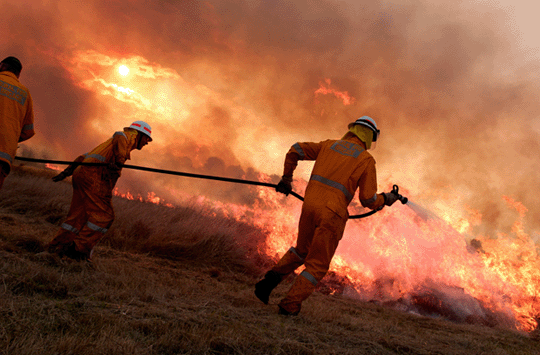
‘This is an omen’: Queensland firefighters battle worst start to season on record More than 50 bushfires are burning with the most dangerous in the Gold Coast hinterland destroying the Binna Burra Lodge, Guardian, Australian Associated Press 8 Sept 19, Queensland is in uncharted territory as firefighting crews battle to get the upper hand in the worst start to the fire season on record.
More than 50 fires were burning across Queensland on Sunday afternoon, the most dangerous in the Gold Coast hinterland where it had destroyed homes and the heritage-listed Binna Burra Lodge.
One of the oldest nature-based resorts in Australia, which dates back to the 1930s, now lies in ruins………
Queensland Fire and Emergency Services’ predictive services inspector, Andrew Sturgess, said the state had never before seen such serious bushfire conditions, so early in spring.
“So this is an omen, if you will, a warning of the fire season that we are likely to see in south-eastern parts of the state where most of the population is,” he said.
The acting premier, Jackie Trad, said climate change meant the state was facing a new era of fire risk.
“There is no doubt that with an increasing temperature with climate change, then what the scientists tell us is that events such as these will be more frequent and they will be much more ferocious,” she told reporters.
Fire authorities have warned the danger posed by the Binna Burra fire will not be over for days, with strong winds expected to persist until Tuesday.
“We’re still very much in defensive mode,” Queensland Fire and Emergency Services’ assistant commissioner, Kevin Walsh, said on Sunday………
Dams and water tanks on rural properties are empty. Stanthorpe itself is subject to emergency water restrictions of 100 litres per person per day, with the supply not expected to last until the end of the year. After that the council will have to truck water in.
“We need rain. That’s the only thing that’s going to save us,” Stanthorpe woman Samantha Wantling said.
In New South Wales firefighters were battling several out-of-control bushfires with strong winds making for challenging conditions. Despite cooler weather, damaging winds of up to 70km/h were expected to ramp up fire activity with very high fire danger in the state’s far north coast, north coast and New England areas. ……. https://www.theguardian.com/australia-news/2019/sep/08/crews-battle-two-huge-fires-threatening-south-queensland-towns
September 8, 2019
Posted by Christina Macpherson |
climate change - global warming, New South Wales, Queensland |
Leave a comment
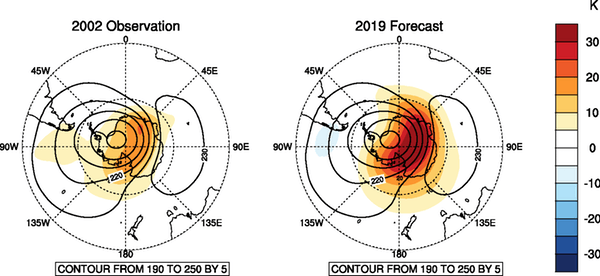
The air above Antarctica is suddenly getting warmer – here’s what it means for Australia The Conversation Harry Hendon, Senior Principal Research Scientist, Australian Bureau of Meteorology, Andrew B. Watkins, Manager of Long-range Forecast Services, Australian Bureau of Meteorology, Eun-Pa Lim, Senior research scientist, Australian Bureau of Meteorology, Griffith Young, Senior IT Officer, Australian Bureau of Meteorology, September 6, 2019
Record warm temperatures above Antarctica over the coming weeks are likely to bring above-average spring temperatures and below-average rainfall across large parts of New South Wales and southern Queensland.
The warming began in the last week of August, when temperatures in the stratosphere high above the South Pole began rapidly heating in a phenomenon called “sudden stratospheric warming”.
In the coming weeks the warming is forecast to intensify, and its effects will extend downward to Earth’s surface, affecting much of eastern Australia over the coming months.
The Bureau of Meteorology is predicting the strongest Antarctic warming on record, likely to exceed the previous record of September 2002…….
Although we have seen plenty of weak or moderate variations in the polar vortex over the past 60 years, the only other true sudden stratospheric warming event in the Southern Hemisphere was in September 2002.
In contrast, their northern counterpart occurs every other year or so during late winter of
the Northern Hemisphere because of stronger and more variable tropospheric wave activity.
What can Australia expect?
Impacts from this stratospheric warming are likely to reach Earth’s surface in the next month and possibly extend through to January.
Apart from warming the Antarctic region, the most notable effect will be a shift of the Southern Ocean westerly winds towards the Equator.
For regions directly in the path of the strongest westerlies, which includes western Tasmania, New Zealand’s South Island, and Patagonia in South America, this generally results in more storminess and rainfall, and colder temperatures.
But for subtropical Australia, which largely sits north of the main belt of westerlies, the shift results in reduced rainfall, clearer skies, and warmer temperatures.
Past stratospheric warming events and associated wind changes have had their strongest effects in NSW and southern Queensland, where springtime temperatures increased, rainfall decreased and heatwaves and fire risk rose……
Effects on the ozone hole and Antarctic sea ice
One positive note of sudden stratospheric warming is the reduction – or even absence altogether – of the spring Antarctic ozone hole. This is for two reasons.
First, the rapid rise of temperatures in the upper atmosphere means the super cold polar stratospheric ice clouds, which are vital for the chemical process that destroys ozone, may not even form.
Secondly, the disrupted winds carry more ozone-rich air from the tropics to the polar region, helping repair the ozone hole.
September 7, 2019
Posted by Christina Macpherson |
AUSTRALIA - NATIONAL, climate change - global warming |
Leave a comment
Australian Medical Association labels climate change ‘a health emergency’, SBS, 3 Sept 19 The Australian Medical Association has joined other international medical groups in recognising climate change as a “health emergency”. The Australian Medical Association says the evidence on climate change is irrefutable and warns there will be more deaths from heat stress, severe weather events, hunger and disease.The AMA Federal Council declared at its meeting in Canberra that, “climate change is real and will have the earliest and most severe health consequences on vulnerable populations around the world, including in Australia and the Pacific region”.
The AMA has joined other international health organisations, including the American Medical Association, the British Medical Association, and Doctors for the Environment Australia, in labelling it a “health emergency”.
“The Federal Council recognises climate change as a health emergency, with clear scientific evidence indicating severe impacts for our patients and communities now and into the future,” the federal council says……..
Dr Bartone said the AMA was calling on the federal government to adopt several measures, including “mitigation targets” on carbon and policies that promote transitioning from fossil fuels to renewable energy. https://www.sbs.com.au/news/australian-medical-association-labels-climate-change-a-health-emergency
September 5, 2019
Posted by Christina Macpherson |
AUSTRALIA - NATIONAL, climate change - global warming |
Leave a comment
 The Coalition is now taking yet another slice of that pudding. Unlike New Zealand, Germany, France, the UK and others, it will continue to draw on unused emission “credits” from the Kyoto era, which expires next year, to meet the modest 2030 target it set for itself in Paris four years ago.
With the exception of two brief years when a carbon price was in operation, emissions have continued to rise. So the Morrison government, like its predecessors, doesn’t mention them. Instead it refers repeatedly to “our target”, which we are meeting “in a canter”.
Australia has now been playing its Kyoto card for over 20 years, and shows no sign of ending the deception.
Kyoto is a magic pudding that keeps on giving.
Is mindless planet-trashing the way to go? http://southwind.com.au/2019/09/03/is-mindless-planet-trashing-the-way-to-go/ 3 September 2019 by Peter Boyer
The Morrison government is engaging in the kind of international chicanery we used to associate with tinpot dictatorships. When the United Nations emerged out of World War II, Australia was widely recognised as a model international citizen, a light helping to guide the world in a new age of diplomacy.
Civilisation’s answer to the wreckage left by nationalism was the UN’s multilateral world order. Both Coalition and Labor leaders knew that it gave a leg up to a middle-sized power like Australia, and worked hard to build our country’s reputation as a good global citizen.
Many older northern nations struggled with the new order, but Australia punched above its weight, notably in environmental advocacy. We led the world in pressing for UN measures to protect natural values in our part of the world, including the Southern Ocean and Antarctica.
Our efforts were noticed. We secured the first UN presidency. UNESCO’s World Heritage committee held its first southern hemisphere meeting in Sydney, and the first Antarctic Treaty meeting was held in Canberra. We hosted the headquarters, in Hobart, of the Commission for the Conservation of Antarctic Marine Living Resources (CCAMLR).
At the UN’s Earth Summit in 1992 Australia lobbied hard for the proposed framework convention on climate change and quickly ratified its agreement. Everyone expected as much. We had the reputation of taking a holistic view, supporting best collective outcomes.
But then something changed. Australia demanded special treatment at the 1997 Kyoto climate conference. Most developed countries agreed to lower their carbon emissions, but Australia was allowed a significant increase over 1990 levels.
That wasn’t all. Continue reading →
September 3, 2019
Posted by Christina Macpherson |
AUSTRALIA - NATIONAL, climate change - global warming, politics |
Leave a comment
|
Calls to preserve Australia’s rainforests as fires rage in the Amazon, https://www.sbs.com.au/news/calls-to-preserve-australia-s-rainforests-as-fires-rage-in-the-amazon P eople must fight to save the Amazon rainforest from deforestation – but it is important efforts to preserve Australia’s rainforests are also made, local environmental groups say. BY EVAN YOUNG 25 Aug 19, Environmental groups are urging people to channel raised awareness about deforestation in the Amazon into renewed efforts to preserve Australia’s own forests.
Over 78,000 forest fires have been recorded in Brazil this year, the highest number of any year since 2013, amid increased land-clearing under new far-right president Jair Bolsonaro.
More than half of those fires are in the Amazon basin, where more than 20 million people live.
The fires have prompted widespread concern around the world, but environmental groups in Australia say our domestic forests are also disappearing at an alarming rate.
“Australia is a world leader in habitat destruction,” Australian Conservation Foundation CEO Kelly O’Shanassy said.
“Our forests are getting a double knockout blow at the moment – climate change is leading to drought and bushfires, but we are still clearing land at a great rate of knots.”
A World Wildlife Fund (WWF) report last year named Australia as one of 11 global “deforestation hotspots”, where 80 per cent of forest loss is projected to happen up to 2030.
Eastern Australia was the only location in the developed world to be on the list of 11.
“We have a huge deforestation problem – all our forests all suffering because laws have been weakened,” WWF-Australia conservation scientist Martin Taylor said.
Queensland and New South Wales were the worst culprits, Dr Taylor said, with most tree-clearing undertaken to create pasture for livestock.
The Queensland Newman government partly removed the state’s ban on broad-scale clearing in 2013.
The New South Wales Berejiklian government repealed the state’s native vegetation act in 2017, allowing most agricultural developments to take place without a permit.
Tree clearing in NSW has caused koala numbers to decline by one third over the past 20 years to an estimated 20,000 across the state, according to WWF.
“We are losing mammals incredibly quickly and that is largely because we are destroying our forests. Our incredible wildlife needs a home to live in.”
Bulldozers are getting into forests and ripping into trees, making way for farmland and other urban developments. We can, and need to be, smarter in our farming.”
Ms O’Shanassy said individuals can make donations to charities opposing deforestation, talk to local businesses supporting unsustainable agriculture practices, eat less meat and contact their local MPs to try and reverse the trend.
“As individuals, we can all live more sustainably, but when we get together and demand bigger action from corporations and governments – that is when we get the type of large scale change needed to protect the Amazon and the rainforests of Australia.”
|
|
August 27, 2019
Posted by Christina Macpherson |
AUSTRALIA - NATIONAL, climate change - global warming, environment |
Leave a comment
Labor urges more action to protect the Amazon, SBS, Labor is urging the Morrison government to do all it can to encourage Brazil to protect the Amazon as international leaders discuss the issue at the G7 summit. In a joint statement, Labor’s foreign affairs spokeswoman Penny Wong and climate change spokesman Mark Butler said the rainforest fires are increasingly occurring at an alarming rate.
“The Amazon has often been described as the world’s lungs. Its protection matters to the whole international community,” they said.
“We call on the Morrison government to do everything they can to encourage Brazil to respond to this rapidly worsening global disaster.”
They said failure to defend against or prevent these fires stands to derail any international efforts against climate change…….https://www.sbs.com.au/news/labor-urges-more-action-to-protect-the-amazon
August 26, 2019
Posted by Christina Macpherson |
AUSTRALIA - NATIONAL, climate change - global warming, politics |
Leave a comment
|
 Scott Morrison caps off his first year by facing a minefield in his own backyard, ABC, Scott Morrison caps off his first year by facing a minefield in his own backyard, ABC,
And as we mark the first anniversary of Morrison’s rise to the top job on August 24 last year, the Pacific Islands Forum seems a good place to start in reviewing the his first year as PM, and what has happened to the country and our politics in the meantime………
Sleeping giant in the Pacific
Straddling the minefield of internal Coalition tensions on climate and energy policy is a long way short of giving yourself any room to manoeuvre when you are talking to your Pacific Island neighbours.
The Pacific Islands Forum was once a definite Second XI event that Australian prime ministers would try to offload onto a colleague. But it has now become a highly contested event, attended by enthusiastic delegations who consider they have an interest in the Pacific — from China to France and Britain.
And this year’s forum came after Mr Morrison had announced the Pacific Step Up: Australia’s attempt to win back, or at least reinforce, its long history of influence in the region as China and other countries take an aggressive interest.
The Islands wanted a commitment Australia would agree to start closing down its coal industry — a demand no side of politics was ever going to agree to.
But what was revealing was that there was so little else we seemed to bring to the table, other than $500 million of rebadged aid funding which, it was said, would help with the effects of climate change, not its causes.
Climate change no longer a hypothetical
The Government might have moved publicly beyond the argument of whether climate change is happening. But it is hard to escape the impression it thinks it is happening to someone else and that, therefore, the politics of the issue — apparently reinforced by the swing in coal seats at the election — is clear cut.But it isn’t of course. In the Torres Strait Islands, sea walls are being breached in big tides and monsoons. Houses, infrastructure, graves and other sacred sites are being lost.
Elders from the same part of Australia that brought on the Mabo case have lodged a case against Australia in the United Nations Human Rights Committee, arguing that not doing anything about climate change is a breach of the islanders’ human rights.
And if the cynics in the Government view this as not an issue because it involves a far-flung community, an Indigenous one at that, and (yawn) the United Nations, they might like to consider how the structures of their own government are now also being influenced by climate change.
When the agriculture portfolio was carved up after the election, David Littleproud became the Minister for Water Resources, Drought, Rural Finance, Natural Disaster and Emergency Management: a range of jobs which bears a striking resemblance to the need to deal with the varying impacts of climate change.
Our politics have changed in the 12 months Mr Morrison has been Prime Minister. The Labor Party is no longer in the ascendancy; the tensions within the Coalition have taken on different forms.
But those tensions have not gone away. We are in a holding pattern on crucial areas of policy on the economy; strategic issues; asylum seekers and climate and energy.
The Coalition saw its election victory as an endorsement of the view the electorate is more conservative, and increasingly driven by people of faith.
But making that political assessment of the views of Australians is different from having a clear-eyed assessment of where policy needs to go, whatever the electorate’s views may be… https://www.abc.net.au/news/2019-08-24/scott-morrisons-first-year-as-prime-minister/11443562
|
|
August 24, 2019
Posted by Christina Macpherson |
AUSTRALIA - NATIONAL, climate change - global warming, politics international |
Leave a comment
Deputy PM apologises for telling Pacific it will survive climate change as workers ‘pick our fruit’ ABC , By political reporter Matthew Doran 23 Aug 19, Deputy Prime Minister Michael McCormack has apologised for comments about Pacific islanders being able to survive the ravages of climate change by taking fruit-picking jobs in Australia.
Key points:
- Pacific countries want Australia to do more about climate change as they face rising sea levels
- Nationals leader Michael McCormack said last week they would survive because they “pick our fruit”
- He has has offered an apology for the comment “if any insult was taken”
Mr McCormack made the comments last Friday as he sought to dismiss criticism levelled at Prime Minister Scott Morrison following the Pacific Islands Forum (PIF), at which leaders claimed Australia was ignoring the threat climate change posed to the survival of vulnerable low-lying island nations.
[I] get a little bit annoyed when we have people in those sorts of countries pointing the finger at Australia and say we should be shutting down all our resources sector so that they will continue to survive,” he said.
“They will continue to survive, there’s no question they will continue to survive, and they will continue to survive with large aid assistance from Australia.
“They will continue to survive because many of their workers come here and pick our fruit.”
On Thursday he apologised…….
‘Appropriate from a drunk in a bar, not from a leader’
The PIF meeting in Tuvalu saw Mr Morrison pressure fellow leaders to water down the PIF’s final declaration, removing references to cutting carbon emissions by phasing out coal.
Former president of Kiribati Anote Tong said he could not understand how Mr McCormack thought it was a smart comment to make.
“If you’re drunk, and in a bar, it would be an appropriate place and time to make the comment. But if you’re speaking as a leader, really it is not appropriate,” he said.
Tuvalu Prime Minister Enele Sopoaga, who hosted the Pacific Islands Forum, said the comments made Pacific Islanders sound like “paupers” who were begging for Australian support. https://www.abc.net.au/news/2019-08-22/mccormack-apology-pick-our-fruit/11438312
August 24, 2019
Posted by Christina Macpherson |
AUSTRALIA - NATIONAL, climate change - global warming, politics |
Leave a comment
 Climate change is an emergency, Mirage News, 23 Aug 19
Bass Coast Shire Councillors have resolved that climate change poses a serious threat and should be treated as an emergency.
A motion was carried at last Wednesday’s Ordinary Council Meeting and will see Council develop a Bass Coast Climate Change Action Plan 2020-30, to set out how Bass Coast Shire can more effectively contribute to climate change mitigation and be more resilient and well adapted to the effects of a changing climate.
It will also include a target of zero net emissions by 2030 across Council operations as well as the wider community.
Bass Coast Mayor, Cr Brett Tessari, said while Council’s Natural Environment Strategy, adopted in 2016, recognises climate change, this declaration goes one step further….. https://www.miragenews.com/climate-change-is-an-emergency/
August 24, 2019
Posted by Christina Macpherson |
climate change - global warming, Victoria |
Leave a comment





 Antinuclear