Crossbenchers put climate on agenda
 SBS 20 May 19, New independent MP Helen Haines says she doesn’t intend to operate in a bloc with other crossbenchers, saying she runs her own race in Indi., The Victorian seat of Indi’s likely new independent MP Helen Haines says she doesn’t intend to operate as a bloc with fellow crossbenchers, but expects they’ll work together on issues such as climate change.
Ms Haines looks set to take the seat that was previously held by independent Cathy McGowan, winning almost 52 per cent of the vote so far after preferences.
It would make her the first independent to succeed another independent in a seat……..
“I’m not operating as a bloc with the other independents. I very much run my own race in Indi,” she said.
“There’s no doubt, though, that we do see eye-to-eye on action on climate. I think climate is the one that we will be collaborating very closely on the crossbench.”……. https://www.sbs.com.au/news/crossbenchers-put-climate-on-agenda
Voters feared climate policy more than climate change
A range of polls and surveys had left many analysts, myself included, with the sense that this would be a crucial issue at the ballot box.
The annual Lowy Institute Poll demonstrated stronger support for climate change action in Australia in 2019 than in any previous survey since 2006.
In the survey more than 60 per cent of Australians agreed with the sentiment that “Global warming is a serious and pressing problem. We should begin taking steps now even if this involves significant cost”.
And while a self-selecting sample, those filling out the ABC’s Vote Compass survey consistently emphasised climate change as a crucial issue for them at the election.
Crucially, those identifying it as the most important issue had risen from 9 per cent in 2016 to 29 per cent in 2019.
Advocacy groups and even media outlets also encouraged the view that 2019 was, and should be, Australia’s climate election.
This was prominent in pre-election statements from NGOs like ACF and Oxfam. GetUp! ran this argument strongly before and during the campaign, and The Guardian’s editorial on the eve of the election exhorted all Australians to view the election as an opportunity to vote for substantive action on climate change.
But in the end, we saw a decline in the primary vote for the Labor Opposition, who had announced a more significant reduction target than the Government and a suite of measures — from investment in renewable energy to an energy guarantee — to get there.
And we saw a rise of only around 0.5 per cent of the primary vote for the party with the most progressive and ambitious climate policy: the Greens. More consequentially, of course, we saw the re-election of a Government with limited ambition on emissions reductions.
How did this happen?
While it’s too early for fine-grained analysis, we can draw a few conclusions at this point.
First, the seats where climate change was significant as an issue at the election tells us something. As the most significant political issue for Greens supporters in the election, climate change clearly played a role in the re-election of Adam Bandt in Melbourne, and in strong primary votes for the Greens in nearby electorates of Higgins, Kooyong and Macnamara.
In Sydney, it was clearly prominent in Wentworth (undecided at the time of writing), and most prominently Warringah where Zali Steggall won the seat from Tony Abbott.
In Warringah, not only was the LNP’s position on climate change inconsistent with the views of most in this constituency, but Mr Abbott was (rightly) seen as the chief architect of an extended period of climate inaction in Australia.
Simply put, he was (in Opposition, in Government and in public debate) the chief contributor to the toxic politics of climate change in this country over the past decade.
Mr Abbott’s re-election was, in short, a bridge too far for his constituency.
But in this case and in other inner-city seats, support for climate action looks broadly consistent with a ‘post-materialist’ sensibility.
Here the emphasis on quality of life over immediate economic and physical needs encourages a focus on issues like climate change. But this is a sensibility that speaks to those in higher socio-economic brackets, and principally with higher levels of education.
It isn’t particularly applicable to regional Queensland, for example, especially when constituents in the latter view large scale mining operations as a crucial potential source of income and employment.
Voters feared climate policy more than climate change
Second, the Lowy Institute polling data also tells us something about when climate support rises and falls.
Simply put, climate concern is at its highest in Australia when there’s a perception (eg 2006, 2019) that the government isn’t doing anything about the issue and isn’t taking it seriously. Conversely, climate concern has been at its lowest as the Government began to pursue substantive climate action, bottoming out when the so-called carbon tax was legislated in 2012.
In this election, Australians were suddenly faced with a prospective Labor Government ready with a suite of measures to tackle climate change.
And they were presented with an account of these measures as a devastating economic blow to Australian prosperity and growth.
However discredited much of this modelling ultimately was, and the broader fear campaign about everything from electricity prices to the end of petrol-based cars, it raised the spectre of immediate economic sacrifice for Australian
We’re already in a climate emergency
So what would it take to make climate change a major political concern in Australia, and a crucial issue in future Australian elections?
A climate emergency, perhaps? The problem with this argument is that by most accounts, we’re in one.
The five hottest years on record have been the past five, natural disasters have increased in intensity and frequency, we’re in the midst of an extinction crisis and the average global temperatures suggest that we’ve almost reached the agreed Paris target for warming: no more than 1.5 degrees.
So the issue is not whether there’s a problem. Rather, it’s how to get Australian policy makers and voters to recognise and respond to it credibly and seriously. It should be easier to do.
We’re confronted more than ever with manifestations of climate change.
The five hottest years on record have been the past five, natural disasters have increased in intensity and frequency, we’re in the midst of an extinction crisis and the average global temperatures suggest that we’ve almost reached the agreed Paris target for warming: no more than 1.5 degrees.
So the issue is not whether there’s a problem. Rather, it’s how to get Australian policy makers and voters to recognise and respond to it credibly and seriously. It should be easier to do.
We’re confronted more than ever with manifestations of climate change.
Independent candidate Zali Steggall’s win in Warringah is a message about need for action on climate change
|
Warringah win a climate message: Steggall, SBS 19 May 19, The Olympian who vanquished Tony Abbott, snatching the Sydney seat he held for 24 years, says his loss means “the handbrake” on climate change action is off.
The independent who defeated Tony Abbott in Warringah says “the handbrake is now off” Australia’s action on climate change, blaming the former prime minister for being a major impediment. Mr Abbott lost his Sydney seat of 24 years on Saturday night to Zali Steggall, a barrister who was the first skier to win a Winter Olympics medal for Australia. Speaking with reporters on Sunday, she congratulated Prime Minister Scott Morrison and described her win as “a message from Warringah … getting away from climate wars”. “Mr Abbott was, I think, very negative when it came to progress on climate change policy and I think now is an opportunity for Mr Morrison to get on with the job,” she said.
“The major person who has been against climate change action, I think, is probably Mr Abbott. “I actually think it is a message from this electorate … the handbrake is now off.” She said climate change had been an important issue for the electorate for some time and the considerable swing against Mr Abbott at the previous election had “just continued” because constituents wanted action….. https://www.sbs.com.au/news/warringah-win-a-climate-message-steggall |
|
What is needed is a war on climate change: why are people not voting Green?
 Climate crisis demands war footing, but we won’t even vote for the Greens, https://www.brisbanetimes.com.au/federal-election-2019/climate-crisis-demands-war-footing-but-we-won-t-even-vote-for-the-greens-20190516-p51o38.html, By Elizabeth Farrelly
May 18, 2019 The world’s children are demanding that we forget the past and look to the future. Hope? “I don’t want your hope,” says Greta Thunberg, the deadpan Swedish teen who inspired the climate strikes. “I want you to panic. I want you to feel the fear.” We’re moved, watching this stuff, but are we listening? Will we act?
Chief Justice Brian Preston’s long and scholarly judgment on the Rocky Hill mine is instructive here, noting with refreshing candour that government is tasked to guard the public interest, that this is not served by climate destruction and that the precautionary principle is required by law to be applied to all State Significant Projects.
Or so the rich (people and countries) like to think. But unless they want, metaphorically speaking, to clean their own toilets they – and especially their kids and grandkids – are umbilically linked to the poor. On anything more than a five-minute time-frame it’s all interconnected. There is no Planet B.
In places where people rejected tower-living, the need for medium density, and for people to like it (since now the developers are not running the show), has placed extra emphasis on both design and consultation.
With the loosening of the developer stranglehold, self-help and co-operative housing has also flourished. The resulting communities, prioritising street life and walkability, render people more engaged and also fitter. Epidemic obesity and diabetes have reduced, paving the way for changes to the health system that shift the emphasis from gargantuan, energy -guzzling, waste-spewing mega-hospitals to smaller local hospitals where sunlight and fresh air reduce energy and enhance healing.
It’s not a pipe dream. It’s not even radical. It simply acknowledges that grabbiness and tribal loyalties are irrelevant. Thunberg told the UN, “we had everything we could wish for and yet now we may have nothing.” Justice Preston puts it more drily. The costs of mining will “exceed the benefits”.
The UK has a national climate change act – why don’t we?
 The Conversation, CEO at ClimateWorks Australia, Monash University, Anna Malos, The Conversation, CEO at ClimateWorks Australia, Monash University, Anna Malos,  Project Manager, climate and energy policy, ClimateWorks Australia, Professor of Environmental Economics, University of Oxford, May 15, 2019 No matter who wins the upcoming federal election, both the ALP and LNP are committed to remaining in the Paris Climate Agreement.This means every five years Australia is expected to submit progressively stronger targets to reduce greenhouse gas emissions, and report on progress. And by 2020, Australia is expected to submit a long-term emissions reduction strategy showing how to get to net zero emissions. Project Manager, climate and energy policy, ClimateWorks Australia, Professor of Environmental Economics, University of Oxford, May 15, 2019 No matter who wins the upcoming federal election, both the ALP and LNP are committed to remaining in the Paris Climate Agreement.This means every five years Australia is expected to submit progressively stronger targets to reduce greenhouse gas emissions, and report on progress. And by 2020, Australia is expected to submit a long-term emissions reduction strategy showing how to get to net zero emissions.
Regardless of what policy mix is chosen to achieve this, the process of hitting the Paris targets is now a permanent feature of economy-wide decision-making, one that will need credible ongoing support from government and businesses. Policy uncertainty, and a lack of national framework, has reduced investment confidence. The UK has shown how national climate change legislation can guide institutional action, and not only dramatically cut emissions, but also promote economic growth. Victoria rolled out similar legislation in 2017, one of the first pieces of legislation in the world to be modelled on the Paris Agreement. But Australia lacks a national version of Victoria’s or UK’s legislation. We have national targets, but not yet ongoing systems embedded in departments. These systems would include measures to ensure continuous target-setting every five years (as used in other jurisdictions) with guidelines and progress reporting obligations. A lack of national legislation means the community and businesses lack transparency about Australia’s long-term direction, pace and progress. How national climate change legislation would work……..How Victoria did itIn 2017, the Victorian Labor government rolled out state-wide climate legislation, the Victorian Climate Change Act. This legislation recognises how addressing climate change needs a whole-of-government approach, extending obligations to each state government portfolio. And it has already catalysed climate change reporting and planning activity across government. An independent committee has been tasked with advising on the first ten years of emissions budgets. Government departments are preparing adaptation plans for each sector, reviewing operational guidelines and establishing regular reporting of emissions in sectors and their future plans. The UK’s success storyThe UK passed its Climate Change Act in 2008 with a near unanimous vote. It has guided government decisions on national energy and industrial policy ever since…….. https://theconversation.com/the-uk-has-a-national-climate-change-act-why-dont-we-115230 |
|
|
Distinguished Australians, and over 60 scientists press the government for immediate action on climate change.
SBS 16 May 19 A group of more than 60 scientists and experts have penned an open letter to the next Australian government, calling for immediate action on climate change.
A group of more than 60 Australian scientists and experts are calling on the next government to prioritise action on climate change.
The 62 experts, including Nobel Prize winners and former Australians of the Year, have penned an open letter to politicians, which features a prominent graph showing Australia’s emissions have been rising since 2014.
“The consequences of climate change are already upon us – including harsher and more frequent extreme weather, destruction of natural ecosystems, severe property damage and a worldwide threat to human health,” they wrote.
“The solutions are all available to address climate change, all that is missing is the political will.”
The group includes former Australian of the Year and Nobel Prize winner Peter Doherty, former Australian of the Year Fiona Stanley and former premier of Western Australia Carmen Lawrence.
“Australia’s greenhouse gas emissions are rising, moving the country further away from its Paris Agreement obligations,” the letter says.
“Whichever party wins government on Saturday, urgent action on climate change must be a top priority for the 46th parliament of Australia.”
Climate change has emerged as a top issue of the federal election ……https://www.sbs.com.au/news/pm-says-climate-goal-will-end-lib-conflict
Australia’s opportunity to become a low carbon, renewable energy, superpower
|
Australia can be ‘superpower of post carbon world’, says Ross Garnaut, SMH, By Peter Hartcher, May 15, 2019 Australia has the opportunity to surpass other rich countries to become more prosperous than ever before in a post-carbon world, according to the eminent economist Ross Garnaut.Australia could become “the superpower of the post-carbon world economy”, said the former economic adviser to prime minister Bob Hawke and author of the Hawke government’s strategy for economic engagement with Asia.
The Australian political debate has been preoccupied with the cost of moving to a lower-carbon economy, but new work by Professor Garnaut finds that the economic costs would be far outweighed by economic gains. “Embrace the post-carbon economy, and Australia will greatly expand new minerals processing and chemical manufactures, way beyond the limits of coal, gas and the industries they supported in the past,” he said in a Melbourne University lecture on Wednesday night. New developments in renewable energy and Australian advantages have made it clearer than ever that the country could “prosper exceptionally in the post-carbon world”. Intelligent climate policy would mean that wholesale electricity prices would fall “substantially”, he said, a source of competitive advantage……. He said that Australia could plausibly achieve zero net carbon emissions by 2040, making its contribution to the global effort to limit global warming to 1.5 per cent, if it embraced the Labor party’s emissions target. The Labor policy is to cut emissions by 45 per cent from 2005 levels by 2030. However, he said that it was “implausible” to reach net zero in that time if Australia continued with its existing Paris commitment under the Coalition to cut emissions by 26 to 28 per cent….. https://www.smh.com.au/federal-election-2019/australia-can-be-superpower-of-post-carbon-world-says-ross-garnaut-20190515-p51nsb.html?utm_source=newsletters&utm_medium=email&utm_term=SMH+AM+News |
|
Pacific leaders have voiced frustration over Australia’s failure to curb its emissions
|
UN secretary-general meets Pacific leaders to discuss ‘global catastrophe’ of climate change ABC
Regional heavyweights had gathered at an historic climate change summit convened with the UN secretary-general Antonio Guterres. Mr Guterres is intent on building global momentum for sharper cuts to emissions, arguing that drastic action is necessary to stave off ecological disaster. The Pacific is on the “front line of climate change”, Mr Guterres told the meeting. “It has a unique moral authority to speak out. It’s time for the world to listen.” Senior Australian officials at the meeting could do little else; sent in the place of Prime Minister Scott Morrison only days before the federal election, they were bound to observer status by the caretaker conventions. As a result, Australia did not sign up to the final statement by Pacific leaders, which declared climate change a “global catastrophe” and called for “transformative action” to stop it…… while Pacific leaders have praised New Zealand’s announcement that it wants to go carbon neutral by 2050, many are frustrated that Australia has failed to curb its emissions. One Pacific official told the ABC the meeting’s call for radical action on climate change “really was aimed at the whole globe” but “for those in the room [it] was a message for one country”.
The outspoken Prime Minister of Samoa, Tuilaepa Sailele, went much further, wading straight into Australia’s election campaign during the post-summit press conference……. decision makers in Canberra also know that the Pacific is increasingly impatient about Australia’s long and painful debate on climate policy. The argument will flare up again in only months when regional leaders gather for the Pacific Islands Forum on tiny Tuvalu, which has long been a vocal champion for drastic climate action. And this time, Australia will not be sitting on the sidelines. https://www.abc.net.au/news/2019-05-16/guterres-antonio-un-pacific-meeting-climate-change/11115816 |
|
Primatologist Jane Goodall calls on Australia’s leaders to take greater action on climate change
|
ABC By Claire Campbell 15 May 19, World-renowned primatologist Jane Goodall has weighed in to Australia’s federal election campaign, calling on the nation and its leaders to take greater action on climate change.
Key points:
Dr Goodall told ABC News she was seeing the impact of climate change everywhere she travelled around the world and there was no time for complacency. “Any leader, any individual has to realise that climate change isn’t something that might affect their country, it’s actually affecting everywhere around the world,” she said. “A lot of them do nothing because they don’t know what to do, they feel helpless. “Sea levels are rising, people have had to leave their island homes … hurricanes are getting more frequent and disastrous and the same with flooding and drought. We just have to do something about fossil fuel emissions and the methane from breeding cattle.” ……. https://www.abc.net.au/news/2019-05-15/jane-goodall-calls-for-more-action-on-climate-change/11116766 |
|
|
Leaders of New Zealand, Tuvalu, Vanuatu, and Fiji welcome UN chief Antonio Guterres for climate talks (What about Australia?)

|
UN chief Antonio Guterres hits out at climate change ‘paradox’ ahead of historic Pacific trip https://www.abc.net.au/news/2019-05-13/un-chief-antonio-guterres-talks-climate-historic-pacific-trip/11106622
The trip marks the first time a sitting UN secretary-general will meet with Pacific Islands Forum (PIF) leaders in the region. Key points:
“Climate change is running faster than what we are … the last four years have been the hottest registered,” Mr Guterres said yesterday alongside New Zealand’s Prime Minister Jacinta Ardern.
Under the Paris Agreement, many countries agreed to a long-term commitment to keep the rise of global temperatures well below two degrees Celsius above pre-industrial levels in a bid to substantially reduce the effects of climate change. After New Zealand, Mr Guterres will travel to Tuvalu, Vanuatu, and Fiji to meet with leaders who have for years been warning that many of the Pacific’s small island nations face being washed away by rising sea levels due to global warming. Mr Guterres added to those sentiments yesterday warning that Pacific nations are on the frontlines of climate change.
“We need to protect the lives of our people and we need to protect our planet.” However, he praised the efforts of Ms Ardern’s Government who just last week, introduced an ambitious bill that aims to make New Zealand mostly carbon neutral by 2050 while giving some leeway to farmers. ‘With America or Australia — Sydney could go down’In Fiji, Mr Guterres will meet with PIF leaders and senior government officials from the region. Samoa’s Prime Minister Tuilepa Sailele, a leading critic against nations who he believes are ignoring the threats of climate change, told the ABC’s Pacific Beat program that he had a message for Mr Guterres. To impress on him the importance of the smallness of our islands, and the quicker moves that our vulnerable islands would like to see from the bigger countries responsible for all these problems that we are facing today,” he said. Mr Sailele, who has previously blasted countries for ignoring the warnings, added that rising sea levels is not just an issue for the Pacific, but for those very same “bigger countries” as well.
His comments follow a controversial withdrawal from the Paris Agreement’s commitments by United States President Donald Trump in 2017, a move that was praised by former Australian prime minister Tony Abbott who last year said that Canberra should do the same. The secretary-general’s Pacific trip comes ahead of an anticipated Climate Action Summit that he plans to convene in September in New York. |
|
|
Protesters scale Sydney Harbour Bridge to declare ‘climate emergency’
SMH 14 May 19, Ten people have been arrested while three protesters remain dangling from the Sydney Harbour Bridge after environmental group Greenpeace called on Prime Minister Scott Morrison to “declare a climate emergency” on Tuesday morning.
The abseiling protesters could be hanging from the bridge all day, with a Greenpeace spokesperson saying they were “fully stocked up” and had enough provisions in their bags to last at least 24 hours.
The three people can be seen holding small banners that read “100% renewables” and “make coal history”.
A NSW Police operation is attempting to remove the protesters who are attached to ropes beneath the bridge….. https://www.smh.com.au/environment/climate-change/protesters-scale-sydney-harbour-bridge-to-declare-climate-emergency-2019051
CSIRO unsure on Adani coal project’s water plans, but Minister For Coal, Melissa Price gave it environmental approval anyway
Adani water plan ticked off within hours despite lack of detail, internal CSIRO emails reveal
Key points:
- Internal CSIRO correspondence explicitly shows the agency went out of its way to avoid giving any categorical scientific advice on Adani’s plans
- A letter from the CSIRO to the environmental department noted other concerns were yet to be addressed
- The emails obtained by the ABC also show how rushed the CSIRO was to provide its “formal assent” to the department
Despite the Government saying Australia’s top science agencies “confirmed” Adani’s water plans had “met strict scientific requirements”, the emails show CSIRO was determined not to give a “categoric” response.
The correspondence obtained by the ABC through freedom of information laws exposes further discrepancies between what the Government said about the assessment of Adani’s environmental plans, and what actually occurred.
The newly uncovered emails follow hand-written notes from Geoscience Australia, obtained by the ABC in April, showing Adani refused to accept several of its recommendations, counter to what the Government said at the time.
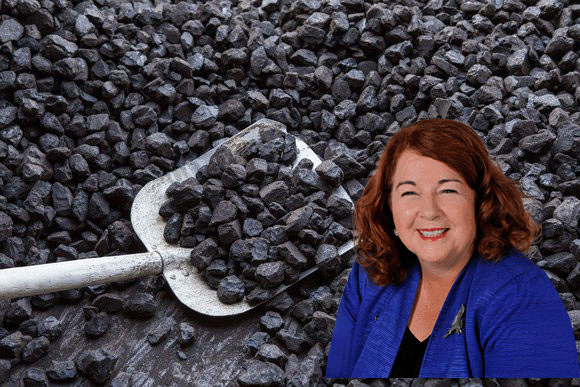 Two days before the federal election was called, Environment Minister Melissa Price signed off on Adani’s two groundwater management plans,meaning Adani had passed all the tests required by the Federal Government before it could start constructing its proposed Carmichael coal mine.
When announcing the decision, Ms Price said she was simply following the advice of scientists.
“I have accepted the scientific advice,” she said, declaring that CSIRO and Geoscience Australia had provided “assurances that these steps address their recommendations”.
Scott Morrison claims that the Liberal Coalition saved the Great Barrier Reef!!
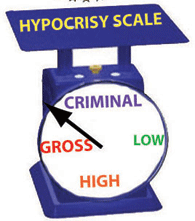 M’s claim Coalition saved reef from nonexistent ‘endangered list’ condemned as ‘ridiculous’, Guardian, Lisa Cox, Mon 13 May 2019
Scott Morrison says government took reef ‘off the endangered list’ – despite no such list existing. Scott Morrison has credited his government with having “saved” the Great Barrier Reef, a claim rejected as “ridiculous” by scientists, environmental groups and the Queensland government.
At the Liberal party’s campaign launch in Melbourne on Sunday, Morrison thanked the former environment ministers Greg Hunt and Josh Frydenberg for their work on reef issues.
“We have saved the Great Barrier Reef – well done to Greg Hunt particularly on his work when he was environment minister – taking it off the endangered list,” he said.
“We’ve invested record funds in researching and protecting its future thanks to Josh’s time as environment minister.”
Morrison’s statement contained more than one inaccuracy, including the suggestion the reef was on an “endangered list” at all.
“There is such a thing as the ‘in danger list’ for world heritage properties,” the coral reef scientist Prof Terry Hughes said. “The barrier reef was never on that list.
“If Morrison is claiming Hunt got Australia off the ‘in danger’ list, the obvious response is: it never was on it.”
In 2017, Unesco opted not to list the reef as in danger after reviewing the government’s Reef 2050 plan. But it will reassess that decision in 2020 and whichever party wins the federal election must submit an update on progress of the plan at the end of this year.
Hughes said recent surveys of the Great Barrier Reef showed the impact climate change and rising ocean temperatures were having on coral cover.
The Australian Institute of Marine Science – the government’s own agency responsible for monitoring reef health – reported in 2017-18 that trends in coral cover in the north, central and south reef showed steep decline that “has not been observed in the historical record”.
Hughes’s most recent paper found that the production of baby coral on the reef had fallen by 89% after the climate change-induced mass bleaching of 2016 and 2017.
Under the Liberal-National coalition government, Australia’s greenhouse gas emissions have continued to increase, which Hughes said was “an abject failure” for the Great Barrier Reef……… https://www.theguardian.com/environment/2019/may/13/scott-morrisons-claim-coalition-saved-great-barrier-reef-condemned-as-ridiculous?CMP=share_btn_fb&fbclid=IwAR0
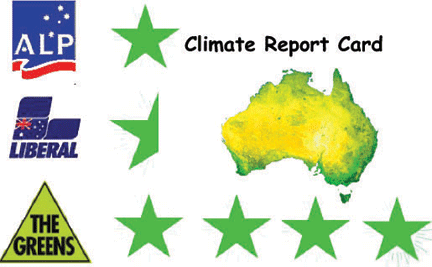
Where do the parties stand on climate and the environment?
|
The climate change election: where do the parties stand on the environment? Guardian, Adam Morton
With the global and local environment at crisis point, Australians have a clear choice at Saturday’s election. Here are the parties’ key policies This has been called the climate change election, and with good reason: concern about the climate and environment has never been greater. A Lowy Institute poll found nearly two out of three adults believe climate change is the most serious threat to Australia’s national interests, an 18-point-increase in five years. It was taken before a landmark UN global assessment defined the extent of the unprecedented biodiversity crisis facing the planet, with a million species at risk of extinction and potentially dire consequences for human society. Australia has a big stake in these issues. It is one of the world’s top greenhouse gas emitters on a per-capita basis and in the top 20 for total pollution, with a footprint greater than Britain or France. It is already experiencing the effects of climate change, including increased heatwavesand mass coral bleaching on the Great Barrier Reef, and is the global leader in mammal extinction. There are clear choices between the parties on these issues at this election. Guardian Australia looks at how the policies of the Coalition, Labor and the Greens line up. EmissionsCarbon pollution in Australia has been rising since the Coalition repealed carbon price laws in 2014. The country is on track to meet its modest Kyoto protocol target – that emissions be 5% lower in 2020 than in 2000 – but not 2030 targets. Coalition Under the Paris climate deal, the Coalition says it will cut emissions to 26% less than they were in 2005 by 2030. It is significantly less than what scientists advising the government say is necessary for Australia to play its part in meeting the goals of the Paris deal (a 45%-63% cut by 2030 compared with 2005). Scott Morrison explained in February how he planned to meet this goal. About eight points of the cut would come from using what are known as Kyoto carry-over credits. Unlike international and domestic carbon credits created through offset projects, Kyoto carry-over credits do not represent an actual reduction in carbon dioxide. They are bonus credits that Australia wants to award itself for beating the low 2020 target it set itself. It would just mean counting the same emissions cut twice. It is unclear if they will be allowed under the Paris deal; almost all other developed countries have said they will not use them. Developing countries do not have the option. Scott Morrison explained in February how he planned to meet this goal. About eight points of the cut would come from using what are known as Kyoto carry-over credits. Unlike international and domestic carbon credits created through offset projects, Kyoto carry-over credits do not represent an actual reduction in carbon dioxide. They are bonus credits that Australia wants to award itself for beating the low 2020 target it set itself. It would just mean counting the same emissions cut twice. It is unclear if they will be allowed under the Paris deal; almost all other developed countries have said they will not use them. Developing countries do not have the option. The Coalition nominates two other significant sources of emissions reduction. One is the direct action emissions reduction fund, now rebadged as the climate solutions fund, under which farmers and businesses bid for cash from taxpayers to cut pollution. The government announced in February it would spend an extra $2bn on it over 10 years, but that was stretched to 15 years in the April budget, including just $189m over the next four. While some projects backed by the fund are widely considered worthwhile, an investigation by Guardian Australia has found questions over its design and uncertainty over what taxpayers were getting for their money. The biggest flaw is in the administration of the other half of the direct action program, known as the safeguard mechanism. It was supposed to put a limit on industrial emissions to ensure they did not just wipe out the cuts taxpayers are buying through the emissions reduction fund, but in practice industrial emitters have mostly been allowed to increase pollution without penalty. The Coalition has criticised Labor for planning to use the safeguard mechanism to do what government frontbencher Greg Hunt designed it to do: reduce emissions. The other major measure on the Coalition’s carbon budget chart (see p8) is “technological improvements”, which have not been explained. An analysis by scientists from Climate Analytics released on Friday found the Coalition’s target was insufficient to deal with the climate challenge and said there was no evidence the government planned to release further policies. Labor Labor has a more ambitious emissions target: a 45% cut by 2030, which Climate Analytics says falls just within what is necessary for Australia to play its part in limiting global warming to 1.5C, and net zero emissions by 2050. Rather than an across-the-board carbon price similar to what it introduced in 2011, it is promising different policies for different parts of the economy. On electricity, it wants to bring in a national energy guarantee, a policy devised and abandoned by the Coalition. Similarly, for heavy industry, it plans to toughen up the government’s safeguard mechanism to set limits and reduce them over time. It is yet to say what the limits would be and the trajectory – how fast they would be cut – but it says both the electricity and industrial sectors will have to meet the 45% target. It wants 50% of new cars to be electric by 2030 and has pledged vehicle emissions standards to limit transport pollution, building on work done under the Coalition but not adopted. It would boost the use of carbon offsets from Australia, allow business to buy an undefined amount from offsets from overseas and has suggested it would limit land clearing. Despite some scary headlines about costs, Labor’s ambition and direction has been praised by policy analysts and scientists. But unanswered questions remain. It has not released a carbon budget explaining how it would hit the 45% target. And it has been accused of hypocrisy for a promise to spend $1.5bn to boost natural gas supply in Queensland and to connect the Northern Territory’s Beetaloo sub-basin to the east coast. Green groups say the emissions that result could dwarf those from Adani’s proposed Carmichael coalmine. Speaking of which: Labor has struggled to articulate a position on the mine. Shorten has expressed personal reservations but not committed to either blocking or supporting it. Greens The Greens want emissions cut by between 63% and 82% by 2030 compared with 2005, and zero emissions by 2040. Their policies include ending fossil fuel subsidies, phasing out fossil fuel mining and electricity generation by 2030, vehicle emissions standards that become a ban on new petrol-fueled cars by 2030 and an economy-wide carbon price to reflect the true cost of pollution. A new public authority, Renew Australia, would lead the transition to low emissions. Climate Analytics says the Greens’ goals sit well within what the scientific literature says would be Australia’s fair share of emissions cuts. Renewable energyCoalition The government does not have a renewable energy policy for beyond 2020……… The government has indicated it would underwrite some new energy projects, having released a shortlist of 12. The list includes one coal upgrade project in New South Wales. Labor Bill Shorten has promised 50% of electricity from renewable sources by 2030. He says he will aim to win support in parliament for the national energy guarantee, which would force energy companies to reduce emissions and meet reliability obligations. If unsuccessful, he would tip $10bn into the government’s green bank, the Clean Energy Finance Corporation, and create a $5bn fund to modernise the power grid. Other promises include $200m over the next four years for a household battery program, with a goal of 1m homes having batteries by 2025. Greens The Greens want the electricity grid to be 100% renewable energy by 2030. They would extend and boost the renewable energy target and back public investment, feed-in tariffs and regulations for clean generation, storage and energy conservation. Environment protection and threatened species…..Waste and recycling…..Great Barrier Reef….. https://www.theguardian.com/australia-news/2019/may/12/the-climate-change-election-where-do-the-parties-stand-on-the-environm
|
|
Climate emergency is here, whatever the election result – Editorial -The Age
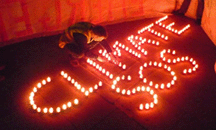 Whatever the election result, we must tackle climate emergency https://www.theage.com.au/environment/climate-change/whatever-the-election-result-we-must-tackle-climate-emergency-20190511-p51mcf.html May 11, 2019 Election 2019 is in its final week – and for many people that will be a relief.
Many voters have switched off from politics and been disengaged from the campaigning, which may be one reason why almost 2 million people have already voted.
But beyond the usual photo set-ups and faux outrage during the campaign, an issue of fundamental importance has gained greater prominence across the nation: climate change. It has become one of the fastest-rising issues of concern for Australians, as it has in many countries. Just over a week ago, the British parliament became the first in the world to declare a ‘‘climate emergency’’, and students across the globe have protested about the lack of action from all governments.
In Australia the issue has gained momentum on the back of relentless drought and a North Queensland flood in early February that killed tens of thousands of livestock and wildlife. A lack of coherent and effective policy on managing our waterways has also been blamed for the death of millions of fish in the Darling River near Menindee.
Last week we received another grim warning: a global report on biodiversity said 1 million species around the world face extinction. The 2019 report for the Intergovernmental Science-Policy Platform on Biodiversity and Ecosystem Services revealed the pace of destruction was as much as 100 times faster than the natural rate over the past 10 million years.
Few mainstream politicians in Australia deny that climate change is real. So why is there not enough being done about it? The main point of contention centres around the argument that given whatever Australia does in isolation will make negligible difference, why take risks on harming the local economy?
The obvious counter to that is that Australia is and must be a global citizen. We are all in this together and Australia must pull its weight. And we, like the rest of the world, must act now.
This paper has long argued for urgent action to bring down Australia’s emissions and to prepare the economy for a cleaner future.
In his landmark review of the impact of climate change in 2006, economist Sir Nicholas Stern warned governments to make the changes early or pay a much steeper price later. His analysis – updated in 2008 – was that ignoring climate change was many times more expensive than fixing it.
Australia did not heed his advice.
Climate action became nothing more than a political weapon for the Tony Abbott-led Coalition, especially through its attacks on the carbon-abatement scheme introduced by the Gillard government – a scheme that saw the country’s emissions fall.
According to the last report of the UN’s Intergovernmental Panel on Climate Change in October 2018, we have only 12 years to halve emissions – and almost eliminate them by 2050 – to keep the rise in temperature around 2 degrees above pre-industrial levels. Exceeding 2 degrees could trigger irreversible tipping points.
“There is nothing opaque about this new data,’’ Christiana Figueres, the former UN climate chief said. ‘‘The illustrations of mounting impacts, the fast-approaching and irreversible tipping points are visceral versions of a future that no policy-maker could wish to usher in or be responsible for.”
Whatever the result of this Saturday’s federal poll, our elected politicians would do well to emulate their British counterparts. A united approach to tackling this emergency is needed. The time for shallow partisan politics has long past.
Our future depends on it.
1 This month
7 April – WEBINAR – Australia and the Doomsday Clock – Preventing nuclear war through NoFirstUse and other policies
Online | Tuesday April 7, 4:00-5:30pm, Australian Eastern Time / 8:00-9:30am Central Europe Time
– Access the registration link
15 April – Zoom –Nuclear Power is Not the Solution
Apr 15, 2026 01:00 AM in Canberra, Melbourne, Sydney

Join the International Physicians for the Prevention of Nuclear War (IPPNW) on Tuesday, April 14th for a timely webinar exploring the risks associated with nuclear power and challenging the myth that it offers a simple, safe, carbon-free solution to the climate crisis

21 April Webinar: No Nuclear Weapons in Australia
Start: 2026-04-21 18:00:00 UTC Canberra, Melbourne, Sydney (GMT+10:00)
End: 2026-04-21 19:30:00 UTC Canberra, Melbourne, Sydney (GMT+10:00)
Event Type: Virtual
A virtual link will be communicated before the event.
Host Contact Info: australia@icanw.org

of the week – Australians for War Powers Reform (AWPR)
To see nuclear-related stories in greater depth and intensity
 Antinuclear