CSIRO unsure on Adani coal project’s water plans, but Minister For Coal, Melissa Price gave it environmental approval anyway
Adani water plan ticked off within hours despite lack of detail, internal CSIRO emails reveal
Key points:
- Internal CSIRO correspondence explicitly shows the agency went out of its way to avoid giving any categorical scientific advice on Adani’s plans
- A letter from the CSIRO to the environmental department noted other concerns were yet to be addressed
- The emails obtained by the ABC also show how rushed the CSIRO was to provide its “formal assent” to the department
Despite the Government saying Australia’s top science agencies “confirmed” Adani’s water plans had “met strict scientific requirements”, the emails show CSIRO was determined not to give a “categoric” response.
The correspondence obtained by the ABC through freedom of information laws exposes further discrepancies between what the Government said about the assessment of Adani’s environmental plans, and what actually occurred.
The newly uncovered emails follow hand-written notes from Geoscience Australia, obtained by the ABC in April, showing Adani refused to accept several of its recommendations, counter to what the Government said at the time.
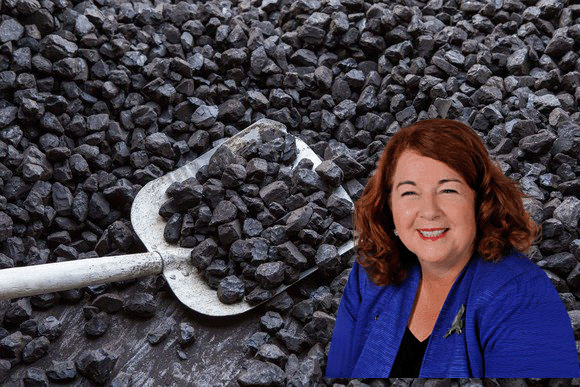 Two days before the federal election was called, Environment Minister Melissa Price signed off on Adani’s two groundwater management plans,meaning Adani had passed all the tests required by the Federal Government before it could start constructing its proposed Carmichael coal mine.
When announcing the decision, Ms Price said she was simply following the advice of scientists.
“I have accepted the scientific advice,” she said, declaring that CSIRO and Geoscience Australia had provided “assurances that these steps address their recommendations”.
Scott Morrison claims that the Liberal Coalition saved the Great Barrier Reef!!
 M’s claim Coalition saved reef from nonexistent ‘endangered list’ condemned as ‘ridiculous’, Guardian, Lisa Cox, Mon 13 May 2019
Scott Morrison says government took reef ‘off the endangered list’ – despite no such list existing. Scott Morrison has credited his government with having “saved” the Great Barrier Reef, a claim rejected as “ridiculous” by scientists, environmental groups and the Queensland government.
At the Liberal party’s campaign launch in Melbourne on Sunday, Morrison thanked the former environment ministers Greg Hunt and Josh Frydenberg for their work on reef issues.
“We have saved the Great Barrier Reef – well done to Greg Hunt particularly on his work when he was environment minister – taking it off the endangered list,” he said.
“We’ve invested record funds in researching and protecting its future thanks to Josh’s time as environment minister.”
Morrison’s statement contained more than one inaccuracy, including the suggestion the reef was on an “endangered list” at all.
“There is such a thing as the ‘in danger list’ for world heritage properties,” the coral reef scientist Prof Terry Hughes said. “The barrier reef was never on that list.
“If Morrison is claiming Hunt got Australia off the ‘in danger’ list, the obvious response is: it never was on it.”
In 2017, Unesco opted not to list the reef as in danger after reviewing the government’s Reef 2050 plan. But it will reassess that decision in 2020 and whichever party wins the federal election must submit an update on progress of the plan at the end of this year.
Hughes said recent surveys of the Great Barrier Reef showed the impact climate change and rising ocean temperatures were having on coral cover.
The Australian Institute of Marine Science – the government’s own agency responsible for monitoring reef health – reported in 2017-18 that trends in coral cover in the north, central and south reef showed steep decline that “has not been observed in the historical record”.
Hughes’s most recent paper found that the production of baby coral on the reef had fallen by 89% after the climate change-induced mass bleaching of 2016 and 2017.
Under the Liberal-National coalition government, Australia’s greenhouse gas emissions have continued to increase, which Hughes said was “an abject failure” for the Great Barrier Reef……… https://www.theguardian.com/environment/2019/may/13/scott-morrisons-claim-coalition-saved-great-barrier-reef-condemned-as-ridiculous?CMP=share_btn_fb&fbclid=IwAR0
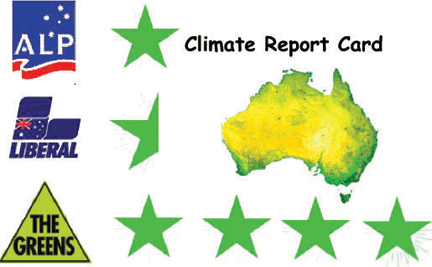
Where do the parties stand on climate and the environment?
|
The climate change election: where do the parties stand on the environment? Guardian, Adam Morton
With the global and local environment at crisis point, Australians have a clear choice at Saturday’s election. Here are the parties’ key policies This has been called the climate change election, and with good reason: concern about the climate and environment has never been greater. A Lowy Institute poll found nearly two out of three adults believe climate change is the most serious threat to Australia’s national interests, an 18-point-increase in five years. It was taken before a landmark UN global assessment defined the extent of the unprecedented biodiversity crisis facing the planet, with a million species at risk of extinction and potentially dire consequences for human society. Australia has a big stake in these issues. It is one of the world’s top greenhouse gas emitters on a per-capita basis and in the top 20 for total pollution, with a footprint greater than Britain or France. It is already experiencing the effects of climate change, including increased heatwavesand mass coral bleaching on the Great Barrier Reef, and is the global leader in mammal extinction. There are clear choices between the parties on these issues at this election. Guardian Australia looks at how the policies of the Coalition, Labor and the Greens line up. EmissionsCarbon pollution in Australia has been rising since the Coalition repealed carbon price laws in 2014. The country is on track to meet its modest Kyoto protocol target – that emissions be 5% lower in 2020 than in 2000 – but not 2030 targets. Coalition Under the Paris climate deal, the Coalition says it will cut emissions to 26% less than they were in 2005 by 2030. It is significantly less than what scientists advising the government say is necessary for Australia to play its part in meeting the goals of the Paris deal (a 45%-63% cut by 2030 compared with 2005). Scott Morrison explained in February how he planned to meet this goal. About eight points of the cut would come from using what are known as Kyoto carry-over credits. Unlike international and domestic carbon credits created through offset projects, Kyoto carry-over credits do not represent an actual reduction in carbon dioxide. They are bonus credits that Australia wants to award itself for beating the low 2020 target it set itself. It would just mean counting the same emissions cut twice. It is unclear if they will be allowed under the Paris deal; almost all other developed countries have said they will not use them. Developing countries do not have the option. Scott Morrison explained in February how he planned to meet this goal. About eight points of the cut would come from using what are known as Kyoto carry-over credits. Unlike international and domestic carbon credits created through offset projects, Kyoto carry-over credits do not represent an actual reduction in carbon dioxide. They are bonus credits that Australia wants to award itself for beating the low 2020 target it set itself. It would just mean counting the same emissions cut twice. It is unclear if they will be allowed under the Paris deal; almost all other developed countries have said they will not use them. Developing countries do not have the option. The Coalition nominates two other significant sources of emissions reduction. One is the direct action emissions reduction fund, now rebadged as the climate solutions fund, under which farmers and businesses bid for cash from taxpayers to cut pollution. The government announced in February it would spend an extra $2bn on it over 10 years, but that was stretched to 15 years in the April budget, including just $189m over the next four. While some projects backed by the fund are widely considered worthwhile, an investigation by Guardian Australia has found questions over its design and uncertainty over what taxpayers were getting for their money. The biggest flaw is in the administration of the other half of the direct action program, known as the safeguard mechanism. It was supposed to put a limit on industrial emissions to ensure they did not just wipe out the cuts taxpayers are buying through the emissions reduction fund, but in practice industrial emitters have mostly been allowed to increase pollution without penalty. The Coalition has criticised Labor for planning to use the safeguard mechanism to do what government frontbencher Greg Hunt designed it to do: reduce emissions. The other major measure on the Coalition’s carbon budget chart (see p8) is “technological improvements”, which have not been explained. An analysis by scientists from Climate Analytics released on Friday found the Coalition’s target was insufficient to deal with the climate challenge and said there was no evidence the government planned to release further policies. Labor Labor has a more ambitious emissions target: a 45% cut by 2030, which Climate Analytics says falls just within what is necessary for Australia to play its part in limiting global warming to 1.5C, and net zero emissions by 2050. Rather than an across-the-board carbon price similar to what it introduced in 2011, it is promising different policies for different parts of the economy. On electricity, it wants to bring in a national energy guarantee, a policy devised and abandoned by the Coalition. Similarly, for heavy industry, it plans to toughen up the government’s safeguard mechanism to set limits and reduce them over time. It is yet to say what the limits would be and the trajectory – how fast they would be cut – but it says both the electricity and industrial sectors will have to meet the 45% target. It wants 50% of new cars to be electric by 2030 and has pledged vehicle emissions standards to limit transport pollution, building on work done under the Coalition but not adopted. It would boost the use of carbon offsets from Australia, allow business to buy an undefined amount from offsets from overseas and has suggested it would limit land clearing. Despite some scary headlines about costs, Labor’s ambition and direction has been praised by policy analysts and scientists. But unanswered questions remain. It has not released a carbon budget explaining how it would hit the 45% target. And it has been accused of hypocrisy for a promise to spend $1.5bn to boost natural gas supply in Queensland and to connect the Northern Territory’s Beetaloo sub-basin to the east coast. Green groups say the emissions that result could dwarf those from Adani’s proposed Carmichael coalmine. Speaking of which: Labor has struggled to articulate a position on the mine. Shorten has expressed personal reservations but not committed to either blocking or supporting it. Greens The Greens want emissions cut by between 63% and 82% by 2030 compared with 2005, and zero emissions by 2040. Their policies include ending fossil fuel subsidies, phasing out fossil fuel mining and electricity generation by 2030, vehicle emissions standards that become a ban on new petrol-fueled cars by 2030 and an economy-wide carbon price to reflect the true cost of pollution. A new public authority, Renew Australia, would lead the transition to low emissions. Climate Analytics says the Greens’ goals sit well within what the scientific literature says would be Australia’s fair share of emissions cuts. Renewable energyCoalition The government does not have a renewable energy policy for beyond 2020……… The government has indicated it would underwrite some new energy projects, having released a shortlist of 12. The list includes one coal upgrade project in New South Wales. Labor Bill Shorten has promised 50% of electricity from renewable sources by 2030. He says he will aim to win support in parliament for the national energy guarantee, which would force energy companies to reduce emissions and meet reliability obligations. If unsuccessful, he would tip $10bn into the government’s green bank, the Clean Energy Finance Corporation, and create a $5bn fund to modernise the power grid. Other promises include $200m over the next four years for a household battery program, with a goal of 1m homes having batteries by 2025. Greens The Greens want the electricity grid to be 100% renewable energy by 2030. They would extend and boost the renewable energy target and back public investment, feed-in tariffs and regulations for clean generation, storage and energy conservation. Environment protection and threatened species…..Waste and recycling…..Great Barrier Reef….. https://www.theguardian.com/australia-news/2019/may/12/the-climate-change-election-where-do-the-parties-stand-on-the-environm
|
|
Climate emergency is here, whatever the election result – Editorial -The Age
 Whatever the election result, we must tackle climate emergency https://www.theage.com.au/environment/climate-change/whatever-the-election-result-we-must-tackle-climate-emergency-20190511-p51mcf.html May 11, 2019 Election 2019 is in its final week – and for many people that will be a relief.
Many voters have switched off from politics and been disengaged from the campaigning, which may be one reason why almost 2 million people have already voted.
But beyond the usual photo set-ups and faux outrage during the campaign, an issue of fundamental importance has gained greater prominence across the nation: climate change. It has become one of the fastest-rising issues of concern for Australians, as it has in many countries. Just over a week ago, the British parliament became the first in the world to declare a ‘‘climate emergency’’, and students across the globe have protested about the lack of action from all governments.
In Australia the issue has gained momentum on the back of relentless drought and a North Queensland flood in early February that killed tens of thousands of livestock and wildlife. A lack of coherent and effective policy on managing our waterways has also been blamed for the death of millions of fish in the Darling River near Menindee.
Last week we received another grim warning: a global report on biodiversity said 1 million species around the world face extinction. The 2019 report for the Intergovernmental Science-Policy Platform on Biodiversity and Ecosystem Services revealed the pace of destruction was as much as 100 times faster than the natural rate over the past 10 million years.
Few mainstream politicians in Australia deny that climate change is real. So why is there not enough being done about it? The main point of contention centres around the argument that given whatever Australia does in isolation will make negligible difference, why take risks on harming the local economy?
The obvious counter to that is that Australia is and must be a global citizen. We are all in this together and Australia must pull its weight. And we, like the rest of the world, must act now.
This paper has long argued for urgent action to bring down Australia’s emissions and to prepare the economy for a cleaner future.
In his landmark review of the impact of climate change in 2006, economist Sir Nicholas Stern warned governments to make the changes early or pay a much steeper price later. His analysis – updated in 2008 – was that ignoring climate change was many times more expensive than fixing it.
Australia did not heed his advice.
Climate action became nothing more than a political weapon for the Tony Abbott-led Coalition, especially through its attacks on the carbon-abatement scheme introduced by the Gillard government – a scheme that saw the country’s emissions fall.
According to the last report of the UN’s Intergovernmental Panel on Climate Change in October 2018, we have only 12 years to halve emissions – and almost eliminate them by 2050 – to keep the rise in temperature around 2 degrees above pre-industrial levels. Exceeding 2 degrees could trigger irreversible tipping points.
“There is nothing opaque about this new data,’’ Christiana Figueres, the former UN climate chief said. ‘‘The illustrations of mounting impacts, the fast-approaching and irreversible tipping points are visceral versions of a future that no policy-maker could wish to usher in or be responsible for.”
Whatever the result of this Saturday’s federal poll, our elected politicians would do well to emulate their British counterparts. A united approach to tackling this emergency is needed. The time for shallow partisan politics has long past.
Our future depends on it.
Torres Strait islanders to United Nations – allege Australian government failure to act on climate change
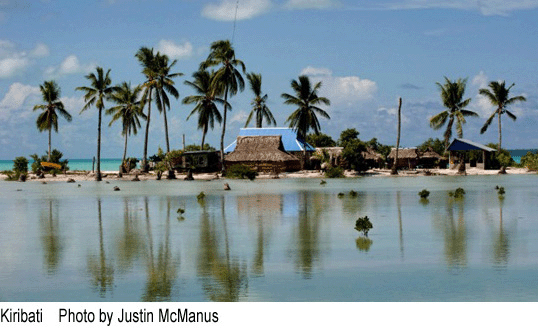 Torres Strait Islanders take climate change complaint to the United Nations https://www.theguardian.com/australia-news/2019/may/13/torres-strait-islanders-take-climate-change-complaint-to-the-united-nations Torres Strait Islanders take climate change complaint to the United Nations https://www.theguardian.com/australia-news/2019/may/13/torres-strait-islanders-take-climate-change-complaint-to-the-united-nations
Morrison government accused of failing to take action to reduce emissions or pursue adaptation measures A group of Torres Strait Islanders from low-lying islands off the northern coast of Australia will on Monday lodge a complaint with the United NationsHuman Rights Committee against the Australian government, alleging climate inaction.The complaint will assert that the Morrison government has failed to take adequate action to reduce emissions or pursue proper adaptation measures on the islands and, as a consequence, has failed fundamental human rights obligations to Torres Strait Islander people. One of the complainants, sixth-generation Warraber man, Kabay Tamu, said in a statement: “When erosion happens, and the lands get taken away by the seas, it’s like a piece of us that gets taken with it – a piece of our heart, a piece of our body. That’s why it has an effect on us. Not only the islands but us, as people. “We have a sacred site here, which we are connected to spiritually. And disconnecting people from the land, and from the spirits of the land, is devastating. “It’s devastating to even imagine that my grandchildren or my great-grandchildren being forced to leave because of the effects that are out of our hands. “We’re currently seeing the effects of climate change on our islands daily, with rising seas, tidal surges, coastal erosion and inundation of our communities.” The non-profit coordinating the complaint by the Torres Strait Islanders says this will be the first climate change litigation brought against the Australian government based on a human rights complaint, and also the first legal action worldwide brought by inhabitants of low-lying islands against a nation state. Lawyers with environmental law non-profit ClientEarth, are representing the islanders, with support from British-based barristers. The UN Human Rights Committee is a body of 18 legal experts that sits in Geneva. The committee monitors compliance with the International Covenant on Civil and Political Rights. The complainants are alleging that Australia has violated article 27, the right to culture; article 17, the right to be free from arbitrary interference with privacy, family and home; and article 6, the right to life. According to briefing material supplied by ClientEarth, the complaint alleges these rights have been violated both by Australia’s insufficient greenhouse gas mitigation targets and plans, and by its failure to fund adequate coastal defence and resilience measures on the islands, such as seawalls. Lawyers for the islanders allege that the catastrophic nature of the predicted future impacts of climate change on the Torres Strait Islands, including the total submergence of ancestral homelands, is a sufficiently severe impact as to constitute a violation of the rights to culture, family and life. The islanders want the government to commit at least $20m for emergency measures such as seawalls, as requested by local authorities, and sustained investment in long-term adaptation measures to ensure the islands can continue to be inhabited. They want a commitment to reduce emissions by at least 65% below 2005 levels by 2030 and going net zero before 2050 and a phase out of thermal coal, both for domestic electricity generation and export markets. ClientEarth’s lead lawyer for the case, Sophie Marjanac, said in a statement: “Climate change is fundamentally a human rights issue. The predicted impacts of climate change in the Torres Strait, including the inundation of ancestral homelands, would be catastrophic for its people. “Australia’s continued failure to build infrastructure to protect the islands, and to take action to reduce greenhouse gas emissions, constitutes a clear violation of the islanders’ rights to culture, family and life.” The impact of climate change has been a significant touchstone in the 2019 election. A recent poll from a respected foreign policy thinktank, the Lowy Institute, has found a majority of Australians believe global warming is a critical threat. The 2019 result is the first time climate has topped the list of threats since Lowy began the research in 2006. |
|
Adani project faces another hurdle – another groundwater review
Adani’s controversial Carmichael coal mine project is facing another hurdle, with the Queensland government seeking a further review of their groundwater plans.
Adani Mining’s chief executive Lucas Dow said the new request came from the Department of Environment and Science last Friday.
“It appears this process will again go beyond the scope of what our project is required to deliver under regulatory conditions – and, put simply, is another fishing expedition,” he said in a statement.
Federal Environment Minister Melissa Price signed off the company’s groundwater plans just before the start of the election campaign. ….
The new review means Adani can’t start construction on the mine which has been stuck in the courts and approval process for almost a decade.
The mine, to be developed in central Queensland’s Galilee Basin, has been a political football, with the country divided on the value of the $2 billion project.
It has dogged the federal election campaign and the coalition believes the Queensland Labor government is putting up road blocks to win over Green preferences in inner-city seats.
This is the second road block for the mine in less than two weeks, with the government recently rejecting Adani’s plans for managing the endangered Black-Throated Finch on the site………..https://www.sbs.com.au/news/adani-project-faces-another-hurdle
Bill Shorten urged to declare climate emergency if Labor wins
 Peter Garrett urges Bill Shorten to declare climate emergency if Labor wins
Former environment minister calls for creation of ‘war’ cabinet committee to plot transition to zero carbon, Guardian, Katharine Murphy Political editor@murpharoo 9 May 2019 The former environment minister Peter Garrett has urged an incoming Labor government to convene a climate emergency summit to plot a transition to zero carbon, and create a super department aligned to Treasury, like the Department of Post War Reconstruction after the second world war, to implement the transition…….
$571 billion loss by 2030 estimated for Australian property values due to climate change
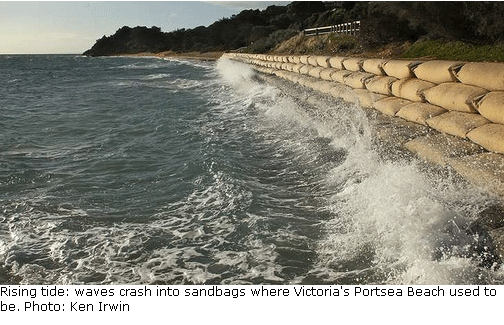 Climate change could slash $571b from property values, study warns, ABC, 10 May 19,
Key points:
- The Climate Council estimates Australian real estate will lose $571b, or almost 9pc, of its value by 2030
- The losses will be concentrated amongst 5-6pc of property owners, with many properties virtually uninsurable
- The report estimates $4 trillion could be wiped off economic growth over the next 80 years if carbon emissions do not fall
The research estimates residential property value losses of $571 billion by 2030 related to increased extreme weather events, inundation of some low-lying coastal properties and higher insurance premiums.
That would wipe approximately 9 per cent of the nation’s total residential property value — about as much as has been lost so far in the current property downturn, which is on track to be the worst in Australia’s recent history.
However, these losses would not be evenly spread, as an estimated 5-6 per cent of property owners bear the brunt of climate change risks.
As insurance companies reshape their risk strategies to manage extreme weather events, the report predicts, the cost of insuring properties — particularly those on the coast — could become unaffordable for one in 19 owners, who would have to pay annual premiums equivalent to 1 per cent of their property value.
A recent study by the Actuaries Institute — actuaries are the statisticians who calculate risk for insurers — warns that as many as one in 10 properties could become uninsurable by the end of this century due to climate change.
Climate risk expert and report author Karl Mallon warned insurance companies were constantly updating their risk strategies, and could hike premiums to deal with extreme events such as rising sea levels, heatwaves and floods.
“Increasingly, Australians are also going to struggle to pay for home insurance. On current trends, by 2030 one in every 19 property owners faces the prospect of insurance premiums that will be effectively unaffordable,” Dr Mallon said.
Even for Australians who can afford to pay, general insurance currently does not cover damage from coastal inundation and erosion — events which are likely to become more common because of climate change.”
‘There are real costs of failing to act’
The report also warns $4 trillion could be wiped off economic growth over the next 80 years if carbon emissions do not fall.
Climate Council chief executive Amanda McKenzie told The World Today both major parties needed to confront climate change with policies that showed political will……..
The new report, Compound Costs, says coastal areas are likely to be hit hardest, and highly populated areas such as the Sunshine Coast, the Gold Coast and Melbourne are all vulnerable. ……
Climate an election issue…..
The Climate Council research follows warnings from the Reserve Bank and the Australian Prudential Regulation Authority that climate change poses serious economic risks and that companies need to disclose their exposures to investors.
https://www.abc.net.au/news/2019-05-09/climate-change-could-wipe-571b-off-property-values/11096768
Scott Morrison and climate leadership ?
|
Fijian PM to call for climate leadership SBS, 8 May 19 Prime Minister Scott Morrison has admitted Australia’s emissions have increased, as a new report warns major change is needed to protect the environment. Scott Morrison has admitted Australia’s emissions have been rising, as a new international report shows climate change is a key factor driving species to extinction.”Yeah they have lifted,” the prime minister told ABC’s 730 program on Monday night, when asked about carbon emissions……
A new report warns that major change is needed globally to prevent further environmental destruction, with one million species currently at risk of extinction. The Intergovernmental Science-Policy Platform on Biodiversity and Ecosystem Services global assessment reveals nature is declining at rates previously unseen in human history. Frogs, big cats and birds are at great risk of extinction and change is needed now, co-chair of the report Sandra Diaz says. “When nature is in trouble we, and our wellbeing, are in trouble,” Prof Diaz told ABC Radio National on Tuesday. “Our style of consumption and production and trade and general lifestyles are costing us the earth, literally.” The report, which is based on 15,000 scientific and government sources, says the biggest drivers of environmental destruction are changes in land and sea use, exploitation of organisms, climate change, pollution, and invasive species. “Climate change is going to become an increasingly important driver,” Prof Diaz said. “We will be seeing an accelerated decrease in biodiversity … unless we change dramatically the way we trade, we consume, we produce, we do business.” Reducing the amount of meat we eat is an easy start, she added. Findings from the report will be used at a global conference next year in China, where leaders are expected to agree to a “Paris agreement for nature”. Labor leader Bill Shorten says climate change is one of the top four issues of the election. “The government just gets itself tied up in knots over doing anything, and in the meantime businesses and community and young people, they all just want real action on climate change.” Mr Shorten has come under pressure to explain the cost of his climate policies, which includes a 45 per cent emissions reduction target by 2030, but he says the cost of not acting is far greater.https://www.sbs.com.au/news/fijian-pm-to-call-for-climate-leadership |
|
Zali Steggall, Independent candidate for Warringah, aims to tackle the health impacts of climate change
 Zali Steggall promises action to stem health impact of climate change https://www.theguardian.com/australia-news/2019/may/06/zali-steggall-promises-action-to-stem-health-impact-of-climate-change 6 May 19,
The Warringah independent signs up to strategy to tackle problems of increased asthma, mental illness and heat-related deaths
Independent candidate for Warringah, Zali Steggall, has pledged to address the health impacts of climate change if she wins Warringah as an independent.
Like her fellow independent, Kerryn Phelps in Wentworth, Steggall signed up on Monday to the strategy developed by the Climate Health Alliance, which has more than one million health professionals behind it through their representative groups. It is pushing governments to start factoring climate change into their thinking about health policy, warning that a rise of 3C in world temperatures would have catastrophic consequences for the health of Australians.
Among the health impacts of climate change are an expected jump in severe asthma attacks, more disease due to severe weather events such as flooding, increased mental illness due to prolonged droughts and higher death rates among the elderly and chronically ill due to more frequent very hot days.
On 21 November 2016 thousands of people were taken ill and 10 people died in Melbourne due to thunderstorm asthma. High temperatures, thunderstorms and windy conditions blew rye grass pollen into the city causing the mass incident.
Melbourne has now implemented an alert system for epidemic asthma which operates during October and December each year when pollen levels are at their highest.
Mary Chiarella, professor of nursing at Sydney university, said increasingly warm weather meant there would be more out-of-season pollen that would extend the asthma risk season.
More hot days would drive hospital admissions putting additional stress – and costs – on the health system.
“[Economist] Warwick McKibbon says no action is not a zero sum game. Just because you don’t spend the money taking action, doesn’t mean it will deliver a zero cost,” said Steggall.
“We are in one of the most exposed regions to climate change,” she said.
Steggall said she would be pushing for the expert panel to look into the climate change impacts on health outcomes and to advise the government on its response.
“My point of difference [with Tony Abbott] is I do like facts and data,” she said, a reference to the criticism that Abbott has made of her expert panel proposal.
At a debate last week, Abbott said Steggall would be shirking her responsibilities as a parliamentarian when she said she would be “led by experts” on climate change policy and what emissions cuts the nation should commit to.
She also criticised Abbott’s focus on power costs due to measures to address climate change.
“The more people understand the other impacts on them personally, the more the case for action,” she said.
Australian Greens will push Australian Parliament to declare a “climate emergency”, as Britain has done
 Greens urge climate emergency declaration, https://www.sbs.com.au/news/greens-urge-climate-emergency-declaration 4 May 19, The Greens will push the Australian parliament to declare a “climate emergency” after the federal election, party leader Richard Di Natale says.The federal Greens will push for Australia to declare a national “climate emergency”, following in the footsteps of the UK.
With Britain’s parliament becoming the first in the world to make such a declaration, federal Greens leader Richard Di Natale says it’s time to do the same at home.
With Britain’s parliament becoming the first in the world to make such a declaration, federal Greens leader Richard Di Natale says it’s time to do the same at home.
“We’ve put forward proposals to the parliament already. We’ll be doing that again when we return to the parliament,” he told AAP on Saturday.
“We’re calling on both the Liberal and the Labor party to support what the conservative party in the UK have now adopted.”
Senator Di Natale says the push isn’t a lost cause in Australia’s political environment because “the pressure (to act) is building and it’s building very fast”.
“The major parties ignore the community at their own peril.”
The Greens leader also said he wanted environmental laws to be changed so projects had to specifically take into account their effect on climate change.
Senator Di Natale also backed Labor’s $1 billion pledge for environmental initiatives, including a native species protection fund and protecting beaches from erosion.
But the Greens want a “climate trigger” put into environment laws.
“Quite simply when any proposal is being put forward and the environment impact is being considered, what we have to do is make sure climate change is the first thing that’s considered as part of environmental impact,” Senator Di Natale said.
Adani coal mine expansion is the critical test for Australia’s climate action. We must stop it – Bob Brown
 ‘It is up to us,’ to stop Adani: Bob Brown’s dire warning on coal mine, SBS, 5 May 19, The stop Adani convoy has ended its long j
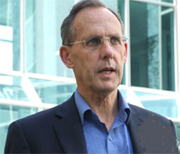 ourney in Canberra with a rally on the lawns of Parliament House where Paul Kelly performed.
Veteran environmental activist Bob Brown has told thousands of climate action supporters they can’t rely on divine intervention to prevent the Adani coal mine. “It is up to us”.
The former federal Greens leader led the stop-Adani convoy that began in Hobart just before Easter and travelled to Clermont in central Queensland before reaching its final destination in Canberra on Sunday where a rally was held on the lawns of Parliament House.
Organisers estimated there were 2,500 people at the rally – “a bigger crowd than Bill Shorten will face today and a bigger crowd than Scott Morrison will ever face”, Dr Brown said.
He told the crowd that neither of the big parties were willing to stop the Adani mine to secure the planet for Australia’s kids……..
Dr Brown told reporters the convoy had been peaceful and law abiding but participants had endured hardships along the route.
“We had rocks thrown at us, we had people spat on, some people were actually physically absued.”…..
Greens leader Richard Di Natale told reporters Australia was in the midst of a climate election.
“Right now the Adani coal mine is a test of whether Liberal or Labor are serious about stopping climate change and right now,” he said,
“Liberal and Labor have failed the test.”……. https://www.sbs.com.au/news/it-is-up-to-us-to-stop-adani-bob-brown-s-dire-warning-on-coal-mine
Young climate activist’s letter to Australia

‘I want my childhood back’: young climate activist’s letter to Australia, SMH ,By Bella Burgemeister, May 4, 2019, My name is Bella, I’m 13 years old and I’m a climate change activist and organiser……
My book – Bella’s Challenge – was published in 2017 and now all the schools in the South West region of WA have a copy! But there’s so much more to be done.
For most of my life, the major parties have done as little as they can get away with when it comes to climate change. Are we really that greedy that we can’t see the bigger, global picture?
Young people like me are the ones who will live with the consequences of inaction on climate
change.
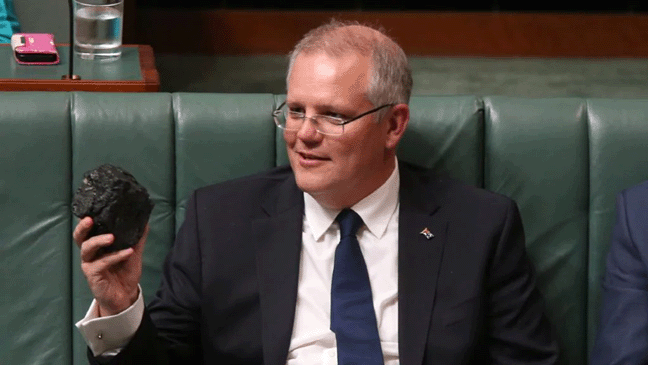
So, when I see our Prime Minister tossing around a lump of coal in the Parliament, I know I have to fight back. When I hear both future potential future prime ministers say they support the Adani coal mine, I know I have to fight back.
When the state government here in WA opens up an area two-thirds the size of Tasmania to gas fracking, I know that I have to fight back. And I’m not the only one.
I’m just one of tens of thousands of kids across Australiagiving up part of their childhood to fight for our future because we have so little time to turn around this human made disaster.
We’ve got until 2030 to get serious – that’s just three more elections – so we can’t waste another term of government.
The School Strike for Climate youth have three simple demands:
2. No new fossil fuel projects, especially drilling in the bight and fracking
3. 100 per cent renewable energy by 2030
The last action, which I was so proud to help organise, saw almost 200,000 young people around
Australia march in over 100 towns and cities.
The Prime Minister used the Parliament to tell us to stay in school, and the opposition leader told us we should have done it on the weekend – surely, he knows, as a former union boss, what the point of a strike is. This time we want to send an even bigger message!
This Friday, May 3, was a national day of action to remind the major parties that this is a climate change election.
Our demands aren’t radical, they’re the very least that needs to be done. They will take effort, but aren’t our futures worth it?
I want to stop worrying about my future and I want my childhood back.
Bella Burgemeister is a WA high school student and one of the key organisers of the WA ‘Schools Strike 4 Climate’ actions. https://www.smh.com.au/national/i-want-my-childhood-back-young-climate-activist-s-letter-to-australia-20190504-p51k2i.html
Schoolkids take their climate message to the politicians. Abbott pooh poohs it.
The earth has survived many things’, Abbott tells children protesting against climate change inaction, SMH, By Laura Chung and Jenny Noyes May 4, 2019 Dark clouds threatened rain as schoolkids gathered outside the Sydney electorate offices of both Labor and Liberal politicians on Friday, but it didn’t dampen their message on climate change.Prime Minister Scott Morrison, former prime minister Tony Abbott and Labor infrastructure spokesman Anthony Albanese were among those targeted as part of the nationwide protest against climate change inaction by federal MPs.
The protest held extra potency in Manly, where Mr Abbott’s 25-year grip on the seat of Warringah is under threat from independent candidate Zali Steggall in a campaign centred on climate change.
Armed with homemade signs, about a hundred students, parents and grandparents marched on Mr Abbott’s Manly office, chanting the slogan favoured by Steggall supporters: “Time’s up Tony”……..
A group of students tracked Mr Abbott down in a local cafe after the protest and voiced their concerns to him.
He also told them he didn’t believe the “environmental catastrophe” predicted by scientists would come about.
“I’m not saying that there isn’t going to be some time in the future when, for whatever reason, things come to an end, but I don’t believe that modest increases of atmospheric carbon dioxide concentrations over the next few decades are bound to bring about the kind of environmental catastrophe that you seem to fear.”……
Another protester dressed up in costume as Scott Morrison and a blackened piece of ‘coal’.
Another protester dressed up in costume as Scott Morrison and a blackened piece of ‘coal’.
Labor wasn’t let off the hook either.
Students also took their climate message to infrastructure spokesman Anthony Albanese’s Marrickville electorate office too, with a focus on urging Labor to pull the plug on the Adani coal mine. A Bill Shorten costume also made an appearance. https://www.smh.com.au/national/nsw/the-earth-has-survived-many-things-abbott-tells-children-protesting-against-climate-change-inaction-20190503-p51jts.html
Australia’s Liberal and Labor Parties on Climate Change – politics theme for May 2019
Federal Election: Whose climate change plan is better?
Shorten’s climate policy and why we don’t need to fear the Coalition’s ‘big scary numbers’ Guardian, Katharine Murphy, 2 May 2019
Scott Morrison wants voters to think that Bill Shorten is risky and reckless …
What’s the cost of not acting?
what Labor is saying is correct. It’s factual for this reason. Labor has set out the framework of its climate policies: the emissions reduction target, which is 45% (compared to the government’s 26%), and the various policy mechanisms to deliver that result.
But there is a fair bit of fine print missing because Labor wants to consult with stakeholders on final design before attempting to legislate the policy. …..
until we know the proportion of permits and a bunch of other things we don’t yet know – including what the Senate does to the policy if Labor wins – any number produced would be a guess. ….. https://www.theguardian.com/australia-news/2019/may/02/shortens-climate-policy-and-why-we-dont-need-to-fear-the-coalitions-big-scary-numbers
Climate change costings that don’t count the cost of inaction are worthless, Guardian, Greg Jericho 5 May 19 We must demand better of our political parties – and there is no excuse for the media either,Just seven months ago the United Nations told the world that we have 12 years to limit the climate change catastrophe. It means that to keep global warming to 1.5C above pre-industrial levels we need to cut carbon pollution by 45% by 2030 and down to zero by 2050. Twelve years. Actually scratch that – now it is 11 years.
 Now ask yourself how often that has been raised during this election campaign?
At the start of the 2019 federal election campaign Scott Morrison put out a video where he was all dewy-eyed about the future, saying “the next 10 years are important to everybody at every stage of life”.
And yet not once – NOT ONCE – did he mention that the UN has given us 11 years to do something about a global catastrophe.
No, instead it’s all standard of living and nothingness statements that would get shot down by any decent advertising firm 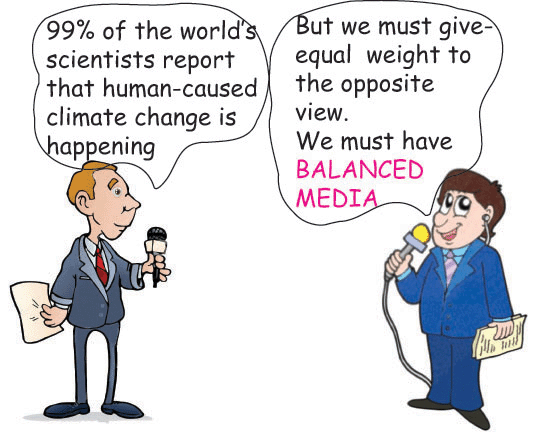 in the first meeting……..
Tony Abbott and his ilk – your time is done….
We need at a minimum a 45% reduction by 2030 and to get to zero net emission by 2050. So parties need to explain what they are going to do to get there and argue why their way is best.
1 This month


Help Aunty Sue Protect Her Land and Sacred Sites From Destructive Rocket Testing.
.

Australians deserve the truth
about
AUKUS – https://aukuspublicinquiry.com/

PETITION – To: Prime Minister Anthony Albanese and the Australian Labor Government

of the week – Australians for War Powers Reform (AWPR)
To see nuclear-related stories in greater depth and intensity

