Adani protesters shut down WA Parliament, ejected from public gallery
WA Today, By Nathan Hondros, March 19, 2019 Protesters against a coal mining project in Queensland briefly shut down question time in WA Parliament on Tuesday.
About eight protesters in the public gallery interrupted Housing Minister Peter Tinley to shout slogans about Adani’s Carmichael mine in Queensland’s Galilee Basin…….https://www.watoday.com.au/politics/western-australia/adani-protesters-shut-down-wa-parliament-ejected-from-public-gallery-20190319-p515kv.h
New South Wales school students rallied for climate action, despite the Premier’s disapproval
Students defy warning from Premier Gladys Berejiklian and skip school to attend Sydney climate rally, ABC News 17 Mar 19 By Antonette Collins and Kevin Nguyen Thousands of NSW students have skipped class to attend a protest in Sydney to call for action on climate change, defying calls from Premier Gladys Berejiklian and Education Minister Rob Stokes to stay in school.
The event at Sydney Town Hall was expected to be one of the largest of the nationwide climate rallies today.
The big crowd of young people, predominantly students, cheered loudly amid calls for an end to the Adani coal mine in Queensland and 100 per cent renewable energy by 2030.
Rock star Jimmy Barnes and Sydney Lord Mayor Clover Moore were among those who attended the rally, and were spotted alongside the students wielding colourful signs.
Many students were attending against the advice of the NSW Government’s leaders and conservative commentators.
Students have called on governments to do more to reduce fossil fuel emissions, but they have faced resistance from government leadership and conservative commentators.
Premier Gladys Berejiklian criticised Opposition Leader Michael Daley, who this week backed schoolkids planning to protest.
“I encourage young people to feel passionately about important issues including climate change,” she said.
“But to suggest that they should strike during school hours is grossly irresponsible. I want to encourage students during school hours to express their views, to discuss their views in the classroom or the playground.
“But to take time off to go to a protest is not acceptable…….
We’re here to make a change’
Around 2,000 students rallied in Newcastle, where many felt environmental issues were close to home.
“I can see the world’s largest coal port from my doorstep and it’s shameful,” said Miette Xenith, 17, from Newcastle High.
She said her generation was scared for the future “because at my age it’s kind of like staring down the barrel of a gun”.
“The Intergovernmental Panel on Climate Change has said that we have 12 years to completely change what we’re doing, before the impact is irreversible, so yeah, I feel strongly about it, because it’s my future.”
Newcastle student Molly Highet said she was angry at the Government’s inaction on climate change. “It’s scary thinking that if they don’t do anything real soon that we won’t have a good future, or maybe won’t have one at all, and our children won’t.
“They’re the ones that can really make a change, but now they’ve left it up to us so we’re trying to make the change for them.” https://www.abc.net.au/news/2019-03-15/nsw-schools-climate-change-rally-sydney-gladys-berejiklian/10904254
It’s time that the Liberal Coalition politicians stopped manipulating dissent about climate change – and apologised to the Australian public
 Malcolm Farr: ‘The public debate on the existence of climate change is over and we are owed an apology’
Some elected politicians have been too frightened or deliberately manipulative to acknowledge this issue. It’s time, writes Malcolm Farr. news.c om.au Malcolm Farr@farrm51 17 Mar 19, The public debate on the existence of climate change is over and we are owed an apology from those who prolonged it for self-serving political purposes.
They might acknowledge their disrespect for science, or for driving rejection as a vehicle for “brutal retail politics”.
Voices as varied as the schoolchildren who marched on Friday, the top ranks of Australia’s central bank, and federal department chiefs are warning of the consequences of those changes.
The debate continues, but it now is centred on measuring the urgency of a response to increasing climate instability, and the detail of that response.
Emergency services, diplomats and farmers are all seeking the best answers to climate change effects — effects which some of their flecked representatives for the better part of a decade said didn’t exist.
Military and intelligence agency leaders have warned climate change is a national security threat to Australia.
There still are holdouts, including a few reactionary MPs who continue to embrace Tony Abbott’s belief just over nine years ago that the science was “absolute crap”. And there is a fringe which make cases which can only be resolved by outlandish conspiracy theories, often along the dubious lines of the United Nations and One World Government.
And there are credible sources moving in the other direction.
Deputy governor of the Reserve Bank of Australia Guy Debelle last week made clear climate change is now a factor in tracking and guiding the economy; he gave no hint it was a UN plot.
But he did stress the need for an orderly transition to clean energy; a need for greater backing of renewable energy projects; preparing for new ways we work and the jobs available to us; and the broader task of readying the entire economy for change.
“Financial stability will be better served by an orderly transition rather than an abrupt disorderly one,” he said.
Last week, secretary of the Department of Home Affairs Mike Pezzullo mentioned climate change in a speech — Seven Gathering Storms — to a think tank.
Mr Pezzullo warned of states which might become ungovernable and a possibility of “mass displacement of people”.
Contributions to this displacement could be “poverty, hunger, water and resource scarcity, and a changing climate, which will have to be thought of as a systemic risk factor”.
These are just a few elements of government which have appreciated the existence and impact of climate change in ways some elected politicians have been too frightened or deliberately manipulative to acknowledge.
These are the folk who might consider an apology.
Tony Abbott is not the only denier in parliament but over a decade he has been the pacesetter if not the leader of that block of ignorance.
“The argument is absolute crap. However, the politics of this are tough for us,” he told a regional audience in December 2009.
“Eighty per cent of people believe climate change is a real and present danger.”
Just as Mr Abbott scorned majority views on same sex marriage, he early on resolved to ignore voters on climate change.
He used that rejection of evidence and local opinion to wreck the carbon price policy of Labor Prime Minister Julia Gillard, his offensive from Opposition against the so-called “carbon tax”.
His chief adviser in Opposition and when he became prime minister, Peta Credlin, in 2017 put that campaign into context.
“That was brutal retail politics, and it took Abbott six months to cut through and when he did cut through Gillard was gone,” she told Sky News.
And, Ms Credlin said, “It wasn’t a carbon tax, as you know.”
However, Mr Abbott was “hugely unconvinced” in 2009 and continued to harness his rejection of climate change science in 2017 in a speech he made in along on.
“Primitive people once killed goats to appease the volcano gods. We are more sophisticated now but are still sacrificing our industries and our living standards to the climate gods to little more effect,” he said.
But something happened 10 days ago.
Mr Abbott abruptly endorsed the UN backed Paris agreement on emission reduction, a process aimed at limiting climate change.
A sudden convert, he has yet to say sorry for his past rejection.
— Malcolm Farr is news.com.au’s national political editor. Continue the conversation @farrm51
Students’ climate action strike: 150,000 people at 60 locations across Australia
Students strike to demand climate action | ABC News
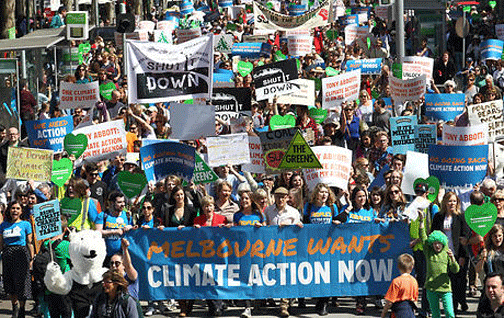
Climate strikes attract 150,000 supporters, https://www.sbs.com.au/news/climate-strikes-attract-150-000-supporters, 16 Mar 19, About 150,000 people took part in climate strikes across the country on Friday, with students planning more rallies if their demands for more action aren’t met. About 150,000 students, parents and activists have taken to the streets to protest over the federal government’s inaction on climate change.
Strikes were held across the country on Friday at 60 locations, as part of a global effort to shine a light on climate change.
The protests were estimated to be 10 times the size of those held in November. The students have three demands: stop the Adani coal mine in central Queensland, no new coal or gas, and 100 per cent renewables by 2030.
More strikes will be planned if the students don’t see the action they want from the government.
“If the politicians are just going to throw our futures away there’s nothing we can do but be out here and say: we’re not going to let you do that,” 15-year-old Olivia Boddington told AAP at a climate strike in Canberra.
“We’re not going to just go away.”
Huge crowds gathered across the country on Friday, including at Sydney’s Town Hall Square, outside Melbourne’s Old Treasury Building and in Brisbane’s CBD.
The movement was inspired by Swedish teen Greta Thunberg, who has been striking for climate action since last August.
The 16-year-old’s activism has earned her a Nobel Peace Prize nomination.
Senior cabinet minister Christopher Pyne criticised the students for striking, saying the move will damage their education.
However, Labor national president Wayne Swan defended student activism.
More drought, more heat, if a large El Nino event occurs in 2019
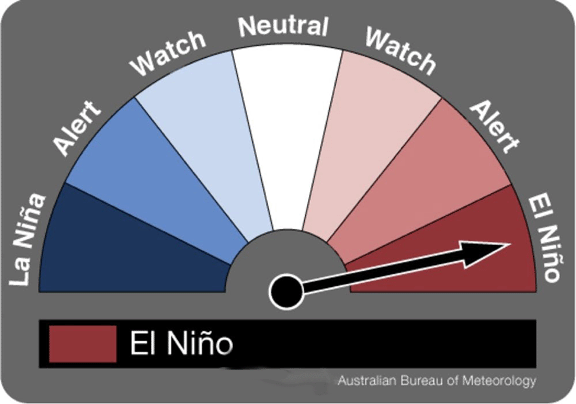 ‘Monster’ El Nino a chance later this year, pointing to extended dry times , Brisbane Times, By Peter Hannam, March 15, 2019 Relief for Australia’s drought-hit regions could be a long way off, with climate influences in the Pacific and Indian oceans tilting towards drier conditions and a large El Nino event a possibility by year’s end.
Climate scientists said the conditions in the Pacific were particularly concerning given an unusual build-up of equatorial heat below the surface that could provide the fuel for a significant El Nino.
If such an event transpires, the Great Barrier Reef would face another bout of mass coral bleaching while the drought gripping southern and eastern Australia could intensify.
Agus Santoso, a senior scientist at the ARC Centre of Excellence for Climate Extremes, said there were two likely outcomes from the developments in the Pacific. “We could have an El Nino fully formed by the end of May and then it could dissipate,” Dr Santoso said.
“The other is that by May it’s already formed and it still keeps building up… and by the end of the year we could have a monster El Nino.”
During El Ninos, the normal easterly winds blowing along the equator slow and even reverse. Rainfall patterns tend to shift eastwards away from south-east Asia and Australia, setting up conditions favourable for below-average rainfall and bushfires………..
Climate change and big events
Dr Santoso’s research, including a paper published late last year, has found the frequency of big El Ninos will increase with climate change.
That result is “quite concerning”, particularly for ecosystems sensitive to heat spikes such as coral reefs that suffered mass bleaching during the 2015-16 big El Nino.
“If we get one or two bleaching events, [the Great Barrier Reef] can recover, but if we keep having these events coming up then maybe the corals are not going to be able to adapt,” Dr Santoso said.
During El Ninos, the Pacific Ocean takes less heat from the atmosphere and even gives some up, giving global surface temperatures a bump up.
The trialling years of big El Ninos, especially 1998 and 2016 – the current holder of the world’s hottest year on record – are particularly warm.
An event later this year would likely see temperatures next year “spike up, and that’s not very helpful for global warming”, Dr Santoso said. https://www.brisbanetimes.com.au/environment/climate-change/monster-el-nino-a-chance-later-this-year-pointing-to-extended-dry-times-20190315-p514hi.html
Good to see former Australian Chief Scientist Penny Sackett with the kids in Canberra climate march
‘More effective than UN’: Student climate strike draws thousands https://www.canberratimes.com.au/national/act/more-effective-than-un-student-climate-strike-draws-thousands-20190315-p514fx.html 16 Mar 19Students have skipped school and marched through Canberra in their thousands to demand federal government action on climate change.
“We’ll stop acting like adults if you stop acting like children,” students told crowds gathered in Garema Place for the “School Strike 4 Climate” rally on Friday.
We’re skipping school today to do some teaching, we’re teaching politicians about science. We’re teaching them that coal causes climate change. We’re teaching them what happens if they continue to do nothing.”
Organisers estimate 150,000 Australian students flocked to 50 rallies across Australia on Friday, part of a global movement spanning more than 100 countries that began in Sweden last year with teen activist Greta Thunberg.
Roads were closed off in parts of Civic as crowds marched to Glebe Park, holding high home-made signs declaring “Don’t burn our future” and “I can’t go to school today, I’m saving the planet”.
While the first school climate strike in November last year drew attention, this time around students wanted action. They came prepared with a list of demands (which they chanted down the line of Prime Minister Scott Morrison’s personal phone in Canberra) – an end to new fossil fuel projects, including the controversial Adani coal mine, and a shift to 100 per cent renewable energy in Australia by 2030.
George, 10, explained why he chose to skip school as he waited for a squadron of classmates cycling over from North Ainslie Primary.
“The earth is warming up and if adults aren’t going to do something about it, we sure are,” he said.
Parents, grandparents, activists and academics also joined the march, including Australia’s former chief scientist Penny Sackett. The reality is that the approach taken by adults so far isn’t working,” Professor Sackett said.
“School children striking around the world may be the beginning of a social movement more effective than 25 years of UN climate summits.”
Fourteen-year-old Maanha Manzur was one of about a dozen student organisers behind the event, coordinating security, land permits and public liability insurance in between classes.
She said the ACT turnout had greatly outstripped the first strike, which saw about 500 students brave the rain outside Parliament House. More than 3500 people poured into the city for Friday’s rally, she said, and at least 2000 of them were students.
Some said they had defied their schools by attending but many said they had been supported to head along, with parental permission. Most scoffed at criticism from federal ministers, including the prime minister’s calls for students to focus on learning not activism.
“We’re here because we’re almost out of time.”
Also among the crowd were federal candidates Tim Hollo from The Greens and Labor’s Alicia Payne, as well as ACT Minister for Climate Change Shane Rattenbury. Mr Rattenbury said he was inspired by the strikers and suggested those still denying the science of global warming should go back to school themselves.
Education Minister Yvette Berry also backed the protest as “learning in itself” and said students would not be penalised for attending.
But shadow education spokeswoman Elizabeth Lee questioned who was really behind the strike and suggested skipping school was not the best way for students to get their point across.
“I would hate for them to have been used as a political pawn in a matter as serious as climate change,” she said.
On Friday afternoon, students shrugged off the suggestion, collapsing gratefully in the shade of Glebe Park after months of hard work.
“We do have our own minds,” one laughed.
“But it’s motivating to see so many people behind us, even my grandma’s here.”
Australia’s Previous Chief Scientist spells it out on global warming
Repeating this item. What a pity that the excellent full article has been removed from the Australian government website!
Why we must act now to reduce greenhouse gas emissions
Australian Government 8 Dec 09 Despite world attention, humans emit more greenhouse gases every year than they did the year before. It’s a situation that Australia needs to help turn around if we don’t want to bear the brunt of climate change, says Chief Scientist Professor Penny Sackett……
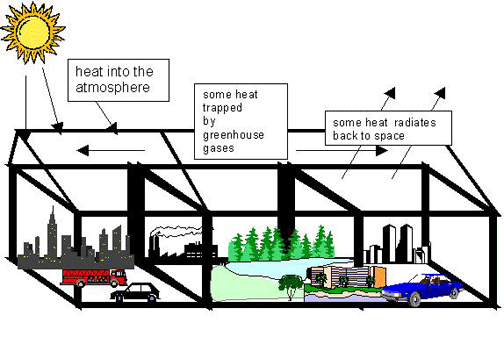
…..The Greenhouse Effect
The sun continuously bathes the Earth with energy in the form of sunlight. Much of this energy is absorbed by the Earth, and then emitted as infrared radiation, or heat. Greenhouse gases prevent the Earth from discarding as much of this heat as it otherwise would back into space.Without naturally occurring greenhouse gases, the Earth would be a much colder place, inhospitable to modern human existence. But by the same token, the additional greenhouse gases added to this store by humans is slowly increasing the average temperature of the Earth system.
Due to the quantity in which it is emitted by humans, its longevity in the atmosphere, and its effects in trapping heat, carbon dioxide is the most important of the greenhouse gases currently causing changes in the Earth’s climate……
In Australia, extreme fire danger days are already becoming more numerous in many parts of the country, and floods and cyclones more intense.
Research by the CSIRO indicates that the frequency of days with very high and extreme Forest Fire Danger Index ratings is likely to increase by 15 to 70 per cent by 2050 in southeast Australia…..
Why we must act now to reduce greenhouse gas emissions | Chief Scientist of Australia
New South Wales Labor leader sticks up for the right of school students to strike over climate change
Michael Daley says NSW schoolchildren have right to strike over climate change, Guardian, Anne Davies
State Labor leader says education is ‘bigger than the classroom’ as he applauds students for ‘standing up and taking action’
The New South Wales opposition leader, Michael Daley, has backed the state’s schoolchildren striking and attending rallies on climate change, saying it was a democratic right to protest and “an important way to realise their own personal power”.
Speaking at a National Press Club event in Sydney, Daley said he supported the rallies on Friday, even though he might soon be the premier and responsible for ensuring children attend school.
“Education is also bigger than the classroom. It is based on life experience. That is, in part, the importance of being confident and passionate enough to form beliefs and being prepared to stand up for them,” he said.
“They don’t have a microphone or money like the big end of town. But they do have their democratic right to assembly. I support that right to protest especially when it comes to climate change and our fragile environment.
“And more importantly in this inert digital age, of acting on that belief. Of standing up and taking action for what you believe in – it is called leadership.”
Labor has sought to distinguish itself from the Coalition by promising more rapid action on climate change, including installing seven gigawatts of regional solar farms and establishing a rebate scheme to encourage households to install a further two gigawatts of rooftop solar……… https://www.theguardian.com/australia-news/2019/mar/13/michael-daley-says-nsw-schoolchildren-have-right-to-strike-over-climate-change
Crikey.com devotes an entire edition to climate change
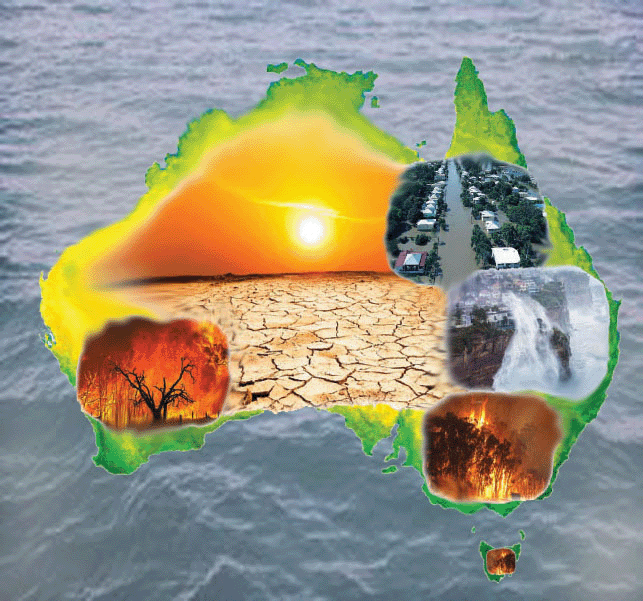 Today, Crikey dedicates an entire edition to covering climate change. The world has reached a tipping point on this issue. Voters now overwhelmingly accept the science, and denialists have increasingly been pushed to the fringes. Among other things, today’s edition looks at what the military is doing to prepare for climate change, and how environmental catastrophe could soon make the insurance industry redundant. This is the slow burn of climate change.
We believe climate change is an issue that needs to be talked about more.

Angus Taylor, Energy Minister, confirms that the Morrison government considering supporting new coal projects
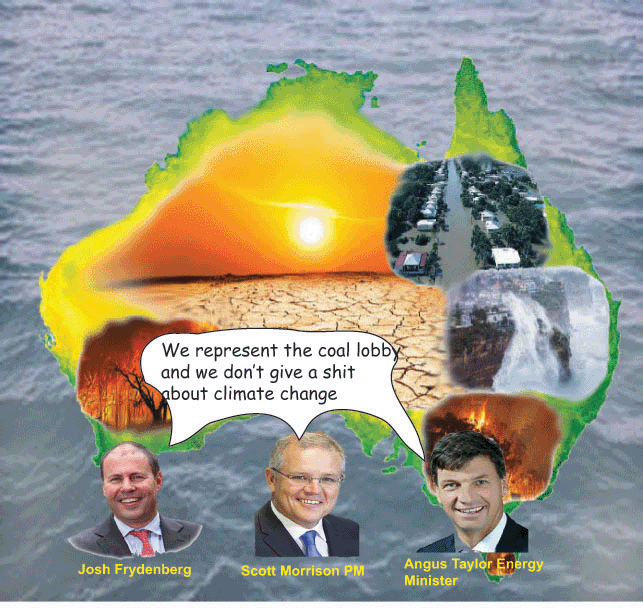
Angus Taylor says Coalition assessing new projects despite pushback from moderate Liberals, but says taxpayers will only support ‘viable’ projects
The energy minister Angus Taylor has confirmed the Morrison government is continuing to assess new coal generation projects despite pushback from moderate Liberals, but he says taxpayers will only support projects that are “viable”.
In a statement to Guardian Australia, Taylor confirmed the government was continuing to consider 10 coal projects through its power generation underwriting program, as well as new gas and pumped hydro proposals……
Taylor’s confirmation that new coal generation projects remain on the table for consideration comes as an open brawl is continuing within the Coalitionabout energy policy.
Queensland Nationals and the former deputy prime minister Barnaby Joyce are demanding the government commit taxpayer support to new coalregardless of whether or not the projects stack up economically, and city-based Liberals, under pressure from their constituencies, are pushing back against that offensive….. https://www.theguardian.com/australia-news/2019/mar/12/morrison-government-has-not-ruled-out-supporting-coal-energy-minister-says
Students strike to spur adults into climate action
Kids across the globe are protesting a failure of governments to cut greenhouse-gas emissions Science News for Students, KATHIANN KOWALSKI, MAR 11, 2019 “…… As of March 6, there were 596 planned events across 64 countries, according to a list kept by the group Fridays For Future.
A worldwide movement Many young protesters have drawn inspiration from Greta Thunberg. The 16-year old Swedish teen……..
began regularly protesting outside Sweden’s Parliament last summer. She also has encouraged kids to strike in other countries. She even spoke to delegates at the 2018 United Nations Climate Change Conference (UNCCC). It was held in December in Katowice, Poland.
“You say you love your children above all else, and yet you are stealing their future in front of their very eyes,” Greta told attendees at the UNCCC. There is still time to limit the worst impacts, she noted — but only if governments act now. “Until you start focusing on what needs to be done rather than what is politically possible,” she said, “there is no hope.”…..
“Climate denialism is like suicide,” Nakate Vanessa of Uganda, says of the people who argue climate change is not happening. “We cannot let ourselves perish as we look on without doing anything,” she says. “Not taking climate action is like locking yourself up in a house on fire.” …….
As Greta Thunberg told the United Nations meeting, “We have run out of excuses, and we are running out of time.” https://www.sciencenewsforstudents.org/article/students-climate-strike-march-spur-adults-climate-action
School students’ climate action strike, across Australia, on 15 March -and this is having its impact!
Students strike for climate change, defying calls to stay in school | ABC News
Australia’s young climate activists to strike again – and people are listening Students around the world have been holding protests over climate change in recent months, and they’re happening again in Australia this week. SBS, BY NICK BAKER 11 Mar 19, Australian students are once again planning to walk out of schools to protest climate change inaction.
Even more Australian students will strike for climate action, this Friday
We’ve been forced into this’: Australia’s school climate strikes to go global Guardian, Naaman Zhou@naamanzhou, 11 Mar 2019 In November, Scott Morrison told the striking students to ‘go to school’ – this time even more of them will strike Four months on, 17-year-old Doha Khan says the school climate strikers have learned a lot.
On Friday, thousands of primary and high school students are again planning to walk out of class across the country, protesting against the government’s inaction on climate change, and what they see as the destruction of their future.
Up to 50 rallies, in scores of regional towns, are planned for 15 March. This time, the students will be joined by others in America and Europe, in what has become a global movement.
At the November protests, thousands took to the streets. In Canberra, they met Greens senators, Labor MPs and the independent MP Rebehka Sharkie. They were told by the prime minister, Scott Morrison, to “go to school”, and by the resources minister, Matt Canavan, that they were “learning to join the dole queue”.
More recently, the New South Wales education minister, Rob Stokes, told students to stay in class because “you can’t strike if you don’t have a job”.
But the leaders of Friday’s strike say the movement has only grown, gained momentum, and become smarter.
“We really did take into account a lot of the criticism that came out of last year,” says Khan, who goes to the Glenunga International high school in Adelaide.
“There were claims that the kids were just striking and didn’t have any demands. So this time around we’ve made our demands a lot clearer.
“We have them set out on all banners: stopping the Adani coalmine. No new fossil fuel projects, 100% renewables by 2030.”
This year, the number of rally points has grown, mostly in regional areas. There are 18 in New South Wales alone – from Bowral to Byron Bay – and Khan feels enthusiasm has risen, rather than quietened down.
“This time our response rate has doubled,” she says. “Last time, a week before the strike, we had 1,000 responses on Facebook. This week we are over 2,300. We are now getting a hundred responses a day. That’s pretty cool – and this is just the Adelaide strike.”……..https://www.theguardian.com/environment/2019/mar/11/weve-been-forced-into-this-australias-school-climate-strikes-to-go-global
Climate change is a key issue for New South Wales election
 Climate change top of voters’ minds in NSW election SMH, By Alexandra Smith March 12, 2019 Climate change is a key election issue for most people in NSW, polling shows, as the environment emerges as a more pressing concern for voters than hospitals, schools and public transport.
Exclusive Herald polling shows that 57.5 per cent of voters say they will be swayed by climate change and environmental protection when deciding who to vote for on March 23…….
Internal party research showed climate change played a major role in last year’s Wentworth byelection and is shaping up to be a key issue in former prime minister Tony Abbott’s seat of Warringah.
With climate change again looming as an issue at the federal election in May, Mr Abbott on Friday abandoned his call to withdraw from the Paris agreement to reduce carbon emissions, falling in to line with Prime Minister Scott Morrison on the key policy………
The three independents – Sydney MP Alex Greenwich, Lake Macquarie MP Greg Piper, and Wagga Wagga MP Joe McGirr – are demanding Labor and the Coalition take action on climate change.
The crossbenchers, who will hold the balance of power if the government loses six seats, wrote to the Premier and Mr Daley last week asking them to act on transitioning from coal mining to clean energy……https://www.smh.com.au/politics/nsw/climate-change-top-of-voters-minds-in-nsw-election-20190311-p513bb.html
State of the drought – New South Wales , South Australia, Northern territory, Western Australia
State of the drought shows dams empty and NSW drowning in dust ABC Weather By Kate Doyle 12 Mar 19, It’s not good. Not good at all.
The hot dry summer has stripped the soils of moisture, water storages are down in every state and territory, and New South Wales is drowning in dust.
Key points:
- Water stores are down in every state and territory
- Keepit dam is empty and Dubbo’s dam could be empty by 2020
- A hot and dry summer has exacerbated low soil moisture, with a dry autumn forecast
So far this drought has been short but hard-hitting. The coming cold season will be a test of that descriptor.
Last year’s national farm production was down on the bumper year of 2016, but a good year in the west, decent prices and some moisture last summer softened the blow.
But with widespread low soil moisture, the pressure is on the arrival of cool-season rain.
The heat is making things worse
Lynette Bettio, a climatologist at the Bureau of Meteorology, said the big dry was affecting large parts of NSW, eastern South Australia and parts of the Northern Territory and northern Western Australia.
And despite the flooding rains in the north, even Queensland isn’t off the hook.
“The floods largely missed those areas of drought that we were covering,” Dr Bettio said.
“It did relieve some of those areas; those large totals of rainfall meant that some areas near the border with the NT are no longer in that bottom 10 per cent for those [drought-measuring] periods.
“But there’s still large parts of southern Queensland that are in that bottom 10 per cent of rainfall and lowest-on-record rainfall for those 11-month and 23-month periods.”…….. https://www.abc.net.au/news/2019-03-12/state-of-the-drought-is-not-good/10876716
1 This month

of the week – Australians for War Powers Reform (AWPR)
To see nuclear-related stories in greater depth and intensity
 Antinuclear