ALERT: Adani Contractor Locked Up and Blockaded
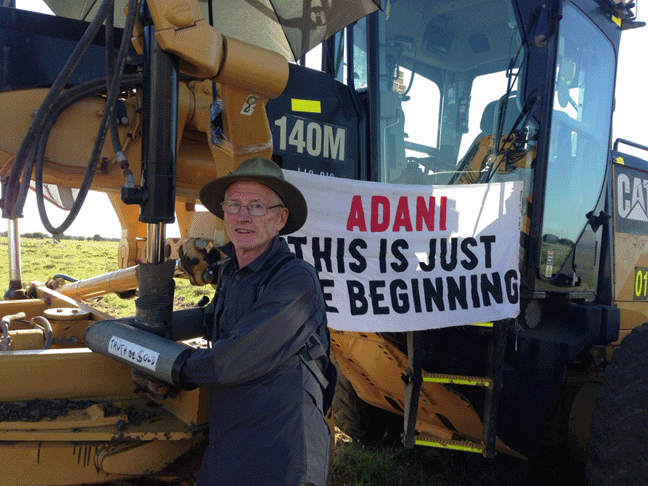 New Adani contractor Eastern Tree Services found themselves locked out of five premises in three states this morning, with citizens blocking work trucks at another two premises.
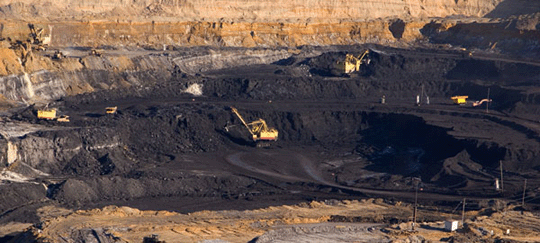
ETS, a large privately-owned company, operates tree clearing services from 20 sites across the country. They start tree clearing work at Abbott Point Coal Terminal this week and sources confirm ETS have accepted a contract to clear the rail corridor from Adani’s controversial Carmichael Coal Mine to link in with the existing railway travelling to Abbott Point. Jai, a spokesperson for Frontline Action on Coal said:
“ETS must listen to the majority of Australians who do not want Adani’s coal mine to go ahead and completely rule out destroying precious bushland for the proposed Adani rail corridor.”
This is not the first Adani contractor to be the target of long-running protests, with prior campaigns leading to banks, insurers and contractors ruling out supporting the mine. Emma from the Brisbane blockade protest said:
“Big businesses need to understand that if they work with Adani they will be held accountable for the damage to the reef, land, culture and climate that will ensue if Adani’s dirty coal mine goes ahead. Adani contractors like ETS will find themselves targets of ongoing protests until they rule out working with Adani.”
“Adani fail to get approvals and keep their promised work deadlines time and time again. They cannot be trusted and should not be allowed to build a climate wrecking coal mine that Australia doesn’t want, and the world doesn’t need.” SourceDoc Frontline Action on Coal: mailchi.mp/frontlineaction.org/adani-contractor-locked-out-as-warning-to-cut-ties-with-the-unpopular-carmichael-coal-mine
Bushfire in Adelaide Hills is still a threat
Just after 4pm on Sunday, the Country Fire Service issued an alert to residents around the Mt Lofty Ranges after a fire started on Montacute Rd, Montacute.
The fire, started from a discarded cigarette butt, was burning steep terrain, making it difficult for crews to access. The spread of the fire has been contained, however the hot and dry conditions forecast this week mean it could pick up again, the CFS say……….A severe fire danger warning, as well as a total fire ban, has been issued today for the Mt Lofty Ranges due to very hot and dry conditions. https://www.adelaidenow.com.au/news/south-australia/sas-breaking-news-blog-the-pulse-fire-crews-battle-uncontained-fire-in-mt-lofty-ranges/live-coverage/dc7bcd73c3c461533c4d8f911319fd20
Air conditioners make a massive contribution to global warming (Why not promote SOLAR air-conditioning?)

Why does this article not mention that solar-powered air conditioners are the most successful way to overcome this problem ?
Treaty on HFCs aims to curb global warming from greenhouse gases in air conditioning, refrigeration https://www.abc.net.au/news/2019-01-12/rising-demand-for-air-conditioning-alarms-climate-change-experts/10710956, ABC Weather By Ben Deacon In many parts of Australia, air conditioners have gone from being a luxury to what many consider a necessity.
It’s a trend that’s being echoed around the world as billions of people in hot counties lift themselves out of poverty.
But the explosion in demand for the energy-intensive appliance is alarming climate change experts, who say we’re heating the world up by cooling it down.
Victoria MacLean, who runs the Bureau of Meteorology’s weather station in Alice Springs, said the start of 2019 was unbearable, even by local standards.
“We had 11 days in a row recently of 40-degree-plus days. We had a 45.6 day. In fact we had another one like this as well and that did break the record for the Alice Springs airport,” said the meteorologist.
During the heatwave, Alice Springs had more days over 45 degrees Celsius in a single week than the town has recorded in the past 76 years.
Like most people in the desert community, Ms MacLean coped by running her air conditioner flat out.
“We closed off the downstairs side of the house and we actually stayed down there, we slept down there a few times, just to stay cool.
“We’ve got two dogs; we had to keep them inside because they just couldn’t handle it.”
But she does worry about the environmental impact of air conditioning.
“It’s kind of ironic that you’d been using the air conditioning, and we’ve got climate change going on, so we’re trying to conserve energy, but then you have to use more of it.”
Air conditioners’ environmental impact
Air conditioners are a double whammy in terms of climate change.
They’re the most energy-hungry appliance in the average home, which in Australia is mostly powered by fossil fuels, and the refrigerants inside air conditioners are potent greenhouse gases
Experts say demand for air conditioning is increasing so fast internationally that it will have a real impact on the earth’s climate. Continue reading
Bureau of Meteorology’ reveals Australia’s record-breaking month of climate change
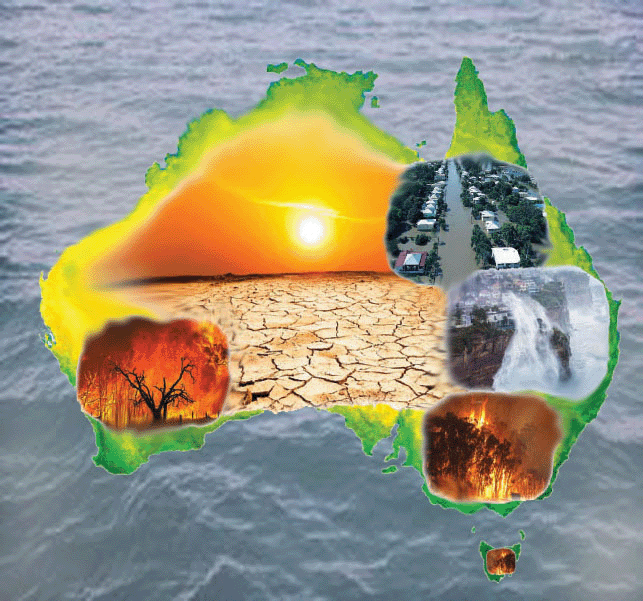 The stunning chart revealing Australia’s record-breaking run of rising temperatures https://www.brisbanetimes.com.au/politics/federal/the-stunning-chart-revealing-australia-s-record-breaking-run-of-rising-temperatures-20190110-p50qk1.html By Nicole Hasham10 January 2019
If there was any question Australians are enduring a more extreme, topsy-turvy climate, look only to the month just gone.
In early December, Cyclone Owen unloaded 678 millimetres of rain in one day on the tiny North Queensland town of Halifax. It was a new December daily rainfall
By mid-December, a month’s worth of rain fell in parts of Victoria in 24 hours. On December 20 it was Sydney’s turn when a monster thunderstorm dropped giant hail stones – some the size of cricket balls. The insurance bill is nearing $675 million.
Then, the sun came out. By month’s end, much of Australia was baking under torrid temperatures. Marble Bar in Western Australia reached 49.3 degrees – the third-highest December temperature recorded anywhere in the country.
Advertisement
The record-breaking events are outlined in the Bureau of Meteorology’s 2018 climate statement released on Thursday, which confirmed the nation experienced its third-warmest year on record in 2018. The bureau attributed the year of meteorological extremes to both climate change and natural variability.
The national mean temperature in 2018 was 1.14 degrees above average. Nine of the 10 warmest years on record have occurred since 2005.
The bureau’s senior climatologist Lynette Bettio said every state and territory experienced above-average day and night temperatures last year.
“The average maximum temperature for the country as a whole was particularly warm, sitting 1.55 degrees above the 1961-1990 average, making 2018 Australia’s second warmest year on record for daily high temperatures,” Dr Bettio said.
Australia’s September rainfall was the lowest on record. Nationally, rainfall in 2018 was the lowest since 2005 and 11 per cent below average, while rainfall in some areas was significantly further below normal.
“Large areas of southeastern Australia experienced rainfall totals in the lowest 10 per cent on record, which exacerbated the severe drought conditions,” Dr Bettio said.
“NSW had its sixth driest year on record, while the Murray-Darling Basin saw its seventh-driest year on record.
“We did see some respite in the final three months of the year with decent rainfall in the east of the country.”
In other significant weather events last year, Broome broke its annual rainfall record just two months into the year and Tropical Cyclone Marcus was the strongest to affect Darwin since Tracy in 1974.
In August and September, up to 100 bushfires were active across NSW, Queensland and Victoria when warm, dry conditions brought an early start to the bushfire season
The Morrison government has been riven with internal tensions over climate change policy. Under the Paris climate accord, Australia has vowed to reduce greenhouse emissions, based on 2005 levels, by 26 per cent before 2030.
The government says Australia will meet that target “in a canter” however this claim has been contradicted by international bodies and the government’s own data.
Most recently, figures released by the Department of Environment and Energy last month showed that on current trends Australia will reduce emissions by just 7 per cent on 2005 levels by 2030, a massive 19 percentage points or two-thirds of the way short of the Paris agreement.
A major report prepared by the United Nations body for climate change, the Intergovernmental Panel on Climate Change, in October said coal-generated electricity must be phased out globally by 2050 if the world is to avoid the most catastrophic impacts of global warming, including the total destruction of the Great Barrier Reef.
The bureau said Australia was strongly influenced by both natural variability and climate change in 2018. Natural drivers included sea surface temperatures in the southern Tasman Sea which rose to “exceptionally high levels” in late 2017 and early 2018, contributing to warm overland conditions.
The report said Australia’s climate “is increasingly influenced by global warming” and the nation has warmed by just over one degree since 1910. Most warming has occurred since 1950.
Australia could use a little-known loophole to help meet up to half its Paris climate commitments in a move that analysts warn could undermine the global accord.
It said radical, swift efforts must be taken to curb greenhouse gas pollution and keep the global temperature increase below the critical 1.5 degree threshold.
“The background warming trend can only be explained by human influence on the global climate,” the bureau said.
Climate change: Victoria’s iconic Great Ocean Road at risk from sea level rise
Great Ocean Road at risk from surging sea , Canberra Times, By Royce Millar, 10 January 2019 Key sections of the Great Ocean Road are at risk of being washed away, raising safety fears and calls for the Andrews government to reroute parts of the world-recognised tourist road.
New studies of dramatic beach erosion around Apollo Bay over the last two years highlight the mounting problem of erosion, flooding and sea level rise along Victoria’s coast.
In a report to the State government released exclusively to The Age, leading coastal geomorphologist Neville Rosengren and engineer Tony Miner recommend urgent action to protect the foreshore of Mounts Bay next to Apollo Bay, after major erosion there in 2017.
They warn the national heritage-listed road could be “compromised” within five years.
A second report on erosion at Apollo Bay by engineers GHD also recommends the eventual “realignment” of the road outside township areas at Apollo Bay. It notes that five metres of erosion at Apollo Bay beach during a June 2018 storm put the road “at risk”.
The studies point to erosion at critical levels at the very time the state’s south-west is hosting ever greater numbers of visitors, now more than five million a year.
Similar problems are being faced along the wider coast, from Port Fairy in the south-west to Inverloch and the Ninety Mile Beach and Lakes Entrance in the south-east and east……..
findings raise the prospect that rising seas due to climate change are now proving a real problem for vulnerable coastal locations.
Mr Rosengren said rising sea levels contributed to the erosion at Mounts Bay.
“You’re witnessing the effects of a complex of processes of which sea level is one,” he said.
The Intergovernmental Panel on Climate Change’s (IPCC’s) current projection for sea level rise, based on high emissions, ‘business-as-usual’ scenario, is almost 90 centimetres by the year 2100, relative to an average sea level for the period 1986-2005.
That projection will be updated, most likely upwards, in the IPCC’s special oceans report due for release this year.
Other peer-reviewed studies have forecast a much steeper rise in sea level by 2100.
……… While possible, realignment of the road would be difficult and expensive at Mounts Bay because the Barham River runs along the landward side of the road, making the area also susceptible to flooding.
…….. A quandary for all concerned is that sea walls of any form will alter the character of a coastline renowned for its rugged, natural beauty. Sea walls also interfere with the coast’s ecology and its ability to naturally replenish itself.
Bankrolled by public donations, the 243-kilometre Great Ocean Road was built by World War I veterans between 1919 and 1932 as a memorial to soldiers killed in the war, and to open the south-west coast to tourists and daytrippers. It was built as close to the ocean as possible.
……… A Victorian Department of Environment Land Water and Planning spokesperson said accounting for sea level rise was now “embedded” in the Victorian planning system.
The Age has sought an interview and comments from federal Environment Minister Melissa Price about the Morrison government’s policies on, and plans for, sea level rise. https://www.canberratimes.com.au/national/victoria/great-ocean-road-at-risk-from-surging-sea-20190110-p50qjb.html
Climate change denier Peta Credlin for Liberal preselection? That would finally blow up the Liberal Party!
The Liberal party is suffering an existential crisis. And no other issue defines this crisis like the looming threat to our safety and security caused by inaction on climate change. Credlin understands this and has used her position as a climate change-denying, hard-right mouthpiece of the Murdoch empire to advance her own political interests, and the interests of the coal industry.
She’s consistently claimed climate change is a political hoax, and used her position in the media to undermine a sitting prime ministerand any energy policy supported by the Coalition party room that does not involve more coal and the end of renewables.
She doesn’t represent real liberal views, and if she appeals to what’s left of the “base”, then many people who used to vote Liberal will keep moving for the exits.
Inspired by Donald Trump, Credlin has argued Australia should tear up the Paris agreement, tear up any sensible national energy guarantee. Credlin has demanded taxpayers’ money go to the Adani coalmine and be used to build new coal-fired power stations. It’s madness.
Australians don’t want this. We would prefer a Great Barrier Reef, renewable energy and a future we can survive and thrive in.
These views are so ignorant – their political manifestation through Tony Abbott, Craig Kelly and their ilk – that it presents a grave economic and security threat to Australia’s future. And it could be the final death knell to the Liberal party.
Credlin’s demonstrated lack of understanding of the serious climate emergency we face, or even the basic economics of power production costs are breathtaking. She promotes the view that climate change is some leftwing conspiracy and that the science is rubbish.
These views need to be called for what they are: dangerous.
In her media roles, Credlin has even attacked the scientific foundation for energy and climate policy. From the desk at Sky, she announced her displeasure that former prime minister Malcolm Turnbull asked chief scientist Alan Finkel for real consideration of the climate change transition and energy policy. Instead she demanded a manufactured report devoid of reality………
Australians know it’s getting hotter every summer and see the increases in extreme weather. Report after report, overflowing with scientific evidence, traditionally a solid foundation for investment and public policy making, has been abandoned by the federal Liberal party. We understand how this will threaten our families, economy and security, and we must act to provide people with a real liberal alternative.
Credlin, Abbott and the rest of the hard-right’s “commitment to coal” is entirely political. The calculation they’ve made is that their short-term political interests, and the interests of the coal industry, are more important than the future of our country, our people and holistically the environment we all share.
It is essential now that real liberals stand against this reckless game of Russian roulette the hard right are playing with our future. If not, they too will adorn the walls as climate change deniers, who, despite all the evidence, refused to act.
• Oliver Yates is a member of the Liberal party and former chief executive of the Clean Energy Finance Corporation https://www.theguardian.com/commentisfree/2019/jan/09/peta-credlins-preselection-could-be-the-spark-that-blows-up-the-liberal-party
TEACHER ATTEMPTS TO DERAIL PATH TO ECOCIDE TO ENSURE FUTURE FOR STUDENTS
 Frontline Action on Coal , 8 Jan 19 Frontline Action on Coal , 8 Jan 19
Early this morning, 37 year old teacher Jesse Secomb brought coal trains to a halt in protest of the proposed Adani Carmichael coal mine. Securing himself to a concrete barrel located on the railway tracks, Jesse has blockaded the transport of coal into Abbott Point Coal Terminal situated just outside of Bowen in Queensland. Jesse’s protest marks the first of its kind against Adani for 2019, following a magnitude of demonstrations in previous years as part of a nationwide movement against the mine after growing concern on the impacts the proposed mine will have on the environment and climate. Jesse stated that concerns about recent planned work by Adani on the mine inspired him to take urgent action. After declaring that work on the mine would start by Christmas, Adani has yet again failed to meet a self imposed deadline, instead blaming the QLD Governement after a recent request to review and resubmit their groundwater management plan after concerns were raised. When asked why action was needed, Jesse said “Working as a teacher, you really grow to care for your students and want to support them in realising their hopes and dreams. But what’s the good of dreaming about the future, if the future of the planet is in crisis? If the Adani mine goes ahead it will pump an extra 705 million tons of deadly carbon into the air, making it almost impossible to make the necessary changes over the next 12 years to avert a climate catastrophe.” He refers to the recent IPCC report by the worlds leading climate scientists which states that we only have 12 years to act on climate change and keep global warming within 1.5C, avoiding extreme heat, droughts, floods and poverty. Despite recent claims by resources minister Matt Canavan that communities of “David’s” were facing huge battles with Goliath’s of green activists, many of those protesting the mine are every day Australian’s who don’t want to see the even more Australians suffer from further drought, fires and heat as a result of inaction on climate change. |
Adani tries to bankrupt Wangan and Jagalingou man, Adrian Burragubba, I
 It’s the multi-billion dollar mega-mine set for Queensland. But one man is trying to stop it going ahead. And he isn’t going away. news.com.au Adrian Burragubba has been a thorn in Adani’s side for years and now the mining giant has had enough.
 Last month Adani filed an order seeking to bankrupt the Wangan and Jagalingou man by demanding payment of more than $600,000 in legal costs.
The extreme action follows numerous failed court actions that Mr Burragubba has been party to since 2015 to stop Adani’s coal mine in Queensland’s Galilee Basin from going ahead.
Mr Burragubba is part of the W&J People, who have a native title claim over about 30,000sq km of land in central Queensland, west of Rockhampton, including the townships of Clermont, Alpha, Rubyvale and Capella.
He’s a vocal member of the W&J Family Council disputing the validity of the indigenous land use agreement (ILUA) which Adani has secured from the traditional owners of the land.
The W&J had been negotiating with Adani since 2011 but were unable to reach an agreement so the company applied to the National Native Title Tribunal to grant them two mining leases.
The tribunal can order that mining leases be granted even if an agreement with traditional owners has not been reached.
In October 2013, the Queensland Government gave notice it intended to grant the leases and a six-month negotiation process started between the mining company and native title holders.
Australia’s first Indigenous silk Tony McAvoy has previously criticised the native title system because the tribunal rarely rejects applications for mining leases.
Mr McAvoy is a W&J traditional owner and he said Aboriginal people were being coerced into agreements with mining companies because if an agreement was not reached, they lost their opportunity to negotiate compensation or royalties.
“If we don’t agree, the native title tribunal will let it go through, and we will lose our land and won’t be compensated either. That’s the position we’re in,” Mr McAvoy told The Guardian.
…….At the meeting, which Mr Burragubba has claimed is not valid, there were 294 votes to approve the agreement and only one against.
But Mr Burragubba said the company failed to explain that once native title is relinquished it cannot be reclaimed.
“Our position has always been the same — that there has never been any free or informed consent with any agreement with Adani,” Mr Burragubba said in August.
However, legal action challenging the registration of the land use agreement was dismissed on August 17, 2018.
The decision was delivered after the Federal Government passed legislation to override a separate Federal Court ruling that all members of a native title group had to approve of an agreement for it to be valid.
The law change was important for Adani because its agreement did not get approval from all 12 families represented.
At that point, state and federal governments had already granted Adani all necessary state and federal approvals, although it still needs to submit groundwater and other plans.
But Mr Burragubba has refused to give up.
Another appeal was filed on September 7 and is due to be heard in May.
Adani tried to stop the most recent action, which was originally scheduled for February, by asking the court to force W&J representatives to pay $160,000 in security costs or have their appeal dismissed.
Adani’s lawyers said it had tried to recoup payment of $637,000 in legal fees from previous cases and had been unsuccessful. While the court agreed to the payment, it reduced the amount to $50,000 that must be paid by the end of January.
The decision was a blow to Adani, partly because its move also saw the court case delayed further and it will be heard in May instead.
After weathering years of legal actions from the W&J Family Council and other environmental activist groups, Adani appears to have had enough and is playing hardball. https://www.news.com.au/finance/business/mining/adani-tries-to-bankrupt-wangan-and-jagalingou-man-adrian-burragubba/news-story/46aefeeca5f02c61f73b3840cfdddad1?fbclid=IwAR1NuyfNRGivxa72zmUl0lBVb91I074dPmTeHqGzIfA6If0_ukjHTkVqepQ
Despite Tony Abbott, renewable energy investment has been promoted by Labor and the crossbench
Senate crossbench gave renewables $23bn boost by thwarting Abbott’s plan https://www.theguardian.com/environment/2019/jan/06/senate-crossbench-gave-renewables-23bn-boost-by-thwarting-abbotts-plan, Paul Karp@Paul_Karp Sun 6 Jan 2019
Decisions by Labor and crossbench to save clean energy agencies encouraged investment, report says The Senate’s decisions to stop Tony Abbott abolishing clean energy agencies helped create renewable energy projects worth $23.4bn, a new report says.
 The Australia Institute says decisions taken by Labor and the crossbench between 2013 and 2015 to
 save the Clean Energy Finance Corporation and Australian Renewable Energy Agency (Arena) have now secured $7.8bn in public funding and investment for clean energy.
Together with the renewable energy target – which was retained but reduced to 33,000GWh by 2020 – these measures will cut greenhouse gases by 334m tonnes over their lifetime, compared with 192m tonnes through the Coalition’s emissions reduction fund.
The Australia Institute released the Saved by the Bench report alongside polling that showed Australians supported the Senate’s role as a check on government power but were split on whether it blocked government legislation too often. Continue reading
Victoria’s bushfires could burn for weeks
 Bushfires across Victoria could burn for weeks, The Age, By Rachael Dexter, Liam Mannix, Rachel Wells & Simone Fox Koob, 5 January 2019, Firefighters will use a brief reprieve from the hot weather to try to get on top of a major bushfire in Gippsland – before temperatures start to rise again.
The bushfire at Rosedale, suspected to be deliberately lit, ripped through more than 10,000 hectares of scrub and forest before it was brought under control about 2.30am Saturday.
After a cool change following one of the hottest days in years on Friday, the mercury is forecast to rise to 31 degrees on Tuesday. Another cool front will bring relief Wednesday and Thursday with temperatures of 23 and 25 degrees.
But the fire, which is burning through a state park and pine plantation, could take weeks to extinguish. Gippsland will get a week of cool weather, before the temperature starts to get into the 30s next weekend. Firefighters hope to have it well under control by then. ……..
The Rosedale fire was the largest of more than 200 that burnt across Victoria on Friday, as high temperatures and fast winds combined to apply a blowtorch to the state. Melbourne recorded its hottest day in five years with a top temperature of 42.6 degrees…….. https://www.theage.com.au/national/victoria/bushfires-across-victoria-could-burn-for-weeks-20190105-p50prw.html
Australia’s wide swathe of mid-40 degree heat breaks records, and there’s more to come
 National records melt in ‘prolonged spell of heat’ with more to come, Brisbane Times Peter Hannam, 4 January 2019 A huge swathe of Australia baked in mid-40 degree heat on Friday, with more records likely to be broken at the tail-end of a heatwave that set a slew of national highs last month.
The mercury was tipped to reach at least 45 degrees over a region stretching from northern Western Australia into Victoria and the NSW Riverina.
Melbourne exceeded its predicted top of 42 degrees, reaching 42.6 degrees. Avalon, to the city’s west, reached 45.8 degrees before a cool change knocked that down to under 25 degrees in less than an hour.
Walpeup in the state’s north touched 46.6 degrees – not far shy of Victoria’s January record of 47.2 degrees set in 1939 – while across the border in South Australia, Marree got to 47.2 degrees…….
Mean temperatures for 2018 were the third-warmest on record, with the bureau due to release its year-end report in coming days.
All but one of the country’s top 10 hottest years have occurred since 2005, a result “in line with long-term trends resulting from anthropogenic climate change”, the bureau said in a preliminary summary on 2018’s national weather. https://www.brisbanetimes.com.au/environment/weather/national-records-melt-in-prolonged-spell-of-heat-with-more-to-come-20190104-p50pkf.html
Over 20 years of Australian governments failure to act on climate change
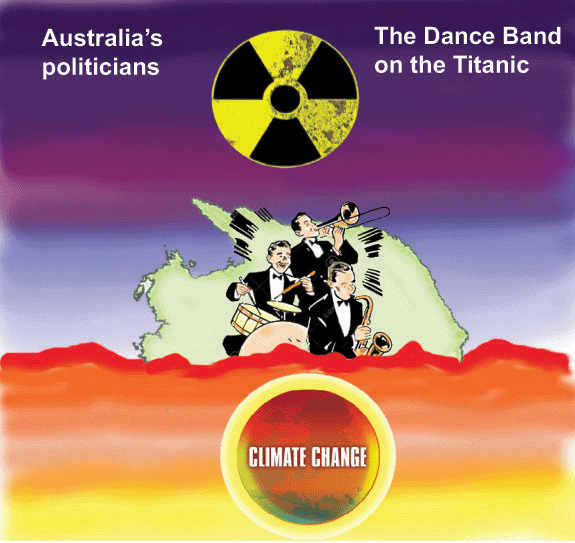 Climate warnings ignored
Twenty years on, only the names have changed, The Age 1 January 2019 The annual release of the federal Cabinet papers is usually a chance to reflect on issues long since settled. … the release today by the National Archives of Australia of the papers from John Howard’s cabinet deliberations of 1996 and 1997.
The most obvious is climate change and finding a way to reduce Australia’s greenhouse gas emissions.
The Cabinet papers reveal how the Howard government clearly rejected the advice of its most senior ministries that the most effective and efficient method to deal with the issue was via a price signal with an emissions trading scheme.
Howard government started the hypocrisy on climate change
Howard government told without a carbon price, emissions would rise, The Age, By Shane Wright, 1 January 2019 The Howard government was urged more than 20 years ago to consider an emissions trading scheme, while its signature plans to deal with Australia’s greenhouse gas emissions were considered by its own departments to be merely aimed at deflecting global criticism.
As the Morrison government continues to fight a debilitating internal battle over how to deal with climate change, previously secret papers from the 1990s reveal a suite of major government departments said the most effective and efficient way to deal with greenhouse gases was to impose a carbon price.
Cabinet papers from 1996 and 1997 released on Tuesday by the National Archives reveal the beginnings of the Howard government’s drawn-out response to the threat posed by rising greenhouse gas emissions and the way some of those issues are still playing out in the Morrison government.
Ahead of the expected adoption of the Kyoto Protocol in December 1997, there were deep concerns within the government about how it may affect Australia with its large coal exports, heavy dependence on coal-fired power stations and increasing LNG production.
Government departments headed by Prime Minister and Cabinet, Treasury and Foreign Affairs fleshed out the details of a series of proposals backed by the government in September 1997 in a bid to deal with Australia’s emissions.
The co-ordinating document produced by the departments, which were aiming to finalise a package discussed at cabinet earlier in the month, made clear the bureaucracy did not believe the government’s plans would go nearly far enough in cutting emissions but may be sufficient to deflect international criticism.
“None of the packages presented here would achieve the stabilisation of emissions at 1990 levels,” they said.
“Rather, they are aimed at deflecting criticism that Australia is not fully committed to reducing its emissions.”
The departments costed a series of proposals which would ultimately become part of the government’s official response to climate change…….
But the departments, which acknowledged the government’s opposition to a price signal, said these would ultimately be expensive initiatives which would not deliver a real impact on the nation’s overall emissions profile.
“The most effective way to reduce emissions would be to combine significant price signals (either general or sectoral increases in taxes on greenhouse producing activities), information so firms and individuals can reduce greenhouse production, opportunities to invest in carbon sinks and some degree of compulsion to address areas where markets cannot be made to work effectively,” they said…….
While a small number of Coalition MPs have backed subsidies for new coal-fired power stations, the cabinet documents from 1997 canvassed ways to use emission standards to effectively end brown coal-fired stations and encourage more gas into the system.
Last month, official figures showed Australia’s greenhouse gas emissions increasing to their highest level since 2011. Projections suggest Australia will fall well short of its stated aim of reducing emissions by between 26 and 28 per cent by 2030. https://www.theage.com.au/politics/federal/howard-government-told-without-a-carbon-price-emissions-would-rise-20181227-p50og9.html
Scorching temperatures sweep across Western Australia
|
|
|
|
Fighting Adani: An Interview With Wangan and Jagalingou Council’s Adrian Burragubba By Paul Gregoire | 21/12/2018

 “Indian mining giant Adani filed an application with the Federal Court last week asking that a legal challenge to its proposed Carmichael coalmine be thrown out, unless the Wangan and Jagalingou Traditional Owners fronted up with $160,000 in potential court fees within two weeks.
On Tuesday, Federal Court Justice Alan Robertson said that Adani’s demand was “disproportionate and unpersuasive”. He ordered that the traditional ownerspay $50,000 in security costs by the end of January or their legal challenge could not go ahead.
Adani’s attempt to have the Wangan and Jagalingou Traditional Owners’ case thrown out has caused the mining company further setbacks with its terminally delayed mine, as the case will now take place in May, when it was initially scheduled for next month.
The traditional owners are appealing an earlier ruling by the Federal Court. They assert that the Indigenous land use agreement (ILUA) that is essential for the Adani mine to go ahead is void. In August, Justice John Reeves found that this claim had “no merit”.
However, on Tuesday, Justice Robertson also upheld that the appeal will be going before the full bench of the Federal Court, as there’s an “arguable case of error” in the decision of the primary judge. …
Sydney Criminal Lawyers spoke with Wangan and Jagalingou spokesperson Adrian Burragubba about his thoughts on Adani’s latest tactic to try and thwart their ongoing opposition, why the Adani ILUA is a sham and how the system of native title needs a complete overhaul. … ”
Read the interview at the source document: www.sydneycriminallawyers.com.au/blog/fighting-adani-an-interview-with-wangan-and-jagalingou-councils-adrian-burragubba/
1 This month
7 April – WEBINAR – Australia and the Doomsday Clock – Preventing nuclear war through NoFirstUse and other policies
Online | Tuesday April 7, 4:00-5:30pm, Australian Eastern Time / 8:00-9:30am Central Europe Time
– Access the registration link
15 April – Zoom –Nuclear Power is Not the Solution
Apr 15, 2026 01:00 AM in Canberra, Melbourne, Sydney

Join the International Physicians for the Prevention of Nuclear War (IPPNW) on Tuesday, April 14th for a timely webinar exploring the risks associated with nuclear power and challenging the myth that it offers a simple, safe, carbon-free solution to the climate crisis

21 April Webinar: No Nuclear Weapons in Australia
Start: 2026-04-21 18:00:00 UTC Canberra, Melbourne, Sydney (GMT+10:00)
End: 2026-04-21 19:30:00 UTC Canberra, Melbourne, Sydney (GMT+10:00)
Event Type: Virtual
A virtual link will be communicated before the event.
Host Contact Info: australia@icanw.org

of the week – Australians for War Powers Reform (AWPR)
To see nuclear-related stories in greater depth and intensity
 Antinuclear