Sydney smashes 1 October heat record as Victoria fights bushfires

Sydney has endured its hottest ever start to October on record as fire
danger warnings were issued across NSW – and as two bushfires threatened
campers and towns in eastern Victoria.
Guardian 1st Oct 2023
Antarctic sea-ice at ‘mind-blowing’ low alarms experts
2
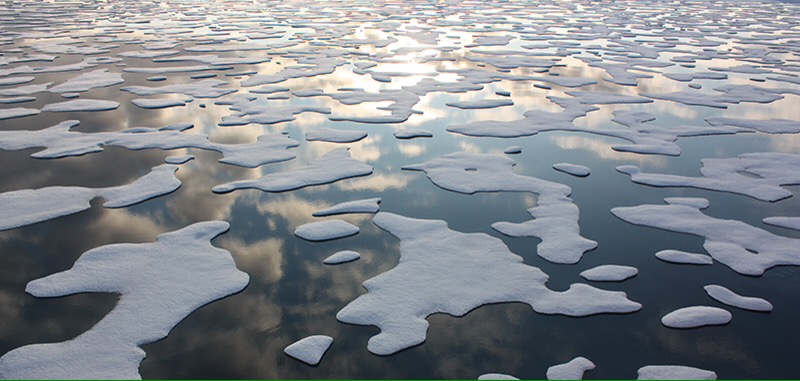
The sea-ice surrounding Antarctica is well below any previous recorded
winter level, satellite data shows, a worrying new benchmark for a region
that once seemed resistant to global warming. “It’s so far outside anything
we’ve seen, it’s almost mind-blowing,” says Walter Meier, who monitors
sea-ice with the National Snow and Ice Data Center. An unstable Antarctica
could have far-reaching consequences, polar experts warn. Antarctica’s huge
ice expanse regulates the planet’s temperature, as the white surface
reflects the Sun’s energy back into the atmosphere and also cools the water
beneath and near it. Without its ice cooling the planet, Antarctica could
transform from Earth’s refrigerator to a radiator, experts say.
BBC 17th Sept 2023
South-east Australia marine heatwave forecast to be literally off the scale.
Australia’s south-east could be in for a marine heatwave that is literally
off the scale, raising the prospect of significant losses in fishing and
aquaculture. The Bureau of Meteorology has forecast a patch of the Tasman
Sea off Tasmania and Victoria could be at least 2.5C above average from
September to February, and it could get hotter.
Guardian 27th Aug 2023
‘Bigger threat than China’: Defence leaders urge release of ‘scary’ climate report

“It’s a much bigger threat to our national security than a potential fight with China
“This is about transparency and keeping people informed.”
By Matthew Knott,, April 5, 2023 https://www.theage.com.au/politics/federal/bigger-threat-than-china-defence-leaders-urge-release-of-scary-climate-report-20230404-p5cxuf.html
A group of leading defence figures is urging the Albanese government to release a secret report on the national security risks of climate change even though its contents may alarm Australians.
Former Defence Force chief Admiral Chris Barrie said climate change posed a bigger risk to Australia than China’s rapid military build-up, and it was crucial to inform the public about the security implications of warmer temperatures, rising sea levels and increased natural disasters.
Potential impacts included famines caused by global warming, conflicts over access to scarce resources and the mass migration of people to Australia from vulnerable Asia-Pacific nations in the coming decades.
“We are worried about the possible collapse of societies because of starvation, a lack of fresh water and shortages of food supplies,” said Barrie, a member of the Australian Security Leaders Climate Group.
Barrie said he understood the Office of National Intelligence (ONI) had delivered a landmark report on external climate risks to the government in December but a declassified version had not been released to the public.
“I expect it might contain things that are a bit scary, but we’re adults and we are up for it,” he said. “This is about transparency and keeping people informed.”
As the government prepares to spend up to $368 billion on nuclear-powered submarines over the next three decades under the AUKUS pact, Barrie said: “I see climate change as an existential threat.
“It’s a much bigger threat to our national security than a potential fight with China or some other conflagration. Only a nuclear war could be more catastrophic.”
Labor went to last year’s federal election promising to deliver a strategic climate security threat assessment and put ONI director-general Andrew Shearer in charge of the project soon after taking government.
Barrie said famine helped trigger the 1917 Russian Revolution and the phenomenon could recur in other countries in coming decades as a result of global warming.
Australia’s large land mass and relatively small population would make it an attractive destination for people displaced by climate change, he said.
The retired navy officer, who led the Defence Force from 1998 to 2002, said Australians living on flood plains and in bushfire zones should also be informed about the domestic threats posed by climate change, which are believed to be examined in a separate report by the Office of National Intelligence.
Spokespeople for the Office of National Intelligence and the Department of Prime Minister and Cabinet declined to comment on whether a public version of the report, which is based on classified information, would be released.
The Australian Security Leaders Climate Group, which includes retired air vice-marshal John Blackburn and the Department of Defence’s former head of preparedness and mobilisation, Cheryl Durrant, said nations such as the United States and United Kingdom had released public versions of similar reports on the national security risks of climate change.
The federal government had also released declassified reports on threats such as cyberattacks and COVID-19 to help inform the public, they said.
US President Joe Biden’s director of national intelligence, Avril Haines, has described climate change as an urgent national security threat, saying it was likely to increase global political instability in future decades.
‘Extreme situation’: Antarctic sea ice hits record low

Damian Carrington 16 Feb 23
https://www.theguardian.com/world/2023/feb/15/antarctic-sea-ice-hits-record-low-climate-crisis
The area of sea ice around Antarctica has hit a record low, with scientists reporting “never having seen such an extreme situation before”. The ice extent is expected to shrink even further before this year’s summer melting season ends.
The impact of the climate crisis in melting sea ice in the Arctic is clear in the records that stretch back to 1979. Antarctic sea ice varies much more from year to year, which has made it harder to see an effect from global heating.
However, “remarkable” losses of Antarctic sea ice in the last six years indicate that the record levels of heat now in the ocean and related changes in weather patterns may mean that the climate crisis is finally manifesting in the observations.
Scientists were already very concerned about Antarctic ice. Climate models suggested as far back as 2014 that the giant West Antarctic Ice Sheet (WAIS), which sits on the continent, was doomed to collapse due to the levels of global heating already seen then.
The increasing loss of sea ice exposes ice sheets and their glaciers to waves that accelerate their disintegration and melting, researchers warned. A recent study estimated that the WAIS would be tipped into gradual collapse – and four metres of sea level rise – with a global temperature rise as low as 1C, a point already passed.
“I have never seen such an extreme, ice-free situation here before,” said Prof Karsten Gohl, from the Helmholtz Centre for Polar and Marine Research in the Alfred Wegener Institute, Germany, and who first visited the region in 1994.
Gohl, on board the research vessel Polarstern in Antarctica, said: “The continental shelf, an area the size of Germany, is now completely ice-free. It is troubling to consider how quickly this change has taken place.”
Prof Christian Haas, also at the Helmholtz Centre, said: “The rapid decline in sea ice over the past six years is quite remarkable, since the ice cover hardly changed at all in the 35 years before.”
Scientists at the National Snow and Ice Data Center in the US have also said a new record low has been set. They said Antarctic sea ice extent fell to 1.91m square kilometres on 13 February, below the previous record set on 25 February 2022.
Sea ice melts away in the Antarctic summer before starting to grow again as autumn arrives. “In past years, the annual minimum has occurred between 18 February and 3 March, so further decline is expected,” the NSIDC researchers said. “Much of the Antarctic coast is ice free. Earlier studies have linked low sea ice cover with wave-induced stresses on the floating ice shelves that hem the continent, leading to break up of weaker areas.”
The German scientists said the “intense melting” could be due to unusually high air temperatures to the west and east of the Antarctic peninsula, which were about 1.5C above the long-term average. Furthermore, there have been strong westerly winds, which increase sea ice retreat. The result is “intensified melting of ice shelves, an essential aspect of future global sea-level rise”, the researchers said.
Historical records also show dramatic changes in Antarctica, they said. The Belgian research vessel Belgica was trapped in massive pack ice for more than a year in the Antarctic summer 125 years ago, in exactly the same region where the Polarstern vessel is now sailing in completely ice-free waters.
Prof Carlos Moffat, at the University of Delaware, US, and recently returned from a research cruise in the Southern Ocean, told Inside Climate News: “The extraordinary change we’ve seen this year is dramatic. Even as somebody who’s been looking at these changing systems for a few decades, I was taken aback by what I saw.”
Former Australian PM Tony Abbott joins board of UK climate sceptic thinktank

Christina’s note: The mad monk rides again. Madder than ever. As he’s an enthusiastic promoter of the nuclear industry, it is puzzling that Abbott is still a climate denialist.
Nowdays, the nuclear industry pushes their lie that nuclear beats global heating. So a good nuclear zealot should believe in climate change.
Abbott says ‘we need more genuine science and less groupthink’ in announcing position at Global Warming Policy Foundation
Guardian. Graham Readfearn 7 Feb 23
The former Australian prime minister Tony Abbott has joined the board of a UK-based thinktank that has been highly critical of climate science and action on global heating.
Since its launch in 2009, the Global Warming Policy Foundation has become known for its consistent attacks on climate science, the risks of global heating and – more recently – policies to reach net zero greenhouse gas emissions.
The group, founded by the former Thatcher government treasurer Sir Nigel Lawson, is facing a complaint from three UK MPs and a not-for-profit campaign group accusing the GWPF of inappropriately claiming status as an educational charity while carrying out lobbying and skewed research.
Abbott said he was pleased to join the foundation “because it’s consistently injected a note of realism into the climate debate”………………
Dr Jerome Booth, the foundation’s chairman, said Abbott brings “a global perspective and policy insight at the very highest level” and he would help the group “to foster a culture of debate, respect and scrutiny in policy areas that are currently dominated by intolerance, high emotions, moral reasoning and confusion”.
Abbott is currently an adviser to the UK government’s Board of Trade. His name was raised last month as a possible replacement for the late senator Jim Molan in the upper house.
During his prime ministership between 2013 and 2015, Abbott drove to dismantle much of the country’s public policy architecture on climate change, successfully repealing a legislated price on carbon, defunding the independent Climate Commission but failing to dismantle the Climate Change Authority and the Australian Renewable Energy Agency.
In 2017, he flew to London to deliver the GWPF’s annual lecture, where he suggested natural factors could be to blame for global warming, that CO2 was a trace gas and hinted at a global conspiracy to tamper with temperature data to make global heating seem worse.
The foundation is seen as influential among some conservatives. Conservative MP Steve Baker resigned as a GWPF trustee when he became minister for Northern Ireland.
A group of Conservative MPs and peers – several with links to the foundation – have formed the Net Zero Scrutiny Group, which has used the GWPF’s work as part of its advocacy.
The GWPF’s non-charitable arm – the Global Warming Policy Forum – runs a project called Net Zero Watch, which claims to scrutinise climate and decarbonisation policies.
The foundation has several Australian links. As the Guardian reported, one of its earliest funders was Australian billionaire hedge fund manager Sir Michael Hintze, who last year was handed a seat in the House of Lords at the recommendation of the former UK prime minister Boris Johnson.
Four Australian climate sceptics sit on the GWPF academic advisory board, including mining industry figure Prof Ian Plimer and controversial marine scientist Dr Peter Ridd of the Institute of Public Affairs, an Australian thinktank known to promote climate science denial.
The late Cardinal George Pell also delivered a GWPF annual lecture in 2011.
Presenting a report last year, the GWPF’s director, Dr Benny Peiser, said: “It’s extraordinary that anyone should think there is a climate crisis.”
Last year three MPs – one each from Labor, the Greens and the Liberal Democrats – joined with a not-for-profit campaign group to complain to the UK’s Charity Commission.
The group questioned if the GWPF was breaking charity rules by commissioning unbalanced research and carrying out political advocacy from charitable funds……………….. https://www.theguardian.com/australia-news/2023/feb/07/former-australian-pm-tony-abbott-joins-board-climate-sceptic-thinktank-global-warming-policy-foundation
‘Save the only planet we have’: Tony Abbott joins climate-sceptic think tank
EMMA ELSWORTHY, FEB 07, 2023 https://www.theguardian.com/australia-news/2023/feb/07/former-australian-pm-tony-abbott-joins-board-climate-sceptic-thinktank-global-warming-policy-foundation
The former Australian PM says he has joined the Global Warming Policy Foundation, a UK think tank founded by a ‘climate denier-in-chief’.
Former prime minister Tony Abbott, who once compared taking action on climate change with killing goats “to appease volcano gods”, has joined the board of a UK climate-sceptic think tank founded by a politician dubbed “the climate denier-in-chief”.
Abbott said he was pleased to join the Global Warming Policy Foundation (GWPF), which “consistently injected a note of realism into the climate debate”, despite the charity spearheading the backlash against the UK government’s net-zero goal.
“All of us want to save the only planet we have, but this should not be by means which impoverish poorer people in richer countries and hold poorer countries back,” Abbott said of his appointment.
“Right now, in countries like Australia, the impact of climate policy is to make electricity less affordable and less reliable rather than perceptibly to cool the planet.
“We need more genuine science and less groupthink in this debate. That’s where the GWPF has been a commendably consistent if lonely voice.”
The GWPF was founded in 2009 by Thatcher-era chancellor Nigel Lawson, who reportedly resigned from the House of Lords last month. Described by UK Green Party co-leader Adrian Ramsay as the “climate denier-in-chief”, Lawson claimed that “global warming is not a problem” in a 2021 article written for The Spectator during the COP26 in Glasgow.
The foundation’s director, Benny Peiser, also made headlines for spurious statements, including that he found it “extraordinary that anyone should think there is a climate crisis” and that climate “alarmism” was driven by “scientists’ computer modelling rather than observational evidence”.
Despite Lawson’s apparent departure from politics, his foundation continues to cause a headache for UK Prime Minister Rishi Sunak. There has been outrage after a UK register of interests disclosure revealed Conservative MP Steve Baker accepted a £10,000 (A$17,464) donation from the chair of GWPF’s Net Zero Watch.
The campaign arm has urged the UK government to recommit to fossil fuels, commission a fleet of coal-fired power plants, and wind down wind and solar completely, while its alleged breaches of charity law were the subject of a complaint from three British MPs in October.
This isn’t Abbott’s first brush with the foundation. In 2017 he delivered an eyebrow-raising annual lecture that suggested climate change was “probably doing good; or at least, more good than harm”.
Abbott also claimed that photos from his electorate showed the sea level hadn’t risen. (The Bureau of Meteorology found last year that the rates of sea level rise to the north and south-east of Australia have been “significantly higher” than the global average for the past 30 years.)
“Contrary to the breathless assertions that climate change is behind every weather event, in Australia the floods are not bigger, the bushfires are not worse, the droughts are not deeper or longer, and the cyclones are not more severe than they were in the 1800s,” Abbott said at the time.
In an echo of Lawson’s claim that rising temperatures are “no bad thing: many more people die each year from cold-related illnesses than from heat-related ones”, Abbott suggested in 2017 that sweltering heatwaves are good, actually.
“There’s the evidence that higher concentrations of carbon dioxide (which is a plant food after all) are actually greening the planet and helping to lift agricultural yields,” he said. “In most countries, far more people die in cold snaps than in heatwaves, so a gradual lift in global temperatures, especially if it’s accompanied by more prosperity and more capacity to adapt to change, might even be beneficial.”
Heat is the biggest natural killer in Australia (and in the US) and has been for the past 200 years, with fatalities outstripping all other natural killers including bushfires, cyclones and floods. Research has found there were 36,000 deaths associated with heat in Australia between 2006 and 2017.
Population growth is not a good thing, it’s a bad thing.

All this enthusiasm for Australia to grow its population! Hasn’t anybody noticed that vast swathes of this continent are getting flooded? Then there have been vast swathes on fire – with hitherto unknown soaring fire temperatures.
And these events are happening in the green fringe around this vast land. With global heating, the centre, the most of this huge land will become too hot, too dry, for human habitation .
We’ll be flat out trying to sustain the population that we already have.
What catastrophes will it have to take, before homo-not-very-sapiens-at-all abandons the suicidal philosophy of endless growth?
SMH January 16, 2023
Growth of both population and the economy is the cause of most of Australia’s problems, not a solution, and does not align with majority Australian opinion (“Big Australia? Dream on”, January 14). Per capita, Australians already consume resources at a rate which, if extended to the whole world, would require four Earths to fulfil that demand, yet Michael Koziol, together with the political parties and most economists, seeks to grow our resource demand into an unsustainable and increasingly inequitable future. We need to curb our demands on nature, not expand them. The economy we must build is a very different one, in which we seek to satisfy real need, not an avalanche of artificially stimulated wants. John Coulter, Bradbury (SA)
Do we value ecological and economic sustainability and the wellbeing of future generations and ecosystems, or do we prioritise the short-term gains of rapid resource exploitation, consumption and waste disposal? The latter are not sustainable on a planet where the human ecological footprint far exceeds Earth’s renewable biocapacity and whose life-support functions are failing. Indeed, we have an extinction and ecosystem crisis in Australia that has prompted 240 leading scientists to call on the government to take strong protective action. Further, our State of the Environment Report named population growth as a factor causing this environmental destruction. A second criterion is surely human wellbeing. Is it enhanced by population growth? In Australia, it appears that wellbeing as measured by the Genuine Progress Indicator was greatest in about 1970 when the population was 15 million but has fallen since as the population has increased. We have to decide to halt the damage to our life-supporting ecosystems and our own wellbeing. Increasing the population will make it harder. Alan Jones, Narraweena
The State of Environment Report 2021 would be a good starting point for Michael Koziol and other Big Australia proponents, as it details the decline in our natural world, and lists population growth as one of the major causes. Immigration may have been beneficial 50 or more years ago, when our population was less than half of now, but in the current global environment, with 8 billion people, it would be foolish for Australia to increase our population – either through immigration or fertility programs – and still expect our remaining natural environment and quality of life to survive. The increasing costs of dealing with climate change disasters should also be factored in to any population discussion. Karen Joynes, Bermagui
Why do we have this obsession with increasing the population of Australia? Admittedly, we live in a large country, but it is mostly arid with a fragile ecosystem that has been badly treated by our sojourn here over the last 234 years. It is time we demanded that our land be protected from greed and stupidity. We do not need an excessively large population, apparently to keep the economy growing, we need a thoughtful government to ensure we have a country that is sustainable, a country which is nourished by care, responsibility and respect. And it had better be soon. Nola Tucker, Kiama https://www.smh.com.au/national/nsw/population-growth-is-not-a-good-thing-it-s-a-bad-thing-20230115-p5ccl7.html
Bushfire deaths and smoke-related healthcare costs predicted to rise in next few years
In the decade to 2030, more than 2,400 lives will be lost to bushfires in
Australia, with healthcare costs from smoke-related deaths tipped to reach
$110m, new modelling led by Monash University suggests. The lead health
economist with the university’s Centre for Medicine Use and Safety,
Associate Prof Zanfina Ademi, who headed the analysis, said it was
important to get a predictive picture of the bushfire situation in
Australia and its impact on health and the economy.
Guardian 2nd Jan 2023
Military join rescue effort as floods ravage outback
The military has been brought into South Australia to help with emergency
evacuations amid official forecasts that thousands of properties are
threatened by the state’s worst flooding in almost 70 years. Officials have
described the crisis as a slow-moving disaster, brought on by heavy
rainfall over the eastern Australian states of Queensland, New South Wales
and Victoria.
Times 1st Jan 2022
Fossocracy Australia: government of the people, by the fossil fuel companies for the fossil fuel companies
https://michaelwest.com.au/fossocracy-australia-government-of-the-people-by-the-fossil-fuel-companies-for-the-fossil-fuel-companies/. by Michael West and Callum Foote | Dec 30, 2022 |
Public subsidies for coal plants are merely the icing on the cake of a triumphant year for multinational fossil fuel corporations operating in this country. Michael West and Callum Foote report on Fossocracy Australia.
If democracy is government of the people by the people for the people, surely a government whose two major parties are financed by fossil fuel payments, and which returns the favour with favourable policies and billions in fossil fuel subsidies each year, can reasonably be labeled a fossocracy.
It might seem a cheeky term, but not an unreasonable one if you follow the money: record fossil profits and record fossil subsidies at a time when the cost of living is soaring, there is record demand for food relief and public housing, and the planet is warming.
This week’s publication of the annual Michael West Media Top 40 Tax Dodgers confirmed fossil fuel corporations once again as the biggest “leaners” on the public purse; and that, hard on the heels of the government’s sheepish admission there would be hundreds of millions of dollars in public subsidies for thermal coal plants operated by the likes of Rio Tinto and Origin Energy. That was quietly concocted amid the Christmas cheer to counter the modest moves by the Albanese government to cap gas and coal prices – instead of something robust such as a super profits tax or carbon exports levy.
It should be noted that Rio pays a lot of corporate income tax in Australia, but both Rio and Origin are still guilty of aggressive tax avoidance; the former with its Singapore hubs grift and the latter with its fake LNG sale.
Further to the organs of Australia’s fossocratic state is our very own Pravda, a fossil media duopoly of Rupert Murdoch’s News Corp and Nine Entertainment’s AFR, both of these funded by federal government subsidies and millions of dollars a year in fossil fuel industry advertising and sponsorships.
The fossil media literally, daily, rewrite the press releases and espouse the talking points of the fossil lobby with its publicly subsidised tax-free status: the Minerals Council of Australia and APPEA (both lobby groups are controlled by foreign corporations despite boasting the word “Australia” in their titles).
This barrage of propaganda is promptly telecast across the rest of the fossil media, from a gun-shy ABC to the subsidised airwaves of Sky News, talkback radio and Kerry Stokes fossil media Seven West.
How otherwise could it have possibly come about that the biggest LNG exporter in the world is importing gas back into Australia from overseas while the gas cartel of Shell, Exxon, Santos and Origin reaps record profits and claim “gas shortages on the East Coast”?
How else could it be that truly independent analysis of this mollycoddled gas cartel be routinely blocked from appearing in the fossil media, such as this from IEFFA’s Bruce Robertson?
How else could it be that Australia is a fossil pariah globally yet remains on track to frack the Beetaloo Basin which could blow out the country’s emissions out by another by 20%?
How can it be that the government is forking out billions in subsidies to foreign tax avoiders while poverty, the working poor and homelessness are all on the rise?
How else could the fossil media duopoly, straight-face, page one, run the hissy-fit by Santos boss Kevin Gallagher that the Albanese government’s modest gas cap measures are “Soviet-style” and risked Australia turning into Venezuela or Nigeria? So embarrassing was the rant that Santos didn’t even run it on its website but got the lapdogs of the fossil press to run it for them.
Once again, the MWM Top 40 is dominated by foreign-controlled fossil corporations paying little or no tax, yet the ATO annual transparency report upon which the figures are based is lagging, capturing mostly the profits and tax payments up until this time last year (December 2021).
Since then, with the war in Ukraine sending coal oil and gas prices into orbit, both revenue and profits have soared. (Indeed, the new government is tipped to have lucked into a Budget surplus this year thanks to precisely this.)
We will therefore see some of the worst offenders, the likes of Exxon, Energy Australia, Santos and Shell perhaps paying what will appear to be big licks of corporate income tax. It’s not about the size though, it is about the proportion.
Globally, Shell racked up a $25bn profit, Exxon $23bn, Chevron $18bn and Santos $1.2bn. That’s profit, not revenue. Locally, their subsidiaries are racking up double digit increases in revenue (not profit but revenue) and are now expected to be so glamorously profitable at the end of 2022, that when their December year profits are quietly released to the corporate regulator in late April, they will finally be seen to be paying some income tax.
A social licence?
So the question must be asked, again, what social licence do the fossil giants have to operate in Australia, given their lies and fear-mongering, their impact on the climate and failure to pay tax to fund roads, hospitals, schools and critical infrastructure?
When you consider that up to 80% of gas and 90% of coal is exported, and that the dazzling profits accrue to foreign shareholders … none.
And that is why they are buying their social licence, not by paying tax like the tobacco companies for instance, but by sporting sponsorships, hundreds of them from local nippers to first grade football and
In doing this, they are buying PR and advertising, paying for the image of a social contribution to Australia in lieu of paying tax.
Routinely, they pay “independent experts” to conduct “analysis” into their contribution, and dutifully, their fossil media clients reproduce their press releases.
But a dig into the actual numbers unearths the big lie.
The Big Lie
The claim by the Minerals Council and their experts (formerly Deloitte and now EY) is that the big mining companies provide over $43 billion in contributions to the Australian government every year in the form of royalties and taxes.
Keeping to one side for a moment that royalties are not taxes, they are the payments which companies make to the states to extract our resources, the fossil lobby has overcooked its contribution by more than $80bn over the years.
The Minister for Energy, Madeline King, has repeated these claims from the carbon lobby, that the mining industry made payments of $43.2 billion in company tax and royalties to Australian governments in a speech given at an NT Resources Week conference. The figures were repeated on ABC Radio without question.
The EY report, the latest that is, has – like Deloitte’s previous work – failed to disclose that up to 60% of the tax that they claim the mining industry pays to Australian governments is returned in the form of GST refunds.
They have included GST paid but not refunded. The false claims come at a critical time for the mining and energy sectors which are reaping record profits, partially at the expense of energy customers, and the minerals lobby is threatening a public campaign against the government if efforts are made to increase taxes and royalties.
As for the government, they are doing things, unlike the previous mob which had a penchant for words over action. The gas and coal caps are modest but you could argue politically savvy, even brave by recent standards.
Yet they are small steps, tiny steps, which do little curb the power and the influence of the fossil giants. Or to tax them properly, contain energy prices, or strike significant reform.
The solution then? Abolish fossil donations, enact media reform (rather than embracing continued subsidies) to attract a diversity of voices and detract from the relentless barrage of propaganda, and bring in a levy on carbon exports as per this excellent roadmap from another independent source Tim Buckley. And stay true to the pledge of no new fossil fuel projects, and up the ante to no fossil subsidies, none.
When the time comes to mend all the mining voids, to rehabilitate, the fossil brigade will have made their super profits and left.
Australia’s debt to the world greater given our ‘real’ carbon emissions
New data revealing Australia’s greenhouse gas emissions are much higher than reported means pressure is on the Federal Government to go beyond current commitments toward global climate action, writes professor Jeremy Moss.
Independent Australia, 24 Nov 22, THE RECENT Conference of the Parties to the United Nations Framework Convention on Climate Change (COP27) meeting in Egypt must ultimately be judged a failure.
While the inclusion of loss and damage in the final deal was a step forward, we can’t ignore that after nearly 30 years of COP the world still can’t agree to phase out fossil fuels as part of the agreements.
The 636 representatives of the fossil fuel industry who attended would be pleased with this outcome. Representatives from the fossil fuel industry outnumbered some countries’ delegates ten to one.
Australia’s Federal Government will claim it as a success. However, new data revealing Australia’s greenhouse gas emissions are much higher than reported means pressure is on to go well beyond current commitments.
Despite praise by U.S. envoy John Kerry on Australia’s climate “u-turn” for the Albanese Government’s commitment to a 43 per cent emission reduction target by 2030, after ten years of inaction, much more will be expected of Australia to play our part in preventing global climate breakdown.
When we hear the Government talk up its climate credentials, we need to bear in mind new data released by ClimateTRACE this week which shows that Australia’s domestic emissions were likely to have been 620 metric tons of carbon dioxide equivalent (Mt CO2-e) in 2021 — a figure more than 20 per cent higher than we reported to the United Nations Framework Convention on Climate Change (UNFCCC) of 488 Mt CO2-e.
Climate Justice Project describes the tracker thus:
‘The new emissions tracker ClimateTRACE uses satellite monitoring of more than 70,000 sites worldwide to produce real-time, facility-level #globalemissions inventories. The tracker, produced by a non-profit coalition, was launched by former U.S. Vice President Al Gore at COP27 in Egypt.’
This discrepancy by Australia is equivalent to roughly twice the volume of emissions from the agriculture sector of 77 Mt CO2-e.
Worse still is the continued contribution made by the fossil fuel export industry. Being one of the world’s largest suppliers of cheap tax-payer-subsidised fossil fuels is a major contribution to climate change.
No amount of “arms dealer defences” from governments and big corporations can mask the fact that supplying fossil fuels is a crucial part of the carbon equation and ought to be allocated some share of the blame.
In Australia’s case, the emissions from exported fossil fuels are double our domestic emissions and they have been rising steadily over the last five years. Those emissions are bigger than the emissions of the UK.
So, where does this leave us?
Firstly, we need to properly measure and account for all of our actual domestic emissions to combat our contribution………………………….more https://independentaustralia.net/politics/politics-display/australias-debt-to-the-world-greater-given-our-real-carbon-emissions,16997#.Y38CW-u8BQQ.twitter
Memo G20 – there is a greater enemy than China to fight
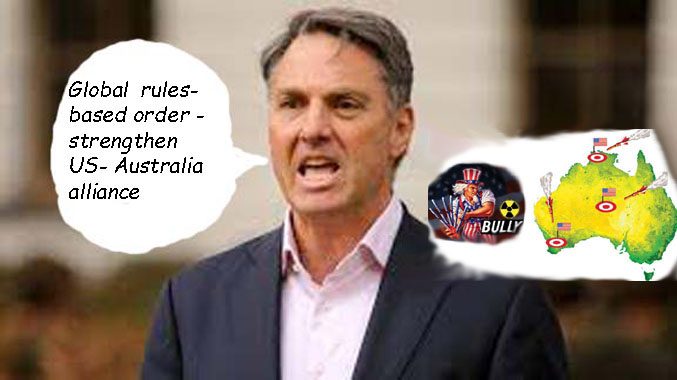
But Australia’s biggest diplomatic effort is going into creating a bifurcated world, preparing to fight another war for another imperial power, surrendering our sovereignty and our military in the process – and happy to remain in the rear on climate.
The Albanese Government shows no sign of changing course, plunging ahead with Australia’s biggest defence spend – submarines designed to sit off China’s coast as part of an offensive force – and hosting American long-range strategic bombers.
Michael Pascoe, The New Daily, 12 Nov 22,
When Earth faces an existential threat in the movies – aliens, rogue asteroids, that sort of thing – human beings unite to fight Armageddon.
Turns out real life isn’t like that.
Right now our quality of life and, for many millions, perhaps billions of people, their actual lives are in imminent danger. So what policy is Australia championing in the face of global disaster?
As a middle power that, in the past, has sometimes punched above its weight, what influence are we trying to exert to save the world? Unite and fight the killer aliens? Pool our talents to divert the asteroid? Nah.
We’re pushing for a hopelessly divided world, ignoring the real problem to fiddle about with less challenging matters, concentrating on supporting one superpower’s economic interests over another.
Tipping Points
Earth is approaching horrific climate change tipping points. It’s not a matter of an extra few tenths of a degree, some more monster bushfires and extra floods.
It’s about sudden collapse in the systems that sustain us.
But Australia’s biggest diplomatic effort is going into creating a bifurcated world, preparing to fight another war for another imperial power, surrendering our sovereignty and our military in the process – and happy to remain in the rear on climate.
The United States’ determination to exert its global primacy isn’t the main game. Much of the world understands that, but not our insular Anglosphere and certainly not the group think that pervades Canberra.
Once Australia hoped to be a bridge between the US and China. That hope was dashed by the gross ineptitude and crass stupidity of the Morrison government, leaping at the opportunity to out Sinophobe the Americans, locking Australia into America’s confrontational agenda.
The Albanese Government shows no sign of changing course, plunging ahead with Australia’s biggest defence spend – submarines designed to sit off China’s coast as part of an offensive force – and hosting American long-range strategic bombers.
“It makes sense to actually normalise the relationships,” Mr Albanese said before heading off to Asia for ASEAN and G-20 summits and, hopefully, a meeting with President Xi.
“We want to see a stabilisation in the relationship.”
Upping the ante
Upping the offensive weaponry ante seems a strange way of normalising a relationship while demanding China roll back the trade penalties imposed after Morrison’s diplomatic blundering. (And regarding Mr Albanese’s alleged “$20 billion” trade sanctions – the figure is bogus. Our wine industry has certainly been hurt, but our other commodity exports have had no trouble finding other markets paying just as well, if not better. Ask any coal miner.)
Back in the main game, climate change doesn’t seem to figure as a headline issue for Mr Albanese at the G20. And it seems not to be for US President Biden ahead of his meeting with President Xi. He is more interested in establishing rules for dividing the world.
Meanwhile, the COP27 climate change summit is underway in Egypt. All the news coming out of it ranges from bad to worse.
Joe Biden is dropping in on his way to Asia. Prime Minister Albanese is skipping it. The approaching climate change tipping points are a very real threat to Australia. Despite what you’re likely to hear on television and read in the mainstream newspapers, China is not.
We won’t be serious about climate change until it is seen as a human problem, not one with national borders. Like COVID, borders don’t register with greenhouse gases. One of the issues at COP27 is rich nations (high carbon intensity people) needing to pay to help poor nations (low carbon intensity people) move to sustainable energy.
Caught in bizarre inertia
Australians are among the world’s very worst polluters. Our previous and present governments prefer not to look at the problem like that, the Albanese government is content with being a little less worse on climate than the coalition governments of the previous nine years………… https://thenewdaily.com.au/opinion/2022/11/12/michael-pascoe-g20-china/
Climate change, not China, is Australia’s real security danger

The definitive case against nuclear subs The Saturday Paper, Albert Palazzo -adjunct professor at UNSW Canberra. He was a former director of war studies for the Australian Army. November 12, 2022 “……………………………………………………………. Too many security officials hold to the mistaken belief that China is the most significant threat Australia faces. In fact, climate change deserves the top spot. Climate scientists, United Nations officials and military commanders themselves, including current US Secretary of Defense Lloyd Austin, consider climate change an existential threat to survival. Any threat posed by China is much more limited. At worst, China’s challenge to the US-led world order could result in America’s withdrawal from the Western Pacific. Climate change could lead to the end of the human project and take countless other species down with us.
China represents, at most, a second-order threat, but it is China that draws the obsessive focus of much of the current generation of security thinkers. It does not make sense for Australia to invest so much in a weapon system that has no utility against the nation’s most dangerous threat, yet this is what is happening.
Advocates of nuclear-powered submarines also propose that constructing these vessels in Adelaide will help sustain a sovereign shipbuilding industry. In fact, the opposite is the likely result. Once in service these vessels will actually increase Australia’s dependence on the US and foreign contractors. This is because many of the sub’s critical components, weapons and systems will be made by foreign parties. Australian sailors might even need shadow US sailors to co-staff technical positions until Australia generates enough nuclear-savvy personnel of its own.
The government has announced it will invest between $168 billion and $183 billion in what it has called a national naval shipbuilding enterprise, with the goal of sustaining and growing a domestic shipbuilding capability and securing Australian jobs for the future. Such a capability is a noble goal, but what has been left unexplained is why it should be such a priority compared with foreign-dominated industries that are more critical to the nation’s future wellbeing.
Last summer, for example, Australian transport risked grinding to a halt as a result of the urea crisis, which led to a serious shortage of AdBlue, a vital diesel fuel additive. Without AdBlue, the nation’s fleet of long-haul trucks would have stopped moving, resulting in supermarkets running out of food, farmers not harvesting their crops and the mining industry coming to a halt. Yet there has been no talk of taxpayer-supported AdBlue production in Australia. Similarly, many medicines are imported, as are a host of important everyday items, such as baking powder and matches. Unlike shipbuilding, these industries apparently warrant no support.
If one wanted a truly sovereign defence industry, then the product that might mandate the level of support proposed for the subs is microchips. Virtually all military and civilian technology contains chips, yet Australia is happy to remain fully reliant on overseas suppliers for this most important of components. Establishing a domestic industry would require a huge subsidy, as well as additional investment in tertiary education and precursor manufacturing processes. Without these chips, however, no weapon system is truly sovereign.
So why the nuclear-powered subs, if they make so little sense? The obvious answer is to support the alliance. Instead of aiming for self-reliance, Australia has always preferred to seek the protection of a great power. But there is another reason: like a kid in a lolly shop, Australia has been given permission to buy the biggest treat on display. Nuclear-powered subs are one of America’s most closely guarded technologies. If Australia gets them, it will be a clear sign that, like Britain, we have been admitted to a very exclusive club, the inner sanctum of US security. What is missed, however, is that being in the inner sanctum generates a massive obligation – and some day that bill may fall due. https://www.thesaturdaypaper.com.au/opinion/topic/2022/11/12/the-definitive-case-against-nuclear-subs
Humanity’s Moment: A Climate Scientist’s Case for Hope by Joëlle Gergis
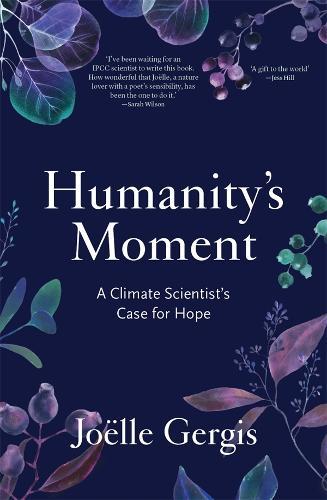
https://www.readings.com.au/review/humanity-s-moment-a-climate-scientist-s-case-for-hope-by-jo-lle-gergis# 1 Sept 22, If there is only one nonfiction book you read this year, it really should be this one. Its author, Joëlle Gergis, is one of Australia’s leading climate scientists and she believes this book is the most important one she will ever write.
Gergis has spent the last few years as a lead author working on the United Nations’ Intergovernmental Panel on Climate Change (IPCC) Sixth Assessment Report. This work (done on a voluntary basis and on top of her day job as a scientist and university lecturer) has radically changed her outlook on life; it has kept her awake at night and led to feelings of anxiety and despair. Before the IPCC process, Gergis had found she could remain relatively emotionally detached from her work, but the cumulative effect of compiling the latest science on climate change from all over the world was overwhelming. She wrote an article about her emotional response and was contacted by other climate scientists who felt the same but were too afraid to share their feelings lest it might compromise the image of a dispassionate, data-driven scientist. With this book, Gergis wants to humanise and reframe climate change as a ‘cultural issue’, and she manages to do this beautifully by blending personal narrative with a distillation of the science.
Divided into three parts – the head, the heart and the whole – the book first outlines the latest science in clear and straightforward language. This is ‘the head’ and it makes for incredibly grim reading. ‘The heart’ looks at our connection to nature across different cultures and how this has changed over time. Here, Gergis outlines the ongoing catastrophes caused by colonisation and capitalism. Finally, in ‘the whole’, Gergis imagines what we as a community can achieve. She looks at the important role of art and literature to inspire us and the necessity of heeding Indigenous knowledge if there is to be a brighter future. Many of the solutions already exist and Gergis’ ultimate hope with this book is that it will remind us how ‘human history is an endless tug-of-war for social justice. We are each part of an eternal evolutional force that can transform our world.’ The first step may just be to read this book.
1 This month

of the week – Australians for War Powers Reform (AWPR)
To see nuclear-related stories in greater depth and intensity
 Antinuclear