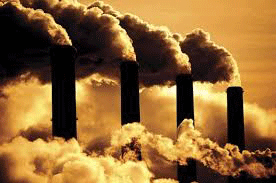

With help from floating data-collectors, a new study reveals the impact greenhouse gas emissions and ozone depletion are having on the Southern Ocean. Inside Climate News, Sabrina Shankman SEP 24, 2018 The Southern Ocean around Antarctica is warming at an alarming rate—twice that of the rest of the world’s oceans. Now, researchers have developed more powerful evidence pointing to the human causes.
For Australia to take its share in climate action – 12 coal-fired power stations need to close by 2030
|
Key points:
The implication comes from simple arithmetic, produced by the Parliamentary Library, and would require nine power stations closing before the end of their scheduled life. To stop warming at 1.5C, the United Nations’ IPCC said this week coal use for electricity must be reduced to almost zero by 2050. But another figure went unreported: the IPCC also said to get to zero by 2050, we need to get to 78 per cent below 2010 levels within 12 years. At the request of the Greens, the Parliamentary Library crunched the numbers for what that meant in Australia, assuming that reduction was shared equally among each country. Continue reading |
Poor countries urge Australia to honour Green Climate Fund commitments
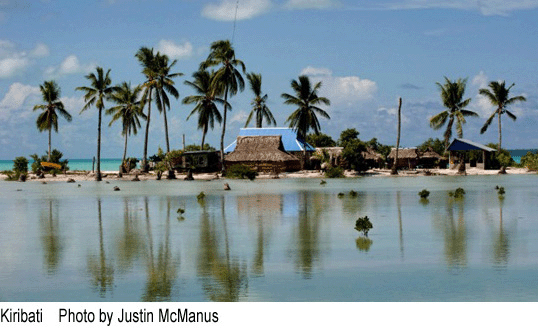 UN group responds to Scott Morrison’s statement that Australia won’t be ‘throwing money’ into fund, https://www.theguardian.com/environment/2018/oct/10/poor-countries-urge-australia-to-honour-green-climate-fund-commitments, Graham Readfearn, An official United Nations grouping of 47 of the world’s poorest countries has urged Australia to “honour its international commitments” after the prime minister, Scott Morrison, said the country would not be “throwing money” into a key international climate change fund.Australia has previously pledged $200m to the Green Climate Fund (GCF), set up through the UN’s climate convention to help developing countries adapt to the impacts of climate change and cut their own greenhouse gas emissions.
But on Monday, in the hours before a major climate report was released, Morrison told radio presenter Alan Jones that Australia would not be “throwing money into some global climate fund”.
One international climate expert said that geopolitically it was “mildly insane” that Australia was backing out of the GCF.
In a statement to Guardian Australia, Ethiopian Gebru Jember Endalew, the chair of the Least Developed Countries (LDC) Group, said: “Funding from wealthy nations such as Australia is key to enabling an effective global response.
“LDCs and other developing countries have made ambitious plans, but these plans cannot be implemented without sufficient tools and resources being mobilised. The Green Climate Fund plays an integral role in delivering these funds and continues to be underresourced.”
The LDC Group represents 47 countries at UN climate negotiations and says its members are “specially vulnerable to climate change but have done the least to cause the problem”. African nations dominate the LDC group, alongside Pacific and East Asian countries Timor-Leste, Kiribati, Vanuatu and Tuvalu. Continue reading
Dave Sharma, Liberal candidate for Wentworth byelection, is complacent about Liberals’ non policy on climate change
 Dave Sharma says Liberals ‘doing enough’ on climate after Hewson attack
The Wentworth candidate rejects former leader’s view that party’s policy on emissions is inadequate, Guardian, Anne Davies, @annefdavies 10 Oct 2018 The Liberal candidate for Wentworth, Dave Sharma, said his party is “doing enough” and has “a good record” on climate change, after a blistering attack from former leader John Hewson, who said the party deserved a “drubbing” over its inaction on the issue…….Hewson has accused the Liberals of putting their heads in the sand on the issue and kicking the issue down the road for future generations.
The former prime minister Malcolm Turnbull dropped plans for a national energy guarantee that would have imposed emissions reduction targets and then was dumped by his own party, which was deeply divided over his plan……
the economy has been growing and so too have overall emissions.
Australia is on a trajectory that will see it miss its Paris climate targets – a reduction of 26% to 28% based on 2005 levels – according to figures from the consultants, NDEVR Environmental, for the year up to the end of June 2018.
The NDVER figures showed Australia’s emissions were again the highest on record when unreliable data from the land use and forestry sectors was excluded. This was the third consecutive year for record-breaking emissions.
Despite this, Frydenberg claimed that the nation is on track to meet its Paris commitments – even without the Neg, which he had supported. He also lauded the Coalition’s record on investment in renewables…….
Asked about the IPCC report this week, which called for coal generation to be phased out by 2050 or the world would be facing a catastrophe, Frydenberg said it was their word, not ours….https://www.theguardian.com/australia-news/2018/oct/10/dave-sharma-says-liberals-doing-enough-on-climate-after-hewson-attack
Climate apocalypse is heading, unless the world takes drastic action
Australia is the world’s largest coal exporter, with thermal and coking coal shipments last year totalling 382 million tonnes.
The findings of the report are at odds with the Morrison government’s insistence that coal will play an essential role in the nation’s economic future.
For the first time in a IPCC report, the authors included social and economic impacts. That marked “the end of magical thinking” that sustainable development goals and poverty reduction could be divorced from climate action.
“If governments fail to drastically and urgently reduce emissions, they are knowingly contributing to the dangers of a world that is at least 1.5 degrees warmer,” Tessa Khan, co-director of the Climate Litigation Network.
“This has clear legal consequences and governments will inevitably be held accountable for knowingly putting people in harm’s way,” Ms Khan said, noting citizens in the Netherlands, Ireland, Switzerland, Norway, Colombia, the US and New Zealand have already taken their governments to court.
“This litigation is only just picking up speed.”
 ‘Next decade critical’: Perils mount at 1.5 degrees of warming, says IPCC , Sydney Morning Herald, By Peter Hannam & Nicole Hasham 8 October 2018 —The amount of coal and other fossil fuels the world can burn without unleashing dangerous climate change that will undermine the livelihoods of hundreds of millions of people and all but wipe out the Great Barrier Reef is “very small”, according to a major climate report.
The Intergovernmental Panel on Climate Change’s special report on a 1.5-degree hotter planet, released on Monday, said limiting warming to that amount remains possible, but only with “rapid, far-reaching and unprecedented changes in all aspects of society”……..
We’re currently heading towards about 3 degrees or 4 degrees of warming by 2100,” said Mark Howden, director of the Climate Change Institute at the Australian National University and one of the review’s editors.
“Limiting global warming to 1.5 degrees is not impossible but would actually require major transitions in many aspects of society, and to do those transitions, the next 10 years are critical.”
Many of those transitions will mean curbing if not halting entirely the release of greenhouse gas emissions from the burning of fossil fuels, land-clearing and other human activities.
Average temperature rises mask extreme events. Temperatures of hot days are forecast to increase three degrees in a 1.5 degree warmer world, and by four degrees if mean temperatures rise by 2 degrees.
Carbon budget Continue reading
Cost of action on climate change is high – political will is lacking
|
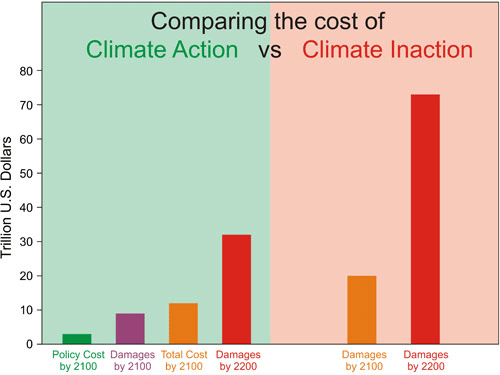
The political will to prevent climate change is lacking, even as the cost climbs Brisbane Times By David Crowe,8 October 2018 Australians are being presented with another startling contrast between colossal risk and paltry action over climate change.The latest scientific advice is that human activity has already caused an increase of 1 degree in world temperatures, with global warming estimated to reach 1.5 degrees by 2052 on current trends.
The cost is astronomical. The damage over the years to 2100 would reach $US54 trillion in today’s dollars if warming was kept to 1.5 degrees. The cost would climb to $US69 trillion if warming reached 2 degrees. The obvious message from the report is to stop the 2 degree scenario. The scientists say this means halting the use of coal by 2050, accelerating the use of renewables and making mammoth investments to change the economy. This cost is just as draw-dropping. The report says the investment would need to be $US2.4 trillion a year by 2034 across the global economy. There is no country-by-country analysis of what this means but Australia makes up about 1 per cent of global emissions, so it may have the same share of the expense. Can Australia invest $US24 billion a year to avert dangerous climate change? That is more than the federal government spends on public hospitals. The answer from the Greens is to shut down coal-fired power stations and stop coal exports, but only about 10 per cent of Australian voters supported this position at the last election by giving the Greens their primary vote. The two major parties will not rush the closure of coal-fired power stations. The answer from the government is to ask for more time to come up with a policy. The leadership turmoil in August left the Liberals and Nationals without a plan to reduce emissions. Prime Minister Scott Morrison insisted on Monday that Australia would meet its emission targets “in a canter” but this is disputed by climate experts. It is a laughable message – nothing more than saying “trust us” – when the demise of the National Energy Guarantee proved again that the Coalition party room is incapable of reaching a consensus and then holding its nerve on energy and climate policy. Labor has a 50 per cent target for renewable energy by 2030 but is yet to spell out how it would reduce emissions in government. One approach is to rebuild a policy from the wreckage of the NEG but this is easier said than done……. https://www.brisbanetimes.com.au/politics/federal/the-political-will-to-prevent-climate-change-is-lacking-even-as-the-cost-climbs-20181008-p508g2.html |
|
To save Barrier Reef, Australia and the rest of the world must virtually eliminate the use of coal for electricity within 22 years
|
IPCC issues dire climate warning, says coal must go to save Great Barrier Reef http://www.abc.net.au/news/science/2018-10-08/ipcc-climate-change-report/10348720 Australia and the rest of the world must virtually eliminate the use of coal for electricity within 22 years if there is to be a chance to save even some of the Great Barrier Reef, the world’s most authoritative climate science body has warned.
In a report authored by more than 90 scientists, and pulling together thousands of pieces of climate research, the UN’s Intergovernmental Panel on Climate Change (IPCC) said global emissions of greenhouse gas pollution must reach zero by about 2050 in order to stop global warming at 1.5 degrees Celsius. At current rates, they said 1.5C would be breached as early as 2040, and 2C would be breached in the 2060s. If that happens, temperatures over many land regions would increase by double that amount. And at 2C of warming, the authors warn the world would risk hitting “tipping points”, setting a course towards uncontrollable temperatures. With the world already 1C warmer than pre-industrial times, experts said this report, released by the IPCC in Incheon, Korea, was likely our final warning before it becomes impossible to keep warming at 1.5C. “To limit temperature change to 1.5 degrees we have to strongly reduce carbon dioxide emissions,” said report contributor Professor Mark Howden from ANU. “They have to decline about 45 per cent by 2030 and they have to reach zero by 2050. 1.5C vs 2C: What’s the difference?Coral reefs would be a particular casualty. They are expected to decline by a further 70 to 90 per cent even under 1.5C, but that rises to more than 99 per cent reef loss as temperature rises hit 2C. In Australia, that means the vast majority of the Great Barrier Reef will undergo significant upheaval or collapse. Combined with increased ocean acidification due to higher carbon dioxide concentrations, this is expected to heavily affect fish stocks and diversity. Meanwhile on land, a rise of 2C would mean three times as much of the earth’s terrestrial ecosystems would undergo transformations, compared to a rise of 1.5C, significantly increasing species extinctions. Then there are the rising waters. Modern humans have never seen an ice-free Arctic, but at 2C that would happen once a decade, compared to once a century at 1.5C. A 2C rise would also mean an extra 10 centimetres of average sea-level rise by the end of the century, affecting an extra 10 million people. And while some are inundated, a 2C rise would also double the number of people experiencing water scarcity. We would be hit with more extreme hot weather events in every part of the world: more floods in most, and more drought in some. Those extreme events would be “far worse” as temperature increases go beyond 1.5C, according to Will Steffen from ANU’s Climate Change Institute. “Loss of the Amazon forests, melting of the permafrost, loss of ice in West Antarctic and Greenland, they are much riskier at 2 degrees than they are at 1.5,” Professor Steffen said. “They could lead to a tipping cascade where the system will get hotter and hotter even if we bring our emissions down.” Coal use needs to drop to ‘0 to 2 per cent’: expert Continue reading |
No Australian government support for “nonsense” like climate change action
 Morrison vows no money for climate conferences and “all that
 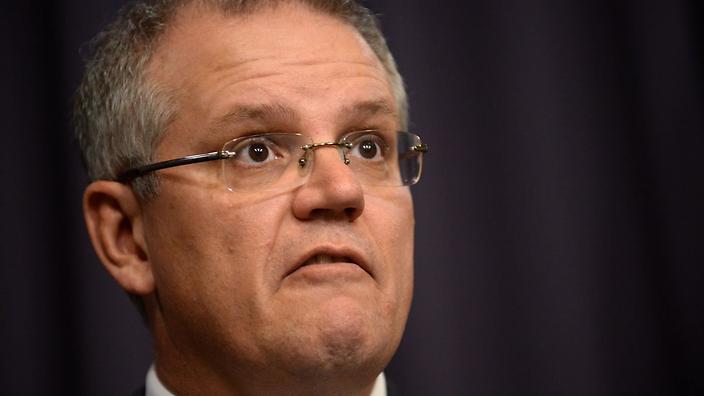 nonsense” https://reneweconomy.com.au/morrison-vows-no-money-for-climate-conferences-and-all-that-nonsense-38468/ 8 October 2018 Australia’s prime minister Scott Morrison has responded to the latest UN Intergovenmental Panel of Climate Change report by declaring that he had no intention of spending money on global climate conferences and “all that sort of nonsense.”
Morrison government cynically tries to hide the truth on greenhouse gas emissions
Our emissions reduction target of 26-28 per cent below 2005 levels by 2030 is woefully inadequate and is not aligned with what the science says is necessary to effectively tackle climate change. Rather than doing it at “a canter” we’re like the champion sprinter, Chautauqua, stuck in the barriers.
Australia is one of the most vulnerable developed countries in the world to the impacts of climate change.
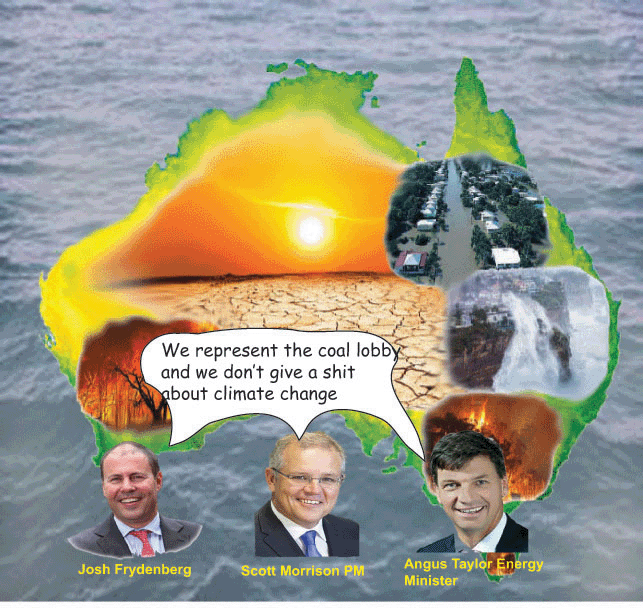
A cynical attempt to avoid scrutiny https://www.brisbanetimes.com.au/environment/climate-change/a-cynical-attempt-to-avoid-scrutiny-20181001-p5074d.html, By Martin Rice, 1 October 2018 —
Late last Friday afternoon, after Commissioner Kenneth Hayne delivered his interim findings into the financial services industry, and the nation prepared for a weekend of football finals, the federal government quietly released a story that should have been front-page news.
It had held onto the information for months, seemingly waiting for the right time to “take out the trash”. The news for it, and for us, was grim. Australia’s greenhouse gas pollution levels have risen yet again.
The reporting of Australia’s rising emissions has been buried on a number of occasions, with data released on Christmas Eve, on weekends, holiday periods, or during major events. It’s a cynical attempt to avoid scrutiny.
For climate policy to be a winner, greenhouse gas pollution levels must be trending downwards; there are no Norm Smith or Clive Churchill medals for the federal government, with emissions increasing by 1.3 per cent for the year to March 2018. Worse still, greenhouse gas pollution has risen three years in a row – we’re chasing the wooden spoon.
On Sunday, Prime Minister Scott Morrison told the ABC Insiders program that people “choose and pick their figures to make a political argument”. This is not a political argument. The figures tell us very clearly that emissions are going up.
The Prime Minister also repeated his claim that Australia will meet its Paris obligations “at a canter”. There are numerous reports – from the Australia Institute last week and the UN Environment Program last year – that outline why Australia won’t meet its 2030 Paris commitments.
Our emissions reduction target of 26-28 per cent below 2005 levels by 2030 is woefully inadequate and is not aligned with what the science says is necessary to effectively tackle climate change. Rather than doing it at “a canter” we’re like the champion sprinter, Chautauqua, stuck in the barriers.
Australia is one of the most vulnerable developed countries in the world to the impacts of climate change. Heatwaves are becoming longer, hotter and starting earlier in the year. In the populous south of the country, dangerous bushfire weather is increasing, and cool season rainfall is dropping off, stretching firefighting resources, putting lives at risk and creating challenges for the agriculture industry.
The unprecedented bleaching events on the Great Barrier Reef in 2016 and 2017 resulted in mass coral mortality, with the 2016 bleaching event at least 175 times more likely to occur due to intensifying climate change. Not only is the reef a natural icon of global significance, it’s a multi-billion dollar economic asset, contributing around $6.4 billion to the Australian economy a year (of which $5.7 billion comes from the tourism industry), and supporting 64,000 direct and indirect jobs. Climate change is putting this industry, and the broader economy, at risk.
NSW and Queensland are experiencing severe drought conditions, with dire consequences for farming and rural communities. Southern Australia, particularly along the eastern coast and hinterlands, could experience devastating bushfire conditions this season. There would be little reprieve for firefighters exhausted from battling fires in the height of the Australian winter (yes, winter!) or helping suppress fires overseas.
Loading
The burning of coal, oil and gas is causing temperatures to rise at unprecedented rates and is making extreme weather events more intense, damaging and costly. The window of opportunity to effectively tackle climate change is closing fast. We need to rapidly and deeply cut our emissions.
The solutions are available. We need to accelerate the transition to clean, affordable and reliable renewables and storage technologies and ramp up other climate solutions in the transport, agriculture and other sectors.
At a time when credible federal government climate policy remains missing in action, it has never been more important for transparent greenhouse gas pollution information. Yet the federal government has consistently withheld or hidden vital emissions data; it’s a serial offender when it comes to climate censorship.
Martin Rice is the Climate Council’s acting chief executive and head of research.
The value of Australia’s coal exports is forecast to decline sharply
Thermal coal prices forecast to drop 25% and metallurgical coal prices 23% as value of iron ore exports also falls, Guardian, Gareth Hutchens@grhutchens, 2 Oct 2018 The value of Australia’s coal exports is forecast to decline sharply over the next 18 months as thermal coal prices drop 25% and metallurgical coal prices fall 23%.
‘Adani and the War Over Coal’ – a new book: Quentin Beresford spills the devious beans
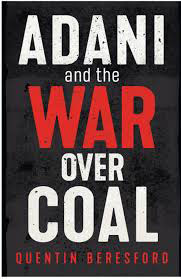 BOOK REVIEW: ‘Adani and the War Over Coal’ — a pox on both their Parties, Independent Australia John Biggs 30 September 2018 The story of the devious and secretive negotiations between Adani and Australian governments of both stripes is appalling, writes John Biggs. “…… Conservation groups, Indigenous people and, eventually, a strong majority of ordinary Australians are outraged. In this book, Dr Beresford brings his sharp research and writing skills to tell this story of the war over coal.Gautam Adani had close connections with India’s PM Narendra Modi, who protected Adani over environmental and human rights violations in India. Adani donated heavily to both major Australian parties, especially to the Coalition. The Abbott and subsequent Coalition governments pushed for Adani as hard as they could. At first, so did Labor, but then sort of didn’t, but if certain conditions are met, well, maybe .
ISSUES IN DISPUTE
The major issues in dispute, as Bereford see it, are as follows.
Climate change
If all the Carmichael coal is burned – here or anywhere – the carbon emissions would be more than Australia already produces. That would likely tip global warming irreversibly. The pro-Adani group deny this.
Great Barrier Reef
The Reef is already seriously endangered by climate change, drainage from fertilised farmlands, and starfish. The mine would make matters immeasurably worse, as dredging (authorised byLabor’s Tony Burke) has already indicated.
Julie Bishop even denied the Great Barrier Reef would be in any danger.
Beresford notes (p.361):
‘None of the major parties has been prepared to unequivocally put the reef’s long term health over the interests of the fossil fuel industry.’
Great Artesian Basin
The Great Artesian Basin, vital for Australian agriculture, would be seriously endangered by the mine, either through using the water or by puncturing and draining the Basin. Adani supporters say this is exaggerated, and anyway coal mining is a thirsty business.
Native title
Doongmabulla Springs is in the mining area and is of high cultural significance to the Wangan and Jagalingou peoples. However Indigenous Land Use Agreements (ILUAs) that favour developers have been foisted onto the locals. These are currently under appeal.
Economic case
The costs of mining coal are now higher than the costs of producing renewables — and the difference is rapidly widening. With Adani’s projected costs, current debts and likely returns, Adani is predicted to lose crippling amounts of money if it proceeds.
Adani’s poor safety, criminal and environmental record
First in India and now here, Adani operations have already badly polluted land in the Carmichael region.
WHY, WHY, WHY?
Given all of this, why on Earth would Australian governments be so determined to support the Adani project?
Beresford discusses these issues and others in depth. His findings and assertions are fully referenced, his arguments convincing.
While much of this is due to the shocking judgement and wickedness of individual people, Beresford sees (p.360) as even more important the way in which the coal wars have transformed politics: …….https://independentaustralia.net/environment/environment-display/book-review-adani-and-the-war-over-coal–a-pox-on-both-their-parties,11949
PM Morrison’s dodgy claim about Australia meeting Paris climate commitment
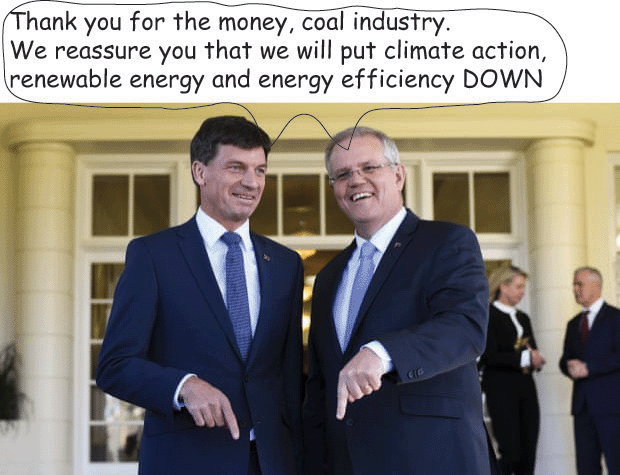 PM claims Australia will meet Paris target ‘in a canter’
  despite emissions climbing
Morrison says rate of increase not as high as previous years and renewables investment will ensure Australia meets commitment, Guardian, Amy Remeikis, 30 Sept 18, Australia’s greenhouse gas emissions have continued to rise, but Scott Morrison seized on the silver lining, maintaining Australia would meet its Paris commitment, despite the government having no legislated instrument to help it get there.
Figures released on Friday showed Australia’s emissions increased 1.3% in the year to March 2018, up all sectors – except land use and electricity, where renewable technologies were having an impact on the latter.
The prime minister jumped on the rate of the increase not being as high as in previous years……..
Morrison said Australia would meet its Paris targets “in a canter”, largely based on investment in renewable energy technologies, despite concerns a lack of legislated instrument may impact investor confidence in the sector. …..
“We still have large-scale and small-scale policies there. We still have the Clean Energy Finance Corporation, and we still have the Emissions Reduction Fund for the period that it’s currently for, and we’re on track to hit it.”…..
Critics of the government’s stance have repeatedly called for legislation to ensure Australia meets the targets it agreed to when Tony Abbott signed the nation up to the Paris agreement.
But with the national energy guarantee a casualty of the leadership spillwithin the Liberal party, the government has no legislated instrument to ensure emission reductions, and no plans to create one…..
He said lowering electricity prices remained the government’s priority and criticised Labor for its policy. ….Labor has said it will look to legislate a version of the national energy guarantee the government abandoned as policy to ensure Australia does meet its targets. The Greens announced its parliamentary team will take a “hard line” on making sure any future Labor government does not back down.
Research released earlier this month found that emission reductions targets were not responsible for driving up power prices. https://www.theguardian.com/australia-news/2018/sep/30/pm-claims-australia-will-meet-paris-target-in-a-canter-despite-emissions-climbing
Great Barrier Reef scientists told to focus on projects to make government look good
 Emails tabled in Senate inquiry recommended ‘trade-offs’ to Great Barrier Reef Foundation, Guardian, Ben Smee @BenSmee 26 Sep 2018
Great Barrier Reef scientists were told they would need to make “trade-offs” to the Great Barrier Reef Foundation, including focusing on projects that would look good for the government and encourage more corporate donations, emails tabled in the Senate reveal.
The documents, including cabinet briefing notes, contain significant new details about the workings of the foundation and the government decision to award it a $443m grant, including:
- The executives of mining, gas and chemicals companies – and international financial houses that actively back fossil-fuel projects – were among the guests at a six-star retreat hosted by the foundation less than a month after the grant was announced;
- The media companies Foxtel and Fairfax and the tech giant Google are among a tightly held list of donors to the foundation;
- The only CSIRO employee contacted about the grant before the announcement in April was in Patagonia, and did not get the email. Documents have previously revealed that the government’s peak science agency was cut out of the decision to award the grant;
- In August, as scrutiny of the grant intensified, public servants pushed to block a long-planned meeting between the then science minister, Michaelia Cash, and the head of the foundation, Anna Marsden, because of concern about the “optics”.
Emails sent by staff at the Australian Institute of Marine Science outline how government expectations, the ability to leverage private donations and public perceptions “may drive the [foundation] to prioritise shorter-term research initiatives in order to demonstrate progress and return on investment”.
“Where it becomes challenging is that … interventions with the largest future benefit also take the longest to develop,” the institute’s executive director of strategic policy, David Mead, wrote in an email to colleagues.
“Among other trade-offs, we will need to determine to what degree we focus on quick wins or whether we progress longer-term strategic interventions and accept that we will only partially progress them during the next five years (perhaps with little outward visibility of success/progress).”
The emails also reveal an initial state of uncertainty about how a $100m allocation for reef restoration and adaptation would be handled……. https://www.theguardian.com/environment/2018/sep/26/great-barrier-reef-scientists-told-to-focus-on-projects-to-make-government-look-good?CMP=share_btn_tw.
Greenhouse gas emissions and ozone depletion causing Antarctic Ocean to heat up
What’s Causing Antarctica’s Ocean to Heat Up? New Study Points to 2 Human Sources
Adani coalmine: most Queenslanders want water licence revoked, poll finds
‘A poll conducted for Lock the Gate found a majority of Queensland voters want water rights taken off Adani and given to farmers. Guardian, Ben Smee www.theguardian.com/profile/ben-smee @BenSmee , 23 Sep 2018 A majority of Queensland’s voters want the government to cancel the Adani mining company’s 60-year unlimited water extraction licence
amid growing concern about the severity of the drought.
‘Polling conducted by ReachTel for the environmental group Lock the Gate shows concern about water extraction by Adani, and the impact on agriculture, is strong among conservative voters.
‘Almost 70% of all voters agreed the licence,
to extract groundwater for the Carmichael coalmine,
should be revoked to safeguard water for farmers. …
‘The national coordinator of the Lock the Gate Alliance, Carmel Flint, said the results showed “incredible support across the political spectrum
to put water above mining and look after Queensland farmers”.
The national coordinator of the Lock the Gate Alliance, Carmel Flint, said
the results showed “incredible support across the political spectrum
to put water above mining and look after Queensland farmers”.
‘“I think this really does reveal that as this drought really bites,
people don’t accept that we can hand over vast quantities of water to Adani,” she said. … ‘
Read much much more of BenSmee’s comprehensive,groundbreaking, interesting article:
www.theguardian.com/business/2018/sep/23/adani-coalmine-most-queenslanders-want-water-licence-revoked-poll-finds
Labor holds meeting with industry, on emissions reduction, as COAL-ition holds private dinner with coal-nuclear lobbyist Trevor St Baker
Pro-coal Coalition MPs schedule private dinner to discuss ‘Australia’s energy future’ https://www.theguardian.com/australia-news/2018/sep/20/pro-coal-coalition-mps-schedule-dinner-to-discuss-australias-energy-future. Monash Forum sets up dinner with Trevor St Baker Trevor St Baker who is director of SMR Nuclear Technology company. as business tells Labor to stick with national energy guarantee, Guardian, Katharine Murphy Political editor@murpharoo 20 Sep 2018 The pro-coal Monash Forum is attempting to convene a private dinner when federal parliament resumes in mid-October with Trevor St Baker, part-owner of the Vales Point coal generator and founder of the business electricity retailer ERM Power.
1 This month
7 April – WEBINAR – Australia and the Doomsday Clock – Preventing nuclear war through NoFirstUse and other policies
Online | Tuesday April 7, 4:00-5:30pm, Australian Eastern Time / 8:00-9:30am Central Europe Time
– Access the registration link
15 April – Zoom –Nuclear Power is Not the Solution
Apr 15, 2026 01:00 AM in Canberra, Melbourne, Sydney

Join the International Physicians for the Prevention of Nuclear War (IPPNW) on Tuesday, April 14th for a timely webinar exploring the risks associated with nuclear power and challenging the myth that it offers a simple, safe, carbon-free solution to the climate crisis

21 April Webinar: No Nuclear Weapons in Australia
Start: 2026-04-21 18:00:00 UTC Canberra, Melbourne, Sydney (GMT+10:00)
End: 2026-04-21 19:30:00 UTC Canberra, Melbourne, Sydney (GMT+10:00)
Event Type: Virtual
A virtual link will be communicated before the event.
Host Contact Info: australia@icanw.org

of the week – Australians for War Powers Reform (AWPR)
To see nuclear-related stories in greater depth and intensity
 Antinuclear