Australia’s Minister For The Coal Lobby, Angus Taylor’s false statement about carbon emissions
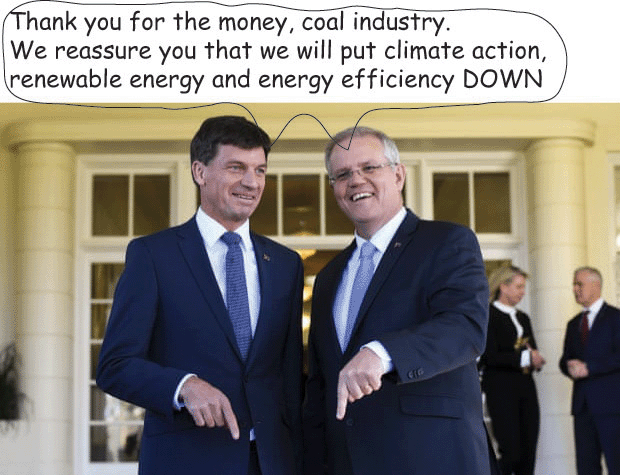 Claim we’re on track to meet emissions targets is false, New Daily, James Fernyhough,
Here is what he wrote in the Australian Financial Review on Tuesday:
“[E]missions reductions are the least of our problems, with every prospect we will reach the 26 per cent reduction below 2005 levels ahead of schedule and without interventions.”
This, he implied, justified the Morrison government’s decision to do nothing to reduce carbon emissions, and focus instead exclusively on price and reliability.
But The New Daily looked into Mr Taylor’s claim, and the evidence suggests it is in one sense downright false, and in another seriously misleading.
Let’s address the seriously misleading aspect first.
Under the Paris Agreement, Australia has committed to reduce its greenhouse gas emissions by 26 to 28 per cent on 2005 levels by 2030.
According to Mr Taylor’s department, Australia is on track to woefully miss the 2030 target.
On page 11 of this document from December last year, the Department of Environment and Energy projects that if no new emissions-reduction policies are implemented (as none have been), our greenhouse emissions will be just 5 per cent below 2005 levels – not 26 per cent, as Mr Taylor seems to claim.
Mr Taylor’s figures appear at a glance to be off by a massive 21 percentage points……….
The Morrison government has scrapped the NEG – the policy that triggered Malcolm Turnbull’s downfall – and has made it clear it will not replace it with anything.
So we are once more back to where we were – on track to miss all our emissions reductions targets.
Minister Taylor’s office did not respond when presented with the evidence that his statement was false. https://thenewdaily.com.au/money/finance-news/2018/09/18/energy-ministers-claim-carbon-emissions-false/
Oh dear! Coal-loving Angus Taylor’s electorate wants action on climate change
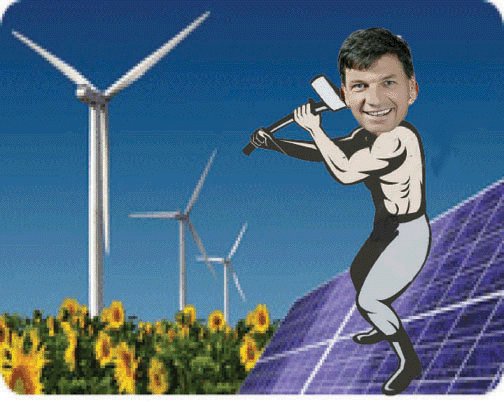 Energy minister’s electorate backs higher emissions reduction target, poll shows
ReachTel poll of Angus Taylor’s voters finds 42.3% want Australia to cut emissions more deeply, Guardian, Katharine Murphy Political editor@murpharoo19 Sep 2018 More voters in the electorate of the new energy minister, Angus Taylor, support an emissions reduction target for electricity and a higher national target than the Paris commitment than oppose those positions.
12.5b litres of water for Adani coal project – no environmental impact statement needed
 Adani plans to draw 12.5b litres of water and there will be no environmental impact statement, ABC By national environment, science and technology reporter Michael Slezak 18 Sept 18 Adani’s plan to take 12.5 billion litres of water from a river in drought-stricken Queensland is a step closer to happening, according to environmental groups, after the Federal Government decided the project did not need a full environmental impact assessment.
Key points:
- Federal Government decides Adani water plan does not need environmental impact statement
- Mining giant wants to take 12.5 billion litres of water from Queensland river
- Environmentalists say the move is “appalling and dangerous”
- Adani says it will work with Government to “complete the required assessment”
To build and run its proposed Carmichael coal mine, Adani wants to extract water from the Suttor River in central Queensland for up to 60 years, expand a dam there, and build a 60-kilometre pipeline to transport the water to its mine.
Federal law requires that if coal mines are likely to have a significant impact on the country’s water resources, they must undergo a full environmental assessment, which would be scrutinised by an independent scientific committee.
But Adani argued that “water trigger” only applied if the water was used in the extraction of the coal, and that the water they would take from this river would not be used that way, but instead for practices like washing coal and dust management.
Environmental lawyers have previously said that argument does not hold water.
On Monday, the federal Department of the Environment decided the water trigger did not apply to the project and that it did not need to undergo a full assessment with an environmental impact statement………..
Water project will ‘avoid full scrutiny’
“As one of the driest continents on Earth, water is the lifeblood of inland Australia,” anti-Adani campaigner at the Australian Conservation Foundation Christian Slattery said.
“It is disappointing that while Queensland suffers through severe drought, the water infrastructure for Adani’s massive polluting coal mine will avoid full scrutiny under Australia’s national environment laws,” he said.
Anti-mining group Lock The Gate Alliance described the move as “appalling and dangerous”.
“This is another special deal for Adani that puts our water resources at risk during a terrible drought and hangs Queensland graziers and communities out to dry,” spokesperson for Lock the Gate Alliance Carmel Flint said.
Arianne Wilkinson, a lawyer at Environmental Justice Australia, said the decision to submit Adani’s proposal to the weaker form of assessment was disappointing.
“Their proposal should be given the full assessment under federal environmental law,” she said…….http://www.abc.net.au/news/2018-09-18/adani-plan-for-12.5b-litres-of-water-to-avoid-impact-assessment/10262764
Adani’s Carmichael coal project massively downsized, but still a climate threat
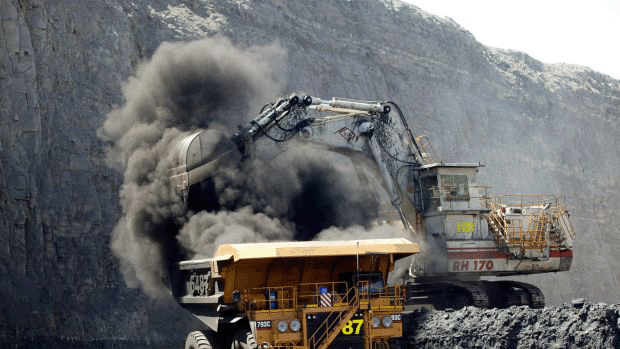 Adani’s rail line cut shows project is on life support but still a threat to climate, Guardian
The short answer is this is the latest in a string of changes that have massively downsized both the Carmichael project and the bigger plans to develop the Galilee Basin. The longer answer is that, despite optimistic talk about a long-term future for coal, the writing is on the wall. The only way to make money out of coal is to do so quickly, before the present gradual decline turns into a collapse.
The original Adani proposal, put forward in 2010, was for a mine producing 60m tonnes of coal a year. The coal would be transported along a completely new 388km standard gauge rail line to a newly built terminal at Adani’s Abbot Point coal terminal. The coal would then be shipped to Adani’s rapidly expanding fleet of coal-fired power stations in India, most notably the 4,620MW plant at Mundra. The oft-repeated claims of 10,000 jobs and billions in revenue (much inflated by spurious economic analysis) refer to this initial proposal.
As prospects for coal declined, and finance dried up, however, the project was cut back in 2017 to a first stage, with planned exports of 25m tonnes a year. Initially, the rail and port components of the project were left unchanged, with the idea that they would be used in subsequent stages. In early August, however, Adani dropped the idea of building a second port terminal, opting instead to ship Carmichael coal through its existing terminal, which is badly underutilised.
The other shoe dropped on Thursday with the announcement that the massive new rail line would be replaced with a connection to Aurizon’s existing line. Meanwhile, staff numbers at Adani’s Townsville headquarters have been slashed.
The combined effect of the cuts is to keep the Adani project alive for the moment, while closing off any realistic prospect of a massive expansion in the Galilee Basin as a whole. That’s a decidedly mixed prospect. On the one hand, 25m additional tonnes of carbon a year would be bad for the global environment. On the other hand, the catastrophic prospect of 300m tonnes a year appears to have been averted. ………
the future for coal looks bleaker than ever. The “pipeline” of future coal plants in China and India has shrunk massively, with cancellations far outweighing new announcements……..https://www.theguardian.com/environment/commentisfree/2018/sep/16/adanis-rail-line-cut-shows-project-is-on-life-support-but-still-a-threat-to-climate
Scott Morrison’s lump of coal not enough: he needs a fairy tale on climate change
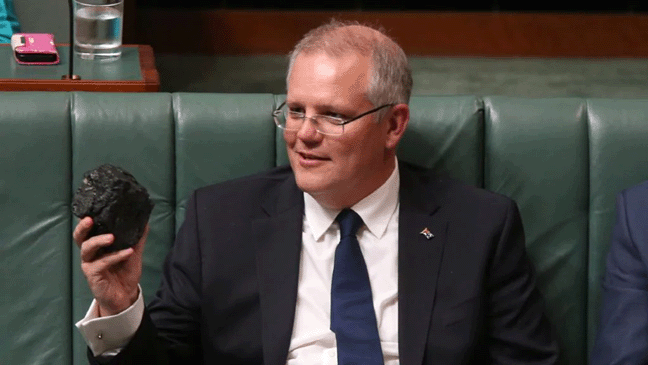
Scott Morrison needs a plan to cut emissions but all he has is a fairytale
Contrary to Scott Morrison’s deceptive boast – Australia is on track to miss Paris climate targets
 Australia on track to miss Paris climate targets as emissions hit record highs https://www.theguardian.com/australia-news/2018/sep/14/australia-on-track-to-miss-paris-climate-targets-as-emissions-hit-record-highs Australia on track to miss Paris climate targets as emissions hit record highs https://www.theguardian.com/australia-news/2018/sep/14/australia-on-track-to-miss-paris-climate-targets-as-emissions-hit-record-highs
NDEVR Environmental data suggests Australia will miss targets by 1bn tonnes of carbon dioxide under current trajectory, Guardian, Lisa Cox, 14 Sept 18, [good graphs on original] Australia remains on track to miss its Paris climate targets as carbon emissions continue to soar, according to new data. The figures from NDEVR Environmental for the year up to the end of June 2018 show the country’s emissions were again the highest on record when unreliable data from the land use and forestry sectors was excluded. It is the third consecutive year for record-breaking emissions. NDEVR replicates the federal government’s national greenhouse gas inventory (NGGI) quarterly reports but releases them months ahead of the official data. Previous NDEVR figures have been within 1% of the official figures when eventually released. The government has yet to publish any emissions data for 2018. Its last update was for the year to December 2017, which it published in May and showed Australia’s emissions continue to soar. NDEVR’s report projects Australia will miss its Paris targets by about a billion tonnes of carbon dioxide if emissions continue on their current trajectory. It projects that emissions, excluding land use, will be 558m tonnes, the highest since records began in 2002. It finds that transport emissions were the highest on record in the final quarter of the 2018 financial year and continue to rise. NDEVR said this was due to the rapid increase in the use of diesel fuel in both passenger cars and heavy transport. Emissions from stationary energy and fugitive emissions continue to trend upwards. The rise in stationary emissions is mostly attributable to energy industries excluding electricity generation NDEVR’s report projects a drop in emissions from the electricity sector for the final quarter of the 2018 financial year because of a reduction in total electricity generation in the national electricity market states and an increase in generation from renewables. But Matt Drum, the managing director of NDEVR Environmental, said Australia was still not on track to meet its Paris targets. “Tracking the Paris trend line, they’re still heading north and missing Paris by a long way and our 2050 two-degree target by an even greater margin,” he said. “The data’s telling us clearly again that we’re not on a trajectory to meet our targets, there’s no effective policy to meet our targets, but we’re still hearing commentary from the government that we’re on track to meet our targets.” |
|
Darebin Council, Victoria leads the way on climate change action
 It’s not too late to act on climate change, The Age, Paul Gilding 11 Sept 18, People engaged in the climate debate are often bewildered by society’s lack of response. How can we ignore such overwhelming evidence of an existential threat to social and economic stability?
Darebin in Melbourne. This local council looked rationally at what the science told them – that we face a crisis and the only logical response is to declare a climate emergency. And so they did. In consultation with their community, they then developed the Darebin Climate Emergency Plan.
Yes, it’s frustrating that these things take time. Therefore, knowing we can still “win” is key. Towards this end I co-wrote nearly 10 years ago a journal paper, The One Degree War Plan, with Professor Jorgen Randers, showing how achieving 1 degree of warming was surprisingly realistic with a WWII style mobilisation. Recently along the same lines, The Climate Mobilisation developed a “Victory Plan” to show what a WWII style economic mobilisation across the USA could look like.
Find this hard to imagine? It is. But as we learnt from Churchill in 1940, when we shift our thinking to “what is necessary”, what we can achieve is quite extraordinary. Or as Nelson Mandela said: “It always seems impossible, until it’s done.”
Paul Gilding is a Fellow at the University of Cambridge Institute for Sustainability Leadership. https://www.theage.com.au/national/victoria/it-s-not-too-late-to-act-on-climate-change-20180911-p50318.html?crpt=index
Australian Communities Foundation Divests $90 Million From Fossil Fuels
A leading Australian foundation is entirely divesting its $90 million corpus investment portfolio from fossil fuels to focus on environmentally sustainable investments. Pro Bono News, 12th September 2018, Luke Michael, Journalist, Australian Communities Foundation has transitioned its portfolio to an ethical investment approach over the past three years, and on Wednesday pledged to fully divest from fossil fuel investments.ACF CEO Maree Sidey told Pro Bono News the change was driven by their donors.
“We made that move because our donors have very strong values around social justice and taking a sustainable approach to the environment,” Sidey said.
“And we were asked by our donors to really start thinking about our investments and how we were aligning our investments with the social outcomes that we wanted to see through our distributions.”
ACF’s commitment means no new investments in the top 200 oil, gas, or coal companies, and selling any of these existing investments within five years.
The organisation will turn its investment focus to climate solutions such as renewable energy, sustainable agriculture and water efficiency…………
The commitment is part of a global DivestInvest announcement at the Global Climate Action Summit in San Francisco.
The global DivestInvest movement has commitments from almost 900 organisations – with combined assets of $6.2 trillion – to stop investing in fossil-fuel companies.
Clara Vondrich, global director of DivestInvest Philanthropy, welcomed ACF’s commitment, noting that “any mission-based philanthropy that pours grant dollars into programming while remaining invested in fossil fuels is treating symptoms while ignoring the cause”. https://probonoaustralia.com.au/news/2018/09/australian-communities-foundation-divests-90-million-fossil-fuels/
Senator Matt Canavan ridicules climate health report, days after climate health expert wins Liberal safe seat
 Canavan ridicules climate health report, days after climate health expert wins Liberal safe seat, REneweconomy, 12 September 2018
But Canavan, who appears to have a new role in the Coalition Cabinet as minister for Not Taking Climate Science Seriously, dismissed the work as seemingly drug influenced, and based on “imaginary” threats.
“This report reads like it was written during poetry slam night at the happy herb cafe,” the senator reportedly told The Courier-Mail, a Murdoch newspaper, on Wednesday……..https://reneweconomy.com.au/canavan-ridicules-climate-health-report-days-after-climate-health-expert-wins-liberal-safe-seat-73431/
68% of Australians want govt to set genuine emissions targets to meet our Paris climate commitments
 Climate poll shows Morrison politically vulnerable as more voters back action https://www.theguardian.com/environment/2018/sep/12/climate-poll-shows-morrison-politically-vulnerable-as-more-voters-back-action
Number of Australians concerned about impact of climate change and wanting coal phased out rises, Guardian, Katharine Murphy Political editor @murpharoo12 Sep 2018 A growing number of Australians are concerned about the impact of climate change, and more than half of a survey of 1,756 voters believe the Morrison government needs to stay in the Paris agreement, despite Donald Trump’s decision to withdraw the US.
A study tracking voter sentiment for more than a decade, funded first by the Climate Institute and now by the Australia Institute, finds 73% (up from 66% in 2017) of respondents concerned about climate change, and a clear majority, 68%, believes the government should set domestic targets to comply with our Paris commitments.
An increased 67% want coal-fired power to be phased out within 20 years, up from 61% in 2017.
The findings suggest the Morrison government is politically vulnerable on climate change at the next federal election. The prime minister has declared Australia will not pull out of Paris but also abandoned the national energy guarantee that imposed an emissions reduction target on the electricity sector. Continue reading
Australia is going backwards on climate change action, as Morrison govt, Trump-like, spruiks “success”
Just before Christmas last year, the Australian Government published a report which suggests that — without significant policy change — Australia will miss that commitment by a long way. Emissions in 2020 will be just 5 per cent below 2005 levels, according to the official projections and — without further measures to cut them — emissions will grow by 3.5 per cent on 2020 levels in the 10 years to 2030.
In other words, we’ll go backwards in the coming decade..
There’s a certain Trump-like quality to Australia’s discourse on emissions reductions, ABC 11 Sep 18 By Stephen Long ,
It seems to be high on the list of the Morrison Government’s talking points: the claim that we’re “on track” to meet our commitments to cut greenhouse gas emissions under the Paris climate accord.
The PM reckons we’ll meet the targets “in a canter”.
“We’re on track to achieve them,” the new Environment Minister, ex-mining industry lawyer and mining executive Melissa Price, also reassured radio listeners, adding that she supports the construction of new coal-fired power stations.
Foreign Minister Marise Payne — back from meeting Pacific Islands leaders whose nations literally face an existential threat from climate change — joined the chorus, as did Energy Minister Angus Taylor.
Australia is on track to “meet and exceed” the Paris commitments, according to Trade Minister Simon Birmingham.
“We are already more than meeting the 26 per cent that was set down in the Paris agreement,” National Party leader Michael McCormack confidently told David Spears on Sky News, though when pressed, he was a bit unsure about what information that claim was based on. Continue reading
Queensland government climate strategy stresses the health impacts
 heat stress among children and the elderly was the health sector’s main concern for the future.
The new statewide strategy to tackle climate-driven health risks argued doctors could play a role as “highly trusted” messengers about climate impacts to the community, where politicians have failed.
The plan, obtained by the ABC ahead of its launch today by Queensland Health Minister Steven Miles, revealed the health sector regarded a lack of political support — including mixed messages from the Government’s own pro-coal and gas development decisions — as the key barrier to adapting to climate change. Continue reading
Morrison government ignores climate change, and so imperils the health of Australians
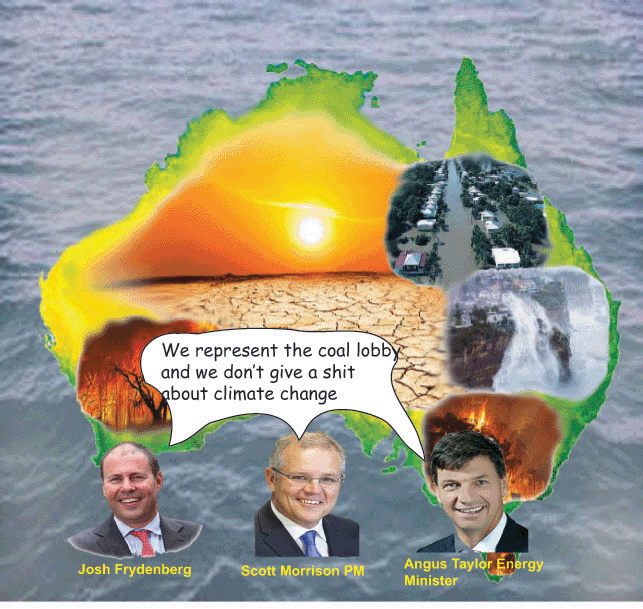 The Morrison Government: An extraordinary health hazard The Morrison Government: An extraordinary health hazard
Doctors for the Environment 10 September 2018, Climate change denial is the denial of many public health casualties.
For example, the increasing number of injuries and deaths from extreme weather events and the psychological and economic trauma consequent to severe climatic change. New Prime Minister Scott Morrison, who when Treasurer carried coal into Parliament, has appointed avid anti-wind farm campaigner, Angus Taylor, as Energy Minister and ex-coal-company lawyer, Melissa Price, as Environment Minister. There has been no mention of climate change in either portfolio. If there is any doubt about the PM’s lack of commitment to Australia’s COP21 agreement to emissions reduction, also consider for a moment that his new chief-of-staff, John Kunkel, spent six years as deputy CEO of the Minerals Council, followed by two years as head of government affairs (that is, lobbying) for Rio Tinto! Furthermore, PM Morrison says climate change doesn’t have to be part of the consideration of drought, yet the science is increasingly secure that Australia is becoming drier and land will be subject to increased evaporation. Now the Government’s signature power policy, the National Energy Guarantee (NEG) is gone, what will replace it? Nothing! Minister for Home Affairs Peter Dutton who headed the leadership challenge against Malcolm Turnbull, may not be prime minister, but the conservative vandals have succeeded in the wanton destruction of even a holding pattern on carbon emissions. The renewed attack on renewable energy generation will lead to more illness and death from pollution because it will slow the transition away from coal-fired power generation. The thinking is doubly wrong because pollution-related illnesses also cost us, the end-users, about the same in dollar terms as the polluting generators collect in charges — equivalent to politicians throwing away our money!………https://independentaustralia.net/environment/environment-display/the-morrison-government-an-extraordinary-health-hazard,11876 |
|
Australia’s Liberal Coalition government abandons plans to combat climate change
Josh Frydenberg says government will focus on power prices over emissions reduction, Canberra Times By Stephanie Peatling, 9 September 2018 Treasurer Josh Frydenberg has conceded the Australian Parliament has failed to deal with the challenge of climate change as he confirmed the new Morrison government will concentrate on lowering power prices ahead of reducing greenhouse gas emissions.
“What you will hear from us, which you will not hear from the Labor Party, is that we will put reducing people’s power bills first, over emissions. You will not hear the Labor Party say that,” he said……..
Mr Frydenberg’s comments on Sunday followed those made by Prime Minister Scott Morrison on Saturday when he said he would formally ask the Liberal party room to ditch the policy when it meets this week.
Mr Morrison repeated his commitment to Australia meeting its international greenhouse gas reduction targets under the Paris agreement but said the target would no longer be legislated. New Energy Minister Angus Taylor is working on a revamped energy policy to take to cabinet.
…….Mr Frydenberg said the issue of climate change was one which had bedevilled Australian politics for more than a decade…….
Mr Frydenberg said he was confident Australia would still meet is international greenhouse gas reduction targets but people wanted to see the government acting on power prices.
“The people of Australia want to see their power bills come down, and they want to see the government take whatever measure possible to do that,” Mr Frydenberg said.
Labor’s energy spokesman Mark Butler said the government’s decision to walk away from the policy was a capitulation to the more conservative elements inside the Coalition.
“In an abject surrender to the hard-right, to the Tony Abbott forces within his own party room, he’s [Scott Morrison] decided to walk away from his government’s own policy, and households will end up paying the price,” Mr Butler told Sky News.https://www.canberratimes.com.au/politics/federal/josh-frydenberg-says-government-will-focus-on-power-prices-over-emissions-reduction-20180909-p502oe.html?crpt
Australia stands to REALLY lose face on climate change at coming international summits
Morrison will face mounting pressure from the vocal band of conservatives in his party room not to commit to anything on climate change, be it symbolic or tangible.Australia is neither a small nation nor one of the most powerful, but for many years it has been a trusted nation. Historically, Australia has been seen as a good international citizen, a country that stands by its international commitments and works with others to improve the international system, not undermine it.
With Australia’s new foreign minister, Marise Payne, attending instead of the prime minister – not a good look, albeit understandable in the circumstances – the government came under yet more international pressure to state plainly its commitment to the Paris climate agreement.
Pacific nations may be divided on many issues, but climate change is rarely one of them.
Before the meeting, Pacific leaders urged Australia to sign a pledge of support for the agreement and to declare climate change “the single greatest threat to the livelihoods, security and wellbeing” of the region.
The government now has a chance to catch its breath before international summit season begins in earnest in November with the East Asia Summit in Singapore, followed quickly by APEC in Papua New Guinea and then the G20 summit in Buenos Aires on November 30 and December 1, not to mention the next round of UN climate negotiationsin Poland in December. Continue reading
1 This month
7 April – WEBINAR – Australia and the Doomsday Clock – Preventing nuclear war through NoFirstUse and other policies
Online | Tuesday April 7, 4:00-5:30pm, Australian Eastern Time / 8:00-9:30am Central Europe Time
– Access the registration link
15 April – Zoom –Nuclear Power is Not the Solution
Apr 15, 2026 01:00 AM in Canberra, Melbourne, Sydney

Join the International Physicians for the Prevention of Nuclear War (IPPNW) on Tuesday, April 14th for a timely webinar exploring the risks associated with nuclear power and challenging the myth that it offers a simple, safe, carbon-free solution to the climate crisis

21 April Webinar: No Nuclear Weapons in Australia
Start: 2026-04-21 18:00:00 UTC Canberra, Melbourne, Sydney (GMT+10:00)
End: 2026-04-21 19:30:00 UTC Canberra, Melbourne, Sydney (GMT+10:00)
Event Type: Virtual
A virtual link will be communicated before the event.
Host Contact Info: australia@icanw.org

of the week – Australians for War Powers Reform (AWPR)
To see nuclear-related stories in greater depth and intensity
 Antinuclear