The Liberal Party of Australia is now officially a party split in half by climate denial. Greens Senator Sarah Hanson-Young explains. We have no chance of seeing the Liberal Government take any type of climate policy to the election.
After dumping Malcolm Turnbull for daring to utter the words “carbon emissions”, Scott Morrison, the man who brought a lump of coal into the Parliament, has appointed a climate sceptic as Environment Minister. He has put an anti-wind farm campaigner at the helm of the Energy Ministry.
While Scott Morrison’s new front bench will spend the week sopping up blood and repeating unconvincing lines of “unity and renewal”, the rest of the country looks on in disgust.
As the nation burns in winter, drought ravages New South Wales, and the Murray Darling River runs to a trickle, the mob governing the country couldn’t give a damn.
In a last-minute attempt to save his own job, Malcolm Turnbull served a fatal blow to the environment making it near impossible for the Coalition to have a climate policy for at least a generation.
Roughly half of the Liberal Party room don’t believe in the science of climate change, and now their leader is a bloke whose pet rock is a lump of coal.A growing number of Australians, tired of waiting for leadership out of Canberra, are taking matters into their own hands. And the good news is, there’s plenty of ways to make a difference.
Whether it is about the waste we create, the food we eat and putting solar panels on our homes to reduce power bills and pollution, we all have the opportunity to help reduce our impact on the planet and environment. But, while everyday Australians are chipping in, our politicians are tapping out, and unfortunately, some problems can’t be solved without political leadership.
The environment needs a strong political advocate. Sadly, the people Scott Morrison has put in place will do nothing to alleviate fears of Australians worried about our impact on the health of the planet.
New Environment Minister Melissa Price is a climate sceptic and advocate for the mining industry, and Angus Taylor, a known anti-windfarm campaigner will put a wrecking ball through renewables as Energy Minister.
After all the internal drama that stopped the Government from governing last week, political leadership on climate change is further away than ever. Dumping any emissions reduction target means there is now no prospect of a roadmap to help drive pollution down or support a transition to renewables. This is worse than policy paralysis, it is policy regression.
We need strong action to save the Murray Darling River system for future generations, arrest climate change by reducing pollution, protect our oceans and stop the extinction crisis in its tracks.
The battle lines are clear. The only way to do any of this now is to kick this mob out.
Can’t vote Liberal ‘in good conscience‘: Alex Turnbull blasts climate stance , Brisbane Times, By Peter Hannam, 27 August 2018Alex Turnbull blamed “rent-seekers” backing the coal industry for felling his father Malcolm Turnbull as prime minister, saying it’s “impossible” to vote for the Liberal-National coalition “in good conscience” because of its climate stance.
In a wide-ranging interview just days after his father lost power in a party room putsch, the Singapore-based fund manager told Fairfax Media the Liberal Party faced being hijacked by financial interests that stood to make windfall profits if coal-related assets were bolstered by taxpayers.
Those interests “have their hooks into the Liberal Party … which has no money”, Mr Turnbull said, adding that returns could be “100 to 1” if policies fall investors’ way.
Mr Turnbull’s experience includes a stint at investment banking giant Goldman Sachs. Some of his work has also involved trading debt for Australian-based coal-fired power plants, giving him insights into that industry’s outlook.
“If you create such an environment – with such a high rate of return – you’ll see a lot more of that [influence peddling],” he said……..
“It’s impossible to vote for the LNP in good conscience,” Mr Turnbull said, adding he had no intention of entering politics himself. “My father fought the stupid and the stupid won.”
Mr Turnbull was also critical of the government’s overall climate action, saying that pulling the Paris Agreement – as conservative MPs and pundits have been demanding – was irrelevant at this point.
“It’s like being in a university course, final exams are coming and you haven’t done three-quarters of the work,” he said. “You’re going to fail anyway.”……
He predicted Labor’s left would keep that party “honest” on climate change.
Bill Shorten “doesn’t really care about climate change – he just wants the jobs”, Mr Turnbull said, adding that there were lots of them in Victoria and elsewhere as the renewable energy boom rolls on.
Two terms of federal Labor should mean Australia’s electricity sector “would have crossed the magic line” – such as exceeding 40 per cent of supply from wind and solar. “They’re not going to be able to go back.”
Climate change is World War III, and we are leaderless, ABC News, 28 Aug18 By David Shearman
“,World War III is well and truly underway. And we are losing,” writes environmental activist Bill McKibben, so when Malcolm Turnbull implied that the insurgency that demolished his government was based on climate ideology, what lessons are there for Scott Morrison?
As a child in Britain during WWII, I lived in a street of mothers and children. ……..
Britain was a united and cohesive community. Young and old worked daily in small ways for the common cause. But most importantly, in the free world, two countries — Britain and the US — had leaders in Winston Churchill and Franklin D Roosevelt who could explain the need for duty and sacrifice.
Their like is yet to emerge today, and indeed the Western world is bereft, perhaps apart from French President Emmanuel Macron, who explained to Congress and the American people that secure borders are irrelevant to this threat, and all of us are world citizens needing to act in concert. “There is no Planet B,” he said.
Two of the world’s highest per capita carbon emitters, the United States and Australia, have deserted the trenches of WWIII by trading ideology for human lives and health.
Climate change litigation rising with the seas
The US response to the climate threat has been withdrawal from the Paris agreement and a full-frontal attack on the US Environmental Protection Authority, a national defence against climate change, pollution and ill-health — as irrational as if the Germans had demolished their “Siegfried Line” of WWII.
Australia’s response to climate change is devious; under the guise of action, the transition to renewable energy has been carefully modulated to maintain coal. Policy was corrupted by deference to a party clique of climate deniers who proudly named their group after Australia’s most illustrious WW1 general John Monash, and were deaf to his descendants pleading for his name to be removed.
Like the US, Australia is failing to save the lives of its citizens by prolonging the life of polluting coal-fired power.
PM Scott Morrison evades climate change link to drought, 9 News
4:22pm Aug 27, 2018 Scott Morrison won’t say if human-induced climate change is associated with the drought in Queensland and NSW because it doesn’t help solve practical problems.The new prime minister visited a drought-stricken Quilpie farm in rural Queensland in his first visit in the job, but refused to say if he thought climate change was affecting the drought.
“Climate is changing, everybody knows that,” he told reporters today.
“It’s not a debate I’ve participated a lot in in the past, because I’m practically interested in the policies that will address what is going on here right and now.
“I’m interested in getting people’s electricity prices down and I’m not terribly interested in engaging in those sorts of debates at this point.”…….Labor attacked Mr Morrison for making Barnaby Joyce a special drought envoy, calling the decision a slap in the face for farmers.
Opposition agriculture spokesman Joel Fitzgibbon said the position would allow the former Nationals leader to campaign across Australia at public expense.
“The appointment of climate change denier Barnaby Joyce as his drought envoy is a joke and a slap in the face for all in the sector who want meaningful drought policy reform,” Mr Fitzgibbon said. ……Mr Fitzgibbon said Mr Morrison had made a bad start, accusing the prime minister of using drought as a plaything to improve his image. https://www.9news.com.au/2018/08/27/15/46/prime-minister-scott-morrison-visits-drought-hit-southern-queensland
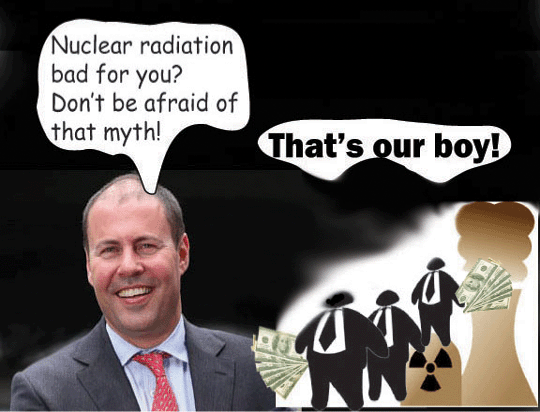
Mathias Cormann, Minister for Finance, Special Minister of State, Leader of the Government in the Senate: WA senator pushes benefits of nuclear energy
A WA Liberal Senator, Mathias Cormann, is pushing the merits of Australia developing nuclear energy …….But, Mr Cormann was unable to say where waste would be buried. “Longer term, very clearly we do have to find ways to store or to dispose of it in deep geological disposal arrangements but we have time for that“….http://www.abc.net.au/news/2009-12-04/wa-senator-pushes-benefits-of-nuclear-energy/1168286
Michael McCormack, Deputy Prime Minister, Minister for Infrastructure and Transport. “
Steve Ciobo, Minister for Defence Industry Steve Ciobo overturned mining loan ban without consulting department The minister for trade, Steve Ciobo, overturned a ban on government-backed loans to domestic miners last year without consulting his department.
Melissa Price, Minister for the Environment. This one is a bit of an unknown quantity. Unlike the rest of them, she actually knows something about the environment. Expect the rest of them to bully her into shape
David Fawcett, Assistant Minister for Defence was noted as a climate change denier, on the Liberals don’t want sustainable energy list http://ramblingsdc.net/Australia/Liberal.html
Richard Glover on climate policy: Australia insignificant? Pathetic and absurd, Brisbane Times By Richard Glover , 24 Aug 18 “……..Australia was a small place of little import, dwarfed by these [overseas] humming centres of real life.
Once you’ve grown up with that idea, as many Australians did, it can be hard to shift gear. That’s why – some years on – I was taken aback when I acquired a copy of the Times Atlas of the World. It had a table listing the great cities of the world, according to the size of their population…….
Australia now has the 13th largest economy in the world, with predictions it will be the 11th largest within a decade. If NSW went it alone, as a separate country, the economy would be the 26th biggest in the world. In military terms, a recent comparison listed the country in 21st position, out of 136.
Do these rankings matter? I think so, if only because the idea of “little ole Australia” is constantly used as an excuse for failure, for accepting the second rate, for shrugging away our responsibilities…..
The latest version of this dire, cringing attitude formed the background to this week’s leadership spill. The Dutton forces kept repeating the same mantra: Australia is so small it has no impact on carbon emissions. We may as well do nothing. Anything else is grandstanding or “virtue-signalling”.
It’s true, of course, that Australia’s emissions are less than those of the United States and China, but that doesn’t mean they are “nothing” or “negligible”, the terms always employed.
Australia was responsible for 1.1 per cent of global emissions in 2016, making us the 16th most polluting country in the world. Per head we’re among the worst.
Then there’s the idea that – due to our size – we should give up the ambition of having a positive impact on the world. Important battles – this is the underlying thought – should be left to others. We can stand on the sidelines and freeload………
It’s the cringe, writ large. It shows neither national pride nor global spirit. It’s also out of step with a balanced understanding of our relatively-significant place in the world.
if all other countries were to follow Australia’s current policy settings, warming could reach over 3°C and up to 4°C.
Climate Change Policy Toppled Australia’s Leader. Here’s What It Means for Others, New York Times, By Somini Sengupta Aug. 24, 2018
Climate change policy toppled the government in Australia on Friday.
How much does that really matter?
It is certain to keep Australia from meeting its emissions targets under the Paris climate agreement.
It’s also a glimpse into what a potent political issue climate change and energy policy can be in a handful of countries with powerful fossil fuel lobbies, namely Australia, Canada and the United States.
In Australia, the world’s largest exporter of coal, climate and energy policy have infused politics for a decade, helping to bring down both liberal and conservative lawmakers.
It could be a bellwether for next year’s Canadian elections, expected in October, in which Prime Minister Justin Trudeau faces a powerful challenge from politicians aligned with the country’s oil industry. Conservatives have pledged to undo Mr. Trudeau’s plans to put a price on carbon nationwide if they take power. At the provincial level, conservatives won a majority in Ontario after campaigning against the province’s newly enacted cap-and-trade program.
The Australian parallels with the United States are striking. The Trump administration has promised to revive the coal industry, rolled back fuel emissions standards and announced the country’s exit from the Paris pact altogether. Climate change is not a driving issue in the United States midterm election campaign, though it is for liberal Democrats, a recent study by the Yale Program on Climate Change Communication has shown.
Environmental policy and global warming are top priorities for those who describe themselves as liberal Democrats, the study found, after health care and gun control.
……… Robert C. Orr, dean of the School of Public Policy at the University of Maryland, pointed to another parallel: In both Australia and the United States, local leaders have embraced renewable energy even as national politicians promote fossil fuels.
“Australia is a lot like the U.S.,” said Dr. Orr, who is also the special adviser on climate change to the United Nations secretary general. “Climate policy has really been driven from below, from the state, local and business level. That is not going to change.”
Most Australian states have renewable energy targets, and Australians are powering their houses with solar energy at one of the highest rates in the world. But Australia’s emissions have continued to rise.
Australia is among several industrialized nations that are not on track to reduce greenhouse gas emissions to keep global warming below two degrees Celsius as the Paris accord promises, according to independent analyses.
Climate Action Tracker, an alliance of European think tanks that tracks countries’ climate pledges under the agreement, concluded recently that “if all other countries were to follow Australia’s current policy settings, warming could reach over 3°C and up to 4°C.” Those are levels that climate scientists consider “highly insufficient” to stop the worst effects of climate change. https://www.nytimes.com/2018/08/24/climate/australia-climate-change.html
‘Climate wars’ claim another political scalpIN Daily, 24 Aug 18 While some remain unconvinced that climate change is wreaking havoc with our weather systems, the current circus in federal politics proves it is doing inordinate damage to our political system, writes climate lobbyist Rod Mitchell. It may not be obvious to all that climate change is beginning to wreak havoc with our weather systems but the last few days in federal politics makes it clear as day that climate change is doing inordinate damage to our political system.
The ‘climate wars’ have deeply infected and divided our parliament. Now they have formally divided the Coalition, perhaps fatally.
The Liberal Party is imploding in large part because of climate change.
The feelings that it engenders have latched onto and amplified other tensions and differences in the party and lit the fuse of self-destruction. The prospect of legislating our Paris Climate Agreement target as part of the NEG was just the last straw in a struggle that has been going on since 2009, at least.
Climate change was a major factor in the successive downfalls of Rudd and Gillard and the end of the Labor government itself. And it has been a significant cause of the increasing polarisation in politics, both here and in other parts of the world.
The great divide between US Democrats and Republicans has been fuelled by vested interests who have funded think tanks to sow seeds of doubt about climate change and have made many ‘political donations’ to Members of Congress.
So why is climate change having such a powerful effect on politics? There are two main reasons.
First, the implications of climate change are truly frightening, so much so that for most of us it is too hard to look at. It is so much easier to look away, to keep busy with life and to welcome the soothing words of anyone who suggests that it is not happening. The survival instincts we have inherited from our ancestors are finely tuned to respond to immediate danger but have not yet evolved to encompass more distant threats. We tend to live for the present and for the short-term future. We can think about setting up our kids with a good education and job prospects but find it too hard to think about leaving them a liveable world.
Secondly, our economic system is set up in such a way that it is unable to put medium to long-term risk ahead of short-term gain. Quite simply, the profits to be made from activities that feed climate change are so great that most industries and their customers (that’s most of us) cannot resist the temptation. Furthermore, companies are obliged to grow their business and produce surpluses, but only in the short term. Only recently are they being urged (but not obliged) to factor climate risk into longer-term planning.
This is the way our economic system has evolved and it is inevitable that corporations would use the political power their wealth has generated to keep it evolving in their interests. Funding think tanks, donating to political parties and MPs and lavishing decision makers with their largesse make perfect economic, if not moral sense. Political instability, opportunist politicking and policy paralysis are acceptable forms of collateral damage if the profits keep flowing.
There comes a tipping point however where the damage begins to threaten the economy itself and the society it is supposed to serve. Perhaps that point has arrived, and our current political crisis may be the most glaring symptom yet.
It says something about the state of Australia’s politics that the new prime minister, the man who brandished a lump of coal in parliament, is considered a moderate, at least in comparison to the forces he beat to the job.
……a relief for the renewable energy industry in Australia – because it is clear that Dutton may have led Australia out of the Paris climate agreement and even brought renewable energy schemes to a crashing halt.
But it may not be cause for celebration. Morrison will lead and will have as his deputy Josh Frydenberg, the man who put together the National Energy Guarantee that proposed no new investment in wind and solar for a decade.
Morrison is known as “Sco-Mo”, an abbreviation of his name. But he might just as well be known as “Scoal-Mo” after brandishing a lump of coal thoughtfully lacquered by the Minerals Council of Australia in parliament in February last year.
But we were. In doing this, Morrison was pinning his colours to the mast of energy policy idiocy of the sort you find in the Murdoch media and on talk back radio, and on the front and back benches of the Coalition.
And Morrison dived even deeper into the murky depths of ignorance a few months later.
South Australia had followed that outage in February – caused by the failure of a gas plant to switch on – by building the Tesla big battery – in just 100 days – but Morrison decried it as being as useful as the Big Banana………
Morrison, as Treasurer, also ignored climate change in his most recent budget, making no mention of it in his speech, apart from insisting that Australia would “maintain our responsible and achievable emissions reduction target at 26-28 per cent and not the 45 per cent demanded by the opposition.”……
Right now, there is no policy in place. Australia’s emissions are rising, predicted to miss the weak 2030 target by a wide margin, and there is complete uncertainty about the National Energy Guarantee that Frydenberg has been spending a year putting together with the Energy Security Board and the big business lobbies.
The story starts in 1997, when the brand-new Howard government (sweating through a brief and cock-up-infested first term during which it lost a series of ministers and most of the margin with which it had wrested power from Paul Keating) sends its environment minister, Robert Hill, to Japan for the seminal Kyoto Climate Summit.
At the summit, Senator Hill negotiates generous terms for his country in the global deal; Australia emerged with large concessions for its agricultural activities and is one of only three countries permitted to increase its emissions under the deal.
Senator Hill is welcomed home as a conquering hero.
However, over the years enthusiasm for the compact is replaced within the government by scepticism.
MPs push for Paris climate exit under Dutton, The Age, By Eryk Bagshaw23 August 2018—Conservative MPs would ramp up the pressure on a Dutton government to exit the Paris climate agreement, opening up Australia to the risk of trade sanctions, stalling negotiations with the European Union and critically endangering relationships with the Pacific.
……..The conservative vanguard, led by former prime minister Tony Abbott and backbenchers Craig Kelly, Jim Molan and Eric Abetz, have been fierce advocates of dumping the Paris climate deal and delivering the Catholic school sector millions in extra funding.
The group has been instrumental in elevating Mr Dutton to within striking distance of the Lodge on a platform of lowering energy bills, cutting immigration and wrestling control of the Liberal Party away from the “inner-city elite”.
They have been aided in their campaign by Nationals MPs, including former deputy prime minister Barnaby Joyce, who said last week: “People in the Kmart, people in the local pub, they don’t care about the Paris agreement.”
Mr Dutton refused to commit to the Paris agreement when he announced he was challenging Prime Minister Malcolm Turnbull for his job. “My judgment is that we do whatever reduces power prices,” he said. …….Mr Kelly, a Dutton ally, said there should a full national audit of the impact of the Paris target on the economy.
……..The agreement locks in an emissions cut of 26-28 per cent on 2005 levels by 2030.
Pulling out of it, which can not be done before 2020, would put Australia in breach of international trade agreements, potentially endangering a free trade deal with the EU that is in the middle of negotiations.
Legislation does not have to pass Parliament to exit Paris. A prime ministerial direction to the joint committee on treaties would be enough to remove Australia from the deal.
Robyn Eckerlsey, a climate treaty expert at the University of Melbourne, said it “was a crazy thing” to be considering given the pledged targets are voluntary and there were no formal penalties……
The Pacific Islands Forum is due to be held in the first week of September, where Australia could be represented by Mr Turnbull, Mr Dutton, Scott Morrison or Julie Bishop if there is a party-room vote on Friday.
The Turnbull Coalition government has effectively dumped the emissions component from the proposed National Energy Guarantee, in what could be prime minister Malcolm Turnbull’s final act of capitulation to the far right forces within the government parties.
Turnbull dumped the emissions component of the NEG in a desperate act to ward off a potential challenge to his 3-year leadership of the Liberals, with home affairs minister Peter Dutton (as we predicted in last week’s podcast) said to be waiting in the wings, and with the numbers, according to Fairfax.
The removal of an emissions target makes a mockery of what the NEG was supposed to be about – a first ever combination of climate and energy policy, of emissions and reliability. It was supposed to be a policy that crossed party lines; instead, it could not even be agreed on by the Liberals.
It remains to be seen if Turnbull gets to keep his job. But it certainly sees the end of any credibility that Turnbull would take climate change seriously.
Instead, the Coalition says it will choose to focus on reliability – even though there is no “reliability issue” because AEMO doesn’t not expect the obligation to be triggered any time in the next 10 years on current measures,…….
The other key component of the Coalition’s policy is to adopt the ACCC proposal of having the government underwrite the financing of new “dispatchable” generation. …….
The need for this is not clear, and while the Coalition’s right wing thinks this will translate into new “base-load” coal, renewable energy developers like UK billionaire Sanjeev Gupta suggests it could help dramatically reduce the cost of solar and storage in the country, to half the price of current wholesale prices.
What’s the chance of the Coalition right wing allowing that to happen? They will be sure to want to choose the technology of their choice. It’s unlikely a Turnbull or a Dutton government would endorse a huge solar and storage project as a result of such a tender.
On top of this, the Coalition is looking to force some energy utilities to divest any assets that it may want to close, think AGL with Liddell. In effect, this is the government intervening to stop coal exiting the market, in effect seeking to stop the clean energy transition. It is appalling.
All in all, Australia’s climate and energy policy remains in a sorry state. Turnbull blames his bare one seat majority for his predicament, but at no time has he shown any leadership or an attachment to his principals, at least as we understood them before he came PM.
The lack of leadership is transparent, but Turnbull is not the only one to blame. That blame should be shared by the principal players in the Energy Security Board and the representatives of the big business lobbies who were behind the NEG.
From the start, they sought to pretend this was something it was not. In the end, that deceipt also became transparent, and the lack of goodwill, and the deliberate doctoring of the modelling that was used to justify it, is quite possibly one of the most shameful episodes in Australian climate and energy policy.
The contrast with the states – whose agreement is needed to sign off on what is left in the NEG – is marked. Victoria’s Labor government has announced an extraordinary scheme to fast-track some 2.6GW of rooftop solar through a combination of rebates and zero interest loans.
Malcolm Turnbull dumps plan to legislate Paris emissions targets, ABC News, By political editor Andrew Probyn and Melissa Clarke , 17 Aug 18
Malcolm Turnbull has capitulated to rebels in the Coalition party room, dumping a plan to embed emissions reduction targets in Commonwealth legislation.
Key points:
Turnbull weakened stance on emissions targets to appease rebel MPs
The 2016 Paris Agreement set emissions targets of 26 to 28 per cent lower by 2030
Cabinet ministers to meet on Sunday to discuss new approach to energy policy
To appease critics and lessen the prospect of a backbench revolt, the Prime Minister will instead propose setting emissions targets by regulation, which does not need the assent of Parliament.
The combination of winter drought and hot, dry weather has made dangerous fires increasingly likely.
Already this week two fires on the south coast have escaped containment lines and destroyed houses.
The weather during these fires was 6 degrees Celsius warmer than the August average, dry and extremely windy.
The wind speed peaked at 104 kilometres an hour in Bega and 85kph in Nowra, two towns close to where fires broke out.
Under these conditions, bushfires will spread quickly, produce large numbers of embers and are hard to stop.
Our fire seasons now start earlier and last longer.
This means we’re increasingly likely to see repeats of historically large fires threatening residential areas……..
The Bureau of Meteorology’s latest seasonal forecast, issued on August 16, considers it likely that dry conditions will persist for the next three months.
The heightened risk of bushfire this season should be a wake-up call for residents in bushfire-prone areas.
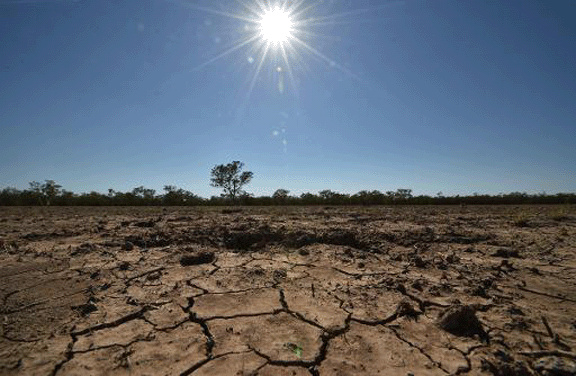
Amidst the worst drought in living memory, the world’s driest continent is also heating up due to climate change. Critics say too little is being done to prevent increasing temperatures and decreasing rainfall.
New South Wales, which is Australia’s most populous state and about the size of France, was declared 100 percent in drought on Wednesday.
Despite the fact that it is winter, farmers in the state and throughout the southern region of Australia are struggling to maintain their livelihood as crops fail and livestock die.
With grazing land turned to dust, some farmers have resorted to hand-feeding to keep their stock alive. They also have permission to shoot kangaroos that compete for pasture. Depression and suicide among farmers are on the rise.
And yet, there is no end in sight to this crippling drought, unseen for generations. The predicted start of bushfire season has been brought forward two months in New South Wales to prepare for what could be an apocalyptic summer scenario.
Though Australia is the driest inhabited continent on Earth and has regularly experienced intense droughts since modern record-taking began after European colonization, the relatively fertile southern regions continue getting hotter while receiving less rain.
Autumn of 2017 in southern Australia was the driest for 116 years. And 2017 was also the hottest year ever in New South Wales.
Increasing drought
“These regions experienced increasing intensity and frequency of hot days and heat waves over the past 50 years, in turn increasing drought severity,” said Lesley Hughes, a professor of biology at Sydney’s Macquarie University and councillor with the Climate Council — a climate change information nonprofit created after the current government closed down the state-funded Climate Commission.
But the “source of the problem is complex,” she told DW.
Scientists are confident that warming linked to human-induced climate change “has contributed to a southward shift in weather fronts from the Southern Ocean, which typically bring rain to southern Australia during winter and spring,” Hughes explained of the reduced precipitation.
As rain-inducing weather fronts drift away from land to the Southern Ocean, the risk of drought has increased, especially in agricultural heartlands such as the Murray Darling Basin in New South Wales.
Benjamin Henley, a research fellow in climate and water resources at the University of Melbourne, shares this view.
“Climate model projections suggest that with anthropogenic emissions, the storm track will shift south, reducing rainfall [over land] in the south,” he told DW.
But global warming could also be increasing the intensity of drought. “Higher temperatures during droughts, which influence evaporation rates, can be due to both the lack of rain itself [due to the reduced evaporative cooling], and the higher probability of warmer temperatures due to climate change,” Henley explained.
Apr 15, 2026 01:00 AM in Canberra, Melbourne, Sydney
Join the International Physicians for the Prevention of Nuclear War (IPPNW) on Tuesday, April 14th for a timely webinar exploring the risks associated with nuclear power and challenging the myth that it offers a simple, safe, carbon-free solution to the climate crisis
21 April Webinar: No Nuclear Weapons in Australia
Start: 2026-04-21 18:00:00 UTC Canberra, Melbourne, Sydney (GMT+10:00)
End: 2026-04-21 19:30:00 UTC Canberra, Melbourne, Sydney (GMT+10:00)
Event Type: Virtual A virtual link will be communicated before the event.













 Antinuclear