Adani’s claims to have secured finance questioned
 Green Left Margaret Gleeson July 20, 2018
‘Karan Adani’s understatement of the cost of the rail link by almost $2.5 billion
is par for the course in Adani propaganda. He also claimed that all approvals
were in place and that work would commence immediately
after the rail finance was approved.
‘However, this is not the case.
There remain several obstacles before work at the mine can begin, including:
‘1. Federal approval for Adani’s proposed water scheme,
involving pumping 12.5 billion litres of water a year from the Suttor River to the mine.
The government has delayed its decision and asked Adani for more information.
‘2. A court challenge by a group of Wangan and Jagalingou people to a land-use agreement.
If the challenge to invalidate the agreement is successful, Adani would then require the
Queensland government to extinguish native title at the mine site.
‘3. A stop order application by a group of Juru people, amid a dispute about cultural heritage
in the vicinity of the Abbot Point coal terminal and a section of the rail link.
‘4. Finance to build an airstrip near the mine site for fly-in fly-out workers. …
‘5. Finance to build the rail line. …
‘6. The Queensland Labor government has imposed more than 240 conditions
on the Carmichael coalmine project, 132 of which relate to water. …
‘Federal Labor environment spokesperson Mark Butler, who opposes the mine,
was sceptical of claims Adani would soon have the finance required for the rail line. …
www.greenleft.org.au/content/adanis-claims-have-secured-finance-questioned
Australian governments finally admitting the dire fate of the Great Barrier Reef
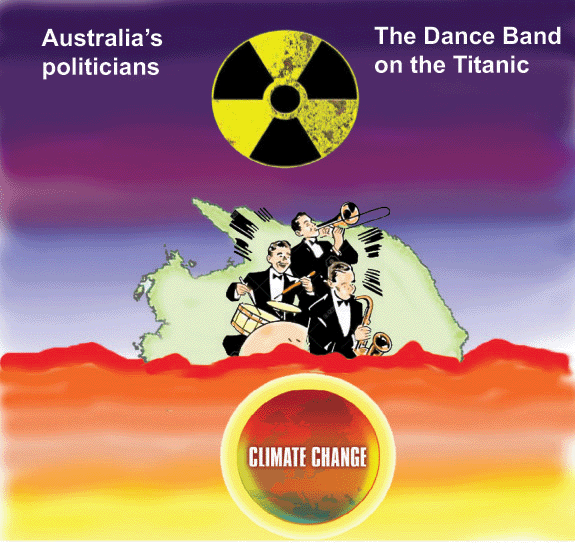 Australian governments concede Great Barrier Reef headed for ‘collapse’ The Age, By Nicole Hasham, 20 July 18 , The world’s climate change path means the Great Barrier Reef is headed for “collapse” according to a plan endorsed by state and federal governments that critics say turns a blind eye to Australia’s inadequate effort to cut carbon emissions.
The federal and Queensland governments on Friday released a “new and improved” Reef 2050 Plan to save the iconic natural wonder, which explicitly acknowledges climate change poses a deadly threat to the reef.
The comments depart starkly from previous official efforts to downplay damage wrought on the reef for fear of denting the tourism industry.
Based on current climate projections, the outlook for coral reefs generally is “one of continuing decline over time, and in many regions, including the Great Barrier Reef, the collapse and loss of coral reef ecosystems”, the plan says.
It concedes that consecutive coral bleaching events and other stressors “have fundamentally changed the character of the reef”, which is one of the most diverse ecosystems on the planet. “Coral bleaching is projected to increase in frequency … those coral reefs that survive are expected to be less biodiverse than in the past,” the plan says.
The reef is the world’s largest living structure, covering an area roughly the size of Italy.
Coral reefs are particularly sensitive to the effects of climate change including higher sea temperatures, ocean acidification and more intense storms and cyclones.
The plan recognised that “holding the global temperature increase to 1.5°C or less is critical to ensure the survival of coral reefs”.
However WWF-Australia head of oceans Richard Leck said Australia’s emissions reduction efforts were not even in line with limiting warming to 2°.
He cited a 2017 report by the United Nations environment program that found Australia’s greenhouse gas emissions were set to far exceed its pledge under the Paris accord. This agreement aims to limit global temperature rises this century to well below 2° and to pursue efforts to limit the increase to 1.5°.
“It is simply not good enough for the revised plan to suggest the global community must work to limit warming when Australia is not doing its fair share,” Mr Leck said.
The Australian Marine Conservation Society’s reef campaign director Imogen Zethoven said increased recognition of climate change as a threat to the reef must be followed by action…….https://www.theage.com.au/politics/federal/australian-governments-concede-great-barrier-reef-headed-for-collapse-20180720-p4zsof.html
Night-time temperatures are going up
Research published in the International Journal of Climatology last year found night-time temperatures were increasing more rapidly than daytime temperatures.
Australia is not immune from warmer nights — our night-time temperatures have been increasing over the past 50 years and they are expected to continue to rise.
 Why temperatures at night are going up around the world and what we can do about it http://www.abc.net.au/news/2018-07-19/nights-getting-hotter-climate-change-has-deadly-consequences/9985340, ABC Weather By Kate Doyle
Ecosystems in Australia are being destroyed by climate change
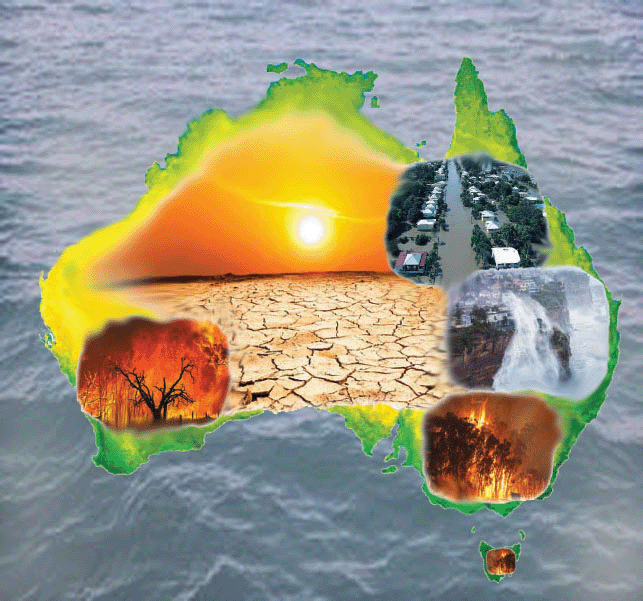 It might be too late to save these Australian ecosystems from climate change
A series of sudden and catastrophic ecosystem collapses has hit Australia – and researchers think they may be irreversible, INDEPENDENT, Rebecca Harris David Bowman 19 July 18
Ecosystems across Australia are collapsing under climate change
The Conversation 4 July 18 Climate Research Fellow, University of Tasmania, Professor, Environmental Change Biology, University of Tasmania, Senior Lecturer, Macquarie University,
To the chagrin of the tourist industry, the Great Barrier Reef has become a notorious victim of climate change. But it is not the only Australian ecosystem on the brink of collapse.
Our research, recently published in Nature Climate Change, describes a series of sudden and catastrophic ecosystem shifts that have occurred recently across Australia.
These changes, caused by the combined stress of gradual climate change and extreme weather events, are overwhelming ecosystems’ natural resilience.
Variable climate
Australia is one of the most climatically variable places in the world. It is filled with ecosystems adapted to this variability, whether that means living in scorching heat, bitter cold or a climate that cycles between the two.
Despite land clearing, mining and other activities that transform the natural landscape, Australia retains large tracts of near-pristine natural systems.
Many of these regions are iconic, sustaining tourism and outdoor activities and providing valuable ecological services – particularly fisheries and water resources. Yet even here, the combined stress of gradual climate change and extreme weather events is causing environmental changes. These changes are often abrupt and potentially irreversible.
They include wildlife and plant population collapses, the local extinction of native species, the loss of ancient, highly diverse ecosystems and the creation of previously unseen ecological communities invaded by new plants and animals.
Australia’s average temperature (both air and sea) has increased by about 1°C since the start of the 19th century. We are now experiencing longer, more frequent and more intense heatwaves, more extreme fire weather and longer fire seasons, changes to rainfall seasonality, and droughts that may be historically unusual.
The interval between these events has also shortened, which means even ecosystems adapted to extremes and high natural variability are struggling.
As climate change accelerates, the magnitude and frequency of extreme events is expected to continue increasing.
What is ecosystem collapse?
Gradual climate change can be thought of as an ongoing “press”, on which the “pulse” of extreme events are now superimposed. In combination, “presses” and “pulses” are more likely to push systems to collapse.
We identified ecosystems across Australia that have recently experienced catastrophic changes, including:
not all examples can be directly linked to a single weather event, or a series of events. These are most likely caused by multiple interactingclimate “presses” and “pulses”. It’s worth remembering that extreme biological responses do not always manifest as an impact on the dominant species. Cascading interactions can trigger ecosystem-wide responses to extreme events.
The cost of intervention
Once an ecosystem goes into steep decline – with key species dying out and crucial interactions no longer possible – there are important consequences.
Apart from their intrinsic worth, these areas can no longer supply fish, forest resources, or carbon storage. It may affect livestock and pasture quality, tourism, and water quality and supply.
Unfortunately, the sheer number of variables – between the species and terrain in each area, and the timing and severity of extreme weather events – makes predicting ecosystem collapses essentially impossible.
Targeted interventions, like the assisted recolonisation of plants and animals, reseeding an area that’s suffered forest loss, and actively protecting vulnerable ecosystems from destructive bushfires, may prevent a system from collapsing, but at considerable financial cost. And as the interval between extreme events shorten, the chance of a successful intervention falls.
Critically, intervention plans may need to be decided upon quickly, without full understanding of the ecological and evolutionary consequences.
How much are we willing to risk failure and any unintended consequences of active intervention? How much do we value “natural” and “pristine” ecosystems that will increasingly depend on protection from threats like invasive plants and more frequent fires?
We suspect the pervasive effects of the press and pulse of climate change means that, increasingly, the risks of doing nothing may outweigh the risks of acting.
The beginning of this century has seen an unprecedented number of widespread, catastrophic biological transformations in response to extreme weather events.
This constellation of unpredictable and sudden biological responses suggests that many seemingly healthy and undisturbed ecosystems are at a tipping point https://theconversation.com/ecosystems-across-australia-are-collapsing-under-climate-change-99367?utm_medium=email&utm_campaign=Latest%20from%20The%20Conversation%20for%20July%205%202018%20-%20105629347&utm_content=Latest%20from%20The%20Conversation%20for%20July%205%202018%20-%20105629347+CID_3caffe1f73b33
Hypocrisy in Australia – our truly awful climate policy
Australia’s history on climate policy is so awful it makes the NEG look like a victory https://www.crikey.com.au/2018/06/28/energy-this-is-what-success-looks-like-in-a-fractured-polity/ Australia is headed for a fifth-best climate and energy policy — and we’ll be told it’s a triumph. Bernard Keane, Politics editor If, as seems more likely than not at this point, Energy Minister Josh Frydenberg manages in the next three months to bring the states and territories on board for the his National Energy Guarantee (NEG) proposal and secure both federal Labor and joint party room support, the headlines will be glowing about his achievement. He’ll be the new golden-haired boy of the government, his leadership credentials burnished, the man who delivered us from a decade of policy paralysis on energy and climate action.
The plaudits will be well-earned, if only for Frydenberg repeatedly enduring the silliness of fossil fuel advocate and rabid coal-seam gas opponent Alan Jones. But they’ll in effect be celebrations of a profound policy failure, Australia’s worst since John Howard lied us into the Iraq War.
For a short while (two years), Australia had a high-quality climate action policy, one that lowered our emissions while having a minimal impact on inflation. That was abandoned in 2014 when the Abbott government repealed the Gillard government’s carbon-pricing scheme. Gillard had also taken some tentative steps to addressing the relentless gaming of the electricity market by participants — especially state-owned distributors — which were, in retrospect, entirely inadequate. We’d have to wait several more years for a government to take real action to stop the gaming.
The carbon pricing scheme, which was by no means perfect, was “replaced” by a kind of joke policy, a back-of-the-envelope idea devised in a hurry by Greg Hunt after Malcolm Turnbull was rolled in 2009, in which the government would hand billions to corporations and farmers to undertake energy efficiency projects they would have done anyway, or plant trees and otherwise conjure “soil magic”.
More sensible figures within the Liberal Party hacked this idiot policy back until it eventually appeared briefly as a $3 billion handout program that wasn’t renewed. That left the Renewable Energy Target, investment by the Clean Energy Finance Corporation — which Abbott was desperate to abolish — and various state renewable energy targets as Australia’s climate policy — even as the Abbott government signed itself up a hard commitment to reduce emissions by 26-28% on 2005 levels.
But Abbott had an informal policy, too, one of relentlessly demonising renewable energy, which drove a 90% fall in renewable energy investment. Malcolm Turnbull’s ascension to the prime ministership changed this dynamic. Indeed, there’s a fair argument that Turnbull’s primary contribution to energy policy as Prime Minister has been his signalling that the war on renewable energy that had been launched by his predecessor was over. Renewable energy investment has surged since he became Prime Minister, such that we’re on track to comfortably beat the Renewable Energy Target for 2020. It’s the one positive in climate-energy policy — to the extent that we actually have any “policy” other than the remnants of former government’s targets, state government one-out commitments and an energy market regulatory framework that’s in recovery phase from the over-optimism of neoliberal policy design.
After being tempted by an emissions intensity scheme, which was strongly backed by business and backed by the opposition, Turnbull backtracked from that under pressure from the right. The subsequent Finkel Review recommended a Clean Energy Target, which Turnbull was initially keen on, but again was forced to abandon under pressure from the right. Then came the National Energy Guarantee, effectively a requirement for retailers to back on-demand (not baseload) power, with a figleaf of emissions reductions thrown in.
Julia Gillard’s carbon-pricing scheme was never perfect, but if that was the closest to best policy we got, an emissions intensity scheme would have been second best policy. A renewable energy target, or a Clean Energy Target a la Finkel, would have been third best. To the extent that a NEG pitched at Australia’s woefully low Paris Accord targets slows the surge in renewables investment, it will be clearly fourth best in policy terms. But the Nationals and some of the Neanderthal faction Liberals like Abbott want to make the NEG worse by tacking on government intervention (because that worked so well with Soil Magic) in the form of billions in funding for state-controlled coal-fired power, because the private sector won’t ever touch coal again.
That would give us fifth-best policy — and be portrayed as a remarkable political achievement. That says a lot both about the government and the media.
Water wars: A new front in the fight against Adani
‘In April Adani applied to the federal Department of Environment and Energy
to expand a dam by 450% and build a pipeline for its Carmichael coalmine,
without an assessment under national environment laws.
‘The project, North Galilee Water Scheme, involves expanding an existing
2.2 billion-litre dam to 10 billion litres and building associated infrastructure,
including 110 kilometres of pipeline to transport water
from the Suttor River and Burdekin Basin. The aim is to supply at least
12.5 gigalitres of fresh water to the Carmichael coalmine and
other mines in the Galilee Basin in central Queensland. …
‘In its application, Adani said the water trigger applies only to
projects associated with extraction. …
‘“It’s an incredibly narrow reading of the EPBC Act,” said
Australian Conservation Foundation Stop Adani campaigner Christian Slattery.
“Clearly it’s a project connected with coalmining.”
‘“If this interpretation is accepted by the minister it further demonstrates
the weaknesses of the EPBC Act and the need for a new generation of environmental laws.”
‘Labor’s environment spokesperson Tony Burke said the government should ensure
a thorough and rigorous environmental assessment is conducted:
“Adani cannot evade the scrutiny of the expert independent scientific committee,
and the minister for the environment should not be facilitating an opportunity for Adani
to avoid scientific scrutiny on its use of water.
‘“The more I look at this [Carmichael] project and the way the company has dealt with
different layers of government the more sceptical I have become.”
‘Lock the Gate Alliance campaign coordinator Carmel Flint said the proposal came
when “most of central Queensland is in drought” and the effects on other water users
and the environment must be considered.
‘“Adani is apparently trying to sneak through approval for a massive water scheme
without a full environmental assessment … in our view that’s an activity
which is absolutely required to go through the water trigger,” she said. …
‘Adani’s claims in the application, in relation to consultation with local Traditional Owners
and its track record on adherence to environmental regulations, are spurious at best. …
‘It makes no mention that its dodgy Indigenous Land Use Agreement (ILUA)
is subject to legal challenge. …
‘The Wentworth Group of Concerned Scientists told the Productivity Commission review
that mining exemptions make it difficult to measure the cumulative
impacts of water extraction,
“placing entire groundwater and interconnected surface water systems at risk”. …
‘Environmental Defenders Office Queensland chief executive Jo Bragg said
the community was not given an opportunity to object to the granting of Adani’s water licence.
‘She said the commission’s findings added to pressure on federal Labor
to revoke Adani’s environmental approvals if it wins power.’
Read more of Margaret‘s comprehensive, well-researched & groundbreaking article,
www.greenleft.org.au/content/water-wars-new-front-fight-against-adani
Support for climate action is rising in Australia: but are politicians listening?
 Lowy Institute Poll shows Australians’ support for climate action at its highest level in a decade , The Conversation Associate Professor of International Relations, The University of Queensland,
The annual Lowy Institute Poll on Australian attitudes to the world and global issues for 2018 has been released. Among a series of interesting findings, one thing is clear: support for climate action and renewable energy continue to grow.
In response to the survey’s questions on climate and energy, 59% of respondents agreed with the statement: “climate change is a serious and pressing problem. We should begin taking steps now even if this involves significant costs.”
This represents an increase of 5 percentage points from 2017, and a consistent increase in support for this statement over the past six years. It suggests that support for climate action in Australia is bouncing back towards its high point of 68% in the first set of Lowy Polls in 2006.
What’s more, while the federal government doggedly pursues a “technology-neutral” energy policy, Australians don’t seem to be buying it. Public support for a large-scale energy transition in Australia is even more emphatic than support for climate action.
According to the Lowy poll, which involved a nationally representative sample of 1,200 adults, 84% of Australians support the statement that “the government should focus on renewables, even if this means we may need to invest more in infrastructure to make the system more reliable”.
This is a staggering verdict, one that casts a shadow over Australia’s rising greenhouse emissions and the looming Commonwealth-state negotiations over the National Energy Guarantee.
Both figures suggest that most Australians are genuinely concerned about climate change, a finding consistent with the ever-growing scientific consensus.
The big question is: will Australia’s political leaders respond to this support for climate action and energy transition by putting legitimate policy in place?
It’s political
Two key impediments present themselves here, both political.
The first is Prime Minister Malcolm Turnbull’s own party……..
In May, a Senate inquiry into the national security implications of climate change concluded that it represents a clear and present danger to Australian security. The Lowy poll suggests that the public endorses this sentiment – Australians ranked climate change as a more pressing threat than cyber attacks, foreign interference, or the rise of China.
Read more: Senate report: climate change is a clear and present danger to Australia’s security
While some Australian politicians are steadfast in their support for coal, despite the questionable economics, mainstream financial institutions and even energy companies like AGL are shifting away from fossil fuels. Far from economic considerations preventing climate action, as they seemed to in the 1990s, the economy might just be starting to drive that action.
The climate message, in short, seems to be reaching the Australian people. But will it get to those we’ve elected to represent us? https://theconversation.com/lowy-institute-poll-shows-australians-support-for-climate-action-at-its-highest-level-in-a-decade-98625
Activists hold jamboree to organise beyond coal and gas
GLW author Margaret Gleeson June 14, 2018
‘The burgeoning movements against coal and gas projects,
to defend the Great Barrier Reef and to conserve precious water resources
were boosted by the Beyond Coal and Gas Jamboree
held on the Sunshine Coast in Queensland over May 31 to June 3.
‘More than 350 activists from around Australia joined
international guests from the Pacific, the US and India
at the fourth Beyond Coal and Gas gathering.
Participants included Indigenous campaigners
against fracking in the Kimberley, Western Australia; the Northern Territory; and
against coal mining on traditional lands in the Galilee Basin, in Queensland. …
‘All age groups were present but youth, particularly Indigenous people and women,
were well represented, …
Indigenous campaigns
‘The opening session, “Indigenous rising: protecting country and organising our people”, heard how
Indigenous communities are heading up the fight to defend their lands from coal and coal seam gas mining.
‘Adrian Burragubba from the Wangan and Jagalingou Traditional Owners Council (W&J) spoke
of their opposition since 2012 of the Adani Carmichael coal project in the Galilee Basin,
and the court challenges they have faced. The current challenge is
against Adani’s bogus Indigenous Land Use Agreement.
The mine cannot go ahead until this issue is resolved.
If the Federal Court rules in Adani’s favour, the W&J will call for a judicial review
and have pledged to take it all the way to the High Court. …
‘Micklo Corpus a Traditional owner from Yaruru people in Broome, Western Australia,
has been campaigning since 2014 against gas company Buru Energy,
where many of the gas wells are located in wetlands.
The government is claiming veto over land to which his people have exclusive rights.
‘“The gas mining company’s offer is only for 40 years financial benefit,” Corpus said.
“I say ‘put the money back in your pockets’, we have 40,000 years to safeguard.”
‘The opening session also included speakers from the Indigenous youth climate network SEED,
who work with remote communities facing extractive industries.
‘Yorta Yorta woman Karrina Nolan spoke of communities having to choose
between safeguarding country and meeting basic needs.
“Communities in poverty shouldn’t have to give into mining to get services
which should be provided by government anyway,” she said. … ‘
Read more of Margaret‘s comprehensive, well-researched & inspiring account,
including Sections on Victorious Campaigns & the View from India re Adani:
www.greenleft.org.au/content/activists-hold-jamboree-organise-beyond-coal-and-gas
Graham Readfern exposes the climate denial group “The Australian Environment Foundation”

The Australian Environment Foundation has secured a former prime minister to speak. But what does it actually do?
Securing a former prime minister to speak at your organisation is no doubt a coup for many groups.
Singapore’s Lee Kuan Yew School of Public Policy recently got Kevin Rudd. Australia’s Nelson Mandela Day committee has snaffled Julia Gillard for their next annual lecture.
What about our most recent former PM, Tony Abbott?
Next month, Abbott will deliver the “2018 Bob Carter Commemorative Lecture” to the Australian Environment Foundation (AEF), where the ticketing site says he’ll talk about “Climate Change and Restraining Greenhouse Gas Emissions”.
The AEF is an “environment charity” that promotes views that wind turbines make you sick, that human-caused climate change isn’t really a thing, and that environmentalists (the other sort) are killing farmers, fisheries and the economy.
Abbott’s lecture will no doubt pick up from his speech in London in December, where he delivered a suite of climate science denial talking pointsto the Global Warming Policy Foundation.
So who, or what, is the AEF? To look into its history, and the people involved with it, is to take a deep dive into Australia’s climate science denial network.
But first let’s look at the AEF right now because, as an “environmental charity”, Abbott’s next port of call doesn’t seem to do very much.
Latest figures available from the Australian Charities and Not-for-Profits Commission show that in 2016, the charity declared an annual income of just $1,175.
In May 2017, the AEF lent its logo to a letter to US President Donald Trump to offer “enthusiastic support” for his commitments to withdraw from the UN Paris climate agreement. But between July 2017 and February 2018, there was virtually nothing posted on its website.
Much of that website, including the “Climate News” section, is content from former Institute of Public Affairs fellow Alan Moran and postings that variously dismiss human-caused climate change and renewable energy, in particular wind power.
The charity has two other trading names listed with the Australian Securities and Investments Commission – the Australian Climate Science Coalition(ACSC) and ListenToUs – but both of these seem to be defunct. …….https://www.theguardian.com/environment/planet-oz/2018/jun/15/inside-the-aef-the-climate-denial-group-hosting-tony-abbott-as-guest-speaker
Australia not doing its fair share on carbon emissions
Australia’s emissions reduction target ‘unambitious, irresponsible’
New Australia Institute paper finds neither Coalition nor Labor’s pollution reduction targets would see us doing our fair share, Guardian, Katharine Murphy @murpharoo 12 Jun 2018
Pollution reduction targets for 2030 proposed by the Coalition and Labor will not see Australia contributing its fair share to cut greenhouse gas emissions under the Paris climate agreement, according to new research.
A paper from the progressive thinktank the Australia Institute finds the Turnbull government’s target of a 26-28% reduction on 2005 levels is “inadequate according to any recognised principle-based approach” and the Labor target of a 45% reduction is “the bare minimum necessary for Australia to be considered to be making an equitable contribution to the achievement of the Paris agreement’s two degree target”…..
The next round of international climate negotiations will be held in the Polish city of Katowice in December this year. The looming talks are critical to ensuring the signatories to the Paris deal maintain the momentum of their various emissions reduction pledges.
Unlike the United States, Australia remains in the Paris agreement, despite continued rumbling from conservatives about climate policy. However, the Turnbull government is still struggling to land its national energy guaranteewhich would impose emissions reductions in the electricity sector.
Because of internal pushback within the Coalition, and lobbying by some sectors, the government has not yet flagged a roadmap for emissions reductions across the economy, and there is widespread criticism of the lack of ambition in the target proposed for emissions reduction in electricity.
The latest official emissions data shows pollution increased by 1.5% in the year to December 2017. Australia’s emissions levels are now higher than they were in 2012 and have climbed by 3.6% since the carbon price was repealed in 2014.
Emissions are increasing in most sectors of the economy – in waste, agriculture and transport. Only one sector of the economy has recorded a decrease – the electricity sector – because aging coal-fired power plants have exited the system, and new renewables projects are coming on stream.
Merzian says Australia is continuing to “profit from high emissions rather than take up its fair share of reductions. We are unfairly shirking our global responsibilities onto others.”…….. https://www.theguardian.com/environment/2018/jun/12/australias-emissions-reduction-target-unambitious-irresponsible
Malcolm Turnbull mouths platitudes about climate change, but his government has no clear policy on climate action
 ‘No doubt our climate is getting warmer,’ Malcolm Turnbull says, Despite the PM’s declaration, it is unclear how current climate policy will ensure Australia reaches its Paris commitment, Guardian, Katharine Murphy Political editor@murpharoo 4 Jun 2018 18.07
In 2018, the chance of limiting human-induced global warming to less than 2 degrees is rapidly disappearing
 Limiting global warming to 2 degrees now ‘aspirational’: scientists, https://www.theage.com.au/environment/climate-change/limiting-global-warming-to-2-degrees-now-aspirational-scientists-20180604-p4zjeb.htmlThe Age, By Peter Hannam, The chance of limiting human-induced global warming to less than 2 degrees is rapidly disappearing as carbon emissions again ramp up in China while reductions in the US and elsewhere stall, scientists say.
Data from the CSIRO’s Global Carbon Project indicates greenhouse gas emissions in China accelerated to 1.5 per cent growth last year. China is now responsible for about a third of the world’s carbon emissions.
“That was quite significant growth for China because we had seen almost three years of little or no increase,” the project’s director, Pep Canadell, told Fairfax Media.
Early indications are that 2018 could see an even larger rise, with China’s carbon emissions in the first quarter jumping 4 per cent alone, according to a Greenpeace analysis.
2017’s increase was partly caused by a revival of China’s reliance on heavy industrial growth to prop up the economy, and a drop in hydro electric generation amid poor rainfall, Dr Canadell said. This year’s growth, though, is also being spurred by a pick-up in the global economy.
Given China’s emissions are roughly double the next largest polluter – the US – and triple the European Union’s, its acceleration means there is a fast-diminishing chance that the rise in global average temperatures can be restricted to the range of 1.5 to 2 degrees, as agreed at the 2015 Paris climate conference.
“Most climate scientists think 2 degrees [compared with pre-industrial levels] to be aspirational,” said Andy Pitman, director of the ARC Centre of Excellence for Climate Extremes.
Even if emissions ceased globally, it is probable warming would still reach at least 1.5 degrees given the longevity of carbon-dioxide and other heat-trapping gases in the atmosphere, he said.
With increasing evidence of extreme weather events even at the roughly 1 degree of warming so far – including compounding risks of bushfires, heatwaves and droughts – societies can expect impacts to worsen, Professor Pitman said: “The notion that 1.5 degrees is somehow safe is totally incompatible with the evidence.”
‘Not a pretty picture’
News in recent days that the Trump administration plans to bolster the ailing US coal-fired power industry by intervening in markets would worsen the global emissions picture.
The CSIRO’s Dr Canadell said while US carbon emissions had fallen for a decade, last year’s decline will likely be much smaller because of quickening economic growth at home and abroad.
The European Union, too, was likely to register a slower emissions drop. Australia, meanwhile, is on course to increase its carbon pollution for a fourth year in a row, a “remarkable” result for a rich nation, he said.
Bruce Nilles, a former head of the Sierra Club’s “Beyond Coal” campaign, who is visiting Australia, said President Trump’s “brazen efforts” to help coal in US would likely be stymied by a flurry of lawsuits from other energy suppliers.
The US had seen 266 coal-fired power plants shut or set closure dates since 2010, and these “were continuing at the same rate as during the last few years of the Obama administration”, he said.
Filling the gap were more than 10,000 megawatts of new wind and solar capacity each year, a process likely to continue as their technology becomes even cheaper, Mr Nilles said.
Adani coal mining company to pay for Isaac council staff working on Carmichael mine activities

Adani to pay for Isaac council staff working on Carmichael mine activities, ABC News 28 May 18  , By Josh Robertson and Emilia Terzon
Senate climate report is a warning for Australia’s military
Climate change warning for Australia’s military Former defence chief Admiral Chris Barrie, who led Australian forces until 2002, says a new Senate committee report on the security risks of climate change must be taken seriously. SBS World News, By James Elton-Pym , 18 May 18
1 This month
7 April – WEBINAR – Australia and the Doomsday Clock – Preventing nuclear war through NoFirstUse and other policies
Online | Tuesday April 7, 4:00-5:30pm, Australian Eastern Time / 8:00-9:30am Central Europe Time
– Access the registration link
15 April – Zoom –Nuclear Power is Not the Solution
Apr 15, 2026 01:00 AM in Canberra, Melbourne, Sydney

Join the International Physicians for the Prevention of Nuclear War (IPPNW) on Tuesday, April 14th for a timely webinar exploring the risks associated with nuclear power and challenging the myth that it offers a simple, safe, carbon-free solution to the climate crisis

21 April Webinar: No Nuclear Weapons in Australia
Start: 2026-04-21 18:00:00 UTC Canberra, Melbourne, Sydney (GMT+10:00)
End: 2026-04-21 19:30:00 UTC Canberra, Melbourne, Sydney (GMT+10:00)
Event Type: Virtual
A virtual link will be communicated before the event.
Host Contact Info: australia@icanw.org

of the week – Australians for War Powers Reform (AWPR)
To see nuclear-related stories in greater depth and intensity
 Antinuclear