‘No doubt our climate is getting warmer,’ Malcolm Turnbull says, Despite the PM’s declaration, it is unclear how current climate policy will ensure Australia reaches its Paris commitment, Guardian, Katharine Murphy Political editor@murpharoo 4 Jun 201818.07
Malcolm Turnbull, on a tour of drought-stricken areas in New South Wales and Queensland, has declared there is “no doubt that our climate is getting warmer”.
Flanked by Nationals on Monday in Trangie, Turnbull acknowledged climate change remained a live political debate but he said: “I don’t know many people in rural New South Wales that I talk to that don’t think the climate is getting drier and rainfall is becoming more volatile.”
The minister for agriculture, David Littleproud, said the last agricultural ministerial council had agreed to help transition farmers into a changing environment and a changing climate.
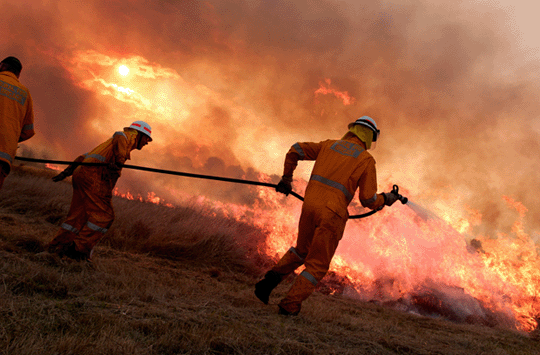
The south-east of Australia this year has experienced record high temperatures during an unseasonably dry and hot autumn, prompting fire bans and warnings from authorities.
In its latest winter outlook, the Bureau of Meteorology is forecasting warmer and drier than average conditions across large parts of the country. It suggests winter rainfall is likely to be below average for NSW, South Australia, northern Victoria and western parts of Western Australia.
The bureau says the dry is likely to be particularly intense in areas around the Murray-Darling Basin and in eastern NSW, with a 70-80% chance of below average rainfall. “Elsewhere around the country, the chances of exceeding average rainfall are roughly 50%,” the new forecast said.
The overwhelming consensus among climate scientists is climate change is accelerating and human activity is making a contribution. If greenhouse gas emissions aren’t reduced, human populations become more exposed to the negative effects of warming, which include extreme weather events – such as prolonged drought, heatwaves, wildfires and storms.
…….The Turnbull government is trying to implement a policy in electricity that would see emissions come down by 26% on 2005 levels by 2030 – a target many analysts say is too low for Australia to meet its commitments under the Paris agreement – but even that target is being gainsaid by government conservatives who have not ruled out crossing the floor to oppose it.
Analysis from Green Energy Markets says the national energy guarantee (Neg) will deliver no meaningful emissions reductions in its own right unless the target is made more ambitious, because the capacity of renewable projects now under construction already exceeds what is required to achieve the 2030 target.
While battling internal pressures over the Neg, the government has also been stalling on new vehicle emissions standards for vehicles, bracing for more internal ructions. Australia no longer has a domestic car manufacturing industry but motoring groupshave been lobbying againsta 105gCO2/km emissions target.
Data from the CSIRO’s Global Carbon Project indicates greenhouse gas emissions in China accelerated to 1.5 per cent growth last year. China is now responsible for about a third of the world’s carbon emissions.
“That was quite significant growth for China because we had seen almost three years of little or no increase,” the project’s director, Pep Canadell, told Fairfax Media.
Early indications are that 2018 could see an even larger rise, with China’s carbon emissions in the first quarter jumping 4 per cent alone, according to a Greenpeace analysis.
2017’s increase was partly caused by a revival of China’s reliance on heavy industrial growth to prop up the economy, and a drop in hydro electric generation amid poor rainfall, Dr Canadell said. This year’s growth, though, is also being spurred by a pick-up in the global economy.
Given China’s emissions are roughly double the next largest polluter – the US – and triple the European Union’s, its acceleration means there is a fast-diminishing chance that the rise in global average temperatures can be restricted to the range of 1.5 to 2 degrees, as agreed at the 2015 Paris climate conference.
“Most climate scientists think 2 degrees [compared with pre-industrial levels] to be aspirational,” said Andy Pitman, director of the ARC Centre of Excellence for Climate Extremes.
Even if emissions ceased globally, it is probable warming would still reach at least 1.5 degrees given the longevity of carbon-dioxide and other heat-trapping gases in the atmosphere, he said.
With increasing evidence of extreme weather events even at the roughly 1 degree of warming so far – including compounding risks of bushfires, heatwaves and droughts – societies can expect impacts to worsen, Professor Pitman said: “The notion that 1.5 degrees is somehow safe is totally incompatible with the evidence.”
‘Not a pretty picture’
News in recent days that the Trump administration plans to bolster the ailing US coal-fired power industry by intervening in markets would worsen the global emissions picture.
The CSIRO’s Dr Canadell said while US carbon emissions had fallen for a decade, last year’s decline will likely be much smaller because of quickening economic growth at home and abroad.
The European Union, too, was likely to register a slower emissions drop. Australia, meanwhile, is on course to increase its carbon pollution for a fourth year in a row, a “remarkable” result for a rich nation, he said.
Bruce Nilles, a former head of the Sierra Club’s “Beyond Coal” campaign, who is visiting Australia, said President Trump’s “brazen efforts” to help coal in US would likely be stymied by a flurry of lawsuits from other energy suppliers.
The US had seen 266 coal-fired power plants shut or set closure dates since 2010, and these “were continuing at the same rate as during the last few years of the Obama administration”, he said.
Filling the gap were more than 10,000 megawatts of new wind and solar capacity each year, a process likely to continue as their technology becomes even cheaper, Mr Nilles said.
Adani to pay for Isaac council staff working on Carmichael mine activities, ABC News 28 May 18 , ByJosh RobertsonandEmilia Terzon
Adani will bankroll the jobs of local government staff tasked with assessing activities around its Queensland mine proposal — a deal anti-corruption campaigners say raises “serious questions” about independent oversight.
The Indian mining giant has struck an unusual deal to pay up to $1.15 million in wages, housing and vehicle costs for four Isaac Regional Council employees to deal with the “extraordinary workload” created by the Carmichael coal project.
Anti-corruption think tank Transparency International Australia called the scenario unprecedented, saying it would raise questions about the independence of council decisions and perceptions of conflict of interest.
But the council said the staff were under its direction and not controlled by Adani.
It said it was protecting ratepayers from bearing costs for a transnational corporation.
A council resolution last October stated that negotiations with Adani led to the company committing to “fund certain positions within council … to address the extraordinary workloads generated for council by the Adani projects”.
According to council minutes, jobs for an executive and legal support officer, a senior engineering manager and two field officers would be “fully funded (including labour and other on-costs, housing and vehicle costs) by Adani”.
‘Potential for conflict of interest’
Transparency International chief executive Serena Lillywhite said the arrangement raised “real questions around the perception or the potential for a conflict of interest, and for undue industry influence, and certainly questions around the independence of decisions being made by the council”.
She said it took the risk of regulatory capture to “a whole new level”.
“When you have a situation whereby people who are employed by the council but are in fact being paid for by Adani to undertake responsibilities and tasks — such as legal support and compliance with contractual arrangements, engineering support to check whether or not there is compliance with standards regarding engineering or environmental aspects — it does create some real concerns.
“You can understand how at best there would be a perception that there is not an arm’s-length arrangement between the council and the company.”
………No other council has similar arrangement
However, a spokeswoman for the Local Government Association of Queensland (LGAQ) said it was not aware of any other such arrangement between a council and a company where funding was tied to jobs involving oversight of the company’s activities.
Climate change warning for Australia’s military Former defence chief Admiral Chris Barrie, who led Australian forces until 2002, says a new Senate committee report on the security risks of climate change must be taken seriously. SBS World News, By James Elton-Pym , 18 May 18
A former chief of Australia’s armed forces has warned a mass migration of climate refugees could one day “overwhelm” the Navy’s attempts at border control if the country fails to respond to the threat of climate change.
Admiral Chris Barrie told SBS News there could be “catastrophic consequences” from rising sea levels if the worst-case scenarios were realised, with a number of low-lying military bases at risk of damage in the coming years.
“I think the time for action is now urgently upon us,” he said.
Despite the dire warning, the admiral said he was “impressed” by a series of recommendations in a new Senate committee report, released on Thursday, and encouraged the government to take heed.
He also praised the current generation of military generals who “fully understood” the nature of the threat.
The Senate inquiry heard evidence from climate change groups who warned rising seas could inflame terrorism and maritime disputes in the Asia Pacific, as competition for shrinking resources intensified.
The Climate Council said the rises could even “intensify” disputes in the South China Sea, as low-lying islands were submerged and eroding beaches led to changes in deeply controversial sea borders.
Defence chiefs told the inquiry rising sea levels, storm surges and coastal erosion could damage military bases and equipment, possibly in the “short” term.
“A large number of key defence installations are at or just above sea level and much of Australia’s infrastructure is ageing,” the official defence submission read.
Senate report: climate change is a clear and present danger to Australia’s security, The Conversation, Matt McDonald, Associate Professor of International Relations, The University of Queensland,
The report makes several findings and recommendations, noting at the outset that climate change has a range of important security implications, both domestically and internationally.
Tellingly, none of the expert submissions questioned the rationale for this inquiry, nor the claim that climate change challenges Australian national security.
The report concludes that:
the consensus from the evidence (is) that climate change is exacerbating threats and risks to Australia’s national security.
Significantly, it also notes that climate change threatens both state and human security in the Australian context. Here are some of the key security implications.
Sea-level rises and natural disasters are key challenges
The report emphasises the risks posed by rising sea levels and an increase in the frequency and intensity of environmental stress (droughts and floods, for example) and natural disasters such as cyclones. In turn, it notes that these could trigger population movements, with people displaced by extreme weather events or rising seas.
This, the report argues, would have significant implications for the Australian Defence Force (ADF). Humanitarian assistance and disaster relief missions involving the ADF have increased significantly in Australia and our region in recent years. The report predicts that the ADF will face even more pressure to carry out this type of mission in the future.
In its submission, the Department of Defence pointed out that the ADF was not established to provide these roles. The report recommends the creation of a senior leadership position within Defence to plan and manage disaster relief missions both here and abroad.
Australia, and its backyard, are particularly vulnerable
The report notes that Australia and its region are particularly vulnerable to the impacts of climate change.
Australia’s population is largely clustered in coastal areas, and this is also true of the Asian region generally and the Pacific specifically. Pacific island nations – as low-lying and with limited resources for implementing adaptive measures – are acutely vulnerable to sea-level rises. In the Asian region 40 million people were displaced by natural disasters in 2010-11 alone.
The report argues that Australia’s obligation to its neighbours in the region, acknowledged in recent statements on the Pacific, will create significant pressure on Australia and its defence force to manage the implications of climate change. It recommends sending even more aid to the Pacific region to help build climate resilience.
Just four citizens’: the Australians who confronted Adani in India, and made a difference Guardian, Geoff Cousins, 12 May 2018
In this book extract, Geoff Cousins describes how the farmer, the activist, the tourism operator and ‘an old bald man with hope in his heart’ travelled to India to protest against Adani……..
The campaign against the Adani mine is unique in my experience of major environmental battles. Most are “place-based” campaigns in one way or another: “don’t dam this river”; “don’t pollute this groundwater reserve”; “build this gas hub somewhere other than in a wilderness area”. The Adani proposal is different and touches on all the major environmental issues of our time, from climate change to global warming, from shifting from fossil fuels to renewables to the direct and indirect impacts on the Barrier Reef.
It has become a symbol of what is wrong with so much of the government policy in this country and elsewhere and that is why the campaign has attracted such widespread and passionate support. The central question that has focused the minds of all involved has become: if we can’t stop this mine at a time in history when urgent action is needed on all these issues, what can ever be achieved by the environment movement?…….
In discussions with traditional owners in Australia, it has been powerful to be able to describe first-hand the mistreatment Adani has meted out to Indigenous groups in India. The same promises are being made here, of employment and funding, and Indigenous groups are increasingly disbelieving of them – even those who may have signed agreements with Adani before they knew the truth.
A farmer in a wide hat and a bright green shirt with a white map of Australia on the back; an experienced and brave Great Barrier Reef activist; a woman who left her tourism business to join us at the last minute; and an old bald man with hope in his heart and fear in his belly – this was the great Aussie delegation. The Indians loved us. “You’re just four citizens?” they asked. “You don’t represent any organisation or government?” “No, just four people,” we answered.
There are thousands now, all over our country. More than 130 Stop Adani groups and thousands more people join the cause every month, with only one aim: to protect the planet, our reef, our natural world and our way of life against the environmental rape and pillage being carried out by Gautam Adani and his band of brothers.
Hours before the doors swung open on the budget lock-up, the bright sparks on Twitter had already started a new meme. #KeepMyTenDollars was a reminder that Australians would gladly forgo an extra few bucks a week for to see the governments prioritise spending on health, education and renewables, not corporate and high-end tax cuts. It was certainly funnier than Scott Morrison’s bizarre attempt at humour.
“What have you achieved?” would have been an odd opening line to the government’s pre-election budget speech, were it not coming from the mouth of the man who famously waved a lump of coal around in Parliament to declare his love for the toxic fuel. The joke was lost on the rest of us, but it was the punch line that betrayed the confusion of the government.
The world’s leading economists have been warning for decades that the damage caused to the climate by burning coal, oil and gas poses one of the most serious threats to the global economy. The cost of destruction in agriculture, tourism, finance, insurance, property, and even mining caused by sweeping floods, droughts and bushfire caused by distorting the world’s life support systems is nearly unimaginable.
Indeed, it’s hard to imagine a sector that will not be severely impacted by climate change. But collapsing costs in renewables and a rising global movement against pollution is changing the headwinds – not that our Government seems to have noticed.
You would think that a Government that waxes lyrical about intergenerational equity would have at least a primary school grasp on climate change. Yet the forbidden words were nowhere to be seen in the budget speech, save for a small reference to the Government’s plans to walk away from innovation in the renewables sector (whatever happened to that dogged commitment to ‘jobs and innovation’). The devil, as always, was in the detail of the budget papers.
Budgets are a statement of values that mark the principles of legislators. In this year’s budget, the Government’s values were laid bare, with climate spending slashed by almost half, falling further to $1.2 billion by 2022. Analysis by the Australian Conservation Foundation found that the under-resourced Department of Environment and Energy will have an axe taken to its bottom line, with spending slated to plunge by 43 per cent on 2013 levels (when the Government took office) by 2022.
The Renewable Energy Target will be abolished by 2020. Taxpayer largesse will continue to flow to the Government’s friends in fossil fuel companies, with $30 billion in diesel tax subsidies pouring into private companies over the forecast period. No additional money for renewables or climate mitigation and adaptation will be forthcoming.
The opportunities that come from renewable energy, which are now cheaper as well as being cleaner and healthier, are being seized by the community of nations while Australia clings to a wheezing, out-dated economy.
On the same day the budget was delivered, the meter at Mauna Loa, Hawaii clocked 410 parts per million of carbon dioxide in the atmosphere – a level not seen in 800,000 years, well before humans developed agriculture, let alone donned suits and waved rocks around in Parliament.
The other critical budget, the carbon budget, is in obvious deficit.
The Government should keep my ten dollars, and use it to achieve real progress towards a coal-free, more liveable society. Most Australians would gladly chip in for wind and solar, and our vast weight of numbers will eventually prevail.
It’s clear after this budget that it will take concerted action from all Australians everywhere for the Government to regain its grip on reality.
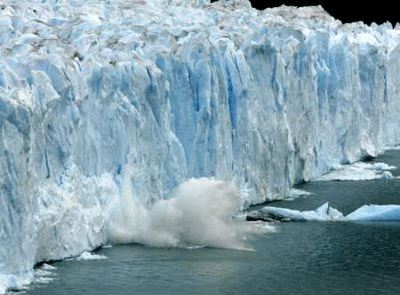
Global warming is melting Antarctic ice from below Warming oceans melting Antarctic ice shelves could accelerate sea level rise, Guardian, John Abraham, 9 May 18, “……With global warming, both of the poles are warming quite quickly, and this warming is causing ice to melt in both regions. When we think of ice melting, we may think of it melting from above, as the ice is heated from the air, from sunlight, or from infrared energy from the atmosphere. But in truth, a lot of the melting comes from below. For instance, in the Antarctic, the ice shelves extend from the land out over the water. The bottom of the ice shelf is exposed to the ocean. If the ocean warms up, it can melt the underside of the shelf and cause it to thin or break off into the ocean.
A new study, recently published in Science Advances, looked at these issues. One of the goals of this study was to better understand whether and how the waters underneath the shelf are changing. They had to deal with the buoyancy of the waters. We know that the saltier and colder water is, the denser it is.
Around Antarctica, water at the ocean surface cools down and becomes saltier. These combined effects make the surface waters sink down to the sea floor. But as ice melt increases, fresh water flows into the ocean and interrupts this buoyancy effect. This “freshening” of the water can slow down or shut down the vertical mixing of the ocean. When this happens, the cold waters at the surface cannot sink. The deeper waters retain their heat and melt the ice from below.
The study incorporated measurements of both temperature and salinity (saltiness) at three locations near the Dalton Iceberg Tongue on the Sabrina Coast in East Antarctica. The measurements covered approximately an entire year and gave direct evidence of seasonal variations to the buoyancy of the waters. The researchers showed that a really important component to water-flow patterns were ‘polynyas.’ These are regions of open water that are surrounded by ice, typically by land ice on one side and sea ice on the other side.
When waters from the polynya are cold and salty, the waters sink downwards and form a cold curtain around the ice shelf. However, when the waters are not salty (because fresh water is flowing into the polynya), this protective curtain is disrupted and warm waters can intrude from outside, leading to more ice melt.
Based on this study, we may see increased ice loss in the future – sort of a feedback loop. That concerns us because it will mean more sea level rise (which is already accelerating), and more damage to coastal communities. I asked the lead author, Alesandro Silvano about this work:
Lead author Alesandro Silvano.
We found that freshwater from melting ice shelves is already enough to stop formation of cold and salty waters in some locations around Antarctica. This process causes warming and freshening of Antarctic waters. Ocean warming increases melting of the Antarctic Ice Sheet, causing sea level to rise. Freshening of Antarctic waters weakens the currents that trap heat and carbon dioxide in the ocean, affecting the global climate. In this way local changes in Antarctica can have global implications. Multiple sources of evidence exist now to show that these changes are happening. However, what will happen in Antarctica in the next decades and centuries remains unclear and needs to be understood.
Adani losses prompt mining company to shift away from imported coal, Guardian, Ben Smee , 7 May 18, Results show Carmichael mine in Queensland no longer a viable proposition, analysts say
Adani’s coal-fired power business has reported more heavy losses, prompting the Indian conglomerate to announce it would shift away from using expensive imported coal.
Analysts say the fourth-quarter financial results for Adani Power, a subsidiary of the Adani group, showed the proposed Carmichael mega-mine in Queensland was no longer a viable proposition.
Remarkably in the context of the Carmichael project, the billionaire Adani Groupboss, Gautam Adani, acknowledged in a statement that the cost of importing coal to India had contributed to Adani Power’s struggles.
“We expect to receive [domestic coal] for the Tiroda and Kawai plants in the near future, which will help reduce fuel costs and improve profitability of these projects,” he said.
“Under-recovery of fuel costs for Mundra project have impacted its financial viability, and we are in dialogue with key stakeholders for an early solution.”
When the Carmichael coal project was first proposed, Adani was pushing a “pit to plug” operational model under which it would mine coal to use at its own generators, making profits through efficiencies and cutting out middlemen.
The Mundra power plant, which operates on imported coal, was the planned destination for the spoils from the Carmichael project. After Mundra fell into financial trouble, Adani attempted unsuccessfully to sell the plant. It has not operated since February.
Climate sceptic group IPA suggested as co-host of Australian visit by Trump’s environment chief, Scott Pruitt’s cancelled trip would have promoted ‘innovation deregulation’, emails released under FoI show Guardian, Adam Morton.4 May 18The climate sceptic thinktank the Institute of Public Affairs was mooted as a co-host of an Australian visit by Donald Trump’s beleaguered Environment Protection Agency head, Scott Pruitt, which may have included discussion with local officials on whether environmental deals should be changed or cancelled.
Emails released to the US environment group the Sierra Club under freedom of information laws show that Matthew Freedman, a Washington consultant who describes himself as “a close personal friend” of the Australian environment minister, Josh Frydenberg, played a central role in organising Pruitt’s proposed August trip before it was cancelled when Hurricane Harvey hit the Texas gulf coast.
In the US, the emails are of interest as evidence that Pruitt relied on business figures and lobbyists to plan and justify his overseas travel. They were first published by the New York Times.
From an Australian perspective, they give insight into Pruitt’s proposed agenda and schedule. They discuss focusing on promoting “innovation deregulation”, federal-state relations and how to counter potential disagreements with Australian officials about climate change. The EPA administrator rejects mainstream climate science and worked closely with fossil fuel companies to reduce environmental regulation when he was Oklahoma’s attorney general.
Freedman suggested that Pruitt meet several members of the Australian government including the prime minister, Malcolm Turnbull (listed as “Malcomb”), the foreign minister, Julie Bishop, the trade minister, Steve Ciobo, and the then resources minister, Matt Canavan, along with Frydenberg …..
Roskam also recommended Pruitt meet Maurice Newman, a former chair of Tony Abbott’s business advisory council who has described global warming as “a delusion”, the former Productivity Commission head Gary Banks and the economist Henry Ergas …..
Roskam said Freedman, the US embassy in Canberra and the US consulate in Melbourne had approached the IPA about Pruitt’s potential visit. He said the organisation had welcomed the chance to “work closely with the world’s leading advocate for cutting environmental red tape” …….
Liberal activists target Tony Abbott’s seat over climate change policy
Sydneysiders urged to join party in former PM’s seat to ‘shift the politics’ and speak up for the environment,Guardian, Anne Davies, 3 May 18,
Tony Abbott’s political future could be under threat from a group of activists who have been organising environmentally conscious voters to join Liberal partybranches on Sydney’s north shore – a move that could unseat the former prime minister.
Billing themselves as “the counterweight” to the pro-coal power Monash Forum, the North Shore Environmental Stewards have held at least two recruitment functions at which attendees were urged to tap into their networks of environmentally conscious people to join the Liberal party branches in Abbott’s seat of Warringah and on the lower north shore.
“There is no planet B” says President Macron in an electrifying speech to Congress, yet for most of us climate change is of much less concern than the cost of living, taxes, schools and health services.
As a slow creeping threat, “unlikely to affect me much anyway”, climate change is easy to dismiss and therefore is never high on the election stakes where it is easy for our leaders to say they are doing everything they should — which they are not.
So as a doctor, why am I distressed by the announcement that gas resources in NT are to be developed and fracked? After all, the NT government indicates it can be managed safely, will occur in sparsely populated regions, will bring jobs and profits for shareholders and restitution for languishing state and federal budgets?
The Adani coal mine has signalled to the world more than any spoken word that the Australian Government does not understand or care about climate change.
Development of Northern Territories huge gas reserves will produce even more emissions than Adani, with a measurable increase in world and domestic emissions.
Australia has no treaty obligation to reduce the export of gas.
Gas mining on hold in many countries
The International Energy Agency (IEA) reported recently that the Earth’s greenhouse emissions from fossil fuels had increased by 1.4 per cent in 2017 after three years of flat emissions. The goals of the Paris Agreement on climate change are in jeopardy.
In Australia in 2017, emissions increased by 0.8 per cent, the third yearly consecutive increase.
The IEA report indicates that natural gas demand in the world, which includes unconventional gas, is increasing rapidly and now supplies 22 per cent of total energy. If other gas developments proceed in WA, Australia is likely to be the world’s greatest exporter of gas as well as of coal.
Recognising the threats from climate change, many countries have decided on “no new coal mines” or delayed or stopped unconventional gas mining on either local health or emission concerns.
Health and the rising level of greenhouse emissions
To the World Health Organisation, climate change is the greatest health threat of this century, a view recognised by the statements of the Australian Medical Association.
It is responsible for thousands of deaths worldwide from storm, flood, fire, drought and hunger and a range of other causes including infections. Deaths are projected to rise to 250,000 by 2030.
We are trading more wealth for lives lost, mainly those living in less developed, poorer countries, those least able to care for themselves.
The desperate pleas for emission reduction by our neighbours in the Pacific Island States under threat or existing inundation are ignored.
Australia absolves itself by indicating it will fulfil its fair share of emission reduction under the Paris Agreement, but even that is in doubt and ignores the fact that wealthy technological nations are positioned to offer leadership and have the capacity to carry greater responsibility to do more against climate change.
These attitudes stem from a failure to recognise our collective responsibility to act, for we all share the same atmosphere and finite resource of freshwater, biodiversity and productive land which are currently threatened by increasing climate change.
As we burn carbon we also burn whatever hope our children and grandchildren will have of having a safe climate in the future. Our legacy to them will rather be an increasingly dangerous and unstable climate.
NT contribution to Australia’s emissions
The gases that leak from gas exploration, mining and sealing of wells are called fugitive emissions; add leaks during transport, loading, distribution and then the burning of gas and you have the full life cycle emissions.
What is fracking?
Fracking is used to extract gases, such as coal seam, tight and shale gas by pumping high-pressure water and chemicals into rock, fracturing it to release trapped gasses
There are concerns the chemicals could contaminate groundwater supplies and threaten agricultural industries
Recent science indicates that with leakage rates as little as 3 per cent, emissions from gas are no better than coal fired power stations.
Fugitive measurements in Australian gas fields are poorly regulated and are currently unknown.
In the US, emissions from unconventional gas mining range from 2 per cent to 17 per cent.
The NT government report acknowledges the problem and hopes piously “that the NT and Australian governments seek to ensure that there is no net increase in the life cycle greenhouse gas emissions emitted in Australia from any onshore shale gas produced in the NT”.
This hope remains unfulfilled in any Australian gas field.
The development of NT gas will inevitably cause an increase in Australia’s domestic emissions, as it did in Queensland.
Chief medical officer Paddy Phillips has told The Advertiser the frequency and severity of heatwaves and bushfires, and the increased risk of the spread of disease by insects and bugs, meant climate change threatened the wellbeing of South Australians.
His warning comes as SA Health released its draft State Public Health Plan for the period from 2019-2024. Professor Phillips said multiple government agencies needed to consider the impact of climate change when developing policies and strategies to manage and prevent public health risks.It should also be front of mind when agencies assessed the suitability of health infrastructure and assets.
“Variations in our climate have increased the frequency and severity of weather events such as floods, droughts, bushfires, storms (and) periods of extreme heat, as well as the spread of vector-borne diseases,” Prof Phillips said.
“These events threaten the wellbeing of our communities, especially in vulnerable populations.”
Increases in diseases transmitted by mosquitoes, sandflies, triatomine bugs, blackflies, ticks, tsetse flies, mites, snails and lice have in recent years been linked to climate change on Australia’s east coast.
The draft report, that has been published for public consultation, lists four priorities:
CREATE healthier neighbourhoods and communities.
PROTECT against public and environmental health risks and adapt to climate change.
PREVENT chronic disease, communicable disease and injury.
FURTHER develop and maintain the statewide public health system.
Health and Wellbeing Minister Stephen Wade said he would review the plan, which was drawn up on the watch of the former Labor state government, to determine if any additional issues needed to be addressed. Mr Wade welcomed the inclusion of climate change as a priority. “It is prudent for public health plans to consider the impact of climate change,” he said.
SA Greens leader Mark Parnell said a suite of measures, including better town planning and the design of individual homes to be more resilient to changing climatic conditions, was needed.
That would help South Australia adapt to the challenge of climate change.
“We know that with a hotter climate comes more health problems including increased hospitalisations and premature deaths from increasing heatwaves,” he said.
I’m a professional firefighter employed by Fire Rescue NSW and working out of Balmain fire station.
When I arrived at work on Sunday, the crew who were just finishing their shift looked dead on their feet. There was a pile of dirty hose in the backyard, and the fire engine stank of smoke.
‘We are leaders from many faith traditions and communities across Australia.
We are writing to you to ask you to abandon your proposed mine and
instead use the same money to invest in solar energy in North Queensland.
‘Our common home, the Earth, is now in great danger
due to the effects of our actions as human beings on the climate.
On this point the scientific community is united.
Today, we too are united as people of faith.
‘Let us be clear.
We are not merely opposed to this one mine.
We are opposed to all new coal development in the Galilee Basin.
We are at a crossroads.
One way lies destruction; the other way, sanity.
We need to turn immediately in the direction of a stable and
compassionate future based on ambitious investment in renewable energy. … ‘