Police said they charged 10 people with trespassing on business land, and those arrested had been taken to the Bowen watch house.
Market Forces list COMPANIES THAT COULD MAKE OR BREAK THE ADANI CARMICHAEL COAL PROJECT
THE ADANI LIST: COMPANIES THAT COULD MAKE OR BREAK THE CARMICHAEL COAL PROJECT Adani’s plans to dig up hundreds of millions of tonnes of dirty Galilee Basin coal are gargantuan, requiring input from a range of project partners. And every company that helps this nightmare become a reality would be partly responsible for the environmental and climate devastation the Carmichael project stands to inflict.
High risk companies, which have known links with Adani or the Carmichael project, are featured below [on original] . Hover over or tap on the company logos to learn how each is connected, [on original] and click to take action. Further down the page [on original] is a more comprehensive list of companies that may be involved, broken down by sector……….http://www.marketforces.org.au/info/key-issues/theadanilist/
Who We Are
‘Market Forcesbelieves that the banks, superannuation funds and governments
that have custody of our money should use it to protect not damage our environment.
‘Our work exposes the institutions that are financing environmentally destructive projects
and help Australians hold these institutions accountable.
‘We work with the community to prevent investment in projects
that would harm the environment and drive global warming.’
www.marketforces.org.au/about-us/
How We Work
‘Market Forces is proud to be an affiliate project of Friends of the Earth Australia
and a member of the BankTrack international network,
connecting us with passionate campaigners, environmental issue experts
and advocates of environmentally sustainable behaviour from the finance sector.’
Our Vision
‘Our vision is a future where institutions invest with a high degree of respect for the environment,
utilising our money to deliver solutions to major environmental issues, and
where the community holds to account the custodians of their money
to ensure it is used to benefit the environment.’
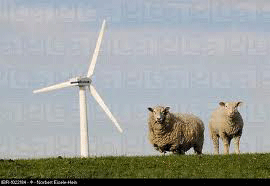
Australia’s farmers need action on climate change, and for renewable energy
Our farmers must rally for climate change action, http://www.bordermail.com.au/story/4958579/our-farmers-must-rally-for-climate-change-action/ With no clear action on climate or energy policies, Australian farmers are scratching their heads and wondering how they can drive change.
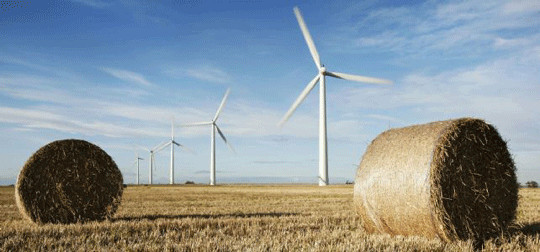
The Federal Government is failing to help. They are talking about extending the life of old, polluting coal-fired power stations; more subsidies and taxpayer assistance to the fossil fuel industry; and pressuring states to frack more gas – an industry that directly competes for prime agricultural land.
They can’t be thinking of our interests. Farmers are the ones already impacted by climate change – look no further than heatwaves and severe rain shortages in parts of the country. We are also dealing with soaring energy costs.
It’s time we used our voice to speed up the change we need. NSW farmer Jim McDonald is a case in point. Infuriated by rural MPs who were spouting anti-renewable energy guff, he started an open letter. More than 2000 farmers around the country have signed on.
As individuals we can get drowned out, but collectively our voice carries weight. If our views are to be heard, however, we must start talking to elected representatives before it’s too late.
Farmers are looking to renewables and storage to cut their energy costs. If you think that should be encouraged, then speak out. Farmers directly benefit from large-scale renewable projects. Wind turbines alone generate approximately $20 million worth of passive income for us.
Agriculture is one of the most climate-exposed industries in the country. If you think farmers should be supported to cope with what’s happening now, and steps taken to avoid worse impacts into the future – then speak out!
The future of farming won’t be assured without a fight. Add your voice. Verity Morgan-Schmidt is CEO of Farmers for Climate Action
Adani Carmichael coal mine: Former Indian minister sounds alarm on Adani’s track record, mega-mine’s viability
 ~ Four Corners www.abc.net.au/4corners/ By Stephen Long, Wayne Harley and Mary Fallon www.abc.net.au/news/2017-10-02/former-minister-sounds-alarm-on-adanis-track-record-in-india/9005596
‘India’s former environment minister Jairam Ramesh is “absolutely appalled”
by the Australian Government’s approval of the Adani Group’s massive coal mine in North Queensland,
which he says will threaten the survival of the Great Barrier Reef, “a common heritage of mankind”.
‘Mr Ramesh, an elder statesman of India’s opposition Congress Party,
also said the Federal Government and Queensland Government have failed to do adequate due diligence
on Adani Group’s environmental and financial conduct in India before granting environmental approvals and mining licenses. …
‘”You’re giving a tax break to a project that is actually going to have adverse environmental consequences, which will have multiplying effects on weather patterns in the region, across the world. I find it bizarre,” he said. …
Adani coal ‘will be too expensive for Indian market’
‘Australian politicians have argued India needs the coal from Adani’s Carmichael mine
in North Queensland to lift millions of India’s poor out of “energy poverty”.
‘But another respected Indian observer, the former head of India’s Ministry of Power, E.A.S Sarma, dismissed that as false and misguided. …
‘”We cannot afford that, it is so expensive. My assessment is it will not be possible for the Indian market
to absorb Adani coal.” … ‘
As Australia’s greenhouse emissions soar, Pacific islanders despair of its backward climate policies
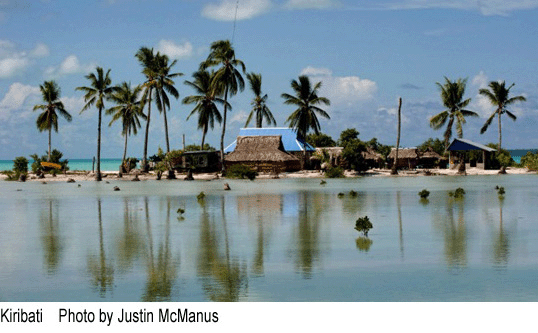 Stuck in the dark ages’: Pacific island leader vents after Australia’s emissions hit record high, The Age, 30 sept 17 Desperate Pacific islands at risk of sinking beneath the sea say Australia is “stuck in the Dark Ages” by relying on fossil fuels, in response to alarming data showing this nation’s energy emissions have hit record highs.
The outcry from Australia’s smallest neighbours comes just weeks after Prime Minister Malcolm Turnbull visited Samoa and reportedly promised Pacific leaders that he understood “very clearly” the threat of sea level rise to low-lying islands.
As Fairfax Media reported on Friday, a national audit prepared for The Australia Institute by energy analyst Hugh Saddler shows Australia’s emissions from energy combustion reached a record high in the year to June, driven largely by petroleum, and specifically diesel, consumption.
The audit showed the increase in Australia’s annual retail diesel emissions in the year to June on its own exceeded the total annual emissions of any Pacific nation.
Tuvalu Prime Minister Enele Sopoaga, whose tiny nine-island nation has become the poster child for the threat of sea-level rise, on Friday vented his frustration at the audit findings.
“While the rest of the world is moving ahead to renewable energy, Australia is stuck in the Dark Ages with its reliance on dirty fossil fuels. This is bad news for the Pacific”, he said, adding that Australia’s continued mining of coal was “extremely disappointing”.
Genevieve Jiva, spokeswoman for the Pacific Islands Climate Action Network, said the findings would prompt Pacific leaders to exert further pressure on Australia at international climate talks in Bonn, Germany, in November. Fiji will chair the talks.
“This is happening right now and needs action right now. Not in 20 years’ time, not after the next Australian election, but right now.”……..http://www.theage.com.au/federal-politics/political-news/stuck-in-the-dark-ages-pacific-island-leader-vents-after-australias-emissions-hit-record-high-20170929-gyrbi6.html
Australia needs a massive switch to renewables, if it is to meet its Paris climate commitments
the bind faced by the formerly green-tinged Prime Minister Malcolm Turnbull
the Australia Institute, which has taken over the intellectual property of the Climate Institute, says even Dr Finkel’s model would be insufficient on its own to meet the international obligations signed under Mr Abbott.
“This analysis of the economic modelling demonstrates meeting these targets for the electricity sector with a policy like the clean energy target is likely to require 66-75 per cent of electricity to be supplied by renewables,” said Australia Institute executive director Ben Oquist.This was because a CET “provides less of an incentive for gas generation than an EIS (emissions intensity scheme) or a carbon price“.
 Climate crunch: Australia to fail on Paris commitments without massive renewable switch http://www.smh.com.au/federal-politics/political-news/climate-crunch-australia-to-fail-on-paris-commitments-without-massive-renewable-switch-20170924-gynkj8.html Mark Kenny, 25 Sept 17 Australia will fall short of its Paris carbon reduction targets signed under Tony Abbott unless it lifts its renewable energy production to levels higher even than Labor’s plan for 50 per cent green energy reliance by 2030.
The first assessment by the Australia Institute’s new Climate and Energy Program, to be released on Monday, has found that unless a higher burden is placed on the more expensive process of carbon reductions in other sectors – agriculture, transport and manufacturing – then the electricity generation sector will need to aim for a renewable energy target of at least 66 per cent by 2030, and possibly as high as 75 per cent.That is, a power generation sector where the fossil fuel component is reduced to perhaps a quarter of the size it is now.
Power generation currently accounts for 35 per cent of total emissions, which is twice as much as the next biggest contributor, fuel combustion and transport, at 18 per cent.
Industry produces 14 per cent and agriculture 13 per cent.
The current emissions reduction target, committed to in Paris while Mr Abbott was prime minister, is 26-28 per cent lower than the 2005 level – part of Australia’s contribution to a global effort to restrict the planet’s temperature increase this century to no more than 2 degrees Celsius.
The government is now wrestling with how to go about this after Chief Scientist Alan Finkel proposed a clean energy target which would lock in a 28 per cent reduction in energy-related emissions by 2030 through a four-pronged strategy emphasising energy security, reliability, affordability for households and business, and meeting Australia’s emissions targets.
Last week Mr Abbott indicated he would cross the floor in Parliament to stop further renewable-friendly policies, calling it “unconscionable for a government that was originally elected promising to abolish the carbon tax and to end Labor’s climate obsessions to go further down this renewable path”. Continue reading
Did Australian govt reject China’s climate change action initiative?
 Government denies claims it knocked back Chinese climate change offer and reveals ‘joint action plan’ Fergus Hunter SMH, 23 Sept 17
The Turnbull government rejected a landmark Chinese invitation to issue a formal joint statement on climate change earlier this year, Greenpeace has claimed, saying Australia vetoed an unprecedented step in the Asian power’s emerging international role in reducing greenhouse gas emissions.
But the Australian government has denied the claim and revealed the two countries’ energy departments were working on a “joint action plan” on climate change as part of their commitments under the Paris agreement.
According to Greenpeace East Asia senior climate policy adviser Li Shuo, the government quietly knocked back an offer – perhaps the first time the Chinese government had proactively sought such an arrangement – during Premier Li Keqiang’s state visit to Australia in March.
Mr Li said the offer was “very, very significant” because it suggested China had become “diplomatically proactive” after previously being on the receiving end of invitations from the European Union and United States to outline mutual commitments on climate change.
He observed it would have been a concrete political signal for the international community amid the uncertainty triggered by the election of President Donald Trump, who has wound back American leadership on climate change and begun the process of withdrawing the US from the Paris accord.
“The Chinese delegation with Li Keqiang came with the proposal but that didn’t get the green light from the Australian side,” Mr Li said, adding that his awareness of it came from a directly involved figure in the Chinese government.
“It was clearly the intention from the Chinese side to build up international climate momentum. I think the proposed bilateral statement was part of that effort to send a signal back to the rest of the world and primarily the US.”
A spokesperson for the Australian government said it “did not decline an offer from the Chinese government earlier this year to make a joint statement on climate change” and labelled the March leaders’ meeting “highly successful”……..
Previously an advocate for sweeping action on climate change, Mr Turnbull has had to compromise since taking the leadership of a Liberal-National Coalition still internally divided on the issue. A significant portion of his party room are keen supporters of coal-fired power and some do not accept the scientific consensus on climate change.
Under the Paris accord, former prime minister Tony Abbott’s Coalition government committed to reducing emissions by 26-28 per cent from 2005 levels by 2030. His government also renegotiated the Renewable Energy Target in the electricity sector down to 23.5 per cent by 2020.
In the face of internal hostility, the government is currently redesigning a Clean Energy Target proposed by Chief Scientist Alan Finkel, which would aim to have 42 per cent of Australia’s energy generated by lower emissions technologies by 2030. The government may loosen the CET to allow for high-efficiency, low-emissions coal-fired power stations……. http://www.smh.com.au/federal-politics/political-news/government-denies-claims-it-knocked-back-chinese-climate-change-offer-and-reveals-joint-action-plan-20170920-gyl3j5.html
Northern Australian Infrastructure Facility likely to fund coal rail line, but not coal mine itself
No coal projects being considered, says NAIF http://www.afr.com/news/politics/no-coal-projects-being-considered-says-naif-20170922-gymmr4
The Turnbull government’s $5 billion Northern Australian Infrastructure Facility has never received a proposal to help fund a coal-fired power station since it was created two years ago.
While senior minister, including Prime Minister Malcolm Turnbull, continue to link the NAIF to funding a next-generation coal plant, it is understood the NAIF board has not assessed any proposal for a high-efficiency low emissions or a carbon capture and storage coal project.
When contacted by AFR Weekend, NAIF chief executive Laurie Walker would not comment on specific proposals, but confirmed the board was on track to announce the first round of funding from the project later this month.
The project would then be put to Deputy Prime Minister Barnaby Joyce, who has taken over the portfolio after resources minister Matt Canavan stood aside following doubts over his citizenship.
Ms Walker said the NAIF board was now looking at 10 projects in due diligence, up from five projects a few months ago, based on 161 inquiries, and was on track to make a decision by the end of the month.
Some of the projects under consideration by the NAIF include a rail link to Adani’s $16.5 billion Carmichael mine in Central Queensland and Genex Power’s $823 million Kidston pumped hydro and solar project in North Queensland.
Other as yet undisclosed projects which have made it to the NAIF short-list include renewables, resources, transport and tourism, Ms Walker said.
Despite the lack of coal projects which have applied for NAIF funding, the infrastructure funding body – established by former treasurer Joe Hockey after the 2015 budget – is constantly linked by senior ministers as a potential funding source for next-generation coal projects.
Mr Turnbull, on a three-day trip to Queensland marginal seats this week, specifically highlighted the NAIF as a way to get new coal projects across the line.
Once a decision by the NAIF board has been sent to the minister he has 21 days to decide whether to veto – a period which can be extended to 60 days.
Some of the projects under consideration by the NAIF include a rail link to Adani’s $16.5 billion Carmichael mine in Central Queensland and Genex Power’s $823 million Kidston pumped hydro and solar project in North Queensland.
Other as yet undisclosed projects which have made it to the NAIF short-list include renewables, resources, transport and tourism, Ms Walker said.
Despite the lack of coal projects which have applied for NAIF funding, the infrastructure funding body – established by former treasurer Joe Hockey after the 2015 budget – is constantly linked by senior ministers as a potential funding source for next-generation coal projects.
Mr Turnbull, on a three-day trip to Queensland marginal seats this week, specifically highlighted the NAIF as a way to get new coal projects across the line.
The Queensland Liberal National Party has vowed to back a HELE coal project in the state if it wins the next election, which is due to be held later this year or early next year. But it says it wants it to be mostly privately funded.
Green Energy Markets director Tristan Edis said the concept of using taxpayer funding for a coal-fired power station in Queensland – which could cost between $2 billion and $5 billion – was not justified.
“It doesn’t make environmental or economic sense, but it makes perfect political sense [for the LNP],” he said.
In Southern Australia, winters are becoming drier
Australia’s southern winters are drying out. Here’s why, ABC 20 Sept 17 ,By Ben Deacon and Kate Doyle Winter rains are in decline across southern Australia, and while it is too early to say beyond doubt it is due to climate change, scientists say it is not just about climate variability.
Key points:
- This winter was particularly dry given there was no El Nino event
- Winters in Australia’s south are drying out, affecting farmers
- Scientists say it is not just due to climate variability
According to the Bureau of Meteorology, June was the driest on record for large parts of southern Australia, and the winter as a whole across Australia was the ninth driest on record.
“It’s actually quite unusual for us to get such a widespread dry through the winter without having an El Nino,” Bureau of Meteorology senior climatologist Blair Trewin said.
El Nino often brings dry conditions to Australia, but this year it is in neutral.
“It’s almost more about what hasn’t been happening,” Dr Trewin said.
Normally in winter, storms come up from the southern Indian Ocean and clip the bottom of Western Australia, delivering rain to the south of the country.
But until mid-July, the storms largely missed the continent………. Rainfall continues to decline in southern Australia. According to the Bureau of Meteorology, May to July rainfall has reduced by about 19 per cent since 1970 in the south-west of Australia.
There has been a decline of about 11 per cent since the mid-1990s in the April–October growing season rainfall in the continental south-east.
CSIRO Agriculture and Food senior principal research scientist Zvi Hochman said winter rain in Australia’s southern wheatbelt had declined by a whopping 28 per cent since 1990.
“I was surprised as anyone to find the extent to which that trend, across the 50 weather stations, is there,” Dr Hochman said.
“Yes, it varies geographically, but it is still a very strong trend……..http://www.abc.net.au/news/2017-09-20/winter-getting-drier-in-southern-australia-heres-why/8956754
BHP supports climate change action – is at odds with Minerals Council
 But don’t let’s forget that BHP is a big member of the nuclear industry – which claims (incorrectly), that nuclear power is ‘clean’ energy, and the solution to climate change
BHP considering Minerals Council exit over lobby group’s climate policies
Key points:
- BHP under pressure to quit lobby groups that don’t support clean energy target
- Activist group backed by big investors including ANZ, AMP, Australian Super, Blackrock
- Board considering move before next month’s AGM
BHP announced it would review its membership of all industry associations, and publish the findings, by the end of this year.
The review comes hot on the tail of a demand by activist shareholders that the miner sever ties with the council, which successfully advocated for the abolition of the carbon price and is currently lobbying the Federal Government to reject a clean energy target.
“We are aware that some civil society and other organisations believe that, where an industry body advocates for a position which does not align with our own, we should cease to be a member of that industry body,” BHP said in a statement issued overnight.
The activist’s resolution to be tabled at the company’s AGM next month is also calling for BHP to terminate its membership of the World Coal Association which, along with the Minerals Council, is also calling for a rejection of a clean energy target.
The resolution was lodged on Friday, and it appears to have hit on some issues already being discussed in the BHP boardroom…….http://www.abc.net.au/news/2017-09-19/bhp-considering-quitting-minerals-council/8960298
Anti-Adani protesters arrested outside Abbot Point coal terminal near Bowen
http://www.abc.net.au/news/2017-09-19/anti-adani-protestors-arrested-bowen/8959752 ABC North Qld
Updated Police say they have arrested 10 protesters who were blockading the road to the Abbot Point coal terminal near Bowen in central Queensland.
About 50 people, including members of anti-Adani group Front Line Action on Coal, held banners and voiced their concerns at plans to develop the Carmichael coal mine facility in the north of the Galilee Basin in central Queensland.
Whitsundays Police inspector Steve O’Connell said it was unfortunate arrests had to be made, but he was happy with the overall peaceful nature of the protest.
Bowen resident of 50 years, Elvyn Smith, attended the protest because she had concerns about the environmental impact of the proposed mine.
“At this time with climate change and the knowledge we have on that, that it is not a good time to be opening a large coal mine,” Ms Smith said.
“With the extreme weather events that have been happening, coal is the thing that is fuelling this.
“I am here for future generations to protect this great place that we have.”
Local councillor Mike Brunker said the protesters did not represent the views of local residents who opposed the protest.
“Finally now we see a bit of light at the end of the tunnel, and now we come and see this sort of rubbish. People are sick of it,” Cr Brunker said.
Security ramped up at water reservoir
Whitsundays Mayor Andrew Wilcox said the council was taking extra measures to protect the Bowen water supply after activists hung a banner on the town’s reservoir.
Cr Wilcox said the council was not taking any risks.
“We’re taking extra precautions now. We are just making sure we’re doing more patrols,” Cr Wilcox said.
“At the end of the day it’s already all secured, but we’re just doing that and we’re also putting some cameras around the place.
“And then if we do catch some of these people, we hope that they face the long arm of the law.
To Malcolm Turnbull’s government, climate change is a joke
 Coalition MPs giggle, cackle, smirk and laugh in Parliament over climate change, Independent Australia , Simon Black Many of our current crop of conservative politicians laugh like naughty children whenever climate change is brought up. This can’t be how the world ends
NERO NEVER FIDDLED while Rome burned.
It is a popular myth, but it’s simply not true — there were no fiddles back in Roman times.
Nero is, however, reported to have sung a song about the sacking of Troy while watching as 70 per cent of Rome was swallowed by flames in a single blistering gulp.
Some of our current crop of politicians have gone one better — they now laugh like small children whenever climate change is brought up.
This week, the conservative side of politics continued what seems to be the running gag of climate change for the during a motion by Senator Peter Whish-Wilson calling for recognition of Australia’s climate scientists.
Whish-Wilson told the floor and later posted on social media, that it was “the angriest I have ever been in the Senate” as he watched members of the house openly mock climate scientists.
Liberal Senator James McGrath stood to read what appeared to be his party’s talking points in a deadpan monotone stopping a number of times to smirk and chuckle.
Leader of the Australian Conservatives Party, Cory Bernardi, rose to make a point of order, informing the house that it was, in fact, he who had been raucously laughing.
Presumably, he was concerned the people who voted him in would be upset if he wasn’t earning his base pay of $199,040 a year by chuckling his way through Senate motions.
Nice work if you can get it.
It’s part of a trend in Australian politics for conservatives to openly mock, laugh and ridicule climate change, even as the Great Barrier Reef bleaches and dies, even as we notch up record hot year after record hot year, even as natural disasters such as Hurricanes Harvey and Irma increase in frequency and intensity worldwide.
When asked about climate change in June this year by a Liberal colleague, Australian Environment Minister Josh Frydenberg had a good laugh.
He spent 30 seconds answering the question and then two-and-a-half minutes openly laughing about an interview where Labor MP Andrew Leigh mentioned climate change could have an impact on the ski season.
“He’s just worried about one thing: losing the ski season,” guffawed Frydenberg.
Someone else who is worried about the ski season is the CSIRO, who warned climate change could shrink Australia’s ski season by 80 days a year by 2050.
But never let reality get in the way of a good joke.
And it seems there’s nothing funnier than the threat posed by climate change — once described by Prime Minister Malcolm Turnbull (before he was Prime Minister) as “catastrophic”. ……..https://independentaustralia.net/politics/politics-display/this-is-how-the-world-ends–not-with-a-bang-but-with-a-chuckle,10722
Anti Adani coal project- action is seriously hotting up in Queensland
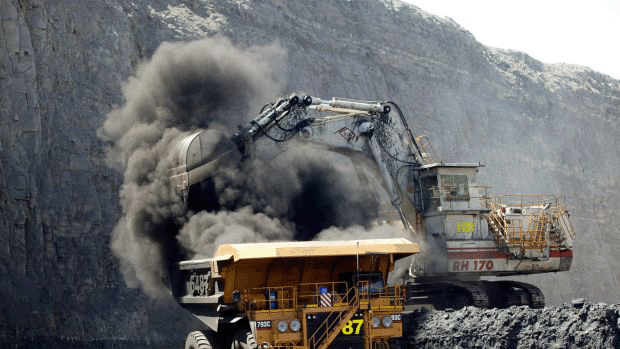 Anti-Adani protesters promise week-long action against Queensland mine https://www.brisbanetimes.com.au/national/queensland/qld-adani-protesters-promise-week-long-action-20170916-p4yvy9.html 16 September 2017
Saying goodbye to coral reefs
If we continue to have warm summers like we had in ’16 and this year, the next one could wipe out the remaining coral. Now, I don’t want to sound doomsday, but that’s where we’re at right now. It’s still a wonderful place to visit. But if we continue on this trajectory it won’t be, very soon – within our lifetime. I think that this is the wake-up call that we need. If losing the Great Barrier Reef isn’t serious stuff, what is?
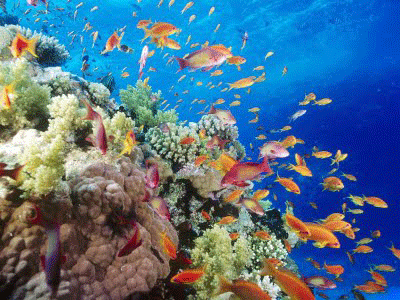 Farewelling coral reefs The Saturday Paper, Karen Middleton, 16 Sept 17 We hear much about trying to contain temperature rises to 2 degrees above pre-industrial levels. Why is that the magic number?
Ove Hoegh-Guldberg The 2-degree guardrail came out of the 2009 Copenhagen meeting. When you looked at how ecosystems were responding, you got into an unmanageable area at 2 degrees above the pre-industrial period, which was where the CO2 concentration had been stable for a long time. The trajectory we’re on today could raise temperatures by as much as 5 or 6 degrees on history.
One of the problems with 2 degrees is that generally people have the idea that it’s a guardrail. You go up to the edge of 2 degrees and look over it and see where you don’t want to go and it’s all very safe here. But it’s more like a slippery slope. Things get progressively worse until they become unmanageable. At the latest Conference of the Parties, the UNFCC [United Nations Framework Convention on Climate Change ] governing framework started to say, “well actually we want to keep things well below 2 degrees, and hopefully aim for 1.5 in the long term”.
KM And where are we now? Continue reading
Carbon capture shown to be uneconomic and impractical
Why Nuclear Energy May Not Be Our Best Alternative Option To Fossil Fuel, Forbes, 9 Sept 17 , Michael Barnard, low-carbon innovation analyst, on Quora: “… From a carbon capture and sequestration perspective, there’s exactly one sequestration project associated with a coal generation plant which is actually sequestering any reasonable amount of carbon. It’s in Saskatchewan, Canada. It was operating at 40% of targets for months and nobody noticed. It’s very expensive.
I did an assessment of all sequestration efforts in Australia over the past 19 years recently and found that they had spent $4,300 AUD per ton to sequester a vanishingly tiny fraction of Australia’s emissions.
The US CCS projects have gone vastly over forecasts and are abandoned and no new ones are projected. The UK government has stopped funding them………
Are environmentalists saying that CCS doesn’t make sense? Yes, because 20 years of work has shown that CCS related to fossil fuel generation has failed to progress, deliver to milestones or show that it is capable of providing any useful contribution. It’s just not economically or practically possible. …….https://www.forbes.com/sites/quora/2017/09/09/why-nuclear-energy-may-not-be-our-best-alternative-option-to-fossil-fuel/#25ec6e8375d0
Australia’s greenhouse gas emissions have risen
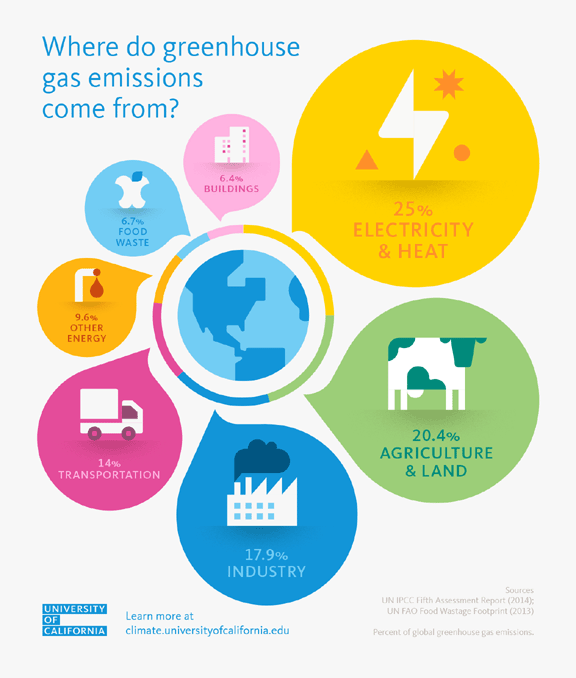 Australian emissions have actually increased since we closed our biggest coal-fired power plant http://www.news.com.au/technology/environment/climate-change/australian-emissions-have-actually-increased-since-we-closed-our-biggest-coalfired-power-plant/news-story/14107f5632844d3ffca1f35e5685b3c6
DESPITE the fact we closed our grubbiest coal-fired power plant in March, Australia’s emissions have actually grown to the highest level since 2011. Kirrily Schwarz , 8 Sept 17 AUSTRALIAN greenhouse gases last year were the highest since 2011, despite the closure of our grubbiest coal-fired power plant.
The electricity sector had its biggest drop on record in the three months to June, following the closure of Victoria’s Hazelwood power station, which burned brown coal deposits from an open-cut mine in nearby Morwell.
However, even that wasn’t enough to stop Australia’s overall greenhouse gas emissions from rising, with increases recorded in every other sector. That’s according to new projections reported in the Guardian, which take stock of quarterly emissions across the country.
According to environmental experts, Australia has now consumed 24 per cent of the carbon budget set by the government’s Climate Change Authority. The budget represents the total amount of carbon Australia can release from 2013 while keeping global warming under two degrees. The alarming revelation comes as new modelling shows South Australia and Victoria both risk four-hour blackouts this coming summer.
The Australian Energy Market Operator released its annual stocktake this week, showing there’s a heightened risk of a shortfall over the next decade if nothing is done. “The power system does not have the reserves it once had,” Audrey Zibelman, chief executive of the Australian Energy Market Operator, told AAP.
The South Australian government’s energy plan includes extra diesel generation, and is working with entrepreneur Elon Musk to develop much-hyped battery storage.
Victoria, meanwhile, is rolling out a large-scale storage plan the government says will boost storage capacity by 100 megawatts by the end of 2018.
Both states will ask consumers to use less electricity during peak times.
Mr Turnbull seized on the report to highlight the vulnerability of the nation’s electricity supply, but said measures were in place to cover the immediate gap.
The Prime Minister also revealed he and Energy Minister Josh Frydenberg were in talks with energy company AGL about keeping open the Liddell power station in NSW at least five years beyond 2022, while the Snowy Hydro 2.0 project is completed.
However, AGL is working on shutting down all its coal-fired plants, and in August ruled out extending the Liddell plant’s life.
Meanwhile, Labor has offered to work with the government for a “constructive compromise” on energy policy so something can actually be done to drive down power prices.
But the Greens are angry the two major parties agree on subsidies for coal.
Mr Turnbull has set a deadline of developing a clean energy target — as recommended by Chief Scientist Alan Finkel — before Christmas.
Opposition Leader Bill Shorten called on the government to just get on with its job. “The number one problem contributing to energy prices in this country, out-of-control energy prices, is the absence of proper national policy,” he told reporters in Canberra.
The figures come at a time when electricity is more expensive than ever. Power prices jumped on July 1 after three major retailers announced increases of up to 20 per cent and $600 a year for the average customer in several states.
1 This month
Chernobyl: The Lost Tapes – A good documentary on Chernobyl on SBS available On Demand for the next 3 weeks– https://www.sbs.com.au/ondemand/tv-program/chernobyl-the-lost-tapes/2352741955560
15 April – Zoom –Nuclear Power is Not the Solution
Apr 15, 2026 01:00 AM in Canberra, Melbourne, Sydney

Join the International Physicians for the Prevention of Nuclear War (IPPNW) on Tuesday, April 14th for a timely webinar exploring the risks associated with nuclear power and challenging the myth that it offers a simple, safe, carbon-free solution to the climate crisis

21 April Webinar: No Nuclear Weapons in Australia
Start: 2026-04-21 18:00:00 UTC Canberra, Melbourne, Sydney (GMT+10:00)
End: 2026-04-21 19:30:00 UTC Canberra, Melbourne, Sydney (GMT+10:00)
Event Type: Virtual
A virtual link will be communicated before the event.
Host Contact Info: australia@icanw.org

of the week – Australians for War Powers Reform (AWPR)
To see nuclear-related stories in greater depth and intensity
 Antinuclear