Climate change- the global emergency – theme for August 17 (nuclear is irrelevant)
Climate change may now be irreversible, and is certainly at an urgent stage. While this website is dedicated to opposing the nuclear threat, we can’t ignore the reality of its twin peril – global warming.
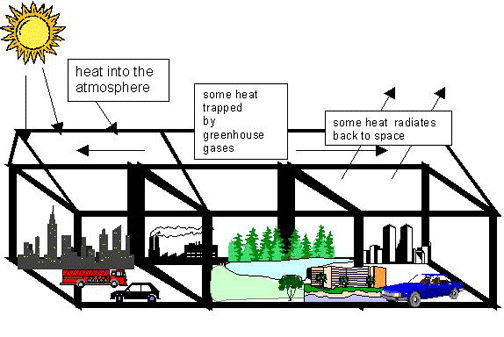
The scientific consensus is that the Earth’s climate system is unequivocally warming, and that it is extremely likely (meaning 95% probability or higher) that this warming is predominantly caused by humans. It is likely that this mainly arises from increased concentrations of greenhouse gases in the atmosphere, such as from deforestation and the burning of fossil fuels (Wikipedia)
The Intergovernmental Panel on Climate Change stated that warming of the climate system is ‘unequivocal’ with changes unprecedented over decades to millennia, including warming of the atmosphere and oceans, loss of snow and ice, and sea level rise.
Right now, climate experts are stressing the urgency of the situation, but offering differing ideas on what action to take. Dr Clive Hamilton, in his new book new book titled “Defiant Earth – the fate of humans in the Anthropocene.” says we will go well beyond the danger point of 2 degrees C. of warming, at least to 3 or 4 degrees. He advises that human society must adapt, and try to avoid the very worst. He warns us to avoid grandiose technological solutions.

Climate scientists agree on the need to drastically cut greenhouse has emissions, but some say that more action is needed. Paul Beckwith wants an international collaboration on further projects, to slow the warming rate – Removing excess CO2 from the atmosphere, Cooling the Arctic and saving the sea ice, Preventing Greenland Ice Sheet disintegration, Suppressing methane.
Of course, the nuclear lobby keeps promising extremely expensive solutions for the very distant future. However, nuclear reactors, of whatever type, would be far too late, even if they did combat climate change, (which they don’t). Nuclear power is irrelevant to climate change, – except for taking resources away and thus slowing up effective measures, such as energy efficiency and renewable energy.
Australia must wake up to the climate disaster facing Pacific Islanders
Australia doesn’t ‘get’ the environmental challenges faced by Pacific Islanders http://theconversation.com/australia-doesnt-get-the-environmental-challenges-faced-by-pacific-islanders-81995 Steven Cork, Adjunct Associate Professor, Crawford School of Public Policy, Australian National University, Vice Chancellor’s Fellow, University of Melbourne, August 7, 2017 What actions are required to implement nature-based solutions to Oceania’s most pressing sustainability challenges? That’s the question addressed by the recently released Brisbane Declaration on ecosystem services and sustainability in Oceania.
There once was an Island
Compiled following a forum earlier this year in Brisbane, featuring researchers, politicians and community leaders, the declaration suggests that Australia can help Pacific Island communities in a much wider range of ways than simply responding to disasters such as tropical cyclones.
Many of the insights offered at the forum were shocking, especially for Australians. Over the past few years, many articles, including several on The Conversation, have highlighted the losses of beaches, villages and whole islands in the region, including in the Solomons, Catarets, Takuu Atoll and Torres Strait, as sea level has risen. But the forum in Brisbane highlighted how little many Australians understand about the implications of these events.
Over the past decade, Australia has experienced a range of extreme weather events, including Tropical Cyclone Debbie, which hit Queensland in the very week that the forum was in progress. People who have been directly affected by these events can understand the deep emotional trauma that accompanies damage to life and property.
At the forum, people from several Pacific nations spoke personally about how the tragedy of sea-level rise is impacting life, culture and nature for Pacific Islanders.
One story, which has become the focus of the play Mama’s Bones, told of the deep emotional suffering that results when islanders are forced to move from the land that holds their ancestors’ remains.
The forum also featured a screening of the film There Once Was an Island, which documents people living on the remote Takuu Atoll as they attempt to deal with the impact of rising seas on their 600-strong island community. Released in 2011, it shows how Pacific Islanders are already struggling with the pressure to relocate, the perils of moving to new homes far away, and the potentially painful fragmentation of families and community that will result.
Their culture is demonstrably under threat, yet many of the people featured in the film said they receive little government or international help in facing these upheavals. Australia’s foreign aid budgets have since shrunk even further.
As Stella Miria-Robinson, representing the Pacific Islands Council of Queensland, reminded participants at the forum, the losses faced by Pacific Islanders are at least partly due to the emissions-intensive lifestyles enjoyed by people in developed countries.
Australia’s role
What can Australians do to help? Obviously, encouraging informed debate about aid and immigration policies is an important first step. As public policy researchers Susan Nicholls and Leanne Glenny have noted, in relation to the 2003 Canberra bushfires, Australians understand so-called “hard hat” responses to crises (such as fixing the electricity, phones, water, roads and other infrastructure) much better than “soft hat” responses such as supporting the psychological recovery of those affected.
Similarly, participants in the Brisbane forum noted that Australian aid to Pacific nations is typically tied to hard-hat advice from consultants based in Australia. This means that soft-hat issues – like providing islanders with education and culturally appropriate psychological services – are under-supported.
The Brisbane Declaration calls on governments, aid agencies, academics and international development organisations to do better. Among a series of recommendations aimed at preserving Pacific Island communities and ecosystems, it calls for the agencies to “actively incorporate indigenous and local knowledge” in their plans.
At the heart of the recommendations is the need to establish mechanisms for ongoing conversations among Oceanic nations, to improve not only understanding of each others’ cultures but of people’s relationships with the environment. Key to these conversations is the development of a common language about the social and cultural, as well as economic, meaning of the natural environment to people, and the building of capacity among all nations to engage in productive dialogue (that is, both speaking and listening).
This capacity involves not only training in relevant skills, but also establishing relevant networks, collecting and sharing appropriate information, and acknowledging the importance of indigenous and local knowledge.
Apart from the recognition that Australians have some way to go to put themselves in the shoes of our Pacific neighbours, it is very clear that these neighbours, through the challenges they have already faced, have many valuable insights that can help Australia develop policies, governance arrangements and management approaches in our quest to meet the United Nations Sustainable Development Goals.
This article was co-written by Simone Maynard, Forum Coordinator and Ecosystem Services Thematic Group Lead, IUCN Commission on Ecosystem Management.
Did Queensland Resources Council urge Great Barrier Reef experts to ignore climate change?
Queensland Resources Council denies urging Great Barrier Reef experts to ignore climate change, ABC, By Louisa Rebgetz, 2 Aug 17, The mining industry’s lobby group urged key advisors on the Great Barrier Reef not to consider climate change in the Reef 2050 plan, according to documents.
However, the Queensland Resources Council (QRC) said its position on climate change had been misrepresented in the notes, taken at Reef Advisory Committee (RAC) meetings in May this year.
The RAC’s role is to advise marine park authorities on ways to address risks to the reef and to assist with policy development.
The ABC has obtained an earlier copy of two reports by the Reef 2050 Independent Expert Panel and the RAC from meetings to advise on responding to mass coral bleaching events on the reef.
Committee members expressed the view both the Australian and Queensland Government’s position on coal extraction was “not consistent with its position on protecting the Great Barrier Reef” and stated the Adani’s Carmichael coal mine “should not proceed”.
The documents contained notes detailing the QRC’s position and stated the QRC did not support the committee making statements regarding climate change.
According to the notes, the QRC argued there was no direct scientific link between coal mining and climate change.
“NOTE — Queensland Resources Council believes that the Reef 2050 Plan should continue to focus on actions to support coral resilience but should not deal with direct action to address climate change,”…….http://www.abc.net.au/news/2017-08-02/lobbyists-deny-urging-reef-experts-to-ignore-climate-change/8766412
Australia’s national security is threatened by climate change
Climate change a serious threat to national security: Climate Council http://www.mygc.com.au/climate-change-serious-threat-national-security-climate-council/, 5 Aug 17 INTENSIFYING climate change poses a serious threat to Australia’s national security and we are not sufficiently prepared, according to a new submission released from the Climate Council.
Climate Council CEO Amanda McKenzies said urgent reforms are needed in order for Australia’s defence forces to deal with the vast and far-reaching impacts of climate change.
She warns more resources and stronger planning is needed to enable the defence force to tackle the increasing threat as extreme weather events, such as bushfires, floods and cyclones become more intense. “The Australian Defence force will have to play an increasing role at home and in the Pacific as extreme weather events become more frequent and forceful,” Ms McKenzies said.
“This requires more resources and strong planning. To bury our heads in the sand would risk not being able to cope effectively.
“When it comes to tackling this threat, Australia is at risk of being labelled Missing In Action, all while the UK and US militaries have spent years preparing for intensifying climate change, driven by the burning of fossil fuels.”
It comes after 2016 was named the hottest year on earth, smashing consecutive records set in 2015 and 2014, as a result of rising greenhouse gas levels from the burning of coal, oil and gas. See below story.
McKenzie said the Climate Council’s recommendations span from military planning and operations, through to training, testing and acquisition.
“These recommendations have already been rolled out and implemented in the US and the UK. Australia cannot ignore these critical footsteps already taken by our strategic allies,” she said.
“We’ve even seen the fingerprints of climate change in Syria’s civil war. The country’s severe drought, which was exacerbated by climate change, contributed to instability in Syria.”
“This should serve as a warning signal for the Australian Defence Force. Australia and its military must be equipped and prepared in the face of worsening climate change.”
AUSTRALIA’S HOTTEST JULY ON RECORD Continue reading
Since Australia’s carbon tax was abolished, greenhouse gas emissions continue to soar
 Australia’s greenhouse gas emissions soar in latest figures Figures reveal trend of increasing emissions since the carbon tax was repealed in 2014 and cast doubt on whether Australia can meet cuts in Paris agreement, Guardian, Michael Slezak, 5 Aug 17, Australia’s greenhouse gas emissions are rising to the highest figures seen in years, according to official government figures, increasing 1.6% in the last quarter and 1% in the past year.
The country’s emissions in the year to March 2017 are the highest on record at 550.3m tonnes of CO2 equivalent when emissions from land use change are excluded – a sector where the government says its figures have a high degree of uncertainty.
The country’s emissions rose by 1.6m tonnes in the quarter to March 2017, or by 1.1% – a figure that is the same whether estimations of land use emissions are taken into account or not…….
The figures reveal a clear trend of increasing greenhouse gas emissions since the carbon tax was repealed in 2014 – a trend that runs counter to Australia’s international commitments…….
Australia pledged to increase its emissions at Kyoto and is meeting its 2020 emissions targets using an accounting measure, where it could “carry over” the amount it overshoots its Kyoto targets, allowing it to increase its emissions again. https://www.theguardian.com/australia-news/2017/aug/04/australias-greenhouse-gas-emissions-soar-in-latest-figures
Australian ski resorts relying on machine-made snow: climate change is making this worse
 Heading to the slopes this winter? Why much of the snow you’ll see comes from a machine, not the sky, ABC Rural , By Catherine McAloon, 5 Aug 17, With below average rain and warmer than usual temperatures, this Australian winter has produced conditions that would have once spelled disaster for the local ski industry.
Murdoch media again attacks the Bureau of Meteorology
 Another attack on the Bureau, but top politicians have stopped listening to climate change denial, The Conversation Associate professor, Monash University, August 4, 2017 Has the Australian climate change debate changed? You could be forgiven for thinking the answer is no.
Just this week The Australian has run a series of articles attacking the Bureau of Meteorology’s weather observations. Meanwhile, the federal and Queensland governments continue to promote Adani’s planned coal mine, despite considerable environmental and economic obstacles. And Australia’s carbon dioxide emissions are rising again.
So far, so familiar. But something has changed.
Those at the top of Australian politics are no longer debating the existence of climate change and its causes. Instead, four years after the Coalition was first elected, the big political issues are rising power prices and the electricity market. What’s happening?
A few years ago, rejection of climate science was part of the Australian political mainstream. In 2013, the then prime minister Tony Abbott repeated a common but flawed climate change denial argument:
Australia has had fires and floods since the beginning of time. We’ve had much bigger floods and fires than the ones we’ve recently experienced. You can hardly say they were the result of anthropic [sic] global warming.
Abbott’s statement dodges a key issue. While fires and floods have always occurred, climate change can still alter their frequency and severity. In 2013, government politicians and advisers, such as Dennis Jensen and Maurice Newman, weren’t shy about rejecting climate science either.
The atmosphere is different in 2017, and I’m not just talking about CO₂ levels. Tony Abbott is no longer prime minister, Dennis Jensen lost preselection and his seat, and Maurice Newman is no longer the prime minister’s business advisor.
Which Australian politician most vocally rejects climate science now? It isn’t the prime minister or members of the Coalition, but One Nation’s Malcolm Roberts. In Australia, open rejection of human-induced climate change has moved to the political fringe……..
Have those who rejected global warming and its causes changed their tune? In general, no. They still imagine that scientists are up to no good. The Australian’s latest attacks on the Bureau of Meteorology (BoM) illustrate this, especially as they are markedly similar to accusations made in the same newspaper three years ago.
This week, the newspaper’s environment editor Graham Lloyd wrote that the BoM was “caught tampering” with temperature logs, on the basis of measurements of cold temperatures on two July nights at Goulburn and Thredbo. For these nights, discrepant temperatures were in public BoM databases due to automated weather stations that stopped reporting data. The data points were flagged for BoM staff to verify, but in the meantime an amateur meteorologist contacted Lloyd and the Institute of Public Affairs’ Jennifer Marohasy.
In 2014, Lloyd cast doubt on the BoM’s climate record by attacking the process of “homogenisation,” with a particular emphasis on data from weather stations in Rutherglen, Amberley and Bourke. Homogenisationis used to produce a continuous temperature record from measurements that may suffer from artificial discontinuities, such as in the case of weather stations that have been upgraded or moved from, say, a post office to an airport.
Lloyd’s articles from this week and 2014 are beat-ups, for similar reasons. The BoM’s ACORN-SAT long-term temperature record is compiled using daily measurements from 112 weather stations. Even Lloyd acknowledges that those 112 stations don’t include Goulburn and Thredbo. While Rutherglen, Amberley and Bourke do contribute to ACORN-SAT, homogenisation of their data (and that of other weather stations) does little to change the warming trend measured across Australia. Australia has warmed over the past century, and The Australian’s campaigns won’t change that…….
How will Malcolm Turnbull’s government respond to The Australian’s retread of basically the same campaign? Perhaps that will be the acid test for whether the climate debate really has changed. https://theconversation.com/another-attack-on-the-bureau-but-top-politicians-have-stopped-listening-to-climate-change-denial-81993
Great Barrier Reef’s great value as a coastal defence
As a coastal defence, the Great Barrier Reef’s value to communities goes way beyond tourism Director, Knowledge to Innovation; Chair, Green Cross Australia, Queensland University of TechnologyAugust 4, 2017 Rising sea levels are widely recognised as a threat to coastal communitiesworldwide. In Australia, the Climate Council estimates that at least A$226 billion of assets and infrastructure will be exposed to inundation if sea levels rise by 1.1 metres. Another report recommended that global mean sea level rise of up to 2.7 metres this century should be considered in planning processes.
The Queensland state government has commissioned the QCoast2100 program. This program aims to help with the development of coastal climate adaptation plans for Queensland communities exposed to sea-level rise.
Although the largest population centres in Queensland are in the state’s southeast, several of the most populous regional centres in Australia are located along the Great Barrier Reef coastline between Gladstone and Cape York. These include Townsville, Cairns, Gladstone, Mackay and Port Douglas.
A major task in developing coastal adaptation plans under the QCoast2100 program is to model inundation from a range of scenarios for sea-level rises and assess how assets will be inundated in the future. However, another threat is on the horizon.
How urban centres are protected
Urban centres along the reef’s coastline, which forms the majority of the Queensland coast, are protected from major ocean storms by natural deposits of coastal sediments. These include dunes and associated vegetation such as coastal forests, wetlands and mangrove systems.
These natural features continue to exist largely because the Great Barrier Reef’s outer reefs dampen incoming ocean waves. Although exposed to the occasional cyclone – which can lead to short-term erosion at specific locations – much of the coastal zone inside the reef is slowly growing out into the sea.
This increasing buffer zone can form a natural barrier to coastal recession.
A recently released report estimated the total economic, social and icon asset value of the Great Barrier Reef at A$56 billion. By design, this report did not include many of the ecosystem services the reef provides. One of these is its role in reducing the energy of waves that impact the coastline behind the reef.
However, an earlier assessment of the total economic value of ecosystem services delivered by the reef estimated the present coastal protection benefit is worth at least A$10 billion.
Despite the inherent uncertainties in such assessments, it is clear the reef acts to reduce incoming wave energy and its impacts on cities and towns along much of the Queensland coastline. The total economic value of these benefits is in the billions of dollars.
What role is bleaching playing?
The Great Barrier Reef’s ability to keep protecting the Queensland shoreline, and communities living along it, depends upon the ability of individual reefs in the system to grow vertically to “keep up” with rising sea level.
The jury is still out on whether the outer reefs will be able to keep up with predicted rises. This is an active area of research.
However, it is clear reefs that are extensively affected by coral bleaching will struggle to maintain the essential processes required for productive reef-building. Many reefs are now experiencing net erosion.
Predictions of ocean warming suggest that bleaching events will become even more common in coming decades. Increasing levels of atmospheric carbon dioxide are also making the oceans more acidic, which makes it more difficult for organisms such as corals to maintain their skeletons, which are made of calcium carbonate. This mineral dissolves more rapidly with increasing acidification, reducing the reef’s capacity to recover from storm damage and coral bleaching.
Therefore, as bleaching events and acidification continue, the outer reefs that protect the Queensland coast from ocean waves will increasingly struggle to perform this function.
In turn, over time the Queensland coast will potentially suffer from more coastal erosion, which may increase the vulnerability of coastal infrastructure. This effect, combined with rising sea levels leading to more coastal inundation events, multiples the risks to coastal settlements and infrastructure.
Australian Academy of Science warns on our shortage of climate scientists
 Shortage of climate scientists ‘significant risk’ to Australia: Academy of Science, Australia’s ability to maintain world-class climate science research is being jeopardised by under-resourcing and a lack of staff, according to a new report by the Australian Academy of Science, SBS, By Marese O’Sullivan, 3 Aug 17,
Glencore, company with global history of corruption and environmental degradation urges “business before climate action
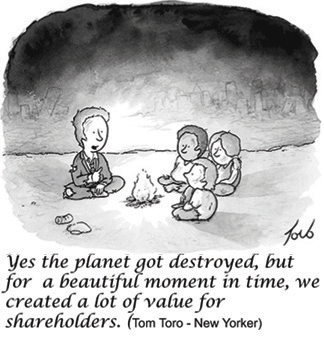
Focus on economy before climate deal, Glencore urges Australia, Perry Williams, SMH, 3 Aug 17 Australia may need to consider delaying its goals to combat global climate change in order to prioritise energy security and economic prosperity, according to a senior executive at Glencore.
Climate change brings Australia’s hottest July on record
 Australia records hottest July, Bureau of Meteorology says ABC News, 2 Aug 17 By Kristian Silva, Lucy Marks and staff Australia has had its warmest July on record, the Bureau of Meteorology (BOM) has said. A BOM report released today shows the country’s average July temperature was at its highest in more than 100 years of weather recording.
BOM forecaster David Crock said the warmest parts had been through Queensland, the Northern Territory, northern Western Australia and New South Wales. Mackay, in central Queensland, had its hottest July day on record at 28.9C on July 19, beating the previous record set only the year before.
“The month has been dominated — at least in eastern Australia — by a ridge of high pressure which has seen very clear skies and a warm air mass sit over the country for days and weeks at a time,” he said.”The inland areas have certainly been warmer away from the cooling influence of the ocean … but certainly some of the temperature anomalies extend right across northern Australia.
“Queensland had its warmest July on record for both maximum and minimum temperatures across the whole state — parts of Queensland have been very dry.” Mr Crock said temperatures had remained warm because the high-pressure system prevented cold fronts moving north from Victoria and NSW.
BOM meteorologist Greg Browning said it was “basically this background warming signal that we’re seeing right across the globe associated with global warming”.
“It seems like the warming conditions we’ve seen right across the globe are just becoming commonplace, and we’re seeing them in monthly temperatures on a regular basis.”
In the Northern Territory, the mean maximum temperature was 3 degrees Celsius above average — the mercury was the highest it had been in July since records began more than 100 years ago. Those in Darwin also sweltered through the nights with only six overnight lows under 20C, while the average for July is 18.5 nights below 20C.
New South Wales recorded the second month in a row of rainfall in the lowest 10 per cent of years since records began in 1910. The hottest July days ever recorded were in Brewarrina, Sydney, Bathurst, Dubbo and Scone.
BOM senior climatologist Blair Trewin said quite a few sites were also showing up as the highest average daytime temperature for July. “It is likely that overall this year the state of New South Wales as a whole will record in the top three years for the highest average daytime temperature for July,” Mr Trewin said.
Mr Trewin said a number of centres in the Riverina also recorded their lowest rainfall figures ever.”Following on from June, which was also very dry pretty well everywhere west of the ranges, it has been pretty dry through much of the state, particularly in the southern and central inland,” he said.
Research published in Nature Climate Change last week indicated the hot and dry climate system would increase in frequency if global warming was kept to the Paris Climate Summit target of 1.5C…. http://www.abc.net.au/news/2017-08-01/australia-records-hottest-july-on-record-bom-says/8762560
Catholic nun’s climate change petition is based on science
Sister Marie takes ‘climate change’ petition to Pirie, 26 Jul 2017 For more than 45 years, Sister Marie O’Shea has been a woman of the Catholic faith.
Now she has a new belief – “climate change”. The Port Pirie-based nun with the Sisters of the Good Samaritan has collected 200 names on a petition calling for stronger action on “climate change”. Christians, Muslims, Buddhists, Hindus, Jews and other people of faith are working with the Catholic Church’s Caritas Australia to raise the petition as the biggest such effort in Australia’s history.
While critics say “climate change” theory is plot to destabilise society, Sister Marie bases her belief on 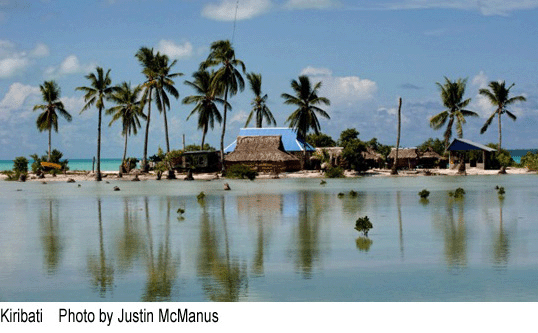 having lived in Kiribati in the Pacific Ocean. The island nation is said to be at risk of being over-run by rising seas attributed to changing environment.
Scientific research suggests increasing carbon dioxide levels, from pollutants such as fossil fuels, are threatening the planet.
Sister Marie said she had many friends among the 110,000 people living in Kiribati where tides were eroding the shore and the sea was contaminating water in wells. “Are we saying it doesn’t matter if these islands disappear?” she said. “The highest part of the country would be no higher than the top of the window in the Parish Centre, in Gertrude Street. “People say the islanders can move to higher land, but there is no higher land.
 “The Pope wrote an encyclical letter on Care of Our Common Home and it was for everyone. “It was about his belief that ‘climate change’ is a threat and action needs to be taken.”
Asked whether she thought God could save the planet, she replied: “I think God expects us to do our bit. He gave us free will and provided scientists with the minds to do their research.”
She said concerns had been raised about the world’s temperatures rising by up to five degrees.
“Can you imagine Port Pirie being five degrees hotter?” she said……http://www.portpirierecorder.com.au/story/4814058/nun-spreads-climate-change-faith/
Head of Donald Trump’s manufacturing council, Australian Mr Liveris breaks with Trump on climate policy
Andrew Liveris adamant US will revisit Paris climate deal, http://www.theaustralian.com.au/business/companies/andrew-liveris-adamant-us-will-revisit-paris-climate-deal/news-story/d4b0e75cb50c717220f4b13543157a67, 22 July 17 JAMIE WALKERAssociate Editor, Brisbane @Jamie_WalkerOz The Australian businessman tasked with making American manufacturing great for Donald Trump has broken with the President on climate policy, saying the US must re-engage with the Paris agreement.
And in a provocative address in Brisbane, Dow Chemical boss Andrew Liveris revealed that spiralling domestic gas prices had forced the multinational firm to review its Australian operations.
As the head of Mr Trump’s manufacturing council, Darwin-raised Mr Liveris is working with the embattled administration to deliver a key election promise to revitalise US manufacturing, while engineering one of the biggest corporate mergers in history between Dow Chemical and DuPont.
Warning that environmental sustainability was “no longer an initiative, it’s a business model”, Mr Liveris said Mr Trump’s decision to pull the US out of the Paris accord should not halt international co-operation on greenhouse gas mitigation. “We cannot as citizens of the world let that move impede our collective progress and our determination to remove carbon from the atmosphere,” he said, to applause from the crowd of 1500 that turned out for the UQ ChangeMakers forum, put on by his alma mater the University of Queensland and supported by The Weekend Australian.
“Many businesses in the US, NGOs and states have re-upped and picked up the commitment of what’s become the slack left behind by the federal government.
“I believe the US will re-engage ultimately with Paris and I am certainly being part of the solution to make that happen.” But he distanced himself from Mr Trump’s handling of the issue, saying it was “very unfortunate” the President had said the US was withdrawing from the 2015 Paris agreement, when the aim was to “redefine its engagement”. Under the UN-backed accord, Australia is committed to reduce greenhouse emissions by 26-28 per cent on 2005 levels by 2030. Mr Liveris said: “They are actually not withdrawing, they just want to re-engage on different terms. So if you think about it that way, I would say the odds would be very high of a re-engagement.”
Mr Liveris was one of the first business leaders to warn of the “gas cliff” that has deepened eastern Australia’s energy crisis, prompting intervention by the federal government to limit LNG exports and boost domestic gas supplies. He said yesterday that the gas price paid by Dow Chemical in Australia had rocketed from “roughly five or six dollars” to $20 in less than a year, jeopardising the business. “So my leader of Australia-Pacific … he’s got a proposal in front of us to look at exiting Australia right now in terms of uncompetitive energy prices.
We are not alone. We … can see the future in terms of the trajectory … you need to fix supply and you have got to basically recalibrate demand so that 90 per cent of the gas isn’t exported.”
Backing the controversial Finkel report to the government on energy security, Mr Liveris said it offered a “great series of policy solutions” and business would accept a target for renewables. The country, however, needed “policies that outlive” the government concerned. “What I would say is give me a policy that has a renewable target, give me time to develop it and I will develop a partnership model with you, in an innovation hub … to develop the technologies over time,” he said.
Australia: Climate change (to which nuclear power is irrelevant) – theme for August 2017
Of course the Great Barrier Reef is important, to Australia, and globally. It is a World Heritage site, and a unique and wonderful ecosystem. It’s just that I get a bit sick of everyone talking about its economic value – as though business is the only thing that matters to Australians.
Even more, I question the emphasis on the GBR, in context where nobody seems to be talking about the appalling impacts of climate change that are already happening, and will increase, in African and Asian nations.
Climate change is a global tragedy, for humans and other species. We are now in an era, (the Anthropocene) in which global action is imperative – quite the wrong time to put up the barriers, and say “our nation first”
Even if we do think “Australia first” – we’d better realise that WE might need some international help, as Australia is predicted to be hit particularly hard by climate change. Some of these impacts: increasing heat waves, some regions drier, bushfires, changed and damaged ecosystems, sea level rise, increased severity of floods. All this has effects on agriculture, infrastructure, human health, and society, with the most disadvantaged communities suffering the most.
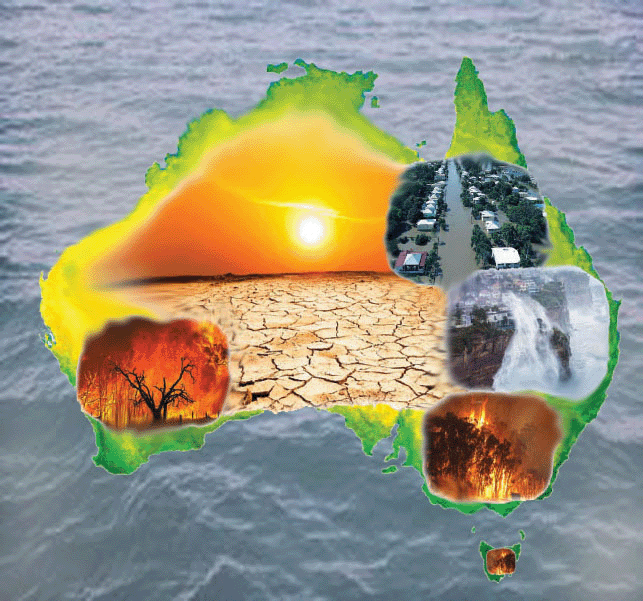
The effects of climate change elsewhere will impact Australia – sea level rise, especially affecting Pacific islands, environmental refugees, food shortages, environmental disasters, social instability, and increasing need for humanitarian aid. Australia is an island, yes, but can no longer function as though the rest of the world doesn’t matter.
Climate change is THE ISSUE right now, although the nuclear issue remains critical too – especially this month, when we remember Hiroshima and Nagasaki. The nuclear industry’s claims to fix climate change are farcical, and deserve to be ignored; the only relevance nuclear has is that its proponents are holding back REAL answers to global warming.
Queensland Liberal National Party refuses to pull out of Paris Climate Accord
 LNP members vote down call to pull out of Paris Climate Accord at Queensland convention, ABC News By Chris O’Brien, 16 July, Queensland Liberal National Party members have steered away from a potentially divisive move against Australia’s global climate position, while the party leader also vowed not to be distracted by federal squabbles in the lead up to the next election.
The party’s annual convention voted down a motion calling on the Commonwealth to pull out of the Paris Climate Accord, after two former presidents warned against undermining the Prime Minister.
“This motion is really about just putting the knife into the Federal Government,” immediate past president Bruce McIver said.
“They’ve agreed on it on our behalf, and I think if we don’t believe we should vote this down today, we are doing them an injustice.”………http://www.abc.net.au/news/2017-07-16/lnp-members-vote-down-call-to-pull-out-of-paris-climate-accord/8713210
1 This month



Help Aunty Sue Protect Her Land and Sacred Sites From Destructive Rocket Testing.
.

Australians deserve the truth
about
AUKUS – https://aukuspublicinquiry.com/

PETITION – To: Prime Minister Anthony Albanese and the Australian Labor Government

of the week – Australians for War Powers Reform (AWPR)
To see nuclear-related stories in greater depth and intensity

