Climate denialism rules the Liberal Party – and is bringing about a split within it
 More than half of federal Liberal MPs ‘don’t trust’ climate science: think tank http://www.afr.com/news/policy/climate/more-than-half-of-federal-liberal-mps-dont-trust-climate-science-think-tank-20170714-gxb7r2 The majority of federal Liberal MPs are not convinced the science behind climate change is settled and support reductions in emissions of greenhouse gases for political reasons, according to an prominent conservative think tank.John Roskam, the executive director of the Melbourne-based Institute of Public Affairs, said he hadn’t conducted a formal count but found most Liberal politicians shared his doubts about what many experts say is the greatest global threat to mankind.
“More than 50 per cent are solid sceptics and more than 50 per cent feel they need to be seen to do something,” he said in an interview. “The science is not settled.”
The overwhelming majority of climate change scientists accept the atmosphere is warming and humans are responsible. The burning of fossil fuels contributed to an increase in atmospheric carbon dioxide from 280 parts per million before 1800 to 396 parts per million in 2013, according to the Australian Academy of Science. Continue reading
The real purpose of Northern Australia Infrastructure Fund? – to supply $billions to Adani
 Northern Australia Infrastructure Fund set up to funnel billions to Adani, Independent Australia Mark Zanker 15 July 2017, The NAIF was set up to allow the Coalition Government to pump billions of dollars of public money into Adani’s Galilee Basin coal mine and other coal mining projects, writes former public servant Mark Zanker.
THE Northern Australia Infrastructure Facility(NAIF) was set up ostensibly is to fund the states and territories to carry out infrastructure works to assist economic growth and increased population in northern Australia. However, a close look at the bill, and the people and circumstances surrounding it, suggests that it is, in fact, a tiny fig leaf behind which the Federal Government seeks to hide its desire to shovel billions of dollars of taxpayers money into Adani’s Galilee Basin coal mine project.
The legislation precludes the appointment to the board of representatives of traditional owners, pastoralists, scientists, environmentalists, the tourism industry, and historians. These groups also have significant expertise in northern Australia — pastoral, cultural, spiritual, historical and scientific. Pastoralism, aquaculture, tourism, including conventional, cultural and ecological tourism, are very important industries in northern Australia, but none of them have a seat at the table here.
With the possible exception of Innisfail Mayor Bill Shannon, the board members of the NAIFall have strong links to the mining industry. Chair Sharon Warburton was a board member of Gina Rinehart’s Fortescue Metals Group, and previously worked at Rio Tinto and other resources companies. Continue reading
The Great Barrier Reef is not going to survive climate change
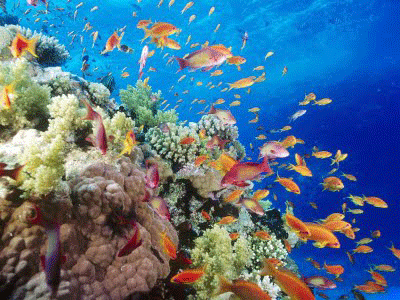 The uncomfortable truth: The Great Barrier Reef is doomed, Independent Australia Dr Geoff Davies 14 July 2017 The Great Barrier Reef is unlikely to survive as more than a small, sad remnant of its past glory.
The reason is straightforward. It is well known in climate science that, even if we stopped harmful emissions tomorrow, global warming would not peak for another several decades. By then, most of the Reef will be long gone.
This is not pleasant news and clearly many would prefer it was not said, but there it is, the argument is simple and the conclusion is difficult to avoid.
The recent decision by the United Nations World Heritage Committee not to list the Reef as “in danger” is, of course, farcical. It reflects the crudest of politics, including the blinkered claim that Australia is not reponsible for global warming. Yet Australian governments, state and federal, do everything they can to spruik the coal mining that would ensure the death of the Reef and threaten to tip us into catastrophic warming.
Most news reports of global warming use only words and try for spurious he-said-she-said “balance”, so you don’t get a very clear impression of what is really going on. A good graph is worth millions of such waffle words.
[lengthy explanation given here with graphs]……
Suppose the world suddenly got sane and we set about the emergency reduction of greenhouse gas emissions, as scientists have been urging for several decades now. Even if emissions drop precipitously, there’s still too much already in the atmosphere. It takes a long time for the gases to be absorbed back into the land and ocean. In the meantime, warming will continue for 20 to 40 years — or even longer (the uncertainty is because we don’t know to what depth the oceans carry the extra heat they absorb)…….
Some scientists think corals have some chance of adapting and reversing a portion of the die-off if temperatures peak at “only” 1.5°C, but the corals’ diversity would be greatly reduced. If the peak is above 1.5°C, there is no chance of recovery.
If people like Donald Trump and Tony Abbott continue to be influential then global warming could even accelerate, as we pump out ever-more fossil fuel exhausts. Or natural reinforcings might already be kicking in and tipping the system into runaway. In that case, we would have to forget the Reef and worry about the survival of civilisation.
On the other hand, there is far more we can do to reduce emissions, reduce them quickly and live well as we do it. Leaders like William McDonough and Amory Lovins have long noted our wastefulness and the huge potential of good design and a cycling industrial system. Regenerative agriculture can not only reduce emissions but recapture and store greenhouse gases, all with abundant yields.
The Great Barrier Reef is not just a pretty decoration and earner of tourist dollars. Thousands of ocean species depend on it for food, shelter and breeding — even species that spend most of their lives far away. The effects of the present death will already be reverberating through ocean ecosystems. We depend heavily on the oceans to maintain a habitable planet.
There is a silence about the Reef. The massive bleachings have been prominent in the news, but nothing happens. We know it’s happening, but we don’t want to mention it. Why are we silent?
If our media were functioning properly, this dire prospect could have been widely understood before it became acute. The problem is not just the Murdoch media, which actively obfuscate and lie about global warming.
The media’s interpretation of ‘balance’ is so superficial as to seriously misrepresent the world. For example, paraphrasing a recent report: Much of the northern Great Barrier Reef is dead. But the good news is the southern parts are still mostly healthy. There is no good news. Such a report might reasonably have said, instead: The GBR has begun its death throes………
might there also be shame? We are the generation, out of all of the long history of humanity, that is allowing the glories of a planet to be destroyed. Oh dear, I’m not supposed to make my readers uncomfortable, they might switch off.
The question stares us in the face anyway. How will we face our grandchildren?
Dr Geoff Davies is an author, commentator and scientist. He is a retired geophysicist at the Australian National University and the author of Desperately Seeking the Fair Go (2017). He blogs at BetterNature and tweets at @BetterNatureOz. https://independentaustralia.net/environment/environment-display/the-great-barrier-reef-is-doomed,10501
Josh Frydenberg, Australia’s Minister Against the Environment, warns the States not to act on clean energy target
 Josh Frydenberg warns states against going it
 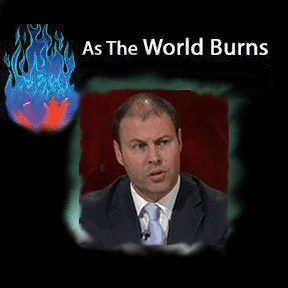 alone on clean energy target, The Age, Adam Gartrell, 14 July 17 The Turnbull government has warned the states their threat to “go it alone” on a clean energy target will only create chaos and inefficiency in the nation’s electricity system.
Energy ministers will clash on Friday as the states seek to pressure the Turnbull government to decide whether it will adopt a clean energy target – the key recommendation of Chief Scientist Alan Finkel’s review of Australia’s energy security – despite ongoing internal divisions over the policy proposal.
Led by South Australian Treasurer Tom Koutsantonis, the Labor states on Thursday threatened to bypass the federal government altogether. Without swift progress on Friday they would ask the Australian Energy Market Commission to model how a state-based target would work, Mr Koutsantonis said.
“The time to act is now – Australian households and businesses cannot be held hostage by the impotence of the federal Liberal government,” he said.
But federal Energy Minister Josh Frydenberg cautioned against the move, urging patience from the states…..
The renewed debate over Finkel came as a Liberal backbencher came under heavy fire for suggesting “people will die” as a result of renewable energy subsidies……http://www.theage.com.au/federal-politics/political-news/josh-frydenberg-warns-states-against-going-it-alone-on-clean-energy-target-20170713-gxafok.html
Torres Strait islanders affected by climate change – evacuation eventually needed
‘The island is being eaten’: how climate change is threatening the Torres Strait
In Boigu, part of Australia but just six kilometres from Papua New Guinea, roads are being washed into the sea, Guardian, Ben Doherty and Michael Slezak, 13 July 17, Torres Strait residents face being forced from their homes by climate change, as their islands are lost to rising seas.
On Boigu Island, the most northerly inhabited island in Australia, just six kilometres from Papua New Guinea, the community’s cemetery faces inundation and roads are being washed into the sea. A seawall installed to protect the community is already failing.
Boigu elder Dennis Gibuma says the situation is worsening every season.
“Our seawall is no longer any good,” he says. “When the high tide and strong winds come together, it breaks. We pray we don’t lose our homes. We don’t want to leave this place.”
Masig Island, to the south-east of Boigu, is less than three kilometres long, and just 800m across at its widest point. Also known as Yorke Island, the low-lying coral cay is steadily being lost to the waves.
“In the short term, we can do what we can. We can’t stop the erosion, our hope is to slow it down.”
But he says he has to face the possibility that his people may have to abandon their ancestral home.
“Long term, we may have to evacuate the island,” he says. “But I am not going. Slowly, I see Masig Island getting out of something I can control.”………
The precise sea level rise around the Torres Strait, and the projected inundation, has not been calculated but low-lying islands are expected to experience a much greater flooding risk than mainland Australia. The department identifies the remote islands of the Torres Strait as some of the most vulnerable, as does the Intergovernmental Panel on Climate Change (IPCC), which warns communities they may be forced to relocate………
Displacement caused by climate change is forecast to be a driver of massive forced migration movements in the 21st century.
Low-lying islands in the Pacific – and Torres Strait islands like Masig and Boigu – are likely to be at the forefront of forced displacement but large and densely populated countries such as Bangladesh also face widespread inundation.
Some forecasts have predicted up to 150 million people could be forcibly displaced by climate change by 2040 – larger than the record number of people already forced from their homes globally.
The US and other militaries have said that climate change poses the greatest security threat to the Asia-Pacific.
But the global legal framework for resettling people displaced from their homes lost to natural disasters or climate change is unclear. The refugee convention – established in 1951 to regularise the resettlement of those displaced by the second world war – does not recognise someone forced from their home by rising seas, or natural disaster, as requiring protection.
Already, more than a dozen Pacific Islanders have attempted to claim refugee status in New Zealand on the grounds that their homes are uninhabitable because of rising seas or climate-related disaster. All have had their claims rejected.
On Masig Island, Hilda Mosby says climate change is already affecting the marine ecosystems on which communities depend for their livelihoods. Climate changeis already affecting her community “big time”, she says.
But the greater existential threat for her home lies ahead….https://www.theguardian.com/environment/2017/jul/13/the-island-is-being-eaten-how-climate-change-is-threatening-the-torres-strait
World’s unstoppable movement on climate change action – explained at Ecocity 2017 World Summit in Melbourne
 Ecocity 2017 World Summit: Cities forge ahead on climate change action http://www.heraldsun.com.au/news/ecocity-2017-world-summit-cities-forge-ahead-on-climate-change-action/news-story/586aeb5ddd424192ca4643f81aad3f6a IAN ROYALL, Herald Sun July 12, 2017 THE great cities of the world are forging ahead with action on climate change despite US President Donald Trump’s stance on the issue, a global conference in Melbourne has been told.
Greenhouse gas emissions of Australian States; – Queensland’s the worst
Queensland remains Australia’s biggest greenhouse gas emitter, Brisbane Times, Tony Moore, 12 July 17
Queensland is still Australia’s biggest emitter of greenhouse gasses, according to the latest research released by the federal government.
Those emissions come mainly from coal and gas burned for electricity generation, transport and from land clearing, according to the annual National Greenhouse Accounts. The information, released in May, shows Queensland contributes 28.3 per cent of Australia’s national greenhouse emissions.
Queensland’s carbon emissions increased 0.8 per cent between 2014 and 2015 to 152.1 million tonnes of carbon dioxide equivalent greenhouse gas emissions.
On Tuesday, the Queensland government announced two plans to reduce carbon emissions by 30 per cent by 2030 and to a “net zero” by 2050 compared with 2005 levels.
Australia’s carbon emitters
- Queensland – 28.3 per cent of the nation’s emissions (up 0.8 per cent).
- New South Wales – 24.8 per cent (down 11.6 per cent).
- Victoria – 22.3 per cent (up 2 two per cent).
- Western Australia – 16.1 per cent (up 30.5 per cent).
- South Australia – 5.6 per cent (down 2 per cent).
- Northern Territory – 2.4 per cent (down 24.7 per cent).
- Australian Capital Territory – 0.3 per cent (up 11.2 per cent).
- Tasmania – 0.2 per cent (down 95.4 per cent).
- External territories – 0.01 per cent (up by 151 per cent). Australia’s external territories include Norfolk Island, Christmas Island, Cocos (Keeling) Islands, Heard and McDonald Islands and the Coral Sea Islands…….
The statistics show the biggest contributor to Queensland’s 152 million tonnes of greenhouse gas emissions in 2015 came from stationary energy sources, including electricity generation and manufacturing. Land use changes came a far third.
Overall in Queensland, the greenhouse gas figures showed 55 million tones of greenhouse gas emissions (26.1 per cent) came from energy industries………..http://www.brisbanetimes.com.au/queensland/queensland-remains-australias-biggest-greenhouse-gas-emitter-20170711-gx951t.html
No plans for real development of Adani coal mine expansion. Adani family will benefit most, if it happens
Adani’s Carmichael coal mine has slow ‘official start’ planned, leaked document shows, ABC News, by Stephen Long , 9 Jul 17 Flanked by Commonwealth and Queensland politicians, the giant Indian conglomerate Adani last month announced that its board had given final investment approval to its controversial mega-mine in North Queensland, and declared the “official start” of the Carmichael coal mining project.
But what does that mean in practice? For the moment, it seems, not much.
The ABC has obtained the plan of operations for the Carmichael coal mine project submitted to the Queensland Government last month.
It covers just six months and involves next to nothing: just re-establishing signage at the site, recommissioning an existing temporary camp and installing some additional demountable buildings.
“The plan of operations will be amended in due course to include all early works related to commencement of construction activities for the mine and related infrastructure works,” it says.
The lack of a substantive plan for development of the mine “is a huge embarrassment for the Adani cheer squad including the Prime Minister, the Premier of Queensland and [Minister for Resources and Northern Australia] Matt Canavan, who have bent over backwards to get this project over the line,” said Rick Humphries, co-ordinator of the mine rehabilitation campaign for the Lock the Gate Alliance — a group established by farmers to fight “inappropriate” coal and gas mining.
“It only really commits Adani to maintaining the existing temporary camp and looking after the signs and roads,” he said.
“It raises serious doubts about the project’s financial viability……..
Adani’s mine project, if it were to proceed to full scale, would be the largest-ever coal mining development in Australia and the biggest export coal project in the world, involving a series of open cut mines and underground pit with a capacity of 60 million tonnes a year.
Adani would also have to build an additional port at the Abbot Point Coal Terminal — which it owns — to accommodate output from the mine, though there has been speculation that Adani intends to scale down the mining venture to less than half the initial planned capacity.
Despite the question marks about Adani’s ability to finance the venture there are clear incentives for the Adani family to make the project happen.
An “overarching royalty deed” at the project will see $2 from each tonne of coal mined beyond the first 400,000 tonnes each year go a private company ultimately owned by an Adani family entity registered in the Cayman Islands.
This could potentially mean that hundreds of millions, or billions of dollars, from the venture could flow to the Adani family rather than to shareholders of the publicly-listed company that owns the Carmichael mine.
The ABC has also been told that the response of Adani’s billionaire chairman Gautam Adani to years of activism and opposition to the mine in Australia is a determination to see the project realised. http://www.abc.net.au/news/2017-07-10/adani-queensland-coal-mine-plan-raises-doubts-on-viability/8691020
Climate Change Authority has now lost all of its climate scientists
Climate Change Authority loses last climate scientist, Guardian, Graham Readfearn. 6 July 17 David Karoly says without an expert to replace him, the CCA will struggle to fulfil its legal mandate. Imagine, if you will, a government board to champion Australian arts without any artists on it, or an agency to advise on medical research without any medical researchers.
Or perhaps even, imagine a government authority set up to provide expertise on climate policy without any actual climate scientists.
Well you don’t have to imagine that last one, because that’s what we now have – the government’s Climate Change Authority is now sansclimate scientist.
Prof David Karoly, of the University of Melbourne, has just finished his term on the authority’s board – the only member to stick it out for the full five years.
Karoly says without someone to replace him, the authority will struggle to fulfil its legal mandate. He told me:
it [the government] won’t replace Karoly and will instead just rely on the chief scientist, Alan Finkel, to act as a go-between, which of course is much more efficient and logical than actually having a climate scientist right there in the room. That would be silly, right?…….
Under the former Liberal leader Tony Abbott, the government vowed to axe the authority entirely – but couldn’t get enough support in parliament. So instead, if you believe its former insiders, the authority was carefully manipulated and undermined.
As Hamilton put it, the CCA became “dominated by people who want action, but not too much action”. https://www.theguardian.com/environment/planet-oz/2017/jul/05/climate-change-authority-loses-last-climate-scientist
Australia Institute takes up the challenge of climate change research and communication
The Australia Institute to Continue Legacy as Climate Institute Shuts its Doors. Pro Bono Australia 3 Jul 17 Australia’s first non-government organisation to focus solely on climate change has shut its doors after more than a decade of climate advocacy work, passing the baton on to the Australia Institute. Monday, 3rd July 2017at 4:26 pm
Wendy Williams, Journalist, The Climate Institute, which was founded in 2005, closed on Friday due to a lack of funding.
Any remaining funds and intellectual property are set to be transferred to the Australia Institute, to “help carry forward the Australia Institute’s climate change-related research and advocacy”.
Mark Wootton, chair of the Climate Institute board said the Australia Institute was chosen from a short-list of strong candidates to continue the legacy.
“I am pleased to announce that, following the closure of the Climate Institute on 30 June, its significant remaining funds and intellectual property will be transferred to the Australia Institute, to help carry forward the Australia Institute’s climate change-related research and advocacy,” Wootton said.
“The Australia Institute shares our commitment to relevant, robust research, innovative communication and well-targeted advocacy….
At the time it was founded the Climate Institute was the only non-government organisation focused solely on climate change.
Through its Climate of the Nation series, the institute conducted what is now the longest trend survey of the attitudes of Australians to climate change and its solutions……
The Australia Institute announced it would establish a specialist Climate and Energy Program to “secure the ongoing legacy of the Climate Institute efficiently and effectively”.
The new program will also house the recently launched National Energy Emissions Audit. https://probonoaustralia.com.au/news/2017/07/australia-institute-continue-legacy-climate-institute-shuts-doors/
United Nations committee encourages Australia to rethink its support for coal mining industry
In a periodic review of Australia’s performance under a UN treaty on human rights, released this week, the committee noted: “environmental protection has decreased in recent years as shown by the repeal of the Emissions Trading Scheme in 2013, and the State party’s ongoing support to new coal mines and coal-fired power stations”.
In light of this, the committee of 18 international human rights experts encouraged Australia to “review its position in support of coal mines and coal export”.
The Australian government has remained a staunch supporter of the proposed Carmichael mine project, coal from which will generate more carbon emissions than New York City each year it operates.
On a trip to India in April, prime minister Malcolm Turnbull claimed the project would create “tens of thousands of jobs” for Australians – a claim that has been discredited by Adani’s own experts and a Queensland court.
A government infrastructure fund is weighing an application for a near-$1bn loan to Adani for a railway to transport the coal to the coast.
Australian ministers have often argued the Adani mine is backed by a “moral case” for supplying Indians with cheap electricity. The experts on the CESCR are elected by state parties based on their “high moral character”. They include an Indian representative.
The UN recognises that climate change is a threat to human rights. Coal mining and other highly-polluting industries could therefore be viewed as contravening international treaty obligations.
Aside from curbing coal mining, the CESCR recommended Australia’s government immediately introduce new measures to cut its growing carbon emissions and expand renewable energy production. http://www.climatechangenews.com/2017/06/29/un-committee-urges-australia-rethink-support-adani-mine/
Farmers for Climate Action gathering huge support in their fight against Adani coal mine expansion
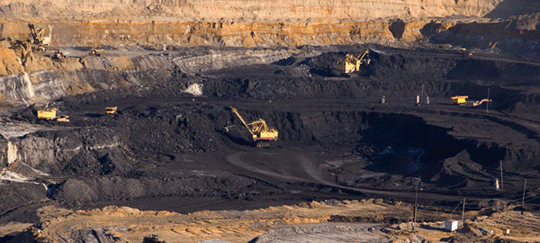 Farmers join fight against Adani coalmine over environmental concerns More than 2,000 farmers and agriculture leaders express concern proposed Carmichael coalmine could affect groundwater, biodiversity and climate change, Guardian, Michael Slezak, 30 June 17, A group of Australian farmers have joined the large coalition of groups fighting against Adani’s giant Carmichael coalmine, after they became concerned about the affects the mine would have on groundwater, biodiversity, rural communities and climate change.
Farmers for Climate Action – a group of more than 2,000 farmers and agriculture leaders concerned about climate change – became the newest group to join the Stop Adani alliance last week, at the same time as one of its members attracted more than 30,000 signatures to a petition calling on the Queensland premier, Annastacia Palaszczuk, to rescind her commitment to give Adani unlimited free access to groundwater used by farmers in the region.
Longreach farmer Angus Emmott launched the petition last week; a few days later he had an accident on his farm and had to be airlifted to hospital. When he checked on the number of signatures on Wednesday, he was shocked to see there were nearly 30,000……
“It’s too big a danger for the future,” Emmott said. “We need clean water. We need good soil. We need food security. And we have the potential to be a leader in renewable energy in Queensland. We don’t need to be reviving an outdated technology.”
Excited by the number of signatures, Emmott decided to try to get a meeting with Palaszczuk and deliver the petition in person. “The doc says I should take it easy after my accident, but as soon as I get the all-clear to travel I’ll fly to Brisbane to deliver the petition in person. I might bring a few other farmers with me too,” he said in an update posted on the petition website.
Emmott said it appeared a lot of farmers have signed the petition, as well as people in cities who share his concerns. He said he hopes to reach 50,000 signatures before he delivers the petition to Palaszczuk.
The Farmers for Climate Action chief executive, Verity Morgan-Schmidt, said the group had decided to join the Stop Adani alliance mainly because of impacts the proposal would have on groundwater, but also because of concerns about biodiversity, rural communities and the climate. The decision brought the number of groups in the Stop Adani alliance to 13.
“No one can tell us, with any confidence, what impact this project could have on water supplies from underground aquifers because there is no independent or government oversight, or trigger levels that would halt mining,” Morgan-Schmidt said…….https://www.theguardian.com/environment/2017/jun/30/farmers-join-fight-against-adani-coalmine-over-environmental-concerns
John Pratt ‘s climate and coal news
-
Wide spread coral decline. #StopAdani #ClimateChange
SECOND YEAR OF BLEACHING IMPACTS GREAT BARRIER REEF – GBRMPA UPDATE 29/5/17 Global coral bleaching over the last two years has led to widespread coral decline and habitat loss on the Great Barrier Reef.
Since December 2015, the Great Barrier Reef has been exposed to above average sea surface temperatures, due to the combined effects of climate change and a strong El Niño.These conditions triggered mass coral bleaching in late summer 2016 and led to an estimated 29 per cent loss of shallow water coral Reef-wide, according to findings by the Great Barrier Reef Marine Park Authority.
Winter sea surface temperatures in 2016 remained above average and, by the beginning of the 2016-17 summer, the accumulated heat stress on the Reef resulted in a second wave of mass bleaching.
Staff from the Marine Park Authority took part in aerial surveys conducted by the ARC Centre of Excellence for Coral Reef Studies, and the results confirmed the extent and severity of the 2017 bleaching event. -
Climate Change Could Spark Another Great Recession! #StopAdani
This Time, It May Be Permanent
Climate change will wreak havoc on the U.S. economy, leading to as much as a 3% decline in national GDP by the end of the 21st century if left unaddressed — and losses will be far higher in some of the country’s poorest areas, according to a new study.
-
Extract from Cairns Regional Council Climate Change Strategy #StopAdani
2.4 Implications for the region
Tourism –
Many tourists visit the region solely because of the natural beauty of its reefs and rainforests.
For Australian climate scientists, climate change is becoming a personal and serious concern
research shows that if there isn’t a reduction in CO2 emissions, there will be up to 50 extra really hot days a year in northern Australia by the end of the century.
Professor David Griggs, who recently retired as director of the Sustainable Development Institute at Monash University, said Australia is in denial about climate change.
“Australians will have to adapt or die,” he said.
 Climate scientists reveal their fears for the future http://www.abc.net.au/news/2017-06-27/climate-scientists-speak-of-their-worst-fears/8631368, Lateline By Kerry Brewster, Cradling her newborn baby girl, heatwave expert Sarah Perkins Kirkpatrick admits to feeling torn between the joy of motherhood and anxiety over her first-born child’s future.
“I always wanted a big family and I’m thrilled. But my happiness is altered by what I know is coming with climate change,” she said.
“I don’t like to scare people but the future’s not looking very good.
“Having a baby makes it personal. Will this child suffer heatstroke just walking to school?”
Dr Perkins Kirkpatrick is one of several climate scientists who Lateline spoke to, seeking a range of opinions from experts at some of the top climate change research units within major universities in Australia. Continue reading
Australian and International Hurdles to Adani Coal Mine Expansion
Final chapter in Adani loan deal, Saturday Paper, Karen Middleton , 24 June 17 “……..While the Queensland government has promised a royalties concession if the development goes ahead, it has also decided not to process the NAIF loan if approved – something that may require federal legislation to circumvent.
And for the Carmichael mine to proceed, the company must have concluded an Indigenous land use agreement, or ILUA, with the area’s native title holders.
Last week, the federal government and Labor combined to pass legislation to reverse a Federal Court ruling that all members of a registered native title claimant group in any relevant area were required to sign an ILUA for it to have force.
The move affected agreements well beyond the Adani ILUA and was welcomed by some Indigenous groups and opposed by others.
That followed Prime Minister Malcolm Turnbull’s promise to Adani owner Gautam Adani during a meeting in India earlier this year that he would fix the native title problems that were preventing the development from proceeding,
 But the Wangan and Jagalingou traditional owners are challenging the ILUA on three other grounds. The court hearing has been set down for next year.
OPPONENTS OF THE MINE ARE GEARING UP TO ARGUE THAT SUCH GLOBAL BAD PUBLICITY SHOULD BE GROUNDS FOR REFUSAL.
Originally, Adani had said it expected to achieve financial close on its Carmichael project by December this year. But recently that date was revised to March – the same month the court is due to hear the ILUA challenge.
What is not clear is whether there is a NAIF deadline by which an applicant must prove it has fulfilled all requirements, or whether an application can remain live for as long as that takes……
In the latest public criticism of the whole proposal, an international group of high-profile conservationists wrote to Malcolm Turnbull late this week urging the government not to proceed.
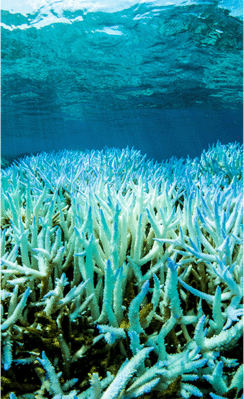 The Ocean Elders, which include ocean explorer Jean-Michel Cousteau, marine biologist Dr Sylvia Earle, businessman Richard Branson and Jordan’s Queen Noor, wrote that the mine would worsen damage to the Great Barrier Reef that Australia, as its custodian, had a global obligation to protect.
The group’s spokeswoman, marine biologist Earle, told ABC Radio that Australia should reject fossil fuels and hence the Carmichael mine, despite its advanced state of official approval.
“It’s never too late as long as the people and as long as rational individuals with power can change course, now that we know what we know,” Earle said.
A prime ministerial spokesman declined to comment on the letter.
One of the conditions of the NAIF approving a loan is that it must not be likely to “cause damage to the Commonwealth Government’s reputation or that of a relevant State or Territory government”.
Opponents of the mine are gearing up to argue that such global bad publicity should be grounds for refusal.
In her speech to the Cairns conference, Sharon Warburton said the NAIF must both reflect government policy and be independent of it.
“First NAIF must align with Commonwealth policy, and that is a whole-of-government position, remembering it is taxpayer funds we are deploying,” Warburton said. “Secondly – importantly – we cannot lend funds if all regulation at both a Commonwealth and state level are not in place.
“The other tremendously important parameter under which we operate is that it was set up to be an independent body making decisions independently of all outside influence.”
Given the attempts at influence being made on all sides of the argument, that may prove to be a challenge. https://www.thesaturdaypaper.com.au/news/economy/2017/06/24/final-chapter-adani-loan-deal/14982264004830
1 This month



Help Aunty Sue Protect Her Land and Sacred Sites From Destructive Rocket Testing.
.

Australians deserve the truth
about
AUKUS – https://aukuspublicinquiry.com/

PETITION – To: Prime Minister Anthony Albanese and the Australian Labor Government

of the week – Australians for War Powers Reform (AWPR)
To see nuclear-related stories in greater depth and intensity

