Adani announces “green light” for expanded coal mine, but still hasn’t got the finance
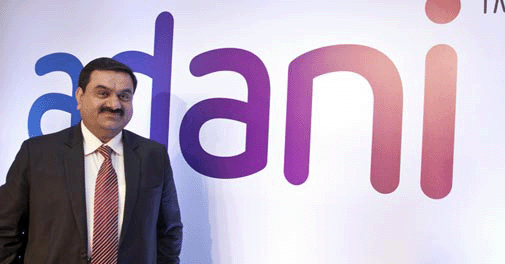 Adani gives itself the green light, but that doesn’t change the economics of coal, The Conversation, Director of the Centre for Energy and Natural Resources Law, Deakin Law School, Deakin University Indian mining firm Adani yesterday announced that its board had approved plans to proceed with the controversial Carmichael coal mine in Queensland’s Galilee Basin.But it is still far from clear whether Adani has actually obtained the finance to proceed with the A$16.5 billion project, or whether it has secured the necessary A$1.1 billion loan from the government’s Northern Australia Infrastructure Facility needed for the mine’s railway.
That hasn’t stopped the state government hailing the announcement as an economic win for Queensland, on the basis of job creation and for the signals it provides to potential investors in the region. But this amounts to little more than short-sighted politics. The government appears to be steadfastly ignoring the realities of the current energy landscape.
Let’s recap: coal mining is not economically viable within the constraints of a global carbon budget, while renewable energy production is rapidly expanding as the world moves to more sustainable investments. The result is that coal projects could become stranded assets, with price tags that may already exceed what would have been the costs of a timely implementation of climate action. Investors and lending institutions are shifting to sustainable projects that limit the risk of catastrophic environmental damage.
The people own the coal
The state government owns the coal resource, but it is a special type of ownership. This is “public resource” ownership, meaning that all decisions made by the state government to exploit it must be in the interest of the public as a whole.
Issuing resource titles that allow Adani to proceed with a vast coal mine – in defiance of the social, economic and environmental impacts of such a project within a carbon-constrained economy – arguably represents a dereliction of the state’s duty to act in the public interest.
It also ignores the fact that in order to have just a 50% chance of keeping global warming within 2℃, a key aim of the Paris climate agreement, 90% of Australia’s current coal reserves must stay in the ground. If the mine proceeds, it will contribute substantially to global warming and accelerate the destruction of one of the world’s greatest natural assets, the Great Barrier Reef. This could have huge knock-on effects for future tourism in the area, which generates A$6 billion a year.
The economics of the Adani coal mine simply do not make sense. While there may be limited short-term employment opportunities and royalty gains for the state should the project actually get financed, the longer-term projections are dire……..
In the end, the real question is whether any lending institution will seriously take a risk on this vast and irresponsible project, which ignores both the safety of the Great Barrier Reef and the fundamentals of carbon-constrained economics.http://theconversation.com/adani-gives-itself-the-green-light-but-that-doesnt-change-the-economics-of-coal-78912
Another obstacle has arisen to the Adani coal rail line plan
Adani white elephant hits another snag as GVK teeters at brink https://www.michaelwest.com.au/adani-white-elephant-hits-another-snag-as-gvk-teeters-at-brink/June 4, 2017 Never was a white elephant so white … and elephantine.
Besides their empty cries that coal from Australia is good for the poor people of India, while delivering monumental “jobs and growth” at home, the shrinking coterie of ideologues and thermal coal apostles has hit another hurdle.
Part of the push for a rail line from the Galilee Basin to Abbot point has hung on the argument that this railway will be a “common-user facility”; that is, it will not only be used to freight Adani coal but also that of GVK. GVK is a smaller Indian company, teetering on the brink of obsolescence, which apparently still harbours hopes that its Alpha coal project in the Galilee will one day be developed.
GVK Hancock is a joint venture between GVK and Gina Rinehart’s Hancock Prospecting. It is partnering with rail group Aurizon in the southern end of the Galilee Basin while Adani’s Carmichael project lies to the north.
In another blow to those who wish the Galilee to be developed with thermal coal mines, GVK Power & Infrastructure announced on Friday it had sold its remaining 10 per cent stake in Bangalore International Airport to Fairfax India Holdings for $US200 million.
It seems GVK has been reduced to selling core assets to stay afloat. Net debt is now $US1.8 billion versus a market value of equity at $US145 million.
GVK has suffered six years of losses, last reporting a net loss of $US209 million for 2017 as its auditor raised questions as to whether it was a “going concern”. Meanwhile, Adani is still holding out for taxpayer subsidies in a bizarre negotiating process knowing full well that, in India, the cost of building new solar capacity is cheaper that new thermal coal.
Adani Power Management recently conceded that almost $US9 billion in existing thermal coal plants fired by imported coal at Mundra, Gujarat, are no longer viable. It referred to the prohibitively high costs of imported coal.
No doubt, while coal futures languish well below the spot price, rendering Adani’s hopes (if they really still harbour them without taxpayers backing the lot) futile, the Carmichael cheer-squad will gloss over these small details as somehow bad for the poor people of India while they continue to promote this most effulgent of white elephants.
It will never happen, nor should it.
Frydenberg’s carbon capture and storage – it’s a joke, really
 Frydenberg’s carbon capture pipe dream, The Saturday Paper Paul
  Bongiorno , 3 June 17
“…..it was with some bemusement that some of the old hacks who were on that trip greeted Energy and Environment Minister Josh Frydenberg’s announcement that he would remove the legislative prohibition on the Clean Energy Finance Corporation (CEFC) to allow it to support investment in carbon capture and storage (CCS). The very optimistic minister said such technology could reduce emissions by up to 90 per cent.
This week Frydenberg pointed out that government has invested $590 million in CCS and said it is now being successfully employed in three overseas power plants. But a closer look shows the lessons learnt from those plants mean its use has already peaked. The proponents of these plants are on the record stating they won’t be investing in any more. Renewables entrepreneur Simon Holmes à Court told the ABC that exponential cost blowouts and disappointing results are the rule.
One plant visited by the energy minister – Petra Nova in Texas – cost $US1 billion. It’s touted as the world’s largest and most successful operation, yet it captures only about 6 per cent of the output of its adjacent power station. That’s “an incredibly low bang for buck”, concludes Holmes à Court. Another CCS plant targeted to cost $US2 billion will open three years late and with an incredible final bill of $US7.5 billion.
Holmes à Court agrees with Frydenberg that CCS has a role to play in cutting emissions in industrial processes such as cement or steel production. Carbon can be captured in these cases for about $15 to $30 a tonne. “So with a healthy carbon price, those projects make sense,” he says. And there’s the rub. The very government wanting to be a champion of CCS for industry is denying it any incentive to spend a cent pursuing it. It’s commercially cheaper to keep polluting. Industry may get away with that but finance markets are now pricing climate change into lending for major energy projects. Bloomberg New Energy Finance earlier this year costed CCS coal at $352 a megawatt hour, compared with wind and solar at between $61 and $140 megawatts an hour.
It’s little wonder that experts can’t see private industry investing in new coal-fired power stations without substantial government input. But none of this seems to deter the resources and Northern Australia minister, the Nationals’ Matt Canavan……..https://www.thesaturdaypaper.com.au/opinion/topic/2017/06/03/frydenbergs-carbon-capture-pipe-dream/14964120004723
Calls to cut support for coal mines after latest Great Barrier Reef report
 Greens believe Great Barrier Reef future at crucial crossroads after new report released, Brisbane Times Toby Crockford
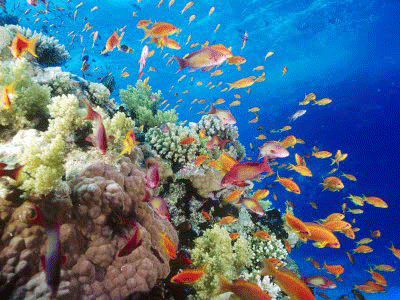
 JUNE 3 2017 The Greens have issued an ultimatum to the state and federal governments after the latest report expressed “serious concern” regarding the Great Barrier Reef rescue plan.UNESCO, which advises the World Heritage Committee, said on Saturday that key targets in the Reef 2050 plan “are not expected to be achieved” and urged Australia “to accelerate efforts”. In response to the fresh concerns, Queensland Greens Senator Larissa Waters launched a scathing attack on the state and federal governments.
“Meanwhile, Queensland Labor and Turnbull roll out the red carpet and public money for Adani for their deadly mega-coal mine,” Senator Waters said.
“As many scientists have said, our governments must choose between new coal or the reef.
“Will the two old parties back the 70,000 people with reef jobs? Or will they pay back the millions in donations from the mining industry, sign the reef’s death warrant and continue to back Adani?”
Queensland Environment Minister Steven Miles admitted progress had been slow in implemented measures outlined in the reef rescue plan, particularly towards 2018 targets.
In a report released in Paris on Saturday, UNESCO praised progress in the inception and initial implementation of the rescue plan but said reef rescue work “must move faster”.
“Progress towards achieving water quality targets has been slow and the most immediate water quality targets … are not expected to be achieved within the foreseen time frame,” the report said.
A previous report revealed coral bleaching at the Great barrier Reef in 2016 was even worse than expected. The most severe bleaching was found north of Port Douglas where an estimated 70 per cent of shallow water corals had died. http://www.brisbanetimes.com.au/queensland/greens-believe-great-barrier-reef-future-at-crucial-crossroads-after-new-report-released-20170603-gwjrgv.html
Australians’ opposition to subsidising Adano coal project – ranges from 70 to 86 per cent
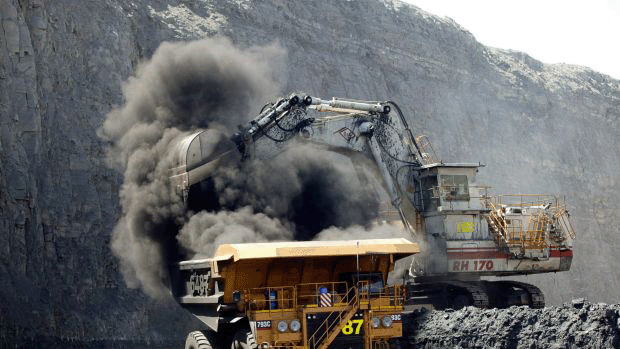 Frydenberg’s carbon capture pipe dream, The Saturday Paper Paul Bongiorno , 3 June 17 “….. no matter what voters think of the [Adani coal] project, they are overwhelmingly against any taxpayer funds bankrolling the Indian billionaire Gautam Adani. Research by the advocacy group GetUp! in marginal seats in Queensland and elsewhere has found resolute opposition to any government loan. Paul Oosting from GetUp! says opposition ranges from 70 to 86 per cent depending on the seat. He has mobilised dozens of his 350,000 members to make 50,000 scripted phone calls into marginal seats in Queensland and around the nation.
It sort of worked with the Palaszczuk Labor government. Much to the delight of Adani, the premier organised a royalties pause. The miner will be given 60 years to pay the tax, although he will attract an interest charge for any delay. That puts all the risk on taxpayers if the project fails to perform as promised or Adani’s labyrinthine company structure for the mine collapses. With some companies registered in the Cayman Islands the existence of a lucrative escape hatch for Adani cannot be ruled out.
Ominously, Indian newspapers are reporting Adani is under pressure to sell its Australian assets. The Reserve Bank of India is worried about a looming debt crisis and is pressuring banks to demand repayment of loans worth billions of dollars. The influential Hindu newspaper noted that the Standard Chartered Bank recalled loans of $2.5 billion from Adani and that “global lenders have backed out from funding the $US10 billion coalmine development project. State Bank of India also declined to offer a loan despite signing an MoU [memorandum of understanding] to fund the group with $1 billion”. What all of this means for Adani’s bid to get a concessional billion-dollar loan from the federal government’s Northern Australia Infrastructure Facility is not yet known. It should make it highly unlikely, but given the zealotry of Canavan and his leader Barnaby Joyce for the project such concerns are a mere bagatelle.
Again we have seen Turnbull’s need for pragmatic appeasement of the conservatives in his ranks undermine his brand on the environment and climate change. It probably goes a long way to explain why again in this week’s opinion polls he is still deep in negative territory for approval of his performance and Labor’s lead looks entrenched.
The resignation of Dr Peter Hendy from the inner sanctum of the prime minister’s offices is being read by some in the Liberal Party as a sign the government’s days are numbered. The economist, long-time Liberal apparatchik and former MP is planning to hang up his shingle as a consultant. “He wants to cash in on his contacts while they are still in power,” was one explanation. Another was: “Peter’s been around a long time and knows when a vote is cemented in.”
On that view Hendy is not waiting to see if the handful of pro-Adani seats in Queensland will be enough to save the federal government. Its chances are up in smoke and out the chimney – like the Beijing carbon capture pilot project. https://www.thesaturdaypaper.com.au/opinion/topic/2017/06/03/frydenbergs-carbon-capture-pipe-dream/14964120004723
Dispelling the myth that the Queensland economy actually needs the Adani coal mine
 The myth that Adani coal is boom or bust for Queensland economy, REneweconomy, By Giles Parkinson on 29 May 2017 There are a whole bunch of reasons why the Adani coal mine does not make sense: for the environment, the climate and on basic economics.
The latest results from Adani Power, revealing over the weekend a $US954 million loss ($A1.3 billion) for the last financial year, its fifth loss in a row, and a growing preference for domestic over imported coal, not to mention the endless delays and requests for government support, underline the fact that the project makes no financial sense.
And we know that on environmental and climate grounds, it makes no sense either. Rescuers minister Matt Canavan counts Adani’s benefits on the basis that the mine will last 60 years. That timeframe assumes that the world will not act on climate change.
Another myth that refuses to go away, and seems to be prosecuted by everyone from the Coalition, to the state Labor government and to the local councils, is that the Queensland economy depends on Adani and its Carmichael mine for jobs and investment, and that the region’s economy would be devastated if the mine didn’t go ahead.
It is simply not true. For a start, the inflated figures being pedalled by those state and federal politicians – the claim of 10,000 jobs – have been debunked by Adani itself, and its more modest investment plans now suggest maybe one-tenth of that, at best.
And perhaps those politicians should have a look around and see what else is happening in the region. It is really quite stunning: some 4,200MW of large-scale wind and solar projects, all of them in central to northern Queensland, and billions of dollars worth of other projects in the pipeline, including biofuels and even a battery gigafactory in Townsville.
The list of already committed projects, compiled by a private consortium known as Future North, include world leading solar resources, world leading solar and storage projects, a world-leading solar-wind-storage hybrid project, and a unique solar and pumped hydro plant proposed for the old Kidston gold mine.
Together, they represent investment of more than $7 billion and jobs of more than 3,200. And as a bonus, they will deliver electricity at an average cost of around $80/MWh, possibly less. Already, it is cheaper than the price of the Queensland grid in the first half of the year – and the low price will be locked in for 25 years.
Some are already going ahead, courtesy of some targeted support from the Australian Renewable Energy Agency and the Clean Energy Finance Corp, or in the case of Sun Metals’ 116MW solar plant near Townsville, in a bid to cut electricity costs and underpin the expansion of the local zinc refinery.
Another 3,000 jobs and $4 billion of investment are on the cards from half a dozen of biofuel projects that are also in the pipeline, and another 2,000 direct jobs and 5,000 indirect jobs could emerge if the consortium led by Boston Energy and Innovation, and supported by US giant Eastman Kodak, goes ahead with a battery storage gigafactory in Queensland.
“Townsville and the region are sitting on a gold mine of opportunities,” Oliver Yates, the former head of the Clean Energy Finance Corporation and a spokesman for Future North, told RenewEconomy on Friday in our Energy Insiders podcast.
Yates says the mixture of solar, wind, storage, hydro, biofuels and manufacturing makes the region ideally placed to be “the centre of action” in Australia’s energy transition.
“The opportunities that they have dwarf anything that they could get (from coal) … tese are sunrise industries. That town gets subject to a lot of pork barreling and nothing ever happens. And no one talked much about solar and wind …. and yet it is happening.
“They are siting in the land of opportunity. It’s the only place in Queensland that has got wind, it’s the got best solar resources, and best water resources. Townsville should be the centre of action.”
The projects include the soon-to-be completed Lakeland solar and storage facility, the massive wind, solar and storage facility at the Kennedy Energy park, the Kidston solar and hydro hybrid plant, large wind farms such as Emerald and Forsyth and others, and a host of large-scale solar farms proposed by Pacific Hydro, Esco Pacific, Eco Energy World, FRV, Windlab, Overland, Edify and others.
Future North is proposing a North Queensland Company should be created – with a minimal amount of government seed funding – to ensure that these projects come to pass.
“We believe there is a massive opportunity for North Queensland to become an economic powerhouse across a range of industries,” a new document says, adding that it is not a choice between new and old industries, but recognises the abundant land, water and sun it has for the many future sunrise industries.
Still, many in the Coalition are locked into those sunset industries. …….
as the Adani results over the weekend reveal, the company is now looking at using domestic coal supplies for its massive Mundra mega-coal plant. India is focused on reducing imports of coal, and also encouraging a domestic solar manufacturing base as part of its ambitious renewable energy targets.
Little wonder that Adani is looking for third parties, including governments, to underwrite the cost, and bear the risk, of long-dated infrastructure such as rails and ports.
“It is an admission that (Adani Power) can’t afford expensive imported coal from Carmichael,” IEEFA’s Tim Buckley wrote in an analysis of the results on Monday.
And there are yet more developments that point to a bleak picture for coal in Asia, including the cancellation of 14 coal projects in India, and the announced closure of coal plants in South Korea.
And that is why Future North wants to jump in now, to ensure that the pipeline of wind and solar projects gets the finance from the private sector it is looking for…..http://reneweconomy.com.au/the-myth-that-adani-coal-is-boom-or-bust-for-queensland-economy-39757/
Australia’s government beholden to the fossil fuel industries, now want carbon capture and storage to be subsidised as “clean” energy
Coalition tries to push CEFC into carbon capture and storage,REneweconomy, By Giles Parkinson on 30 May 2017
In its latest attempt to prop up Australia’s fossil fuel industry, the Turnbull government says it will seek to remove restrictions that prevent the $10 billion Clean Energy Finance Corporation from supporting investment in carbon capture and storage (CCS) technologies.
The move was announced by energy minister Josh Frydenberg on Tuesday, in what he painted as a “technology-neutral, non ideological” approach to national energy policy.
In a statement, Frydenberg said that CCS was cited by both the International Energy Agency and the Intergovernmental Panel on Climate Change as critically important for the world to meet its emission reductions targets.
But both those citations carry heavy caveats – only if the technology works, and only if the costs fall significantly. So far, there has been little evidence of either, with less than a handful of CCS projects actually capturing emissions from power generators and at great expense, despite years of investment.
The Coalition has waged a war against renewable energy since its election in 2013, canning the carbon price, seeking to abolish and then cut the 2020 renewable energy target, and seeking at various points to close both the CEFC and the Australian Renewable Energy Agency, before slashing ARENA’s funding. Continue reading
Queensland govt dumps support for $1 billion rail loan to Adani
Adani’s coal mine dealt fresh blow as Queensland shunts $1 billion rail loan role, Brisbane Times, Peter Hannam 28 May 17,
Prospects for the controversial Adani coal mine have dimmed further after the Queensland government said it wanted no role in any federal loan to support the project.
In a statement on Saturday, Premier Annastacia Palaszczuk said that “consistent with our election commitments, cabinet has determined that any [Northern Australia Infrastructure Facility] loan needs to be between the federal government and Adani”.
If the NAIF does provide funds for the 388 kilometre, $1 billion-plus rail link to support the proposed Carmichael mine, it will do so without the support of the state government. The NAIF’s guidelines say loans should “align” with a state’s needs.”If [Prime Minister] Malcolm Turnbull wants to spend his money in this way, that’s his decision,” a source said, requesting anonymity.
David Barnden, a lawyer for Environmental Justice Australia, said Queensland’s move appeared to block any NAIF loan to Adani under the current laws.”The Commonwealth’s legal power to fund projects through the NAIF is granted by a constitutional power for the provision of financial assistance to the states,” Mr Barnden said.
“If Queensland is not a part of any agreement for NAIF funding, then, in our view, Adani’s railway line cannot receive NAIF concessional loans under the current legal framework.”The NAIF abstention comes a day after the state government called a snap cabinet meeting to settle on the royalty plan to be offered to the Indian-owned miner. Adani says it will consider the plan.
Fairfax understands the cabinet agreed on a capped payment for the first six years of $5 million annually. Any delayed payments would be made up in later years with interest.While touted as a $16.5 billion project – excluding the railway and port expansion – the mine is looking increasingly less ambitious, if it gets built at all. Rather than 60 million tonnes, annual output is likely to be much less than the “mega” scale promoted, and a price tag is closer to $4 billion at least for the start.Ms Palaszczuk defended the royalty plan on Saturday, saying there was no “holiday” and that Adani would have to pay “every cent … in full”.By avoiding involvement in the NAIF loan, the government will argue it has kept its pre-election promise not to provide financial support for the mine. ……
Environment groups have applauded Queensland’s decision to avoid serving as a go-between for the NAIF funds.”Today Queensland Labor are holding firm to their promise at the last election not to throw taxpayer funds at Adani’s coal rail line, by refusing to hand over money from Senator Canavan’s slush fund,” GetUp national director Paul Oosting said.”The pressure is now on the federal government to put an end to special treatment for the megamine, and stand with Australians to say no to Adani.” http://www.brisbanetimes.com.au/environment/adanis-coal-mine-dealt-fresh-blow-as-queensland-shunts-1-billion-rail-loan-role-20170527-gweiuj.html
Sea level rise threatening Australia’s East Coast holiday beaches
South Coast 2100: what sea level rise could do to Canberra’s beach getaways http://www.canberratimes.com.au/act-news/south-coast-2100-what-sea-level-rise-could-do-to-canberras-beach-getaways-20170524-gwc19u.html Stephen Jeffery Canberra holidaymakers at the end of this century could drive down the Kings Highway to find the villas and waterfront homes of Batemans Bay below the high tide line.
Updated mapping from Coastal Risk Australia has estimated the effect of plausible sea level rises on the south coast by 2100.
Earlier this year, the United States National Oceanic and Atmospheric Administration this year lifted the “plausible” sea level rise to as high as between 2 and 2.7 metres by 2100 if emissions remained at their current levels.
The map showed the highest risk scenario, a two metre rise during the highest tides, would engulf most beachfront properties and promenades in Batemans Bay and Batehaven.
-
- Further north, the Shoalhaven River would claim much of the low-lying farmland between Nowra and the ocean, stranding Shoalhaven Heads, Greenwell Point and Culbarra Beach.
The canal properties that front Sussex Inlet would go underwater, while the Princes Highway would be cut at Dolphin Point and on either side of Moruya.
- Merimbula Airport would be inundated, according to the forecast, as would the marina and Market Street bridge over Boggy Creek.
The worst effects of the sea level rise would be felt elsewhere in the state, including in the Illawarra, Newcastle, Port Macquarie, Ballina and Byron Bay.
- Further north, the Shoalhaven River would claim much of the low-lying farmland between Nowra and the ocean, stranding Shoalhaven Heads, Greenwell Point and Culbarra Beach.
Parts of Sydney, including two airport runways, would also be adversely affected, based on the estimates.
NOAA estimated sea levels rose 0.65 millimetres per year between 1886 and 2010 in Sydney, with a global mean rise of about 3.2 millimetres per year between 1993 and 2014.
NGIS, which developed the mapping tool, used Google technology and local tide measurements to create Coastal Risk Australia.
The NOAA report, published in January, was developed through analysis of the expected melting rate of Greenland’s and Antarctica’s ice sheets.
“Recent results regarding Antarctic icesheet instability indicate that such outcomes [higher sea level rises] may be more likely than previously thought,” the report said.
“There has been continued and growing evidence that both Antarctica and Greenland are losing mass at an accelerated rate.”
Shoalhaven and Eurobodalla councils developed a south coast regional sea level rise policy in 2014.
Shoalhaven adopted a projected 36 centimetre sea level rise by 2100 in 2015, but agreed to conduct revised projections every seven years.
Eurobodalla has adopted a 50-year planning period for residential development and 23 centimetre sea level rise by 2050, but will also revise the guidelines every five to seven years.
Bega Valley Shire Council’s climate change strategy warned of a rise of up to 91 centimetres by 2100.
The strategy recommended future risk assessments, a coastal strategy and the incorporation of sea level rise consideration into environmental planning, infrastructure development and emergency management.
Australia’s major political parties face national campaign against Adani coal mine project

 Federal Labor feels the heat over Adani, and Coalition is sweating too, Guardian, Katharine Murphy, 26 May 17
The biggest environmental campaign seen in Australia since the 80s is causing bumps in the road for both sides of politics When it comes to the Adani Carmichael coalmine, the spotlight this week has been trained on Queensland as the state government battled an internal split on whether to give the project a royalties holiday. There have also been murmurings in Canberra, where Labor MPs are starting to express public opposition to a project many have been privately wringing their hands about.
But to fathom the next phase in the political battle against the project, we need to train our eyes a bit further south.
Over this past week in Victoria, the Greens have launched a new fundraising drive to produce placards which will begin appearing shortly around the electorates of Melbourne, Batman, Wills and Melbourne Ports.
The placards have a simple message, easily consumed from a passing car or tram. They say: Stop Labor’s Adani Mine. It won’t stop with some signage. The Greens are planning to door knock the inner urban electorates where they now slug it out with Labor in hand-to-hand combat during federal elections.
While a couple of Labor MPs, David Feeney and Peter Khalil, have got out ahead of the new onslaught by outing themselves as opponents of Adani, the Greens are telling their supporters the objective is to force the federal Labor leader, Bill Shorten, to rule out supporting the Adani coalmine…..
The anti-Adani effort links in to coordinated global efforts by the environment movement to stop new coalmines. #StopAdani (and the associated activities) is the environmental movement’s equivalent of a multinational corporation – with Queensland the local frontline of a global, anti-coal offensive……
One Liberal said to me forcefully this week when I asked how Adani was playing out on home turf: “Christ, I wish it would just go away.”
One Labor figure puts the problem for his party this way: “It is talismanic. It’s the litmus test. Adani has become shorthand for ‘are you serious about climate change?’.” https://www.theguardian.com/environment/2017/may/27/federal-labor-feels-the-heat-over-adani-and-coalition-is-sweating-too
Queensland cabinet has decided not to grant a royalty holiday for the Adani Carmichael mine.
Palaszczuk rules out royalty holiday for Adani http://www.brisbanetimes.com.au/business/mining-and-resources/palaszczuk-rules-out-royalty-holiday-for-adani-20170526-gwe937.html Felicity Caldwell, 27 May 17
Queensland cabinet has decided not to grant a royalty holiday for the Adani Carmichael mine.
It comes after ongoing reports of tension between the Left and Right factions in the Palaszczuk cabinet over royalties for the Adani mine. Adani released a statement on Friday evening following news of the unanimous decision.
“Adani Australia will give urgent consideration of state cabinet’s decision tonight on a royalties arrangement for the $16.5 billion Carmichael coal mine project.” “Adani will analyse the details when they have been formally provided (and) confirms again that it will pay every cent of royalties to the state as was always the case.”
Ministers were called to a cabinet meeting on Friday afternoon to make a decision on the issue. In a brief statement released at 5.29pm on Friday, Ms Palaszczuk said state cabinet had “unanimously agreed to a new policy approach for the future development of the Galilee and Surat Basins and the North West Mineral Province”.
“Under this new policy, the Adani Carmichael mine will pay every cent of royalties in full,” Ms Palaszczuk said. “There will be no royalty holiday for the Adani Carmichael mine.”
On Monday, May 22, Adani announced it would postpone its final investment decision on the $21 billion central Queensland project after learning the cabinet did not make a ruling on royalties.
Earlier this week, Ms Palaszczuk told journalists that cabinet would meet as usual on Monday, May 29. She did not flag the unexpected Friday afternoon meet-up. More details would be released in “due course”, Ms Palaszczuk said.
Most Queensland voters reject taxpayer support for Adani coalmine
Most Queensland voters oppose taxpayer support for Adani coalmine – poll
59% give thumbs down to state or federal assistance for Carmichael mine as state government faces factional fight over whether to give project a royalties holiday, Guardian, Katherine Murphy, 25 May 17 Queensland voters have given the thumbs down to taxpayer support for the controversial Adani coalmine, with 59% saying they were opposed to state or federal assistance.
A new poll of 1,618 Queenslanders taken by ReachTel indicates 57% of the sample objected to a loan for a rail link between the mine and Abbot point, which is championed by the federal resources minister Matt Canavan.
Just over 50% of the sample said a decision by the Queensland government to grant the project a royalties holiday would be a broken election promise.
The poll was commissioned by the progressive thinktank the Australian Institute.
It comes as the state Labor government is battling an internal split on whether or not to give the project a royalties holiday.
This week officials from Infrastructure Australia told Senate estimates they had not identified the proposed rail line as a priority, and they had not consulted the body which is expected to stump up a concessional loan, the Northern Australia Infrastructure Facility.
Adani is seeking a $900m concessional loan from the Naif for the rail line. Infrastructure Australia and the Naif are required to consult on projects worth more than $100m.
As well as facing internal resistance to taxpayer support, the environment group, the Australian Conservation Foundation, has warned the Turnbull government it will pursue all avenues, including possible legal action, to stop a concessional loan being granted to the rail line.
The new poll also comes as federal Labor MPs this week have also broken ranks to express public objections to the controversial project…… https://www.theguardian.com/environment/2017/may/25/most-queensland-voters-oppose-taxpayer-support-for-adani-coalmine-poll
Legal action against Northern Australia Infrastructure Facility directors if they fund Adani coal mine?
 Australian Conservation Foundation vows to pursue all avenues to stop Adani loan
Environmental group warns it will take legal action against Northern Australia Infrastructure Facility directors if funding granted for rail line, Guardian, Katharine Murphy, 24 May 17, Infrastructure Australia produces a priority list of nationally significant investments which is supposed to guide government investment decisions.
Infrastructure Australia’s chief executive, Philip Davies, said he had not yet discussed the Adani project with the Naif, even though the rail project has completed a preliminary assessment and been referred for further consideration.
Cousins said the evidence given in Senate estimates this week indicated the loan was nowhere near being granted. “Clearly all the rumours that this loan is about to be granted are untrue,” he said.
“I cannot see from this evidence that there is any way this loan can be granted.”
Cousins contends the directors of the Naif could be in breach of their fiduciary duties if they approve a loan to the project…….https://www.theguardian.com/environment/2017/may/23/australian-conservation-foundation-vows-to-pursue-all-avenues-to-stop-adani-loan
‘Dirty Deeds’ – The shady web behind potential Adani coal mine finance
https://www.acf.org.au/dirty_deeds STOP ADANI 24 MAY 2017
An Australian Conservation Foundation (ACF) investigation has discovered the publically funded Export Finance Investment Corporation (Efic) could be used as a backdoor option to finance Adani’s Carmichael coal mine.
An Australian Conservation Foundation (ACF) investigation has discovered the publically funded Export Finance Investment Corporation (Efic) could be used as a backdoor option to finance Adani’s Carmichael coal mine.
Efic could provide loan insurance to private investors for Adani’s Carmichael coal mine, leaving Australians exposed to billions of dollars being lost to a useless stranded asset.
These findings are part of a new report from ACF exposing the web of ties between the fossil fuels industry, the government, the Northern Australia Infrastructure Facility (NAIF) and Efic.
- Five of the seven NAIF directors have close connections to the fossil fuel industry.
- NAIF Board has lack of experience with industries such as communications and renewable energy which are critical to the development from Northern Australia.
- NAIF’s chief adviser, Efic, has a track record of investing in large fossil fuel projects, backing fossil fuels over renewables at a rate of more than 100:1.
- Efic could insure private investment in Adani coal mine – Turnbull government has refused to rule it out.
Download the investigation, and watch a video below showing the web of NAIF and Efic coal interests.
“That public money could be put on the line to protect private profit from the Adani coal mine that will help destroy the Reef and Australian tourism jobs is a truly gobsmacking and outrageous idea.” said Kelly O’Shanassy, Australian Conservation Foundation CEO.
“Both NAIF and Efic must be prevented from supporting a mine that will end up being a stranded asset, potentially wasting billions in public money. The Turnbull government must take responsibility and rule it out immediately.
“When the Adani mine fails, the Australian public will be the very last people to get their money back and probably won’t.
“Public investment in coal is a losing proposition for public money, the Reef and the 70,000 tourism jobs that rely on it.”
Is the Australian govt secretly planning for tax-payers to finance Adani coal mine?
Report; EFIC may finance Adani coal mine, Michael West, May 23, 2017 Is the government secretly planning to put taxpayers on the hook to build the world’s biggest new thermal coal mine? It is refusing to rule it out.
Until now, speculation has centred on a $1 billion discount loan from the Northern Australia Infrastructure Facility (NAIF) to Indian billionaire Gautam Adani to build a rail line from the Galilee Basin to Abbot Point on the Queensland coast. This is a “cart before the horse” proposition however. There can be no rail line without a mining project, and Adani is yet to attract project finance from commercial banks to build its mine.
A new report by the Australian Conservation Foundation notes that a number of approaches were made to the Federal Government and its credit agency, Export Finance and Insurance Corporation (EFIC), asking whether the agency was considering supporting the Carmichael thermal coal project. Already EFIC has a team working within NAIF on project evaluation. Continue reading
1 This month



Help Aunty Sue Protect Her Land and Sacred Sites From Destructive Rocket Testing.
.

Australians deserve the truth
about
AUKUS – https://aukuspublicinquiry.com/

PETITION – To: Prime Minister Anthony Albanese and the Australian Labor Government

of the week – Australians for War Powers Reform (AWPR)
To see nuclear-related stories in greater depth and intensity

