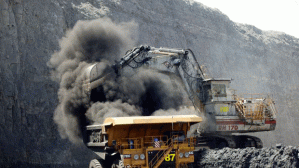
 Final chapter in Adani loan deal, Karen Middleton , Saturday Paper, 24 June 17, While the dealings of the government’s Northern Australia Infrastructure Facility remain shrouded in secrecy, pressure mounts over funding for the Adani rail line. “…….Among those addressing the annual Developing Northern Australia conference, held this year in Cairns, was Sharon Warburton, the chairwoman of the somewhat opaque Northern Australia Infrastructure Facility, known as the NAIF.
The NAIF is a $5 billion-government-owned lender, set up to make concessionary loans to companies planning infrastructure projects in northern Australia that are of demonstrated public benefit and would not otherwise be able to proceed…..
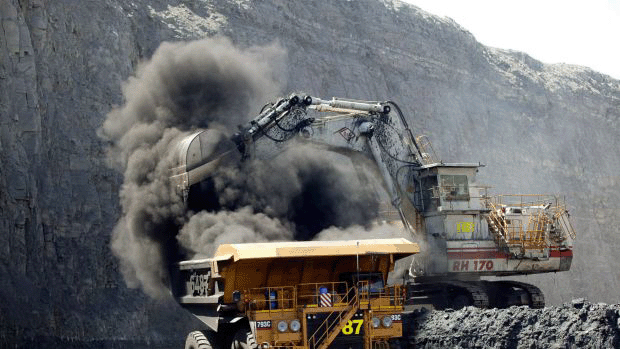
The NAIF has not yet lent any money. But Warburton is hinting that it’s close to a decision on at least one application, the one that’s attracted the most controversy and has become an open secret: the request from Indian mining conglomerate Adani for $1 billion to fund a railway line to support its proposed Carmichael coalmine in Queensland’s Galilee Basin.
“We know there is a lot of interest in NAIF and the Adani rail project,” Warburton told the conference on Monday. “I can confirm we are in our due diligence phase on that project.”
That translates as the final stage of assessment, with three other applications apparently also reaching finality. But, Warburton said, she could not say any more about Adani than that…..
Greens senator Larissa Waters said clean coal was “a lie”.
“This is straight from the big tobacco playbook,” Waters said. “Remember ‘light’ cigarettes? To meet the commitment under the Paris Agreement to keep global warming to safe levels, we need to reach zero pollution in the electricity sector transitioning away from coal. Building more coal-fired power stations is simply incompatible with the science.”
Environmental activists continue to mount a strenuous campaign against any kind of coal-fired power and the Adani mine development in particular, on the grounds that it represents an investment in a backwards-looking energy source that will add to Australia’s greenhouse gas emissions and damage the Great Barrier Reef…….
The company has sent mixed messages on whether it needs the NAIF loan to proceed, initially saying it wasn’t essential and then saying it was, a distinction crucial to NAIF’s considerations.
Details of any NAIF decision will only be published after it has been finalised and within 30 days of being taken.
Larissa Waters and Labor senator Murray Watt succeeded last week in establishing a senate inquiry into the NAIF, and Waters is pushing to have Adani called before it.
In recent senate budget estimates committee hearings, Labor and the Greens attempted to extract information on the status of the NAIF’s deliberations in general and the fate of Adani’s bid in particular.
As part of its processes, the NAIF must consult with Infrastructure Australia on projects it proposes to fund.
Greens leader Richard Di Natale asked Infrastructure Australia chief executive Philip Davies whether it had received a submission on the Adani rail line, as per the requirement that it must assess all projects seeking more than $100 million.
Davies said it had not…..
….NAIF director Karla Way-McPhail, who is chief executive of two companies that service the mining industry.
Minister Matt Canavan confirmed to a senate estimates hearing this month that Way-McPhail, who has spoken out in support of opening up the Galilee, was a friend whom he had recommended for the board…..
NAIF chief executive Laurie Walker declined to tell the senate estimates committee whether Way-McPhail or any other NAIF director had recused themselves from any discussions on the grounds of a potential conflict of interest. Walker said that was “not information that I think is appropriate to disclose”.
She said more than six conflicts had been declared…..
The Greens’ main focus has been on the suitability of the loan applicant rather than the assessors.
Larissa Waters wants the government to insert a “suitable person” test into the NAIF’s process for assessing loan bids, arguing she believes it would rule out Adani.
The Greens also want the environmental history test strengthened within environmental law and are calling for Adani’s approvals for the Carmichael project to be reviewed on the basis of “revelations about their environmental and corporate history” in activities overseas.
Waters has produced a private member’s bill to reflect the concerns but the government is not obliged to bring it forward for a vote……
despite Adani having announced with flourish recently that it had taken the final decision to proceed, others argue there are still obstacles to be cleared.
Tim Buckley, a director at the Institute for Energy Economics and Financial Analysis, believes it is not viable without massive taxpayer subsidies.
“The green light that Adani made such a fuss about a couple of weeks ago was actually just a sham,” Buckley told The Saturday Paper.
He has written a paper suggesting “defer, delay and pray” appear to be the company’s unspoken watchwords……despite Adani having announced with flourish recently that it had taken the final decision to proceed, others argue there are still obstacles to be cleared….https://www.thesaturdaypaper.com.au/news/economy/2017/06/24/final-chapter-adani-loan-deal/14982264004830
June 28, 2017
Posted by Christina Macpherson |
AUSTRALIA - NATIONAL, climate change - global warming, politics, Queensland |
Leave a comment
UNESCO warns climate change means time is running out for World Heritage Great Barrier Reef http://www.couriermail.com.au/news/queensland/unesco-warns-climate-change-means-time-is-running-out-for-world-heritage-great-barrier-reef/news-story/4765a338156dd9e5b9b2c1d2b357d655?nk=ba26857f63080120cbd5fc74c94d3959-1498465693, Daryl Passmore, The Courier-Mail, June 25, 2017
THE Great Barrier Reef will be dead by the end of this century without a reduction in greenhouse gas emissions, a world-first study warns.
The threat to Australia’s natural wonder is detailed in the first global assessment of climate change impacts on coral, released yesterday by the United Nations Educational, Scientific and Cultural Organisation (UNESCO).
It comes just a month before the World Heritage Committee meets in Poland to consider the condition of the Great Barrier Reef and the effectiveness of a management plan introduced by the Queensland and federal governments to protect it.
“Soaring ocean temperatures in the past three years have subjected 21 of 29 World Heritage reefs to severe and/or repeated heat stress, and caused some of the worst bleaching ever observed at iconic sites like the Great Barrier Reef,’’ it says.
“The analysis predicts that all 29 coral-containing World Heritage sites would cease to exist as functioning coral reef ecosystems by the end of this century under a business-as-usual emissions scenario.”
The report calls on all countries with World Heritage coral reefs to act to reduce net greenhouse emissions to zero in order to save them.
On current trends, the assessment predicts, global warming will increase by 4.3C by 2100.
Under that scenario, the Great Barrier Reef would suffer severe coral bleaching twice a decade by 2035 – “a frequency that will rapidly kill most corals present and prevent successful reproduction necessary for recovery of corals.’’
The diversity of life on reefs has led to them being been dubbed the “rainforests of the sea”. Covering less than 0.1 per cent of the ocean floor, they host more than a quarter of all marine fish species.
Australian Marine Conservation Society spokeswoman Imogen Zethoven said the Great Barrier Reef and other World Heritage reefs were in grave danger from climate change, mainly driven by the burning of coal.
“Yet the Australian government appears hell-bent on making the problem worse by pushing ahead with Adani’s monstrous coal mine (planned for central Queensland), talking up a coal-fired power station next to the Great barrier Reef and failing to do its fair share of global pollution reduction,” she said.
“The Australian government is not only placing our Great Barrier Reef and the 70,000 jobs that depend on it at grave risk, it is endangering the future of World Heritage coral reefs around the world,” Ms Zethoven said.
“The majority of Australians believe the state of our reef is a national emergency, but the Australian government doesn’t care.”
June 26, 2017
Posted by Christina Macpherson |
climate change - global warming, environment, Queensland |
Leave a comment
Great Barrier Reef ‘too big to fail’ at $56b, Deloitte Access Economics report says http://www.abc.net.au/news/2017-06-26/great-barrier-reef-valued-56b-deloitte/8649936, By Louisa Rebgetz The Great Barrier Reef has a total asset value of $56 billion and is “too big to fail”, according to a new report.
Key points:
- Deloitte Access Economics says GBR has calculated economic, social and iconic value of $56 billion
- Tourism is the biggest contributor to the total asset value making up $29 billion
- But tourist figures are down 50 per cent in the Whitsundays — operators say “this is as bad as it was during the GFC”
Deloitte Access Economics has calculated the economic, social and iconic value of the world heritage site in a report commissioned by the Great Barrier Reef Foundation.
Tourism is the biggest contributor to the total asset value making up $29 billion.
The Great Barrier Reef generates 64,000 jobs in Australia and contributes $6.4 billion dollars to the national economy, the report said.
It states the brand value, or Australians that have not yet visited the Reef but value knowing it exists, as $24 billion.
Recreational users including divers and boaters make up $3 billion.
The report does not include quantified estimates of the value traditional owners place on the Great Barrier Reef and it said governments should consider doing more to protect it.
Climate change remains biggest threat
It also references the back to back coral bleaching events which have devastated the reef and says climate change remains the most serious threat to the entire structure.
“We have already lost around 50 per cent of the corals on the GBR in the last 30 years. Severe changes in the ocean will see a continued decline ahead of us,” the report states.
“Today, our Reef is under threat like never before. Two consecutive years of global coral bleaching are unprecedented, while increasingly frequent extreme weather events and water quality issues continue to affect reef health,” said Dr John Schubert AO, Chair of the Great Barrier Reef Foundation.
Association of Marine Park Tourism Operators executive director Col McKenzie said the reef is crucial to the industry.
“We don’t have an industry without the Barrier Reef being in good condition.”
He said the negative coverage of the reef relating to the destruction caused by Cyclone Debbie earlier this year and the bleaching event is having an impact on visitor numbers.
Mr McKenzie said tourist figures are down 50 per cent in the Whitsundays and it is being felt along the Queensland coast.
June 26, 2017
Posted by Christina Macpherson |
business, climate change - global warming, Queensland |
Leave a comment
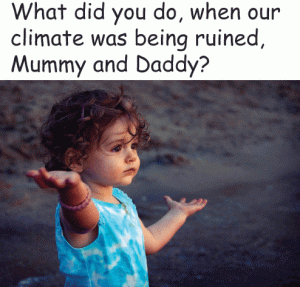 Climate forces consolidate as coal backers rush for government help http://www.theage.com.au/federal-politics/political-news/climate-forces-consolidate-as-coal-backers-rush-for-government-help-20170623-gwx3qy.html, Mark Kenny 22 June 17 Forces on the green-energy side are positioning for a renewed climate change debate in coming months, as the Turnbull government struggles to convince internal dissenters of the need for tougher carbon reduction measures.
The nation’s preeminent advocate of strong laws against carbon emissions, the Climate Institute, will close its doors on June 30 after a dozen years in operation, and transfer its assets and intellectual property to high-profile progressive think tank the Australia Institute.
The financial terms of the new arrangement have been kept confidential.
As the recipient body, the economically-oriented Australia Institute will in turn establish a dedicated “Climate and Energy Program” with the aim of stepping up the public pressure on lawmakers to meet Australia’s obligations under the Paris Accord.
It comes as some opponents of renewable-energy subsidies have called for the government to directly finance investment in coal-fired power.
Its final annual survey of community attitudes to climate change will be released within days. “At a time when climate sceptics are revealing themselves to be economic sceptics, it is significant that there is a coming together of a key Australian economic think tank and a leading climate organisation,” said the Australia Institute’s executive director, Ben Oquist.
“As capital increasingly seeks out clean-energy projects with a long and sustainable future, the lions of the free market have become lambs of largesse, so desperate to keep coal going they’d have taxpayers carry an unconscionable risk which is both financial and environmental” he said.
Climate Institute chairman Mark Wootton said the Australia Institute had been selected from a shortlist of strong candidates.
“Its expanded role in the climate change debate comes at a pivotal moment for policy development, economic transformation, and public expectations,” he said.
Chief Scientist Alan Finkel this week told the National Press Club that investors tended to favour new projects in wind and solar over coal because they could be started small and then scaled up as demand rises. His clean energy target proposal is now mired in internal government debate as conservative MPs push for the CET model to be skewed to allow for the subsidisation of new coal generators, or old generators retro-fitted with carbon capture and storage, to qualify for partial clean energy certificates.
Under pressure to reverse rising household electricity prices – driven largely by a scarcity value on local gas – the government has announced plans to mandate reserves for domestic access ahead of export sales – even where that gas is already contracted.
That has raised eyebrows with private capital markets wary of new sovereign risks caused by changing government policy.
The government has also left open the possibility of directly financing new generation coal-fired power, given the absence of private sector investors.
June 23, 2017
Posted by Christina Macpherson |
AUSTRALIA - NATIONAL, climate change - global warming |
Leave a comment
 Australia, deep in climate change’s ‘disaster alley’, shirks its moral responsibility http://www.smh.com.au/comment/australia-deep-in-climate-changes-disaster-alley-shirks-its-moral-responsibility-20170621-gwvhs6.html Ian Dunlop,
A government’s first responsibility is to safeguard the people and their future well-being. The ability to do this is threatened by human-induced climate change, the accelerating effects of which are driving political instability and conflict globally. Climate change poses an existential risk to humanity that, unless addressed as an emergency, will have catastrophic consequences.
In military terms, Australia and the adjacent Asia-Pacific region is considered to be “disaster alley”, where the most extreme effects are being experienced. Australia’s leaders either misunderstand or wilfully ignore these risks, which is a profound failure of imagination, far worse than that which triggered the global financial crisis in 2008. Existential risk cannot be managed with conventional, reactive, learn-from-failure techniques. We only play this game once, so we must get it right first time.
This should mean an honest, objective look at the real risks to which we are exposed, guarding especially against more extreme possibilities that would have consequences damaging beyond quantification, and which human civilisation as we know it would be lucky to survive.
Instead, the climate and energy policies that successive Australian governments adopted over the last 20 years, driven largely by ideology and corporate fossil-fuel interests, deliberately refused to acknowledge this existential threat, as the shouting match over the wholly inadequate reforms the Finkel review proposes demonstrates too well. There is overwhelming evidence that we have badly underestimated both the speed and extent of climate change’s effects. In such circumstances, to ignore this threat is a fundamental breach of the responsibility that the community entrusts to political, bureaucratic and corporate leaders. Continue reading →
June 23, 2017
Posted by Christina Macpherson |
AUSTRALIA - NATIONAL, climate change - global warming |
1 Comment
 Australia warned it has radically underestimated climate change security threat
Senate inquiry starts as report into political, military and humanitarian risks of climate change across Asia Pacific released, Guardian, Ben Doherty 21 June 17, As the Senate launches an inquiry into the national security ramifications of climate change, a new report has warned global warming will cause increasingly regular and severe humanitarian crises across the Asia-Pacific.
Disaster Alley, written by the Breakthrough Centre for Climate Restoration, forecasts climate change could potentially displace tens of millions from swamped cities, drive fragile states to failure, cause intractable political instability, and spark military conflict.
Report co-author Ian Dunlop argues Australia’s political and corporate leaders, by refusing to accept the need for urgent climate action now, are “putting the Australian community in extreme danger”. Continue reading →
June 21, 2017
Posted by Christina Macpherson |
AUSTRALIA - NATIONAL, climate change - global warming |
Leave a comment
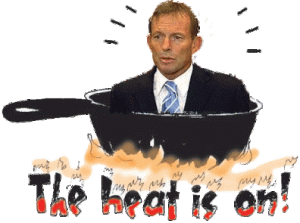 Tony Abbott: Concetta Fierravanti-Wells challenges former PM on climate policy ‘about-face’ ABC News, PM 20 June 17 By political reporter Tom Iggulden, Former prime minister Tony Abbott is being accused of damaging Australia’s international reputation and his own political credibility in another outbreak of internal coalition infighting.
Key points:
- Prime ministers are judged on what they’ve done when in government, Concetta Fierravanti-Wells says
- Criticism follows Tony Abbott’s comment his Paris Agreement targets were “aspirational”
- She calls on Mr Abbott to reflect on his actions for the good of the party
International Development Minister Concetta Fierravanti-Wells, once seen as an ally of Mr Abbott’s, says he has performed a “total about-face” on climate policy that is threatening to turn off investors.
“Credibility is a very important commodity in politics,” she told PM.
“Any former prime minister will be judged on what they’ve actually done when they were in government, not on what they say they should have done or could have done subsequently.”
The criticism follows Mr Abbott’s assertion last week that the Paris Climate Agreement targets he devised as prime minister in 2015 were “aspirational”.
Senator Fierravanti-Wells pointed to “categoric” comments Mr Abbott made in 2015 when he announced the “pledge” to reduce emissions by 26 to 28 per cent by 2030…….http://www.abc.net.au/news/2017-06-19/abbott-shows-about-face-in-climate-policy:-fierravanti-wells/8631956
June 21, 2017
Posted by Christina Macpherson |
AUSTRALIA - NATIONAL, climate change - global warming, politics |
Leave a comment
 Who are the Liberal MPs worried about Turnbull’s Clean Energy Target?, Crikey.com, 16 June 17 Crikey intern Will Ziebell looks back over past public comments to work out which MPs could end up dissenting. Various media outlets reported this week that at least 22 Coalition MPs spent Tuesday’s joint party room meeting voicing their concern about the proposed Clean Energy Target.
With the numbers supposedly evenly divided between the Liberals and the Nationals, it’s worth taking note of exactly who among the Liberals is on the record as being BFFs with coal. So here are the defenders of coal, in their own words:
Tony Abbott The former PM is still ardently attached to the rock he’s described as good for humanity…….Kevin Andrews……Ian Macdonald…….Craig Kelly……Andrew Hastie……Chris Back…..Rowan Ramsey…….Russell Broadbent……Angus Taylor……Tony Pasin……https://www.crikey.com.au/2017/06/16/who-are-the-liberal-mps-worried-about-malcolm-turnbulls-clean-energy-target/
June 19, 2017
Posted by Christina Macpherson |
AUSTRALIA - NATIONAL, climate change - global warming, politics |
Leave a comment
 Five ways to improve Finkel’s energy blueprint http://reneweconomy.com.au/five-ways-to-improve-finkels-energy-blueprint-60985/ By Giles Parkinson on 13 June 2017 [good graphs]
First thing first, this scheme won’t amount to a hill of beans unless the Paris climate targets are adopted, and that does not mean the modest down-payment from the Coalition on which this blueprint is modelled, but a serious attempt to deliver on the pledge to limit average global warming to well below 2°C.
Quite why the chief scientist didn’t choose to make much of the chief science questions is a bit of a mystery, but he did underline the importance of bipartisan and federal and state agreement on this. The reaction, to date, shows this is as difficult now as it was when the climate-denying, fossil fuel-backing Coalition hard right thrust Tony Abbott to the head of the party in 2009.
Can we see some modelling please? The actual energy blueprint is vague on details. Some results of the modelling are shown, such as the modest fall in consumer bills (above), and the lingering presence of coal-fired generation in 2050 (25 per cent).
But the inputs are not revealed, neither are comparisons with other options, or how they are stress-tested with a 2°C target. Most consumer watchdogs would warn against buying something with so little information, and no warranties, but that is – in effect – what we are being asked to do. Or, at least, may be what the Coalition back bench is being asked to do.
Don’t leave the clean energy target mechanism in the hands of the gentailers. We saw what happened with the renewable energy target, as the big gentailers fought to have the target cut, then went on a capital strike, and then cashed in as the prices for renewable energy certificates were pushed to their penalty level.
The gentailers have too many vested interests to protect, so a better and more efficient mechanism would be for a new authority to auction capacity at various points along the target. This has been used very effectively across the world, and at state level too. It gets a good price and avoids the market being held to ransom.
Be smarter about energy storage. There is no doubt that many solar plants, and wind farms, will be happy to add battery storage to their installations, and Finkel’s report acknowledges that these combinations will beat either gas or coal on both costs and emissions. But Finkel’s proposed obligation for ALL new wind and solar plants to have storage seems like regulatory overkill, adding unnecessarily to prices.
Only in South Australia has the penetration of wind and solar reached a level where storage is now required, according to the CSIRO, which suggests that anything under 40 per cent wind and solar is “trivial” to the management of the grid (presuming the grid managers are on top of their brief). So making a no-argue requirement now seems overkill, and the approach of the Victoria and Queensland state governments – calling for bids for cheapest storage – as they roll out more wind and solar seems more sensible.
Make this transition quicker, smarter, cleaner. As we noted last week, this is not Grid 2.0, it’s actually not a whole lot different from business as usual. This review was an opportunity to redefine those boundaries, but comes up short, mainly because it does not focus enough on the implications and the benefits of all the solar and storage added behind the meter by households and businesses. The CSIRO estimates $200 billion will be spent by consumers over the next three decades.
They will want to know that this investment is worth it, and they are not locked in to a utility business model that has failed to evolve, and continues to impose costs on consumers. Indeed, half of their bills comes from the transport of electricity, which means that even if the wholesale component was free, it could not match the cost of solar and storage. Which does not mean, for a moment, that everything would go off the grid, or should; but unless there is some regulatory recognition that technology changes and costs are moving fast, then they will simply not be prepared to deal with it.
And let’s not forget, all consumers will be wanting more than $90 savings a year over the next decade after seeing their bills going up $300 a year. That’s one step forward and three steps back. There is simply no reason why more savings cannot be delivered, given the falling cost of wind, solar and storage.
June 14, 2017
Posted by Christina Macpherson |
AUSTRALIA - NATIONAL, climate change - global warming, energy, politics |
Leave a comment
The problem is that Langton’s argument boils down to mining, good, anything that stands in its way, bad. That’s why it falls apart when faced with Adani’s proposed coal mine in the Galilee Basin, slap-bang in the middle of which is Wangan and Jagalingou country.
Adani’s proposed mine has become the Coalition’s cargo cult and its free-marketeer ministers have happily ditched their principles to promote it, fund it and change laws (including the Native Title Act) to try and force it to happen.
For this treatment to come from a non-Aboriginal person would be suspect, but for it to come from a fellow Indigenous Australian is surely unforgivable.
 Why Marcia Langton is wrong on Adani https://independentaustralia.net/business/business-display/why-marcia-langton-is-wrong-on-adani,10396 Tom Allen 13 June 2017 For all her powerful and peerless leadership of Aboriginal rights, Professor Marcia Langton has it wrong on Adani.
Her speech to the Minerals Council of Australia (MCA) last week made headlines because she provocatively accused environmentalists of wanting to send Aboriginal Australians back to terra nullius. That’s simply wrong. But perhaps just as bad is the fact that, just as the #StopAdani campaign is gearing up, Ms Langton was shilling for Big Coal. Continue reading →
June 14, 2017
Posted by Christina Macpherson |
aboriginal issues, AUSTRALIA - NATIONAL, climate change - global warming |
Leave a comment
As Adani continues to find multiple reasons to delay progress on Carmichael, one might argue that perhaps it is looking to holdbacks on a hoped-for string of royalty/loan/water subsidies as the excuse it needs to withdraw from the project.
 Adani’s ‘pit-to-plug strategy’ is fraying at both ends http://reneweconomy.com.au/adanis-pit-plug-strategy-fraying-ends-86291/ By Tim Buckley on 13 June 2017 Gautam Adani, the chairman of the Indian conglomerate Adani Group, has long argued that the Carmichael coal proposal in the Galilee Basin of Australia is a key part of his company’s “integrated pit-to-plug strategy.”
The Adani logic for the Carmichael project assumes that the traded price of seaborne thermal coal is irrelevant to the commercial viability of Carmichael because the coal would be used within the Adani family group of companies.
The company line is that Carmichael venture needs to be viewed, in other words, strictly in the context of the overall profitability of the pit-to-plug strategy.
IEEFA sees Carmichael as both
unviable and unbankable if it is tied to actual coal markets (with the forward price of
thermal coal back down to US$66/t), which is why the pit-to-plug strategy Adani talks up is the linchpin said to be holding the proposal together.
It’s a shaky foundation on which to proceed, however. Last week Adani Power reported that its core asset —the 4.6 GW 100 percent import-coal-fired power plant at Mundra—is no longer viable, news that brings what was an already questionable argument for Carmichael into further question.
In IEEFA’s view, any decision to walk away from Carmichael would require a A$1.4 billion (US$1.05billion) write-off for Adani Enterprises (AEL), a very unpalatable outcome for Adani Group bankers owed a collective US$15 billion, particularly if Adani Power (APL) were forced to also take a US$1 billion write-down on Mundra on top of the US$954 million net loss just reported.
- Adani Power’s financial distress is growing, which is why it has just recorded that US $954 million loss, Continue reading →
June 14, 2017
Posted by Christina Macpherson |
climate change - global warming, Queensland |
Leave a comment
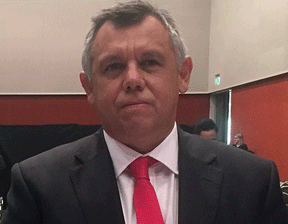 Leading Indigenous lawyer hits back at Marcia Langton over Adani Tony McAvoy says traditional owners are ‘proud and independent’ and are not being used by anti-mining activists to block the $16bn mine, Guardian, Joshua Robertson, 9 June 17, One of Australia’s leading native title lawyers has spoken publicly for the first time as a traditional owner fighting to stop the Adani mine, a campaign he said was driven by “proud and independent people” who were among the best-informed Indigenous litigants in the country.
Tony McAvoy SC, who became Australia’s first Indigenous silk in 2015, said the Wangan and Jagalingou people were keenly aware of how their priorities differed from environmentalist allies in a battle to preserve their Queensland country from one of the world’s largest proposed coalmines.
McAvoy dismissed claims by the prominent Indigenous academic Marcia Langton that Indigenous people had become “collateral damage” as the “environmental industry” hijacked the Adani issue.
He said the rhetoric of Langton and Warren Mundine, who likened anti-Adani campaigners to colonial oppressors running roughshod over Indigenous self-determination, “serves a purpose for them but is just so inaccurate”.
The barrister said to suggest that “the greens are puppet masters pulling the strings and we’re somehow puppets” was wildly off the mark and disrespectful to the many families opposing the mine, including his.
The W&J are the only Indigenous group in Australia to have, in McAvoy, a senior counsel with expertise in native title law within their ranks.
“We are likely to be one of the best informed claimant groups in the country, we have many people who are experienced in native title, including my own input, and representation by an extraordinary team of lawyers,” he said.
McAvoy is part of a contingent within W&J who have mounted legal challenges to an Indigenous land use agreement (Ilua) with Adani, contesting the right of pro-Adani representatives to approve a deal previously spurned by their claim group. The miner resurrected an Ilua last year with majority support in the W&J native title applicant, then sought to register it with the native title tribunal.
But the W&J opponents challenged the deal in the federal court, on grounds including that the pro-Adani applicant members were voted out in a claim group meeting, and that a rival meeting that endorsed the Adani deal was not legitimate.
Then Adani’s hopes suffered a blow with the McGlade native title case, which found that an Ilua was invalid because not all Indigenous representatives had signed it.
The shock precedent prompted the government to put up a bill changing native title legislation to safeguard what it argued were hundreds of Iluas thrown into doubt because they had a majority but not all the signatures of claimants.
The bill also contains amendments that would pave the way for Adani’s unregistered, contested Ilua.
Langton lashed out at Greens and environmentalists on Wednesday for delaying the government’s bill “in order to bolster their campaign against the Adani project”……….
McAvoy said Langton was “very poorly informed” on the Adani issue.
He and a swathe of the W&J argue there should be no rush to pass law changes dealing with critical issues around Indigenous property rights through future land access deals.
McAvoy argues for “splitting the bill” to validate Iluas already registered with the National Native Title Tribunal, but not those unregistered, such as Adani’s. McAvoy said he hoped this proposal would find favour with Labor and crossbench senators, with the bill due for voting as early as next week.
The W&J objectors were open about the fact that “we have an alliance between our objectives [and those of environmentalists] so that we can make use of each other and we do that”, he said.
But the group raises its own funds for its legal challenges.
“And more than that, we are very, very aware that our interests of preserving our country are not entirely aligned with the green interests,” he said……..
A land access deal is crucial to Adani gaining finance for the mine, initially needing $3.3bn.
The miner last week cited the end of this year as its deadline for finance. But the federal court this week signalled a trial to decide the fate of Adani’s deal with the W&J would take place in March 2018.
McAvoy said that even if the Senate “amends the Native Title Act in the way proposed [by the government], that proceeding is still to run its course”. https://www.theguardian.com/environment/2017/jun/09/leading-indigenous-lawyer-hits-back-at-marcia-langton-over-adani
June 11, 2017
Posted by Christina Macpherson |
aboriginal issues, AUSTRALIA - NATIONAL, climate change - global warming, politics |
Leave a comment
Not that it was in writing. The only assurance Queenslanders truly had was a photo of a handshake. The premier ought to have stopped there, but she kept going.
For a premier under pressure to create jobs in a state with a population of 4.6 million, of whom more than 160,000 were unemployed in May this year, supporting a coalmine that will see job losses from elsewhere seems a serious folly.
 the myriad companies that make up the Adani conglomerate make it nearly impossible to follow the money. What tax on profits will be paid in Australia? How much will be siphoned off to Adani’s “marketing hub” in Singapore and the Adani family company in the Cayman Islands?
Revealed: Gautam Adani’s coal play in the state facing global-warming hell The extraction of mammoth coal deposits in Queensland’s Galilee Basin will only exacerbate climate change. Who supports the mines – and why? The Age, Anna Krien, 9 June 17 “…….
It was December 2016 when Gautam Adani flew into Townsville to meet Queensland Premier Annastacia Palaszczuk and the city’s mayor, Jenny Hill. Yes, there was some animosity: a couple of hundred people gathered on the foreshore to protest against Adani’s proposed coal mega-mine, and two native-title owners, Carol Prior and Ken Dodd, were also on his trail.
But for the nation’s kingmakers, Adani may as well be Midas. That very morning he had nipped down to Melbourne to meet Prime Minister Malcolm Turnbull to discuss the Coalition’s “conditional” offer to chip in a $1 billion loan to his project. After the meeting in the Townsville City Council chambers, there was the obligatory handshake photo with the Queensland premier, and then he was gone – a “fly-in, fly-out” billionaire.
Continue reading →
June 11, 2017
Posted by Christina Macpherson |
climate change - global warming, employment, Queensland |
Leave a comment
 Alan Finkel’s emissions target breaks Australia’s Paris commitments Chief scientist’s report flies in the face of previous recommendations on reducing electricity emissions, Guardian, Michael Slezak, Friday 9 June 2017
Less than two weeks ago, Alan Finkel told the Senate his landmark report would help Australia meet the commitments it made in Paris to reduce its economy-wide emissions by 28% below 2005 levels by 2030.
But his recommendations on the future of the National Electricity Market, released today, appear to fly in the face of those very commitments. Before Senate estimates Finkel said: “We are very cognisant of the commitment that the nation has made through the Paris accords.
“We absolutely need to deal with the issue of ensuring that the electricity sector can do its fair share in helping the nation to meet its obligations under the Paris accord – the COP21 accord.”
Now today, his landmark review of the National Electricity Market has modelled cuts to emissions of the electricity sector that are the same as what the entire economy needs to do: 28% below 2005 levels by 2050. He said anything deeper, which had been suggested in other reports, would cause problems.
But what is the electricity sector’s fair share?
Well it’s a lot more than that recommended by Finkel’s report.
How do we know it needs to be higher? We can look at a report from the Climate Change Authority, that Finkel himself co-wrote, that examined how much the electricity sector needed to do.
After examining several scenarios for meeting Australia’s emissions reduction targets, it concluded: “The common finding is that the electricity sector can contribute deep, cost-effective emissions reductions as part of national action to meet global temperature goals.”
The electricity sector has to do much of the heavy lifting for several reasons.
- it’s the biggest source of carbon emissions – producing more than a third of the country’s total.
- many other industries can’t easily reduce emissions – it’s very hard to reduce the emissions from the agriculture sector, for example.
- decarbonising the electricity sector will help other sectors decarbonise – for example, if cars stop using petrol and shift to electricity, we will need the electricity system to be low-emissions in order to see an actual reduction in emissions.
That last point was made by the Climate Change Authority report. “Substantial decarbonisation of electricity supply can facilitate emissions reductions in other sectors, as electricity can displace their direct use of fossil fuels,” it said.
But in his report today, Finkel said any deeper cuts could be problematic. “The adoption of a more ambitious target would have larger consequences for energy security as such a target would likely see a higher level of [variable renewable energy] incentivised,” Finkel wrote.
Bill Hare, the a leading climate scientist and CEO at Climate Analytics has spent a lot of time modelling precisely this issue
“From a scientific perspective this is quite shocking because the almost universal consensus from the modelling exercises for how to achieve the Paris agreement has the power sector doing a lot more than the rest of the economy everywhere in the world,” Hare said.
“I think this conclusion appears to have been crafted to fit with the politics of the present government rather than the science and understanding of these systems,” he said.
Hare said he doesn’t know of any work globally that supports Finkel’s claim that deeper cuts to emissions will put the system’s reliability or security at risk.
Dylan McConnell from Melbourne University said an additional problem with having shallow cuts in emissions in the electricity sector, was that it was the cheapest place to make the cuts – so the overall cost to the economy of meeting our Paris commitments will be more expensive…….https://www.theguardian.com/environment/2017/jun/09/alan-finkels-emissions-target-breaks-australias-paris-commitments
June 9, 2017
Posted by Christina Macpherson |
AUSTRALIA - NATIONAL, climate change - global warming, energy |
Leave a comment
Low emissions target: On carbon schemes, no one says the same thing for long http://www.smh.com.au/comment/low-emissions-target-on-emissions-schemes-no-one-says-the-same-thing-for-long-20170606-gwl8b0.html 8 June 17
 Peter Martin If you don’t know the difference between a carbon tax and an emissions trading scheme, or a low emissions target and an emissions intensity scheme, it’s time to wise up.
On Friday Malcolm Turnbull gets the report of the Finkel review of the electricity market and later this year the report of the official review of his government’s climate change policies.
What he does next will affect how much we pay, how much we use, the types of electricity we use, how quickly we cut emissions and how often the system breaks down.
But if we don’t even know what the words mean, we’ll be in the dark So here’s a quick (opinionated) guide. And a warning: no one seems to say the same thing for long.
Carbon tax: It had the advantage of being simple, so simple that Tony Abbott actually backed it in his early days as opposition leader before reversing course and opposing it, and being swept to power.
“If you want to put a price on carbon, why not just do it with a simple tax?” he asked back then. “It would be burdensome, all taxes are burdensome, but it could certainly raise the price of carbon, without in any way increasing the overall tax burden.”
It’s what Julia Gillard did, and was martyred for. Exemptions from the tax and overcompensation in the form of income tax cuts and direct payments meant every cent it raised was handed back. And it cut emissions. Each year for more than a century through two world wars and the great depression Australia had used more electricity than the year before, until the lead-up to the carbon tax when both electricity use and electricity emissions began to fall and then fell sharply until mid-2014 when the tax was abolished by Abbott himself.
Turnbull gets the argument for the tax. “If you want people to do less of something, you tax it,” was how he described another measure during the 2016 election campaign.
Emissions trading scheme: It’s like a carbon tax (in fact, the carbon tax was designed to transition into one) except that it uses carrots as well as sticks. The government issues a limited number of pollution permits, but then leaves the polluters free to buy and sell them from each other. If one manages to cut emissions easily and no longer needs its permits it can sell them to another who needs them more, perhaps for a profit. It means the market sets the price of the permits, and the price is no higher than it needs to be.
US President George H. W. Bush issued tradeable sulphur dioxide pollution permits to cheaply halve the incidence of acid rain. In his last days in office John Howard promised to use tradeable permits to cheaply meet Australia’s carbon emission reduction obligations. Kevin Rudd got to work on the details with the then opposition leader Malcolm Turnbull, then Turnbull was rolled, the Greens said no, and Rudd baulked at taking the plan to an election. It would be painted as a big new tax. Voters would remember the electricity price hike but not the compensating tax cut, as Gillard later discovered.
Emissions intensity scheme: Long championed by Turnbull and independent Nick Xenophon and Greg Hunt as environment minister, an intensity trading scheme would have the advantage of raising no money whatsoever, and not pushing up prices much. Each industry would be given a “baseline” for its emissions intensity. For the electricity industry it would be a certain number of tonnes emitted per megawatt-hour produced. Plants that were above the baseline would have to buy permits from plants that were below it. As a result coal-fired plants would become more expensive to run and get less business, and gas and wind-powered plants would become cheaper and get more. All without anything that looked like a tax.
Critics say it would give gas a leg-up when what’s needed is to move straight to renewables. This year Turnbull ruled it out partly because it could be presented as the emissions trading scheme he promised not to introduce. The real downside is that it wouldn’t be an emissions trading scheme. By not moving prices much, it would do little to reduce electricity demand, working only on the sources of supply.
Low emissions target: Described by the Climate Change Authority as a second-best alternative to its preferred option of an intensity scheme, a low emissions target would operate pretty much in the same way as the current renewable energy target. Electricity suppliers would be required to source a certain proportion of their power from renewables or other very low emission sources such as highly-efficient gas or even coal plants, should they ever be built.
Its biggest drawback is that if it’s all there is, there’s no guarantee it won’t change. The government might be lobbied to weaken it (making lobbying a very cost-effective proposition) or another government might impose a grander scheme on top of it. Potential investors in new plants might be forgiven for holding back. Given the dizzying array of changes since Howard first proposed an emissions trading scheme 10 years ago, it would be hard to blame them.
Peter Martin is economics editor of The Age.
Follow Peter Martin on Twitter and Facebook
June 9, 2017
Posted by Christina Macpherson |
AUSTRALIA - NATIONAL, climate change - global warming, energy |
Leave a comment