Senate Committee Report recommends market-based carbon trading scheme, but shows idealogical divisions between political parties
Senate inquiry sparks ideological fight over Australia’s energy supply and climate change, ABC News, By political reporter Angelique Donnellan, 10 Apr 17, A Senate inquiry report into Australia’s electricity supplies has descended into a slanging match between members, prompting questions about its value for taxpayers.
The Select Committee into the Resilience of Australia’s Electricity Infrastructure in a Warming World heard from 60 witnesses in Adelaide, Canberra and Melbourne, including major energy generators, retailers and industry regulators.
But in the committee’s draft report released today, Federal Greens senator and chairwoman Sarah Hanson-Young took aim at the Coalition and its policies.
“The introduction of a market-based carbon trading scheme would effectively end the decades-long subsidy that coal has received in the electricity generation market,” she said.
“Yet like the proverbial ostrich, the Coalition Government has buried its collective head in the coalmine and refuses to address in any meaningful way the crisis facing the nation.”
The committee had seven other members, including three Labor senators, two Liberal, One Nation and Nick Xenophon.
All dissented to Senator Hanson-Young’s draft report, with Coalition senators calling it biased, false, misleading and dismissive of coal as a generator for electricity…….
Senator Hanson-Young questioned the use of gas as a transition fuel and the need for more gas mining.
“The misplaced notion that coal seam gas could provide a solution to the gas shortage on Australia’s east coast displays a profound ignorance of how the market works,” she said.
“Any unconventional gas will surely find its way onto the export market.”http://www.abc.net.au/news/2017-04-10/coalition-senators-take-aim-at-senates-draft-electricity-report/8431790
Malcolm Turnbull, Marketing Man for Coal in India – despite the glut in India’s coal market
 Malcolm Turnbull talks up coal in Delhi, despite India’s aim to stop imports Glut in Indian coal market, plans to phase out imports and lower than forecast energy demands cast doubt on future for exports from proposed Adani mine, Guardian, Michael Safi , 11 Apr 17, Malcolm Turnbull is adamant that Australian coal will play “a very big role” in powering India’s future despite a glut in the local market and clear signals from Delhi that it aims to eliminate imports of the fossil fuel as soon as possible. ………..On Monday Turnbull met Gautam Adani, the mining magnate whose company will soon decide whether to begin building the world’s largest coalmine in Queensland’s Galilee basin. Continue reading
Young Nationals split from party policy, now to back emissions trading
The motion taken by the Young Nats brings them into line with the National Farmers’ Federation, the Business Council of Australia, the Australian Industry Group and much of the energy sector, including the electricity transmission and distribution businesses
Young Nationals reject federal party policy to back emissions trading, The Age, Heath Aston , 10 Apr 17, The Young Nationals have split with the senior ranks of the party, voting to support the introduction of a carbon trading scheme. Continue reading
Turnbull in India, for talks with Mr Adani, who will press him for $900 funding for coal project
Adani to press Turnbull on $900m boost during visit , THE AUSTRALIAN, DAVID CROWE, Political correspondent, Canberra, @CroweDM, 10 Apr 17, Malcolm Turnbull will be asked to seal a $900 million deal to clear the way for the mammoth Adani coal mine in central Queensland during his visit to India that also seeks to inject momentum into a trade deal between two countries.

The Prime Minister arrived in New Delhi last night for a three-day state visit that will include talks with his Indian counterpart Narendra Modi, meetings with business leaders and a focus on the country’s demand for energy.
The $21 billion coal project towers over other items on the agenda, with Adani pushing for action within months on financing agreements and regulatory hurdles. Its Carmichael mine is being opposed by green groups in the courts and on the ground.
“We’ll certainly be talking about the importance of energy exports to India,” Mr Turnbull said before flying to New Delhi from Port Moresby, where he concluded a two-day visit yesterday morning. “India has a massive program of expanding electrification across the country and Australian coal has a very big role to play in that.”
Adani founder Gautam Adani told Indian media last month the company was eligible for $900m from the Turnbull government’s Northern Australia Infrastructure Fund to build the rail line from the mine to the company’s port at Abbot Point.
The backing from the fund, which uses federal guarantees to finance commercial projects, will help Adani limit its equity contribution to the rail project to about $800m of a total investment of about $2.5bn in the next two years, with the rest coming from debt and the NAIF.
Queensland Premier Annastacia Palaszczuk met Mr Adani in Mumbai last month and announced most approvals had been concluded for the project. At the same function, Mr Adani said he expected final approval from the federal government by May.
Mr Turnbull is expected to see Mr Adani during the visit after meeting him at least twice, in November 2015 and December 2016, when the billionaire pushed for more help to get the mine open.
After the 2015 meeting, Mr Adani said he had pressed Mr Turnbull to legislate to stop environmental groups delaying the project in the courts. The Abbott government’s attempt to amend the Environmental Protection and Biodiversity Conservation Act to stop “vigilante” activists was stymied in the Senate a month before Mr Turnbull became Prime Minister.
Writing in The Australian today, Mr Turnbull emphasises the opportunities for Australia as the Indian economy grows, increasing demand for Australia….. http://www.theaustralian.com.au/national-affairs/foreign-affairs/adani-to-press-turnbull-on-900m-boost-during-visit/news-story/6beae575a49aacfad4d51eca3dfe0846
Farmers For Climate gives a voice for rural Australians
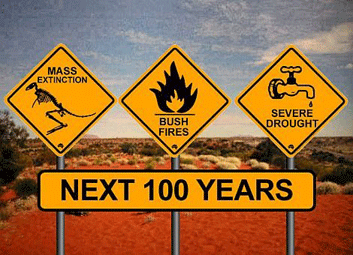 Farmers are leading way on climate change action, http://www.examiner.com.au/story/4582398/farmers-are-leading-way-on-climate-change-action/?cs=97 John Iser, 9 Apr 2017, It’s often assumed that farmers and regional communities aren’t concerned about climate change. Our state and federal politicians debate the issue with little thought of what’s happening in the country, despite agriculture being Australia’s most climate-exposed sector.
However, farmers are taking it upon themselves to bridge the divide. A new advocacy group called Farmers for Climate Action has formed to give a voice to those who are on the frontline of climate change. At the same time, the country’s peak farming body, the National Farmers’ Federation, has updated its thinking on the issue. It now recognises that climate change poses a significant challenge for Australian farmers. In fact, taking action offers many benefits for the millions who live in the country.
The practical solutions for farmers to reduce carbon emissions will advance innovation, and renewable energy developments create jobs.
Climate action is also crucial for land health and biodiversity, both of which affect the productivity of agriculture.
Farmers and rural communities also have a major influence on government decisions.
The Victorian government have just banned fracking after farmers vigorously voiced their concerns. The politicians recognised that mining of unconventional gas puts the quality of farmland and its water at risk, as well as the health of people and animals living nearby.
In South Australia, a parliamentary inquiry made a similar finding.
Rural communities are now turning their attention to the effects of climate change. They know that action will protect farmland and their livelihoods which will then benefit the country as a whole. John Iser is the Victorian chairman of Doctors for the Environment Australia
Scientists despair at new data on Great Barrier Reef destruction
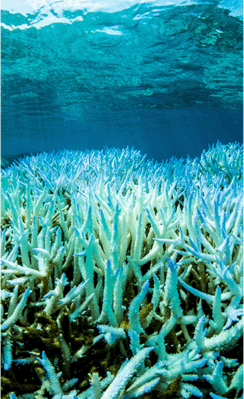 Great Barrier Reef at ‘terminal stage’: scientists despair at latest bleaching data ‘Last year was bad enough, this is a disaster,’ says one expert as Australia Research Council finds fresh damage across 8,000km
‘Australia’s politicians have betrayed the reef and only the people can save it, Guardian, Christopher Knaus and Nick Evershed, 10 Apr 17, Back-to-back severe bleaching events have affected two-thirds of Australia’s Great Barrier Reef, new aerial surveys have found.
The findings have caused alarm among scientists, who say the proximity of the 2016 and 2017 bleaching events is unprecedented for the reef, and will give damaged coral little chance to recover.
Scientists with the Australian Research Council’s Centre of Excellence for Coral Reef Studies last week completed aerial surveys of the world’s largest living structure, scoring bleaching at 800 individual coral reefs across 8,000km.
The results show the two consecutive mass bleaching events have affected a 1,500km stretch, leaving only the reef’s southern third unscathed.
Where last year’s bleaching was concentrated in the reef’s northern third, the 2017 event spread further south, and was most intense in the middle section of the Great Barrier Reef. This year’s mass bleaching, second in severity only to 2016, has occurred even in the absence of an El Niño event.
Mass bleaching – a phenomenon caused by global warming-induced rises to sea surface temperatures – has occurred on the reef four times in recorded history.
Prof Terry Hughes, who led the surveys, said the length of time coral needed to recover – about 10 years for fast-growing types – raised serious concerns about the increasing frequency of mass bleaching events.
“The significance of bleaching this year is that it’s back to back, so there’s been zero time for recovery,” Hughes told the Guardian. “It’s too early yet to tell what the full death toll will be from this year’s bleaching, but clearly it will extend 500km south of last year’s bleaching.”
Last year, in the worst-affected areas to the reef’s north, roughly two-thirds of shallow-water corals were lost.
Hughes has warned Australia now faces a closing window to save the reef by taking decisive action on climate change.
The 2017 bleaching is likely to be compounded by other stresses on the reef, including the destructive crown-of-thorns starfish and poor water quality. The category-four tropical cyclone Debbie came too late and too far south for its cooling effect to alleviate bleaching……….https://www.theguardian.com/environment/2017/apr/10/great-barrier-reef-terminal-stage-australia-scientists-despair-latest-coral-bleaching-data
Insurance companies want big increase in govt disaster mitigation spending
Australia’s biggest insurers want the government to revisit the plans to dramatically increase natural disaster prevention spending, which the commission believes will save billions in post-catastrophe clean-ups.
As the damage wrought by Cyclone Debbie continues to mount, Insurance Australia Group and Suncorp have hit back at politicians’ accusations companies are “stingy” with claims, and have called on the government to adopt the recommendation it commit to an annual $200 million spend on mitigation. The proposal, part of the Productivity Commission Inquiry into Natural Disaster Funding Arrangements, was rejected by the government two days before Christmas last year, after it sat on the report for two years.
“There is overwhelming evidence that shows the economic and social impact savings which upfront mitigation funding could achieve and this is being ignored,” IAG chief executive Peter Harmer told The Weekend Australian.
“The government response in late December …. was disappointing and did not go far enough, particularly in the area of funding for disaster resilience and mitigation.
“We have been advocating for some time that there needs to be a different approach to natural disaster funding, with more focus on mitigation, to avoid some of the impacts we are seeing.”
As of yesterday, insurers had received nearly 47,000 claims from Queensland and NSW policyholders for insured losses stretching to $413m. It is estimated losses will break $1 billion.
The federal government invests about $50m a year on adaptation funding but spends more than $500m on average on post-disaster relief and recovery.
The Australian Business Roundtable for Disaster Resilience said spending $250m a year on preventive infrastructure, such as flood levees, would slash recovery costs in half and generate savings of more than $12bn by 2050.
“The recommendations of the review included significantly reducing recovery funding provided to states, while increasing mitigation funding over time,” a government spokeswoman said……. http://www.theaustralian.com.au/business/news/insurers-call-for-disaster-mitigation-increase/news-story/acf1ecfd783c1422864a4c7ad21908a3

While the Australian government slumbers on, business takes lead on climate disasters
With actuaries warning that some properties could become uninsurable in future, land values in some areas would likely plummet.
“The possibility of legal liability heightens risks for companies that aren’t responding”
While the financial sector is now seriously factoring the practical impact of climate change into their plans, many within it fear government is not.
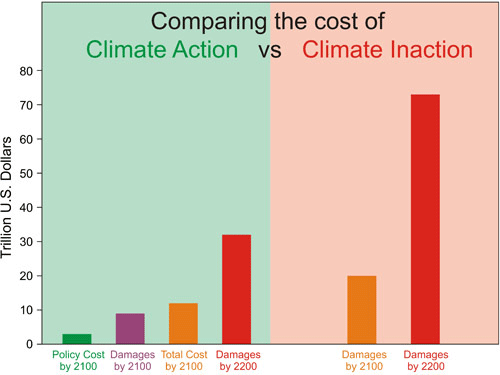 Business takes lead on climate disasters, In the wake of cyclone Debbie, the insurance and banking industries are pushing for better mitigation measures, while the federal government lags behind. By Karen Middleton, Saturday Paper 8 Apr 17, “……..The Cannons and their neighbours join the residents of Murwillumbah, Lismore and other affected areas of NSW and Queensland in surveying the damage from cyclone Debbie, and the storms and flash flooding of its aftermath, and asking what can be done to help communities protect themselves in future.
The same questions are being asked in the boardrooms of corporate Australia – especially but not only in the finance sector – with an increasing emphasis on planning for and guarding against such events, rather than just cleaning up afterwards.
…….The Insurance Council of Australia wants the federal government to focus on mitigation as a priority in the upcoming federal budget.
“Cyclone Debbie and the floods that followed it should be a starting point for state and federal governments to address mitigation,” council spokesman Campbell Fuller said.
In the insurance and superannuation industries, work is being done on the likely longer-term impact of climate change on the frequency and ferocity of these major disasters and how they and other investors – and ultimately governments – should respond.
The big banks have also begun studying the implications of climate change on their risk exposure through mortgages reaching back 30 years. Continue reading
Galilee Blockade grandparent activists occupied office of Qld Dep Premier Jackie Trad.
 ‘On Tues a large group of Galilee Blockade grandparent activists occupied office of Qld Dep Premier Jackie Trad. Cayman Islands was the theme, Gautam Adani holidaying with a billion dollars of public funds.’
Eleven Hour Occupation.
Three Arrests.
One Message.
Galilee Blockade campaign http://galileeblockade.net/occupying-trad/ http://galileeblockade.net/wordpress/wp-content/uploads/2017/04/S1010163.jpg
“Prepared with food, bedding and a camp toilet, the grandparents vowed to occupy the office until Jackie Trad (as Minister for Infrastructure) signed a legal letter stopping our money going to Adani.
NAIF’s own process is clear that the Queensland Labor Government can reject the applications of both Adani and Aurizon. …
“Bill Shorten says he is against taxpayer funds going to Adani.
Wayne Swan says it’s a slush fund for the Liberals and has asked the Auditor-General to investigate.
Jackie Trad has the power to actually stop our money going to Adani but refuses, despite 75% of Australians being against it. …
Direct action can be very fun. The grandparents engaged staff and the general public, often in song.
https://www.facebook.com/GalileeBlockade/videos/1883638468560217/
The grandparents stopped the office closing for the day, taking turns blocking the doorway for almost 5 hours. Again with music! https://www.facebook.com/GalileeBlockade/videos/1883714215219309/
Anne, Richard and John were arrested but released without charge. We broadcast this live on Facebook.
https://www.facebook.com/GalileeBlockade/videos/1883853088538755/
“P.S. Activist tip. What does a grandparent activist do when he’s about to be arrested.
Take a selfie and put it on Facebook!” http://galileeblockade.net/wordpress/wp-content/uploads/2017/04/3.jpg
Australia’s big banks scrutinising business customers for exposure to climate change risks
Climate change: three of Australia’s big four banks reviewing exposure to fossil fuels https://www.theguardian.com/australia-news/2017/apr/07/climate-change-three-of-australias-big-four-banks-reviewing-exposure-to-fossil-fuels
Commonwealth, NAB and ANZ are each analysing the financial position of business customers in sectors exposed to climate change, Guardian, Gareth Hutchens, 7 Apr 17, Three of Australia’s big four banks are reviewing their exposure to fossil fuels, including their lending practices to households and farmers, in response to climate change.
The Commonwealth Bank is conducting a “detailed climate policy review” that will be released publicly pending board approval, and NAB has a working group reviewing the risks from global temperatures rising two degrees.
ANZ is conducting portfolio analysis to identify changes in the financial position of business customers in sectors “most exposed” to climate change. It is also working with the Bureau of Meteorology to understand variability in average annual rainfall over recent decades to understand how climate change is affecting Australia’s traditional farming areas.
Executives from the three banks shared this information with the House of Representatives’ standing committee on economics, as part of a review of the four major banks. The revelations, written in response to questions on notice from the committee, were published on the federal parliamentary website on Friday afternoon.
It comes two months after the banking regulator warned climate change posed a material risk to Australia’s financial system, and urged companies to start adapting.
He pointed to the Paris Climate Agreement, ratified by Australia in November, as a significant policy moment for all governments, including Australia’s.
Summerhayes said the Paris Agreement provided an “unmistakable signal” about the future direction of policy and adjustments that companies, markets and economies “will need to make”.
The revelations from CBA and NAB come after ANZ’s chief executive, Shayne Elliott, said last month he was examining the impact of sea level rise and other climate impacts on housing mortgage risk.
Adam Bandt, the Greens’ climate and energy spokesman, has welcomed the revelations. He also questioned why Westpac has not ruled out funding Adani’s giant Carmichael coalmine in Queensland given its competitors’ concerns about climate change.
“Following ANZ’s revelation that sea-level rises might make it tougher to grant a mortgage, CBA and NAB seem to be examining whether to follow suit,” Bandt said. “The penny doesn’t seem to have fully dropped, because banks like Westpac still think they can commit to a two degree target but leave the door open to expanding coal mines.
“Westpac’s refusal to rule out funding Adani is especially concerning; as the bank seems to think it can have its climate cake and eat it too. But the days of dealing with climate change simply by putting a polar bear in your ad are long gone.”
Last year, financial activists Market Forces said Australia’s big four banks could act on their stated ambition to help achieve a 2C warming target simply by giving no new loans to coal projects.
While coal mining contributes to climate change, climate change is wiping out coal mining revenue!
Cyclone Debbie could wipe $200m of coal revenue, John McCarthy, The Courier-Mail, April 5, 2017 THE State Government could lose up to $200 million from coal royalty revenue after Cyclone Debbie knocked out crucial rail links to the coast.
Australia’s security, like America’s, is threatened in unexpected ways, by climate change

The internal cohesion of many nations is already under great stress, including in the United States, as a result of both a dramatic rise in migration, and changes in weather patterns and water availability.
Throughout Asia, climate change will increase regional instability.
The economic and social implications will be profound, with a major effect on Australia’s export-dominated economy.
Climate threatens Australia’s security in unexpected ways, Brisbane Times, Sherri Goodman, 6 Apr 17, When President Donald Trump became the commander-in-chief of the US Armed Forces, he accepted the responsibility to protect my country against enemies, foreign and domestic. Prime Minister Malcolm Turnbull shares the same responsibility to protect Australians.
Do these leaders understand that a key component of national security and global stability is climate change and the instability it is already causing around the world? The intersection of these two issues is already striking the world in unexpected ways, as climate change interacts with other pre-existing problems to become an accelerant to instability. The consequences include overwhelming humanitarian crises, forced migrations like those we are witnessing around the Mediterranean, and a breakdown in the human systems that make our societies work. Continue reading
Adani coal mine granted UNLIMITED ACCESS TO GROUNDWATER!
 ‘Barbaric’: Farmers rattled as Adani coal mine granted unlimited water access, Brisbane Times, Peter Hannam, 6 Apr 17, The proposed Adani coal mine has been granted unlimited access to groundwater by the Queensland government in a move farmers fear would allow it to drain huge amounts of water from the Great Artesian Basin.
According to a copy of Adani’s water licence obtained by Fairfax Media, the $16 billion Carmichael mine merely needs to monitor and report the amount of water it extracts with a permit that runs until 2077.
The mine, the biggest of nine proposed for the Galilee Basin west of Rockhampton, can conduct its own review of its groundwater model without independent or government oversight.
There are also no impact levels specified that would trigger a halt to mining, with the company able to offset any significant water loss elsewhere, the licence shows.
“It’s bloody-minded and barbaric,” said Bruce Currie, a grazier who lives in the region and has joined legal action against Galilee mines. “This is going to definitely impact on the integrity of [the Great Artesian Basin].”
According to a supplementary environmental impact statement, the mine will draw 26 million litres of water per day from its pits by 2029 as it ramps out annual production to as much as 60 million tonnes. Over its life, the mine’s water tally would reach an estimated 355 billion litres……….
The licence would not be subject to the new Water Act Referral Panel set up to ensure “the sustainable management of water in Queensland”……
Opponents, though, argue the coal is largely poor quality and the basin will require huge subsidies to become viable. Burning the fuel would also release a “carbon bomb” that would contribute to harming the Great Barrier Reef, which is already being hammered by unprecedented coral bleaching blamed on global warming.
Fairfax also sought comment from Adani Mining, the local subsidiary of the Indian company.
Without the water, their businesses are basically finished.
Limited scrutiny Unlike other controversial mines, such as the New Acland coal mine planned for the Darling Downs, Adani’s water usage is not subject to public submissions and appeals, said Jo Bragg, chief executive of Queensland’s Environmental Defenders Office.
Groundwater evidence is often the most controversial feature and public scrutiny is often the most significant aspect of any review, Ms Bragg said. “It’s a matter of grave concern that there’s not that opportunity.”…….http://www.brisbanetimes.com.au/environment/barbaric-farmers-rattled-as-adani-coal-mine-granted-unlimited-water-access-20170404-gvdk5v.html
Adani’s Carmichael coal mine is environmentally reckless and contrary to today’s energy markets
http://www.smh.com.au/business/mining-and-resources/adanis-carmichael-coal-mine-is-environmentally-reckless-and-contrary-to-todays-energy-markets-20170404-gvdkgh.html
~ Julien Vincent executive director of Market Forces 6 April 2017:
“If at first you don’t stack up economically, make the public pay for it.”
“This could be the mantra that delivers Adani’s Carmichael mega coal mine in the Galilee Basin
at the expense of the environment, culture, our prospects of a stable climate and in defiance of sound economics. …
“Since buying the coal tenements from Linc Energy in 2010, Adani has failed to secure a single private backer for the Carmichael mine.
“In fact, since then, 17 banks have either publicly distanced themselves from Galilee Basin
coal export projects or introduced policies that prevent them lending to the Carmichael mine. …
“In an industry where sentiment and market signals have a huge impact, leadership from private banks like Westpac can do more than just prevent a project like Adani’s Carmichael coal mine, and its impacts on people, the environment and climate. It can help prevent Australians for having to pay for the privilege.”
Climate change is pushing cyclones further South
Watch out, Gold Coast, climate change is pushing cyclones further South Cyclone the size of Debbie could be catastrophic for Gold Coast, modelling shows, The Age, Eryk Bagshaw, 2 Apr 17,
A cyclone the size of Debbie could have catastrophic consequences on the Gold Coast, new modelling has shown, as climate change pushes cyclones further south and puts tens of billions of dollars worth of infrastructure at risk.
Actuaries, who predict and model scenarios for banks and insurers, have warned properties could become “uninsurable” as premiums rise to meet environmental challenges. Debbie devastated northern Queensland and swept floods into NSW which caused $1 billion in damage, forced 30,000 people to evacuate and took two lives.
Under modelling compiled by Deloitte’s principal actuary Sharanjit Paddam and James Cook University, a shift in the cyclone-prone region of just three degrees would cause winds in excess of 260km/h to hit the Gold Coast and stretch as far as Brisbane, where many homes and towers do not meet cyclonic safety standards.
The “sting in the tail” of ex-Cyclone Debbie battered the Gold Coast this week with winds half as strong as those that hit Bowen and Proserpine, along with torrential downpours. Continue reading
1 This month

of the week – Australians for War Powers Reform (AWPR)
To see nuclear-related stories in greater depth and intensity
 Antinuclear