Stockholm Environment Institute very critical of Australia’s high rate of carbon emissions
 Australia’s carbon budget to be exhausted in six years, Stockholm group says http://www.smh.com.au/environment/climate-change/australias-carbon-budget-to-be-exhausted-in-six-years-stockholm-group-says-20160908-grbql4.html Peter Hannam
Australia will burn through its “fair share” of carbon within six years if the more-ambitious end of the global warming goals agreed to at the Paris climate summit is to be achieved, a respected European think-tank says.
Restricting warming to 1.5 degrees above pre-industrial times implies a global carbon budget of less than 250 billion tonnes of carbon-dioxide equivalent from 2015, the Stockholm Environment Institute said in a new study. The planet has warmed about 1 degree in the past century alone.
Taking Australia’s share of this budget to be 1 per cent – arguably a generous measure as the nation makes up just 0.3 per cent of the world’s population – the country will emit that 2.5 billion-tonne portion within six years at present polluting rates.
“[Australia’s] transformation to a post-carbon era must be rapid and comprehensive, and include diversification away from fossil extraction for energy and export,” Sivan Kartha, the author of the report, said.
Among the world’s largest polluters on a per-capita basis, Australia had “a high level of responsibility for the greenhouse gases that have caused the climate problem”. Its wealth and technical capabilities, though, also gave Australia “a level of capacity to help solve it”, the report says.
Geoffrey Cousins, president of the Australian Conservation Foundation, said the Turnbull government “had made new commitments in Paris, talked them up when they came back but not a single policy has changed since then”.
“There is no great urgency, things will just roll nicely on, and we continue to approve new coal mines,” Mr Cousins said, adding the Stockholm report revealed how little time was left to take serious steps to cut emissions.
Two developments on Thursday offered conflicting signals of government action on climate.
As revealed by Fairfax Media, $92 million in grant funding by the Australian Renewable Energy Agency had sparked almost as much as $1 billion in private funding that will triple the size of large-scale solar in the country.
The government also announced $30.05 million to fund a new ARC Centre for Excellence for Climate Extremes. The seven-year funding will mean the existing centre, based at the University of NSW, can morph into a group study on why rising temperatures are triggering a disproportionate increase in extremes such as heatwaves.
According to the Stockholm report, a large fraction of the world’s proved fossil fuel reserves will have to stay in the ground for any “plausible budget” to keep global warming the “well-below 2 degrees” goal agreed in Paris.
That means the market for Australia’s fossil fuel exports will need to “rapidly reduce and ultimately disappear”.
“Action taken to increase Australia’s capacity for fossil fuel production – such as increasing export capacity or commissioning new coal mines – is difficult to reconcile with the goals of the Paris Agreement,” the report says.
Australia is the world’s second-biggest coal exporter and also the second-largest exporter of liquefied natural gas.
Sharp falls predicted for Australia’s thermal coal exports
 Australia’s thermal coal exports face 20 years of sharp falls, The Australian, September 8, 2016, BARRY FITZGERALD
Australia’s thermal coal exports are facing a sharp reduction over the next 20 years as the world steps up its attack on carbon emissions.
Leading industry consultancy Wood Mackenzie estimates Australia’s exports of the power generating fuel could slump from 210 million tonnes this year to 135 million tonnes by 2035
Key markets in Asia, Europe, and the Americas are all expected to record sharp falls in demand as the switch to meeting energy demand through energy efficiencies, nuclear power and a growth in renewables/battery storage alternatives steps up.
the next 20 years as the world steps up its attack on carbon emissions…….http://www.theaustralian.com.au/business/mining-energy/australias-thermal-coal-exports-face-20-years-of-sharp-falls/news-story/e059ac40237ef59ccc2889a61d68284b
Australia the Pacific Pariah as it idolises coal
It is the world’s largest coal exporter, and both major political parties are financially backed by the coal lobby. Rather than move away from coal, the government is seeking to expand exports dramatically, with public subsidies and taxpayer-funded infrastructure.
The contrast could not be starker. While Pacific leaders are praised for their efforts to develop global climate solutions, Australia faces ignominy. Unless Australia changes direction, it will continue to be seen as an irresponsible middle power – a rogue state undermining global efforts to tackle climate change.
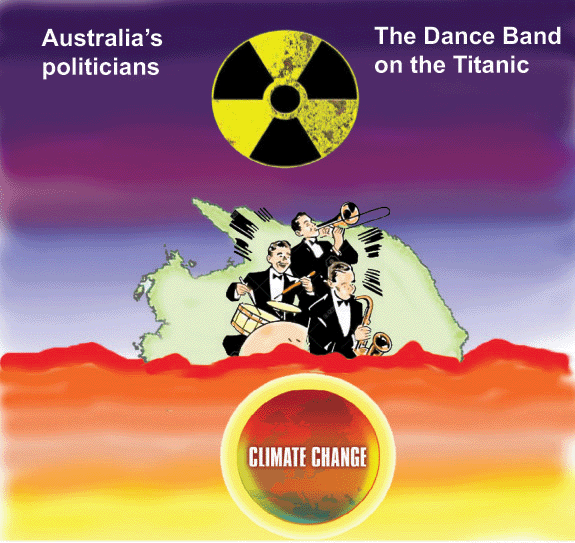 Pacific pariah: how Australia’s love of coal has left it out in the diplomatic cold, https://theconversation.com/pacific-pariah-how-australias-love-of-coal-has-left-it-out-in-the-diplomatic-cold-64963 The Conversation, Wesley Morgan, 7 Sept 16, Australia’s Prime Minister Malcolm Turnbull will have some explaining to do when he attends the Pacific Islands Forum leaders’ meeting in Pohnpei, Micronesia, this week.
Australia’s continued determination to dig up coal, while refusing to dig deep to tackle climate change, has put it increasingly at odds with world opinion. Nowhere is this more evident than when Australian politicians meet with their Pacific island counterparts.
It is widely acknowledged that Pacific island states are at the front line of climate change. It is perhaps less well known that, for a quarter of a century, Australia has attempted to undermine their demands in climate negotiations at the United Nations.
The Pacific Islands Forum (PIF) – organised around an annual meeting between island leaders and their counterparts from Australia and New Zealand – is the Pacific region’s premier political forum. But island nations have been denied the chance to use it to press hard for their shared climate goals, because Australia has used the PIF to weaken the regional declarations put forward by Pacific nations at each key milestone in the global climate negotiation process. Continue reading
Australia an international pariah? as other nations ratify Paris Climate Agreement
 US-China ratification of Paris Agreement ramps up the pressure on Australia, The Conversation, Peter Christoff September 5, 2016, When President Barack Obama and President Xi Jinping announced their countries’ ratification of the Paris climate agreement ahead of last weekend’s G20 meeting in Hangzhou, they boosted its chances of coming into force by the end of this year, some 12 months after the deal was brokered last December.
To enter into force, the Paris Agreement requires ratification by at least 55 nations which together account for at least 55% of global greenhouse emissions. It will then become legally binding on those parties that have both signed and ratified it. These thresholds ensure that the deal has broad legitimacy among states, but are also low enough to limit the opportunities for blocking by states that may oppose its progress.
Aside from China and the United States – the world’s two largest emitters, which together produce 39% of the world’s emissions – another 24 countries have ratified the agreement.
To get over the threshold, it now only needs the support of a handful of major emitters like the European Union (a bloc of 27 countries producing some 10% of global emissions), India, Russia or Brazil. Ratification by countries such as Australia, South Africa and the United Kingdom (each of which contributes about 1.5% of emissions) would also contribute significantly to this momentum………
Australia left as a laggard
The US-China announcement not only increases the momentum for ratification, but also increases pressure on Australia. With the Kyoto Protocol, Australia loyally supported the United States and refused to ratify until 2007. This time, similar recalcitrance is likely to be met with strong international disapproval.
However, ratification is only the beginning. Australia will then be required to revise and toughen its targets for 2030 and beyond. Its weak 2030 mitigation target is accompanied by policies inadequate to meet this goal.
The Paris Agreement, once in force, will require a more robust Australian target to be announced by 2023 at the latest. This in turn will further highlight the gap between current and sufficient implementation measures.
The US-China ratification announcement is the next step along a path that must see Australia climb – or be dragged – out of its current climate policy torpor. https://theconversation.com/us-china-ratification-of-paris-agreement-ramps-up-the-pressure-on-australia-64821
Queensland University of Technology to divest its fossil fuel shares
Queensland University of Technology commits to divesting its fossil fuel shares, ABC News by Nick Kilvert, 5 Sep 16, Student activists and academics at the Queensland University of Technology (QUT) are celebrating after learning the university has committed to divesting its shares in fossil fuels.
The decision comes after an ongoing campaign by Fossil Free QUT, which included an open letter signed by more than 120 academics, calling for the university to join the global movement, following the success of similar campaigns at universities across Australia.
Vice-chancellor Professor Peter Coaldrake sent a statement via email on Friday informing staff of the decision to steer investments away from coal, oil, and gas companies.
“We have reviewed QUT’s investments relative to climate risk and instituted changes to the university’s investment strategy,” the statement said.
“QUT is committed to an orderly and considered transition away from investment in fossil fuel companies.”…….
The move makes QUT the first university in Queensland and the second largest in Australia to withdraw investment in fossil fuel companies, and comes despite a strong focus on geological science (earth science) at the university’s Gardens Point campus…….http://www.abc.net.au/news/2016-09-05/qut-to-divest-fossil-fuel-investments/7816016
High Profile Members of Climate Change Authority slam ‘Untrue and dangerous’ report
‘Untrue and dangerous’: Climate Change Authority board at war over own advice, The Age, 5 Sept 16 Adam Morton High-profile members of the federal government’s Climate Change Authority have launched a stinging critique of their colleagues, accusing them of giving “untrue and dangerous” advice that ignores what science demands.
Board members David Karoly, an internationally recognised scientist, and Clive Hamilton, an academic and author, have published a dissenting report criticising the authority’s advice to the government released last week.
The split is over whether the authority’s role is to give unflinching science-based advice or, after years of policy failure in Canberra, recommend what is politically achievable.
It follows then environment minister Greg Hunt’s appointment of five new board members last year, including former Coalition politicians.
The dissenting pair accuse the authority of failing to give independent guidance, and instead basing its report on “a reading from a political crystal ball”……..
Professor Karoly said the authority’s report failed to meet its terms of reference and was a recipe for further delay.
“It makes recommendations that are not soundly based on climate science,” he said.
Professor Hamilton, a former Greens candidate, said it gave the impression Australia had plenty of time to introduce measures that could bring down emissions sharply.
- “This is untrue and dangerous. Given this, we felt we had no choice but to write our own report,” he said…….
Climate Change Authority Special Review: Minority Report
 BY CLIMATE COUNCIL 05.09.2016 Last week, the Climate Change Authority (CCA) published its report on how Australia should deliver on its international climate commitments.
Meaningless climate weasel words from Environment Minister Josh Frydenberg
 Gaping chasm between Coalition’s climate mantra and the real debate, Guardian, Lenore Taylor, 3 Sept 16 Like the emperor with no clothes, Josh Frydenberg is continuing the grand parade, insisting that Australia is making a successful transition.
Amost every group with a financial, intellectual or ethical interest in salvaging a workable climate policy is now deep in an urgent debate about how Australia can break a decade of policy paralysis. Everyone except the Turnbull government, that is.
The debate, involving big business, small business, investors, the government’s own independent climate advisers, academics, environmentalists, the welfare lobby and the unions, is predicated on the obvious conclusion that our policy – as it stands – cannot deliver the cuts to greenhouse emissions that are domestically necessary and which Australia has promised internationally.
But like the emperor with no clothes, continuing with the grand parade even after the whole crowd has finally declared him naked, the new environment and energy minister, Josh Frydenberg, still insists Australia is “transitioning successfully with the policies we already have in place”. Continue reading
G20: Which country is worst on climate change action? Oh it’s Australia, AGAIN!
The report notes that if every country emulated Australia’s level of ambition, global warming would likely exceed 4C.
It also said that Australia’s currently implemented policy measures were not set to achieve even those inadequate targets and instead would rise to about 27% above 2005 levels by 2030, rather than the targeted 26 to 28% below 2005 levels.
Australia worst among G20 when it comes to action on climate change, report finds
Australia the only country to receive a rating of ‘very poor’ in a majority of categories in Climate Transparency scorecard, Guardian, Michael Slezak, 1 Sept 16, Australia is the worst country among the G20 when it comes to action on climate change, according to a comprehensive assessment before the G20 summit in China.
Under China’s leadership, this weekend’s G20 in the eastern city of Hangzhou has had a strong focus on climate-related issues.
By analysing the policies and actions of each of the 20 countries, which together produce 75% of the world’s greenhouse gas emissions, Climate Transparency produced a report, scorecard and series of country profiles detailing their findings, revealing Australia was not pulling its weight.
On the scorecard, Australia was the only country to receive a rating of “very poor” in a majority of categories.
Australia was given the worst possible rating of “very poor” for its performance on emissions trends, carbon intensity, share of renewables in its energy supply and overall climate policy.
It was rated as “poor” in every other category: for its energy intensity, share of coal in energy supply and electricity emissions intensity. Continue reading
Climate Change Authority’ s review on Australia’s climate goals and policies
Towards a climate policy toolkit: special review on Australia’s climate goals and policies, Australian Policy Online Climate Change Authority 31 August 2016 The Climate Change Authority is pleased to release the third and final report of its Special Review into the actions or policies that Australia should take to implement outcomes flowing from the historic Paris climate change agreement……..The emissions reduction policy toolkit needs to take account of Australia’s climate policy history, be suited to the emissions opportunities and challenges in individual sectors and be able to be scaled up in the future to meet the emission reduction challenges in the Paris Agreement…….
The Authority is also recommending that an enhanced safeguard mechanism be put in place as an effective, pragmatic and durable way of reducing emissions across a range of industrial, manufacturing and resource sectors. For households, vehicles and buildings, the Authority recommends that energy efficiency standards be put in place or strengthened.
For the land sector, the Authority found that voluntary offsets are the best tool for the task, given the large number of landholders and the differences between farming operations. In this report, as flagged in the Authority’s Special Review final report on targets, the Authority has not sought to provide further advice on emissions reduction targets. Emissions reduction targets are very important parts of the emissions reduction armoury but without effective policy action they will remain aspirational rather than determinative for the way ahead.
Australian govt’s environment and energy committee chaired by climate sceptic
Climate sceptic MP appointed chair of environment and energy committee
Liberal Craig Kelly will lead backbench committee that provides advice and feedback on legislation and policies, Guardian, Gabrielle Chan, 29 Aug 16, The climate sceptic Liberal MP Craig Kelly has been appointed chairman of the backbench environment and energy committee, with National party MP Kevin Hogan as secretary.
The committee will provide feedback on legislation and policies relating to the environment and energy, including to the minister, Josh Frydenberg.
Kelly served on the committee during the last parliament and previously invited climate sceptics to “balance” a presentation given by top climate scientists…….https://www.theguardian.com/australia-news/2016/aug/29/climate-sceptic-mp-appointed-chair-of-environment-and-energy-committee
Liberal Chairman of Coalition’s environment policy committee a proud climate sceptic, suggests nuclear power
Coalition environment committee chairman takes aim at solar subsidies Craig Kelly says he wants wind and solar funding to be redirected to research into ‘technological breakthroughs’ because existing renewables had ‘little effect’, Guardian, Gabrielle Chan, 31 Aug 16, The Liberal chairman of the Coalition’s environment policy committee, Craig Kelly, has questioned solar and wind power subsidies and would like a cost-benefit analysis of future emission reductions policy, due to be reviewed next year.
Kelly was named chairman of the environment and energy committee at the party room meeting on Monday, making him responsible for coordinating backbench feedback to the government on climate and energy policy.
 He said he was proud to be a climate sceptic rather than “wallow in groupthink, to be a sheep, or a lemming”. Kelly described himself as in the “Bjorn Lomborg” camp, suggesting wind and solar funding should be channelled into “further research” because those current renewables like wind and solar power had “diminishing returns”………
Kelly said in considering the price of power, the option of nuclear power should be considered……..https://www.theguardian.com/environment/2016/aug/31/coalition-environment-committee-chairman-takes-aim-at-solar-subsidies
Underground Coal Gasification (UCG) a disaster for climate
Friends of the Earth has recently released a report called ‘Fuelling the Fire: the chequered history of Underground Coal Gasification and Coal Chemicals around the world’
The report draws together evidence of UCG test projects over the last three decades and highlights how destructive UCG and Coal Chemicals are
Fuelling the fire: New coal technologies like UCG spell disaster for climate https://independentaustralia.net/environment/environment-display/fuelling-the-fire-new-coal-technologies-like-ucg-spell-disaster-for-climate-,9393 Cam Walker 26 August 2016, Given UCG’s disastrous history including Linc Energy’s irreversible environmental damage in Queensland, Friends of the Earth is calling for a moratorium on all UCG projects in Australia. Cam Walker fromFriends of the Earth reports.
IN RECENT years Australia, like many countries around the planet, has seen a major expansion in the development of unconventional oil and gas drilling.
These are oil and gas resources which cannot be produced by conventional processes (that is, through using the natural pressure of the wells to release the resource trapped in a coal or rock seam).
Until the 1990s, production of conventionaloil and gas kept prices relatively stable, so there was limited incentive to develop technologies to explore and produce unconventional oil and gas resources.
In the 2000s, prices started to increase, and with known reserves starting to peak, it was clear that this trend would continue into the future.
As debate increasingly focused on energy independence, a number of countries who consume large volumes of fossil energy such as the USA, Canada and China started to realise they had potentially enormous volumes of unconventional oil and gas. This in turn lead to a major development effort that saw a huge expansion in the use of hydraulic fracturing (‘fracking’) to access methane in shale beds to produce gas in the USA and elsewhere.
Australia also has major reserves of oil and gas which could potentially yield through the use of unconventional drilling methods. Here the unconventional gas resource includes coal seam gas (CSG), shale gas and tight gas. Exploration for CSG in Australia began in 1976 in Queensland’s Bowen Basin. The industry took hold, initially in Queensland, where there are currently around 4,000 onshore gas rigs. More than 37% of the Australian landmass is currently under exploration permit or application for coal or gas.
The UCG industry has been strongly resisted by regional communities and environmental groups around the country and the many dangers of fracking are well documented. This has resulted in moratoriums on fracking in states such as Victoria. Continue reading
Another dumb Resources Minister supports ‘clean coal’ myth
 Coalition climate numbskulls back again flogging CCS at a cost of $209 billion Lachlan Barker, Independent Australia 25 August 2016, The Coalition’s latest brainsnap of flogging Carbon Capture and Storage (CCS) as a solution to CO2 emissions from coal-fired power stations will set the taxpayer back an eye-watering $209 billion, says Lachlan Barker. “…… the utterly ludicrous notion of Carbon Capture and Storage (CCS), as a solution to CO2 emissions from coal fired power stations has raised its idiot head once more.
The CCS process involves capturing the CO2 emitted from the burner chamber, compressing it, and sequestering it underground.
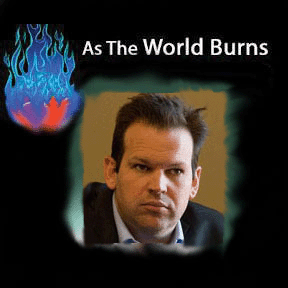 Resources Minister Matt Canavan recently handed out $23.7 million to various bodies around the country to (once more) discover CCS can never work. So I can tell you right here, right now, CCS is not feasible in any way — financially, ecologically or in an engineering sense.
However since Canavan has done this thing, once more we are all forced to go through the mill of showing why CCS is an utterly fallacious idea.
The Massachusetts Institute of Technology (MIT) has an excellent reference page for CCS, so I’ve distilled the Power Plants CCS Projects page down for you here: [excellent charts and graphs on original]……..https://independentaustralia.net/politics/politics-display/coalition-climate-numbskulls-back-again-flogging-ccs-at-a-cost-of-209-billion,9394
Climate Change Adaptation – South Australia in the lead
National Climate Adaptation Conference 2016, Day Three – Sean Kidney
SOUTH AUSTRALIA: LEADING ON CLIMATE CHANGE ADAPTATION The Climate group, August 2016. Sandy Pitcher, Chief Executive of South Australia’s Department of Environment, Water and Natural Resources, reflects on the achievements of Australia’s preeminent climate change forum, the Climate Adaptation 2016 conference, which took place in Adelaide in July.
The Climate Adaptation 2016 conference provided an unprecedented opportunity for South Australia to highlight the important progress being made on climate change adaptation in our state, and learn from others in Australia and around the world.
The conference was presented by the National Climate Change Adaptation Research Facility and the Commonwealth Scientific and Industrial Research Organisation, with the South Australian Government – a member of The Climate Group’s States & Regions Alliance, the platinum sponsor. It attracted around 490 policy makers, researchers and practitioners and the debate focused on the challenges and opportunities presented by climate change adaptation.
The innovation that we’re seeing mainly happens at the local level, and can be shared at conferences like this. It is a crucial way, for us in South Australia and beyond, to share ideas, catalyze local action, and bring key influencers together.
ADAPTATION IS A VERY KEY TENANT TO ANY FUTURE STRATEGY – THERE ARE MANY PEOPLE WHO ARE GOING TO BE IMPACTED BY A CHANGING CLIMATE
South Australia has long been recognized as a global leader on climate action, and our work in climate change adaptation is central to our efforts.
Our award-winning adaptation framework is based on a collaborative, regional approach involving partnerships between local government, regional development committees and natural resources management boards, who are working together to develop well-informed adaptation solutions for their communities.
Currently, in each of the State’s regions, five climate adaptation plans have been completed with the remainder due to be finalized by the end of the year….https://www.theclimategroup.org/news/south-australia-leading-climate-change-adaptation
1 This month


Help Aunty Sue Protect Her Land and Sacred Sites From Destructive Rocket Testing.
.

Australians deserve the truth
about
AUKUS – https://aukuspublicinquiry.com/

PETITION – To: Prime Minister Anthony Albanese and the Australian Labor Government

of the week – Australians for War Powers Reform (AWPR)
To see nuclear-related stories in greater depth and intensity

