James WhitmoreEditor, Environment & Energy, The Conversation
Interviewed
Andrew Glikson Earth and paleo-climate scientist, Australian National University
Andrew Blakers Professor of Engineering, Australian National University
Lesley Hughes Professor, Department of Biological Sciences, Macquarie University
August 25, 2016 154 Australian experts have signed on open letter to Prime Minister Malcolm Turnbull demanding urgent action on climate change that matches the dire warnings coming from climate scientists.
The letter, organised by Australian National University climatologist Andrew Glikson, calls on the federal government to make “meaningful reductions of Australia’s peak carbon emissions and coal exports, while there is still time”.
They point out that July 2016 was the hottest month ever recorded, and followed a nine-month streak of record-breaking months. Average carbon dioxide concentrations in the atmosphere reached 400 parts per million (ppm) in 2015, and are rising at a rate of nearly 3 ppm each year.
Australia, along with 179 other nations, has signed the climate treatybrokered in Paris last year, aiming to limit average global warming to “well below 2℃ above pre-industrial levels and to pursue efforts to limit the temperature increase to 1.5℃”.
However Glikson warned that “the Paris Agreement, being non-binding, is in danger of not being fulfilled by many of the signatories”. The deal will not enter into force until it is ratified by 55 nations accounting for at least 55% of the world’s greenhouse emissions.
Glikson called for action to “transition from carbon-emitting technologies to alternative clean energy as fast as possible, and focus technology on draw-down (sequestration) of greenhouse gases from the atmosphere”.
Andrew Blakers, professor of engineering at the Australian National University, said Australia could reduce emissions by two-thirds by 2030 “at negligible cost”.
He said the falling cost of renewable energy, particularly solar and wind, the replacement of gas with electricity for heating, and the advent of electric vehicles would eliminate most emissions. Solar and wind installation, currently at 1 gigawatt each year, would need to be increased to 2.5 gigawatts each year to reach 100% renewable energy by 2030.
Remaining emissions, from shipping, aviation, and industry, could be eliminated after 2030 at slightly higher costs.
Lesley Hughes, a member of the Climate Council and professor at Macquarie University, said there were a number of factors causing the gap between science and policy, including vested interests, perception of economic downsides of climate action, ideological biases, and inertia in the system from current investment in fossil fuels. But she said the “most important issue” was the difficulty in convincing people to act to reduce risk decades in the future.
The Climate Change Authority, which advises the government on climate policy, in 2014 recommended Australia adopt a target of 40-60% below 2000 levels by 2030.
In a report released yesterday, The Climate Institute highlighted that aiming for 1.5℃ instead of 2℃ would avoid longer heatwaves and droughts, and give the Great Barrier Reef a better chance of survival.
The institute recommended that Australia adopt an emissions reduction target of 65% below 2005 levels by 2030 and phase out coal power by 2035.
Keeping global warming to 1.5C, not 2C, will make a crucial difference to Australia, report says, The Conversation, James Whitmore, August 24, 2016 , Australia could avoid punishingly long heatwaves and boost the Great Barrier Reef’s chances of survival by helping to limit global warming to 1.5℃ rather than 2℃, according to a report released by the Climate Institute today.
Australia, along with 179 other countries, has formally signed the Paris climate agreement. The deal, which has not yet come into force, commits nations to limit Earth’s warming to “well below 2℃” and to aim for 1.5℃ beyond pre-industrial temperatures.
The new research, compiled by the international agency Climate Analytics, suggests that limiting global warming to 1.5℃ rather than letting it reach 2℃ could make a significant difference to the severity of extreme weather events in Australia. Heatwaves in southern Australia would be an average of five days shorter, and the hottest days a degree cooler. In the north, hot spells would be 20-30 days shorter than the 60-day heatwaves potentially in store if warming hits 2℃……..
University of Melbourne researcher Andrew King, who studies climate extremes, said the report “paints a grim picture for the future”, given that Australia is already experiencing climate-driven events such as this year’sunprecedented bleaching on the Great Barrier Reef.
“There are many benefits if warming could be limited to 1.5℃, with less frequent and intense extreme weather. On the other hand, we are entering the unknown if we allow warming to surpass 2℃, as tipping points in the Earth’s climate system make accurate predictions difficult to make,” Dr King said.
The report predicts that half of the world’s identified tipping points – such as the collapse of polar ice sheets and the drying out of the Amazon rainforest – would be crossed under 2℃ warming, compared with 20% of them at 1.5℃………
Stronger targets
In a separate report, the Climate Institute recommends that Australia adopt greenhouse gas targets of 45% below 2005 levels by 2025, and 65% by 2030, if it is to do its fair share in achieving the Paris Agreement’s goals.
The institute also recommended that Australia phase out coal-fired electricity generation by 2025, increase renewable generation to 50% by 2030, and double energy productivity by 2030.
It argues for a carbon price, and urges politicians to factor the costs and benefits of climate change and climate action formally into all policy decisions.
“Campaign of intimidation” One of the academics on the receiving end of Roberts complaints, John Cook, of the University of Queensland, told DeSmog:
Beneath the public attacks on climate science, scientists are also subject to a more insidious campaign of intimidation, otherwise known as the subterranean war on science. This takes the form of complaints to universities to get scientists fired, complaints to journals to get papers retracted and FOIrequests to pick through scientists’ emails.
Sen. Malcolm Roberts: Climate denier, conspiracy nut and serial pest, Independent Australia DeSmog Blog 15 August 2016 One Nation’s Senator Malcolm Roberts has spent countless hours harassing scientists, researchers and politicians with rantings about climate change conspiracy theories. DeSmogBlog‘s Graham Readfearnreports.
MALCOLM ROBERTS is a former Australian mining consultant who thinks the United Nations is using the “scam” of human-caused climate change as a cover story while it builds an all-powerful world government.
Roberts will sit in Australia’s upper house as a member of the far-right One Nation party that wants to ban Muslim immigration and investigate climate scientists for “fraud and corruption”.
Since his election, Roberts has been given blanket coverage in the Australian media, with high profile interviews on flagship shows on the publicly funded ABC. Continue reading →
The notion that climate science denial is no longer a part of Australian politics was swept away yesterday by One Nation Senator-Elect Malcolm Roberts.
In his inaugural press conference, Roberts claimed that “[t]here’s not one piece of empirical evidence anywhere, anywhere, showing that humans cause, through CO₂ production, climate change”.
He also promoted conspiracy theories that the CSIRO and Bureau of Meteorology are corrupt accomplices in climate conspiracy driven by the United Nations.
His claims conflict with many independent lines of evidence for human-caused global warming. Coincidentally, the University of Queensland is releasing a free online coursethis month examining the psychology and techniques of climate science denial. The very first video lecture addresses Roberts’ central claim, summarising the empirical evidence that humans are causing climate change.
UQx DENIAL101x 1.2.1.1 Consensus of Evidence
Scientists have observed various human fingerprints in recent climate change, documented in many peer-reviewed scientific papers.
Not only do these unique fingerprints confirm humanity’s role in recent climate change, they also rule out other potential natural contributors. If the Sun caused global warming, we would expect to see days warming faster than nights, and summers warming faster than winters.
Instead we observe the opposite: nights are warming faster than days, and winters are warming faster than summers, which is a greenhouse pattern predicted by John Tyndallas long ago as 1859.
Similarly, if global warming were caused by internal variability, we would expect to seeheat shuffling around the climate system with no net build-up. Instead, scientists observe our climate system accumulating heat at a rate of more than four atomic bombs per second.
The scientific consensus on climate change has also been endorsed by many scientific organisations all over the world, including the national science academies of 80 countries
Is it a conspiracy?
How does one dismiss a global scientific consensus built on a robust body of empirical evidence?
There are five characteristics of science denial. These common traits are seen when people reject climate science, the benefits of vaccination, or the research linking smoking to cancer.
The techniques of denial are: fake experts; logical fallacies; impossible expectations; cherrypicking; and conspiracy theories. This is summarised in the acronym FLICC.
UQx DENIAL101x 1.4.3.1 Five Characteristics of Science Denial
Climate science denial and conspiratorial thinking are often found together. A well-known example is that of Donald Trump, who has dismissed climate change by blaming it on a Chinese conspiracy.
Several studies have linked climate science denial and conspiratorial thinking. If a person disagrees with a global scientific consensus, they’ll typically believe that the scientists are all engaging in a conspiracy to deceive them.
Malcolm Roberts’ conspiracy theories have been well documented and were once again on offer in yesterday’s speech. He espouses a conspiracy that encompasses the CSIRO, Bureau of Meteorology, international banking families, the United Nations and Al Gore.
Unfortunately, I am not optimistic that the evidence for human-caused global warming will persuade Malcolm Roberts. The scientific evidence from psychology tells us that scientific evidence is largely ineffective on those who dismiss climate science with conspiracy theories.
My own research found that communicating the science of climate change to those who exhibit conspiratorial thinking can even be counterproductive, activating their distrust of scientists and strengthening their denial of the evidence.
Furthermore, conspiratorial thinking is self-sealing. When conspiracy theorists are presented evidence that there is no conspiracy, they often respond by broadening the conspiracy to include that evidence. In other words, they interpret evidence against a conspiracy as evidence for the conspiracy.
Our course on climate science denial will be much more useful to those who are open to scientific evidence and curious about the research into the causes and impacts of climate change and the psychology of climate science denial.
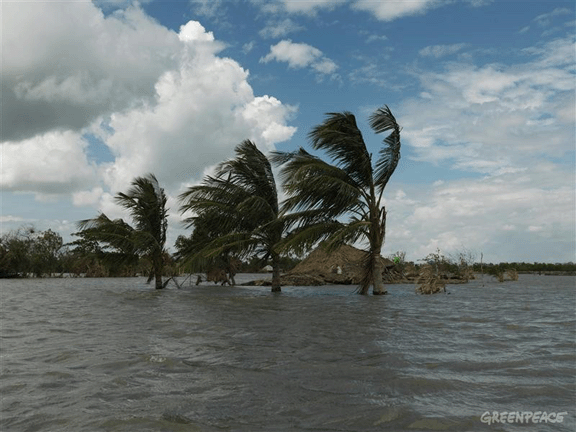
Carteret climate refugees seek homeA grassroots group in Bougainville is scrambling to relocate the Carteret Islanders before rising sea levels swallow their land forever. ABC News 7 Aug 16 By Lauren Beldi for Pacific BeatAt only 1.5 metres above sea level at their highest point, the Carteret Islands are some of the first to succumb to the rising ocean tides.
The grassroots Tulele Peisa group, which means “sailing the waves on our own” in the local Halia language, is hoping to relocate more than half of the population by 2020. They have secured land for new homes on the main island of the Autonomous Region of Bougainville, to the east of mainland Papua New Guinea.
Tulele Peisa formed in late 2006 after the Council of Elders on the islands decided to establish their own relocation program. The group’s chief executive, Ursula Rakova, says the encroaching tides on the islands have a major impact on people’s health. “We’re beginning to get more requests for people wanting to move because of the situation and the dire need for food,” she says.
The storm surges not only wash away houses, but also vegetable gardens, which are critical for the islanders’ survival.
With no cash economy on the Carterets, the only source of food is what people are able to grow for themselves……
Tulele Peisa has also provided thousands of mangrove seedlings to prevent the erosion of the coastline, and helped to build raised garden beds. But this will only stave off the inevitable for so long.
“Those are adaptation strategies, they aren’t really long-term solutions to containing the islands, because we know the islands are going, but we are looking at supporting our families,” Ms Rakova says.
She says the islanders want to maintain their independent way of living but that the international community should provide more support.
“The islanders on the Carterets are victims of what other people have caused and the international community needs to aid and support the work that we are doing,” she says.
CSIRO’s renewed climate change focus will not reverse damage done by job cuts: scientists, ABC News, PM , 4 Aug 16 By Felicity Ogilvie and staff Some of Australia’s top climate scientists say new instructions given to the CSIRO to renew its focus on climate science will not be enough to reverse the damage done by previous jobs cuts.
Climate scientists from around the country, meeting in Hobart to discuss how climate change will affect Australia’s future, say they are having a hard time keeping up with the changes in how climate science at the CSIRO is being run.
CSIRO Fellow Dr John Church, an expert in estimating and understanding global and regional sea-level rise, is one of the 275 CSIRO scientists who are losing their jobs.
“This is only a step in the right direction, it certainly doesn’t recover all the positions that have been lost,” Dr Church told PM.
University of Tasmania polar scientist Matt King said Dr Church was irreplaceable, and said he was finding it hard to digest the directive given by Mr Hunt…….
Dr Rintoul said damage had been done to Australia’s international reputation as a result of the CSIRO job cuts…….he also agreed that CSIRO staff losses would have a major negative impact on Australian research.
One of their [climate denialists] cheerleaders is Frydenberg’s successor in the resources portfolio, Queensland senator Matt Canavan.
Canavan has form as a climate science doubter. A fortnight ago he told Sky News that the impact of carbon emissions had been “overhyped” by “certain interest groups” — in line with an earlier newspaper article in which he advocated funding “scientists who take a different view”.
New minister’s political comments on science raise concerns, PETER BOYER, Mercury
August 2, 2016 “……..Malcolm Turnbull’s Cabinet reshuffle saw climate and energy combined for the first time in the one portfolio, which I think was a good decision. Putting coal-power champion Josh Frydenberg in the job may not be, but in this new regime I am prepared to keep an open mind.If he is to understand the perils of burning coal, Frydenberg first has to come to grips with the science of climate change. His performance on ABC’s Lateline last week shows he has work to do.
“I absolutely accept that man is contributing to climate change,” he declared. But that is not really how it is. Saying we are contributing to climate change is like saying the sun contributes to a warm day, or Hawthorn contributed to winning last year’s AFL premiership.
In the cautious words of the Intergovernmental Panel on Climate Change, there’s a 95 to 100 per cent chance that human activities have been the dominant cause of observed warming since the mid-20th century. We have not just contributed to climate change — we have caused it.
In the same Lateline interview, Frydenberg said Australia’s 2030 target — emissions 26 to 28 per cent lower than in 2005 — was “very ambitious” and among the highest in the world on a per-capita basis.
We have already heard the same from Abbott, Hunt and Turnbull.
All have failed to acknowledge our unhappy record of long being the G20’s highest per-capita emitter, skated over much tougher European targets, and ignored completely the all-important target of zero emissions.
Frydenberg is taking the classic conservative halfway position, allowing the established scientific truth that human emissions affect the climate but dodging the further truth, reinforced by every IPCC report, that their impact is both potent and increasingly dangerous.
He is playing to the many holdouts in the Coalition who still do not accept the real and present danger of climate change and the rising urgency to address it. Continue reading →
CSIRO researchers extracted ice bubbles in pre-industrial polar ice to measure the planet’s sensitivity to changes in temperature.
They found that for every degree Celsius of global temperature rise, the equivalent of 20 parts per million less CO2 is stored by the land biosphere.
CSIRO principle research scientist Dr David Etheridge said the research confirmed the relationship for the first time and revealed how it impacted the cycles of carbon between land, ocean, and the atmosphere.
“That’s useful to know. It’s a bit concerning because it’s going to amplify the climate change, but it’s good news in a way because it can be used in modelling.”
The research team used ice core samples from the Australian Antarctic Program’s unique Law Dome site, together with ice cores from the British Antarctic Survey.
The study focused on CO2 changes preserved in ice before, during, and after a naturally-cool period known as the Little Ice Age (1500 to 1750 AD).
“It gives global planners something to work with, to help estimate what CO2 emissions are allowable to limit global warming to one and a half or two degrees Celsius,” Dr Etheridge said.
The finding is a result of a collaboration between CSIRO, the Seconda Universita di Napoli, University of Melbourne, British Antarctic Survey, University of East Anglia, Australian Antarctic Division, University of Tasmania, and the Australian Nuclear Science and Technology Organisation.
Coal fan Frydenberg’s figleaf fluttering in the wind
Environment and Energy minister Josh Frydenberg is claiming to be a convert to the cause of renewables but the grim truth is that this government has no interest in meaningful climate action., Crikey, Bernard Keane Alarmed at the criticism of his appointment as combined energy and environment minister, Josh Frydenberg has launched a media campaign to overhaul his image as that of the man who recently insisted there was a “strong moral case” for burning more coal and starting economically unviable new coal mines like Adani’s Carmichael project (not to mention his loathing of environmental groups).,… (subscribers only)https://www.crikey.com.au/2016/07/28/frydenberg-on-renewables-and-coal-but-no-real-action/
Sections of Great Barrier Reef suffering from ‘complete ecosystem collapse’
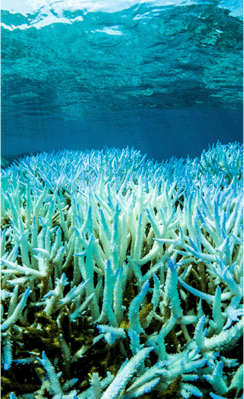
Coral Watch investigator reports ‘shocking’ lack of fish and says the surviving corals are continuing to bleach, even during winter, Guardian, Michael Slezak, 22 July 16, “Complete ecosystem collapse” is being seen on parts of the Great Barrier Reef, as fish numbers tumble and surviving corals continue to bleach into winter, according to a scientist returning from one of the worst-hit areas.
“The lack of fish was the most shocking thing,” said Justin Marshall, of the University of Queensland and the chief investigator of citizen science program Coral Watch. “In broad terms, I was seeing a lot less than 50% of what was there [before the bleaching]. Some species I wasn’t seeing at all.”
Marshall spent a week this month conducting surveys on the reefs around Lizard Island………overall, Marshall estimate that more than 90% of the branching corals had died around Lizard Island. He said many of the huge porites corals, which could be a thousand years old, had died.
Coral and other organisms like anemones and giant clams bleach when water temperatures are too high for too long. When they become stressed, they expel their colourful symbiotic algae that provide them with energy, becoming pale or white. Unless the water temperatures quickly return to normal, many of those organisms die.
Lizard Island was particularly badly hit by the global bleaching event that hit every major reef region in the world and killed almost a quarter of the coral on the Great Barrier Reef. But, in the northern section of the Great Barrier Reef, between Lizard Island and the Torres Strait, a majority of the coral is thought to have died.
Frydenberg signals $5 billion taxpayer frolic with Adani’s unwanted
fossil flop,Independent Australia Sophie Vorrath 24 September 2015In a shock interview yesterday, the Turnbull Government’s new energy and resources minister, Josh Frydenberg, signalled that taxpayers would be stumping up funds for Adani’s unpopular Carmichael coal mine.Renew Economy’sSophie Vorrath reports.
IF AUSTRALIA’s new Prime Minister and refreshed front bench are showing signs of being more progressive about renewable energy investment and R&D, it looks like they are also going to be far more candid about coal, and their plans to invest heavily there, too.
In an interview with Fairfax media on Wednesday, the newly sworn in energy and resources minister Josh Frydenberg was crystal clear on the government’s intent to use taxpayer money from its $5 billion Northern Infrastructure Fund to help get the Adani-owned Carmichael coal mining project off the ground.
[Carmichael coal mine is] a very important project, which will see significant investment in Australia and provide electricity to millions of people in the developing world,”
Anti-development activism can create major delays in projects and send investment offshore, and you have to be very conscious of that when there are such large time frames involved and we are competing internationally for investment in this country.
Three minutes to midnight and our politics ignores the climate threat The further burning of vast carbon reserves is an attack on the human species, writes scientist Dr Andrew Glickson. Crikey, 19 July 16
“We are as humans conducting a massive science experiment with this planet. It’s the only planet we’ve got … We know that the consequences of unchecked global warming would be catastrophic … We as a human species have a deep and abiding obligation to this planet and to the generations that will come after us.”
US Senators detail a climate science “web of denial” but the impacts go well beyond their borders Australians have been both helpers and victims of the fossil fuelled web of climate science denial being detailed in the U.S Senate, Guardian, Graham Readfearn, 12 July 16, By the middle of this week, about 20 Democratic Senators in the US will have stood up before their congress to talk about the fossil fuelled machinery of climate science denial.
The Senators are naming the fossil fuel funders, describing the machinery and calling out the characters that make up a “web of denial”……
Australia has been a consumer, a contributor and a victim of the web of climate science denial.Australia has long provided personnel and contributors to the efforts of several of the key groups being named in the US Senate.
Malcolm Roberts (the wannabe One Nation Australian Senator) and bloggers JoNova and her husband David Evans have all written reports for the SPPI that claim human-caused climate change is some sort of elaborate hoax.
Retired Australian meteorologist William Kininmonth is also an SPPI science advisor.
Former Family First Senator Steve Fielding, current Liberal Senator Cory Bernardi and the current Nationals MP George Christensen have all spoken at Heartland’s conferences. The conferences themselves have been enthusiastically sponsored by several Australian groups over the years.
Australia’s role in the web of denial has been running since the 1990s, when groups like the CEI flew staff to Australia to firm up opposition to greenhouse gas regulations around the world.
Partnerships were formed with groups like the Melbourne-based Institute of Public Affairs, which has hosted and supported many visits from US-based climate science denialists.
Once here, those speakers will write columns for newspapers, do radio and television interviews and travel around the country to give talks.
In 2011 when the Gillard Government was trying to introduce laws to put a price on greenhouse gas emissions, the stopgillardscarbontax.com enlisted Pat Michaels, of the Cato Institute, as a science advisor. Cato is another member of the web of denial. Michaels once estimated that about 40 per cent of his funding came from the petroleum industry.
The impact of all this on the Australian public and the way the media covers climate science is clear.
There remains a split among Australians about the cause of climate change, despite multiple studies showing that more than 90 per cent of climate scientists are in agreement that it’s the burning of fossil fuels that’s driving up temperatures, fuelling weather extremes, raising sea levels, melting ice sheets and killing corals (and that’s just a few of the impacts).
The public becomes doubtful and the media, so often looking for controversy and conflict, has been a conduit for the fossil fuelled messages.
The fossil fuel companies, meanwhile, retain a grip on their so-called “social licence to operate.”
When Senator Whitehouse said the web of denial is “so big, because it has so much to protect” we might also think that we have so much to lose.
In failing to unravel the web of denial and by allowing our public discourse to be polluted by fossil fuelled PR outfits, ideologues and pseudo-science, who knows how much time we may have lost.
Indigenous rangers on the frontline of coral bleaching in remote Australia, ABC News By the National Reporting Team’s Kate Wild, 12 July 16 [Excellent pictures and video] In April this year Indigenous rangers from the Crocodile Islands received an alarming photograph of a coral reef off the coast of Arnhem Land. Leonard Bowaynu, who has fished the same reef since he was teenager, had seen small scattered patches of white coral before — but never anything this extensive.
“We used to go out, catch fish from the reefs. I never seen coral turning to white, like around the island or reef,” he said. Concerned by the image, rangers travelled to the area with a drone and GoPro camera to collect further evidence.
Michael Mungula said it was the first time Yolgnu people had seen the coral bleached white at that reef.
“At Murrangga [Island] we never seen white coral there before, during the 50s, 60s and 70s. But we seen it now, 2016.” “We need scientists to come here and do research in the Crocodile Islands,” Mr Mungula said. Meanwhile, 300 kilometres south-east, in waters around Groote Eylandt, Indigenous Rangers were watching giant clams turn white as well.
Anindilyakwa Rangers on Groote Eylandt began trialling the cultivation of giant blue-lipped clams (Tridacna squamosa) five years ago.
But in April the rangers noticed a number of the clams had turned white. Rick Taylor, the ranger manager, sent underwater footage of the clams to the ABC. He said it was first time he had seen the clams bleach since the trial was established in 2011.
With the two ranger groups’ permission, the ABC sent images of the Crocodile Islands coral and clams from Groote Eylandt to marine scientist Andrew Heyward at the Australian Institute of Marine Science.
Dr Heyward said the aerial photograph from the Crocodile Islands provided the first confirmation of a bleaching event in Arnhem Land. “It appears that in those areas checked it was severe,” he said. He said the photograph Crocodile Islands Rangers had received was confirmation of a massive bleaching event over the reef.
“The comments by the local rangers that they have never seen it [like this] before in their country is particularly telling that things are unprecedented, at least in human generational time frames,” Dr Heyward told the ABC……..
Skilled observers a precious commodity Dr Heyward said Indigenous rangers were able monitor environmental shifts in parts of the country most people cannot reach, and said he was keen for scientists and rangers to work together……Ranger groups have expressed enthusiasm for equal partnerships with scientists. http://www.abc.net.au/news/2016-07-11/indigenous-rangers-on-the-frontline-of-coral-bleaching/7557646




 , PETER BOYER, Mercury