Urgent need to end $7.7 Billion Fossil Fuel Subsidies
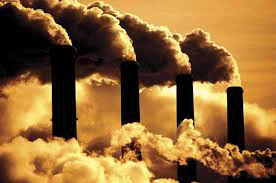 $7.7 Billion Fossil Fuel Subsidies ‘Like Being In Bed With Big Tobacco’ , New Matilda, By Thom Mitchell on April 26, 2016 Calls for an end to fossil fuel subsidies are growing louder in the lead up to Treasurer Scott Morrison’s May 3 budget, with a diverse coalition of advocates demanding an end to the $7.7 billion free ride they claim the fossil fuel industry gets each year.
At a press conference in Canberra this morning academics, religious leaders, renewable energy interests and unionists said it was illogical and counter-productive for the government to continue to subsidise fossil fuels if it’s serious about transitioning to clean energy.
“Continuing to fund polluters when we know the damage being done to the environment is unforgivable intergenerational theft,” said Luke Stickels, from the Australian Education Union.
“It is grossly foolish and unfair. Developing our nation’s future is foremost in the minds of educators in schools across the country, but that future is not secure when the government continues to defy the urgent public desire for strong action on climate change,” he said.
In a letter sent late March, a group of more than 50 civil society groups spelled out the savings they believe could be made if the government winds back subsidies to the industries which are fuelling climate change. They urged the government to:
● End nonagricultural fuel tax credits, boosting the budget by $5.5 billion in 2016/17
● End exploration and prospecting deductions for the mining industry ($650m)
● End statutory effective life caps for the oil and gas sector ($349m)
● End the concessional rate of excise levied on aviation gasoline and aviation turbine fuel ($1.24b)
● Confirm that the Northern Australia Infrastructure Facility will not invest in fossil fuel projects or in infrastructure that primarily assists such projects
This morning, former Anglican Church Bishop George Browning reiterated that the government “must stop handing over billions of our dollars to the fossil fuel industry, whose activities are driving dangerous climate change”.
“Science and Christianity are on the same page in urging human responsibility in the face of escalating climate change,” he said. “The clock is ticking. We cannot sit on our hands any longer.”……..https://newmatilda.com/2016/04/26/govt-urged-to-pull-the-handbreak-on-fossil-fuel-industrys-7-7-billion-free-ride/
Australian govt might have to back down on its cuts to CSIRO climate research
 CSIRO eyes alternative plan to climate job cuts as Chairman Thodey faces inquiry, The Age, April 24, 2016 Peter Hannam Environment Editor, The Sydney Morning Herald CSIRO is expected to offer an alternative to deep cuts of its climate science program as soon as this week in a bid to defuse criticism as a Senate committee prepares to widen its inquiry to include chairman David Thodey.
Mr Thodey is scheduled to address the committee in Canberra on Wednesday. Unusually, the chairman has asked the session be held in camera and that he not be joined by CSIRO management, Fairfax Media has been told.
Speculation of a resolution was fanned by Environment Minister Greg Hunt last week breaking his silence on the cuts, which originally targeted as many as 110 of the 140 staff in the key Oceans & Atmosphere division……..
Instead, senior CSIRO staff now expect the agency to pare back the planned cuts and offer a “face-saving” alternative of a special climate unit, possibly headquartered in Hobart……http://www.theage.com.au/environment/climate-change/csiro-eyes-alternative-plan-to-climate-job-cuts-as-chairman-thodey-faces-inquiry-20160424-godtal.html.
Malcolm Turnbull – fine words, but actually retreating on climate action
 ‘Walking in the other direction’: Malcolm Turnbull’s broad retreat on climate, The Age April 22, 2016 Peter Hannam Environment Editor, The Sydney Morning Herald When Prime Minister Malcolm Turnbull rose to address the United Nations Climate Change Conference in Paris late last year, he told the world Australia would meet the challenges of global warming “with confidence and optimism”.
You don’t turn off R&D spending when there’s a revolution under wayAndrew Blakers, Centre for Sustainable Energy Systems, ANU
Australia’s carbon emissions target – slicing 2000 levels by about 19 per cent by 2030 – would halve pollution on a per capita basis, “one of the biggest reductions” of any G20 nation, Turnbull said. The government would also double “clean energy innovation” investment over the next five years, and carve out $1 billion from the existing aid budget to help threatened Pacific neighbours build “climate resilience” and cut emissions……….
The pact, which the government plans to ratify later this year if re-elected, aims to limit global temperature increases to between 1.5 and 2 degrees of pre-industrial levels – even if current national offers fall far short of the greenhouse gas reductions needed.
But in the four months since Turnbull’s speech, climate news from abroad and at home has been anything but positive………..
For policy areas directly under Turnbull’s control, it’s been a dismal few months for climate action, not least CSIRO’s assault on climate science launched on February 4 that will see dozens of leading researchers sacked among as many as 450 jobs to go.
Despite pleas of budget penury, the government somehow managed to find $15.4 million a couple of weeks later for a new Oil, Gas and Energy Resources Growth Centre to, among other things, “foster community support” for non-renewables, including coal and nuclear energy.
It is also forked out $3.3 million to two researchers to examine the effects of wind farms on health. Just four researchers made submissions for the cash, a remarkably small number, according to Sydney University public health expert, Simon Chapman.
Taken for granted
And a fresh concern surfaced this week with 61 leading scientists writing to Turnbull decrying the government’s decision last month to end grants from the Australian Renewable Energy Agency (ARENA).
Set up by the Rudd-Gillard government, the agency still had $1.3 billion in funding to disperse by 2022.
Instead, it will now work with the Clean Energy Finance Corp to offer $100 million in loans annually for 10 years to foster “clean and renewable energy”. ARENA still has $130 million to be allocated, with “high interest” from potential proponents, Hunt says.
The proposed end of ARENA’s grant funding removes “an essential component of technology innovation”, the mostly solar researchers said in the letter obtained by Fairfax Media.
Forty years of such grants over had allowed Australia to contribute “very far above its weight” in renewable energy. By contrast, reliance on equity returns “have rarely been effective” in advancing early-stage research, the scientists said.
Richard Corkish, chief operating officer of UNSW-based Australian Centre for Advanced Photovoltaics, said his facility faced “an existential threat” if the $4 million in annual ARENA funds ended. The school continues to spawn world-leading technology, including new types of solar cells using abundant, non-toxic materials.
“ARENA is our major funding source,” Corkish says.
Andrew Blakers, who led development of the solar PV technology being adopted by the world’s largest producers, said all new electricity investment in Australia over the past five years had been in solar or wind energy.
“This is incredible”, says Blakers, who heads the Centre for Sustainable Energy Systems at the Australian National University. “You don’t turn off R&D spending when there’s a revolution under way.”
………Greens deputy leader Larissa Waters said there’s “an obvious disconnect between the Prime Minster’s rhetoric in Paris last year and his actions in Canberra”.
“Presiding over cuts to CSIRO’s world-leading climate research and gutting renewable technology research is stupid on so many levels.
“The government is tipping new money into fossil fuel research so that the big mining companies profiting off the world’s warming don’t have to pay for research themselves,” Waters says……..http://www.theage.com.au/environment/climate-change/walking-in-the-wrong-direction-malcolm-turnbulls-broad-retreat-on-climate-20160420-goat2p.html
Australia needs action, not just Turnbull’s words, to save the Great Barrier Reef
 Climate deal won’t stop Great Barrier Reef from getting ‘cooked’, say Greens, Guardian, 23 Apr 16 Australia’s lack of action on pollution reduction targets has made the country a laughing stock on the international stage, according to senator Larissa Waters Australia’s lack of follow-through on climate change will leave the Great Barrier Reef “completely cooked” despite it signing the Paris climate deal, the Greens say…….
“Unfortunately, minister Hunt likes to bandy about some figures but Australia has been a laughing stock on the international stage,” she said.
“Our pollution reduction targets are so far below the science and people know that our policies aren’t even getting us towards those very low targets.”
Senator Waters rejected the government’s commitment of a further $11m on projects to continue improving water quality on the Great Barrier Reeffollowing a study this week showing 93% of the reef was bleached.
She pointed to the Queensland and federal government’s backing of the Adani coal mine, which critics say will further imperil the reef. “We need to really have a change of policy when it comes to approving every coal mine anyone ever thinks of and instead really fund and support the transition and speed it up to clean-energy,” Senator Waters said. http://www.theguardian.com/environment/2016/apr/23/climate-deal-wont-stop-great-barrier-reef-from-getting-cooked-say-greens
ANOTHER Liberal Senator doubts the science of climate change!
 Senator agrees climate science ‘not settled’ http://www.skynews.com.au/news/politics/federal/2016/04/21/senator-agrees-climate-science–not-settled-.html 21 April 2016 Deputy Nationals leader Fiona Nash has supported her coalition colleague Liberal Senator George Brandis’ view that the science on climate change is not settled.
Labor has condemned Senator Brandis after he told parliament he was not ‘at all’ convinced there is a scientific consensus about climate change.
‘It doesn’t seem to me that the science is settled at all,’ Senator Brandis said on Tuesday during debate on the tabling of documents relating to the Commonwealth Scientific and Industrial Research Organisation (CSIRO).
‘The commitment of Senator Brandis to addressing the impacts of climate change is so shallow, he hasn’t made up his mind whether it actually exists yet,’ environment spokesman Mark Butler and shadow attorney-general Mark Dreyfus said in a statement.
Senator Nash told Sky News she agrees there are ‘varying views’ between scientists on climate change..
‘I don’t think it is certainly necessarily settled,’ she said. ‘I think we should be taking every precaution that we ensure the planet is healthy.’
The NSW Senator says she was not sure whether her view on climate science was shared by her cabinet colleagues
‘I think you would have to ask the other cabinet ministers but it’s certainly my view.’
– See more at: http://www.skynews.com.au/news/politics/federal/2016/04/21/senator-agrees-climate-science–not-settled-.html#sthash.4k3e4pDd.dpuf– See more at: http://www.skynews.com.au/news/politics/federal/2016/04/21/senator-agrees-climate-science–not-settled-.html#sthash.4k3e4pDd.dpuf– See more at:http://www.skynews.com.au/news/politics/federal/2016/04/21/senator-agrees-climate-science–not-settled-.html#sthash.4k3e4pDd.dpuf
Australia at New York climate talks – the ultimate climate action hypocrite
 Australia is the hollow man of global climate action, SMH April 21, 2016 Kelly O’Shanassy This week a record number of more than 130 countries will gather in New York to sign the Paris Climate agreement that was thrashed out last December. In doing so, they are acknowledging that human-induced climate pollution from burning fossil fuels is driving dangerous changes to our climate – and they are on board to tackle the problem.
Australia will be among those nations gathered in New York – but despite seeking to project a perception of credibility on climate, the Turnbull Government is still implementing the retrogressive policies from the Abbott era – and that needs to change………..
Speaking on behalf of the Umbrella Group of Countries, a loose coalition of non-European developed 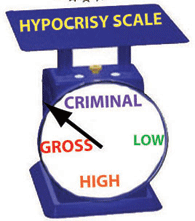 nations, Julie Bishop went further stating the Paris Agreement “recognises that our common purpose is to hold global temperature rise well below 2 degrees, keeping 1.5 degrees in our sights and that this will require a long term transformation to an emissions neutral and climate resilient world”.
These are welcome words, but stacked up against Australia’s woeful climate policy record – they ring hollow and fail to convince. Let’s break down recent Australian government climate policy against Ms Bishop’s words.
Firstly, Australia’s current pollution reduction targets of 26-28 per cent pollution reduction by 2030 are nearly the weakest of any developed nation. If the rest of the world adopted such poor targets, we would likely see global warming of 3-4 degrees – with much more devastating impacts than we are currently witnessing.
Far from nurturing a vibrant and agile renewable energy sector, recent Australian governments have mounted what looks more like a long-running and sustained attack on renewable energy in Australia.
This has resulted in an 88 per cent reduction in investment in 2014 and a weakened Renewable Energy Target. It has effectively stymied progress in the sector at the very time we needed to be stepping up as a global renewable energy leader – and comes despite the fact the Australian public, through rooftop solar PV, has been among the leading adopters of clean energy globally.
At the same time, we’ve witnessed the Australian government unsuccessfully trying to get rid of the Clean Energy Finance Corporation and Australian Renewable Energy Agency. These vital agencies were only saved in the Senate – but the signal from the Federal government was clear for all to see.
Moreover, those carbon abatement mechanisms that have been set up are floundering. Despite $2.55 billion being committed to Australia’s much-vaunted Emissions Reduction Fund (ERF), market analysts RepuTex have found that Australia’s emissions growth is significantly outpacing abatement contracted. The ERF instead uses taxpayer funds and reverse auctions to buy pollution reduction without getting to the heart of the problem – how to break our addiction to the dirty energy sector.
Added to all this, the government has only committed to review Australia’s inadequate raft of climate policies in 2017 – meaning unnecessary delays and offering no certainty that better policies will be implemented any time in the next 12 months.
This inglorious litany of weak policy settings and lack of tangible support for the growth of the renewable energy sector bespeaks Australia’s inability to break the shackles of the fossil fuel industry. It was captured neatly during the Paris climate conference by the global Climate Change Performance Index, which placed Australia third from last in climate policies, above only Kazakhstan and Saudi Arabia.
Despite fine words in international forums, Australia’s carbon pollution from the electricity sector has been steadily increasing. Reporting by the National Greenhouse Gas Inventory shows clearly that changes in the fuel mix – particularly an increase in coal – is driving this pollution growth.

And to top it off, the government has approved one of the biggest coalmines in the world – Adani’s Carmichael coal proposal in the Galilee Basin – a veritable carbon bomb that would strongly contribute to pushing global warming over the 2-degree limit.
So while the world is desperately trying to avert a climate catastrophe and our coral reefs are fighting for their lives, the Australian government is standing alongside global leaders in New York this week having done very little to meaningfully address the problem.
All scenarios that limit global warming to well below 2 degrees require a clean energy transformation that includes rapidly getting carbon pollution out of the energy sector. That means replacing coal-burning power plants with clean renewable energy, an end to new coalmines and fossil fuel developments and a massive ramp up in energy efficiency.
Australia has become the hollow man of the Paris Climate Agreement – spouting fine words in the international spotlight but ultimately bringing nothing substantial to the table. http://www.smh.com.au/comment/australia-is-the-hollow-man-of-global-climate-action-20160420-gob80a.html
Steaming hot world sets more temperature records, especially in Australia
The most abnormally hot regions of the world last month included Australia, which set a record with minimum temperatures almost 2 degrees above the average for 1961-90, while the Arctic region was about 3.3 degrees above average, NOAA said.
‘ Worse things in store’: Steaming hot world sets more temperature records, The Age, April 20, 2016 Peter Hannam Environment Editor, The Sydney Morning Herald
The Earth sizzled in March with the most unusually warm month in recorded history as average land surface temperatures easily exceeded levels deemed by scientists to constitute dangerous climate change.
The abnormal weather has continued into April as the most powerful tropical cyclone ever recorded in the Indian Ocean dumped rain at rates reaching 300 mm an hour, and Australian scientists declared the worst coral bleaching event ever on the Great Barrier Reef.
Combined global land and sea-surface temperatures in March were 1.22 degrees above the 20th-century average, beating the previous record for the month – set just a year earlier – by almost one-third of a degree, the US National Oceanic and Atmospheric Administration said. Each of the past 11 months have now broken global temperature records, the longest such streak in the agency’s 137 years of data collection. Continue reading
The death of the Great Barrier Reef – due to Australia’s carbon exports
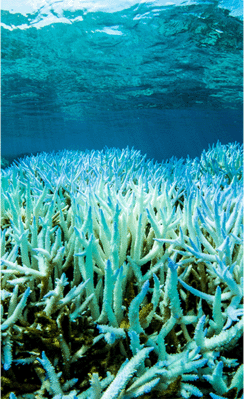 Greenpeace: Australia’s Carbon Exports Are Killing The Reef, New Matilda, By Thom Mitchell on April 21, 2016 On Friday the Australian Government will be in New York presenting itself as a world-leader in the race to reduce carbon emissions, at the official signing of the Paris agreement.
But on the eve of this historic hippodrome, Greenpeace Australia has released a new report which it says puts the lie to the Government’s posturing.
It notes that while Australia’s emissions have remained relatively stagnant since 1990, coal exports have exploded a staggering 253 per cent, and now represent almost twice as much carbon as total domestic emissions of carbon dioxide.
Greenpeace says that this year Australia will “export” one billion tonnes of carbon dioxide, through coal alone. That’s more than it plans to cut down through reducing domestic emissions using the Direct Action in the decade to 2030, according to the report.
It’s a carbon trade that the United Nations process takes no stock of: emissions are counted at the national level. Conversely, the fossil fuels nations export are treated as the responsibility of the importer country where they’re burned.
Greenpeace maintains that in reality – outside the United Nations Framework Convention on Climate Change – “Australia’s overall contribution to global climate change is getting worse, not better”.
The report argues Australia has taken advantage of the international framework around climate change by “growing its coal exports and disowning the consequences”. “This has helped to suppress coal prices, making the dirtiest option more competitive for longer in electricity generation and in steelmaking.” And the iconic environmental group points out the government has no plans to stop.
According to government projections, coal exports will continue to grow nearly two thirds more by 2030. It’s an ambition this government, and the Labor governments before it, have made little secret of……… https://newmatilda.com/2016/04/21/greenpeace-australia-carbon-exports-killing-reef/
Changes to CSIRO may mean loss of international grant money
CSIRO changes risk losing millions of dollars in international grants, leading scientists say, ABC Lateline By political correspondent David Lipson, 20 Apr 16 Some of Australia’s leading scientists say the CSIRO is at risk of losing millions of dollars in international grants due to changes being implemented under CEO Larry Marshall.
Key points:
- CSIRO staff fear they will lose grants due to new CEO
- CEO rejects claims, says valuable research will continue
- Former manager says CSIRO at risk of breaching Paris climate agreements
Lateline has obtained unofficial minutes of a CSIRO staff meeting last month, where one researcher directly raised the United Nations Development Program’s concerns about funding the organisation in future. “The UN told him that in their view, the new CEO was not reliable,” retired CSIRO fellow Dr Nick Abel said.
“And they were frightened that if they did hand over a lot of money to CSIRO under contract, there was a danger that he might cancel those contracts and leave them with the ultimate embarrassment for the UN, which is millions of dollars of unspent money.”
Billions of dollars worth of grants were pledged for climate research and mitigation at the Paris climate talks last year.
Lateline has spoken to a number of scientists who fear the CSIRO’s new innovation and industry focus is leading to a “dramatic reduction” in “public good” science………
Australia ‘reneging’ on Paris agreement, ex-CSIRO manager says
Research manager Dr Peter Craig retired from the CSIRO just over two weeks ago. He believes as well as the loss of reputation and capacity, Australia is also at risk of breaching commitments made at last year’s climate talks in Paris.
“The COP21 agreement actually requires an increase in climate science, not a decrease in climate science,” he said……http://www.abc.net.au/news/2016-04-20/csiro-changes-risk-losing-millions-in-grants-scientists-say/7343750
Australia’s Attorney General George Brandis doubts the science of climate change
Brandis questions climate change science, Herald Sun, April 19, 2016 Attorney-General George Brandis has questioned the science of climate change, saying he’s not “at all” convinced it is settled.
Labor has seized on comments by the senior Turnbull government minister that there were a number of views about the cause of climate change, arguing it proves the deep climate scepticism in the coalition.
“It doesn’t seem to me that the science is settled at all,” Senator Brandis told parliament on Tuesday during debate on the tabling of documents relating to the CSIRO.
The attorney-general was addressing a recent CSIRO restructure – undertaken internally – which will move the focus away from collecting climate data.
About 200 jobs are at risk, however the overall head count is expected to return to current levels within two years………CSIRO head Larry Marshall said in an email to staff when announcing the restructure that the question of climate change had been proved and it was time to refocus on solutions to it.
However, scientists say without continuous data collection – some of which is undertaken by the CSIRO in partnership with the Bureau of Meteorology – huge gaps could form that could never be recovered.
Labor said the attorney-general’s comments were breathtaking.
“The commitment of Senator Brandis to addressing the impacts of climate change is so shallow, he hasn’t made up his mind whether it actually exists yet,” environment spokesman Mark Butler and shadow attorney-general Mark Dreyfus said in a statement. http://www.heraldsun.com.au/news/breaking-news/brandis-questions-climate-change-science/news-story/b64dbb4d1c70a5429142f02f4aca0b3c
Bleaching of Barrier Reef inevitable, unless govt policies change
Great Barrier Reef: Federal, Queensland governments not listening to scientists, ‘Godfather of Coral’ says, ABC News, By Stephanie Smail 18 Apr The Queensland and Federal governments are not listening to scientists about the mass coral bleaching hitting the Great Barrier Reef, a renowned researcher says.
Dr Charlie Veron, a prominent marine scientist who is known as the “Godfather of Coral” for having discovered about one-third of all coral species in the world, described the severe bleaching across the northern reef as “gut-wrenching”.
Dr Veron said he was angry the Great Barrier Reef was not being made a priority. “Governments are being anything but up-front — they’re behaving like a mob of drunken sailors,” he said.
Dr Veron said scientists had warned governments for decades about risks to the reef and frustration was building over state and federal approvals forAdani’s giant Carmichael coal mine in central Queensland.
“For heaven’s sake, take it seriously – listen to scientists for a change,” he said. “They never listen about climate change in general and now they’re not listening about the Great Barrier Reef.”
University of Queensland Professor Justin Marshall, who has been monitoring the reef for decades, also urged action. “I’m now just furious that the Federal Government is still sitting back not doing enough,” he said.
Scientists warn if policy does not change, severe bleaching would keep happening…….http://www.abc.net.au/news/2016-04-18/great-barrier-reef-federal-qld-governments-not-listening-science/7336134
Australia knew about global warming in 1968
US firms knew about global warming in 1968 – what about Australia?, The Conversation, Marc Hudson, April 18, 2016 “……..In 1974, the Australian Conservation Foundation established its Habitatmagazine. An early issue included an article about global warming.
The following year, the economist and bureaucrat Herbert Cole “Nugget” Coombs persuaded the Whitlam government to commission research on the issue. This gave rise to an Australian Academy of Science (AAS) report that concluded it was too early to tell.
By the late 1970s, The Canberra Times began running prominent stories about the possibility of sea-level rise and other climate impacts. One that presumably caught the coal industry’s attention was a November 1977 article in which a US physicist warned that relying only on coal-fired power would flood US cities.
In 1981, the AAS followed up on its earlier work, releasing a report on “The CO₂-Climate Connection: A Global Problem from an Australian Perspective”. At this time, pro-nuclear Liberal politicians were invoking climate change as a reason for Australia to pursue nuclear energy.
The same year, the Office of National Assessment wrote a report for the Fraser government titled “Fossil Fuels and the Greenhouse Effect”. Clive Hamilton, who uncovered it, described how the report urged the government to consider moving away from fossil fuels…….
That decade climate change slowly but surely climbed the political agenda, thanks largely to the work of then federal science minister Barry Jones. In 1987 his Commission for the Future worked with CSIRO under the banner of the “Greenhouse Project” to stage a series of workshops, to be followed – with exquisite timing – by conferences across Australia in late 1988………
the first mention of climate change I found in the now-defunct Australian Journal of Mining was a November 1988 article titled “Physicist claims CO₂ will actually benefit biosphere”……… https://theconversation.com/us-firms-knew-about-global-warming-in-1968-what-about-australia-57878
Australia’s government completely beholden to fossil fuel industries

 The links between big polluters and politicians , The Saturday Paper, BILL MCKIBBEN, 16 Apr 16 “…….Despite the crisis unfolding around it, the current Australian government seems determined to ignore the role it has to play in preventing the planet from cooking.
Six months ago, Australia agreed to the Paris deal. Yet, since then, Australia has reapproved one of the world’s largest coalmines, opened a new research centre for the fossil fuel industry, cut funding for renewable energy, cut funding for climate research. The bewildering list goes on and on…..
Australia’s political system is …….becoming more and more American with each new donation. Until recently you had a prime minister who, between mouthfuls of onion, told the world that coal was good for humanity.
Granted, Malcolm Turnbull is no Tony Abbott. But Turnbull is also friendly with the fossil fuel industry. Just this week in Perth, he attended a dinner with the CEOs of Shell, Chevron and Woodside. Blocked by radical conservatives and wined and dined by the fossil fuel industry, Australia is now left adrift with a laughable climate strategy.
As the planet burns, Australia continues to dig up more fossil fuels. But it’s no surprise when you look at the amount of cash changing hands between your politicians and the big polluters.
In fact, for every $1 the fossil fuel industry has donated to Australia’s major political parties since your most recent federal election, they will be handsomely rewarded with $2000 worth of handouts in the upcoming federal budget. We have a similar crisis in the US. The more donations the industry gives to congress, the more they get back in subsidies. Recent research shows members of the US house of representatives who voted in favour of the Keystone Pipeline got 13 times more in donations from Big Oil than those who voted against. All up, five key refinery companies spent $58.8 million lobbying.
Like the US, the companies that donate most in Australia are those that have the most to lose from your government taking action on climate. They’re companies such as Australia’s biggest carbon polluter, AGL; or Origin, whose existence depends on throwing a wrecking ball through the solar and wind sector; and Chevron, from the same family of companies as Exxon, which knew about the climate damage we were setting ourselves up for yet pushed its dangerous product onto the world.
And then there’s the revolving door between your government and the mining industry. One of your chief negotiators on the Kyoto Protocol left public service to become the head of the Australian Coal Association. Australia’s former climate change minister is now an adviser to AGL and Santos. The deputy prime minister to John Howard left parliament to sit on the board of Whitehaven Coal. Heck, one of your richest coal barons is a sitting parliamentarian. And this is just the tip of the melting iceberg: it doesn’t consider the many staffers and unelected individuals who walk back and forth between parliament and the fossil fuel industry. This is why Prime Minister Turnbull has no climate plan. His government is full of climate deniers and fossil fuel fanatics whose political life depends upon blocking climate action. …..
Parliamentarians such as Cory Bernardi, who has spent his time in Canberra questioning the weather bureau and running “grassroots” campaigns to axe the carbon price. Or Angus Taylor, who describes human-induced climate change as “religion” devoid of facts. People such as former oil and gas executive, now senator, Gary Gray, who helped found one of the world’s most notorious climate denialist think tanks…….
The incoming federal election means politicians currently have their ear to the ground. Right now is a perfect opportunity to begin calling for an end to polluter handouts and donations – and real action on climate change.
It will take a movement to break the link between Australia’s politicians and the big polluters. But the foundations for a pollution-free politics, here in Australia and around the world, are building by the day. https://www.thesaturdaypaper.com.au/opinion/topic/2016/04/16/the-links-between-big-polluters-and-politicians/14607288003136
Election: Liberal and Labor prefer to ignore Climate Change
 Climate change has dropped off the political radar (and this is a big problem) ABC THE DRUM, 14 APR 16 By Mike Steketee The aversion to talking about climate change during the election campaign reflects a wider problem: our concern for this issue has fallen even while it has become larger and more urgent, writes Mike Steketee.
How much of an issue will climate change be in this year’s election?
Not a major one, if Malcolm Turnbull gets his way. He has saddled himself with Tony Abbott’s policy as one of the costs of appeasing the conservatives in his ranks.
And while Bill Shorten will be arguing he has a superior policy – but also risking a fear campaign over re-introducing a carbon tax – Labor, too, believes it has bigger fish to fry, such as pushing forward its credentials on education and health. Continue reading
Great Barrier Reef will soon be unable to cope with global warming
Now the scientists have found that the coping mechanism barrier reef corals use to prepare themselves to face warm summer water is also under threat from global warming, and from human activities such as agriculture, shipping, and fishing.
“As temperature warms, the evidence is that this protective mechanism will no longer function
How the Great Barrier Reef is going from bad to worse Christian Science Monitor, 14 Apr 16 Though the corals of Australia’s Great Barrier Reef historically have managed to adjust to gradually warming seawater of the summer months, they will likely lose their defenses when the ocean warms overall in the near future, say scientists.This was the latest finding from a team of American and Australian coral reef experts from James Cook University, the University of Queensland, and the US National Oceanic and Atmospheric Administration (NOAA).
These same scientists recently reported that their aerial surveys of some of the 3,000 coral reefs that make up this iconic natural wonder off Australia’s northeastern coast have showed that coral bleaching this year is the worst that has ever been observed. This is largely due to a recurring weather event known as El Niño, a storm system that is expected to become more frequent and more severe in the future.
I agree that El Niño is a natural variability; it’s a part of nature, but that variation in patterns and temperatures is superimposed upon a trend of warming,” Scott Heron, a NOAA coral reef scientist based in Australia, tells The Christian Science Monitor in an interview. “There are ups and downs, but now there are just higher ups than ever before, and the downs are not as low,” he says.
Coral bleaching happens when ocean temperatures rise to a point that zooxanthellae – tiny algae that live on corals and provide them with nutrients and their radiant colors – leave their coral homes, thereby rendering coral white or “bleached.” When corals go without zooxanthellae for too long, they die. This affects about a quarter of marine species that depend on coral reefs for shelter, and the humans who depend on those species for their livelihoods.
This year’s is the third major bleaching event in recent history for the 2,300-kilometer-long Great Barrier Reef, which is home to one of the most diverse ecosystems in the world. But this one is much worse than the bleaching events that occurred in 1998 and 2002, say scientists who recently found bleaching in almost 1,100 kilometers of northern barrier reef, from the island of New Guinea to the Australian coastal city of Cairns. The researchers estimate that 30 to 50 percent of the corals there are already be dead.
Now the scientists have found that the coping mechanism barrier reef corals use to prepare themselves to face warm summer water is also under threat from global warming, and from human activities such as agriculture, shipping, and fishing.
“As temperature warms, the evidence is that this protective mechanism will no longer function,” C. Mark Eakin, a scientist with NOAA Coral Reef Watch, tells the Monitor in an interview…….
The most viable immediate remedy, say paper authors, is to reduce the carbon emissions that cause warming and restrict other human activities near the reefs that add more stress, including runoff from agriculture, unsustainable fishing practices, and physical damage to the reef from ship groundings.
“These are all human stressors on reef that have to be minimized or eliminated for reefs to be able to bounce back from these bleaching events, even in a decade or two,” Eakin says.http://www.csmonitor.com/Science/2016/0414/How-the-Great-Barrier-Reef-is-going-from-bad-to-worse
1 This month



Help Aunty Sue Protect Her Land and Sacred Sites From Destructive Rocket Testing.
.

Australians deserve the truth
about
AUKUS – https://aukuspublicinquiry.com/

PETITION – To: Prime Minister Anthony Albanese and the Australian Labor Government

of the week – Australians for War Powers Reform (AWPR)
To see nuclear-related stories in greater depth and intensity

