Climate Institute Report recommends shutdown of coal plants, and real price on carbon
Shut down coal power, price carbon: report http://www.news.com.au/national/breaking-news/shut-down-coal-power-price-carbon-report/news-story/5eee677132223a88b2c3ed14d603a701 APRIL 14, 2016 By Elise ScottAAP
The Climate Institute report found delaying a transition to cleaner energy until 2030 would cause sudden unemployment in some communities and drive up electricity costs. A “modest” carbon price of $40 per tonne by 2030 alone would not be enough to mitigate the need for fast, deep emission cuts, the modelling found. That price would achieve the Turnbull government’s 26 to 28 per cent target by 2030 but would also mean a 60 per cent collapse in projected clean energy growth from 2020, the report found. Continue reading
Australian authorities covering up severity of Great Barrier Reef’s plight
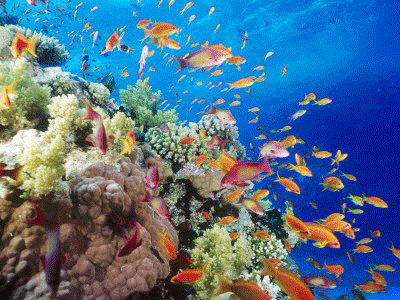 Great Barrier Reef disaster: Marine biologist lashes out at reef authorities for ‘cherry-picking to try and paint a better picture’ IBT, By Ritwik Roy @ritwikroy1985 on April 14 2016 The Great Barrier Reef is getting destroyed by massive coral bleaching, and marine biologist Glen Holmes is disappointed with the statements by the Reef and Rainforest Research Centre (RRRC). Despite reports that the Great Barrier Reef may never recover from the extent of damage done by widespread coral bleaching, the RRRC has said that popular diving areas near Cairns have suffered only low levels of damage.
Recent underwater surveys have found that of the 32 reefs between Lizard Island and Cairns, only five percent have suffered from bleaching and that only has low level of damage. RRRC managing director Sheriden Morris said the bleaching was “patchy,” which means the corals have a good chance of recovery. However, Holmes believes it is too early to be passing such comments.
“It’s way too early to be hanging comments off reports on the level of mortality. I think they’re cherry-picking to try and paint a better picture,” said Holmes.
Morris on the other hand believes reefs off Cairns are more likely to recover than others, reports AAP.
Unfortunately, according to Independent Australia, the Great Barrier Reef may lose out to mining giant Adani as State and Federal governments are favouring the mining giant more than the world heritage site. This has irked conservationists around the globe and numerous Australians who want to preserve the natural wonder.
CEO of the Australian Conservation Foundation, Kelly O’Shanassy said that if Federal and State governments side with Adani, there will be “hell of a fight.” The Queensland government had already given Adani the licence to dig Australia’s biggest ever coal mine.
Adani’s Carmichael coalmine will produce massive climate pollution and as the Great Barrier Reef can undergo coral bleaching with even a little temperature change, O’Shanassy is at a loss of words and she can’t believe how the licence was given as Carmichael will be raising Australia’s water temperatures greatly.
According to The National Coral Bleaching Taskforce, almost 95 percent of the reefs in the northern region are severely bleached. The convenor of the taskforce, Professor Terry Hughes, said every reef showed highly levels of bleaching “from the reef slope right up onto the top of the reef.”
“We flew for 4000km in the most pristine parts of the Great Barrier Reef and saw only four reefs that had no bleaching. The severity is much greater than in earlier bleaching events in 2002 or 1998,” Hughes added……. http://www.ibtimes.com.au/great-barrier-reef-disaster-marine-biologist-lashes-out-reef-authorities-cherry-picking-try-paint?utm_source=www.titles.ws&utm_medium=links&utm_campaign=BolsaDeNoticias
Carbon Disclosure Project lists Canberra as a global climate change leader
Canberra ranked as a global climate change leader, http://www.canberratimes.com.au/act-news/canberra-ranked-as-a-global-climate-change-leader-20160408-go1utu.html, James Hall Canberra’s ranking as a global climate change leader by the Carbon Disclosure Project is an “important acknowledgement”, Climate Council chief executive Amanda McKenzie says.
The CDP placed the capital among the top 10 cities in the world for its “quality and completeness” of environmental risk reporting.
“It’s not just that one area of the policy is doing well [to be ranked so highly],” Ms McKenzie said. “Reducing emissions, adequately reporting and disclosing internationally, a renewable energy policy, a risk assessment of what the climate change impact will be and have a plan to adapt to those consequences.”
Despite the ACT being significantly smaller than other states and territories and not having coastal environmental concerns, she said the city had substantial environmental elements affecting its climate.
She said Canberra’s recognition by the CDP is significant because its size is more common globally and it provides a more realistic comparison on how to implement sustainable technologies and processes. “Our view is that it is a very good example of how you transition a community that has previously been reliant on fossil fuels and moving towards more renewable energy,” Ms McKenzie said.
ACT Environment and Climate Change Minister Simon Corbell said the government had shown Canberrans and the world it was committed to tackling climate change. “In doing so we are also showing the world that moving to a low-carbon economy is not only achievable and affordable, but also can be a benefit to both the community and our economy,” he said. “By attracting renewable energy companies to Canberra and fostering a positive environment for renewable energy operation, research and development through our progressive policies we have positioned the territory to take advantage of growth in the renewable energy industry”.
Much of the sustainable energy being harnessed by the nation’s capital is being supplied by interstate facilities, but Ms McKenzie said it was the implementation of the energy being produced which is both environmentally responsible and economically innovative.
“It depends on why those projects have been built and if Canberra has played a significant role in making those projects get off the ground,” she said. “And then if the electricity is then being used by Canberra, the ACT has then brought in the investment for plants.”
“That is also reflected in some of the local businesses that now exist in Canberra, like Reposit Power for instance, businesses are being attracted to Canberra because it is a better investment environment for renewable energy than other parts of the country.”
Since Liberal Coalition govt dumped carbon price, greenhouse emissions have soared
 Electricity emissions soar since Coalition dumps carbon price, Independent Australia Giles Parkinson 9 April 2016 RenewEconomy‘s Giles Parkinson discusses Australia’s rapidly rising electricity emissions following the Coalition’s axing of the carbon price and in direct contradiction to the Paris climate agreement.
AUSTRALIA’S ELECTRICITY emissions continue to rise and are now 5.5 per cent higher than they were before the carbon price was dumped, putting Australia against the global trend which is seeing energy emissions flat-lining even as the global economy expands.
Pitt & Sherry analyst Hugh Saddler says in his latest monthly survey that total emissions from electricity generation in the National Electricity Market (NEM) – all but Western Australia and the Northern Territory – increased again in the year to March 2016.
Annual emissions were 5.5 per cent higher than in the year to June 2014, when the Coalition killed the carbon price introduced by the Labor Government, to much acclaim from the government.
This startling jump in emissions comes despite the fact that Australia has signed up to the Paris climate agreement, which seeks to limit global warming to 2°C, and if possible 1.5°C. Energy emissions, according to the International Energy Agency, have flatlined for the past two years.
The rise in emissions also comes amid rising global CO2 levels, soaring temperatures, and the most serious coral bleaching event ever witnessed in the Great Barrier Reef.
Saddler blames the rise in emissions on a number of factors. One is the removal of the carbon price, which paved the way for more burning of coal, black coal in particular.
Another is the rise in coal generation in Queensland to support the exports of liquefied natural gas — which will contribute an extra 8 million tonnes of CO2 equivalent a year. Continue reading
Climate denialist Maurice Newman might split the Liberal Party?
Maurice Newman claims to be head of business council disbanded by Turnbull
Former adviser to Tony Abbott says Malcolm Turnbull’s ‘left leaning positions’ could lead to formation of breakaway conservative party, Guardian, Lenore Taylor, 8 Apr 16 Businessman Maurice Newman has insisted he remains the head of the prime minister’s business advisory council, despite being informed by Malcolm Turnbull last year that the council was being disbanded.

Last September Guardian Australia revealed that Newman’s term as chairman of the prime minister’s business advisory council had expired and that a spokesman for Turnbull had confirmed he would not be reappointed………
Newman, a strong supporter of former prime minister Tony Abbott, told Lateline Turnbull’s “left leaning positions” could potentially lead to the formation of a breakaway conservative party…….
Asked whether he was saying Turnbull’s leadership could lead to the emergence of a new conservative party Newman replied “Well, I think it’s most likely that if the people who support the Liberal party and the Liberal party values find that essentially it’s a Labor-like party, then they’ll clearly be attracted to whatever alternatives might be presented to them.”
He nominated “giving more money” to renewable energy and the Clean Energy Finance Corporation as Labor-like policies being undertaken by the Coalition.
Newman has used a weekly column in the Australian to expound his views on climate change, including that the world was ill-prepared for a period of global cooling and that the United Nations was using debunked climate science to impose a new world order under its own control.
He also called for a government-funded review of the Bureau of Meteorology to “dispel suspicions of a warming bias” in its temperature record-keeping, something freedom of information documents last year revealed was under consideration by the former prime minister’s department…….http://www.theguardian.com/australia-news/2016/apr/08/maurice-newman-claims-to-be-head-of-business-council-disbanded-by-turnbull
Minister Greg Hunt did not impress David Attenborough, with his uninformed comments about the Great Barrier Reef
 Greg Hunt rebuked by Attenborough film-maker after upbeat verdict on Great Barrier Reef http://www.theguardian.com/environment/2016/apr/08/greg-hunt-rebuked-by-film-maker-after-great-barrier-reef-verdict
Environment minister told to ‘watch the series’ after saying David Attenborough documentary is evidence reef is safe, Guardian, Melissa Davey and Steph Harmon, 8 Apr 16 Enamoured by stunning footage in David Attenborough’s latest documentary series, the Australian environment minister, Greg Hunt, took it as proof that theGreat Barrier Reef remained an untouched beauty.
But he might have been better off waiting to see the whole series before commenting.
“The key point that I had from seeing the first of the three parts is that, clearly, the world’s Great Barrier Reef is still the world’s Great Barrier Reef,” Hunt told theCourier Mail.
The documentary was one of “profound importance” that “Australia would rightly be proud of”, he continued, and was evidence that the reef was not facing the death that climate change scientists and environmentalists feared.
Hunt made the comments after seeing part one, which airs on the ABC on Sunday night. Had he watched the full series, however, he would have seen footage of coral bleaching and heard Attenborough describe, in the final part of the documentary, how “the Great Barrier Reef is in grave danger”.
“The twin perils brought by climate change – an increase in the temperature of the ocean and in its acidity – threaten its very existence,” Attenborough says.
“If they continue to rise at the present rate, the reefs will be gone within decades. And that would be a global catastrophe. About a quarter of the species of fish in the world spend some part of their lives in the reefs. If the reefs go, the fish will also disappear. And that could affect the livelihood and diet of human communities worldwide.”
The producer of the Great Barrier Reef series, Anthony Geffen, responded to Hunt’s comments, encouraging him to “watch the series, you know”.
“It’s like watching one of those Hollywood movies when everybody’s happy at the front and everybody’s dead at the end, and saying, ‘Well I think the family was really happy and everybody’s really good’, but you haven’t got to the end of the movie, where his whole family is lying on the floor dead,” Geffen told Guardian Australia.
Geffen said the series captured “horrific” levels of coral bleaching, which occurs when rising sea temperatures destroy the tiny marine algae that live inside corals’ tissue and provide up to 90% of the energy corals require to grow and reproduce.
“It was horrific and, obviously, we’ve been very much still in touch with the scientists and some of the areas we’ve just filmed in have been devastated by bleaching,” he said.
“And, in fact, scientists were asking for our footage so they could compare what had disappeared, which is quite extraordinary. I mean [the documentary] is only just coming out in Australia and already the footage is being used as archives to [document] the destruction of the reef.”
However, Geffen described the series, which has already aired in the UK, as “bigger than” and “above” politics.
“This series has gone out to, I think by the end of the year, a billion people or something – that’s what people should be reflecting on,” he said. “And I hope it doesn’t get hacked over by political means and ends, because it shouldn’t.”
Paris climate agreement to be signed by Australia
 Australia to sign Paris agreement on climate change, ABC News 7 Apr 16 By environment reporter Sara Phillips Australia will be among the first countries in the world to sign the Paris agreement on climate change, with a “very senior” representative being sent to a signing ceremony in New York later this month, according to government sources. Continue reading
Science for The Public Good: if not CSIRO – then who?
If the CSIRO won’t do research for the public good, who will?, The Age, April 7, 2016 Les Field
Australian society will be the biggest loser if the organisation is forced to abandon its blue-skies work. Scientists in Australia’s universities and research organisations are responsible for ground-breaking inventions such as the world’s first effective influenza drugs; smart mathematics that enabled superfast Wi-Fi and the bionic ear. These have also been resounding commercial successes, and show that local discoveries can be profitable.
Government policy emphasises the importance of commercially focused research and rightly encourages researchers to fully capitalise on their discoveries. But, in our focus on innovation geared towards commercialisation, have we overlooked the tremendous value to our community of research done in the public interest?
It is in this context that the emails sent between CSIRO executives revealed this week are worrisome. The email trail suggested that, in early stages of planning, there was a contemplation of removing all public-good climate research from CSIRO – that “public good” was not considered to be sufficient reason for CSIRO to be carrying on research. While it is important to realise that CSIRO’s priorities will rightly change from time to time to reflect the challenges facing Australia, this sentiment does raise some difficult questions about its role in Australia’s overall science and research effort.
Some of the most critical challenges our society faces – such as combating epidemics of chronic disease or finding ways to better predict natural disasters, or improving our ability to live the good life while caring for our environment – have almost no prospect of generating a commercial return. Yet every Australian would attest to their importance, and recognise that research in these areas contributes greatly to the welfare of the community………
The larger question that must be asked is that if CSIRO is no longer to consider public-good research as a valid endeavour, then who does? Australia’s science and research effort is made up of many players, who all have distinct roles. A substantial contribution to public interest research is made by our universities, who produce much of the fundamental knowledge that innovations are based upon. However, most university researchers work on relatively short projects, dictated by grant cycles……
It is also important to consider that, in the absence of co-ordinated public-interest research, who will investigate uniquely Australian problems? Without the knowledge and expertise of CSIRO’s animal health laboratories, would we today have the vaccine to the Hendra virus that can prevent its passage from bats to horses and then to humans? Who could provide us with a picture of the sustainable limits of water use in the Murray-Darling river system? Who can tell us about the likely impacts of long-term climate change on our coastal cities and our vital agricultural industries? http://www.theage.com.au/comment/if-the-csiro-wont-do-research-for-the-public-good-who-will-20160407-go0p4r.html#ixzz45GxrXlQX
Carmichael coal project – the whitest of white elephants
 Adani’s Carmichael mine is just not going to happen, The Age, April 5, 2016 Michael West Business columnist Adani is not going to happen; the construction, that is, of the leviathan Carmichael mine, the world’s largest thermal coal mine in the hinterland of the Great Barrier Reef.
Much is the wailing and gnashing of teeth at the move by the Queensland government to approve the project but this approval is entirely political.
The evidence is compelling. Carmichael is the whitest of white elephants.It is all about the appearance of commitment to jobs, jobs that will never occur unless the coal price doubles, and it is about the government not getting bashed up by the opposition for being anti-jobs and abandoning its election commitments.
Even Adani is coy. No sooner had the Indian conglomerate been granted approval than it deferred the project for another year. Buried in the detail of its press release was this: “opportunity for final investment decision and construction in 2017”.
Reaching “final investment decision” would require willing financiers with a cool $10 billion just for Phase One. But Adani’s bankers have long since fled the scene.
There would be no taxpayer support nor “dredging [of the reef] at Abbot Point [port] until Adani demonstrates financial closure,” said Resources Minister Anthony Lynham.
The head of the world’s biggest power provider, chairman Liu Zhenya of China’s State Grid Corporation, recently told a US energy conference the ramp-up of renewable energy and ongoing integration of wind and solar power projects into the grid were gathering pace.
“A fundamental solution [to address power needs and climate change] is to accelerate clean energy,” Liu told his audience of energy executives. The eventual aim was “replacing coal and oil”.
Bureau of Meteorology might be able to take over CSIRO’s lost climate research
 Bureau of Meteorology plan to take over CSIRO climate change research, The Age, April 5, 2016 Adam Morton, Peter Hannam, The Bureau of Meteorology has offered to save climate research that CSIRO plans to axe under a plan that would see long-term programs and dozens of jobs transfer between the two national science agencies.
The proposal, discussed at a meeting convened by chief scientist Alan Finkel last month, is the most concrete of several ideas thrown up by the scientific community in a bid to retain internationally respected climate researchers and data collection.
Scientific agencies were taken by surprise when CSIRO chief Larry Marshall announced in February that the organisation would stop climate data collection as it re-positioned itself as an “innovation catalyst”, focusing on work that was financially attractive to government or private partners.
The recasting of the century-old Commonwealth Scientific and Industrial Research Organisation, initially linked to about 350 job cuts including up to 100 climate scientists, has drawn criticism from some research institutions in Australia and overseas.
It is understood the Bureau of Meteorology put forward two proposals that would see it hire either 40 or 50 CSIRO scientists as it took on more climate measurement and modelling – but was contingent on additional funding to pay for them. CSIRO is yet to respond in detail……….. Continue reading
Queensland government takes an evil decision on Adani’s Carmichael coal mine
 Decision on coal mine ‘defies reason’ April 4, 2016 Tim Elliott Features and investigations journalist for The Sydney Morning Herald
The decision on Sunday to approve mining leases for Queensland’s Carmichael coal mine is akin to “evil”, according to one of the world’s foremost marine scientists.
“It defies reason,” said Dr Charlie Veron, former chief scientist at the Australian Institute of Marine Science. “I think there is no single action that could be as harmful to the Great Barrier Reef as the Carmichael coal mine.”
The $21.7 billion project, which involves mine, rail and port facilities, would allow Indian multinational Adani to extract 60 million tonnes of thermal coal a year from the Galilee Basin, in central Queensland. Adani claims the mine will generate 5000 jobs during construction and more than 4000 during operation, with construction to begin next year……..
conservationists say the mine is an environmental disaster waiting to happen, citing particular risks to the Great Barrier Reef.
“It’s an extraordinary decision, especially coming at a time when the Great Barrier Reef is experiencing its worst ever coral bleaching event,” Australian Conservation Foundation chief executive Kelly O’Shanassy said. “We know the bleaching is because of global warming, and Carmichael will only make that worse.”
By Adani’s own figures, the mine and its coal will emit more than 4.6 billion tonnes of carbon dioxide over its lifetime. “The pollution from this mine is so big that it cancels the pollution cuts the Turnbull government committed to at the Paris Climate Summit,” Ms O’Shanassy said.
The impact of such emissions could be terminal to the reef, according to Dr Veron. “The reef is obviously in dire straights, irrespective of what anyone says, and that’s blindly obvious.
“There is extraordinary disconnect between science and the political action. Politicians think the mine is good because it’s good for economy, but we are selling out the next generation of Australians as fast as we can go.”
Dr Veron has devoted his life to studying coral reefs: he discovered more than 20 per cent of the world’s coral species, and has been likened by Sir David Attenborough to a modern day Charles Darwin.
“Roughly a third of marine species have parts of their life cycle in coral reefs,” Dr Veron said. “So if you take out coral reefs you have an ecological collapse of the oceans. It’s happened before, mass extinctions through ocean acidification, and the main driver of that is CO₂.”
Dr Veron recently travelled to Canberra to talk to government about the decline in the reef. “The politicians do listen to scientists, but that is the worst part of it,” he said. “If this was all done out of sheer ignorance, that is sort of understandable. It’s like child porn – you might say you don’t know it exists, but if you know it exists and you do everything to promote it, then that’s evil.”…….
Australian Institute of Marine Science principal research scientist Dr Frederieke Kroon has told the ABC that government policies designed to keep the reef on UNESCO’s World Heritage list are insufficient.
“Our review finds that current efforts are not sufficient to achieve the water quality targets set in the Reef 2050 Plan,” she said. http://www.smh.com.au/federal-politics/political-news/decision-on-coal-mine-defies-reason-20160403-gnxbc6.html#ixzz44p5A45Es
Australia had hottest March on record
 March temperatures sets record as hottest ever, Bureau of Meteorology says http://www.abc.net.au/news/2016-04-01/march-temperatures-sets-record-as-hottest-ever,-bom-says/7293500?section=environment By environment reporter Sara Phillips You could be forgiven for not noticing the end of summer — March was a hot one.
Information released by the Bureau of Meteorology (BoM) indicated it was the hottest March on record, reaching 1.7 degrees Celsius above the long-term average. This eclipsed the 1986 record of 1.67 degrees above the average, BoM said in its monthly climate report.
The unusual heat was particularly noticed in the Top End, where the failure of the monsoon allowed temperatures to creep up. This, coupled with a high pressure system off the east coast of Australia, caused a heatwave strong enough to prompt BoM to issue a special climate statement about the phenomenon.
March 2 became Australia’s hottest day on record.
Averaged across the country, it reached a top of 38 degrees Celsius. There was no relief overnight either with minimum overnight temperatures the warmest ever, smashing the 1983 record by 0.83 degrees.
The hot March came on the back of the hottest February globally, and the hottest year for 2015.
A strong El Nino weather pattern prevailed at the start of the year, which has traditionally been associated with hotter weather. Although the El Nino is weakening, the heat effects are expected to persist for a few more months.
Climate change is thought to be adding to the unusual heat. The scorching start to 2016 prompted Australia’s chief scientist Alan Finkel to warn that the world was “losing the battle” against climate change.
Impact of climate change on Victoria worse than previously thought
Climate change fears worsen following University of Melbourne and CSIRO research April 1, 2016 CHRIS McLENNAN The Weekly Times THE impact of climate change on Victoria’s weather could be twice as bad as previously thought.A team of University of Melbourne and CSIRO researchers believes popular computer predictions over-estimate the flow of rain run-off into rivers.
Victorian Government scientists believe the state faces a much warmer and drier future which could result in longer fire seasons, less rainfall in winter and spring south of the Great Dividing Range, and less rainfall in autumn, winter and spring in the north.
Scientists say climate change is already being felt across Victoria, with a rise in temperature and a drop in rainfall since 1950.
The university research found climate modelling failed to adequately cater for drought. Under prolonged dry conditions, modelling predicted twice as much run-off into rivers and catchments than was occurring,” Prof Andrew Western said……..http://www.weeklytimesnow.com.au/news/climate-change-fears-worsen-following-university-of-melbourne-and-csiro-research/news-story/cac037efb28f859f6f491d0fbc70ef46
Future Fund must not finance Adani’s Carmichael coal mine
Australia’s ‘future’ fund should not consider financing the energy projects of the past http://www.theguardian.com/commentisfree/2016/apr/01/australias-future-fund-should-not-consider-financing-the-energy-projects-of-the-past Stephen Bygrave
Australia can be a renewable energy superpower if it plays its investment cards right – we have to move on from our misguided fossilised past
It was all over the news in India. The Indian finance minister Arun Jaitleywould be meeting Future Fund chairman Peter Costello to discuss using the Fund to help finance Adani’s Carmichael coal mine. There was no announcement of the meeting in Australia, but the questions must be asked: how should Australia’s sovereign wealth fund be used, and should it, a “future” fund, be considering the energy projects of the past?
The prospect of Costello dedicating sovereign funds to the massive coal mine in the Galilee Basin is so misguided. Future energy investment lies in renewables, not coal, and this trend is already playing out worldwide. The Australian economy already runs a real risk of becoming fossilised, caught in the past and missing out on the huge investment market in renewable energy as the world inevitably decarbonises and shifts to a zero emissions economy.
This global transition to renewables is an unavoidable condition for containing global warming below 2C. The future is renewables, the past is coal, and the economic benefits are easy to highlight.
In this transition, Australia stands to attract a major portion of the $2.3tn annual trade value from emissions-intensive trade-exposed industries, like cement, steel, and aluminium. In this era, countries with abundant, cheap, high quality renewable energy will attract these industries.
The Renewable Energy Superpower report to be released in Sydney on Monday 4 April shows that Australia is consistently in the global top three of countries with economic wind and solar energy resources, whether based on energy production potential per square kilometre, energy production potential from total land area, energy production potential from un-utilised land area, or energy production potential from rural land area.
Under various scenarios developed by the International Energy Agency for their WorldEnergy Outlook, investment in renewables and energy efficiency will make up around half of the future investment in energy in the next two decades, with investment in coal only making up 1-2%.
Whichever scenario the IEA looks at, renewables and energy efficiency attracts more investment in the next two decades than coal, oil and gas combined. Some $28tn is expected to be invested globally in renewable energy and energy efficiency by 2035.
Investment in renewables and energy efficiency globally is already large – around US$390bn isestimated to have been invested in 2013 alone, according to the International Energy Agency. In order to contain global warming to the 2C, the IEA estimates the annual investment in this market to more than double by 2020 to around US$750bn annually, and then to grow exponentially to US$2,300bn annually by 2035.
It also estimates that the renewables dominated power sector and energy efficiency markets will be 20-40 times the value of future coal sector development. The other important point that is relevant to Australia is that power sector and energy efficiency investment is skewed towards Australia’s neighbours in the Asia-Pacific region (40%) compared to global fossil energy investment (25%).
So how large is Australia’s renewable energy resource? While it is widely accepted that the total renewable energy resource across Australia is significant, the Superpower report conservatively models only the solar and wind resource that is available within 10kms of Australia’s existing electricity grid and able to generate power at a price competitive with other new power stations.
This is the resource that is immediately available to the existing electricity grid. The results are staggering even when only this small portion of Australia’s total renewable energy resource is captured – it is equivalent to 5000 exajoules, enough to power the world for 10 years.
Put another way, this solar and wind resource is greater than Australia’s coal, oil, gas and nuclear resources combined. Many proponents of fossil fuels argue that there are enough fossil fuels to power the world for hundreds of years, that coal is cheaper and isgood for humanity. These arguments ignore the reality that burning fossil fuels is incompatible with meeting the globally agreed goal of limiting warming to 2C, that new renewables are cheaper than new coal and new gas, and that many developing countries want solar.
In the decarbonised world in which we are heading, Australia will be a renewable energy superpower if it plays its investment cards right. If we are serious about our Future Fund funding the future for all Australians, it is renewables – not coal – where the investments must be made.
Guardian Australia and the author sought comment from Future Fund before publication. Future Fund responded after publication with the statement that “Finance Minister Jaitley has never raised Adani with the Future Fund.”
Urgent need to shift to zero carbon power – as soon as 2018
“If the time for halting investments into new fossil fuel infrastructure is 2017 for the world, that time has been 10 years ago for Australia – the highest per-capita emitter in the developed world.”
renewable energy ventures are likely to meet any near-term need for additional large-scale capacity
 Shift to zero-carbon power must start by 2018 to avoid extra warming: study http://www.theage.com.au/environment/climate-change/shift-to-zerocarbon-power-must-start-by-2018-to-avoid-extra-warming-study-20160331-gnuy7x.html April 1, 2016 Peter Hannam Environment Editor, The Sydney Morning Herald The world must begin the shift to zero-carbon sources of electricity as soon as 2018 to avoid adding new fossil-fuel power plants that will lock in dangerous climate change, according to a team of Oxford University researchers.
Taking the average operating life of coal or gas-fired plants as 40 years, the world’s fleet of carbon-emitting power stations had already committed by 2014 a total of 87 per cent of the emissions required to ensure a 50-50 chance of reaching two degrees of warming compared with pre-industrial levels.
By 2017, the remaining stock of potential emissions will have been locked in, necessitating a transition to renewable or zero-emissions electricity from then on. Alternatively, radical technologies will be needed to sequester carbon dioxide or extract it from the atmosphere, the researchers including Australian Cameron Hepburn wrote in a paper published in Applied Energy journal.
“For policymakers who think of climate change as a long-term future issue, this should be a wake-up call,” the authors said in a statement. “Whether we succeed or fail in containing warming to 2 degrees is being determined by actions we are taking right now.”
The papers come in a week when environmental groups warned as many as 1500 coal-fired power plants are being planned or being built worldwide, scientists found coral bleaching in the Great Barrier Reef to be worse than first thought, and Antarctic ice sheets were declared to be melting faster than expected.
Electricity generation accounts for about one quarter of man-made greenhouse gas emissions and about one third of Australia’s total. The researchers assumed other emission sources, such as transport and agriculture, would track towards a 2-degree warming limit, an assumption “which may well be optimistic”, the paper notes.
Australia was one of almost 200 nations to sign up to limiting warming to a 1.5-2 degree range at the Paris climate summit late last year.
The lower end of that target has been well exceeded, the researchers argue: “Meeting a 1.5-degree target without [carbon capture and storage] or asset stranding would have required all additions to the electricity sector were zero carbon from 2006 onwards, at the latest”.
Malte Meinshausen, director of Melbourne University’s Climate & Energy College, said the research confirmed work by the International Energy Agency and others “that we now have enough fossil fuel infrastructure globally in place to emit a detrimental amount of carbon”.
“With the correct market signals in place – such as a price on carbon emissions – it will be more economical even for the utilities to abandon fossil fuel [plants] and switch to renewable investments instead,” Associate Professor Meinshausen said. “If the time for halting investments into new fossil fuel infrastructure is 2017 for the world, that time has been 10 years ago for Australia – the highest per-capita emitter in the developed world.”
As it happens, the combination of Australia’s flat or declining demand for grid-supplied electricity and the need to meet the mandated 2020 Renewable Energy Target (RET) means there is little likelihood of new coal or gas-fired power plants being built in this country for at least the next decade, said Dylan McConnell, a research fellow at Melbourne University’s Melbourne Energy Institute.
While there are several proposed gas projects and one black coal project in NSW at AGL’s Bayswater site, renewable energy ventures are likely to meet any near-term need for additional large-scale capacity, Mr McConnell said.
Some 14,000 megawatts (MW) of wind or solar plants are seeking approval, a tally that is “certainly much more than needed for the RET”, he said. “The cost curve for fossil fuel [plants] is going in the other direction.”
This week, Origin Energy signed up for its first power purchase agreement for large-scale solar, taking output from a 56 MW solar farm in Moree in northern NSW.
“Ten years ago, 15 years ago the prospectors were in Queensland looking for [coal seam gas] resources,” Grant King, Origin’s chief executive, said last year. “I would think the next great round of investment in Queensland will be utility scale solar.”
Origin is among the prospectors, applying to the Australian Renewable Energy Agency for funding to support a 106 MW solar farm of its own to be built on the Darling Downs next to its existing gas-fired plant.
1 This month



Help Aunty Sue Protect Her Land and Sacred Sites From Destructive Rocket Testing.
.

Australians deserve the truth
about
AUKUS – https://aukuspublicinquiry.com/

PETITION – To: Prime Minister Anthony Albanese and the Australian Labor Government

of the week – Australians for War Powers Reform (AWPR)
To see nuclear-related stories in greater depth and intensity

