Donations to Political parties reap #millions in subsidies to fossil fuel industry
Fossil-fuel industry gets $2,000 in ‘subsidies’ for each $1 in party donations
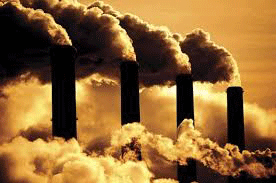 Activist group 350.org claims fossil-fuel companies’ $3.7m donations to Liberal, National and Labor parties taints the electoral process, Guardian, Michael Slezak 17 Feb 16 Major political parties have receive $3.7m in donations from fossil-fuel companies since the last election, and will deliver $2,000 in subsidies to the industry for every dollar donated, according to a 350.org report.
“The ongoing failure of our politicians to tackle climate change is directly attributable to the political influence of the fossil-fuel industry,” said Blair Palese, the chief executive of 350.org Australia.
“If we are serious about climate solutions, we must end the cosy relationship between our politicians and the big polluters.” (Below donations by mining industries)

The activist organisation has launched the report alongside a campaign asking individual federal politicians to sign a “pollution-free politics pledge”, where they commit to refuse donations from the fossil-fuel industry.
It has already been signed by all federal Greens politicians, independents Cathy McGowan and Andrew Wilkie, and outgoing Labor MPs Melissa Parke and Kelvin Thomson.
A list of those who have signed is being curated by 350.org. Continue reading
Australia’s greening cities: Adelaide leads
Australia’s greenest city: Adelaide pulls ahead of Sydney and Melbourne, Guardian, Annie Kane, 12 Feb 16 Across the nation, city councils are tackling climate change at a grassroots level, with green buildings, electric transport and ambitious emissions targets. “……Last year, Adelaide city council and the government of South Australia announced that they were working in partnership to make the state capital the “world’s first carbon neutral city” (or at least by 2025). According to a spokesman, Adelaide City Council allocates 1% of total rates to its Climate Change Action Initiatives Fund annually. In 2015/16 this is $932,000.
An action plan is in the works for later this year, but it is hoped the program will bring $10bn of low-carbon investment to the state and eradicate nearly a million tonnes of greenhouse gas emissions every year.
The state has also committed to match-fund the city’s incentives scheme so that all building owners and tenants installing energy-efficient devices could claim back some of the costs, ranging from $120 for energy-monitoring systems to $5000 for solar panels and energy storage systems.
“One of the things I noticed while in Paris at COP21 in December 2015, was the uniqueness of the partnership we have here in Adelaide between the city council and the state government,” says Adelaide’s lord mayor, Martin Haese.
“Effective collaboration between the city and the state is essential for real progress.”
Indeed, with the federal government still to announce details of how it will meet its COP21 commitment to reduce its greenhouse gas emissions to 26 to 28% of 2005 levels by 2030, any work that can come from a state or local level is welcome.
Sydney’s lord mayor, Clover Moore, says: “As we know, the time for action on climate change is now. In the face of inaction from the federal government, we’re calling on other Australian cities to pick up our plan and help us get on with the job of tackling climate change.” http://www.theguardian.com/sustainable-business/2016/feb/12/australias-greenest-city-adelaide-pulls-ahead-of-sydney-and-melbourne
World’s best-known climate crusader Al Gore urges Australian Government rethink on CSIRO cuts
FORMER US vice president and climate crusader Al Gore has added to the chorus of protest at plans to cull CSIRO’s ocean and atmosphere research positions, of which as many as 193, or 80 per cent, are in Hobart..
http://www.themercury.com.au/news/tasmania/worlds-bestknown-climate-crusader-al-gore-urges-australian-government-rethink-on-csiro-cuts/news-story/feda0e3aaaea4aba128e540d5c4de015
2900 scientists urge Malcolm Turnbull to prevent the drastic cuts to CSIRO’s climate researchers
Australia played a vital role in monitoring and modelling, particularly for the southern hemisphere.
 CSIRO climate cuts ‘devastating’, almost 3000 scientists tell Malcolm Turnbull http://www.smh.com.au/environment/climate-change/csiro-climate-cuts-devastating-almost-3000-scientists-tell-malcolm-turnbull-20160211-gms3ea.html Peter Hannam Environment Editor, Almost 3000 scientists from nearly 60 nations have appealed to Prime Minister Malcolm Turnbull and other Australian leaders to halt the CSIRO’s plans to halve the number of researchers working on climate monitoring and modelling.
In a letter that was also sent to the CSIRO’s board and chief executive Larry Marshall, the 2900 researchers said the decision to cut 100 full-time positions out of about 140 staff from two units of the Oceans and Atmospheric division “alarmed the global research community”.
“The decision to decimate a vibrant and world-leading research program shows a lack of insight, and a misunderstanding of the importance of the depth and significance of Australian contributions to global and regional climate research,” the letter said.
“The capacity of Australia to assess future risks and plan for climate change adaptation crucially depends on maintaining and augmenting this research capacity.”
The letter follows a statement earlier this week by the World Climate Research Program that the proposed axing risked severing “vital linkages with Australian colleagues and to essential southern hemisphere data sources, linkages that connect Australia to the UK, the US, New Zealand, Japan, China and beyond”. Continue reading
A big mistake to gut CSIRO climate change research
 The gutting of CSIRO climate change research is a big mistake, Guardian, John Abraham, 10 Feb 16 To be able to adapt to climate change, we need scientists to project how the climate will change Last week, surprise news shocked the world’s scientific community. One of the most prestigious and productive scientific organizations is slashing hundreds of jobs, many related to climate change research. The organization, the Commonwealth Scientific and Industrial Research Organization (CSIRO for short) is simply put, one of the best in the world. It rivals well-known groups like NASA, NOAA, and the Hadley Centre for its contributions to climate science.
What does CSIRO do that is so special? Many things. For instance, they are world leaders in measuring what is happening to the planet. Their research includes ocean-going vessels and other instrumentation that measure the chemistry and temperature of the ocean; they help track where human-emitted carbon dioxide is going, how heat is building up in the oceans, and what is happening with the general health of the ocean biosystem.
CSIRO is also a modeling superpower. Their climate models form the backbone of our understanding of what changes have happened and what changes will happen because of human greenhouse gases.
But they also have deepened our knowledge about extreme weather. They’ve provided insights regarding how droughts, heat waves, and floods will change in the future.
All of these contributions are important not only for the understanding that they provide but also because this knowledge helps us plan for the future. If you want to know what we can do to mitigate or adapt to climate change, you need this information.
But according to CSIRO chief executive, Larry Marshall, CSIRO should shift focus. …….
Australia is a small country (by population). Yet, it has punched far above its weight class in research. To think that this treasure of a research organization will be gutted is just shocking.
This story has gotten a lot of press in Australia such as here and here. It is also covered in international venues such as here and petitions such as here and here. Let’s hope this move is reversed before it is too late. http://www.theguardian.com/environment/climate-consensus-97-per-cent/2016/feb/10/the-gutting-of-csiro-climate-change-research-is-a-big-mistake
Rural Australia loses climate science guidance from CSIRO
Martin McDonald: Climate change has not been answered for farmers – we need more information, not less
Cuts to the CSIRO’s climate and land and water research will make finding solutions – and making milk Australian families can afford – ever more difficult
http://www.theguardian.com/commentisfree/2016/feb/09/climate-change-has-not-been-answered-for-farmers-we-need-more-information-not-less
 Canberra Times Editorial: CSIRO a chance for PM to lead on climate
Malcolm Turnbull should give the research organisation with a little more room to breathe.
http://www.canberratimes.com.au/comment/ct-editorial/csiro-has-given-the-prime-minister-an-opportunity-to-lead-on-climate-policy-lead-20160208-gmp38x.html
Mel Fitzpatrick: Job cuts threaten to sink science
CLIMATE research community fears Australia’s highly regarded programs are at risk
http://www.themercury.com.au/news/opinion/talking-point-job-cuts-threaten-to-sink-science/news-story/a6932b8499835afe3233593a3df7ac52
Australian Government cuts climate science jobs at CSIRO
CSIRO climate scientists speak out about job cuts
As the boss of the CSIRO continues to defend his planned restructure, senior climate scientists have spoken out about their fears. A Chief Research Scientist has told PM Australia risks losing world-leading research capabilities. Another says climate work that helps with weather prediction, ocean rescue, defence capabilities and natural disaster prediction is under a cloud.
http://www.abc.net.au/pm/content/2015/s4402366.htm
CSIRO staff ponder industrial action over climate shake-up
CSIRO’s staff body has taken steps towards industrial action as the fallout from the restructure continues.
http://www.theaustralian.com.au/national-affairs/industrial-relations/csiro-staff-ponder-industrial-action-over-climate-shakeup/news-story/f09aab1d5ae2c0c8128cecd0496d0cab
CSIRO cuts criticised by senior UK climate scientist – don’t stop the underpinning science
A senior climate scientist at the UK national weather service has criticised the proposed job cuts at the CSIRO, which will reduce the organisation’s capacity to monitor climate change.
http://www.abc.net.au/worldtoday/content/2015/s4402135.htm
Michael Slezak: CSIRO climate cuts attack a national treasure when we need it most
Chief executive Larry Marshall is right that we need to invest in adaptation, but this requires a proper understanding of how the climate will change
http://www.theguardian.com/australia-news/2016/feb/08/csiro-climate-cuts-would-be-attacking-a-national-treasure-when-we-need-it-most
John Birmingham: Blunt Instrument: CSIRO cuts bring Australia global fame for choosing stupid
From the earliest days of the penal colony the journals of the First Fleet officers remarked upon the weird, often violent climatic changes that made survival in the antipodes such a fraught, contingent affair.
http://www.canberratimes.com.au/comment/blunt-instrument/blunt-instrument-csiro-cuts-bring-australia-global-fame-for-choosing-stupid-20160208-gmovwf.html
Science researcher debunks Tony Abbott’s climate claims
 Tony Abbott’s climate claims debunked: researcher dissects 2013 statement Guardian, Michael Slezak, 23 Jan 16 Sophie Lewis was so annoyed about the way science was ignored in the political debate about climate change she went to work to disprove the myths. Climate scientists are regularly infuriated by the things politicians say. But it’s not often they publish a scientific paper tearing a politician’s comments to shreds.
Sophie Lewis, from the Australian Research Council’s centre for excellence in climate science, has done exactly that, dissecting statements about climate records made by the former prime ministerTony Abbott in 2013.
Last week, temperature figures showed 2015 was officially the hottest year on record. Before that, 2014 was the hottest year on record. And scientists are expecting 2016 to once again win the dubious honour.
Heat records are being broken with wild abandon. Last year, 10 months broke temperature records.
Climate scientists say a rise in the average temperature caused by greenhouse gas emissions makes extreme heat records more likely.
In 2013, the UN’s top climate official, Christiana Figueres, linked bushfires in Australia to climate change. Abbott called such claims “complete hogwash” and said drawing links between broken records and climate change was a sign of desperation.
Lewis says she was frustrated by the gap she saw between what the science showed and what some politicians said was happening.
In a peer-reviewed paper published in the journal Weather and Climate Extremes, Lewis pulls Abbot’s comments apart, shred by shred…………
The first way to understand Abbott’s claim is that in any system, the longer you wait, the more often you will see records fall. But Lewis points out that the exact opposite is true. In a system without any sort of trend, such as a random string of temperatures, the first one will be a record-breaker, by default. The second one will have a 50% chance of being a record-breaker. The third has a one in three chance of being a record breaker … and so on. In a very long temperature series, you should see very few records being broken, and they will break less often over time.
Unless, of course, there is a warming or cooling trend………
Lewis ran a series of climate models in which the greenhouse effect was removed – so all that was left was natural variability. Unsurprisingly, in those models, high temperature records were less common than they are in reality. In other words, the record-breaking that we have seen cannot be explained by natural variation……http://www.theguardian.com/science/2016/jan/23/tony-abbotts-climate-claims-debunked-researcher-dissects-2013-statement-australia
Oh my God! Global Warming Is Affecting The TENNIS!
 According to Malcolm Tulloch, director of entertainment, crew and sport at the Media, Entertainment & Arts Alliance (MEAA), the hotter climate is having an impact on the hundreds of people working at the tournament.
 Rising temperatures at Australian Open ’caused by global warming’ http://www.sbs.com.au/news/article/2016/01/18/rising-temperatures-australian-open-caused-global-warming Hot temperatures at the Australian Open tennis tournament may be down to global warming, according to some climate experts.
Analysis from University of Melbourne Atmosphere and Ocean researcher Ben Hague shows January temperatures in Melbourne have risen by 0.8 degrees Celsius each decade since 1987, but in the two weeks of the Australian Open the increase has been 1.25 degrees.
The Bureau of Meteorology 2015 Climate Statement showed days of extreme weather are on the increase across Australia.
A number of tennis clubs have implemented extreme heat policies to fulfill their duty of care to players, including Victoria based Australasian Academy of Tennis Coaches. Continue reading
Has Malcolm Turnbull got any hope of real action on climate change?
 Paris UN Climate Conference 2015: Paris delivers, but can Malcolm Turnbull? SMH December 13, 2015 Tom Arup Environment editor, The Age With the Paris summit wrapping up having delivered an historic global climate agreement, questions will inevitably turn to whether Malcolm Turnbull will use the international momentum to advance the climate debate back home.
For half a decade, Australia has been stuck in a fact-free debate on climate policy – one that has seen one of the biggest challenges the world faces turned into a domestic political chew toy.
But where the failure at Copenhagen helped derailed Kevin Rudd’s climate ambition back in 2009, success in Paris presents the opposite opportunity for Turnbull, who many believe has a deep desire to move to a more robust climate policy.
We will soon find out whether two weeks on, and one historic agreement later, Turnbull feels the world has moved enough to take a few brave steps forward.
Deeper cuts will also require a bigger re-think of domestic policies – Australia will not be able to rely on the current combination of paying some farmers and businesses to cut emissions, carbon accounting fiddles and falling demand for electricity.
It will have to find a way to finally address pollution from the country’s fleet of large, ageing coal-fired power plants. Emissions from coal have been rising since the Coalition abolished the national carbon price scheme.
The government’s direct action scheme is not fit for this job – at least not as currently designed. It will need a radical overhaul, perhaps one that would make it look more like a type of emissions trading scheme……..forward. http://www.smh.com.au/environment/un-climate-conference/paris-un-climate-conference-2015-paris-delivers-but-can-malcolm-turnbull-20151212-glm6op.html#ixzz3uFQmfQc5
Julie Bishop signs Paris Declaration for clear rules for carbon trading
What a tortuous track Julie Bishop, Greg Hunt and co. have to navigate, as they weave about within the Turnbull government’s climate policies – which are exactly the same as Tony Abbott’s !
 How long before the Turnbull government trips itself up in its own convoluted
rhetoric?
How long before Australia’s voters wake up to them?
Australia signs up for clear carbon trading rules, hinting at policy change, Guardian, Lenore Taylor in Paris, 10 Dec 15
Signing declaration at the Paris climate talks ‘recognises the role a carbon market might play after 2020’, foreign minister Julie Bishop says. Australia has signed a Paris declaration calling for new clear rules for international carbon trading in a signal the Coalition’s six-year carbon pricing policy veto could be softening as it prepares to review its climate policy in 2017.
Foreign minister Julie Bishop, who signed the declaration in Paris, said it was in Australia’s interests to recognise the role an international carbon market might play in reducing emissions after 2020.
“It’s just a declaration, it’s not legally binding,” she said after a speech to an event organised by Australia’s Carbon Market Institute. Continue reading
Australia not welcomed into “high ambition coalition” climate action group
 Aust missing from climate change group, Herald Sun, 12 Dec 15 Australia has not yet been welcomed into a new “high ambition coalition” of 100 nations at major climate talks in Paris, despite claiming it had joined through the European Union.
Marshall Islands Foreign Minister Tony de Brum revealed the alliance of around 100 countries, including the United States, this week at the United Nations summit.
Australia was not among them and Foreign Minister Julie Bishop seemed unaware of the group when it was revealed on Wednesday.
Mr de Brum, who spearheaded the alliance, issued an open invitation to countries in Paris.
A spokeswoman for Ms Bishop on Friday confirmed Australia had been formally invited by the European Union and had accepted the invitation. However, it appears Australia hasn’t yet been welcomed into the group, the Marshall Islands hinting the country would have to prove its worth.
“We are delighted to learn of Australia’s interest and look forward to hearing what more they may be able to do to join our coalition of high ambition here in Paris,” a spokesman for Mr de Brum said.
Earlier on Friday Mr de Brum read out a list of countries that had accepted his open invitation, with Australia notably absent.
WHAT THEY WANT *Reference to limiting global warming to 1.5C (is in the text)
*Clear path towards a low-carbon future (emissions neutrality by second half of century in text)
*Five yearly updates (is in the text)
*Strong package of financial support for developing nations ($100 billion per year plus scale up after 2020 is an option in the text – could be removed) http://www.heraldsun.com.au/news/breaking-news/aust-not-yet-welcome-in-climate-alliance/news-story/f7812eb6755851c7cc8ecd71ae9ca55f
‘High ambition coalition” on climate change – but Australia won’t be joining
Australia unlikely to join climate coalition, Sky News, 11 December 2015 Canada has joined a new coalition of 100 countries calling for an ambitious agreement at major climate talks in Sky News alia is unlikely to add its name to the list.
Some predict the new ‘high ambition coalition’ could be a significant force in the negotiations, with a majority of nations – from the richest to the poorest – involved.
Australia, while supporting its intention, hasn’t joined.
The 100 countries, including the United States, are demanding a reference to limiting global warming to 1.5C, five-yearly reviews and a pathway to low carbon.
It also wants adequate financing for poor countries.
Marshall Islands Foreign Minister Tony de Brum urged more countries to join while revealing the coalition on Wednesday night.
Canada’s environment and climate change minister Catherine McKenna took up that offer the following day, despite not initially being on the list.
Australia is understood to agree with the group’s goals but wants to focus its energy elsewhere…….http://www.skynews.com.au/news/top-stories/2015/12/11/-difficulties–in-climate-talks–hollande.html
Sydney’s Lord Mayor Clover Moor in Paris: upbeat about city’s climate change action
Paris UN climate conference 2015: Clover Moore tells government to get out of the way http://www.canberratimes.com.au/environment/un-climate-conference/paris-un-climate-conference–clover-moore-says-government-hindering-her-carbon-neutral-efforts-20151203-glf653.html December 8, 2015 Peter Hannam Environment Editor, The Sydney Morning Herald In Paris, the local city government is presenting a grim view of the possible impacts of global warming. It is offering visitors to the climate conference apocalyptic visions of a Venice or New York largely under water, and Stonehenge surrounded by an English desert.
Sydney lord mayor Clover Moore adopts a more optimistic view. In the French capital for a number of events held on alongside the climate summit, she has a positive story to tell, noting her city’s operations are already carbon neutral and deep emissions cuts are under way as business and green groups get on with it.

The city’s top commercial landlords have cut 45 per cent of their carbon dioxide emissions since 2006, saving $30 million a year, she said on the sidelines of the Paris . A surge in developments – almost $4 billion in 2014 rising to $7 billion this year – means a focus on efficiency in new buildings will also avoid future costs for energy, water and waste.
“The actions cities are taking across the world are making an incredible difference,” Cr Moore told Fairfax Media, noting 75 per cent of Australians and more than half the world’s people live in cities.
The performance and potential of the world’s major cities has been a theme of the Paris climate summit through a series of urban events – Ms Moore attended or spoke at five – highlighting the contribution that cities can make to meeting the conference’s wider goal of keeping global warming to less than 2 degrees of pre-industrial levels.
A report released at the conference found that cities – already home to more than 50 per cent of the world’s population – alone had the potential to cut global greenhouse gases by about 6 per cent by 2030 – or 3.7 gigatonnes of carbon dioxide – and more than double that by 2050.
For Sydney, the goal is to cut emissions 70 per cent on 2006 levels by 2030. Although well on the way to that goal, the city’s progress is being hampered by Canberra on the planning front, Cr Moore said. Continue reading
Don’t undervalue the contribution of Australia’s indigenous people at Paris Climate Summit
West Australian Indigenous association, the Kimberley Land Council has sent a group of representatives to the conference.
The Council’s CEO, Nolan Hunter, warns that Indigenous communities shouldn’t be undervalued.
What do the Indigenous voices say on climate change? SBS, 8 Dec 15 Climate change continues to dominate the agenda, with Prime Minister Malcolm Turnbull holding firm to his target of a 26 to 28 per cent reduction on 2005 levels of carbon emissions at the Paris talks, but some are wondering where the Indigenous voices are in the debate?It’s a truly international topic of discussion: what can and should the world do about climate change?Like many nations, Australia faces hotter summers, more droughts, rising tides and a significant impact on its ecology.
Larissa Baldwin, national coordinator of youth climate group Seed, says the country’s Indigenous communities will bear the brunt.
And she believes their voices aren’t being given enough attention.
“I don’t think we have been given enough of a say, when you look at Indigenous communities around the world we’re already being impacted by climate change right now. We’re also on the forefront of fossil fuel extraction in Australia, and I think for a lot of us – we’ve had to send people over to Paris to actually get in front of our world leaders and say ‘hey you need to listen to us’.” Continue reading
1 This month



Help Aunty Sue Protect Her Land and Sacred Sites From Destructive Rocket Testing.
.

Australians deserve the truth
about
AUKUS – https://aukuspublicinquiry.com/

PETITION – To: Prime Minister Anthony Albanese and the Australian Labor Government

of the week – Australians for War Powers Reform (AWPR)
To see nuclear-related stories in greater depth and intensity

