Climate scepticism behind Abbott’s idea to scrap Renewable Energy Target
According to the Australian Energy Market Commission, the RET makes up less than 1% of the average household electricity bill.
Renewable energy: Tony Abbott signals he could wind back or scrap targetsPM says while Coalition supports ‘sensible use’ of renewable energy, scheme is ‘causing pretty significant price pressure’ Lenore Taylor, political editor theguardian.com, Wednesday 18 December 2013
Tony Abbott has signalled next year’s review of the renewable energy target could wind back, or even scrap, the scheme, saying lower power prices are the government’s primary goal and the rationale for the RET no longer exists.
Announcing modest government assistance for Holden, the prime minister also revealed he would chair a new taskforce to find ways to make industry more competitive, with reducing the cost of energy a primary aim.
Asked whether that could involve scaling back the RET, which was set up by the Howard government and requires energy retailers and large customers to source a proportion of their energy from renewable sources, Abbott said: “We support sensible use of renewable energy, and as you know it was former Howard government which initially gave us the RET and at the time it was important because we made very little use of renewable energy.”
But times had changed, he said. “We have to accept that in the changed circumstances of today, the renewable energy target is causing pretty significant price pressure in the system and we ought to be an affordable energy superpower … cheap energy ought to be one of our comparative advantages … what we will be looking at is what we need to do to get power prices down significantly,” he said.
Abbott said he would also “consult closely” with his Business Advisory Council, chaired by Maurice Newman, as the taskforce looked for ways to increase industry competitiveness.
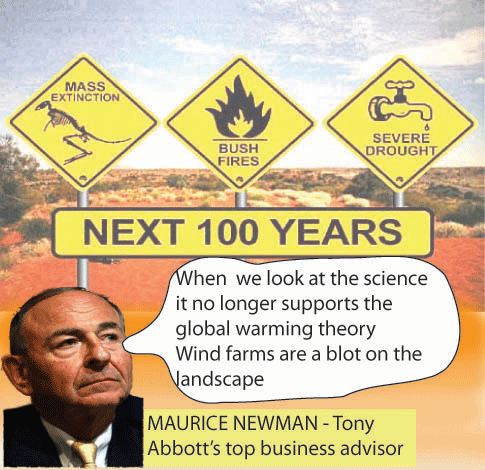
Newman has previously called for the RET to be scrapped because he believes the scientific evidence for global warming and the economic case for renewable energy no longer stack up. Continue reading
100% of Australia’s new power sources to be renewable through 2020
AEMO: Renewables to account for all new power in Australia through 2020 Penn Energy December 16, 2013 By Dorothy Davis Content Director A new report from the Australian Energy Market Operator (AEMO) forecasts 100 percent of new power in Australia will be generated from renewable energy sources through 2020.
The AEMO’s National Transmission Network Development Plan (NTNDP) The AEMO’s National Transmission Network Development Plan (NTNDP) 2013, predicts the majority of new electric generation will be based on wind power (84%), followed by solar (13%) and finally biomass(3%). This includes 168 MW of new wind generation that has recently come online in Tasmania, and a further 131 MW in Victoria, 270 MW in South Australia, and 386 MW in New South Wales committed to come online from 2014–15. AEMO said it is aware of close to 15,800 MW of proposed wind generation projects.
The NTNDP estimates approximately 8,700 MW of new wind generation to connect to the transmission network by 2020, resulting in a total installed National Electricity Market wind generation capacity of around 11,000 MW………..
Read the full report here: National Transmission Network Development Plan 2013 (pdf) http://www.pennenergy.com/articles/pennenergy/2013/12/renewable-energy-to-account-for-nearly-all-new-power-in-australia-through-2020.html
With development of battery storage, Australia’s renewable energy will go ahead
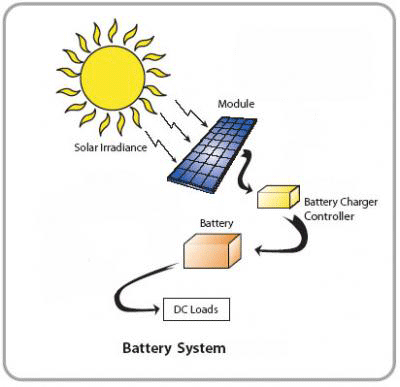 Storing renewable energy starts at home, DW Jonathan Gifford 16 Dec 13 Almost all of Australia’s solar energy comes from the roofs of private homes. There’s no shortage of sunlight, but to develop solar power, a storage solution is needed. Vast solar power plants may be commonplace in Germany, but in Australia the turn to renewable energy has largely taken place on an individual basis. More than one million Australian homes now have solar panels, but how to store that energy for when it’s needed is emerging as the next challenge.
Australia’s recently elected coalition government has wasted no time in taking measures to halt the expansion of renewable energy. It has passed legislation to repeal the previous government’s carbon price mechanism, closed the Climate Change Commission and slashed funding for the Australian Renewable Energy Agency.
Much of Australia’s renewable energy, and almost all of its solar efforts, however, have been deployed in the country’s suburbs on the roofs of private households.
This also brings with it challenges, and electricity grid operators have begun taking measures to limit the amount of solar power that can be added in an area. In Western Australia, the utility Western Power is preventing large installations – bigger than 30 kilowatt peak (kWp) – from feeding any electricity produced back into the grid. The utility that supplies remote or rural parts of the state, Horizon Power, announced in October that if a solar system is installed, it needs to be equipped with some kind of “renewable energy smoothing” technology – essentially some form of battery………
http://www.dw.de/storing-renewable-energy-starts-at-home/a-17266796
Queensland Government’s unreasonable attack on renewable energy
The large scale renewable energy target is probably the smallest component of the electricity bill. It’s interesting that McArdle chooses to attack this, and not the network costs, which account for around half of consumer bills.
It’s all about self-interest, and McArdle has just underlined the untenable conflict of interest in having governments acting as owner, regulator, price-setter and policy developer.

Queensland energy minister launches wild attack on renewables http://reneweconomy.com.au/2013/queensland-energy-minister-launches-wild-attack-on-renewables-15549 By Giles Parkinson on 16 December 2013 The Queensland government has declared its hand in the upcoming review of the renewable energy target with an extraordinary – and in many places misinformed – attack on the costs of renewable energy.
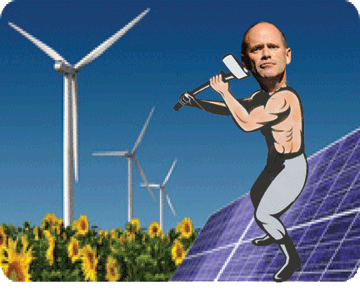
The Queensland Energy Minister Mark McArdle wrote an opinion piece in The Australian on Monday challenging an assertion by Miles George, the head of Infigen Energy and a director of the Clean Energy Council, that renewable energy has a dampening impact on electricity prices. Continue reading
For the moment – limits to traditional battery storage of renewable energy
Falling battery prices coupled with a desire for self-sufficiency and the need for resilience against extreme weather events may mean that families purchasing a house Down Under may soon ask: “does it come with batteries?”
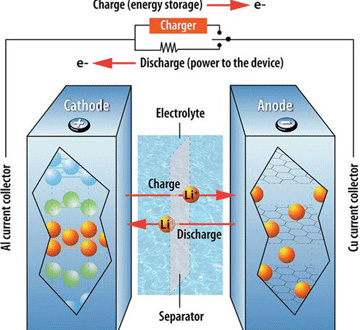
Storing renewable energy starts at home, DW Jonathan Gifford 16 Dec 13 “……At this stage the problem is that batteries are either expensive or inefficient. Even homes with a relatively large solar installation find that they cannot rely on it exclusively – even under the Australian sun. “The main problem for me is the storage of electricity hasn’t improved a great deal in the 41 years I’ve been here,” said Peter Holland, a Western Australian who has been living on a ‘bush’ property outside of the state’s capital, Perth.
“I’ve always had a bank of 12 two-volt batteries, but there’s a huge amount of loss,” Holland said. “The batteries are relatively inefficient and they’re extremely expensive.” Because of this, Holland’s off-grid system still requires a backup generator to cope when the sun isn’t shining or when large household appliances are switched on.
The solar industry has long understood the necessity of electricity storage. Shaun Qu, founder and CEO of Canadian Solar, says that the development of storage technologies will allow for more renewable energy to be installed. Continue reading
New report shows rise in renewable energy, decline in coal-powered
AEMO sees coal sidelined as renewables dominate new capacity REneweconomy By Sophie Vorrath on 12 December 2013 The need to add more ‘poles and wires’ to Australia’s electricity transmission networks has again been questioned, with a new report by the Australian Energy Market Operator (AEMO) predicting future oversupply of generation capacity in the National Electricity Market and signalling potential generation reductions.
The 2013 National Transmission Network Development Plan (NTNDP), released on Thursday, also predicts that only renewable energy generation will be added to Australia’s grid out to 2020; 84 per cent of which would come from wind, 13 per cent from large-scale solar PV, and 3 per cent from biomass. (graphs)
The report, which considers the impact of changing dynamics in the NEM over the next 25 years, including the effect of the Large-scale Renewable Energy Target (LRET) and of a carbon price – or the absence, thereof – finds that the LRET remains the main driver of national electricity generation investment up to 2020.
This includes 168MW of new wind generation that has recently come online in Tasmania, and a further 131MW in Victoria, 270MW in South Australia, and 386MW in New South Wales committed to come online from 2014-15. AEMO says it is aware of close to 15,800MW of proposed wind generation projects…….http://reneweconomy.com.au/2013/aemo-sees-coal-sidelined-as-renewables-dominate-new-capacity-19726
Westpac Bank cautiously promoting renewable energy
 Westpac focuses on renewables, Ecogeneration, 13 Dec 13, “In an exclusive excerpt from the February 2014 edition of EcoGeneration, Westpac Institutional Bank Director of Infrastructure and Utilities David Scrivener discusses the Bank’s approach to clean energy financing and the key things financiers look for when investing in clean energy projects……….Westpac is committed to financing the development of clean energy solutions and best practice pollution controls. Today, more than 50 per cent of our lending to the energy sector is to renewable energy generation, including hydro, wind and solar. Continue reading
Australian government aiming to slow development of small scale solar power?
Renewable Energy Target Review Red Alert , Renewable Energy News, 12 Dec 13 The Abbott government will soon release its terms of reference for another Renewable Energy Target review says the Australian Solar Council. Given the general vibe; it doesn’t bode well for remaining small scale solar subsidies.
As solar feed-in-tariff incentives are dialled down, the Renewable Energy Target is now the major form of support to the solar industry in Australia and for those buying solar panel systems.
“The future of the small-scale scheme for solar PV is in considerable doubt,” states Australian Solar Council CEO John Grimes…….
The solar power industry currently employs more than 18,000 people in 4,500 small and medium businesses across Australia – many in rural and regional areas.
With Renewable Energy Target related support still providing subsidies of up to a couple of thousand dollars on solar panel systems and that support continuing after the review not something to bank on; the best time to go solar may be right now……..http://www.energymatters.com.au/index.php?main_page=news_article&article_id=4074
Victorian Aged Care Facility to get grid-connected solar power
Yingli Green Energy Hold. Co. Ltd. (ADR) : EnviroGroup Installs Australia’s Largest Grid-Connected Enphase Microinverter Project in Conjunction with Yingli Solar, 4 Traders Group, 12/11/2013 |Glenlyn Aged Care Facility to power 50 percent of its energy needs with solar power
Enphase Energy, Inc. (NASDAQ:ENPH), today announced that EnviroGroup, a specialist provider of renewable energy products and systems for commercial applications, government clients and residential home owners, has successfully installed Australia’s largest grid-connected solar power system with Enphase microinverters, in conjunction with Yingli Green Energy, known as “Yingli Solar”, at the Glenlyn Aged Care Facility in Glenroy, Victoria.
This 100kW installation is expected to generate over 392kWh of solar energy daily – which is approximately 50 percent of Glenlyn’s electricity requirements – to power the center’s operational and cooling facilities, particularly in periods of peak daytime demand……….http://www.4-traders.com/YINGLI-GREEN-ENERGY-HOLD-52545/news/Yingli-Green-Energy-Hold-Co-Ltd-ADR–EnviroGroup-Installs-Australias-Largest-Grid-Connected-E-17603508/
Solar power is reshaping Australia’s electricity market
People power: Rooftop solar PV reaches 3GW in Australia REneweconomy,By Giles Parkinson on 4 December 2013 Australia has passed through another significant solar milestone, reaching 3GW of solar PV this month, as Queensland nudged the 1GW mark and states such as South Australia reached household penetration rates of 25 per cent.
“Solar power is reshaping Australia’s electricity market,” says Warwick Johnston, the head of solar research group SunWiz, who compiled the data. “This is a milestone as note-worthy as the one millionth solar power system that was installed in April.”
The growth in solar PV in Australia is quite remarkable, given that Australia’s capacity was barely more than 180MW in 2009. Much of this growth came as a result of generous feed in tariffs, but the growth continues as a new generation of households look to solar to hedge against the rising cost of grid-based electricity, to make a statement about green energy, or to do both.Australia is almost unique in the world in having its solar installations almost exclusively in rooftop solar PV. That, according to Johnston, now totals 3GW on its own, mostly residential but also on a growing number of commercial rooftops, such as wineries.
Australia has only one solar PV array above 1.2MW, the 10MW Greenough River solar farm in Western Australia, although three projects have begun or are about to begin construction in the ACT, and the 102MW Nyngan project will also begin construction in January. Others are in the wings. To put this into comparison, the Japanese market is expected to install 9GW of solar in 2013 alone, much of it at commercial or larger scale…….http://reneweconomy.com.au/2013/people-power-rooftop-solar-pv-reaches-3gw-in-australia-99543
Renewable Energy Target (RET) to bring down electricity prices
The Climate Change Authority carefully considered the costs and benefits of the RET during its review of the scheme last year.
A 130-page modelling report it commissioned from SKM-MMA concludes that the RET scheme’s net impact on retail electricity prices will be to reduce retail electricity prices in 2020, as the cost of the RET scheme will be completely mitigated by its downward pressure on electricity prices.
RET brings downward pressure on electricity prices http://www.theaustralian.com.au/business/opinion/ret-brings-downward-pressure-on-electricity-prices/story-e6frg9if-1226775423434# MILES GEORGE THE AUSTRALIAN DECEMBER 05, 2013
ON November 20, 1997, John Howard announced a proposal to establish a national mandatory renewable energy target.
In a speech titled Safeguarding Australia’s Future: Australia’s Response to Climate Change the prime minister said a mandatory renewable energy target would “accelerate the uptake of renewable energy in grid-based electricity and provide a larger base for the development of commercially competitive renewable energy”.
Three years later Australia’s renewable energy target scheme was passed into law, with bipartisan support.
Over the past 16 years the RET has been expanded and improved, in each case with bipartisan support, and it continues to enjoy bipartisan support as an effective piece of market-based legislation that has consistently achieved its objectives.
During that period the scheme has enabled more than $20 billion of investment in the construction and operation of clean energy facilities, resulting in enough electricity to be generated to power about two million homes — half of which largely represents utility scale wind and solar photovoltaic investments in regional areas, and the other half residential rooftop solar PV facilities.
Perhaps most important, it has been shown the RET creates significant downward pressure on electricity prices. This is because large-scale renewable energy facilities nearly always underbid fossil fuel generation in the wholesale electricity market, thereby reducing wholesale prices.
This fact is acknowledged by the Australian Electricity Market Operator, the Climate Change Authority, Bloomberg New Energy Finance and other experts. Continue reading
Large scale solar energy company to begin operations in Australia
SolarReserve Sets Up Shop In Australia, Renewable Energy News, 6 Dec 13 SolarReserve has announced the company’s international expansion into Australia through the opening of an office in Perth. The company says its Australian operations will focus on large-scale concentrating solar power (CSP) and photovoltaic (PV) projects, particularly in the off-grid mining sector.
“In Australia, the best solar resources are commonly found in remote areas where mines operate, presenting the off-grid mining sector with a substantial opportunity to offset the high price of electricity generation in these remote locations with a solar energy alternative,” says SolarReserve’s CEO Kevin Smith.
There are more than 1,000 operating mines in Western Australia – and many of those are powered by high-priced and polluting diesel fuel.
“In the face of impending policy decisions by the Australian government related to renewable energy and carbon emissions, solar energy for the mining sector is a win-win: good for business and good for the environment.”
The company was one of the participants in a meeting earlier this year in the gold mining city of Kalgoorlie in Western Australia to plan the Goldfields’ renewable energy future……http://www.energymatters.com.au/index.php?main_page=news_article&article_id=4062
National survey on energy affordability
Aussies Want Cheaper Power – But Hands Off Renewables http://www.energymatters.com.au/index.php?main_page=news_article&article_id=4056 3 Dec 13 While not the largest cost-of-living expense, electricity bills are the bogeyman that concern Australians most.
A national survey on energy affordability carried out by CHOICE, the Brotherhood of St Laurence and Energy Efficiency Council revealed 84 per cent of Australian households are concerned or very concerned about energy costs. The same percentage felt it was important or very important for their State Government to help rein in these costs.
However, instead of screaming for renewable energy support to be hit to cut the cost of power – a default choice it seems for many politicians – this was the least popular action in the survey. In fact, knee-capping renewables had a negative net approval rating in every state.
Nearly double the percentage of respondents strongly opposed such action compared to those who strongly supported it. This is a message Australia’s government would be well-advised to heed; particularly given it appears to have its sights set on the Renewable Energy Target next year.
Energy Efficiency Council’s chief executive officer, Rob Murray-Leach, said there was also a danger the national debate about the carbon bill meant other expenditures that have an even bigger impact on energy costs, like poles and wires, could be ignored or overlooked.
The most popular methods for reducing power costs emerging from the survey were:
– Government helping homes and businesses save energy
– The introduction of time of use pricing
– The use tax revenue to subsidise energy bills for low-income households
While many Australians spend far more on petrol than electricity, CHOICE says the fear stirred up by power bills could be due to several factors – electricity costs jumping far more rapidly than transport costs over the past two years, the “sticker shock” aspect of larger than expected bills and that electricity bills tend to be a significant outlay given they are received quarterly.
The summary results of the Survey of Community Views on Energy Affordability for Australia can be viewed here (PDF).
Trial of electric cars shows they can be effective for Australia
 Trial complete: electric vehicles can work in Australia The Conversation, 3 Dec 13 Australia’s first electric vehicle trial has been completed. It ran from early 2010 to the end of 2012 with 11 electric Ford Focus and 23 fast-AC charging bays (Level-2). We found few technological barriers to the adoption of electric vehicles (EVs) in Australia, but government incentives for early adopters and government programs for the roll-out of fast-DC charging stations would help Australia fully embrace these cars……..
When are cars charged?
We were particularly interested in what time of day drivers charged their cars. This determines how much renewable energy can be used for charging (to make an EV really emission-free) and whether electricity utilities have to worry about an increase of peak demand in the future, when there might be millions of EVs.
The fleet EVs did most of their charging in the morning until mid-day, so most of the charging energy could be supplied by solar photovoltaics. This finding is significant, as company fleets are not only an early adopter of new car technology, but are also the largest customer segment for the new vehicles market in Australia………
Recommendations We found:
EVs can function as regular fleet pool cars for most applications. Continue reading
Solar Citizens a formidable lobbying force in Australia
 Sun Tax’ Petition Hits 25,000 Signatures http://www.energymatters.com.au/index.php?main_page=news_article&article_id=4054 2 Dec 13 20 advocates associated with Solar Citizens will be travelling to Canberra on Monday to present a petition signed by more than 25,000 Australians who are demanding politicians to not tax the sun.
The group will be meeting with dozens of federal politicians, dispelling the myths and highlighting the need for positive measures to help the growth of solar throughout Australia. Prime Minister Abbott signalled he had renewable energy in his crosshairsrecently and incorrectly stated that the RET was contributing significantly to electricity bills. That certainly isn’t the case, even with home solar.
“Solar is a small portion – less than 6%. So, why is solar being blamed?” said Adrian Brown, a spokesperson for Solar Citizens. “The simple answer is that it appears that big energy companies are trying to dictate our energy future, attempting to salvage their profit margins and investment in the network – and penalising solar along the way.”
Mr. Brown stated the ‘sun tax’ concept may have just been a recommendation and is by no means set in stone, but slugging solar seems to be the default solution for politicians.
More than 1.1 million Australian households have invested $8 billion to take power over their bills says the group; saving families collectively many hundreds of millions of dollars on energy bills annually. “Making the move to solar is a real way for families to take power over their bills and do their part for our environment,” Mr Brown says.
In addition to the substantial power bill savings, the solar revolution in Australia has created many thousands of jobs. Geoff Bragg, NSW Chairman of the Solar Energy Industries Association (SEIA), says the industry could continue to grow; however, stability must be ensured. The trip to Canberra is only another step in the anti-sun tax campaign, not the end. Later this month, the group intends presenting the petition to State Premiers and Energy Ministers.
Solar Citizens is a grassroots initiative bringing together existing and future solar owners to ensure their rights are protected and to help see solar panels on every rooftop in Australia.
1 This month

of the week – Australians for War Powers Reform (AWPR)
To see nuclear-related stories in greater depth and intensity
 Antinuclear