Malcolm Turnbull blasts government’s ‘right-wing’ over energy policy sabotage
Former Prime Minister Malcolm Turnbull has blasted the “right wing” of the Morrison federal government for bringing down his signature energy policy, calling for it to be “reinstated now”.
On Monday, a Twitter user challenged Mr Turnbull for only “calling for coherent energy policies now [he’s] out of government”
The former PM responded by defending his proposed National Energy Guarantee (NEG), which faced opposition in government ranks and was later ditched.
“The National Energy Guarantee was a coherent integration of climate and energy policy,” he tweeted.
“It was sabotaged by the right-wing of the Coalition and their supporters in the media and coal lobby and finally abandoned by Morrison Government. It should be reinstated now.”
The policy was intended to deal with rising energy prices as well as cutting emissions.
Mr Turnbull was later dumped as the leader and his successor Scott Morrison announced the NEG “is dead”…… https://www.sbs.com.au/news/malcolm-turnbull-blasts-government-s-right-wing-over-energy-policy-sabotage
Even within a pro nuclear propaganda article, admission that renewables are a better bet
|
“…… Roger Dargaville, a Senior Lecturer in Resources Engineering with the Department of Civil Engineering at Monash University, is more confident of the standalone capability of renewables. In 2018, the proportion of Australia’s total electricity generated from renewables passed 20 per cent for the first time, with clean energy contributing 21.3 per cent of total electricity generation. This was an increase compared to 2017, when renewables were responsible for 17 per cent of total electricity generation. And there’s more in the pipeline. “As we approach the 2020 renewable energy target of at least 33,000 GWh per year, we have seen a rush of new projects. After that, most of the states have renewable targets of 50 per cent or more that, combined with the continuing falling prices of PV, should lead to a continuation of the trend.” Dargaville said many published studies already show that 100 per cent renewable systems are technically achievable, cost-effective and reliable, without having to resort to nuclear power….” Australia’s review of its energy mix resurrects the nuclear power debate, by Create Digital, 10 Dec 19 |
|
Power bills to fall by $40 as New South Wales Central West becomes wind and solar power hub,
|
Power bills to fall by $40 as Central West becomes wind and solar power hub, Central West Daily News, David Fitzsimons 26 Nov 19
The Central West will become the focus of wind and solar energy generation in NSW under a state government plan that would see 450 construction jobs created and household electricity bills cut by $40 a year. Energy Minister Matt Kean said Australia’s first Renewable Energy Zone would be developed in the Central West over the next few years. Mr Kean said the 3000 megawatt pilot program was aimed at attracting up to $4.4 billion in private sector investment into the region for clean energy generation…….
The Central West project is the first of three planned for NSW as part of the NSW Electricity Strategy which was unveiled by Mr Kean. It said the Central West was chosen for the pilot because it has “significant existing investment and investor interest.”…… https://www.centralwesterndaily.com.au/story/6508798/power-bills-to-drop-by-40-as-central-west-becomes-hub-for-wind-and-solar-power/?fbclid=IwAR0WqMLLb5ODbAA0EU-h8VPtnfVoU8PYrvFIEhNhuTeOVKunqnhR4f3PWms |
|
|
How are Australian States progressing on renewable energy? South Australia way ahead
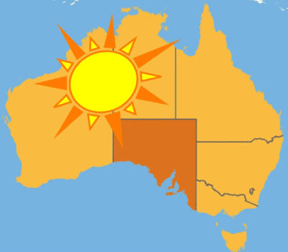 South Australia leading the nation in renewable energy, https://thenewdaily.com.au/news/national/2019/11/25/renewable-energy-winners/ Samantha Dick
South Australia is shifting to renewable energy faster than any other state or territory.
This is despite the federal government’s “lack of leadership” and continued support for major fossil fuel projects, says the Climate Council.
|
Progress is based on how much electricity is derived from renewable energy, proportion of households with rooftop solar, large-scale wind and solar capacity per capita, and policies to support the transition. South Australia earned this year’s top spot for generating more than half of its electricity from wind and solar, and for setting a target of net 100 per cent renewable energy in the 2030s. Following closely in second place was the Australian Capital Territory, which is on track for 100 per cent renewable energy from 2020. The ACT has also announced impressive plans to achieve net zero emissions by 2045 by cutting emissions from transport and cities. Tasmania was in third place for making headwinds toward 100 per cent renewable energy by 2022, and for researching three pumped hydro sites that could supply energy to Victoria over the next 10 to 15 years. Victoria was ranked fourth, winning points for planning the nation’s most ambitious large-scale wind and solar projects, and for legislating a renewable energy target of 50 per cent by 2030. However, more than 80 per cent of the state’s power still comes from fossil fuels, meaning it has a long way to go to catch up to the frontrunners. Further behind in fifth place was Queensland, where nearly half of Australia’s large-scale renewable energy projects were completed last year. But despite making big improvements, the Queensland government lost marks for continuing to support new fossil-fuel projects like the Adani coal mine. The Adani coal mine, backed by the federal government, will put out an estimated 7.7 billion tonnes of greenhouse gases over 60 years through extracting 2.3 billion tonnes of coal. It is also unlikely the Sunshine State will meet its target of 50 per cent renewable energy by 2030.
|
|
Australian Energy Market Operator predicts ‘completely new’ two-sided energy market
|
Australia told to prepare for ‘completely new’ two-sided energy market https://www.theguardian.com/australia-news/2019/nov/14/australia-told-to-prepare-for-completely-new-two-sided-energy-market
Consumers should be rewarded for buying and selling energy in real time, Australian Energy Market Commission says Katharine Murphy Political editor @murpharoo, Thu 14 Nov 2019 Australia needs to prepare the ground for a two-sided national energy market, where consumers are rewarded for buying and selling energy in real time, according to the Australian Energy Market Commission.In a new discussion paper to be released on Thursday, the AEMC says technology has previously limited consumer participation in the energy grid but the advent of smart devices and virtual power plants has created the opportunity for a fully fledged two-sided market. Comparing the opportunity in energy with disruptive platforms such as eBay or Airbnb, the AEMC chairman, John Pierce, says “digitalisation has progressed to the point where it is time to consider a completely new approach”. He says the Australian Energy Market Operator knows how much generation to expect from scheduled generators, but now attention needs to turn to virtual power plants which households are creating through solar PV and local battery storage. As well as creating incentives for households to invest in smart appliances and distributed energy infrastructure, Pierce says there is opportunity to utilise more demand management in the system, because batteries, pool pumps, air conditioners and electric vehicles can be set to consume power off peak and export power back to the grid at times when that is most remunerative. The commission has already released a draft rule for a demand-response mechanism allowing large commercial and industrial users to sell forsaken demand directly into the wholesale market for the first time. The rule would put demand response on an equal footing to generation for the first time, with energy users paid as if they are generators. Pierce says the Australian energy market is already in the process of becoming more decentralised. The grid is transitioning away from centrally controlled, big generators dominating the market. “Looking to the future – both the demand and supply sides of the energy market would be actively engaged in electricity scheduling and dispatch processes – while delivering all the services people expect like hot water, air-con and dishwashing,” the AEMC chair says. “Less generation and network capacity would be needed in a market with higher levels of consumer participation and responsiveness. Decisions to consume or not to consume would be valued digitally through any device that’s connected to the internet and remotely controlled. “Then all you will need are price signals to automatically switch your household or business power plant from grid import to export and back again delivering the services you want at least cost. It would also be cheaper for streets and suburbs to share local generation resources and storage devices.” The AEMC paper will be released to contribute to market design work being undertaken by the Energy Security Board, with reform options expected to be pursued in 2020. |
First offshore wind farm in Australia being tested
Testing begins for first offshore wind farm in Australia, The Age, By Benjamin Preiss, November 10, 2019 —Scientific testing begins this month for Australia’s first proposed offshore wind farm, near Gippsland, which could provide enough power for more than 1.2 million homes.
The testing comes as the union movement launches a campaign to lobby the state and federal governments to smooth the way for the project to proceed.
The Star of the South wind farm is expected to provide up to 2000 megawatts of power − about 18 per cent of the state’s power demand − and is set to cost between $8 billion and $10 billion.
Within weeks, the company will begin detailed studies of the wind and wave conditions at the 496-square-kilometre area off the south coast of Gippsland. It will also conduct environmental studies on marine and bird life.
If considered feasible, the wind farm is slated to provide “full power” by 2027.
Unions hope the wind farm will provide secure jobs for electricity workers in the Latrobe Valley, where the economy has relied heavily on coal-fired power generation.
The Latrobe Valley was hit hard by the closure of the Hazelwood power plant in 2017, and remaining coal-fired power plants are scheduled to begin closing in coming decades.
The broader region is bracing for more job losses with the state government phasing out native timber logging by 2030, sparking a furious response from the Construction Forestry Maritime Mining and Energy Union.
Previous estimates indicated the Star of the South wind farm could include 250 turbines but that is yet to be determined. Its proposed site is between 10 kilometres and 25 kilometres from Port Albert.
Last week a group of unions and Victorian Trades Hall Council launched a report calling for a “direct transition” to help redeploy workers in fossil fuel industries to jobs at Star of the South.
They want the commonwealth to establish a “transition authority” and a master plan to develop offshore renewable energy……
The Victorian government has set a renewable energy target of 50 per cent by 2030…..https://www.theage.com.au/national/victoria/testing-begins-for-first-offshore-wind-farm-in-australia-20191110-p53970.html?fbclid=IwAR2pEmquJ0zzGw5egjYDTM1H6loOXZBaaTWIPAY0brsixjmlUuwiU4r-_lg
Tasmanian renewable energy projects tipped to pour $6.5 billion in state’s economy
Premier Will Hodgman says the state will benefit from an economic injection of $6.5 billion through two key renewable energy projects.
Mr Hodgman said the business case for a second interconnector was stronger after new analysis from TasNetworks showed the Marinus Link project would be able to transport a higher amount of energy to the mainland as previously anticipated……. https://www.examiner.com.au/story/6423824/states-energy-potential-better-than-anticipated/?cs=95
Zero-carbon Energy for Asia-Pacific project – a bold plan to make Australia a Pacific energy hub
A radical shift towards renewable energy has the potential to reshape the Australian economy and create exports worth hundreds of billions of dollars, according to the head of a major research project to be announced on Thursday.
Malcolm Turnbull says renewables plus storage are cheaper than coal and nuclear for new power generation. Is he correct?
 RMIT ABC Fact Check ABC News, 11 Sept 19, “…… Former prime minister Malcolm Turnbull chipped in to the debate with a recent tweet claiming: “The bottom line is renewables + storage are cheaper than new coal let alone the loopy current fad of nuclear power which is the current weapon of mass distraction for the backbench.”
Is new generation from renewables plus storage cheaper than new coal or nuclear generation? RMIT ABC Fact Check investigates.
The verdictMr Turnbull’s claim is a fair call.
There is some uncertainty around cost estimates for different power generation technologies.
Under current policy settings and economic conditions, it is generally cheaper to produce electricity from wind or solar sources than it would be using a new coal or nuclear plant, with or without “storage”……
The best available data suggests that under current conditions, nuclear energy would not be a cheaper source of electricity than renewables, as Mr Turnbull points out………. https://www.abc.net.au/news/2019-09-12/is-renewable-power-cheaper-than-coal-nuclear-malcolm-turnbull/11495558?fbclid=IwAR0O0BVlxfj11ABHSA1bDdUwB8g3S0DUEABe_08a
‘Bold’ scheme launches to power every property on SA’s Eyre Peninsula with solar
‘Bold’ scheme launches to power every property on SA’s Eyre Peninsula with solar ABC Eyre Peninsula By Lucy Robinson and Emma Pedler 6 Sept 19, An ambitious plan to power every property in one region of South Australia with solar has been labelled an Australian first — but experts are divided over whether it will work.Key points:
- The Eyre Peninsula in SA has been plagued by blackouts and a new Community Solar Scheme is rolling out to boost energy security in the region
- The scheme includes finance solutions and free quotes to help people access the technology
- SA Power Networks said the current energy network in SA has “limited capacity to support solar” across the state
Home to around 60,000 people, Eyre Peninsula has been plagued by blackouts in recent years and left without power for several days at a time on multiple occasions.
Its towns were among those hit hardest by the statewide blackouts in September 2016, with Eyre Peninsula businesses wearing a median cost of $10,000 from the event.
The Eyre Peninsula Local Government Association (EPLGA) has released a Community Solar Scheme, put together by Regional Development Australia (RDA), which it says could boost energy security while helping residents save money on power bills…….. https://www.abc.net.au/news/2019-09-06/bold-solar-scheme-launched-to-power-whole-eyre-peninsula/11459992
Renewable energy booming in Australia: nuclear power irrelevant
 Nuclear power not the answer as renewables continue to boom in Australia, report finds, https://www.abc.net.au/news/2019-08-27/energy-audit-finds-nuclear-power-is-not-the-answer-for-australia/11450850Australia’s continuing renewable energy boom means the development of nuclear power is not a viable option, a new report from public policy think-tank the Australia Institute has concluded.
Key points:
- The Australia Institute’s energy emissions audit for the month July was released today
- It found SA’s renewable energy generation is setting a “real example” for other states
- It also found nuclear energy would not complement a high renewables sector
With the potential for nuclear power set to be examined by a federal parliamentary inquiry, the institute said the rapid development of wind and solar resources, particularly in South Australia, would render new “baseload” power resources like nuclear uneconomic.
The think-tank’s latest National Energy Emissions Audit found that for 44 hours during the month of July, South Australia generated enough wind and solar energy to power 100 per cent of its own demand, with some left over for export to eastern states.
The Institute’s climate and energy director, Richie Merzian, said the power grid in SA is effectively eliminating the need for so-called “baseload” supply, the type typically supplied by coal or nuclear.
What high renewables don’t need is a baseload type of energy, so a consistent supply of energy that doesn’t ramp up or ramp down to meet peak demand,” he said.
“That usually happens when you have those extremely hot days in summer that are becoming more common.
“What our audit shows is the windows where you need that peak demand are few, but that’s really where the additional support needs to come and that won’t be provided by a baseload support like nuclear.”
He said the other issue with nuclear energy was the cost and timeframe needed to build a nuclear power station.
“It takes a long time to build and it doesn’t complement high levels of renewables which is what we’re seeing in South Australia and the direction we’re going in in other states,” he said.
Earlier this month, Federal Energy Minister Angus Taylor announced the potential for nuclear energy would be examined by a parliamentary inquiry, but insisted Australia’s moratorium on nuclear energy would remain in place.
The parliamentary inquiry is expected to be finalised by the end of the year.
The Australia Institute’s audit acknowledged that South Australia’s high renewable energy output had forced the Australian Energy Market Operator (AEMO) to regularly intervene in that state’s market to maintain system security of the grid.
AEMO does so by directing gas generators to run or directing windfarms to curtail their output, or both, when the level of wind energy is deemed a risk to the stable operation of the grid.
But, according to the institute, AEMO has been gradually reducing such interventions as it gains more experience dealing with the high renewable energy mix.
SA is setting a ‘real example’
Mr Merzian said the latest audit had looked at South Australia in particular and had shown it was setting a great example for other states in terms of renewable energy.
“What we found is that for nine of the last 18 months, half of all the energy supplied in South Australia has been from renewable generation, including rooftop solar,” he said.
“That means that South Australia has been able to operate for a good chunk of the last year and a half with at least 50 per cent of its energy coming from wind and solar.
“That’s impressive and that’s the highest in the country and is a real example for where most of the states are going to go.”
He said Victoria and Queensland both had ambitious renewable energy targets and while New South Wales did not have a renewable energy target at state level, it would soon be the largest generator of renewable energy.
Renewable supply meeting demand
Mr Merzian said one prime example from the audit was that for almost 50 hours, the supply of wind and solar power in South Australia was equal with the amount of energy demand.
“Over the last month there were 44 hours in total where the state was generating enough wind and solar that is equal to what it actually required as an energy demand,” he said.
“Not only is South Australia a great example for the rest of the country, it’s also a great example globally.”
He said South Australia did not have the same energy security from coal and gas as other states and had become a “champion” for renewable energy because of it.
“South Australia has really had to charge on its own to build that internal reliability from its own energy sources and that’s really helped it champion its current make up of energy,” he said.
“It also puts a lot of pressure on that transmission link between South Australia and Victoria.
“If South Australia is going to continue to evolve, it’s important that we continue to build on these transmission links and infrastructure.”
A 2006 report on nuclear power led by Ziggy Switkowski suggested Australia could have up to 25 reactors providing over a third of the country’s electricity by 2050.
Australia needs intelligent long-term energy policy – nuclear does not ‘stack up’
There are questions about how long it might take to get a nuclear power station planned, built and operational (maybe as long as 20 years), not to mention that a change of legislation is required before a nuclear plant can even begin to be built. And then there’s the question of cost. Continue reading
Noosa the first Queensland council to declare a climate emergency – Mayor explains why
 Why this south-east Queensland council declared a ‘climate emergency’ https://www.brisbanetimes.com.au/national/queensland/why-this-south-east-queensland-council-declared-a-climate-emergency-20190724-p52acd.html, By Tony Wellington, July 27, 2019
Frustrated by stagnant policy at the federal level, Australian communities are looking elsewhere for responses to climate change.
Businesses, communities and, increasingly, local governments are stepping up to the plate.
Noosa council declared a climate emergency to send a strong message, according to the mayor.
As the closest tier of government to the people, it’s our responsibility to listen to the concerns of residents, and they are demanding a healthy and resilient future for their children and grandchildren.
The concerns of our communities are not being heard by the national decision-makers. Local governments have no choice but to act as climate advocates for their communities and thus take matters into their own hands.
That’s why we in Noosa shire have set ourselves a target of net-zero carbon emissions by 2026 – and our community has jumped on board.
Our modelling shows that, if action is not taken to significantly reduce global greenhouse gas emissions, a much larger proportion of our residential and commercial properties will be within the storm tide inundation zone in the year 2100.
In other words, with a projected sea-level rise of 0.8 metres and intensifying weather events, many properties could be flooded in a significant storm or else subject to coastal erosion. We need to plan for this now, not wait until it’s too late.
Noosa recently became the first Queensland council to declare a climate emergency, joining 847 other government jurisdictions across the world who have already done so. We want to send a strong message to higher levels of government that this is the most serious issue facing humankind.
Noosa council is rolling out solar panels and battery storage, adopting a wide range of energy efficiency measures and tackling methane emissions from our landfill. And we are working with our community to reduce emissions at the business and household level. Of course, there is much more to be done. But we’re not alone.
We’re just one of many councils across the country who are rising to the challenge of climate change. From the Huon Valley in Tasmania to Port Douglas in northern Queensland, councils are working together through alliances such as the Cities Power Partnership.
We need to learn from each other and share our knowledge because we’re all in this together. Every local government wants to see sustainable, healthy communities that thrive in the future. And, like it or not, the future is renewable energy. Tony Wellington is the Mayor of Noosa Shire Council
Melbourne’s tram network is set to be powered by the state’s largest solar farm
 Victorian solar farm to generate enough electricity to power Melbourne’s entire tram network Victorian solar farm to generate enough electricity to power Melbourne’s entire tram network
The 128-megawatt solar farm near Numurkah, north of Shepparton, took less than a year to build and will use more than 300,000 panels to power the city’s trams. Key points:
It is one of two solar farms supplying renewable energy to the network, and will generate approximately 255,000 megawatt hours of electricity into the national grid each year. Victorian Minister for Energy Lily D’Ambrosio said the project was the largest in the state. “The Numurkah solar farm will play an important role in supporting the transformation of our energy system towards clean, renewable energy and reaching our renewable energy target,” Ms D’Ambrosio said. Farm built in record timeBased just outside of Numurkah in the tiny town of Drumanure, the farm spans 500 hectares of land once used for cattle grazing and cropping. The carbon emission reduction generated by the farm is the equivalent of taking 75,000 cars off the road or planting 390,000 trees…….. https://www.abc.net.au/news/2019-07-20/numurkah-solar-farm-to-power-tram-network/11327346 |
|
South Australia the leader in energy efficiency
 South Australia leads push for energy efficiency, India Murphy,
  ,
,
1 This month



Help Aunty Sue Protect Her Land and Sacred Sites From Destructive Rocket Testing.
.

Australians deserve the truth
about
AUKUS – https://aukuspublicinquiry.com/

PETITION – To: Prime Minister Anthony Albanese and the Australian Labor Government

of the week – Australians for War Powers Reform (AWPR)
To see nuclear-related stories in greater depth and intensity

