Lithium is valuable for many clean devices, but we can’t just ignore the wastes from its mining
Enormous lithium waste dump plan shows how shamefully backward we are SMH, Emma Young, 25 June 19 Emma Young covers breaking news with a focus on science and environment, health and social justice for WAtoday. We are all – well, all of us who are privileged enough – existing on a spectrum somewhere between “concerned” and “downright panicking” about human impact on the environment.
Western Australia holds some of the world’s richest known lithium deposits and now has an emerging industry to process that lithium here, not just ship it to China as previously done.
It’s part of a plan to make us more than just the world’s quarry; a bigger player in an industry promising big money, and bring jobs and industry to the South West.
But we have run up against a reality, in the very recognisable area of the Ferguson Valley: a reality predictable, yet startling.
Lithium mining will leave its own scars on a landscape already littered with tens of thousands of abandoned mining voids, pits, equipment and piles of tailings – and create its own waste.
In WA’s South West, processing of spodumene ore from the Greenbushes lithium mine will result in 600,000 tonnes per year of waste material being dumped – or ‘stacked’, if you want the euphemism – only 3.5km outside the charming little town of Dardanup.
Let me repeat that: 600,000 tonnes per year.
The application has offended the residents who already put up with dust, rubbish and runoff from the existing and already enormous landfill site.
To them, it’s on the nose.
And it’s not just sand and dirt. It’s waste of a kind so new to Australia that they had to get samples from China to find out what to classify it as.
Cleanaway submitted to the EPA that it was inert and non-toxic waste.
Yet no sustainable market exists for its reuse.
“By storing tailings in dedicated storage cells, in the event a sustainable market for reuse was developed, the material might one day be recovered,” it submitted, optimistically, to the Environment Protection Authority considering its proposal.
Somehow, I find it hard to believe that it is any miner or processor’s priority to find or develop such a market.
Australian States taking the lead on energy policy, as renewable energy generates more Queensland jobs than coal does,
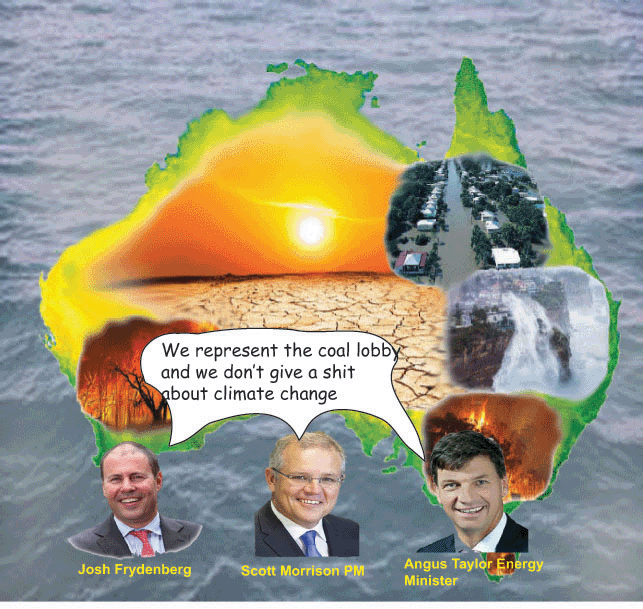
It’s ironic, perhaps, that in an election cycle where a number of regional Queenslanders voted for the promise of blue-collar jobs, backing the party that backed the Adani coal project, renewables generated more than 13,000 actual jobs in construction, with a lot of that activity in north Queensland.
Liberal states in talks to revive Turnbull’s dumped energy policy In Canberra, a month on from Scott Morrison’s election victory, there is talk of feasibility studies for a new Queensland coal plant, and a nascent nuclear debate. But if we shift our vantage point to Adelaide, Australia’s near-term energy outlook looks very different.
Dan Van Holst Pellekaan, the Liberal energy minister, is talking about South Australia hitting 100% net renewables by the 2030s. When asked to explain what that means, he tells Guardian Australia “producing more renewable energy in South Australia than we need for our own consumption and exporting the surplus”.
There is no talk of coal, apart from the inevitability of its displacement.
The South Australian renewables export plan relies on a new interconnector with New South Wales. Van Holst Pellekaan says if the proposed interconnector is approved, there are opportunities to construct large-scale solar and wind farms in the north-east of the state, on pastoral land, adjacent to the transmission equipment. “Then we start to displace coal in NSW,” he says. “It’s not just about a bit of renewable energy making a difference … that’s where you start to get a really big win on emissions reduction.”
But pushing ahead with that kind of progress is much easier if there’s a national framework driving the transition. Post-election, Van Holst Pellekaan wants Canberra back at the table being collaborative, implementing a coherent energy policy.
What the South Australian doesn’t say, but is obvious to people who know how the Coag energy council works, is the states can force this issue if they choose to.
If they can agree among themselves about what needs to happen, they can create a framework setting out the rules of the road even if the commonwealth resists.
Liberal states drive energy policy reboot Continue reading
The Northern Territory’s opportunity – clean energy found a ‘pathway to prosperity’
 Clean energy found to be a ‘pathway to prosperity’ for Northern Territory, Renewable energy is not only a money-spinner for the NT, it can also help mining industries expand, a new report says, Guardian, Adam Morton@adamlmorton 20 Jun 2019 Energy development in the Northern Territory is a typically Australian story: it is backing fossil fuels – in this case gas – when it could, as one of the sunniest places on Earth, be reaping economic and environmental benefits from renewable energy. Clean energy found to be a ‘pathway to prosperity’ for Northern Territory, Renewable energy is not only a money-spinner for the NT, it can also help mining industries expand, a new report says, Guardian, Adam Morton@adamlmorton 20 Jun 2019 Energy development in the Northern Territory is a typically Australian story: it is backing fossil fuels – in this case gas – when it could, as one of the sunniest places on Earth, be reaping economic and environmental benefits from renewable energy.
|
|
Lynas’ rare earths miner: its troubles are a reminder that even renewables technologies involve radioactive trash
 Toxic waste: Lynas Corporation and the downside of renewable energy, Independent Australia, 28 April 2019 In some cases, renewable energy can have profoundly harmful environmental effects if not managed correctly, writes Noel Wauchope.AUSTRALIA’S LYNAS CORPORATION is currently under the business and political spotlight. The current controversy over Lynas rare earth elements company is a wake-up call to an area of vulnerability in renewable technologies – the radioactive pollution produced by developing the rare earth elements essential for today’s hi-tech devices. Electric cars, batteries, energy efficient lighting, smartphones, solar panels, wind turbines and so on all need some of the 17 mineral elements classed as rare earth. The mining and processing of this produces radioactive trash. Toxic waste: Lynas Corporation and the downside of renewable energy, Independent Australia, 28 April 2019 In some cases, renewable energy can have profoundly harmful environmental effects if not managed correctly, writes Noel Wauchope.AUSTRALIA’S LYNAS CORPORATION is currently under the business and political spotlight. The current controversy over Lynas rare earth elements company is a wake-up call to an area of vulnerability in renewable technologies – the radioactive pollution produced by developing the rare earth elements essential for today’s hi-tech devices. Electric cars, batteries, energy efficient lighting, smartphones, solar panels, wind turbines and so on all need some of the 17 mineral elements classed as rare earth. The mining and processing of this produces radioactive trash.
Environmentalists, in their enthusiasm for renewable energy, seem unaware of this fact, while they rightly condemn coal and nuclear power, for their toxic by-products. Australia’s Lynas Corporation has two major rare earth facilities — mining at Mount Weld, Western Australia, and processing at Kuantan, Malaysia. For years, there’s been a smouldering controversy going on in Malaysia, over the radioactive wastes produced by the refining facility at Kuantan. Now, this has come to a head. On 17th April, the Malaysian Government insisted that Lynas Corp must remove more than 450,000 tonnes of radioactive waste from the country, for its licence to be renewed in September. Australian Government legislation and policy prohibits the import of radioactive waste. However, some categories of radioactive waste are exempt from this law, if they contain very low levels of radioactivity. Here’s where it all gets terribly complicated. Wesfarmers wants to take over Lynas. The Australian Securities and Investments Commission (ASIC) is examining this, and especially Wesfarmers’ involvement with the Malaysian government. The Age on 16 April, reported that Prime Minister Mahathir, following discussions with Wesfarmers, announced that a company interested in acquiring Lynas had promised to extract the radioactive waste before exporting the ore to Malaysia. All this raises the question of exactly what would an Australian company, such as Wesfarmers, do with that radioactive waste? This is a thorny problem. And what would Lynas do about their current problem?…… It is complicated to grasp the methods used and just what is required for the proper cleanup of the Lynas rare earth elements refining. Lynas CEO Amanda Lacaze maintains that the wastes left behind are only marginally radioactive. …… culture and history really have their impact, precisely in Malaysia’s experience of rare earth processing. Even if the Lynas waste really is only slightly radioactive, Malaysians remember the environmental and health disaster of Bukit Merah; where, early this century, rare earth processing left a toxic wasteland. China’s rare earth element processing disaster in Inner Mongolia is better known, an environmental catastrophe from the 1960s which lingers today. Modern processing has improved safety in waste management. In relation to nuclear power, there is an abundance of information on radioactive waste management, for China and for other countries. However, there’s little or no information that’s easily available to specifically discuss radioactive waste from rare earth processing. Australia does have another, smaller, rare earth elements mining and processing operation, Arafura Resources, in Central Australia. The Northern Territory Environment Protection Authority (EPA) found this acceptable….. What is clear, is that the production of the world’s hi-tech devices is not a simple matter as far as the environment goes. Climate change activists, anti-nuclear activists and environmentalists in general can keep on promoting renewable energy and electric cars. But they seem to be blind to the total picture, which includes the downside. Obviously, it is necessary to ensure safer disposal of the trash from rare earth mining and processing. A better idea is to develop the design of devices so that the minerals can be retrieved from them and recycled, thus greatly eliminating the need for mining rare earth. And this is beginning to happen. ….. Energy conservation is the biggest factor in the change that is needed. Social change, however difficult that will be, is going to be the most important answer — the transition from a consumer society to a conserver society. The Lynas radioactive trash controversy is not going to go away quickly, however much governments and corporations want to keep it under wraps. And it also could be a catalyst for discussion on that downside of renewable and hi-tech devices. This is something to think about as we throw away last year’s iPhone in favour of the latest model. https://independentaustralia.net/environment/environment-display/toxic-waste-lynas-corporation-and-the-downside-of-renewable-energy,12619#disqus_thread |
|
|
Western Australian Aboriginal community uses solar hydropanel to solve problem of uranium in water
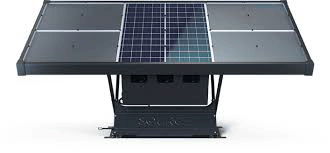 Buttah Windee in remote WA now has clean water thanks to solar hydropanel technology https://www.abc.net.au/news/2019-03-31/solar-hydropanels-fix-water-supply-in-remote-community/10941788?fbclid=IwAR2j446RfOuRIZNBC0K1xY6CWBq3Jnn48zx0b-WiuI8o96Jklb-bL1pfZHQ
Key points:
- Six solar hydropanels have been installed in the small WA community, capturing 900 litres of water a month from the air
- The community had discovered its water supply contained uranium more than twice the national health standard, and the State Government deemed it too expensive to address
- With the help of crowdfunding and technology donated by a WA company, the residents of the community no longer need to live elsewhere
The remote Aboriginal community is 760 kilometres north-east of Perth on the outskirts of Meekatharra.
Almost a decade ago, resident Andrew Binsiar discovered the community’s water was tainted with naturally occurring uranium at more than twice the national health standard.
“I was actually very surprised,” he said.
“You’d imagine people would test the water for human consumption before people are allowed to drink it.”
Unable to drink the community’s tap water, most of the 50 people who lived at Buttah Windee left.
Too expensive to fix: State Government
But for Andrew Binsiar and his wife Janine, leaving the home where they had raised their five children was not an option.
He turned to the State Government for help, but was told fixing the water supply would be too expensive.
“They come out and put up ‘do not drink the water’ signs and that was their solution to it,” Mr Binsiar said.
The State Government offered to move the remaining residents into state housing in Meekatharra, but Mr Binsiar was apprehensive about exposing his family to the town’s social issues.
“We knocked them back … for the simple reason I’d already been there and done that. My life changed when I moved here,” he said.
“I wasn’t a very good father when I lived in Meeka.”
Solar hydropanels pull water from air
Almost a decade on, Buttah Windee is the first remote Aboriginal community in Australia to use innovative technology for its water supply.
Six solar hydropanels have been installed at the outback community, donated by a WA company who heard about the community’s plight and wanted to help out.
Director of Wilco Electrical Frank Mitchell said the units captured water from the air and produced up to 900 litres of water a month.
“Those fans, you can hear them whirring away, are just drawing in air all day, all around, and the piece of material inside collects … the moisture in the air, then condenses down into the tank where it’s got a pump straight out to the tap,” he said.
Mr Binsiar said it was a simple idea, which should be introduced to all remote communities.
“Water is a basic human right that everyone deserves,” he said.
“It could mean better health for your children … I would guarantee that most communities have bad water.”
Crowdfunding rallies support
The near decade-long battle for clean drinking water has not come easily for the Buttah Windee residents, with Mr Binsiar turning to crowdfunding as a last resort.
Word spread quickly when Mr Binsiar began the fundraising campaign last year, and people from across Australia donated nearly $26,000 in three months.
“It was a huge success. The Australian public have been awesome,” he said.
Mr Binsiar used the funds to install a reverse osmosis water treatment plant.
“Reverse osmosis takes out all the contaminants in the water … on the back end of it, it puts the minerals your body needs back into the water,” he said.
“They’ve given us a chance where no-one else would and we are really proud of what we have done here.”
Barramundi fish farm to boost employment
The two separate systems now supply the community with safe drinking water and enough water to run a small barramundi fish farm.
Mr Binsiar and several residents built the fish farm hoping it would eventually provide local employment and a potential source of income. “Hopefully we can continue on and make it bigger and provide this region with fresh barramundi,” he said.
“I’d like to welcome everyone out to Buttah Windee and come and look at the work we do.”
New South Wales Labor’s pledge for ‘solar schools’
 Labor promises $100 million for ‘solar schools’ https://www.smh.com.au/nsw-election-2019/labor-promises-100-million-for-solar-schools-20190315-p514i9.html, By Lisa Visentin, March 17, 2019 Labor leader Michael Daley has pledged to spend $100 million installing solar panels on hundreds of public schools across NSW.
Mr Daley linked his “solar schools package” to the recent student strike over climate change inaction, and said the policy would help teach students about renewable energy.
“As we saw at rallies across the country on Friday, the next generation is demanding real action on climate change,” Mr Daley said.
“Putting solar panels on schools will help students further their knowledge about renewable energy, as well as bring down their school’s power bills and reduce emissions.”
Under Labor’s plan, solar panels would be installed at 350 government schools. The $100 million package would be funded as part of the Labor’s $800 million “cool schools” policy to install airconditioning in every single classroom in the state.
Mr Daley’s announcement comes after he publicly backed the striking school students during a speech earlier in the week, describing their actions as a “demonstration of young leadership”.
His endorsement drew fire from Premier Gladys Berejiklian who said she was “appalled” the alternate premier was encouraging students to skip school.
It comes as a recent ReachTEL poll revealed climate change was a pressing concern for most NSW voters, with 57.5 per cent of voters saying it would influence the way they voted.
As part of the state election campaign, Ms Berejiklian has announced interest-free loans to 300,000 households for solar and battery systems while Labor has pledged to put solar on 500,000 homes over the next decade through rebates.
Ms Berejiklian earlier this week restated her government’s support for action on climate change and said NSW had the largest renewable projects in Australia.
“We’ve had a consistent position since we’ve been in government, that climate change is real and that as a government we need to do everything we can to deal with it and we have been,” she said.
Australia’s Previous Chief Scientist spells it out on global warming
Repeating this item. What a pity that the excellent full article has been removed from the Australian government website!
Why we must act now to reduce greenhouse gas emissions
Australian Government 8 Dec 09 Despite world attention, humans emit more greenhouse gases every year than they did the year before. It’s a situation that Australia needs to help turn around if we don’t want to bear the brunt of climate change, says Chief Scientist Professor Penny Sackett……
…..The Greenhouse Effect
The sun continuously bathes the Earth with energy in the form of sunlight. Much of this energy is absorbed by the Earth, and then emitted as infrared radiation, or heat. Greenhouse gases prevent the Earth from discarding as much of this heat as it otherwise would back into space.Without naturally occurring greenhouse gases, the Earth would be a much colder place, inhospitable to modern human existence. But by the same token, the additional greenhouse gases added to this store by humans is slowly increasing the average temperature of the Earth system.
Due to the quantity in which it is emitted by humans, its longevity in the atmosphere, and its effects in trapping heat, carbon dioxide is the most important of the greenhouse gases currently causing changes in the Earth’s climate……
In Australia, extreme fire danger days are already becoming more numerous in many parts of the country, and floods and cyclones more intense.
Research by the CSIRO indicates that the frequency of days with very high and extreme Forest Fire Danger Index ratings is likely to increase by 15 to 70 per cent by 2050 in southeast Australia…..
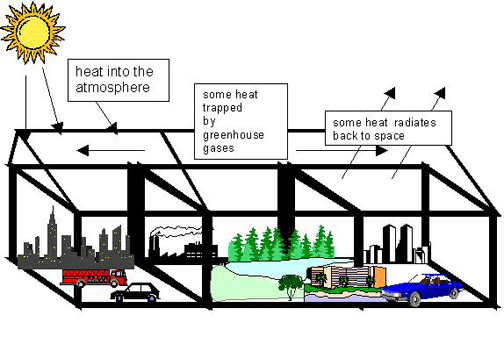
Why we must act now to reduce greenhouse gas emissions | Chief Scientist of Australia
Climate and Energy Policies – Liberal/National versus Labor
Libs v Labor: climate and energy policies, https://www.sbs.com.au/news/libs-v-labor-climate-and-energy-policies
A comparison of the climate and energy policies of the Morrison government and the Labor Party.
 Liberal-Nationals
– $2 billion boost to the Emissions Reduction Fund over 10 years, rebranded as the Climate Solutions Fund.
– The Paris agreement target for emissions of 26 to 28 per cent below 2005 levels by 2030.
– Continuing to fund the Australian Renewable Energy Agency until 2022, and investing what’s left of the $10 billion Clean Energy Finance Corporation.
– Default market prices for energy.
– Underwriting new generation plan to inject more energy into the network.
 Labor
Labor
– $10 billion for the Clean Energy Finance Corporation over five years.
– $5 billion to set up an independent Energy Security and Modernisation Fund.
– $31 million for an Energy Productivity Agenda.
45 per cent emissions reduction target by 2030.
– 50 per cent of power from renewables by 2030.
Morrison govt stalls Australia’s first offshore wind farm
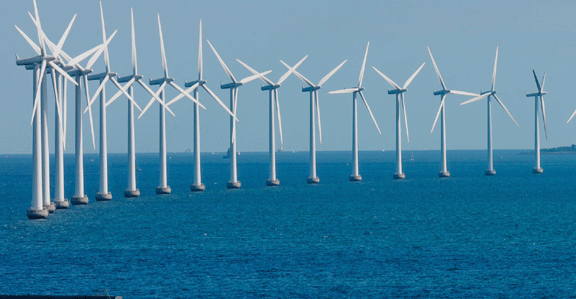 au/australia_s_first_offshore_wind_farm_being_stalled_by_morrison_government?fbclid=IwAR03wrT3rnusfJfKqLdcDaHlm2qGTdLjKAUBBcVQbhTv-PfxC3_CmeSwEFE
Development of Australia’s first offshore wind farm, which would power up to 1.2 million homes, has been stalled by Energy Minister Angus Taylor’s failure to sign off on an exploration license allowing a detailed assessment of the wind resource to commence.
Development of Australia’s first offshore wind farm, which would power up to 1.2 million homes, has been stalled by Energy Minister Angus Taylor’s failure to sign off on an exploration license allowing a detailed assessment of the wind resource to commence.
The Department of the Environment and Energy confirmed during Senate Estimates that an evaluation of the project has been undertaken, a plan for a customised exploration license developed, and a briefing and recommendations provided to the Energy Minister, but that the project can progress no further without the Minister granting the exploration license.
The Star of the South project seeks to construct 250 wind turbines in Commonwealth waters off the coast of Victoria’s Gippsland region, generating up to 20 per cent of Victoria’s electricity needs and feeding the power into the National Electricity Market via an underground cable to the Latrobe Valley.
The Maritime Union of Australia said the project — which the company claims will create up to 12,000 manufacturing and construction jobs and slash Australia’s carbon emissions — appeared to be falling victim to the Morrison Government’s ideological hatred of renewable energy.
MUA Deputy National Secretary Will Tracey said the exploration license awaiting approval did not allow construction to commence and was simply about allowing the use of floating buoys and platforms off the Gippsland coast to gather wind and wave observations.
“We have a major wind project that would create thousands of jobs and provide clean, reliable energy for more than a million Australian households, but because of their ideological hatred of renewable energy the Morrison Government appears to be actively stalling its development,” Mr Tracey said.
“The Star of the South project has been in the works since 2012, yet in this time no legislation has been put forward, no regulatory framework put in place, and no responsible agency nominated, despite offshore wind being an established industry internationally.
“Now we have revelations from Senate Estimates that Energy Minister Angus Taylor has been briefed on the project and presented with recommendations, yet the exploration license continues to sit on his desk gathering dust.
“Rather than support renewable energy projects, under the Morrison Government we can’t even get approval for a few wind measurement buoys off the Gippsland coast.
Energy Minister Angus Taylor must get off his hands and immediately allow the Star of the South wind project to move forward to the exploration stage.”
Mr Tracey said offshore wind generation was a mature industry internationally which has successfully operated for two decades, but Australia was falling behind, putting future employment opportunities at risk.
“This project isn’t just about generating renewable energy and tackling climate change, it’s about creating secure jobs for the future, particularly for workers who are being displaced from the offshore oil and gas industries,” he said.
“The Federal Government urgently needs to put in place a plan to support the development of the offshore wind industry, including a clear regulatory framework, along with the right port infrastructure and specialised construction vessels to roll out this project and others like it as quickly as possible.”
New South Wales Labor announces plan for 500,000 households to get rooftop solar
Labor announces plan for 500,000 households to get rooftop solar, https://www.smh.com.au/national/nsw/labor-announces-plan-for-500-000-households-to-get-rooftop-solar-20190209-p50wrl.html, By Laura Chung,February 9, 2019 NSW Labor has announced it will support a program to help 500,000 households to install rooftop solar, reducing electricity bills in the next 10 years.
Under Labor’s Solar Homes policy, owner-occupied households in NSW with a combined income of $180,000 or less would be eligible for a rebate, to be capped at $2200 per household.
Shadow Minister for Energy and Climate Change, Adam Searle, said the policy could add solar to an additional million homes over the next decade, and could save the average household anywhere between $600 and $1000 a year on electricity bills.
“This is a bold program to push NSW to the front of the energy revolution,” he said. “This will significantly cut electricity bills and carbon emissions.”
“We will have much more to say about energy and tackling climate change.”
The program would be phased in during the 2019-2020 financial year. The policy announcement comes ahead of the launch of Labor’s campaign bus, which will travel around the state from Sunday.
The Smart Energy Council said Labor’s policy addressed two of NSW residents’ main concerns: the cost of living and climate change.
It shows “a strong commitment towards climate change” and is a “sign of confidence in renewable energy, a critical part of NSW’s future,” a spokesman said.
The council said it would like to see a stronger commitment from both the NSW Government and the Opposition to supporting families’ purchases of household solar batteries, which would provide people “with a greater sense of control of power and how they use power.”
In a statement, deputy leader of NSW Liberals Dominic Perrottet said Labor “cannot be trusted” to deliver more affordable, reliable and clean energy, “with a history of energy cost blowouts and blunders”.
The NSW Coalition government “is getting on with the job of taking pressure off electricity prices, while maintaining energy security,” Mr Perrottet said.
Renewable power costs less than nuclear
 PAT CONROY: Renewable power costs less than nuclear https://www.theherald.com.au/story/5880610/renewable-power-costs-less-than-nuclear/?fbclid=IwAR0-Upp9z0ZN2kv9P_fItO6uDJEf89pKvl2t0fXLK14roYCbNq69EWwtSlo Nuclear power is the fool’s gold of energy policy. On the surface, beautiful, but when tested it proves to be a mirage.
But even if we could build a nuclear power industry from close to scratch, and even if we could persuade a community to accept a station in their neighbourhood, it would actually increase electricity prices.
The UK government is paying the owners of the Hinkley Nuclear Power Station about $200 per megawatt hour (MWh) for nuclear power, indexed for inflation for the next 35 years. By contrast the current NSW wholesale electricity price is about $80/MWh. When you compare cost of alternatives, nuclear loses. The levelised cost of energy is the best way to compare technologies. It accounts for the fact that solar produces electricity about 30 per cent of the time, wind 40 per cent and coal 85 per cent.
The levelised cost of energy of a solar farm is $60MWh and wind is $50/MWh. The cost of nuclear in nations with established industries is between $160/MWh and $270/MWh. To make solar and wind completely reliable, you need to firm it up with back-up sources, usually a combination of gas plants, pumped hydro storage and batteries.
Power companies and government estimates put this cost at $15/MWh.
Wind power made completely reliable will cost Australians about $75/MWh. That is less than the current cost of producing electricity and a third of the cost of nuclear.
The Australian Energy Market Operator has found that the cheapest new energy for Australia is renewable energy backed up by pumped hydro storage and gas.
As the cost of generating electricity makes up 35 per cent of a consumer’s bill, by arguing for electricity produced at three times the cost, Senator Burston is arguing for a consumer’s electricity bill to be 70 per cent higher. Labor’s policy of supporting a national energy guarantee has been overwhelmingly supported by the energy industry, unions and environment groups. It will deliver 50 per cent renewable energy in a planned way that ensures electricity is as cheap as possible and reliable.
Independent modelling predicts that the 50 per cent renewable plan will lead to wholesale energy prices being 25 per cent lower and the creation of 71,000 jobs from construction through to maintenance.
How our electricity system of the future could be powered by sun, wind and waves
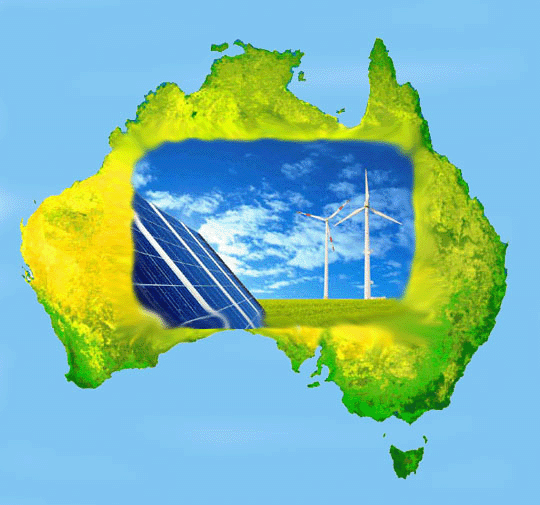 What would Australia look like powered by 100% renewable energy? https://www.theguardian.com/commentisfree/2019/jan/28/what-would-australia-look-like-powered-by-100-renewable-energy What would Australia look like powered by 100% renewable energy? https://www.theguardian.com/commentisfree/2019/jan/28/what-would-australia-look-like-powered-by-100-renewable-energyOur electricity system of the future could be powered by sun, wind and waves@nickymison |
|
Despite grid problems, Australia’s solar, wind, energy boom to power ahead in 2019
Australia’s solar, wind boom to power past grid woes in 2019, Sonali Paul, MELBOURNE (Reuters) 21 Jan 19 – Australia’s wind and solar boom looks set to power through 2019 following a record year, despite grid constraints and extra scrutiny from network operators to make sure new projects don’t spark blackouts like ones that hit two years ago.
Abundant wind and sun, falling turbine and panel costs, and corporate demand for contracts to hedge against rising power tariffs have attracted dozens of international developers looking to build wind and solar farms Down Under.
Even though the developers have met with flip-flops on energy policy, a strained grid that has trouble integrating intermittent renewable power, and unexpected hook-up costs, they still see Australia as a growth market.
“We believe that we have a great future in Australia, because we have the right answers,” said Xavier Barbaro, Chief Executive of France’s Neoen (NEOEN.PA), whose biggest market is Australia.
Companies like Neoen, its compatriot Total-Eren (TOTF.PA), India’s Adani (ADEL.NS), U.S. utility AES Corp (AES.N) and Germany’s Sonnen are expanding in Australia, looking to fill a gap as ageing coal-fired plants are retired over the next two decades.
“Confidence is high as the industry enters 2019, with unprecedented levels of construction activity under way,” said Anna Freeman, a director at the Clean Energy Council, an industry group.
Australia generates nearly 20 percent of its electricity from renewables. This is forecast to jump to 75 percent over the next 20 years.
A total of 14.7 gigawatts (GW) of large-scale solar and wind projects worth A$20 billion ($14 billion) were under construction or reached financial close last year, more than double 2017’s record, according to the Clean Energy Council.
……….HOOK-UP HICCUPS
A Clean Energy Council survey of senior executives in December found grid connection is the biggest industry concern heading into 2019, Freeman said.
UK-based solar investor Octopus Investments said grid issues were what took it two years to choose its first investment in Australia. The Darlington Point solar farm is about to begin construction and will be the country’s largest.
“The grid is the biggest issue where assets fail in our project filter,” Octopus Managing Director Sam Reynolds told Reuters, declining to name projects the company rejected……..https://www.reuters.com/article/us-australia-renewables/australias-solar-wind-boom-to-power-past-grid-woes-in-2019-idUSKCN1PE0V8
CSIRO/AEMO study says wind, solar and storage clearly cheaper than coal
 REneweconomy, 21 December 2018 Australia’s leading scientific research group and the country’s energy market operator have released a benchmark study that shows the cost of new wind and solar – even with hours of storage – is “unequivocally” lower than the cost of new coal generation.
Thanks to Leonardo Di Caprio’s foundation, Australia leads in research on renewables plus energy efficiency
 ‘Not too late’: Australians develop carbon model with DiCaprio’s help https://www.canberratimes.com.au/environment/climate-change/not-too-late-australians-develop-carbon-model-with-dicaprio-s-help-20190121-p50sq5.html, By Peter Hannam, 21 January 2019 Renewable energy can supplant fossil fuels across the global economy, with Australia among the three regions best placed to benefit because of its rich solar and wind resources, according to a new study funded by the Leonardo DiCaprio Foundation’s One Earth project. ‘Not too late’: Australians develop carbon model with DiCaprio’s help https://www.canberratimes.com.au/environment/climate-change/not-too-late-australians-develop-carbon-model-with-dicaprio-s-help-20190121-p50sq5.html, By Peter Hannam, 21 January 2019 Renewable energy can supplant fossil fuels across the global economy, with Australia among the three regions best placed to benefit because of its rich solar and wind resources, according to a new study funded by the Leonardo DiCaprio Foundation’s One Earth project.The work – based on a two-year project between the University of Technology Sydney, the University of Melbourne and German Aerospace Centre – found a combination of renewables and energy efficiency can achieve the net-zero emissions outcome needed by 2050.
“The main barrier is neither technical nor economic – it’s political,” Sven Teske, research director at the UTS’s Sydney’s Institute for Sustainable Futures, said, adding “it’s not too late” to restrict global warming to 1.5 degrees, the lower end of the Paris climate target. The research, released on Monday at the World Economic Forum in Davos, modelled 72 regional energy grids at hourly increments through 2050, including the Australian states on the National Electricity Market and other regions.
Costs would be moderated in Australia because the average age of coal-fired power plants was about 40 years, and would soon have to be replaced anyway. Solar and wind-generated electricity was also already cheaper than new coal, he said. Fossil-fuel use in other sectors, such as transport and agriculture, could also be phased out and replaced by synthetic fuels, particularly hydrogen. Australia’s abundant sun and wind resources gave the nation an advantage only matched by north Africa and the Middle East as a renewable powerhouse, Dr Teske said.
Australia would benefit from the transition from the export of hydrogen-based or other synthetic fuels, and from shipments of cobalt and silver used for storage and solar panels, respectively. While biofuels offered potential to supplement renewables, the sector would be constrained by the need to maintain farm land to feed growing populations. Reforestation would also be needed to provide a carbon sink to help reduce carbon-dioxide levels, he added. “Citing a growing body of research, we show that using land restoration efforts to meet negative emissions requirements, along with a transition to 100 per cent renewable energy by 2050, gives the world a good chance of staying below the 1.5-degree target,” Malte Meinshausen, founding director of the Climate and Energy College at the University of Melbourne, said. The research, understood to cost in the range of $1 million, was the first in Australia by the foundation set up by prominent actor and environmentalist Leonardo DiCaprio.
Given the scant carbon budget left to keep warming from reaching dangerous levels, “every year of delay is a huge problem”, Dr Teske said.
|
|
1 This month



Help Aunty Sue Protect Her Land and Sacred Sites From Destructive Rocket Testing.
.

Australians deserve the truth
about
AUKUS – https://aukuspublicinquiry.com/

PETITION – To: Prime Minister Anthony Albanese and the Australian Labor Government

of the week – Australians for War Powers Reform (AWPR)
To see nuclear-related stories in greater depth and intensity

